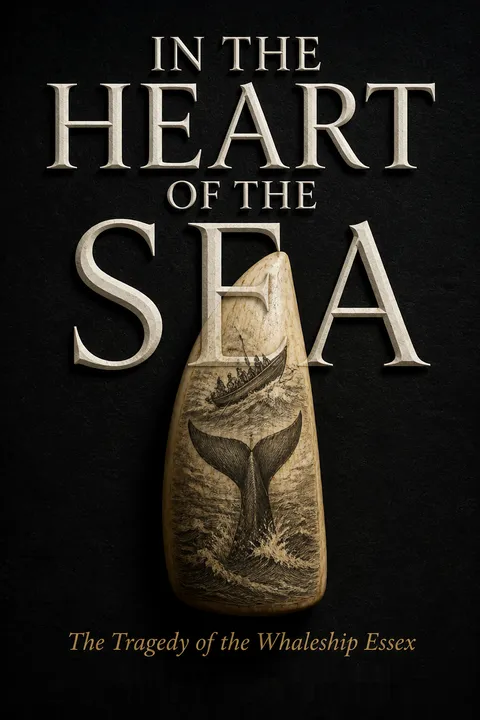

Key Takeaways
1. Nantucket's Paradoxical Whaling Empire
Combining rigid self-control with an almost holy sense of mission, these were what Herman Melville would call “Quakers with a vengeance.”
A unique society. Nantucket, a remote island off New England, became the global hub of the sperm whaling industry in the early 19th century. This success was fueled by a paradoxical culture where Quaker pacifism coexisted with a ruthless, almost religious zeal for the bloody hunt. Islanders, often better educated than mainlanders, developed a distinct identity, seeing themselves as a "Nation of Nantucket" whose destiny was tied to the sea.
Economic engine. The island's economy thrived on whale oil, which lit cities and lubricated the machines of the Industrial Age. Despite its barren soil and isolation, Nantucket prospered by relentlessly pursuing whales across vast oceans. This single-minded focus on whaling meant long voyages, often two to three years, creating a unique social structure where women managed most of the island's businesses and households.
Omens and superstitions. Life on Nantucket was deeply intertwined with the sea's unpredictable dangers, fostering a superstitious community. The departure of the Essex in 1819 was marked by unsettling omens:
- A comet with an "uncommonly long tail"
- Sightings of an "extraordinary sea animal"—a fifty-foot serpent
- A plague of grasshoppers in the turnip fields
These signs, though dismissed by some, hinted at the extraordinary fate awaiting the Essex and its crew.
2. The Unprecedented Whale Attack
Never before, in the entire history of the Nantucket whale fishery, had a whale been known to attack a ship.
A shocking assault. On November 20, 1820, over 1,500 miles west of the Galapagos, the Essex was rammed and sunk by an enraged sperm whale. This was an unprecedented event; whales were hunted, but never before had one deliberately attacked a ship. The 85-foot bull, estimated at 80 tons, struck the vessel twice, first forward of the forechains, then beneath the anchor, causing the ship to fill with water and capsize within minutes.
The whale's motive. First Mate Owen Chase believed the whale acted with "decided, calculating mischief," as if "fired with revenge for their sufferings" after the crew had struck three of its companions. Modern science suggests the whale, equipped with the largest brain of any animal, might have initially collided by mistake, but its subsequent, targeted attacks indicated a deliberate, aggressive response. The ship's old, weakened oak planking, likely compromised by rot or marine growth, contributed to its rapid demise.
Instant devastation. The attack plunged the crew into immediate chaos and despair. Within ten minutes, the Essex, once the "pride and boast of her captain and officers," was a capsized hulk. Miraculously, the steward, William Bond, salvaged crucial navigational instruments—two compasses, two copies of Bowditch's Navigator, and two quadrants—which would prove vital for the survivors' desperate journey.
3. Flawed Leadership and Fatal Decisions
Not wishing to oppose where there was two against one, the captain reluctantly yielded to their arguments.
Pollard's indecision. Captain George Pollard Jr., a first-time captain, displayed a tendency to defer to his mates, particularly Owen Chase. This was evident after an early knockdown in the Gulf Stream, where Pollard initially wanted to return to Nantucket for repairs but was persuaded by Chase and Second Mate Matthew Joy to continue the voyage despite losing two whaleboats. This pattern of yielding to others would have dire consequences.
The fateful council. After the Essex sank, the officers held a "council" to decide their course. Pollard proposed sailing west to the Society Islands, which were closer and offered a fair trade wind. However, Chase and Joy, fearing "savages" and cannibalism based on vague rumors, insisted on sailing south and then east towards South America, a journey of thousands of miles against prevailing winds and currents. Pollard, lacking the "fishy" assertiveness of a typical whaling captain, reluctantly agreed.
A tragic miscalculation. This decision, driven by xenophobia and ignorance of the Pacific's true geography, sealed their fate. The Society Islands, particularly Tahiti, were known to be safe, with thriving English missions. By choosing the longer, more arduous route to a "civilized harbor," the crew condemned themselves to an impossible ordeal, as Nickerson later lamented, costing "many... fine seamen their lives."
4. The Agony of Open-Boat Survival
The privation of water is justly ranked among the most dreadful of the miseries of our life.
Relentless suffering. The journey in the three whaleboats quickly became an agonizing test of human endurance. Overloaded and constantly battered by waves, the boats were barely seaworthy. The men faced:
- Extreme thirst, exacerbated by salt-soaked bread
- Gnawing hunger, with rations reduced to a mere 1.5 ounces of hardtack daily
- Skin covered in painful sores from constant wetness and salt
- Lethargy, irritability, and difficulty concentrating
Physical deterioration. Their bodies rapidly wasted away, muscles atrophied, and limbs swelled from edema. The lack of fat reserves meant their bodies began consuming muscle tissue, leading to rapid decline. The constant bailing of leaky boats became an "irksome and laborious task" for their weakened frames.
Psychological torment. The mental toll was equally severe. Dreams of lavish feasts tormented them, and the "intoxicating blindness" from standing up too quickly became common. The "horrors of our situation came upon us with a despairing force," leading to "melancholy forebodings" and an "utter indifference to their fate" for many.
5. Cannibalism: The Ultimate Taboo
My lad, my lad! If you don’t like your lot, I’ll shoot the first man that touches you.
The unspeakable choice. As provisions dwindled, the men on Pollard's and Hendricks's boats faced the grim reality of survival cannibalism. After Lawson Thomas, a black sailor, died, the crew made the "most grievous and shocking" decision to eat his body. This act, though born of "absolute necessity," was a profound moral compromise, transforming them into a "modern feral community."
Drawing lots. When food ran out again, 16-year-old Charles Ramsdell proposed casting lots to decide who would be killed for the others to live. Captain Pollard, initially refusing, eventually acquiesced when his cousin, Owen Coffin, and Barzillai Ray supported the idea. The lot fell to Coffin, who, with "composure and resignation," accepted his fate. Ramsdell, Coffin's friend, was forced to execute him.
The cost of survival. The act of cannibalism, particularly the "gastronomic incest" of eating a kinsman, left deep psychological scars. While it provided temporary sustenance, it also brought a "rancid green" to the flesh and a "horrid thought" to their minds. The survivors were forced to confront the darkest aspects of human nature to cling to life.
6. Social Dynamics and Disproportionate Loss
It was almost as if the Nantucketers existed in a protective bubble as off-island crew members, first black then white, fell by the wayside until the Nantucketers had, in the case of Pollard’s crew, no choice but to eat their own.
Clannish survival. The Essex crew was a microcosm of Nantucket society, with distinct social hierarchies. The Nantucketers, bound by kinship and shared heritage, formed a protective subgroup. This clannishness, intensified by the disaster, played a significant role in who survived.
Racial disparity. The survival statistics reveal a stark pattern:
- Of the first four sailors to be eaten, all were African American.
- Of the first six to die (excluding the sickly Matthew Joy), five were black.
This disproportionate loss suggests that the African American crew members, likely less well-fed before the voyage and possibly with lower body fat, succumbed faster to starvation.
Moral implications. While there's no overt evidence of murder, the Nantucketers' actions, such as assigning the sickly Matthew Joy to a boat with mostly "coofs" (non-Nantucketers) and then Obed Hendricks's boat running out of provisions first, raise questions about implicit biases. The narrative highlights how extreme conditions can erode moral veneers, leading to a focus on self-preservation within one's immediate social circle.
7. Henderson Island: A Fleeting Respite
Never have my eyes rested on anything so pleasingly beautiful.
A mirage of hope. After a month at sea, the men sighted Henderson Island, a low rise of sand and rock that appeared as a "basking paradise." Believing it to be Ducie Island, they were overjoyed, seeing it as "the final end to [their] long confinement and sufferings." The island, though uninhabited, offered a temporary reprieve from the open ocean.
False promise. The initial euphoria quickly faded. Despite its green vegetation, the island was a "scrap heap of fractured coral" with no readily available fresh water. The men found only a temporary trickle at low tide and had to ration it carefully. Food, initially abundant with birds and crabs, was quickly depleted by the twenty voracious men.
Abandoning salvation. Within a week, the island's meager resources were exhausted. The men discovered that their situation was "worse than it would have been in our boats on the ocean." Three off-islanders—Thomas Chappel, Seth Weeks, and William Wright—chose to remain on the island, fearing the boats more than the desolate land. The remaining seventeen, with their boats repaired and water casks refilled, set sail for Easter Island, unaware they were leaving a potential, albeit difficult, salvation behind.
8. The Psychological Toll of Despair
All was dark in his mind, not a single ray of hope was left for him to dwell upon.
The breaking point. As the ordeal stretched into its third month, the psychological impact became as devastating as the physical. The men's minds were "wrought up to the highest pitch of dread and apprehension," leading to:
- Delusions and hallucinations
- Incoherent ranting and bizarre behavior
- A profound loss of the will to live
The power of hope. First Mate Chase, despite his own suffering, recognized that hope was the only thing standing between his men and death. He constantly rallied their spirits, insisting it was their "solemn duty to recognize in our calamities an overruling divinity." His ability to adapt his leadership from strict disciplinarian to compassionate encourager was crucial.
Surrendering to fate. Isaac Cole, a young white off-islander in Chase's boat, succumbed to this despair, declaring it "folly and madness to be struggling against what appeared so palpably to be our fixed and settled destiny." He suffered "horrid and frightful convulsions" before dying, a victim of extreme dehydration and starvation, possibly exacerbated by magnesium deficiency. His death forced Chase to make another agonizing decision about cannibalism.
9. Rescue and Lingering Trauma
My unexpected appearance was welcomed with the most grateful obligations and acknowledgments to a beneficent Creator, who had guided me through darkness, trouble, and death, once more to the bosom of my country and friends.
Miraculous rescue. On February 18, 1821, after 89 days at sea, Chase, Lawrence, and Nickerson were spotted by the British whaleship Indian. They were within sight of Masafuera, their intended destination. Five days later, Pollard and Ramsdell, found "sucking the bones of their dead mess mates," were rescued by the Nantucket whaleship Dauphin. The three men left on Henderson Island were rescued by the Surry in April, having survived for over four months.
The long road to recovery. The survivors were skeletal, covered in ulcers, and too weak to stand. Their digestive systems struggled with food, and the psychological recovery was even harder. Pollard, in particular, suffered a relapse after recounting the horrors, his "head... on fire at the recollection" of eating his cousin.
Lasting scars. The ordeal left indelible marks. Chase, though professionally successful, was plagued by headaches and later hid food in his attic, eventually deemed "insane." Pollard, despite his integrity, was branded "unlucky" and never commanded a whaler again, becoming a night watchman. He famously fasted annually on the anniversary of the Essex's loss, a private penance for the horrors he endured.
10. The Essex Legacy: A Cautionary Tale
The leviathan, it was said, had finally achieved his revenge.
A forgotten tragedy. For decades, Nantucket largely suppressed the Essex story, particularly the cannibalism, which was a "cultural embarrassment" for the abolitionist Quaker community. They preferred to highlight tales of black sailors' success in whaling. However, the story spread off-island, appearing in children's schoolbooks and influencing writers like Edgar Allan Poe.
Melville's inspiration. Herman Melville, after meeting Owen Chase's son and reading his narrative, was profoundly affected. His masterpiece, Moby-Dick, draws heavily on the Essex disaster, particularly the whale's attack on the Pequod. Melville later met Captain Pollard, finding him "the most impressive man" he ever encountered, and based a character in his poem Clarel on the twice-wrecked captain.
Nantucket's decline. The Essex disaster foreshadowed the eventual decline of Nantucket's whaling industry. Over-reliance on depleted grounds, the challenge of the Nantucket Bar for larger ships, and the Great Fire of 1846 (which destroyed the waterfront and its oil stores) all contributed. The discovery of gold in California and later oil in Pennsylvania further hastened its demise. The story of the Essex remains a powerful, complex tragedy, a testament to human endurance, flawed decisions, and the unforgiving power of nature.
Review Summary
In the Heart of the Sea by Nathaniel Philbrick recounts the 1820 Essex whaling disaster that inspired Moby Dick. A sperm whale rams and sinks the ship, leaving twenty crew members adrift in the Pacific for ninety days. Facing extreme starvation and dehydration, survivors resort to cannibalism. Reviewers praise Philbrick's meticulous research, engaging narrative style, and ability to make history read like fiction. The book provides extensive detail on Nantucket's whaling culture, the brutal whale hunting process, and survival psychology. Most readers found it gripping and informative, though some sympathized more with the whale than the whalers.
People Also Read







About the Author
Other books by Nathaniel Philbrick





Download PDF
Download EPUB
.epub digital book format is ideal for reading ebooks on phones, tablets, and e-readers.








































