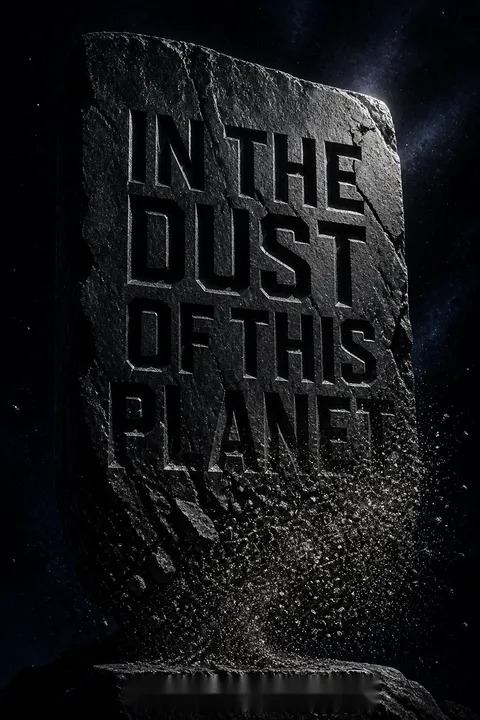

Key Takeaways
1. The World is Unthinkable: Confronting the Non-Human
The world is increasingly unthinkable – a world of planetary disasters, emerging pandemics, tectonic shifts, strange weather, oil-drenched seascapes, and the furtive, always-looming threat of extinction.
Human-centric views. We typically interpret the world through human-centric frameworks: mythological (classical Greece), theological (Medieval Christianity), and existential (modernity). These approaches recuperate the non-human world into a "world-for-us," governed by human values and understanding, even when acknowledging forces beyond our control. This perspective, however, is increasingly inadequate in the face of global challenges.
Three concepts of the world. To move beyond anthropocentric limitations, the book introduces three distinct concepts:
- World (world-for-us): The human-interpreted, meaningful world.
- Earth (world-in-itself): The objective, scientifically studied, yet ultimately inaccessible world.
- Planet (world-without-us): The spectral, speculative world, defined by the subtraction of the human, existing as an impersonal and horrific zone between the World and the Earth.
Beyond human comprehension. The "Planet" represents a profound challenge to thought, persisting in the shadows of our human-centric and objective understandings. It is the world as absolutely unhuman, indifferent to our hopes and desires, a concept explored not through traditional philosophy but through the paradoxical language of supernatural horror and science fiction. This perspective suggests that the world's true nature lies beyond our capacity to fully grasp or control it.
2. The Horror of Philosophy: Thinking Beyond Human Limits
The genre of supernatural horror is a privileged site in which this paradoxical thought of the unthinkable takes place.
Philosophy's limitations. The book argues for "the horror of philosophy," isolating moments where philosophy confronts its own boundaries and the "unthinkable." This isn't about the philosophy of horror, but rather how horror, as a non-philosophical language, articulates what philosophy struggles to pronounce. Supernatural horror, akin to darkness mysticism or negative theology, becomes a crucial lens for this paradoxical thought.
Horror as a philosophical mode. Unlike fear, which is a human emotion within a human world, horror, in this context, is about the limits of the human when facing a world that is not merely "World" or "Earth," but "Planet"—the world-without-us. It's about the enigmatic thought of the unknown, echoing Lovecraft's assertion that "the oldest and strongest kind of fear is the fear of the unknown." Horror, therefore, functions as a "negative philosophy," revealing the world's indifference.
Challenging presuppositions. Genre horror, through its bestiary of impossible life forms—mists, ooze, blobs, slime—takes aim at philosophy's presupposition that the world is always "for us." It makes these blind spots its central concern, expressing them not in abstract concepts but in visceral, non-human terms. This approach allows for an exploration of the world's inherent strangeness and its resistance to human-imposed meaning.
3. "Black" as Cosmic Pessimism: The World's Indifference
Hence another possible meaning of the term “black”: Black = Cosmic. Or better, Black = Cosmic Pessimism.
Beyond Satanism and Paganism. In analyzing the term "black" in black metal culture, the book moves beyond common associations with Satanism (opposition/inversion, dark technics) and Paganism (exclusion/alterity, dark magic). Both these interpretations, while exploring non-human forces, remain anthropocentric, viewing the world either as a tool or a force for human benefit.
Cosmic Pessimism's anti-humanism. A third, more profound meaning emerges: "Black = Cosmic Pessimism." This perspective attempts to relinquish the human point of view entirely, embracing the anonymous, impersonal "in itself" of the world, which is utterly indifferent to human desires and struggles. Its limit-thought is absolute nothingness, unconsciously represented in images of planetary cataclysm and extinction.
Schopenhauer's influence. Arthur Schopenhauer is identified as a key proponent of this metaphysical misanthropy. He challenged philosophy's basic premises, including the principle of sufficient reason and the self-world dichotomy, to entertain a world without inherent meaning or order, an order "absolutely indifferent to our existence." His concept of Wille (Will) as an impersonal, blind "nothing" at the heart of the world, and his nihil negativum (negative nothing), resonate with Lovecraft's "cosmic outsideness," where human concerns are negligible in the vast, black seas of infinity.
4. The Demon as Meontological: Non-Being and Indifference
Perhaps there is a meaning of the demonic that has little to do with the human at all – and this indifference is what constitutes its demonic character.
Beyond human metaphor. Traditionally, the demon has been interpreted anthropologically—as a metaphor for human evil or the threatening "Other"—or mythologically, as an allegory for the limits of human understanding of the non-human. However, the book proposes a "meontological" demon, one concerned with non-being rather than being, whose essence is its indifference to the human.
Dante's "black wind." Dante's Inferno offers a powerful illustration of this meontological demon. Beyond the counter-sovereign Lucifer or the Faustian Malebranche demons, the "black wind" (aura nera) in the Second Circle is a fully immanent, distributed "life-force" that is everywhere but nowhere, pure force and flow, yet also pure nothingness. This demon is not a discrete entity but an elemental, unmediated absence, challenging divine sovereignty by its refusal to be organized.
Demontology: Against the human. This leads to the concept of "demontology," a philosophical approach that distinguishes itself from both anthropology and pure metaphysics. Demontology considers the world as "world-without-us" and challenges the principle of sufficient reason, embracing an "insufficiency of reason." It is "against" the human being, exploring negation, nothingness, and the non-human, acknowledging that if such a field could exist, it would not be made respectable by its existence, "for nothing is more frowned upon than nothing."
5. Occult Philosophy's Anti-Humanist Turn: The Hiddenness of the World
Whereas traditional occult philosophy is a hidden knowledge of the open world, occult philosophy today is an open knowledge of the hiddenness of the world.
Agrippa's occulted world. Agrippa's De Occulta Philosophia introduced the idea of "occult qualities"—aspects of the world that exist but are unexplainable by humans, remaining hidden or "occulted." This concept forms the "dark underside" of humanist claims, suggesting a world that refuses to be fully revealed, indifferent to our attempts to comprehend it.
The hiddenness of the world. The book reinterprets "occult philosophy" for a contemporary context. Instead of humanity seeking hidden knowledge to reveal the world (traditional occult philosophy), the world now simply reveals its hiddenness to us. This "hiddenness" is anonymous, indifferent, and resistant to both theistic providence and scientific reason. It's the "world-in-itself-for-us," presenting itself without becoming fully accessible or knowable.
Magic circle to magic site. The motif of the "magic circle" evolves from a human-governed boundary between natural and supernatural (Marlowe, Goethe, Wheatley) to an anomalous, blurring force (Hodgson, Outer Limits), and finally to a "disappearing" circle where its effects are diffused into the world itself (Lovecraft, Ito). This leads to the "magic site"—a spontaneous, unhuman intrusion of the hidden world into the apparent world, manifesting as "mists and ooze," entities neither animate nor inanimate, organic nor inorganic.
6. Life as Dread: The Blasphemous and Nouminous
If horror – as we’ve been discussing it – is a way of thinking the world as unthinkable, and the limits of our place within that world, then really the specter that haunts horror is not death but instead life.
Dread of life. The book posits that horror is less about the fear of death and more about the dread of "life" itself, particularly a "life-in-itself" that hovers between scientific and religious definitions. This "life" is not easily categorized, constantly challenging our understanding and revealing a profound fissure at its heart.
Blasphemous and nouminous life. "Blasphemous life" refers to living contradictions, like Lovecraft's Shoggoths—formless, abstract, mathematical patterns of organic "dots" that are alive but should not be. This is a dialethic biology, where contradictions are foundational. "Nouminous life" combines Rudolph Otto's "numinous" (the horror of the divine as absolute otherness) with Kant's "noumena" (the unhuman, anonymous world). It's a life that indifferently lives on, eliciting a noumenal horror.
Living contradictions in horror. Horror cinema's "creature features" exemplify this "spirit of biology," presenting living contradictions that repudiate "life itself" for some form of afterlife.
- Zombie: Animated corpse, metaphysical principle of "flesh."
- Vampire: Decay of immortality, metaphysical principle of "blood."
- Demon: Supernatural being/lowly beast, metaphysical principle of "meat."
- Phantasm: Materialization of immateriality, metaphysical principle of "spirit."
These figures highlight the incommensurability between "Life" (the principle) and "the living" (particular instances).
7. Extinction as a Biological Void: The Unthinkable End
In this sense extinction can never be adequately thought, since its very possibility presupposes the absolute negation of all thought.
Beyond individual death. Extinction, as a scientific concept, differs from individual death. Organisms live and die, but species exist or cease to exist. This distinction raises questions about the relationship between the life of an organism and the existence of a species, and whether one can exist without the other.
The paradox of witnessing extinction. The ultimate paradox of extinction, especially human extinction, is the question of who would witness or give testament to it. If all human thought is negated, then the very thought of extinction becomes impossible. This renders extinction a "speculative annihilation," not an event to be experienced or measured, but a void that challenges the principle of sufficient reason.
Extinction as a null set. Extinction is presented as a "biological void," a form of life that is neither biological life (the death of the organism) nor the existence of a set (the persistence of a species). It is the "null set of biology," implying the non-being of life that is not death. This concept pushes the boundaries of what can be conceived, highlighting the unhuman indifference of the planetary scale.
8. Life as Non-Being: The Anonymous "There Is"
This impersonal, anonymous, yet indistinguishable ‘consummation’ of being, which murmurs in the depths of nothingness itself we shall designate by the term there is…The rustling of the there is…is horror.
Life as a receding horizon. Philosophical attempts to ontologize "Life" often find it to be an always-receding horizon, never fully available to thought. This "Life" is not a privation but a superlative, exceeding any particular instance of the living, making it "nothing" precisely because it is never some thing or is always more than one thing. This negative concept of life aligns with negative theology, where the divine is nihil due to its superlative nature.
The "there is" of horror. Drawing on Emmanuel Levinas, the book introduces the "there is" (il y a)—an impersonal, anonymous presence that invades when the forms of things dissolve into night. This "nothing" is not pure nothingness but an unavoidable presence, a "consummation of being" that murmurs in the depths of nothingness itself. This "rustling of the there is" is horror, eviscerating all noological interiority and turning subjectivity inside out.
Life-without-Being. The concept of "Life-without-Being" challenges philosophy's traditional assumption that "Life" must always presume "Being." The "there is" of Life suggests that Life itself is already enveloped in the gothic horror of absolute otherness and anonymity. This "terato-logical noosphere" of concept-horror is populated by unnamable, unthinkable creatures that are aberrations of thought, existing as form-without-matter or matter-without-form, highlighting conceptual aberrations rather than mere natural abominations.
9. Dark Mysticism of the Unhuman: The Planet's Indifference
If historical mysticism is, in the last instance, theological, then mysticism today, a mysticism of the unhuman, would have to be, in the last instance, climatological.
Beyond human-centric mysticism. Traditional mysticism aims for a union of self and world, often with God as its highest principle, and is fundamentally human-centric. However, the book proposes a "dark mysticism of the unhuman," or a "mysticism of the world-in-itself," which confronts the radical disjunction and indifference of self and world. This contemporary mysticism is about the impossibility of experience, focusing on what withdraws from human comprehension.
The unground and planetary ambience. This mysticism draws from figures like John of the Cross, who described "divine darkness" as exceeding human capacity, and Jakob Böhme, whose concept of Ungrund (unground) posits the divine as neutral, anonymous, and indifferent. Georges Bataille's "The Congested Planet" further evokes an unhuman, indifferent planet, where human knowledge is a "restricted economy" contrasted with the "general economy" of the planet's deep time and tectonic shifts, which operates indifferently to human concerns.
Absolute nothingness and indifference. Keiji Nishitani's interpretation of Buddhist śūnyatā (absolute nothingness) provides a framework for this dark mysticism. It's an emptiness that empties itself even of the standpoint of emptiness, a cosmic nihility where everything is nameless and unknowable. This perspective reveals the world's indifference to humanity, a core problematic in climate change discourse. This unhuman mysticism is not theological but climatological, expressed in the "dust of this planet," confronting a world that is against us, or more accurately, utterly indifferent.
Review Summary
In the Dust of This Planet receives mixed reviews, averaging 3.68/5 stars. Readers praise its ambitious exploration of cosmic pessimism, horror philosophy, and the "world-without-us" concept, using references from Lovecraft to black metal. Many find it dense, jargon-heavy, and more like an academic thesis than accessible philosophy. Some appreciate Thacker's erudition and dark mysticism discussions, while others criticize superficial philosophical treatment and lack of cohesive argument. The book polarizes: horror enthusiasts enjoy its cultural references; philosophy readers find it insufficiently rigorous. Most agree it raises more questions than answers, being the first of a trilogy.
People Also Read
Horror of Philosophy Series
Download PDF
Download EPUB
.epub digital book format is ideal for reading ebooks on phones, tablets, and e-readers.








































