

Key Takeaways
Most of a conversation happens in the body, not the words
We are barely paying attention to how people communicate. Van Edwards opens with a jolt: people tell two to three lies in a ten-minute conversation, 91% lie regularly, yet untrained observers catch deception only about half the time, no better than flipping a coin. Meanwhile she claims as much as 93% of interpersonal communication is nonverbal, meaning we build entire relationships on the sliver we consciously hear.
The good news is that lying is learned, so reading it can be relearned. Three-year-olds confess to peeking at a forbidden toy; by five, none do, because they have absorbed that truth gets punished. Some people, dubbed truth wizards, spot deception naturally, and studies found 20 to 30% of them had turbulent childhoods where reading adults was a survival skill.
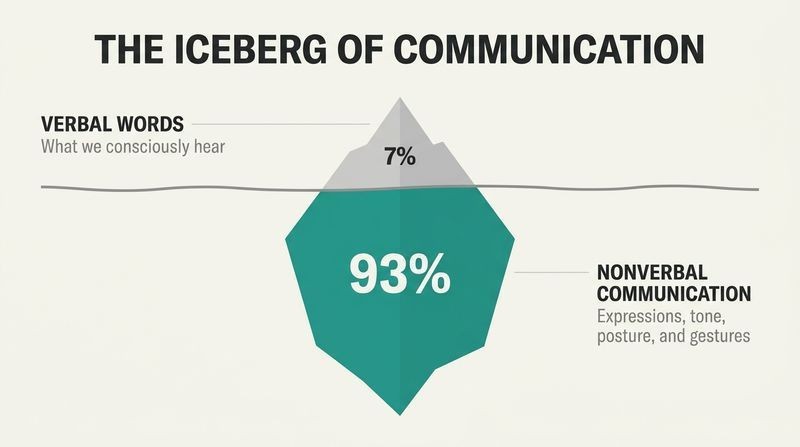
The 93% figure descends from Albert Mehrabian's 1960s research and is frequently overstated: his experiments concerned only communication of feelings and attitudes, not all speech. Treating it as a universal law is shaky. Yet the deeper claim holds up well. Meta-analyses (Bond and DePaulo, 2006) confirm humans detect lies at roughly 54%, barely above chance, which validates the book's central provocation. The truth-wizard finding echoes attachment research showing hypervigilant children develop acute affect-reading. The reframe that matters: nonverbal literacy is a trainable skill built on equipment evolution already installed, not a mystical gift.
Learn how someone acts honestly before deciding they're lying
Baselining is the non-negotiable first step. A baseline is how a person looks, sounds, and moves under calm, non-threatening conditions, when they have no reason to deceive. Start with harmless small talk (weekend plans, the weather), watch posture, fidgeting, hand gestures, voice pitch, and verbal tics, then note how they light up discussing a passion. Only after mapping their normal do you ask the harder questions.
Context demands a second baseline: the nervous one. A job candidate is anxious even answering easy questions, so you must learn how they look when nervous but honest, perhaps by raising a sad news topic. Otherwise you will mistake ordinary jitters for guilt. In the office example, colleague Wyatt stiffens his torso on tense subjects (his nervous baseline) but only clears his throat obsessively and rubs his neck when questioned about the project he padded.
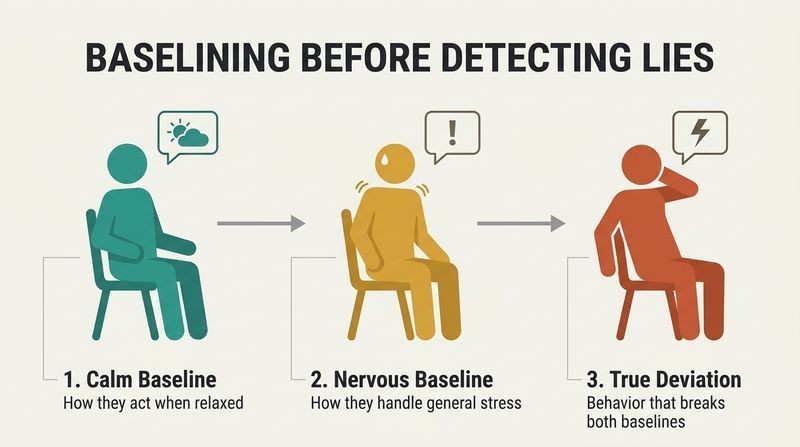
This is the book's most defensible and important idea, and it inoculates against the field's biggest failure mode: treating gestures as a universal codebook. Crossed arms mean nothing until you know a person's default. The logic mirrors clinical medicine, where a single blood pressure reading is meaningless without the patient's normal range, and statistical process control, where you flag only deviations from an established mean. It also quietly guards against confirmation bias, since baselining forces you to gather disconfirming data before accusing. The catch: baselines are unstable across mood, fatigue, and setting, so even a careful baseline is a moving target.
One odd gesture proves nothing; hunt for three red flags clustered
There is no behavioral smoking gun. A single deviation from baseline is noise. Van Edwards' rule of thumb: take a topic seriously only when three red flags appear in one response. A red flag is any departure from the baseline or any leaked hidden emotion. Clusters, not solo signals, point to a touchy subject or a lie worth investigating.
The clustering discipline protects you from false accusations. Wyatt scratching his neck once is nothing. Wyatt stiffening his torso, then clearing his throat far more than usual, then reaching for a self-soothing neck rub, all on the same question, is a cluster. Van Edwards frames deception spotting not as catching people but as returning to truth. The goal is more honest conversations, not a courtroom in your head where everyone is guilty.
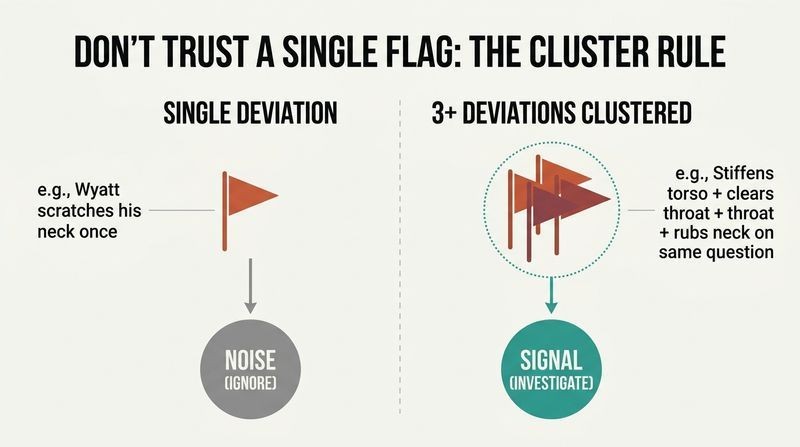
The three-flag heuristic is smart risk management dressed as folk wisdom. It raises the evidentiary bar, cutting false positives, which matters because the cost of wrongly branding an honest person a liar is corrosive to trust. This resonates with signal detection theory: any single cue has a low signal-to-noise ratio, but independent cues combined sharply improve discrimination. A caveat worth flagging: the individual cues in the popular literature (neck touching, throat clearing) have weak empirical support as deception markers. Bundling three unreliable signals does not automatically yield one reliable verdict. The cluster rule is best read as a brake on hasty judgment rather than a precision instrument.
Seven facial expressions are universal and nearly impossible to fake
The face is a shared human map. Drawing on Paul Ekman, the pioneer who catalogued over 10,000 expressions, Van Edwards focuses on seven emotions that read identically across cultures: surprise, fear, disgust, anger, sadness, happiness, and contempt. Remote tribespeople, Tokyo executives, and people blind from birth all make them, proving the wiring is innate, not learned by watching others.
Microexpressions betray what words conceal. These involuntary flashes fire in as little as 1/25 of a second, too fast to suppress. Tells to memorize:
1. Real happiness engages crow's feet at the eyes; a fake smile does not.
2. Surprise shows upside-down-U brows, fear shows flat drawn-together brows.
3. Contempt is a one-sided smirk, which John Gottman found predicts divorce with about 90% accuracy.
4. Sadness is hardest to fake because the inner eyebrow corners rarely lift on command.
Ekman's universality thesis is one of psychology's genuine landmarks, though it is not unchallenged. Lisa Feldman Barrett and colleagues argue emotion recognition is more culturally constructed and context-dependent than the seven-basic-emotions model implies, and cross-cultural agreement drops when faces are shown without labels to choose from. Still, the practical advice is gold: the crow's feet test (the Duchenne marker) genuinely distinguishes felt from posed smiles and is hard to counterfeit. Gottman's contempt finding is robust and clinically influential; contempt, unlike anger, signals a hierarchy of disgust that predicts relational collapse. The takeaway for daily life is to weight the eyes and upper face, which people forget to manage.
The feet are the body's most honest square inch
Liars run out of mental bandwidth from the ground up. A liar must recall the truth, invent a false version, monitor your reactions, keep facts straight, and manage face and voice. That cognitive load means the feet, evolution's fight-or-flight launchpad, get forgotten. Ekman found unconscious foot movements spike when people lie.
Read the lower body for real intent. Signals to watch:
1. Feet pointed toward the exit mean the person wants out; jurors who dislike a witness angle their feet toward the door.
2. L-shaped feet (one turned away) show partial disengagement.
3. Widely splayed legs claim territory and signal confidence or dominance.
4. Tightly locked ankles signal holding back; dental patients locked ankles far more when facing an injection than a checkup.
Van Edwards advises interviewers to use glass tables or none at all to keep feet visible.
The insight rests on cognitive load theory, and this is where deception research is genuinely strongest. Aldert Vrij's work shows that increasing a liar's mental burden (asking for reverse-order recall, unexpected questions) degrades their performance far more than the truth-teller's, precisely because fabrication is effortful. The feet claim follows the same logic: attention is finite, so the least-monitored channel leaks most. The specific readings (exit-pointing feet, ankle locks) are plausible and intuitive but rest on thinner evidence than the load principle itself. The durable lesson is architectural: design the physical setting so the honest channels stay visible, rather than trusting yourself to decode a hidden signal.
Liars talk more, so stay silent and let them overfill the gap
Deception is verbose, not terse. A 2004 study found liars use roughly a third more words than truth-tellers, piling on detail to sell the story. So the single most effective technique is counterintuitive: shut up. Wait an extra beat after they finish and let them scramble to fill the silence, then ask another open-ended question.
Word choice leaks intent. Watch for these verbal tells against a baseline:
1. Distancing language ('that woman' instead of a name) to psychologically separate from the lie.
2. Dropped contractions for emphasis, as in Clinton's 'I did not have sexual relations,' not 'didn't.'
3. Bolstering oaths like 'to be honest' or 'swear to God,' which truth needs less often.
4. Character defenses ('my friends will tell you I'm honest') instead of facts.
Van Edwards' frame: liars try to convince you, honest people simply convey.
The convince-versus-convey distinction is the sharpest tool in this section and maps neatly onto forensic linguistics. James Pennebaker's pronoun research shows deceptive language uses fewer first-person singular pronouns (the distancing effect) and more negative-emotion words. The verbosity finding aligns with the idea that fabricators overcompensate, though skilled liars do the opposite and strip detail to avoid contradiction, so word count alone can mislead. The strongest, most actionable piece is strategic silence, which exploits our discomfort with conversational voids. Interrogators call it the pause; negotiators weaponize it too. The person who tolerates silence longest usually controls the exchange and harvests the most unguarded information.
Trusting people catch more liars than suspicious ones do
Paranoia makes you worse, not sharper. Counterintuitively, research cited by Van Edwards shows people who score higher on trust also detect lies more accurately. Chronically suspicious people misfire, falsely accusing the innocent and missing the actual deceivers. The point of the whole book is not to weaponize suspicion but to relax, because knowing you can spot a lie frees you to stop policing everyone.
Rapport is a truth serum. People lie more when they feel disconnected or uncomfortable. Baselining doubles as a rapport-builder, since close attention signals genuine interest and breeds loyalty. Warmth literally loosens tongues: in one experiment, briefly touching a stranger's elbow raised the rate of returning a found coin from 23% to 68%. Connection, not interrogation, is what pulls the truth out of people.
This resolves the book's central tension: how to become a lie detector without becoming a cynic. The finding that trust improves accuracy is well grounded; suspicion narrows attention and triggers a bias toward seeing deception everywhere, which mathematically guarantees more false alarms. It connects to Paul Zak's oxytocin research, where trust and reciprocity form a biochemical loop, and to rapport-based interrogation, which the high-value detainee research (Alison and Alison) found dramatically outperforms coercive methods at eliciting reliable information. The elbow-touch study is a classic of the compliance literature. The unifying insight is humane and practical: people confide in those who make them feel safe, so warmth is an intelligence-gathering tool, not just a nicety.
Strangers judge you in a tenth of a second, so decide what they see
First impressions are near-instant and sticky. Princeton's Todorov and Willis found people predicted election winners with about 70% accuracy from a microsecond glimpse of a candidate's face. Snap judgments form in roughly a tenth of a second and rarely revise. Since you cannot stop people from judging fast, engineer the signal.
Project confidence with deliberate nonverbal choices.
1. Think up: head up, shoulders up, spine straight, the universal code for strength.
2. Give a firm, vertical handshake; beware the dominance move where someone rotates their hand on top.
3. Carry one bag, not two, and shed your coat before entering, since clutter reads as scattered.
4. Smile at the right moments, not constantly, because over-smiling reads as submissive, especially for women.
5. Sit at a slight angle, never directly opposite, which spikes recall and lowers hostility.
Todorov's thin-slice research is landmark work and mildly unsettling, since competence judgments from faces predict real electoral and even courtroom outcomes despite being demonstrably unreliable guides to actual ability. That is a bias to resist in yourself as much as a lever to pull on others. The self-presentation advice draws on Amy Cuddy's power-posing research, elsewhere referenced in the book, which has faced a serious replication reckoning: the hormonal claims largely failed to replicate, though the felt-confidence effect is more durable. The soundest counsel here is the angle-of-seating point, backed by memory and rapport research, and the smile-timing nuance, which shrewdly notes that constant smiling can undercut perceived authority.
Increase the liar's mental load to make the story crack
Fabrication is fragile under strain. Because a lie is constructed rather than remembered, it breaks when you tax the storyteller. Ask them to retell events backwards or from a different starting point; honest people reshuffle a real memory easily, liars stumble. Ask them to draw the scene: in one experiment, 80% of truth-tellers included the other person in their sketch versus only 13% of liars, and truth-tellers drew from a first-person shoulder view while liars floated to an overhead perspective they had to invent.
Then lower the cost of confessing. Offer a face-saving rationalization ('anyone would in this economy'), minimize the significance, or describe a worse version and watch them correct you. Ask about motive, which honest people struggle to supply because they never had one. Each move nudges the guilty toward relief and disclosure.
This is the book at its most evidence-based, drawing directly on Aldert Vrij's cognitive-load paradigm, arguably the most validated approach in modern deception science. The reverse-order and draw-the-scene techniques are documented to widen the behavioral gap between liars and truth-tellers far more reliably than passive cue-spotting. The drawing perspective finding (egocentric versus observer viewpoint) is a genuinely clever exploitation of how episodic memory differs from imagination. A necessary ethical caveat: minimization and false-evidence tactics are the same tools that produce false confessions from the innocent under pressure, as the Reid technique's troubled record shows. Load-increasing questions are safer than pressure-based coercion, which can manufacture the very admission it seeks.
Watch the top half of the face; that's where the truth escapes
People fake the mouth and forget the eyes. When someone lies, they consciously arrange the easy-to-control lower face into the expression they want you to buy, usually a smile. But the upper face (eyes, forehead, brows) is far harder to command, so the real emotion leaks there. A person beaming while their inner brows tug up in sadness or their brows lower in anger is broadcasting a mismatch.
Scan for incongruence and bad timing.
1. Little movement in the upper face while the mouth smiles.
2. Asymmetry, such as a one-sided smirk, which doubles as the contempt expression.
3. A one-shouldered shrug, the body's version of a half-truth.
4. Expressions that lag the words, since genuine emotion fires with speech, not a beat after.
Eliminated reality-TV contestants are a perfect lab: mouths smile bravely while sad eyes give them away.
The upper-lower face asymmetry has solid anatomical backing. The muscles around the eyes, especially the orbicularis oculi that produces the Duchenne crow's feet, are largely resistant to voluntary control, which is why posed and felt smiles genuinely differ and why the top of the face is the better tell. The timing insight is subtler and underappreciated: authentic microexpressions are involuntary and synchronous with speech, whereas deliberate ones tend to onset late and linger too long. This offers a cleaner diagnostic than any single gesture. The reality-TV suggestion is unexpectedly rigorous training advice, since it supplies high-stakes emotional suppression footage on demand, the closest most people get to a deception laboratory.
Analysis
This is a practical, research-referencing field guide, not a theoretical treatise. Its structure is anatomical and procedural: establish a baseline, scan face, body, and voice for deviations, then require clusters before judging. That architecture is its greatest strength, because it front-loads the discipline (baselining, three red flags, trust over suspicion) that separates responsible reading from pop-psych mind-reading. The book earns credibility by leaning on the field's genuine giants: Ekman on universal microexpressions, Vrij on cognitive load, Gottman on contempt, Todorov on thin slices, Navarro on limbic body language. Where it is on firmest ground is precisely where academic consensus is strongest: humans are terrible at detecting lies unaided, fabrication is cognitively effortful and therefore breakable, and the Duchenne eye markers reliably separate felt from faked emotion. Where it overreaches is the compression of nuanced findings into confident single-cue readings. The 93% nonverbal figure is a misapplied Mehrabian statistic; many gesture-to-meaning mappings (neck touching equals anxiety, ankle locks equal concealment) rest on thin or anecdotal evidence and risk the illusion of a universal codebook the book otherwise warns against. The neuro-linguistic-programming eye-direction claims (up-left equals memory, up-right equals fabrication) have been repeatedly debunked and are the weakest material here. The Lance Armstrong appendix illustrates both the appeal and the peril: post-hoc interpretation of a known liar is unfalsifiable and prone to hindsight bias. The wisest reader treats the book as an attention-training tool rather than a decoder ring. Its real value is behavioral: slow down, gather a baseline, tolerate silence, increase load, and stay warm and trusting rather than paranoid. Those meta-skills improve judgment even if no individual gesture means what the book claims. Read this way, it delivers on its humane thesis, that reading people well is ultimately a route back to honest connection.
Review Summary
Human Lie Detection and Body Language 101 receives mostly positive reviews, with readers finding it informative and useful for beginners. Some appreciate the explanations behind expressions and nonverbal cues. Critics note that much of the information is instinctual or not new. The book is praised for its simplicity and accessibility, making it a good starting point for those interested in body language and lie detection. Readers value the practical tips and insights provided, though some find it brief and lacking depth compared to more comprehensive works on the subject.
People Also Read




FAQ
What's "Human Lie Detection and Body Language 101" about?
- Overview: "Human Lie Detection and Body Language 101" by Vanessa Van Edwards is a guide to understanding and interpreting nonverbal behavior to detect lies and improve communication.
- Focus Areas: The book covers topics such as microexpressions, body language, vocal tone, and language patterns to help readers decode hidden emotions and detect deception.
- Practical Application: It provides scientifically-backed techniques and practical advice for various contexts, including personal relationships, business interactions, and interviews.
- Target Audience: The book is intended for anyone interested in improving their communication skills, from professionals to everyday individuals.
Why should I read "Human Lie Detection and Body Language 101"?
- Improve Communication: The book offers tools to enhance your ability to read nonverbal cues, leading to more effective and honest interactions.
- Detect Deception: Learn to spot lies and hidden emotions, which can be crucial in personal and professional settings.
- Scientific Basis: The techniques are grounded in academic research, providing reliable methods for lie detection and understanding body language.
- Versatile Use: Whether you're a teacher, manager, or parent, the skills taught in the book can be applied to various aspects of life.
What are the key takeaways of "Human Lie Detection and Body Language 101"?
- Nonverbal Dominance: Up to 93% of communication is nonverbal, emphasizing the importance of understanding body language.
- Baselining: Establishing a person's baseline behavior is crucial for detecting deviations that may indicate lying.
- Microexpressions: Recognizing universal facial expressions can reveal true emotions, even when someone is trying to hide them.
- Clusters of Clues: No single gesture indicates lying; look for clusters of red flags to make more accurate assessments.
How does baselining work in lie detection?
- Definition: Baselining involves observing how someone behaves under normal, non-threatening conditions to identify their truthful behavior.
- Steps: Start with neutral topics to establish a baseline, noting physical and verbal behaviors such as posture, gestures, and voice tone.
- Comparison: Use the baseline to detect deviations when discussing more sensitive or important topics, which may indicate deception.
- Nervous Baseline: Consider how someone behaves when nervous but truthful to differentiate between anxiety and lying.
What are microexpressions, and why are they important?
- Definition: Microexpressions are brief, involuntary facial expressions that reveal true emotions, often occurring in 1/15 to 1/25 of a second.
- Universal Expressions: There are seven universal microexpressions: disgust, anger, fear, sadness, happiness, surprise, and contempt.
- Detection: Learning to recognize these expressions can help you understand hidden emotions and detect lies.
- Practice: The book suggests practicing these expressions in the mirror to better identify them in others.
How can body language indicate deception?
- Feet and Legs: Liars often forget to control their feet, which may point towards exits or jiggle when nervous.
- Torso and Arms: Leaning away, crossing arms, or touching the neck can indicate discomfort or deceit.
- Facial Clues: Incongruous facial expressions, such as a smile with angry eyes, can be red flags.
- Clusters: Look for multiple signs of nervousness or blocking behavior to identify potential lies.
What role does vocal tone play in lie detection?
- Voice Changes: Liars may exhibit changes in pitch, such as a higher pitch for women and a lower pitch for men.
- Speech Patterns: Liars often use more words, avoid contractions, and provide excessive details to convince others.
- Delayed Responses: Hesitation or repeating questions can indicate stalling for time to fabricate a lie.
- Distancing Language: Avoiding pronouns or using vague terms can be a sign of deception.
What are some common lying gestures?
- Frozen Bodies: Liars may freeze their upper bodies due to fear and the limbic response.
- Lip Pursing: This gesture often indicates holding back information or disagreement.
- Eye Blocking: Squinting or rubbing eyes can show discomfort with what is being said or heard.
- One-Sided Expressions: Asymmetrical facial expressions, like a one-sided smile, can indicate contempt or deceit.
How can I use the techniques in "Human Lie Detection and Body Language 101" in everyday life?
- Personal Relationships: Improve trust and communication by understanding nonverbal cues and detecting lies.
- Professional Settings: Use body language skills in interviews, negotiations, and meetings to gain insights and build rapport.
- Parenting: Recognize when children might be hiding something or feeling uncomfortable.
- Social Interactions: Enhance your ability to connect with others by reading their true emotions.
What are the best quotes from "Human Lie Detection and Body Language 101" and what do they mean?
- "Lie spotting is about getting back to truth." This emphasizes the book's goal of fostering honest interactions rather than simply identifying liars.
- "Our brain is much more adept at spotting lies than we realize." Highlights the innate ability to detect deception, which can be honed with practice.
- "There is no behavioral smoking gun that means a subject is lying." Stresses the importance of looking for clusters of clues rather than relying on a single indicator.
- "Learning to decode human behavior will completely change the way you interact and listen to others." Encourages readers to embrace the transformative power of understanding nonverbal communication.
How can I make a great first impression using body language?
- Handshakes: A firm, straight handshake conveys confidence and equality.
- Posture: Stand straight with your head up and shoulders back to project confidence.
- Smile Appropriately: Smile at key moments, such as greetings and farewells, to appear friendly but not submissive.
- Minimize Distractions: Carry only one bag and remove outerwear to appear organized and focused.
What are some special considerations for using body language in business?
- Interviewing: Use glass tables to observe candidates' feet and sit at an angle to reduce tension.
- Sales: Show your palms to convey openness and avoid barriers like desks during pitches.
- Public Speaking: Use broad gestures and eye contact to engage the audience and avoid pointing, which can seem aggressive.
- Confidence Gestures: Use steepling and take up space to project confidence in meetings and negotiations.
About the Author
Other books by Vanessa Van Edwards
Download PDF
Download EPUB
.epub digital book format is ideal for reading ebooks on phones, tablets, and e-readers.








































