
Key Takeaways
1. Embrace Diverse Pedagogical Approaches for Tailored Learning
Pedagogy can be understood as the art and science of how people learn, and consequently how we can help them by teaching.
Teaching is multifaceted. There isn't one universal "best" way to teach; effective pedagogy involves understanding various approaches and applying them flexibly to suit the student, material, and learning goals. A teacher's ability to adapt their style significantly impacts student engagement and depth of understanding. By having a diverse toolkit, educators can create stimulating and relevant learning environments.
Five core approaches. The book outlines five distinct pedagogical approaches, each offering a unique lens through which to facilitate learning. These mindsets guide how teachers connect ideas, attitudes, and techniques, ensuring a comprehensive learning experience.
- Constructivist: Students actively build knowledge on existing foundations, with the teacher as a facilitator asking guiding questions.
- Collaborative: Students learn from and with each other through group work, debates, and peer teaching, fostering social and communication skills.
- Inquiry-Based: Students drive their learning by asking questions and solving problems, stimulating curiosity and critical thinking.
- Integrative: Students make cross-curricular connections, blending knowledge from different subjects to deepen understanding and recall.
- Reflective: Students engage in self-appraisal and metacognition, observing their actions, adjusting, and gaining insight into their own learning process.
Flexible application. These approaches are not rigid prescriptions but adaptable tools that can be blended and modified. The goal is always to serve the student's learning process, creating an environment that is encouraging, stimulating, relevant, and interconnected. Good teaching is inherently collaborative, facilitative, applied, student-centered, and flexible, moving beyond the outdated "teacher talks, student listens" model.
2. Cultivate a Passionate and Flexible Teacher Mindset
Hattie also claimed something you might already suspect to be true, i.e. that much of the variability in education, and the overall effectiveness of certain methods, comes down to the characteristics of the teacher and the teacher-student relationship.
Teacher's impact. A teacher's mindset and personal characteristics are more influential on student achievement than specific techniques or curriculum. John Hattie's research highlights that a teacher's passion for student learning, not just their subject, is paramount, as it models an optimal attitude towards learning and resilience in the face of challenges. This enthusiasm is contagious and shapes how students perceive education.
Key characteristics. Six main qualities define a good teacher, according to Hattie's findings, impacting student outcomes significantly. These traits enable teachers to create a supportive and effective learning environment.
- Passion: Genuine enthusiasm for helping students learn, modeling a positive attitude towards challenges and mistakes.
- Flexibility: Readiness to adjust pedagogical approaches, techniques, pace, materials, and communication style based on student needs.
- Clarity: Organized and focused communication, providing a clear learning path and transparent expectations.
- Positive Relationships: Building mutual respect, empathy, and trust with students, fostering a sense of security and inspiration.
- Pragmatism: Commitment to evidence-based strategies, honestly appraising effectiveness and adapting when necessary.
- Desire to Improve: A continuous willingness to learn, refine approaches, and seek feedback, embodying a growth mindset.
Modeling behavior. Teachers are constantly communicating more than just subject content; they teach students how to approach learning, deal with adversity, set goals, and take responsibility. By embodying these characteristics, teachers empower students to internalize positive attitudes towards their own educational journey, fostering self-belief and a lifelong love for learning.
3. Calibrate Learning Challenges to the "Goldilocks Zone"
We learn best when we are doing a task where we can expect around an eighty-five percent accuracy rate.
Optimal challenge. The "Goldilocks Principle" in learning suggests that students thrive when tasks are "just right"—neither too easy (leading to boredom) nor too difficult (causing frustration). Research indicates that an 85% accuracy rate represents this sweet spot, pushing students to the edge of their abilities without overwhelming them. This balance keeps learners engaged and motivated.
Arousal and performance. This principle aligns with the Yerkes-Dodson law, which describes how performance increases with arousal (cognitive stimulation or stress) up to an optimal point, after which further increases in arousal lead to declining performance. Teachers must observe students' emotional states and adjust the challenge level to maintain this optimal arousal, ensuring learning is difficult yet satisfying.
- Too easy: Students become bored, distracted, and unmotivated.
- Too hard: Students feel demoralized, confused, and stressed, leading to disengagement.
- Just right: Students are optimally challenged, fostering growth and satisfaction.
Personalized adjustment. Recognizing that each student has a unique threshold for challenge is crucial. Teachers should use student reflection, monitor energy levels, and observe the quality of mistakes to fine-tune lesson difficulty. Balancing challenging questions with manageable ones helps maintain confidence, allowing students to develop both competence and self-assurance in tandem.
4. Uncover True Understanding with a Cognitive Taxonomy
Heick’s taxonomy is a list of isolated tasks that increase in complexity.
Beyond surface knowledge. It's often challenging to truly know if a student has understood a concept, as they might simply parrot back desired answers. Heick's Learning Taxonomy provides a structured framework to assess the depth of student comprehension, moving beyond rote memorization to genuine insight. This tool helps teachers identify exactly where a student's understanding stands and adjust teaching strategies accordingly.
Six domains of cognition. The taxonomy outlines six progressive levels of understanding, each building on the previous one, allowing teachers to gauge a student's grasp of a topic. By asking targeted questions or assigning specific tasks, educators can "open the black box" of a student's mind.
- The Parts: Identify and recognize individual components, describe in simple words, categorize.
- The Whole: Understand how parts integrate, explain the bigger picture, use as a tool.
- Interdependence: Connect the topic to other ideas, compare/contrast, explain misconceptions.
- The Function: Apply the concept in various situations, describe its ideal use, analyze its purpose.
- The Abstraction: Deal with nuances, apply critical thinking, debate, analyze objectivity/subjectivity.
- The Self: Devise future learning plans, self-assess, identify gaps, evaluate self-knowledge.
Dynamic assessment. Teachers can quickly run through this taxonomy during lessons, using insights to adjust their approach and prevent later surprises about a student's lack of understanding. This continuous assessment ensures that teaching is always aligned with the student's current cognitive level, fostering deeper and more robust learning.
5. Master Clear Communication Through Definitions and Analogies
When we understand something and have knowledge of it, it’s the concepts we have grasped.
Explaining concepts. Effective teaching hinges on the ability to clearly communicate concepts, which are the tools we use to make sense of the world. A student's grasp of new material is directly proportional to the quality of the teacher's explanation, requiring a deep understanding of the concept itself and how to convey it. This involves a two-step process to bridge the gap between ignorance and understanding.
Two-step explanation:
- State and Define: Clearly establish the context and goal, identifying whether the concept is sensory or abstract. Provide a precise definition that categorizes the concept and highlights its unique characteristics. This acts as an orientation, telling the student "you are here" on the learning map.
- Example: "Ragtime was a popular musical style... recognized by its syncopated 'ragged' rhythms."
- Use Examples, Elaboration, and Analogies: Bring the definition to life by linking the new concept to what the student already knows. Analogies and metaphors are powerful tools, creating psychological familiarity and bootstrapping comprehension.
- Example: "Ragtime sounds a little like the old-timey music they’d play in a saloon in a classic Western movie..."
Making connections. Teachers should draw on students' existing knowledge, background, and interests to craft relatable analogies. Using both examples and non-examples helps students understand what a concept is and what it isn't. This iterative process of defining and illustrating not only clarifies the material for the student but can also deepen the teacher's own understanding.
6. Foster Critical Thinking by Identifying Logical Fallacies
To get better at critical thinking, we need to consistently be aware of and guard against logical fallacies that undermine the quality of our thought processes.
Beyond content. A great teacher not only imparts knowledge but also teaches students how to think, enabling them to learn independently. Cultivating critical thinking skills is vital for academic success and life in general, requiring students to evaluate the quality of their thoughts and arguments. Teachers can achieve this by helping students recognize and avoid common logical fallacies.
Common fallacies to address:
- Ad Hominem: Attacking the person making the argument instead of the argument itself (e.g., dismissing an idea because of who said it).
- Strawman: Distorting or oversimplifying an opponent's argument to make it easier to attack (e.g., misrepresenting a nuanced position as extreme).
- False Dilemma: Presenting only two options when more exist, forcing a choice (e.g., "You're either with us or against us").
- Circular Argument (Begging the Question): Restating the conclusion as a premise, offering no real proof (e.g., "Pot is bad because it's illegal, and it's illegal because it's bad").
- Causal Fallacies: Incorrectly assuming cause-and-effect relationships (e.g., "Post hoc ergo propter hoc" – assuming A caused B because B followed A; "Cum hoc ergo propter hoc" – assuming two correlated things are causally linked).
Socratic method. Teachers can use targeted questions (Socratic method) to challenge assumptions, prompt deeper analysis, and guide students to identify these fallacies in their own thinking and in external information. This approach fosters open-mindedness, intellectual rigor, and the ability to hold one's own cognition to a higher standard, making students more competent self-learners.
7. Empower Students Through Self-Assessment and Metacognition
With an effect size of 1.44, the next on our list of interest in called “self-reported grades.”
Student ownership. John Hattie's research highlights "self-reported grades" as an incredibly effective technique, advancing student achievement by approximately three years. Instead of traditional external grading, students set their own performance goals and predict their outcomes, then assess their own work. This process deeply engages students, fostering self-awareness, responsibility, and insight into their learning journey.
Metacognitive power. Closely related, "cognitive task analysis" (effect size 1.29) encourages students to think about their thinking processes, not just the content. Teachers simultaneously teach specific material and how to learn, making students aware of the cognitive tasks they perform (e.g., problem-solving, memory, critical thinking). This higher-order skill empowers them to take charge of their learning.
- Self-reported grades: Students predict their performance, then evaluate it, with the teacher acting as a facilitator or fact-checker.
- Peer-grading: Students grade each other using agreed-upon rubrics, enhancing understanding of learning goals and comparative progress.
- Cognitive task analysis: Discussing how students are thinking, identifying skills used (e.g., "compare and contrast," "explain"), and reflecting on strengths and weaknesses in these skills.
Internalized learning. By involving students in their own assessment and encouraging metacognition, teachers shift the focus from external judgment to internal growth. This approach helps students develop the ability to self-reflect and adjust independently, ultimately becoming more effective and self-directed learners.
8. Prioritize Early Intervention and Developmentally Appropriate Lessons
The idea is that if you understand the developmental stage your student is at, then you can match your teaching and assessment strategies to fit them most appropriately.
Targeted support. Hattie's research emphasizes the significant impact of "response to intervention" (effect size 1.29), which involves providing early, targeted help to struggling students. Just as a very overweight person sees rapid initial weight loss, students facing significant learning challenges often make the biggest gains with focused support. Teachers should identify difficulties early, intervene promptly, and continuously monitor progress.
Developmental alignment. Another high-impact influence (effect size 1.28) is pitching lessons at the right developmental level, inspired by Jean Piaget's theory. This means tailoring teaching strategies to a student's cognitive stage, ensuring the material is challenging but not overwhelming.
- Preoperational (2-7 years): Use imaginary play, stories, and concrete examples (e.g., teaching spelling with letter shapes).
- Concrete Operational (7-11 years): Tie concepts to the real world with objects, pictures, and hands-on activities (e.g., sums on an abacus).
- Formal Operational (11+ years): Introduce abstract thinking, self-reflection, and metacognition, gradually moving from concrete to abstract tasks.
Individualized approach. Every student develops at their own pace, so teachers must observe and adapt, ensuring lessons fit where the student is in their learning journey. Starting with "low hanging fruit"—addressing the most challenging areas first—can yield significant initial gains and boost student confidence, regardless of whether they have a diagnosed learning disability or simply a specific area of struggle.
9. Leverage Productive Failure in a Judgment-Free Environment
Productive failure is an idea identified by Manu Kapur, a researcher at the National Institute of Education in Singapore.
Learning from mistakes. Productive failure posits that struggling and making mistakes, without immediate instructional support, can lead to deeper understanding than being guided to instant success. Manu Kapur's research showed that groups allowed to flounder and collaborate to solve problems, even if they didn't find the correct solution initially, significantly outperformed those given full support when later tested on related concepts. This process forces deeper dives into problem structures and potential solutions.
Conditions for productive failure:
- Appropriate challenge: Problems should be difficult enough to challenge but not so frustrating as to demotivate.
- Elaboration opportunity: Learners must have the chance to explain their processes and ideas.
- Comparison of solutions: Students should compare and contrast various solutions, both good and bad.
Safe learning space. To embrace productive failure, teachers must create a learning environment free from judgment. When students feel safe to take risks, experiment, and make mistakes without fear of humiliation or damage to their self-worth, they are more resilient to adversity. This means disconnecting performance from personal identity, fostering a growth mindset where "I failed" doesn't become "I'm a failure." This paradoxically makes students more likely to evolve and learn.
10. Deliver High-Quality, Actionable Feedback for Continuous Growth
Feedback is information on how we are doing relative to our goal.
The essence of feedback. Feedback is a vital conversation, providing information on the outcome of actions relative to a goal, enabling students to adjust and improve. It's not merely praise or criticism, but a deliberate tool to support, guide, and encourage. The quality of feedback, rather than just its presence, determines its effectiveness in fostering self-evaluation and awareness.
Characteristics of effective feedback:
- Respectful: Delivered with dignity and politeness, ensuring it's received as constructive input, not a personal attack.
- Timely: Provided as close to the event as possible, often and in small doses, to prevent errors from compounding.
- Specific: Clear about what was done well, what needs improvement, and concrete steps for remediation.
- "Sandwich" method: Start with a compliment, deliver the correction, and end with another compliment (all sincere).
- Descriptive, not evaluative: Focus on actions, skills, or abilities ("showing your work made it easier to follow") rather than personal attributes ("you're great!"), promoting internal motivation and a growth mindset.
- Impersonal: Avoid making it about the teacher's feelings; focus on the student's performance and the learning process.
- Varied: Tailor delivery methods (verbal, written, modeling, self-evaluation) to suit the student's personality and learning style.
Actionable insights. Good feedback answers "where am I going?", "how am I going?", and "where to next?", bridging the gap between current and desired learning states. It should always lead to actionable steps, allowing students to incorporate suggestions and see tangible improvements. This continuous loop of action, feedback, and adjustment empowers students to internalize their ability to self-evaluate and refine their skills.
Review Summary
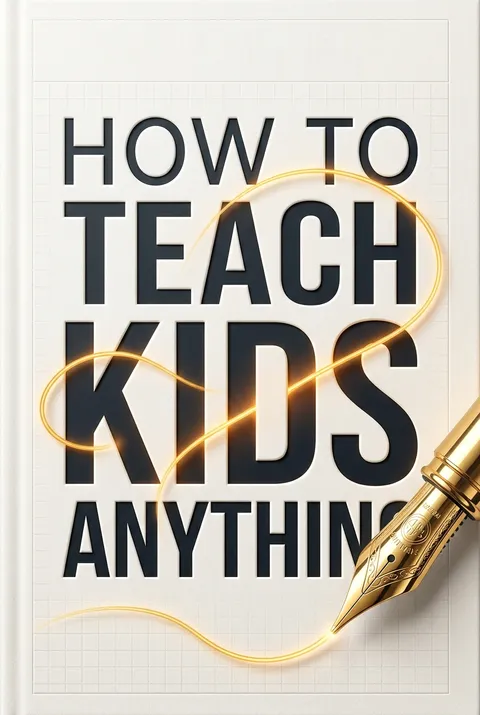
How to Teach Kids Anything receives a 3.72/5 rating with mixed but generally positive reviews. Readers appreciate its practical, accessible approach to teaching theory without dense academic language. Teachers find it valuable for enhancing their pedagogical knowledge, with one reviewer noting the concepts align with their natural teaching instincts. The book offers actionable tips on motivation and instruction, with helpful chapter summaries and clear formatting. Reviewers recommend it for both new and experienced educators seeking to improve their teaching practices, particularly those questioning traditional educational systems.
People Also Read









About the Author
Other books by Peter Hollins





Download PDF
Download EPUB
.epub digital book format is ideal for reading ebooks on phones, tablets, and e-readers.








































