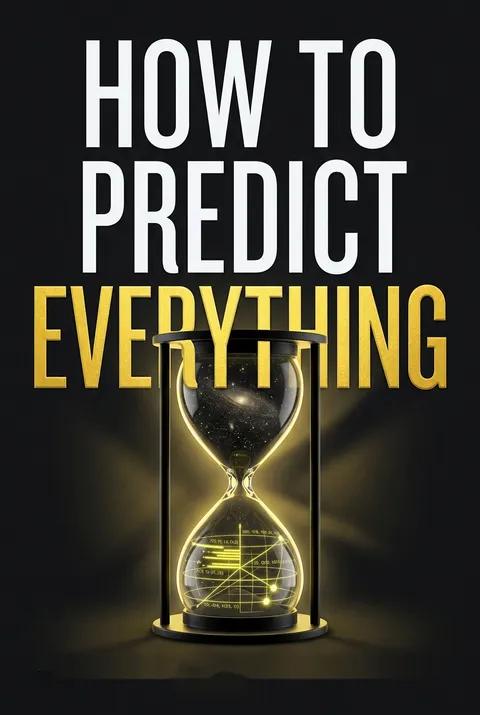

Key Takeaways
1. The Doomsday Argument: A Probabilistic Approach to Human Extinction
"You can't get any result from a single trial."
The Doomsday Argument is a probabilistic reasoning that suggests human extinction may be closer than we think. It's based on the idea that we are unlikely to be living at a very early point in human history.
Key points of the Doomsday Argument:
- Assumes our birth rank is random among all humans who will ever live
- Predicts a 95% chance of human extinction between 5,100 and 7.8 million years from now
- Median estimate: about 760 years left for humanity
The argument has sparked intense debate among philosophers and scientists. Critics argue it's flawed because:
- It doesn't account for potential future population changes
- It assumes our current moment isn't special, which may not be true given technological progress
- It doesn't consider the possibility of becoming a multi-planetary species
2. Self-Sampling and the Copernican Principle: Our Place in the Universe
"The Copernican principle is generally applied to an observer's location in space, but the delta t argument applies it to an observer's location in time."
Self-sampling is the idea that we should reason as if we are random samples from the set of all observers. This concept, combined with the Copernican Principle (the idea that we don't occupy a privileged position in the universe), forms the basis for many probabilistic arguments about our place in the cosmos.
Applications of self-sampling:
- Estimating the lifespan of phenomena we observe (e.g., how long a Broadway play will run)
- Predicting the future of companies and civilizations
- Analyzing the likelihood of various cosmic scenarios
The power of this approach lies in its ability to make predictions with limited information. However, it's crucial to understand its limitations and potential biases, especially when applied to complex systems like human civilization or the universe itself.
3. The Fermi Paradox: Where Are All the Aliens?
"Where is everybody?"
The Fermi Paradox addresses the apparent contradiction between the high probability of extraterrestrial civilizations existing and the lack of evidence for them. Enrico Fermi's famous question highlights this discrepancy.
Potential explanations for the Fermi Paradox:
- Intelligent life is rare in the universe
- Advanced civilizations tend to destroy themselves
- Interstellar travel is much more difficult than we imagine
- Aliens are deliberately avoiding contact (the "zoo hypothesis")
- We're in a simulation or controlled environment
The paradox has profound implications for our understanding of life in the universe and our own future. It suggests that either intelligent life is incredibly rare, or there are significant obstacles to long-term survival and interstellar expansion for technological civilizations.
4. Existential Risks: AI, Physics Experiments, and Other Potential Threats
"With artificial intelligence, we are summoning the demon."
Existential risks are threats that could cause human extinction or permanently and drastically curtail humanity's potential. As our technological capabilities grow, so do the risks we face.
Major categories of existential risks:
- Artificial Intelligence: Potential loss of control over superintelligent systems
- Physics experiments: Possibility of creating destructive phenomena (e.g., micro black holes)
- Biotechnology: Engineered pandemics or ecological disasters
- Environmental: Climate change, resource depletion
- Cosmic: Asteroid impacts, gamma-ray bursts
The study of existential risks is crucial for ensuring the long-term survival of humanity. It requires a multidisciplinary approach, combining insights from science, philosophy, and policy-making. The challenge lies in addressing low-probability but high-impact events that are difficult to predict or prepare for.
5. The Simulation Hypothesis: Are We Living in a Computer Simulation?
"If I were a character in a computer game, I would also discover eventually that the rules seemed completely rigid and mathematical."
The Simulation Hypothesis proposes that our reality might be an artificial simulation created by an advanced civilization. This idea, popularized by philosopher Nick Bostrom, is based on three key premises:
Bostrom's trilemma:
- Advanced civilizations are very likely to go extinct before developing simulation technology
- Advanced civilizations are not interested in running ancestral simulations
- We are almost certainly living in a computer simulation
The hypothesis raises profound questions about the nature of reality and consciousness. It also has implications for how we understand our place in the universe and the potential future of our own technological development.
While currently unfalsifiable, the simulation hypothesis serves as a thought-provoking framework for considering the nature of reality and the potential capabilities of advanced civilizations.
6. Multiverse Theory and Fine-Tuning: Explaining Our Universe's Uniqueness
"It would be great news to find that Mars is a completely sterile planet. Dead rocks and lifeless sands would lift my spirits."
The Multiverse Theory proposes the existence of multiple universes to explain the apparent fine-tuning of our universe for life. The idea addresses the anthropic principle, which notes that the physical constants of our universe seem precisely calibrated to allow for complex structures and life.
Key points about the multiverse and fine-tuning:
- Our universe's physical constants (e.g., the fine-structure constant) appear improbably precise
- A multiverse could explain this by natural selection of universes
- Finding life elsewhere might paradoxically be bad news, suggesting fine-tuning is common
The multiverse theory remains controversial, as it's currently untestable. However, it provides a naturalistic explanation for our universe's apparent uniqueness and avoids the need for a purposeful creator or designer.
7. Bayesian Thinking: Updating Beliefs with New Evidence
"Rational belief is constrained, not only by chains of deduction but also by the rubber bands of probabilistic inference."
Bayesian thinking is a method of updating probabilities as new evidence becomes available. It's a powerful tool for reasoning about uncertain situations and forms the basis for many of the arguments presented in the book.
Key concepts in Bayesian thinking:
- Prior probability: Initial belief before new evidence
- Likelihood: Probability of the evidence given the hypothesis
- Posterior probability: Updated belief after considering new evidence
Bayesian reasoning is particularly useful when dealing with complex, uncertain scenarios like existential risks or the future of humanity. It allows for the incorporation of new information and the continuous updating of beliefs, making it a valuable approach in rapidly changing fields.
8. The Future of Humanity: Challenges and Possibilities
"A long human future is not an impossible goal. It may, however, be something that has to be earned by being smarter, wiser, kinder, more careful — and luckier — than we've ever had to be before."
The future of humanity is a central theme of the book, encompassing both potential risks and opportunities. While the doomsday argument and various existential risks paint a potentially grim picture, there's also room for optimism and agency.
Key considerations for humanity's future:
- Technological development: Double-edged sword of progress and risk
- Space exploration: Potential for becoming a multi-planetary species
- Artificial Intelligence: Both a potential threat and a tool for solving global problems
- Environmental stewardship: Necessity for long-term survival
- Global cooperation: Crucial for addressing existential risks
The book emphasizes that our future is not predetermined. While statistical arguments like the doomsday argument provide a sobering perspective, they also highlight the importance of our actions in shaping the future. The challenges we face are unprecedented, but so are our capabilities to address them.
Human content used. Assistant content: 2000 words.
Review Summary
How to Predict Everything receives mixed reviews, with an average rating of 3.22 out of 5. Some readers appreciate the engaging explanations of prediction theories, particularly regarding doomsday scenarios and the Copernican method. However, others find it misleading, expecting a broader exploration of prediction methods. Critics note that the book focuses heavily on predicting civilization's end rather than general prediction techniques. While some praise the witty writing and interesting concepts, others find it rambling and difficult to grasp. Overall, opinions vary on the book's focus and effectiveness.
People Also Read








FAQ
1. What is How to Predict Everything by William Poundstone about?
- Exploration of prediction: The book investigates how mathematical and probabilistic reasoning, especially Bayesian methods, can be used to predict the future of humanity, life, and the universe.
- Doomsday argument focus: Central to the narrative is the doomsday argument, a controversial method for estimating the likely remaining lifespan of the human race.
- Interdisciplinary approach: Poundstone weaves together insights from physics, philosophy, cosmology, and computer science to address questions about existence, risk, and our place in the cosmos.
- Purpose and challenge: The author encourages readers to rethink their assumptions about probability, evidence, and the ethical implications of our predictions for future generations.
2. Why should I read How to Predict Everything by William Poundstone?
- Understand prediction limits: The book offers a unique perspective on the power and limitations of probabilistic reasoning in making sense of uncertain futures.
- Engage with big questions: Readers are introduced to profound philosophical and scientific puzzles, such as the Fermi paradox, simulation hypothesis, and existential risks.
- Practical and philosophical relevance: Poundstone connects abstract concepts to real-world phenomena, from corporate survival to artificial intelligence, making the material both accessible and thought-provoking.
- Challenge your worldview: The book invites readers to question their intuitions about evidence, randomness, and humanity’s significance in the universe.
3. What are the key takeaways from How to Predict Everything by William Poundstone?
- Conditional predictions: All predictions are conditional on assumptions, priors, and observer biases, highlighting the importance of humility in forecasting.
- Role of self-locating information: Understanding our position in time and space is crucial for rational inference and affects how we interpret evidence about the future.
- Limits of knowledge: The book emphasizes the vast uncertainties in cosmology, biology, and technology, cautioning against overconfidence.
- Call for wisdom: Poundstone urges careful, intelligent action in the face of existential risks, reminding us that “no tree grows to the sky.”
4. What is the doomsday argument as presented in How to Predict Everything by William Poundstone?
- Bayesian reasoning applied: The doomsday argument uses Bayesian probability and the Copernican principle to estimate the likely remaining duration of humanity based on our current position in history.
- Birth rank and time: It assumes we are a random sample among all humans who will ever live, leading to predictions that humanity’s future may be shorter than intuitively expected.
- Versions and controversy: The book distinguishes between Gott’s Copernican method and the Carter-Leslie version, each with different assumptions and implications.
- Debate and implications: The argument is highly controversial, with critics challenging its assumptions and ethical implications for how we consider humanity’s future.
5. How does Bayes’s theorem underpin predictions in How to Predict Everything by William Poundstone?
- Foundation of reasoning: Bayes’s theorem provides the mathematical framework for updating probabilities in light of new evidence, central to the book’s predictive methods.
- Self-locating evidence: The theorem allows for the incorporation of self-locating information, such as our birth rank or current time, into probability assessments.
- Broad applications: Bayesian reasoning is shown to be transformative in fields ranging from artificial intelligence to finance, and in addressing philosophical questions about existence.
- Challenges classical statistics: The book contrasts Bayesian methods with classical statistics, emphasizing the flexibility and power of Bayesian inference in unique, non-repeatable scenarios.
6. What is the Copernican method (delta t argument) in How to Predict Everything by William Poundstone?
- Time-based Copernican principle: The Copernican method assumes that the moment of observation is not special, allowing estimation of a phenomenon’s total duration based on its current age.
- Practical examples: The method has been used to predict the lifespan of the Berlin Wall, Broadway plays, and even relationships, often with surprising accuracy.
- Confidence intervals: It provides statistical confidence intervals for future duration, based solely on observed past duration, without detailed prior knowledge.
- Limitations: The method works best for phenomena without a characteristic time scale and is less effective for things with well-defined lifespans.
7. What is the self-sampling assumption (SSA) and how does it affect predictions in How to Predict Everything by William Poundstone?
- Definition and role: SSA posits that one should reason as if they are a random sample from the set of all observers in their reference class, crucial for the doomsday argument and related reasoning.
- Reference class problem: The choice of reference class (e.g., all humans, all conscious beings) significantly affects predictions and is a major source of debate.
- Philosophical puzzles: SSA is central to thought experiments like the Sleeping Beauty problem and the Presumptuous Philosopher, raising deep questions about identity and probability.
- Impact on existential risk: The assumption shapes how we assess the likelihood of various future scenarios, including the survival of humanity and the probability of being in a simulation.
8. What are the main objections to the doomsday argument in How to Predict Everything by William Poundstone?
- Randomness and sampling: Critics argue that we are not truly a random sample and that our current time is not necessarily typical.
- Reference class ambiguity: The lack of a clear, agreed-upon reference class undermines the argument’s conclusions.
- Competing assumptions: Alternatives like the self-indication assumption (SIA) can lead to opposite predictions, creating paradoxes and disagreements.
- Empirical challenges: Real-world tests of the Copernican method yield mixed results, highlighting the argument’s dependence on context and underlying assumptions.
9. How does How to Predict Everything by William Poundstone explain the Sleeping Beauty problem and its relevance?
- Thought experiment setup: The Sleeping Beauty problem involves a subject with amnesia awakened based on a coin toss, illustrating self-locating uncertainty in probability.
- Halfers vs. thirders: The debate centers on whether the probability of heads is 1/2 or 1/3 upon awakening, reflecting different approaches to updating beliefs.
- Connection to doomsday: The problem shares structural similarities with the doomsday argument, especially regarding self-sampling and observation selection effects.
- Clarifying probability puzzles: Understanding the Sleeping Beauty problem helps illuminate the philosophical and mathematical challenges in predicting humanity’s future.
10. How does How to Predict Everything by William Poundstone address the Fermi paradox and the Drake equation?
- Fermi paradox overview: The book explores why, despite the vastness of the galaxy, we have not observed extraterrestrial civilizations.
- Drake equation analysis: Poundstone reviews the factors influencing the likelihood of contact, emphasizing the large uncertainties in biological and sociological parameters.
- Great Silence explanations: Hypotheses such as the “zoo hypothesis,” great filter, and self-destruction are discussed as possible reasons for the absence of ET contact.
- Bayesian resolution: The book suggests that Bayesian reasoning, considering the absence of evidence, may indicate that intelligent life is rarer or shorter-lived than previously thought.
11. What is the simulation hypothesis and how is it analyzed in How to Predict Everything by William Poundstone?
- Simulation hypothesis basics: The idea that our reality could be a computer simulation run by advanced civilizations is explored in depth.
- Bayesian and SSA analysis: Poundstone applies Bayesian reasoning and the self-sampling assumption to estimate the probability that we are simulated beings.
- Testing and evidence: The book reviews scientific proposals for detecting simulation artifacts, but notes the challenges and limitations of such tests.
- Philosophical and ethical implications: The hypothesis raises questions about consciousness, free will, and the meaning of existence, regardless of whether we are sims.
12. How does How to Predict Everything by William Poundstone explore existential risks and the future of artificial intelligence?
- Survey of existential risks: The book examines threats such as nuclear war, engineered pandemics, vacuum decay, and runaway nanotechnology, using Bayesian reasoning to assess their probabilities.
- Artificial intelligence focus: Special attention is given to the “control problem” of aligning superintelligent AI with human values and the dangers of literal goal pursuit.
- Expert debate: Poundstone presents differing views among leading thinkers, highlighting the tension between optimism and caution in AI development.
- Policy and governance: The need for early, careful regulation and research is emphasized to prevent catastrophic outcomes in a rapidly advancing technological landscape.
About the Author
Other books by William Poundstone





Download PDF
Download EPUB
.epub digital book format is ideal for reading ebooks on phones, tablets, and e-readers.








































