

Key Takeaways
You're not selling information, you're selling transformation
Cochrane's central reframe: nobody googles for knowledge, they hunt for results. Weight loss, better relationships, a profitable business, radio-ready recordings. Information is only the vehicle. This is why free content on YouTube doesn't cannibalize your paid products. Three reasons people pay in a sea of free content:
1. People are overwhelmed by conflicting free information and pay for one curated, step-by-step path.
2. Paying money creates accountability, the way a paid gym trainer gets used but a free workout video gets ignored.
3. Buyers get access to you, the guide, not just static content.
He went from food stamps in 2009 to a music-recording blog to a business generating over $1 million a year requiring roughly three hours of work weekly.
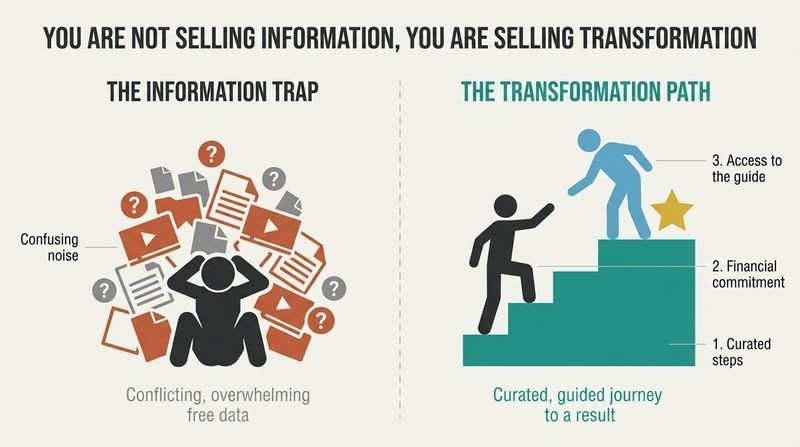
The transformation framing echoes Harvard's Theodore Levitt, who taught that people buying a drill actually want a hole in the wall. It survives scrutiny well: online education thrives despite YouTube because curation, accountability, and access are genuinely scarce. One nuance worth flagging: the accountability claim (paying makes people act) has mixed empirical support. Sunk-cost effects are real but weaker than intuition suggests, and course completion rates industry-wide hover in the single digits even for paid products. The stronger driver is probably curation. In an age of infinite content, the person who saves you 40 hours of sifting is worth paying, regardless of accountability psychology.
Give, sell, overdeliver, receive: value compounds in a loop
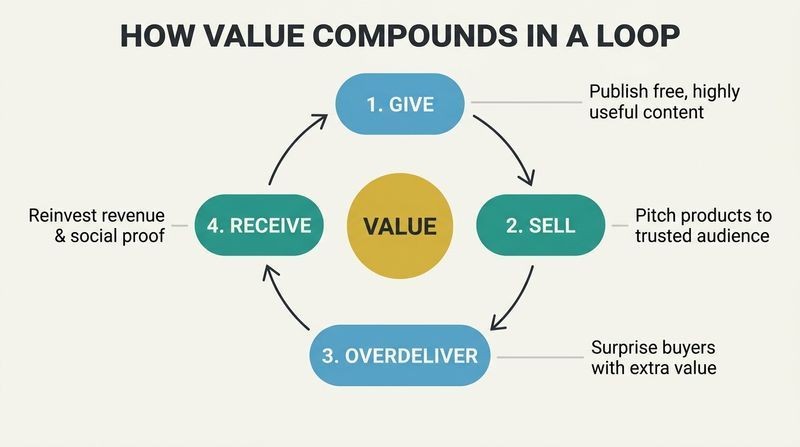
The value circle is Cochrane's core model, drawn like a flywheel on a napkin with VALUE at the center. Four stages spin continuously:
1. Give: publish genuinely useful free content so people taste your value before paying.
2. Sell: having earned trust, pitch products, which now convert far more easily.
3. Overdeliver: surprise buyers with an unexpected bonus, because delight builds loyalty cheaply.
4. Receive: collect money plus testimonials, then reinvest both into more giving.
He pairs this with the Law of Compensation from The Go-Giver: income equals how many people you serve times how well you serve them. A math teacher and movie star both add value, but the star reaches millions. Want more income? Serve more people.
The flywheel logic mirrors Jim Collins's work on how good companies build momentum through consistent pushes rather than single dramatic moves, and Cochrane openly nods to it. The generosity-first ethic also aligns with Adam Grant's research in Give and Take, showing givers can outperform takers over long time horizons, provided they give strategically rather than burning out. The weak point is the Law of Compensation's tidiness: reach and compensation correlate loosely at best. Plenty of people serving millions earn little (viral creators with no product), and plenty serving dozens earn fortunes (elite consultants). Reach matters, but monetization architecture and pricing power matter just as much.
You only need to be one chapter ahead of your students
The most paralyzing objection Cochrane hears is credential-based: who am I to teach this? He cites research suggesting roughly 70% of people experience impostor syndrome, the persistent feeling of being a fraud despite competence, including physicians and executives. His answer: students don't need you to be the world expert, they need you to get them results. Credentials mostly soothe your own ego. What actually establishes credibility is helping people, and your free content lets them test-drive that help before buying. You can only teach those a few steps behind you on the journey, so stop staring up at the gurus ahead and look back at whom you can pull forward. As you grow, your teachable pool grows too.
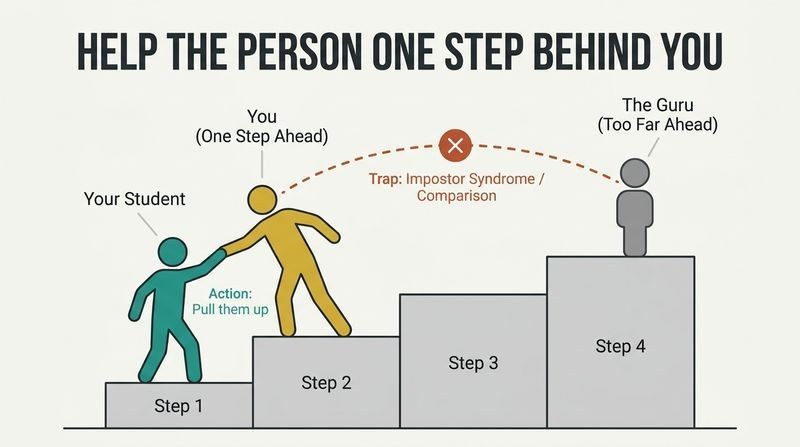
This reframe has real pedagogical backing. The expert blind spot, documented in learning science, shows that deep experts often teach beginners poorly because they've forgotten what confusion feels like. Someone one step ahead remembers the struggle vividly and explains it better. It connects to the protege effect, where teaching material cements your own mastery. The caveat: some domains carry genuine safety, legal, or financial stakes where credentials protect consumers, not just egos. Teaching guitar tone is low-risk; teaching medication protocols or tax strategy is not. Cochrane's advice fits skill and lifestyle niches best, and readers should calibrate to how much harm bad advice could cause.
Passion alone won't pay; validate demand before you build
Cochrane borrows Mike Rowe's line that being passionate about something doesn't mean you won't suck at it, and that following passion blindly ignores whether anyone will pay. His three-part profitability framework filters ideas:
1. Start with what you know, love, and are good at, using four prompts like what comes easy to you and what people ask your help with.
2. Do Customer Research 101: ask real people their biggest frustration and biggest hope in your topic.
3. Do Customer Research 201: study Amazon bestseller titles and 2-to-4-star reviews to spot gaps, plus Google and YouTube auto-suggestions revealing what millions actually search.
He also invokes Scott Adams's talent stack: combine ordinary skills (Adams is a decent artist, writer, and businessman, not the best at any) into something rare.
The demand-validation logic anticipates lean startup methodology, where founders test hypotheses with real customers before building, avoiding the classic trap of falling in love with an unwanted product. Mining Amazon reviews and search auto-complete is essentially free market research that agencies once charged fortunes for. The talent stack deserves emphasis: originality at the intersection beats excellence at a single skill, a point David Epstein's Range reinforces about generalists thriving in complex domains. One tension worth naming: research reveals what people say they want, which often diverges from what they'll actually buy. Stated preference and revealed preference differ. The truest validation remains someone handing over money, which is why a small pre-sale beats a hundred survey responses.
Without an audience nothing sells; build it with generous content
Cochrane's blunt equation: great course plus warm audience equals money, great course plus no audience equals nothing. His preferred audience-building method is content marketing, publishing free, valuable articles, videos, or podcasts your ideal customer wants, rather than paid ads he considers expensive and unnecessary. His five arguments for content: it's free, evergreen (a five-year-old video still draws viewers daily), trust-building, shareable, and magnetically generous. To never run dry, use content buckets: pick four or five subtopics, then brainstorm ten to twelve ideas each, yielding roughly fifty pieces. Two secrets elevate content: be consistent (at least weekly, since algorithms reward freshness) and be bold or polarizing, like Dave Ramsey declaring debt dumb, because safe content is forgettable and repelling wrong-fit people is as valuable as attracting right ones.
The content-over-ads stance is genuinely contrarian in a marketing world addicted to paid acquisition, and Cochrane's point about gurus hiding ad spend is sharp: a launch grossing $30,000 on $20,000 of ads is worse than $15,000 on zero. Content compounds like an owned asset while ads are a rented faucet that stops the moment you stop paying. The polarization advice aligns with research on emotional arousal driving sharing, per Jonah Berger's Contagious. The honest limitation: content marketing's payoff curve is brutally slow and survivorship-biased. For every creator whose video pops after two years, many quit first. Ads buy speed and data that patient content cannot, which is why the two are complements, not enemies.
Social followers are bystanders; email subscribers are warm leads you own
Cochrane's most counterintuitive claim: email beats social media for making money. A like costs nothing and signals passing interest, but handing over an email address is an invitation to be contacted directly. He cites data that email converts around three times better than social and drives vastly more engagement, with 60% of consumers reporting a purchase from an email versus 12.5% considering a social buy button. Beyond conversion, it's about ownership: social platforms are rented land. When Facebook changed its algorithm, his organic reach to 100,000-plus followers collapsed to 13-to-18%, halving his traffic overnight. Email is owned; you reach subscribers regardless of algorithm shifts. This is why every major brand's pop-up begs for your email, not a follow, dangling a discount or guide in exchange.
The rented-versus-owned distinction is the durable insight here, validated repeatedly as creators built empires on Vine, then watched them vanish when it shut down. Owning the direct channel is a hedge against platform risk, a lesson from portfolio theory applied to attention. The conversion statistics, though, deserve caution: they come from marketing vendors like OptinMonster whose business is selling email tools, so directional truth is likely but precise magnitudes are self-interested. There's also generational drift; younger cohorts live in DMs and short video, and email open rates decline as lists age (Cochrane's own lead-decay concept). The wisest reading is not email over social, but owned channels over rented ones, whatever form they take.
Trade a free lead magnet for email addresses, never beg for newsletter signups
Nobody wants to join your newsletter, so don't ask. Offer a lead magnet instead: a free, benefit-driven resource that instantly solves one small problem, available only to those who opt in. It's just content with a gate. Cochrane offers five templates:
1. The multistep guide (six steps to a radio-ready song).
2. The cheat sheet or checklist (quick wins, converts well precisely because it's short).
3. The stacked-benefit how-to (earn $1,000 a month in just 30 minutes a day, pairing two benefits).
4. The ultimate guide (long and authoritative).
5. The multiday challenge (a series of daily emails that doubles as your sales sequence).
Your website should exist to capture emails, built around a clear customer-focused headline, since visitors decide in about three seconds whether to stay.
The lead magnet is applied behavioral economics: reciprocity, Robert Cialdini's principle that receiving a gift creates an urge to give back, here paid in the currency of an email address. The three-second headline rule matches usability research on how brutally fast users judge relevance before bouncing. Cochrane's customer-first headline advice echoes Donald Miller's StoryBrand insight that brands lose when they cast themselves as the hero instead of the guide. One practical tension: the checklist converts best but delivers the least, risking subscribers who grabbed a freebie with no real buying intent. The quality of a lead magnet should mirror the product it leads toward, or the list fills with tire-kickers who inflate vanity metrics.
Build a research-validated online course, not a product in a vacuum
Most courses fail because creators build first and hope buyers appear. Cochrane insists the digital video course is the ideal first product: nearly 100% profit margin, easy to build and update, and once made, it sells hands-off. He demolishes three myths: you don't need a film crew (a smartphone, a $25 clip-on mic, and window light suffice), courses needn't be long (great ones run two hours or less), and you don't need fancy tools. Before filming, validate through informal research (your most popular content, most common questions) and formal surveys. Then craft an irresistible outline using the bookstore strategy: a compelling title and mouthwatering module names, plus Brendon Burchard's list-100-benefits exercise, which forces benefit-driven thinking and exposes whether your product is even good enough.
The 100-benefits exercise is quietly brilliant as a diagnostic. If you can't articulate more than ten benefits, the market signal is that your product lacks depth, a failure worth discovering before launch rather than after. This inverts the engineer's instinct to list features, aligning with decades of marketing evidence that customers buy outcomes, not specifications. The smartphone-quality claim is largely true now; audio, not video, is the actual quality bottleneck, which is why the microphone matters more than the camera. The scope limitation: high-margin, low-friction digital courses have flooded every niche, so validated demand no longer guarantees differentiation. Research tells you people want the topic, but your voice, teaching style, and results must still stand out in a crowded shelf.
Selling means giving; use the PSA formula and offer tiered pricing
The word sell descends from the Old English sellan, to give, which reframes ethical selling as giving people what they genuinely want. Cochrane's three-step PSA sales-copy formula:
1. Person, Problem, Pain: name exactly who this is for and what hurts.
2. Story, Struggle, Solution: share your relatable struggle, then transition with and that's why I created.
3. Ask for the sale: explicitly tell them to buy.
He prices most courses in Tim Ferriss's $50-to-$200 sweet spot. His biggest lever is tiered pricing: offer two or three versions, because it shifts the buyer's question from should I buy to which one. When he added $149 and $349 tiers to a $99 course, over half chose the middle tier, lifting revenue 25% with near-zero extra work.
Tiered pricing exploits well-documented cognitive biases: the compromise effect, where consumers gravitate to the middle option, and anchoring, where a pricey top tier makes the middle feel reasonable. Behavioral economist Dan Ariely famously demonstrated with Economist subscriptions how a decoy option reshapes choice. Cochrane's real-world 25% lift is consistent with this literature. The PSA formula is a compressed cousin of classic copywriting frameworks like Problem-Agitate-Solve, and its insistence on story reflects narrative-transportation research showing stories lower persuasion resistance. The etymological flourish (sell equals give) is charming but rhetorically convenient; selling can serve or exploit, and the same tiered-pricing psychology that helps honest sellers also powers manipulative upsells. The ethics live in the product's actual value, not the technique.
Pitch within the seven-day Golden Window when interest peaks
Automation is Cochrane's favorite payoff: he describes earning roughly $5,000 on days he does no work at all. The mechanism is the automated email funnel, a prewritten five-to-seven-day sequence every new subscriber receives automatically. Days one and two overdeliver pure value; days three through five transition into pitching the course. Why the rush? His Golden Window of Sales: the best time to sell someone is the first seven days after they discover you, while excitement is high, before life distracts them and interest decays. Realistic launch expectations matter too: expect only 0.5-to-1% of your email list to buy. One client made $20,000 on launch but had spent $20,000 producing the course, netting nothing, because she never knew the benchmark.
The Golden Window intuition aligns with decay curves in engagement data: novelty and intent are perishable, and marketers who strike while attention is hot outperform those who wait. It also connects to the mere-exposure and recency effects in memory research. The 0.5-to-1% conversion benchmark is the book's most valuable reality check, inoculating beginners against the delusion that a 10,000-person list means 10,000 buyers. Where nuance helps: rushing the pitch can backfire if trust hasn't formed, and aggressive early selling risks unsubscribes that shrink the asset. The optimal window likely varies by price point and topic; a $47 impulse buy tolerates a fast pitch, while a $2,000 commitment may need a longer trust runway.
Four repeating tasks, the Income Engine, keep the business growing
Once launched, the business isn't finished. Cochrane compares it to a plane: the startup phase builds and takes off, but the pilot can't parachute out; flight requires ongoing work, just less of it. His Income Engine is four tasks to repeat weekly, monthly, and yearly:
1. Create regular content (never stop, since it's the fuel).
2. Grow your email list (new subscribers matter more than total size, given lead decay).
3. Nurture your list (treat subscribers as VIPs with exclusive content, ask their opinions).
4. Build new products (aim for just one new launch per year).
He notes the first three components alone can sustain multiple six figures from a single product; his $99 course earned over $1 million this way. Only one new launch annually builds a full product suite in five years.
The Income Engine is essentially a personal operating system, and its power is in radical simplicity, resisting the entrepreneur's temptation to chase every new tactic. This echoes James Clear's systems-over-goals philosophy: outcomes follow from repeatable processes, not heroic sprints. The lead-decay insight (new subscribers convert better than aging ones) is an underappreciated metric that reframes list-building as replenishment, not accumulation, much like a leaky bucket needing constant inflow. The one-product-per-year cadence is refreshingly humane against hustle culture's more-is-better ethos. The honest caveat: this steady-state model assumes a functioning engine already exists. For someone at zero, the unglamorous truth is that months of unrewarded content creation precede any flywheel momentum, and most quit during that flat stretch.
The only line you control is the starting line, so start now
Cochrane closes with a Chinese proverb: the best time to plant a tree was 20 years ago, the second-best time is now. Fear is what stops people, and drawing on Jon Acuff's Start, he notes fear argues both extremes, telling you either to not chase your dream at all or to do it all at once, when neither is required. Practical guardrails: don't quit your day job until you have six-to-twelve months of savings or the business covers half your bills, commit just three-to-six hours weekly (30 minutes a day), and plan only the next twelve months. Slow growth wins because it's stable. Of ten competitors when he started in music, only three survive, because the fast-built gets destroyed just as fast.
The slow-growth argument finds unlikely support in Chamath Palihapitiya's half-life observation that Cochrane cites: things built fast collapse fast, a pattern visible from crash-diet weight regain to venture-funded startups that scale before finding fit. It connects to Nassim Taleb's antifragility, where gradual, stress-tested systems endure while fragile fast-growth ones shatter. The perfectionism-as-procrastination diagnosis is psychologically sound; research links perfectionism to task avoidance and paralysis. The one blind spot in an otherwise grounded close: the good enough mantra, liberating for the paralyzed, can excuse genuinely shoddy work in saturated markets where the bar keeps rising. Starting beats waiting, but starting is necessary, not sufficient. The finish still demands the years he honestly warns about.
Analysis
Cochrane's book is a framework-driven business how-to aimed at reluctant, non-entrepreneurial knowledge workers, roughly 56,000 words organized as a linear six-step build. Its structural strength is also its rhetorical trick: the promise of passive income is delivered through relentlessly active, sequential labor. The book's honesty about this (foundations before payoff, 0.5% conversion benchmarks, years of unrewarded content) distinguishes it from the get-rich-quick genre it explicitly disavows.
The intellectual core is a single reframe applied repeatedly: sell transformation, not information; give before you take; serve more people to earn more. This generosity ethic, borrowed from The Go-Giver and grounded in the author's stated Christian faith, gives the book coherence but also its main vulnerability. The value circle, Law of Compensation, and PSA formula are less discoveries than well-packaged syntheses of existing marketing wisdom (Jeff Walker's launches, Ramit Sethi's copy, Tim Ferriss's pricing, Brendon Burchard's benefits). Cochrane's contribution is integration and accessibility, not novelty.
Three claims deserve scrutiny. First, the email-beats-social data leans on vendor sources with commercial interest; the durable truth is owned-versus-rented channels, not email specifically. Second, the anti-paid-ads stance, while a bracing corrective to ad-spend obsession, understates that content marketing is survivorship-biased and painfully slow, making ads a legitimate accelerant rather than a moral failing. Third, the accountability-through-payment argument overstates thin behavioral evidence; curation and access are the sturdier reasons free content doesn't cannibalize paid.
The book's most transferable assets are its reality checks: the 0.5-to-1% launch benchmark, the lead-decay concept, tiered pricing's compromise effect, and the talent stack. These arm beginners against delusion. What it cannot solve is saturation. The very repeatability that makes the model teachable has flooded every niche, so the author's own advice (bring your unique voice, be polarizing, stack talents) quietly bears the entire burden of differentiation. Sound execution manual; the hard part remains standing out.
Review Summary
How to Get Paid for What You Know receives mostly positive reviews, praised for its practical advice on monetizing skills through online courses and content creation. Readers appreciate the step-by-step guidance, finding it helpful for beginners and a good refresher for experienced entrepreneurs. Some criticize it as too basic or repetitive of existing information. The book is commended for its easy-to-follow structure, emphasis on ethical business practices, and encouragement to readers. While a few reviewers note the author's promotion of specific tools, most find the overall content valuable for starting and growing an online business.
People Also Read




FAQ
What's "How to Get Paid for What You Know" about?
- Overview: "How to Get Paid for What You Know" by Graham Cochrane is a guide to turning your knowledge, passion, and experience into an online income stream. It focuses on creating a business that allows for both financial success and personal fulfillment.
- Target Audience: The book is aimed at individuals looking to transition from traditional jobs to self-employment by leveraging their expertise in a digital format.
- Core Concept: It introduces the concept of knowledge commerce, where individuals can monetize their skills and knowledge through online courses, memberships, and other digital products.
- Outcome: By following the book's guidance, readers can create a sustainable online business that provides both income and flexibility.
Why should I read "How to Get Paid for What You Know"?
- Practical Guidance: The book offers a step-by-step plan for creating an online business, making it accessible even for those without prior experience in entrepreneurship.
- Empowerment: It empowers readers to believe in the value of their knowledge and skills, encouraging them to take action and start their own ventures.
- Proven Strategies: Graham Cochrane shares his personal journey from financial struggle to success, providing real-world examples and strategies that have worked for him.
- Flexibility and Freedom: The book emphasizes the potential for a balanced life, where one can achieve financial success without sacrificing personal time and well-being.
What are the key takeaways of "How to Get Paid for What You Know"?
- Value Circle: The book introduces the concept of the value circle, emphasizing the importance of giving value to receive value in return.
- Audience Building: Building an audience is crucial before creating and selling products. The book provides strategies for growing an audience through content marketing.
- Product Creation: It guides readers on how to create digital products like online courses and membership sites that align with their audience's needs.
- Automation: The book highlights the importance of automating business processes to create a passive income stream, allowing for more freedom and flexibility.
How does Graham Cochrane suggest building an audience in "How to Get Paid for What You Know"?
- Content Marketing: Cochrane emphasizes the use of content marketing to attract and build an audience. This involves creating valuable, free content that resonates with your target market.
- Consistency: Regularly publishing content is key to maintaining audience engagement and growing your reach over time.
- Engagement: Engaging with your audience through comments, social media, and email helps build trust and credibility.
- Lead Magnets: Offering lead magnets, such as free guides or checklists, can help convert audience members into email subscribers, which are more valuable for business growth.
What is the "Value Circle" in "How to Get Paid for What You Know"?
- Concept: The value circle is a business model that focuses on giving immense value at every touchpoint of your business to receive value in return.
- Four Elements: It consists of four elements: Give, Sell, Overdeliver, and Receive, all centered around the concept of value.
- Cycle of Awesomeness: Each element affects the others in a cyclical fashion, creating a continuous loop of giving and receiving value.
- Business Success: By focusing on adding value before, during, and after a sale, businesses can create loyal customers and sustainable success.
How does Graham Cochrane recommend pricing online courses in "How to Get Paid for What You Know"?
- Pricing Range: Cochrane suggests a price range of $50-$200 for most online courses, as this range provides the most profit with the least customer service hassle.
- Course Levels: He categorizes courses into mini courses ($47-$97), flagship courses ($97-$497), and premium courses ($497-$1,997), each with different levels of depth and content.
- Value Justification: The book advises pricing high and then justifying the price by clearly communicating the value and benefits of the course.
- Tiered Pricing: Offering multiple pricing tiers can increase revenue by allowing customers to choose the level of value they want to purchase.
What are the best quotes from "How to Get Paid for What You Know" and what do they mean?
- "You are sitting on a gold mine." This quote emphasizes the potential value of one's existing knowledge and skills, encouraging readers to recognize and monetize their expertise.
- "The more you give, the more you earn." This highlights the value circle concept, where generosity and value creation lead to business success and financial gain.
- "Your business should serve your life, not the other way around." This quote underscores the book's focus on creating a business that provides both financial success and personal freedom.
- "If you build it, they will (not) come." This challenges the assumption that simply creating a product will attract customers, emphasizing the importance of audience building and marketing.
How does "How to Get Paid for What You Know" address the fear of starting an online business?
- Acknowledging Fear: The book acknowledges that fear is a common barrier to starting a business and encourages readers to recognize and confront it.
- Starting Small: Cochrane advises starting small, with just 30 minutes a day, to gradually build confidence and momentum.
- Focus on Action: The emphasis is on taking action and starting, rather than waiting for the perfect moment or feeling 100% ready.
- Empowerment: By sharing his own journey and struggles, Cochrane empowers readers to believe in their potential and take the first step.
What role does social media play in "How to Get Paid for What You Know"?
- Connecting Tool: Social media is viewed as a tool for connecting with the audience, not primarily for selling products.
- Engagement: It provides a platform for engaging with the audience, gathering feedback, and building relationships.
- Lead Generation: Social media can be used to drive traffic to lead magnets, helping to grow the email list.
- Selective Use: Cochrane advises focusing on one or two platforms where the target audience is most active, rather than trying to be everywhere.
How does "How to Get Paid for What You Know" suggest automating your business?
- Email Funnels: The book emphasizes the use of automated email funnels to sell products to new subscribers, capitalizing on their initial interest.
- Content Overdelivery: Providing valuable content in the email sequence builds trust and primes subscribers for the product offer.
- Golden Window of Sales: The first seven days after a subscriber joins the list is the optimal time to pitch a product.
- Passive Income: Automation allows for the creation of a passive income stream, freeing up time and providing financial stability.
What is the "Income Engine" in "How to Get Paid for What You Know"?
- Four Components: The Income Engine consists of four core activities: creating regular content, growing the email list, nurturing the list, and building new products.
- Simplicity: It provides a simple, repeatable framework for maintaining and growing an online business.
- Focus on Essentials: By focusing on these four activities, business owners can drive growth and revenue without getting distracted by unnecessary tasks.
- Long-Term Success: The Income Engine ensures that the business remains sustainable and profitable over the long term.
What are some common misconceptions addressed in "How to Get Paid for What You Know"?
- Need for Perfection: The book dispels the myth that everything must be perfect before launching, emphasizing the importance of starting and iterating.
- Overemphasis on Social Media: It challenges the belief that social media is the most important tool for business growth, highlighting the value of email marketing.
- Complexity of Online Courses: Cochrane addresses misconceptions about the difficulty of creating online courses, showing that they can be simple and cost-effective to produce.
- Quick Success: The book counters the idea that success will come quickly, advocating for slow, steady growth and consistent effort.
Download PDF
Download EPUB
.epub digital book format is ideal for reading ebooks on phones, tablets, and e-readers.








































