
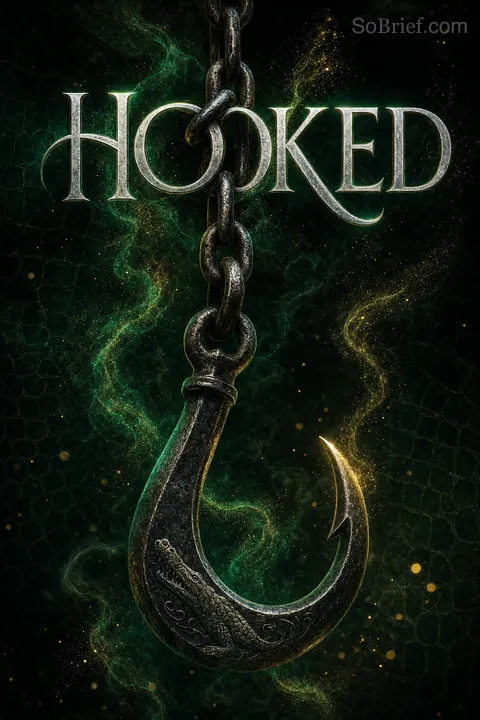


Plot Summary
Prologue
In a blood-soaked office, a young man named James Barrie1 kneels over the uncle14 he has just executed, hooking a blade into the man's throat to make death slow enough to savor. He feels no fire, no triumph, only anticlimax. On the phone, his mentor Ru4 congratulates him and invites him to celebrate.
Before leaving, James1 finds his uncle's14 gold pocket watch still ticking in the corpse's pocket. The sound splits something inside him. He smashes it under his heel until silence returns. Killing the man who abused him for years14 brings no peace. It only sharpens his hunger for the true architect of his ruin, a man who once flew away3 and whom James1 intends to ground for good.
The opening announces its thesis: this is a villain's origin, not a hero's. McIntire inverts fairy tale morality by rendering murder as bureaucratic disappointment rather than catharsis, establishing James as a man hollowed by trauma into pure instrumentality. The ticking watch operates as a Proustian trigger in reverse, collapsing present power into remembered helplessness. His compulsion to silence it reveals the wound beneath the monster. Crucially, the prologue defers its real antagonist, promising a larger reckoning and reframing the uncle's death as mere prelude. The Peter Pan scaffolding (the man who flew away) is seeded early, teaching readers to read the coming romance as a fractured retelling.
A Dare at the Jolly Roger
Wendy Michaels,2 twenty and dutiful, has trailed her billionaire father Peter3 to a cold Massachusetts town, working a coffee shop counter and mothering her withdrawn teenage brother Jon.6
Her coworker Angie12 and the prickly Maria13 goad her toward a club called the Jolly Roger, mocking her innocence until wounded pride pushes her to prove herself. Borrowed fake ID in hand, she joins the girls chasing sightings of a mythic figure the regulars call Hook.1
Turned away at the door, she nearly flees in a cab, humiliated, before a blond man whispers to the bouncer and ushers them into the VIP room. Wendy2 feels absurdly out of place sipping expensive champagne, yet more alive than she has felt in years, unaware she has stepped into a predator's territory.
Wendy's inciting choice is powered by a lifetime of being told to stay small. Her rebellion is modest by design, which makes it legible as characterization: the good girl whose obedience has curdled into loneliness. McIntire frames peer cruelty (Maria's jabs about childishness) as the lever that overrides caution, showing how belonging-hunger drives self-endangerment. The bar functions as a threshold space between Wendy's daylight propriety and the underworld's gravity. The mythologizing of Hook before we meet him builds him as legend, letting the reader anticipate the collision. Her father's omnipresent control is established as the pressure she is quietly straining against, seeding the entire arc.
The Enemy's Daughter Walks In
Upstairs, James,1 the true power behind Ru's4 operation, learns that a new partner wants to distribute their drug (nicknamed pixie) across the globe: Peter Michaels,3 owner of NevAirLand. The name freezes James's1 blood. Peter3 is the man he has hunted since childhood, the reason his family is ash. When a scuffle erupts at the door over fake IDs, James1 glances at the cameras and fixates on a nervous brunette in blue.
Recognizing Wendy Michaels,2 the man's cherished shadow, he orders the girls admitted. He does not begrudge children their fathers' sins, but the universe has served her up like a gift. He resolves to seduce, defile, and return her to Peter3 as a ruined offering, a pawn in a symphony of revenge he has composed for fifteen years.
This chapter fuses coincidence with predation, converting romance's meet-cute into a hunter's opportunity. James's interiority exposes the transactional logic of trauma: people become tools, intimacy becomes tactics. The dramatic irony is now fully loaded, since readers know his design while Wendy knows nothing. McIntire complicates the villainy by noting his flicker of genuine attraction, the first crack in a self he describes as an empty shell. The Peter Pan lattice deepens: pixie dust, Lost Boys, a man who steals youth. The scene also establishes the power asymmetry that will haunt the love story, because every tender gesture James later offers is shadowed by this origin of pure instrumentalization.
Coffee, Charm, and a Yacht
James1 begins his slow capture disguised as pursuit. When an obnoxious patron berates Wendy2 at the coffee shop, James1 dismantles the man with quiet menace and murmured threats, transforming her shame into feeling seen. He asks for a date and refuses her refusals with relentless charm.
She finally relents, and he brings her not to a public restaurant but to his sailing yacht, the Tiger Lily, where his loyal crewman Smee5 has staged a candlelit dinner. Wendy,2 terrified of being wanted only for her surname, is intoxicated that James1 claims never to have heard of Peter Michaels.3 She climbs into his lap, insisting she wants to know the man, not his possessions. He silences her question the only way he knows how, with a kiss.
The seduction weaponizes Wendy's deepest deprivation: to be valued as herself, not as an heiress. James's lie about not knowing her father is the load-bearing deception of their intimacy, a poison hidden in sugar. McIntire stages the coffee shop rescue as a dark parody of chivalry, revealing how easily protection and possession blur for a controlling man. Wendy reads danger as attentiveness, an emotionally precise portrait of how neglect primes someone for a charismatic captor. The yacht, mobile and escape-ready, literalizes James's rootlessness. Every gallantry is authentic in feeling yet strategic in function, forcing the reader to hold both truths at once, which is the novel's central discomfort.
Surrendering to the Mask
Their attraction accelerates into consuming intimacy. On the yacht's deck, James1 discovers Wendy's2 particular kink, that she can only find release when her breath is taken, and he indulges it, gripping her throat until she shatters, then cradling her with praise.
Later she gives him her virginity, trusting a man who quietly warns her that she should not. She interprets his possessiveness and filthy tenderness as proof she has finally found someone who treats her as a woman rather than a fragile doll.
James,1 meanwhile, notes with alarm that she quiets his lifelong nightmares and grants him dreamless sleep. He refuses to let her unbutton his shirt, hiding the scars that map his past. Both are falling, one blind to the trap, the other unnerved that the trap is catching him too.
McIntire builds an eroticism of control that doubles as psychological portraiture: Wendy's breath-play is a literalized wish to relinquish the vigilance her father's world demands, while James's need to dominate is a survivor's compensation for stolen agency. Their compatibility is disturbing precisely because it is real. The withheld scars foreshadow a shared history neither yet understands. The dreamless sleep signals that Wendy is becoming a genuine anchor, destabilizing James's revenge architecture. The chapter interrogates consent and trust inside deception, asking whether feelings built on a false premise are false themselves. It is the romance's high tide before the structural betrayals begin to surface.
Two Fathers at the Cave
Ru4 insists James1 accompany him to meet Peter3 at Cannibal's Cave, a remote abandoned cavern. James1 recalls the buried truth: as a boy he flew home from America on a NevAirLand jet that crashed into trees, killing his parents and leaving only him, marked by a jagged scar.
His father Arthur had gone ghost-white reading a note Peter3 handed him minutes before boarding. Now James1 steps from the shadows to face his enemy,3 introducing himself only as Hook while gripping his blade to keep from killing Peter3 on sight.
Peter,3 cool and calculating, haggles over drug distribution percentages, then leaves early, claiming he promised his daughter dinner. The men part with veiled promises, each recognizing an adversary, neither yet naming the war between them.
The confrontation delivers backstory as detonation, reframing the entire drug-partnership plot as a collision of two men bound by an old murder. McIntire withholds specifics of the crash, sustaining mystery while confirming Peter's guilt in James's cosmology. The scene's restraint (James swallowing homicidal rage to preserve his elaborate revenge) demonstrates his defining trait: control as both armor and pathology. Peter's exit toward a family dinner he never actually honors exposes his hypocrisy, the public devotion contradicted by private neglect. The cave, later the site of the climax, is planted here with quiet inevitability, a geography of reckoning introduced before it becomes a slaughterhouse.
The Island School Goodbye
Peter3 overrides his own promise and ships sixteen-year-old Jon6 to Rockford Prep, a harsh boarding school on an island, telling the boy by phone rather than in person and leaving Wendy2 to grieve the loss of the sibling she raised. James,1 startling even himself, offers to drive them to the ferry.
He takes to Jon6 instantly, recognizing a wounded, defensive kid much like his younger self, and privately intimidates the headmaster into protecting him. He gives Jon6 his phone number and murmurs that circumstances are temporary, that worth is measured by how one rises from the ashes. Wendy2 watches a man give her brother6 the fatherly attention Peter3 never has, and her heart tilts further toward him even as her faith in her father crumbles.
This chapter deepens the domestic tragedy underpinning the crime plot: Peter's serial abandonment is the true villainy Wendy can feel, while James's cruelty remains hidden. The unexplained kinship James feels for Jon is a planted clue, its payoff withheld for the climax. McIntire uses caretaking as courtship, showing that James's tenderness toward Jon is unfeigned, which makes his coming betrayal of Wendy more agonizing. Rockford Prep, an island reachable only by boat, evokes Neverland's exile while grounding it in institutional dread. Wendy's mounting disillusionment with Peter is the emotional engine being wound tight, preparing her for the shattering revelations that recontextualize her whole family.
Ru Nailed to a Tree
Racing between duties, James1 arrives late to the cave and discovers Ru,4 the man who saved him from his uncle14 and called him a son, nailed to a tree, disemboweled, strung up for animals. He pulls the spikes from the body himself, then sets it aflame with the ruby lighter he once gifted Ru,4 whispering a farewell.
Grief calcifies into rage. He remembers the baker's report of a woman collecting protection money in a new boss's name and recalls that Wendy2 was present at the meeting where Peter3 promised repercussions.
Convinced she distracted him deliberately so her father could strike, James1 decides she was complicit all along. The woman who quieted his nightmares now becomes their center. He resolves to punish both father and daughter without mercy.
The murder is the novel's structural hinge, converting slow-burn romance into captivity thriller. Ru's mutilation deliberately mirrors James's own signature savagery, a poetic suggestion that violence returns to its source. McIntire routes grief through paranoia: James, conditioned to expect betrayal, projects guilt onto the one person who has disarmed him, protecting himself from vulnerability by weaponizing suspicion. The lighter's inscription (straight on til morning) becomes a funeral rite, binding mentorship, loss, and the Peter Pan motif of never giving up. This false accusation is the tragic engine of the middle act, an error the reader recognizes even as James commits fully to it, guaranteeing that his revenge will wound the innocent.
Chained in the Dark
Alone and forgotten on her birthday, snubbed by father and boyfriend alike, Wendy2 resolves to leave town. Instead James1 materializes in her bedroom mirror, presses a hooked blade to her cheek, and drugs her unconscious. She wakes shackled to a stone wall in the Jolly Roger's basement, guarded by the once-friendly bartender Curly,9 whom she spits at in defiance.
James, now fully the villain called Hook,1 tells her that her father took something irreplaceable and that she helped. He unlocks her chains only to keep her useful, threatening to string her up if she disobeys, and revealing he knew her identity from the first night. Betrayal floods her: the tender man she loved1 was a mask stretched over a monster hunting her family.
The romance's romantic-hero fantasy collapses into its horror underside, honoring the author's promise of an unredeemed villain. Wendy's captivity externalizes the theme running through her whole life, that powerful men cage her under the banner of care. Her spitting defiance marks the birth of a spine that neglect never allowed her. McIntire stages the mirror reveal as a splitting of self, James and Hook confronting Wendy simultaneously, dramatizing the doubled identity at the book's core. The drug, the blade, the collar to come: intimacy's tools turned to imprisonment. This is the darkest node of the captor-captive dynamic, testing how far the narrative will follow a heroine who still cannot fully stop wanting him.
The Choker at the Gala
James1 fastens a diamond choker (secretly a GPS tracker) around Wendy's2 neck and parades her at a charity gala where Peter3 is guest of honor, using her to taunt his enemy. He coerces her by threatening to fetch Jon6 from school. But when Peter3 appears, his confusion is genuine: he asks why she is not home at the mansion, revealing he never even knew she was missing.
Wendy,2 humiliated and furious, discovers her father assumed she was throwing a tantrum. Her ignorance of Peter's3 schemes becomes obvious to James,1 who realizes with a jolt that she never conspired against him at all. The pawn he condemned is innocent, yet he finds he no longer wants to release her, only to keep her.
The gala is a theater of appearances where the truth leaks through performance. Peter's careless question detonates two illusions at once: Wendy's last hope in her father and James's justification for her captivity. McIntire lets exculpation arrive not through pleading but through a father's indifference, a bitterly efficient irony. James's shift from vengeance to possession is morally sideways rather than upward, keeping him a villain while opening a sliver of feeling. The tracker collar literalizes ownership dressed as adornment. Wendy's public defiance of Tina and Peter shows her captivity has paradoxically freed her voice, the same liberation her captor keeps accidentally nurturing, which complicates any clean reading of victimhood.
A Father's Silence
On the gala terrace, Peter3 warns Wendy2 that Hook1 is a psychopath using her, and admits he never came looking. When James1 follows and draws his blade, Wendy2 throws herself between the men, begging him to spare her father.3 James1 asks Peter3 for his own plea in return, offering to spill her blood to cover Peter's3 sins. Peter3 says nothing.
The silence is total and annihilating. James1 pulls Wendy2 away, telling her to memorize the moment she learned her father3 would let her die to save himself. Later, riding home, they find the Jolly Roger burned to rubble. In the wreckage Wendy2 chooses, against all sense, to open her broken heart, telling James1 she sees the grief he hides.
This is Wendy's true heartbreak, eclipsing even her kidnapping. McIntire makes the deepest violence emotional rather than physical: a father's refusal to bargain for his child. The scene inverts the captor-rescuer binary, since the criminal has shown her more regard than her blood. Wendy's acorn confession afterward (memories of a father who once left love tokens) mourns not the man but the myth. Her decision to comfort her captor signals the trauma-bond crystallizing into something the novel insists on calling love. The burning JR escalates the gang war while symbolically incinerating James's origins, clearing ground for a self he does not yet know how to inhabit.
Croc's Hidden Hand
James1 strikes back, having his men torch every NevAirLand plane, and slowly admits he no longer wants Wendy2 as a weapon but as his own. After she flees the yacht for fresh air and he panics at her absence, he recognizes he has come to care, even love. He finally lets her see his scars and confesses his origin: the plane that killed his family was Peter's,3 and Peter3 murdered his father.
Wendy,2 learning that James1 secretly phones Jon6 daily even while playing tyrant, softens completely and admits she loves him. Meanwhile brutal interrogations surface a terrifying pattern: low-level dealers bear a tattoo of a crocodile wrapped around a watch, marking loyalty to a mysterious rival named Croc,5 a name pulled straight from James's1 nightmares.
The middle-to-late act performs a double movement: emotional thaw and mystery escalation. James's love is real yet never sanitized, coexisting with rat-torture and casual murder, which is precisely the author's refusal of redemption. Wendy's forgiveness, cued by the discovery of his covert care for Jon, dramatizes how the neglected will rationalize devotion when shown even coded tenderness. The Croc tattoo is a masterstroke of dread, resurrecting the dead uncle's iconography and hinting that the war is more intimate than a corporate rivalry. McIntire braids romance and revenge so tightly that intimacy and investigation advance in the same breath, priming the reader for a betrayal from inside the closest circle.
The Trap in the Mansion
A phone call changes everything. Jon6 tells Wendy2 that James1 has been calling him daily and that their father is coming to collect him, wanting to reveal something. Torn between loyalty and love, Wendy2 drives to the mansion despite knowing James1 would forbid it. There she finds Tina, Peter's assistant,7 glassy-eyed and high on pixie, who confesses her jealousy of Wendy's2 place in Peter's3 world.
Tina7 slaps her, then smashes a glass vase over her head until everything goes black. Meanwhile James1 extracts the truth from the waitress Moira,8 whose crocodile tattoo betrays her: she has been the traitor feeding the rival all along, and she knows where Wendy2 has been taken. The GPS choker points to Cannibal's Cave, the very ground where Ru4 died.
McIntire converges her plot threads with thriller precision, using family bait (Jon) to override Wendy's caution one final time, a callback to the peer-pressure that opened the book. Tina's addiction and envy expose the collateral rot around Peter's empire, humanizing even a minor antagonist as a product of neglect and craving. The choker James imposed as a possessive tether becomes, ironically, the instrument of rescue, a rare narrative reward for controlling behavior that the text does not fully critique. Returning the action to Cannibal's Cave closes a geographic loop, promising that the site of James's greatest loss will host his final reckoning, where every hidden bloodline is about to surface.
Blood and Buried Kin
At the cave James1 finds Wendy2 bound and bloodied, then absorbs a cascade of betrayals. His crewman Smee steps forward as the mastermind Croc,5 revealing he is James's1 cousin, the son of the murdered uncle,14 who infiltrated James's1 life to destroy it. Starkey,10 a trusted man, holds a gun to Wendy.2 Smee5 tortures James1 with a ticking watch and stabs him.
Peter3 shoots Smee5 and Starkey10 dead, then delivers the final blow: Jon6 is James's1 half-brother, the child of Wendy's2 mother and James's1 father Arthur, and Wendy's2 mother did not die in a car crash. As Peter3 prepares to execute James,1 Wendy2 shoots Tina,7 lowers the gun on James's1 plea, then turns and kills her own father3 to save the man she loves.1
The climax detonates every planted charge at once: the uncle's tattoo, James's kinship with Jon, the withheld crash, the false backstory of Wendy's mother. McIntire mirrors the two men (Smee wanting from James exactly what James wanted from Peter) to argue that vengeance is a self-replicating disease. Smee is James's dark twin, the road not taken. Wendy's patricide is the novel's moral event horizon: the once-obedient shadow authors her own damnation to choose love over blood. It is horrifying and, within the book's amoral logic, triumphant. The heroine completes her transformation from caged innocent to willing partner in darkness, sealing a romance that never pretends to be clean.
Epilogue
Two years later, aboard the Tiger Lily he once used as a hunting blind, James1 watches his pregnant wife2 laugh with her brother Jon6 while their toddler son, named Ru,4 dances on the sundeck. Wendy2 was already carrying their first child when she buried her father.3 Jon,6 freed from boarding school and now living with them, is starting college to design planes.
James1 bought Wendy2 back the coffee shop that fired her, where she reconciled with Angie12 and even Maria,13 who softened after dating Curly.9 The man who hated the sea now stands grateful in its spray, marveling that a woman's stubborn, forgiving love taught a ruined heart to beat for something beyond revenge, straight on til morning.
The coda insists on a happy ending for characters steeped in murder, the genre's promise honored without moral laundering. Naming the child Ru transmutes grief into legacy, closing the mentor's arc through inheritance. McIntire domesticates the Peter Pan iconography (the yacht, the sea, the refrain) into a chosen family assembled from wreckage, arguing that kinship is built rather than born, a direct answer to the biological betrayals of the climax. Jon's ambition to build the very planes that once destroyed James's family reframes trauma as something the next generation can repair. The peace is deliberately uneasy: an empire still runs beneath the idyll, and love, the book suggests, can redeem feeling without redeeming deeds.
Analysis
Hooked reframes Peter Pan as a study in how trauma manufactures monsters and how neglect manufactures the people who love them. McIntire refuses the redemption arc her genre often demands: James1 remains a torturer and killer to the final page, and the book's honesty lies in insisting that love can transform feeling without absolving deeds. The novel's most radical move is emotional relocation. It positions a lawful father, Peter,3 as the deeper villain, and a criminal captor1 as the truer caretaker, forcing readers to sit inside Wendy's2 compromised logic rather than judge it from outside. Her arc dramatizes the psychology of the trauma bond with uncomfortable precision. A young woman conditioned to shrink, to absorb cruelty, to equate control with care, becomes uniquely vulnerable to a man whose possessiveness masquerades as the recognition she has always been denied. That the same captivity awakens her voice is the book's central paradox and its riskiest suggestion. The doubling of James1 and Smee5 articulates the thesis cleanly: vengeance is self-replicating, and every avenger is someone else's origin story. The ticking watch, transmitted abuse rendered audible, and the crocodile insignia inherited from a dead abuser,14 argue that violence is a legacy passed hand to hand until someone chooses, or refuses, to break the chain. McIntire's fractured fairy tale converts whimsy into dread (pixie dust as narcotic, Lost Boys as syndicate, Neverland as an island reform school) while retaining the source's ache for chosen family. The ending's chosen kin, assembled from wreckage and named for the lost, offers the only mercy the book allows: not that the damaged become good, but that they might build tenderness atop ruin, straight on til morning.
Review Summary
Hooked received mixed reviews, with readers divided on its dark romance retelling of Peter Pan. Some praised the chemistry and spicy scenes, while others criticized the underdeveloped characters and rushed plot. Many found the violence and explicit content problematic. Readers appreciated the Peter Pan references but were split on the contemporary setting. Some enjoyed the villain-centric narrative, while others felt it lacked depth. The book's polarizing nature sparked intense reactions, with readers either loving or hating the unconventional take on the classic tale.
People Also Read

Characters
James (Hook) Barrie
Vengeful crime bossOrphaned as a boy when his family died and shipped to an abusive uncle14 in America, James rebuilt himself into Hook, the feared power behind a Massachusetts drug empire. Impeccably suited, British-accented, and surgically calm, he wields a hooked blade and an obsession with control forged from years of helplessness. He experiences almost no emotion, describing himself as an empty shell with a single purpose: destroying the man he blames for everything3. A ticking watch can shatter his composure, exposing the traumatized child beneath the monster. Psychologically he is a study in dissociation and instrumental thinking, treating people as tools until an unexpected attachment threatens the vengeance that has organized his entire existence. He loves fiercely once he loves, but never gently and never safely.
Wendy Michaels
Sheltered heiressThe twenty-year-old daughter of an airline billionaire3, Wendy has spent her life as her father's3 little shadow, mothering her brother Jon6 and swallowing every insult from friends and family to keep the peace. Kind, dutiful, and starved for genuine recognition, she works a coffee shop job just to feel she has earned something herself. Beneath her softness runs a suppressed hunger to be seen as a woman rather than a fragile doll, a hunger that makes her dangerously responsive to attention that treats her as an equal. Over the story she sheds inherited obedience and discovers a voice, a temper, and a capacity for choices that terrify her. Her arc traces how neglect can prime a good person to love someone monstrous, and to change herself utterly in the process.
Peter Michaels
Billionaire airline mogulFounder of the airline NevAirLand and a serial adventurer, Peter is celebrated publicly as a devoted father while privately abandoning his children for the next venture. Charming, calculating, and far more dangerous than his golden reputation suggests, he expands into criminal enterprise as if it were merely another market. He calls Wendy2 his little shadow yet cannot be troubled to notice her absence. His controlling love masks a ruthless self-interest, and secrets buried in his past make him the axis around which the novel's revenge turns.
Ru (Roofus)
Crime boss mentorA red-haired Boston crime lord with a cigar habit and a collector's love of fine lighters, Ru discovered James1 stalking him as a boy and took him in, teaching him the streets and the trade. He is the only person James1 trusts, a rough surrogate father whose fondness runs beneath a gruff, temperamental surface. Growing reckless with age, he trusts too easily and refuses to admit his protege1 has surpassed him.
Smee
Loyal yacht crewmanJames's1 live-in first mate aboard the Tiger Lily, rescued years ago from homelessness beside the bar. Boyish, red-beanied, and eager to please, Smee maintains the yacht and quietly witnesses James's1 private life while being kept deliberately at arm's length from the darkest business. His warmth toward Wendy2 and his easy familiarity with his boss1 hide depths that James, ever guarded, never bothers to examine.
Jon (Jonathan)
Wendy's teenage brotherWendy's2 sixteen-year-old brother, dark-haired and bespectacled, bullied at school and happiest building model airplanes in solitude. Guarded and prickly, he masks hurt with sarcasm but remains fiercely loyal to the sister who raised him2. Neglected by their father3 in ways even Wendy2 was not, he carries an air of not quite belonging that makes his defensiveness sympathetic and his devotion touching.
Tina Belle
Peter's jealous assistantPeter's3 petite blonde right-hand woman, spritely and outwardly cheerful but consumed by envy of Wendy's2 place in Peter's3 affections. She enjoys untapped access to the man everyone else in the family begs for scraps from3, and she guards that proximity with quiet malice. Her loyalty to Peter3 shades into something more compromised and volatile as the story darkens.
Moira
Alluring cocktail waitressA raven-haired waitress at the Jolly Roger whom James1 occasionally uses for release but never affection. Possessive and catty, she regards herself as having a claim on him and treats Wendy2 with sneering hostility. Beneath the jealousy, she nurses ambitions and resentments that make her a wild card in the operation's shifting loyalties.
Curly
Bartender enforcerA dark-skinned bartender at the Jolly Roger who is initially warm toward Wendy2, defending her against Moira8, but proves capable of cold obedience when the operation demands it. His loyalty to the organization runs deep.
Starkey
Nervous young recruitA jittery, boyish member of James's1 crew who works the door and runs errands, perpetually anxious in his terrifying boss's1 presence. His eagerness to prove himself and his fear of James1 make his reliability an open question.
The Twins
Identical enforcersTwo identical brothers James1 recruited as teenage panhandlers, so alike he stopped using their names. Silent, efficient, and unwaveringly loyal, they handle the operation's dirty work and interrogations at his command.
Angie
Wendy's coffee-shop friendWendy's2 easygoing coworker who drags her out to the Jolly Roger and pushes her toward independence. Friendly and blunt, she offers Wendy2 a first taste of ordinary friendship outside her father's3 shadow.
Maria
Catty club regularA sharp-tongued member of Angie's12 circle obsessed with glimpsing the mysterious Hook1. Her belittling jabs at Wendy's2 innocence goad her into the fateful night at the bar.
The Uncle (Croc)
Abuser from the pastJames's1 late uncle and guardian, a politician who abused him nightly and burned his few keepsakes. His crocodile boots and ticking pocket watch became the soundtrack of James's1 trauma, and his shadow reaches far beyond the grave.
Plot Devices
The Ticking Watch
Trauma trigger and motifA ticking pocket watch is the sensory key to James's1 abuse, once carried by his uncle14 whose crocodile boots and clockwork ticks announced nightly terror. Whenever James1 hears that sound, his surgical composure fractures and he plunges into flashbacks and uncontrollable rage, a reaction that repeatedly overrides his prized self-control. McIntire deploys it from the prologue, where he smashes the dead uncle's14 watch, through interrogations where a victim's loud wristwatch provokes savagery, to the climax where it is wielded against him deliberately as psychological torture. The device externalizes post-traumatic memory as a literal sound, making his inner wound audible. It also encodes the Peter Pan crocodile-clock imagery, binding the retelling's whimsy to genuine horror.
Pixie Dust
Criminal enterprise engineThe organization's signature drug, nicknamed pixie or pixie dust, is the commodity around which the entire plot turns. Peter's3 proposal to distribute it through his global airline is the pretext that brings enemy1 and mentor4 to the negotiating table, and its disappearing shipments signal an internal rebellion long before the traitor is named. It fuels addiction, greed, and betrayal across the underworld, from low-level pushers to Peter's3 own circle. As a naming device it grounds the Peter Pan retelling in gritty realism, transforming fairy magic into narcotics. Every escalation of the gang war, and several confessions extracted under torture, ultimately trace back to who controls the pixie and who is skimming or stealing it.
The Diamond Choker
Ownership tether and trackerJames1 clasps a diamond-encrusted choker around Wendy's2 throat before parading her at the charity gala, framing it as a collar that marks her as his. He forbids her ever to remove it, humoring the demand as aesthetic possessiveness, but the jewelry secretly houses a GPS tracker. The device dramatizes his controlling love, adornment that is also surveillance, and Wendy's2 compliance in keeping it on becomes a measure of her ambivalent surrender. Crucially, the same instrument of domination becomes the mechanism of her rescue when her location must be found in a crisis. McIntire uses it to complicate the moral texture of their bond, since the leash that cages her is also what saves her.
The Crocodile Tattoo
Clue to hidden enemyA tattoo of a crocodile wrapped around a pocket watch appears on the bodies of dealers who have defected to a shadowy rival called Croc5. Extracted through brutal interrogations, the mark terrifies James1 because its imagery is lifted directly from his uncle's14 iconography, suggesting the new enemy knows his most private history. The device functions as a slow-burn mystery, each interrogation peeling back another layer, from an unnamed woman to a name that should be impossible. It ties the drug-war subplot to James's1 buried past, transforming a corporate turf battle into something intimate and personal, and it plants the trail that leads inexorably toward the identity of the mastermind.
Straight On Til Morning
Bond and thematic refrainThe phrase, the first advice Ru4 ever gave the boy who stalked him1 (never quit until you get what you want, even if it takes all night), recurs as the emotional signature of their bond. James1 has it inscribed on a custom ruby lighter gifted to Ru4, and the words echo through the mentorship, the mourning, and finally the romance, where Wendy2 adopts them. Borrowed from Peter Pan's directions to Neverland, the refrain threads the retelling's source through a story of vengeance and love. It marks continuity across loss, transferring from mentor to lover, and becomes the promise on which the novel closes, redefining perseverance from revenge toward devotion.
FAQ
Synopsis & Basic Details
What is Hooked about?
- Dark romance unfolds: Hooked is a dark, contemporary romance that follows James Barrie, a man consumed by revenge, and Wendy Michaels, the daughter of his enemy.
- Fractured fairy tale: It's a fractured fairy tale, not a literal retelling, where the main character is a villain, and the story explores themes of power, manipulation, and obsession.
- Complex relationships: The narrative delves into the complex relationship between James and Wendy, blurring the lines between manipulation and genuine affection, while also exploring the dark underbelly of power and control.
Why should I read Hooked?
- Intense emotional journey: Readers seeking a dark, emotionally charged romance with morally gray characters will find this book compelling.
- Unique narrative perspective: The story offers a unique perspective by presenting the villain as the main character, challenging traditional notions of good and evil.
- Exploration of complex themes: The book delves into themes of revenge, trauma, and the transformative power of love, making it a thought-provoking read.
What is the background of Hooked?
- Contemporary setting: The story is set in a contemporary world, with elements of organized crime and business power dynamics.
- Fractured fairy tale: It draws inspiration from the Peter Pan story, but it's not a literal retelling, instead using the characters and themes as a foundation for a dark romance.
- Psychological depth: The background includes the psychological impact of trauma and abuse, shaping the characters' motivations and actions.
What are the most memorable quotes in Hooked?
- "You can have anything in life if you will sacrifice everything else for it.": This quote, attributed to J.M. Barrie, sets the tone for the book, highlighting the theme of obsession and the lengths characters will go to achieve their goals.
- "I'm a very possessive man, Wendy. And I want you for myself.": This quote reveals James's controlling nature and his intense desire for Wendy, showcasing the dark side of his affection.
- "Straight on 'til morning.": This recurring phrase, initially a piece of advice from Ru to James, becomes a symbol of perseverance and the relentless pursuit of one's goals, even in the face of adversity.
What writing style, narrative choices, and literary techniques does Emily McIntire use?
- Dual POV: The story is told from the alternating perspectives of James and Wendy, providing insight into their thoughts and motivations, enhancing tension and complexity.
- Dark and descriptive: McIntire employs a dark and descriptive writing style, creating a vivid and immersive reading experience, emphasizing the gritty and violent aspects of the story.
- Foreshadowing and symbolism: The author uses foreshadowing and symbolism, such as the hook and the watch, to add layers of meaning and create a sense of unease and anticipation.
Hidden Details & Subtle Connections
What are some minor details that add significant meaning?
- The ticking watch: The recurring sound of a ticking watch is a subtle yet powerful symbol of James's trauma and his uncle's control, foreshadowing his violent outbursts and the deep-seated pain he carries.
- The color blue: The color blue, often associated with Wendy, becomes a symbol of her innocence and vulnerability, contrasting with the darkness of James's world, and also a trigger for James.
- The mention of "pixie dust": The term "pixie dust," used to refer to the drugs James deals, is a dark twist on the magical element of the Peter Pan story, highlighting the corruption and moral decay in his world.
What are some subtle foreshadowing and callbacks?
- Wendy's "filthy mouth": James's repeated comments about Wendy's "filthy mouth" foreshadow her eventual embrace of her own desires and her defiance of his control.
- The mention of "a pet project": James's casual remark about Wendy being a "pet project" foreshadows his initial manipulative intentions, but also hints at the possessiveness that will grow into something more.
- The phrase "straight on 'til morning": This phrase, initially a piece of advice from Ru, becomes a callback to James's past and his determination to keep going, even when faced with overwhelming odds.
What are some unexpected character connections?
- Smee's true identity: The revelation that Smee is James's cousin and the mastermind behind the chaos is an unexpected twist, highlighting the theme of betrayal and the hidden connections between characters.
- Peter and Arthur's past: The reveal that Peter and James's father, Arthur, were business partners adds a layer of complexity to their relationship, showing how their pasts are intertwined.
- Jon's connection to James: The reveal that Jon is James's half-brother adds a layer of complexity to their relationship, and highlights the theme of family and loyalty.
Who are the most significant supporting characters?
- Ru: As James's mentor and father figure, Ru's influence is profound, shaping James's worldview and actions, and his death serves as a catalyst for James's rage.
- Smee: As the betrayer and mastermind, Smee's actions drive the plot forward, highlighting the theme of betrayal and the hidden connections between characters.
- Moira: As a cunning associate, Moira's jealousy and manipulation add complexity to the story, and her actions reveal the dark underbelly of James's world.
Psychological, Emotional, & Relational Analysis
What are some unspoken motivations of the characters?
- James's need for control: Beneath his desire for revenge, James is driven by a deep-seated need for control, stemming from his traumatic past and his desire to never be powerless again.
- Wendy's desire for independence: Wendy's actions are often motivated by her desire for independence and her need to break free from her father's control, even if it means entering a dangerous relationship.
- Smee's longing for recognition: Smee's betrayal is fueled by his longing for recognition and his desire to step out of James's shadow, revealing a deep-seated insecurity and resentment.
What psychological complexities do the characters exhibit?
- James's trauma and rage: James exhibits complex psychological traits, including deep-seated trauma, a need for control, and a tendency towards violence, all stemming from his abusive past.
- Wendy's naivety and resilience: Wendy's character is marked by a mix of naivety and resilience, as she navigates a dangerous world while grappling with her own desires and moral compass.
- Smee's hidden resentment: Smee's character is complex, marked by a hidden resentment and a desire for revenge, which he masks with a facade of loyalty and friendship.
What are the major emotional turning points?
- James's recognition of his feelings for Wendy: James's emotional turning point occurs when he realizes his feelings for Wendy are more than just manipulation, leading to a conflict between his desire for revenge and his growing love for her.
- Wendy's realization of her father's betrayal: Wendy's emotional turning point occurs when she realizes her father's emotional distance and his willingness to use her as a pawn, leading to a shift in her perspective and a desire for independence.
- James's discovery of Smee's betrayal: James's emotional turning point occurs when he discovers Smee's true identity, shattering his trust and forcing him to confront the depth of his betrayal.
How do relationship dynamics evolve?
- James and Wendy's power dynamic: The relationship between James and Wendy evolves from one of manipulation and control to one of mutual respect and love, as they navigate their complex emotions and desires.
- James and Ru's mentor-mentee bond: The relationship between James and Ru is a complex mix of loyalty and dependence, with Ru serving as a father figure and James struggling with his own identity.
- Wendy and Peter's father-daughter relationship: The relationship between Wendy and Peter deteriorates as she uncovers his lies and manipulation, leading to a complete breakdown of trust and affection.
Interpretation & Debate
Which parts of the story remain ambiguous or open-ended?
- The extent of James's redemption: While James shows growth, the extent of his redemption remains ambiguous, leaving readers to question whether he can truly escape his dark past.
- The nature of Wendy's feelings for James: The nature of Wendy's feelings for James is complex, leaving readers to debate whether her love is genuine or a result of manipulation and trauma.
- The long-term consequences of violence: The long-term consequences of violence and revenge are left open-ended, prompting readers to consider the cyclical nature of violence and its impact on the characters' lives.
What are some debatable, controversial scenes or moments in Hooked?
- James's treatment of Wendy: James's manipulative and controlling behavior towards Wendy is a controversial aspect of the story, prompting debate about the nature of consent and power dynamics in relationships.
- The graphic violence: The graphic violence in the book, particularly James's acts of revenge, is a controversial element, prompting readers to question the morality of his actions and the glorification of violence.
- Wendy's acceptance of James's darkness: Wendy's acceptance of James's dark side is a controversial aspect of the story, prompting debate about the nature of love and whether it can truly conquer all.
Hooked Ending Explained: How It Ends & What It Means
- James and Wendy's unconventional love: The ending of Hooked sees James and Wendy together, having overcome numerous obstacles, but their relationship remains unconventional, challenging traditional notions of romance.
- The cycle of violence: The ending highlights the cyclical nature of violence, as James and Wendy are forced to confront the consequences of their actions and the impact of their pasts.
- A new beginning: Despite the darkness, the ending offers a glimmer of hope, suggesting that even the most damaged individuals can find love and a new beginning, but not without scars.
Never After Series
About the Author
Other books by Emily McIntire



Download PDF
Download EPUB
.epub digital book format is ideal for reading ebooks on phones, tablets, and e-readers.








































