
Key Takeaways
1. Timothy McVeigh's Radicalization: A Confluence of Grievances
"One of the special characteristics that predispose men to commit murder, or other serious physical violence, is an unusually strong wish to be loved and taken care of, and unusually strong feelings of being inadequate and unlovable."
Early life struggles. Timothy McVeigh's path to extremism began in a declining Buffalo region, marked by personal and economic instability. His parents' unhappy marriage and eventual divorce, coupled with his mother's abandonment, left him with deep-seated rage and feelings of inadequacy. This personal turmoil mirrored the industrial decline of his hometown, fostering a sense of loss and resentment.
Obsession with firearms. Guns became McVeigh's primary source of power and control, a consuming interest from his teenage years. He channeled his earnings into weapons, becoming an expert marksman and joining the National Rifle Association at a transformative moment for gun politics. This obsession was intertwined with a nascent political worldview that saw gun rights as the core of American liberty.
Ideological influences. McVeigh's aimless post-high school years were filled with right-wing media, shaping his grievances into a coherent, albeit extreme, ideology. He absorbed anti-government sentiments from publications like Soldier of Fortune and The Spotlight, and from radio hosts like Rush Limbaugh and William Cooper. These sources reinforced his belief that the federal government was an oppressive force threatening American values and individual freedoms.
2. "The Turner Diaries": A Blueprint for Domestic Terrorism
"Read the book when you have time to sit down and think. When I read it, I would have to stop at the end of every paragraph and examine the deeper meaning of what I had just read…. I am not giving you this book to convert you. I do, however, want you to understand the ‘other side’ and view the pure literal genious [sic] of this piece."
A fictional catalyst. McVeigh's discovery of The Turner Diaries, a neo-Nazi novel, profoundly shaped his worldview and provided a direct blueprint for his actions. The book, circulated through conservative magazines, depicted a right-wing revolution against a "System" controlled by a Jewish cabal, with gun confiscation as the essence of tyranny. Its opening act of terrorism—bombing the FBI building with a truck bomb—became McVeigh's inspiration.
Ideology of white supremacy. The novel's themes resonated deeply with McVeigh's growing paranoia about immigration and "race-mixing," which he saw as a "demographic war." This ideology, later known as "replacement theory," fueled his belief that "legacy Americans" were under attack. The book's grotesque violence, culminating in "the Day of the Rope" where enemies were tortured and murdered, provided a justification for extreme measures.
Violence as a solution. The Turner Diaries presented violence as a necessary and righteous tool to destroy the "System" and protect the white race. McVeigh embraced this, seeing his mission as a quest for individual freedom centered on gun rights and resistance to federal power. The book's detailed description of bomb-making and its call for a broad rebellion against the government became McVeigh's guiding principles.
3. Waco and Gun Control: The Catalysts for Violent Action
"It’s common sense—at least to me it was—that when you look at their place, it’s their home. They didn’t ask these agents to come out to their home. Nothing could stop the federal juggernaut from taking these people in custody."
The Waco siege. The 1993 FBI siege of the Branch Davidian compound in Waco, Texas, became a pivotal event for McVeigh, solidifying his anti-government rage. He viewed the federal government's actions, which resulted in the deaths of 76 Davidians (including 25 children), as an intentional act of mass murder and a direct assault on citizens' rights to bear arms. This event, along with Ruby Ridge, became his casus belli.
"First blood of war." McVeigh saw Waco as the moment the federal government "declared open warfare on the American people," marking "the first blood of war, no longer of peacetime." He was particularly incensed by the lack of fire equipment and the raising of federal flags over the ruins. This outrage was amplified by right-wing media, with Rush Limbaugh calling it "the Waco invasion" and William Cooper taunting listeners to act against government "cowardice."
Assault weapons ban. The final "last straw" for McVeigh was President Clinton's signing of the assault weapons ban in September 1994. He felt this law, like the fictional "Cohen Act" in The Turner Diaries, criminalized law-abiding gun owners and threatened his way of life. This legislative act, combined with the perceived abuses at Waco and Ruby Ridge, pushed McVeigh to abandon defensive posturing and commit to "pro-active steps" against the government.
4. The Conspiracy of Two: Assembling the Instruments of Destruction
"I decided we needed to turn the tide and go on the offensive, and that is when we started formulating a plan in the summer of ’94."
A shared mission. After the assault weapons ban, McVeigh and Terry Nichols committed to the bombing project, setting April 19, 1995—the anniversary of Waco and Lexington/Concord—as their target date. Nichols, facing economic hardship and marital strife, became McVeigh's active, though junior, partner. He sent his wife and daughter to the Philippines to avoid distractions, signaling his full commitment.
Acquiring materials. The duo meticulously gathered the bomb's components, following the blueprint from The Turner Diaries.
- Fertilizer: Nichols purchased 4,000 pounds of ammonium nitrate fertilizer in Kansas, using fake names.
- Barrels: Dozens of 55-gallon drums were obtained cheaply or for free.
- Explosives: They robbed a Martin Marietta quarry in Kansas, stealing 300 sticks of dynamite and 350 pounds of blasting caps.
- Fuel: McVeigh, disguised, purchased three 55-gallon drums of nitromethane racing fuel in Dallas, after being turned away in Topeka.
Financing the plot. To fund their operation, McVeigh proposed robbing Roger Moore, an Arkansas gun dealer he knew kept cash, gold, and guns. Nichols, who had never met Moore, executed the robbery, stealing 76 guns, thousands in cash, and valuables. This windfall provided the necessary funds for their "offensive" against the federal government.
5. The Fateful Day: Bombing and Immediate Capture
"I set the parking brake, dropped the key behind the seat so that if any Rambo jumped in the truck or something, he could not get it started or move it or anything. Opened the door, locked it, shut the door behind me."
Final preparations. On April 18, McVeigh and Nichols mixed the bomb ingredients at Geary Lake State Park, filling 12 barrels with fertilizer and racing fuel, and improvising with diesel fuel when nitromethane ran low. McVeigh, wearing a T-shirt with "Sic semper tyrannis" and a Thomas Jefferson quote about refreshing the tree of liberty with blood, then drove the Ryder truck towards Oklahoma City. Nichols, having helped assemble the bomb, was not present for the final act.
The explosion. On April 19, 1995, at 9:02 a.m., McVeigh detonated the truck bomb outside the Alfred P. Murrah Federal Building. The blast, felt 55 miles away and registering 6.0 on the Richter scale, destroyed a third of the building, killed 168 people (including 19 children), and injured hundreds more. McVeigh, having lit the fuse and parked the truck, jogged to his getaway car, a beat-up Mercury Marquis, which he had stashed in a nearby alley.
Arrest and revelation. Seventy-five miles north of Oklahoma City, Trooper Charlie Hanger pulled McVeigh over for driving without a license plate. McVeigh, carrying a loaded handgun and an envelope of anti-government literature, was arrested. His identity, combined with the discovery of the Ryder truck's axle at the bombing site, quickly linked him to the attack. McVeigh's capture, just 90 minutes after the bombing, was a pivotal moment in the investigation.
6. The Swift Investigation: Unraveling the Plot
"We got him! We got him!"
Axle to arrest. The FBI's investigation rapidly converged on McVeigh, starting with the discovery of a truck axle blown hundreds of feet from the blast site. A confidential vehicle identification number (CVIN) on the axle traced it to a Ryder truck rented from Elliott's Body Shop in Junction City, Kansas. This led agents to "Robert Kling," the renter, and then to Timothy McVeigh, who had registered at the Dreamland Motel under his real name with a Ryder truck.
Connecting the dots. Phone records from McVeigh's motel room, including a Chinese food order placed under the name "Kling," confirmed that McVeigh and Kling were the same person. An "off-line" search of the National Crime Information Center (NCIC) revealed Trooper Hanger's arrest of McVeigh. By Friday morning, April 21, just two days after the bombing, McVeigh was identified as the primary suspect and taken into federal custody.
Unmasking John Doe 2. The initial sketches of "John Doe Number 2," based on a mechanic's mistaken recollection, caused a significant diversion of resources. However, further investigation revealed that the mechanic had confused McVeigh's rental with another truck rented the next day by a soldier named Michael Hertig and his friend Todd Bunting, who perfectly matched the sketch. This confirmed that McVeigh acted alone in renting the truck.
7. The Fortiers: Key Witnesses and Moral Compromise
"Well, if you don’t consider what happened in Oklahoma, Tim is a good person."
McVeigh's confidants. Michael and Lori Fortier, McVeigh's Army buddy and his wife, became crucial witnesses for the prosecution, despite their initial lies to the FBI. They had known about McVeigh's bombing plans for months, witnessing his detailed preparations, including his "soup can" demonstration of a shaped charge and his lamination of the fake "Robert Kling" driver's license. Their testimony provided the "narrator" the prosecution needed.
The pressure to cooperate. Facing intense pressure from the FBI, including threats of the death penalty, Mike Fortier eventually agreed to a plea bargain. He pleaded guilty to four felonies, including lying to the FBI and misprision of a felony (withholding information about a crime), in exchange for a reduced sentence and immunity for his wife, Lori. This deal was a difficult sell to the victims but secured devastating evidence against McVeigh.
A moral dilemma. The Fortiers' cooperation highlighted a profound moral question: their failure to act could have prevented the bombing. Mike Fortier, a meth addict at the time, initially dismissed McVeigh's plans as mere talk. Lori, though more directly involved in small "acts in furtherance" like laminating the fake ID, also failed to alert authorities. Their testimony, while crucial for conviction, underscored the tragic consequences of their inaction.
8. Merrick Garland's Strategy: Conviction Over Context
"The best way to undermine an investigation is to say things out of court."
The "un-O.J." prosecution. Merrick Garland, supervising the bombing prosecution, aimed to avoid the sensationalism and perceived blunders of the O. J. Simpson trial. He enforced strict public silence from his prosecutors, believing that a narrow, fact-based case, devoid of "clutter" or political context, was the most effective path to conviction. This approach prioritized legal integrity over public discourse.
Narrow focus. Garland's strategy limited the prosecution's scope to proving McVeigh and Nichols guilty of specific crimes, rather than exploring the broader political and social forces that inspired them. This meant avoiding discussions about the militia movement, white supremacists, or the role of incendiary media figures like Rush Limbaugh. The goal was a conviction, not a national conversation about extremism.
Consequences of silence. While successful in securing convictions, this approach inadvertently fostered the impression that McVeigh was an isolated anomaly. By not addressing the wider ideological context, the prosecution left a void that allowed conspiracy theories to flourish and minimized the enduring threat of right-wing extremism. This narrow focus contrasted sharply with President Clinton's broader warnings about the dangers of such movements.
9. McVeigh's Unrepentant Patriotism: A Soldier's Justification
"I am sorry these people had to lose their lives, but that’s the nature of the beast. It’s understood going in what the human toll will be."
The "necessity defense." McVeigh, viewing himself as a "Paul Revere–type messenger," instructed his defense team to pursue a "necessity defense." He argued that the federal government's actions at Waco and the assault weapons ban created an "imminent" threat, compelling him to act. He saw his bombing as a patriotic response, akin to the American Revolution, to prevent greater harm from a tyrannical government.
Justifying child deaths. McVeigh chillingly rationalized the deaths of children in the Murrah building by claiming the federal government had "set the rules for engagement" at Ruby Ridge and Waco, where women and children were killed. He even calculated a "kill ratio" to argue his actions were less "inhumane" than the government's. This demonstrated his fanatical commitment and profound lack of remorse.
A message of defiance. Throughout his trial and until his execution, McVeigh remained unrepentant, using the legal process to advance his political agenda. He saw the bombing as an act of advocacy, a "shock value, analogous to Hiroshima," meant to inspire a broader rebellion. His final statement, quoting Justice Brandeis, underscored his belief that his actions were a necessary lesson for a malevolent government.
10. McVeigh's Enduring Legacy: From Lone Wolf to Mass Movement
"Time, unfortunately, has failed to recognize the stark difference between the Unabomber and the OKC bombing. Namely, the Unabomber has approximately one sympathizer (Al Gore), whereas the OKC bombing represents a massive feeling of disenchantment and growing unrest in the country."
Resilience of extremism. McVeigh's vision of a broad rebellion, though not immediately realized, did not die with him. The Oklahoma City bombing sparked a wave of subsequent right-wing extremist violence across the country, with groups like the "Patriots" and "Freemen" continuing to plot attacks. These acts, often overlooked by national media, demonstrated the movement's resilience and commitment to violence.
The "lone wolf" fallacy. While McVeigh was often portrayed as a "lone wolf" like the Unabomber, he correctly recognized that his actions resonated with a "massive feeling of disenchantment and growing unrest." This "pack" of like-minded individuals, sharing obsessions with gun rights, anti-government sentiment, and "replacement theory," would later find powerful new platforms in the internet and social media.
Trump and January 6th. McVeigh's legacy found its clearest expression in the Trump era, where his core values became mainstream.
- Gun rights: Proud Boys and Oath Keepers, prominent in the January 6th insurrection, mirrored McVeigh's extreme focus on the Second Amendment.
- "1776" rhetoric: Rioters invoked the American Revolution, chanting "1776" and flying the Gadsden flag, just as McVeigh had.
- Embrace of violence: Trump's rhetoric, encouraging supporters to "fight like hell," directly preceded the Capitol riot, demonstrating the real-world consequences of incitement.
- Conspiracy theories: The denial of right-wing violence and the blaming of "false flag" operations, a pattern seen after OKC, recurred after January 6th.
McVeigh's belief that "a lot of right-wingers in the United States believed that violence was an appropriate response to political grievances" proved prescient. His actions, once seen as an aberration, now stand as a chilling precursor to a persistent and evolving threat in American politics.
Review Summary
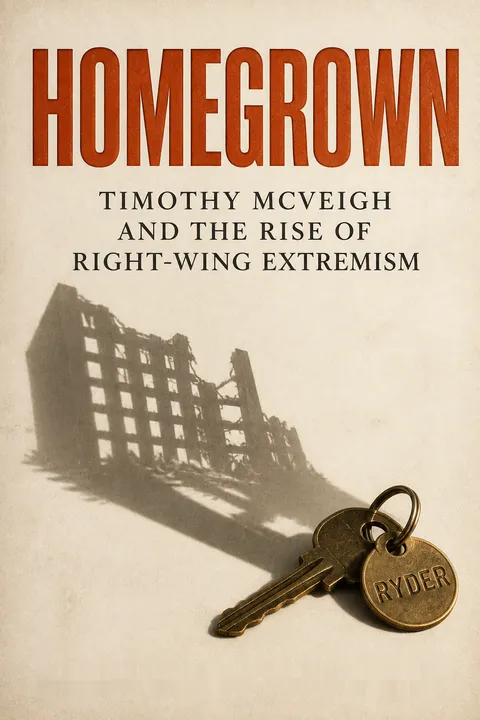
Homegrown by Jeffrey Toobin examines the 1995 Oklahoma City bombing and Timothy McVeigh's motivations while drawing connections to January 6th and right-wing extremism. Reviewers praise Toobin's thorough research and readable narrative, particularly regarding McVeigh's trial. However, many criticize the book's subtitle as misleading, noting it focuses primarily on McVeigh rather than comprehensively tracing extremism's rise. The connections to January 6th feel superficial to some readers. Most appreciate the factual account but wish for deeper analysis of broader extremist movements and historical context.
People Also Read

About the Author
Other books by Jeffrey Toobin
Download PDF
Download EPUB
.epub digital book format is ideal for reading ebooks on phones, tablets, and e-readers.








































