
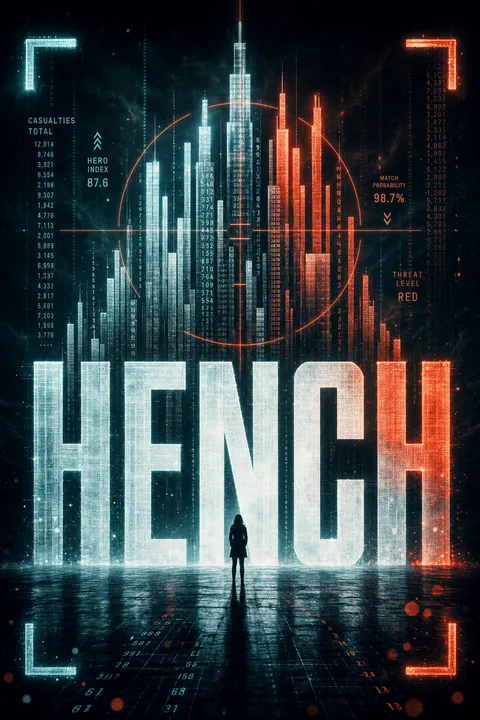


Plot Summary
The Temp Agency Call
Anna Tromedlov,1 rationing groceries against her thin overdraft, answers a call from the Temp Agency. In her world, henching is gig work: supervillains staff their lairs the way offices hire receptionists. She lands a remote data-entry contract with Electrophorous Industries, run by a wellness-obsessed villain called the Electric Eel,13 while her acid-tongued best friend June,4 a hench cursed with painfully acute senses, takes an on-site post with the same boss.
The spreadsheets Anna1 sorts turn out to be an identity database matching scars and tattoos to superheroes. Bored and quietly restless, she accepts an offer to leave her keyboard for a day of fieldwork, telling herself that owning her role as a hench is the honest choice.
Walschots opens by domesticating villainy into the language of precarious labor: overdraft math, ramen, temp recruiters mangling names. The genius is the frame, treating supervillain infrastructure as an underpaid service economy, which recasts moral categories as class categories. Anna's restlessness signals the central psychological engine: a competent person starved of significance. Her willingness to step into fieldwork, rationalized as authenticity, is really the hunger to be seen. The identity database she assembles quietly foreshadows her future weapon, information itself. Beneath the comedy runs a thesis, that good and evil are branding exercises layered over ordinary desperation to make rent.
Booth Babe, Broken Femur
The Electric Eel's13 press conference is a hostage stunt. He hijacks a municipal broadcast, drags in the mayor's kidnapped son, and demonstrates his Mood Ring device by ordering Anna1 to hold it near the drugged, eerily obedient boy. When he hands the child a cleaver and tells him to sever his own finger, a window bursts inward.
Supercollider,3 the planet's greatest hero, storms in to rescue the boy. In the chaos he sweeps Anna1 out of his path as casually as clearing a chair. The glancing contact shatters her femur into floating fragments. She wakes to a titanium rod, a six-month recovery, and a police report that erases her injury entirely, blaming everything on the villains.
The scene weaponizes the superhero rescue against its own mythology. Supercollider saves a child and, in the same gesture, mutilates a bystander without noticing, dramatizing collateral damage as a structural feature of heroism, not an accident. Anna's body becomes evidence, and the falsified police report performs the erasure that will radicalize her: the system literally cannot record her suffering because acknowledging it would indict its savior. The Mood Ring, mind control dressed as emotional wellness, mirrors the Eel's therapeutic vocabulary, satirizing how coercion hides behind the language of care. This is the wound the entire novel metabolizes into ideology.
The Injury Report
A cheap grocery-store fruit basket arrives with an HR letter: Electrophorous is severing her contract because her injury makes her a liability. Broke, evicted, and convalescing on June's4 lavender-scented couch, Anna1 pours her rage into arithmetic.
Borrowing a disaster-economics formula that measures catastrophes in lost years of human life, she calculates that Supercollider3 costs the world as much as an earthquake. She launches a blog, the Injury Report, tallying the bodies and wreckage heroes leave in their wake.
A journalist mocks her as a bitter castoff, but readers check her math and find it sound. The report spreads, drawing tips and grim notoriety, while June4 grows frightened that Anna's1 public feud with capes will get them both killed.
Grief becomes methodology. Anna transmutes powerlessness into a spreadsheet, and the DALY framework lets her reframe Supercollider from person to phenomenon, a rhetorical move that both liberates and dehumanizes. The blog is revenge disguised as data journalism, but its virality reveals a latent public appetite for counter-narrative, suggesting the hero consensus was always brittle. The fruit basket is a masterstroke of banal cruelty, corporate indifference reduced to a clearance-aisle gesture. Crucially, the report strains her bond with June: Anna chooses the abstraction of justice over the intimacy of a friend's fear, previewing the recurring trade she will make between people and numbers.
Leviathan's Supercar
On the morning of a mundane interview, a matte-black supercar waits at the curb instead of her usual cab, driven by Melinda,14 a stunt-trained driver Anna1 once watched get hired at the agency. The ride ends inside the walled compound of Leviathan,2 the most feared supervillain alive, sheathed in strange, organic-looking black armor.
He has read the Injury Report and wants to know what she could build with limitless means. He asks one decisive question: does she hate the heroes now? Anna1 answers yes, from somewhere deep and certain. He hires her instantly, gives her an apartment and medical care. But the sudden move costs her June,4 who returns home to find every trace of Anna1 gone and assumes she was disappeared.
The recruitment stages seduction as vocation. Leviathan offers what the world denied Anna: recognition of her competence and permission to be exactly as furious as she is. His single question, do you hate them, converts private trauma into shared purpose, the classic radicalization script. The luxury of the compound contrasts sharply with June's shabby couch, dramatizing how institutional power can rescue individuals only by extracting them from their ties. That Anna's ascension immediately terrifies and severs June makes the cost legible: every step toward significance amputates a piece of her old, human life. Ambition here is inseparable from abandonment.
Ruining Heroes for a Living
Under the cyborg department head Molly,9 Anna1 pitches a new villainy: stop unmasking heroes and instead weaponize consumer data to predict and sabotage their lives. Leviathan2 approves, and she assembles a team, the spreadsheet savant Jav,11 the disarmingly warm Nour,10 the hacker Darla.12
They trick a supermax prison into flash-freezing the hero Tardigrade during a live media tour, and the humiliating clip explodes across the internet. Then Anna1 studies Glassblower, a hero unraveling over his breakup with his sidekick-turned-ex Tardigrade.
Her team feeds his obsession, quietly circulating his drunken, jealous public outbursts and keeping the damning footage alive online, nudging a fragile man toward a spectacular, career-ending collapse he will perform himself.
Anna reinvents antagonism as data-driven psychological warfare, a chillingly contemporary vision where surveillance capitalism becomes the deadliest weapon. The insight that humiliation outperforms brute force reflects a networked age in which reputation is capital and virality is violence. The team dynamic humanizes cruelty: coworkers bantering over snacks while ruining lives, which is precisely the banality that makes it plausible. Glassblower's engineered meltdown reveals Anna's core method, she does not destroy heroes, she creates conditions in which they destroy themselves, exploiting their private wounds. It is villainy as behavioral economics, and the moral horror lies in how efficient, collaborative, and gleeful it feels.
Becoming the Auditor
The skeptical enforcement chief Keller5 forces Anna1 into the field to prove her plan. Hidden in an alley, she watches her team lure the disintegrating Glassblower into assaulting two decoy villains, then tases him with her weaponized cane while the team gasses him unconscious, leaving him amid the smoking wreckage he caused.
The operation annihilates his career and wins Leviathan's2 rare, insect-like laughter. Her team christens her the Auditor.1 Increasingly trusted, she begins traveling with Leviathan2 on diplomatic missions, wearing a prosthetic pregnancy to disarm the cautious hero Abyssal of the Ocean Four while harvesting intelligence. She grows close to Keller5 and to Vesper,6 a gentle cyborg pilot, and discovers she is genuinely, unsettlingly happy engineering misery.
Anna crosses from strategist to operative, and the taser in her cane literalizes how her injury has been forged into agency, the instrument of her limp becomes an instrument of harm. Keller's coercion, meant as a test to sabotage her, backfires and cements her legitimacy, a recurring pattern where opposition hardens her. The name Auditor is perfect: it fuses her accountant's precision with judgment and reckoning. Her enjoyment is the section's quiet alarm bell. Competence, belonging, and cruelty have fused into a single satisfying feeling, and the workplace comedy of villainy masks how thoroughly she is being remade by the thing she is good at.
Opened on the Table
Anna1 is dragged off the sidewalk outside June's4 building and wakes shackled beneath Dovecote, the Draft's supermax. Supercollider3 himself interrogates her, laying out his doctrine that heroes create their own worst enemies by letting the wounded fester into villains.
He resolves to remove her from the board, not by killing her, but by surgically dulling her brain. Mid-operation, her skull already opened, Leviathan's2 strike team blasts in and extracts her.
His surgeons not only repair the damage but go further, embedding cybernetic implants, a new eye that reads infrared and ultraviolet, and activating latent superhuman potential the Draft's childhood tests missed. Anna1 returns transformed, now able to see the hidden data written across every living body.
The near-lobotomy externalizes the novel's thesis, that heroism preserves order by mutilating threats to it, and Supercollider's chess metaphor about pawns becoming queens reveals a paranoid worldview that manufactures the enemies it fears. His refusal to kill, cloaked in the phrase we are heroes, exposes the moral vanity that permits atrocity so long as it is bloodless. The rescue inverts the earlier hospital abandonment: this time someone comes. Leviathan's upgrade is both salvation and appropriation, repairing her while binding her more tightly to him. Her new spectral vision is a gorgeous metaphor for the analyst's curse, seeing everyone's vulnerabilities laid bare.
June's Nine Words
Recovery brings a second, quieter devastation. June4 sends a message worded like a restraining order, then a nine-word confession: she cannot keep watching Anna1 disappear into strange cars. The friendship that anchored Anna's1 old life is finished. Keller,5 gruff and unexpectedly tender, takes her drinking and lays out the arithmetic of their world.
Success drives ordinary people away because the violence feels contagious, and villains endure precisely because they have no loved ones left to be threatened. He admits his own husband abandoned him when he chose a black cape. Anna1 takes in the lesson: isolation is not a bug of this life but its protective feature, and she is becoming someone willing to pay that price.
The section reframes loneliness as tactical armor, Keller's grim comfort that villains cannot be held hostage because they have nothing left to lose. June's departure completes Anna's severance from her civilian self; the woman who painted her toenails and mocked Tinder profiles is now unreachable. Walschots refuses to romanticize this, letting the grief sit raw even as Anna intellectualizes it. Keller functions as a dark mentor and unlikely friend, modeling a masculinity that chose honesty over respectability. The chapter interrogates a real cost of any all-consuming vocation: the people who love you are collateral, and eventually only those already inside the machine remain.
The Hollow Hero
Poring over every mission, Anna1 concludes that Supercollider3 has no interior at all, a walking archetype defined entirely by the network propping him up. To topple him she resolves to cut those supports one by one. First: Accelerator,16 the fast but fragile sidekick whose presence makes the hero recklessly destructive as he shields the boy.
She sends Nour10 undercover to seduce the young hero and whisper that his mentor3 is smothering him. Accelerator16 demands full partnership, quarrels bitterly with Supercollider,3 and strikes out alone. Anna1 then quietly places a bounty on him. Emboldened and unprotected, he takes a wound in an alley brawl and dies days later of infection. Nour,10 hollowed by the deception, asks to be released.
Anna's diagnosis, that the hero is defined by his relations rather than any essence, is both strategic insight and philosophical claim: identity as network, not soul. The Accelerator operation marks her passage from humiliation to homicide, and the novel refuses to let it feel clean. He was decent, uninvolved in her abduction, and she kills him anyway because the math endorsed it. Nour's quiet ruin is the collateral Anna failed to compute, the human cost hidden inside instrumental reasoning. This is the book's darkest turn on utilitarian logic: when suffering becomes fungible units on a spreadsheet, even one's own allies become expendable inputs.
Collision Course
Turning to Quantum Entanglement,7 Supercollider's3 powerful partner, Anna1 expects a marriage worth demolishing and instead finds a sterile, loveless arrangement already dead between them. So she attacks the public's love for the pair instead.
She feeds a respected, hero-injured journalist named McKinnon17 her own anonymous testimony, spawning the article Collision Course and a viral hashtag cataloguing heroes' forgotten victims. The campaign flushes out Quantum's7 affair with the hero Melting Point, whose jilted ex brandishes stained evidence at a press conference.
Days later Melting Point and the ex are found dead, staged by panicked Draft fixers. Ordered to make a groveling public apology, Quantum7 instead breaks down, refuses, and blinks out of existence live on air.
Anna discovers that the couple's relationship is beyond ruining because it was never real, so she pivots to their true marriage, the one with an adoring public. The move reveals her maturing thesis: heroes are sustained by collective belief, so belief is the target. McKinnon embodies the story's ethical vertigo, a genuine victim whose real pain Anna sincerely shares while cynically deploying it. The staged murders implicate the Draft as the true killers, dissolving the hero-villain binary into shared corruption. Quantum's on-air refusal is the first crack in a woman treated as scenery, a subjugated power beginning, unpredictably, to assert a self.
Leviathan Goes Alone
Convinced Supercollider3 is finally weak enough, Leviathan2 discards Anna's1 patient strategy and flies off alone in his stealth jet. He abducts the aging hero Doc Proton,15 Supercollider's3 beloved mentor, from a retirement home and issues a ransom video invoking the second law of thermodynamics, a riddle only Doc15 comprehends.
Enraged, Supercollider3 descends on Leviathan's2 compound. Anna1 watches from a command van as the two titans collide with earth-cracking force, until the hero3 tears the roof open, hoists her by the hair, and nearly crushes her throat.
The sudden arrival of the Ocean Four makes him drop her. She collapses, catching a last glimpse of Leviathan's2 armored body sprawled and motionless, and wakes to a world certain the great villain is dead.
Leviathan's solo gambit exposes the ego beneath the ideology, he cannot let Anna's method claim the victory that belongs, in his mind, to their private war. The thermodynamics riddle plants the mystery of Entropy that the next chapter detonates. The battle finally strips Supercollider's heroic mask, revealing naked murderousness, yet again a team of heroes arrives to interrupt, the recurring nick-of-time trope now weaponized ironically to save the villain. Anna's second brush with Supercollider's hands rhymes with her first injury, closing a loop of vulnerability. The apparent death of Leviathan lands as genuine catastrophe, because the novel has made his approval her emotional center.
The Body Is Wrong
The world accepts the corpse in the news footage. Anna1 does not, her upgraded memory snagging on a wrongness she cannot articulate. Then Quantum7 arrives at their shabby safe house, not for revenge but seeking help clearing her name, and reveals the Leviathan2 Protocol: his death is staged so the Draft can study him before termination. He is alive.
Wired with a surveillance egg, Quantum7 visits Doc Proton,15 who confesses two truths. Leviathan's2 armor is not armor at all but his own transformed body, which proves the displayed corpse is a fabrication. And long ago Supercollider3 accidentally killed Leviathan's2 mentor Entropy, then was taught to lie about it. Anna1 finally understands both the fraud and the ancient enmity.
The armor revelation reframes Leviathan retroactively: what looked like technological menace is a body irreversibly altered by the Draft's experiments, transforming him from monster into victim of the same machine that made Supercollider. Doc's confession about Entropy supplies the tragic origin, the hero literally dropped a woman to her death and papered it over with crisis communications, and Leviathan's rage is grief for a murdered mother-figure. Quantum's alliance, born of mutual disposability, and her surveillance-egg proxy visit dramatize how the discarded find each other. Anna's intuition, validated by data, affirms the novel's faith that pattern-reading is a kind of love, attention as devotion.
The Dovecote Rescue
With Doc's15 confession forced into print by the villain-heiress Cassowary, who happens to own the outlet, Anna1 leads a desperate raid on Dovecote using herself as bait. Supercollider3 attacks, but Quantum,7 now reborn under a new name, shields Anna1 and battles her former partner,3 phasing his indestructible body into itself until he is a folded, sobbing mass of flesh.
Using his crushed hand and eye to pass the biometric locks, the team descends to Leviathan's2 cell and frees him. Yet the rescued villain,2 gutted by captivity, screams in anguish rather than triumph at seeing his nemesis3 undone by others, not himself. Quantum,7 who had secretly believed him already dead, glimpses him and vanishes, leaving Anna1 feeling used all over again.
The climax delivers grotesque catharsis: Supercollider, invulnerable to everything external, is destroyed by being turned against his own flesh, a literalization of the hero who was always his own worst structure. Quantum's rebirth as an accountability figure completes her arc from ornament to agent. But Walschots denies clean victory. Leviathan's grief rather than gratitude punctures the fantasy of rescue as reunion, exposing wounded male pride and the intolerable knowledge of having needed saving. Quantum's disappearance, and the discovery she had lied about the timeline, re-wounds Anna precisely where June did. Triumph and abandonment arrive together, refusing the reader the comfort of a happy ending.
Epilogue
Leviathan2 recovers but withholds the one thing Anna1 craves, his voice, ignoring her for days until she fears her rescue only shamed him. When he finally summons her, he offers not gratitude but a kind of apology: her method worked, and he will stop obstructing her. Then he escalates the ambition to a staggering scale.
Not one hero at a time, but the entire Draft, all of Superheroic Affairs, the whole apparatus that manufactures heroes and villains alike. He wants to know whether the strategy scales. Horrified by the human cost yet unable to resist the gravity of him, Anna1 answers the only way she knows how. She will run the numbers.
The ending refuses resolution in favor of escalation, converting a revenge plot into a revolutionary one. Leviathan's silence-then-summons enacts the withholding intimacy of the powerful, and his apology is really a concession to her superior method, ego dressed as growth. The pivot from destroying individuals to dismantling the entire system reframes the whole novel as an anatomy of institutional violence rather than personal grudge. Anna's closing surrender, I will run the numbers, is chilling and clarifying: her arithmetic, born of one shattered femur, now scales toward total war. The book leaves her fully transformed, her ambivalence intact but overruled, complicit and indispensable, hungry.
Analysis
Hench reinvents the superhero story as a workplace novel about labor, data, and institutional violence, asking who cleans up after the gods and who counts the bodies. Its central provocation is arithmetic: by measuring heroism in lost years of human life, Anna1 forces readers to see rescue and ruin as two faces of unaccountable power. The book's satire lands because it grounds cosmic conflict in overdrafts, HR letters, and microwaved office fish, translating good and evil into the grammar of precarious employment. Beneath the comedy runs a serious inquiry into radicalization: not through cruelty but through indifference, the falsified police report that refuses to record Anna's1 pain becomes the wound that manufactures a villain, literalizing Supercollider's3 own paranoid doctrine. Walschots is fascinated by the ethics of instrumental reason. Anna's1 spreadsheets promise justice through optimization, yet the novel repeatedly stages the human residue the numbers cannot capture, Nour's10 hollowed warmth, June's4 terror, a decent sidekick's16 death by sepsis. The story neither absolves nor condemns her; it shows how competence, belonging, and grievance fuse into a self that pays for clarity with connection. The recurring motif of vision, from disaster math to infrared sight, frames attention itself as ambivalent, both loving devotion and predatory targeting. Its most radical move is structural empathy: villains have no loved ones to kidnap because loving anyone is a liability, a bleak thesis about how all-consuming vocations amputate intimacy. The armor-as-body revelation reframes monstrosity as manufactured victimhood, indicting the system that produces heroes and villains from the same broken children. The ending refuses catharsis, escalating from personal vengeance to total systemic war and leaving Anna1 complicit, indispensable, and hungry. Hench ultimately argues that the real supervillain is the machine that decides whose suffering counts, and that resisting it may require becoming fluent in its cruelties.
Review Summary
Hench is a darkly humorous and thought-provoking novel that subverts superhero tropes by focusing on a data analyst working for supervillains. Readers praised its unique perspective, compelling characters, and exploration of moral ambiguity. The book garnered appreciation for its witty writing, office dynamics, and critique of superhero collateral damage. While some found the protagonist's lack of self-awareness frustrating, many enjoyed the novel's blend of spreadsheet-wielding villainy and social commentary. The ending left some readers wanting more, hinting at potential for a sequel.
People Also Read




Characters
Anna Tromedlov, the Auditor
Vengeful data-analyst henchA broke temp henchperson who begins the story sorting spreadsheets and rationing groceries, defined by gallows humor, meticulous intelligence, and a starved need to matter. Her true gift is arithmetic: she reduces suffering, risk, and collateral damage to quantifiable units, a habit that becomes both weapon and worldview. Wounded physically and abandoned emotionally, she is radicalized less by cruelty than by indifference, the refusal of the world to record her pain. She oscillates between genuine empathy and escalating ruthlessness, forever running the numbers even as she flinches at their conclusions. Loyalty, recognition, and belonging drive her as fiercely as revenge. Her arc traces how a decent, funny, ordinary person, given competence and grievance, can be reshaped into something formidable and frightening.
Leviathan
Enigmatic supervillain employerThe most feared supervillain alive, encased in sleek, unsettlingly organic black armor and rumored to be inhuman beneath it. He speaks in courtly, faintly alien cadences, quotes Paradise Lost, keeps a beloved iguana, and rules a corporate empire more startup than lair. Coldly brilliant and monstrously patient, he prizes competence and rewards it, drawing Anna1 into his orbit with recognition rather than fear. Beneath the calculated menace burns an inextinguishable, personal rage focused on Supercollider3, a fury Anna1 gradually senses has roots in old loss. He is less a person than a force to be studied, and Anna's1 fascination with him blurs disturbingly into devotion. His approval becomes the gravitational center of her transformed life.
Supercollider
World's mightiest heroThe planet's greatest superhero, all quarterback jaw and blazing concentric-ring insignia, worshipped as an unstoppable force for good. In practice he is careless, grandiose, and casually catastrophic, injuring bystanders without noticing and cloaking violence in the language of righteousness. He carries a paranoid doctrine that heroes create their own nemeses, which drives him to hunt and eliminate anyone he suspects might rise against him. Beneath the archetype lies a startling hollowness: a man who exists only as the sum of the institutions, mentors, and partners that prop him up. Vain, wounded, and increasingly desperate, he is the embodiment of power that has never once been asked to account for its cost.
June
Anna's best friend, super-senses henchA hench who has worked the trade longer than Anna1, cursed with hypersensitive smell and taste that make the world a constant assault. Sharp-witted, viciously funny, and fiercely protective, she is Anna's1 anchor to her old civilian self, painting her toenails, mocking Tinder profiles, offering her couch. Pragmatic about danger, she grows terrified as Anna1 courts increasingly powerful enemies, and that fear steadily strains the friendship they built out of shared desperation and laughter.
Keller
Gruff enforcement chiefHead of Leviathan's2 Enforcement and Tactical division, a cinder-block ex-military man who initially dismisses Anna1 as a useless liability. Their rivalry curdles into rough affection and genuine loyalty once she proves herself. Blunt, unshakable, and secretly tender, he mentors her through the loneliness of villainy, having lost his own husband to the choice of a black cape. He speaks hard truths with disarming warmth and becomes her steadiest ally.
Vesper
Gentle cyborg pilotA former hero sidekick, mistreated and disillusioned, who crossed over and accepted extensive cybernetic augmentation under Leviathan2, replacing his eyes, ears, and hands. Patient, kind, and quietly cruel when it counts, he becomes Anna's1 guide to living with enhanced senses. He offers her comfortable silence rather than chatter, and a tender, unhurried attraction she treats with care rather than embracing.
Quantum Entanglement
Overshadowed hero partnerSupercollider's3 partner, a hero from New Zealand whose reality-warping force fields rival his strength but whose fame does not. Marked by Maori chin tattoos and a queenly bearing, she has spent over a decade clipped and confined into a supporting role, standing behind a man3 who barely sees her. Beneath her serene, guarded exterior runs deep loneliness and a slow-building fury. Strategic, proud, and privately miserable, she proves capable of far more than anyone allowed her to be.
Greg
Anxious tech-support henchA perpetually overworked network administrator hench whom Anna1 befriends early, forever fielding 3 A.M. calls from incompetent villains. Gangly, excitable, and loyal to a fault, he geeks out over her brushes with Supercollider3 and eventually joins Leviathan's2 IT department. His goofy optimism and genuine adoration make him one of Anna's1 few remaining tethers to warmth.
Molly
Cyborg department headHead of several of Leviathan's2 departments, including Information and Identities, with robotic hands ending in sixteen superfine fingers and data-display glasses. Brilliant and encouraging, they help Anna1 shape her vague talents into a formal role and proposal, acting as an early sponsor and translator of her ideas into operational reality.
Nour
Charming social engineerA member of Anna's1 team whose extraordinary warmth and trustworthiness make her a perfect infiltrator and impersonator. She can be any customer-service voice, helpful or obstructive, and can make anyone feel like the center of her world. Her gift for intimacy becomes a weapon, and the toll of using it forms one of the story's quiet tragedies.
Jav
Spreadsheet virtuosoThe self-described Excel pervert on Anna's1 team, building elegant systems to channel torrents of data. Eager, funny, and devoted to Anna1, he sulks whenever her travels pull her away from the office they love working in together.
Darla
Team hackerA skilled infiltrator poached from Technology into Anna's1 department, breaking into systems the team cannot charm or bluff past. Dry, sharp, and hungry for the next scheme, they track hashtags and feeds with predatory focus.
The Electric Eel
Wellness-obsessed midtier villainAnna's1 first on-site employer, a goateed villain who insists on being called E, reads auras, asks about feelings, and runs his operation like a therapeutic startup. Mediocre yet supremely confident, he craves the validation of tangling with a real hero, and his hostage stunt sets Anna's1 catastrophe in motion before he discards her without a thought.
Melinda
Elite getaway driverA stunt-certified driver Anna1 first sees hired at the Temp Agency, later revealed as Leviathan's2 premier chauffeur. Confident, muscular, and warm behind smoked-lens tactical glasses, she ferries Anna1 into her new life and becomes a comfortable, admiring crush and steadfast presence at the wheel.
Doc Proton
Aging hero-mentorA venerable retired hero, Supercollider's3 early mentor, now frail and medically dependent in a home for aging capes. Courtly and self-aware, he carries enormous guilt over old compromises and secrets. He proves willing to sacrifice himself for a reckoning, and holds the truths that unlock the enmity at the story's heart.
Accelerator
Fragile speedster sidekickSupercollider's3 young, physics-defying sidekick, dazzlingly fast but surprisingly breakable. Proud and ambitious, he chafes under his mentor's3 protection and yearns to prove himself. Decent enough personally, he becomes dangerous chiefly because the hero's need to shield him magnifies the destruction they cause together.
McKinnon
Injured investigative journalistA respected columnist left with spinal injuries decades earlier by a hero's carelessness, now living with partial paralysis. Sharp, principled, and hungry for truth, he recognizes the betrayal in Anna's1 story because he shares it. He becomes the vehicle for exposing hero collateral damage, wary of being manipulated even as he agrees to help.
Ludmilla
Devoted bodyguardLeviathan's2 loyal bodyguard with old-fashioned, knightly manners and a habit of instantly calculating how to kill anyone she meets. Fiercely committed, pessimistic, and unshakable, she would follow the faintest hope into hell.
Plot Devices
The Injury Report
Quantifies heroic collateral harmAnna's1 blog, built on a disaster-economics formula that measures catastrophes in lost years of human life, tallies the deaths, injuries, and property destruction heroes leave behind. It transforms her private grievance into a public, data-backed argument that superheroes are net disasters for the world. The report goes viral, attracts tips and notoriety, and crucially catches Leviathan's2 attention, becoming the credential that lands her the job. More than a plot mechanism, it is the novel's ideological spine: the reduction of suffering to numbers that both empowers Anna1 and slowly erodes her humanity. Its methodology recurs throughout, from ruining heroes to weighing lives, and the book closes on her promising to run those numbers once more.
The Mood Ring
Mind-control demonstration weaponThe Electric Eel's13 signature invention, a gaudy handheld device shaped like a dinner plate on brass knuckles, marketed as reading auras and emotional states. In truth it induces eerie serenity and total suggestibility in its target. At the fateful press conference, the Eel13 uses it on the mayor's kidnapped son, ordering the drugged boy to mutilate himself while Anna1 is forced to hold the device. The demonstration triggers Supercollider's3 violent intervention, which shatters Anna's1 leg and launches the entire narrative. The Mood Ring also satirizes the villain's therapeutic branding, coercion disguised as wellness technology, mirroring how power throughout the book cloaks control in the language of care and good intentions.
Cybernetic augmentation
Grants spectral, data-rich visionAfter Anna's1 near-lobotomy, Leviathan's2 surgeons repair her brain and go further, embedding implants and a new eye that perceives infrared and ultraviolet, and activating latent superhuman potential the Draft's childhood screenings missed. She learns, with Vesper's6 guidance, to read the heat, blood flow, arousal, and fear written across every body, turning perception itself into intelligence-gathering. The augmentation externalizes her role as analyst, she now literally sees everyone's vulnerabilities, and provides the eidetic memory that later lets her sense the wrongness of a faked corpse. It also deepens the theme of transformation through violence: the same institutions that broke her are the ones that remade her into something far more dangerous.
The armor that is a body
Reveals Leviathan's true natureLeviathan2 is never seen without his sleek, organic black armor, universally assumed to be an advanced mecha suit hiding a disfigured man. The revelation that the armor is not worn but is his own transformed body, the product of the Draft's experiments, recontextualizes him entirely, from monstrous choice to mutilated victim. It also provides the crucial forensic clue: a displayed corpse wearing removable armor cannot be him, proving he survived. This device fuses the story's mystery mechanics with its central argument that the hero-making system manufactures its monsters, and it deepens Anna's1 intuition-as-devotion motif, since only she and Doc15 truly understood what they were looking at all along.
Make-your-own-nemesis doctrine
Frames hero as self-defeating systemSupercollider's3 guiding belief, taught to him by Doc Proton15, that every great villain is one the hero himself created by failing to eliminate a threat early. He cites it to justify hunting and blunting Anna1. Ironically, the doctrine becomes Anna's1 own analytical breakthrough: if the hero is defined by relationships and structures rather than any inner self, then he is hollow, and his support network, mentor, sidekick, partner, public, can be dismantled piece by piece. The idea drives the entire back half of the novel, converting a revenge plot into a strategic siege and ultimately a plan to topple the whole system that generates heroes and villains alike.
FAQ
Synopsis & Basic Details
What is Hench about?
- A Data-Driven Reckoning: Hench follows Anna Tromedlov, a temp worker in the gig economy of supervillainy, whose life is derailed when a careless encounter with a famous hero, Supercollider, leaves her severely injured and jobless.
- Quantifying Heroic Damage: Hospitalized and betrayed by her former employer, Anna begins compiling "The Injury Report," a blog that uses data analysis to expose the devastating human and economic cost of superhero actions, challenging the public narrative of heroism.
- Ascent in the Villainous World: Her unique perspective and analytical skills attract the attention of Leviathan, one of the world's most powerful and enigmatic villains, leading her into his inner circle and a high-stakes mission that blurs the lines between victim, villain, and agent of change.
Why should I read Hench?
- Fresh Genre Subversion: The novel offers a unique, grounded perspective on the superhero genre, focusing on the often-ignored collateral damage and the lives of those caught in the crossfire, particularly the low-level henches.
- Compelling Character Arc: Anna's transformation from a struggling, cynical temp to a powerful strategist is deeply engaging, driven by relatable experiences of injury, betrayal, and finding purpose in unexpected places.
- Thought-Provoking Themes: It delves into complex questions of accountability, the nature of good and evil, the power of data, and the human cost of larger-than-life conflicts, prompting readers to reconsider traditional heroic narratives.
What is the background of Hench?
- Gig Economy of Villainy: The story is set in a world where superpowered conflicts are commonplace, and low-level support staff for both heroes and villains operate through temp agencies and specialized services like the "Meat Market."
- Bureaucracy of Conflict: Despite the fantastical elements, the world is grounded in mundane realities like HR departments, insurance claims (or lack thereof), and the crushing financial precarity faced by those without powers or powerful patrons.
- Public Relations War: Heroes maintain their status through carefully managed public perception, often downplaying or outright ignoring the destruction they cause, creating a stark contrast with the lived experiences of those affected.
What are the most memorable quotes in Hench?
- "Supercollider was as bad for the world as an earthquake.": This quote encapsulates Anna's central thesis from The Injury Report, starkly reframing the hero's impact from savior to natural disaster based on quantifiable data of lives and property lost.
- "I don't think you can win if you're not broken.": Anna's chilling realization about the nature of true power in the villainous world, suggesting that profound damage and loss are prerequisites for becoming a significant threat, reflecting her own journey.
- "He pulled me off an operating table and rebuilt my brain. He killed people to get to me. What more could I possibly need to know?": Anna's stark, almost terrifyingly pragmatic assessment of Leviathan's feelings towards her, highlighting the unique and intense nature of their bond forged through violence and rescue.
What writing style, narrative choices, and literary techniques does Natalie Zina Walschots use?
- First-Person Cynicism: The novel is told from Anna's sardonic first-person perspective, filled with dry wit, dark humor, and a deeply cynical view of the world, which makes her observations sharp and often hilarious despite the grim subject matter.
- Data-Driven Narrative: Walschots integrates data analysis and statistical concepts into the narrative structure and thematic core, using spreadsheets, calculations, and the language of metrics to frame Anna's understanding of the world and her actions.
- Sensory and Visceral Detail: The writing is rich in sensory details, particularly focusing on physical sensations of pain, discomfort, and the uncanny, making Anna's experiences and the consequences of violence feel immediate and impactful (e.g., the smell of lavender, the feeling of shattered bone, the texture of Leviathan's armor).
Hidden Details & Subtle Connections
What are some minor details that add significant meaning?
- The Recurring Fruit Basket: The cheap, thoughtless fruit basket from Electrophorous Industries, containing Anna's termination letter, becomes a symbol of corporate callousness and the impersonal nature of her initial betrayal, echoing later, more significant "gifts" like Supercollider's storage unit payment and Leviathan's orchid.
- Oscar the Cab Driver: Oscar, Anna's preferred cab driver, initially seems like a minor convenience but represents a rare point of reliable, non-judgmental service in Anna's precarious life, his silent presence and eventual small acts of kindness (like covering for her with Bracken) highlighting the value of simple decency.
- The Smell of Lavender: June's pervasive use of lavender scent in her apartment, initially a coping mechanism for her supersenses, becomes a poignant symbol of her attempt to create a safe, calming space for Anna during her recovery, contrasting with the chaos and violence outside.
What are some subtle foreshadowing and callbacks?
- Early Mentions of the Draft: The Draft, the government agency overseeing heroes, is mentioned early in mundane contexts (like screening children for powers) before its more sinister role in controlling heroes and covering up their damage is fully revealed, foreshadowing its eventual confrontation with Anna and Leviathan.
- Leviathan's Mask: The mask of Leviathan's mentor, Entropy, displayed in his office, is initially a mysterious object but subtly foreshadows the deep, unresolved trauma driving Leviathan and becomes a key piece of information for Anna in understanding his motivations and past.
- Anna's "Confusion" in Police Reports: The police report dismissing Anna's injury as due to "nefarious activities" and her being "confused by all the noise and violence" is a callback to the official narrative that consistently minimizes hero damage, fueling her rage and validating her need for the Injury Report.
What are some unexpected character connections?
- Anna and Keller's Mutual Respect: Despite Keller initially viewing Anna with suspicion and annoyance, their shared experiences of being underestimated and their pragmatic approach to villainy forge an unexpected bond of mutual respect, culminating in Keller becoming a key ally and confidante.
- Quantum Entanglement and Doc Proton: The revelation of Quantum's deep, almost filial bond with Doc Proton, Supercollider's mentor, is unexpected and crucial, providing Anna with a vital link to Supercollider's past and a means to expose his secrets through Doc's confession.
- Leviathan's Affection for Shannon the Iguana: Leviathan's seemingly out-of-character devotion to his pet iguana, Shannon, and his extreme reaction to her discomfort, reveal a hidden layer of his personality and capacity for fierce loyalty, contrasting with his public persona and hinting at the depth of his grief for Entropy.
Who are the most significant supporting characters?
- June: Anna's initial anchor in the henching world, providing essential guidance, emotional support (in her own way), and a safe space during Anna's recovery, though their relationship strains under the weight of Anna's escalating involvement and the danger it brings.
- Keller: The head of Enforcement, initially an antagonist figure, becomes a crucial ally and mentor to Anna, respecting her strategic mind and providing pragmatic support, embodying the "honest" cruelty of villainy compared to heroic hypocrisy.
- Quantum Entanglement: A powerful hero disillusioned by the system, her unexpected alliance with Anna is pivotal, providing the physical power needed for the rescue mission and becoming a complex partner in the fight against the Draft.
Psychological, Emotional, & Relational Analysis
What are some unspoken motivations of the characters?
- Anna's Need for Validation: Beyond financial stability, Anna is deeply motivated by a need to be seen and valued, particularly after being dismissed and discarded by Electrophorous and the system, driving her to create the Injury Report and seek recognition from Leviathan.
- Leviathan's Grief and Vengeance: While publicly a powerful villain, Leviathan's core motivation is a profound, long-held grief for his mentor, Entropy, and a burning desire for vengeance against Supercollider and the Draft for their role in her death and his own transformation.
- Supercollider's Desperation for Control: Beneath his heroic facade, Supercollider is driven by a desperate need to maintain control over his image, his relationships, and the narrative surrounding him, leading to increasingly reckless and cruel actions when that control is threatened.
What psychological complexities do the characters exhibit?
- Anna's Coping Mechanisms: Anna uses dark humor, cynicism, and obsessive data analysis as coping mechanisms to process trauma and maintain emotional distance, but her vulnerability and underlying need for connection are revealed through her relationships with June, Keller, and Vesper.
- Leviathan's Dual Nature: Leviathan exhibits a complex duality, capable of immense cruelty and strategic ruthlessness while also showing moments of unexpected warmth, loyalty, and even vulnerability, particularly in relation to his past and those he cares about.
- Supercollider's Fragile Ego: Supercollider's psychological complexity lies in the vast gap between his public image and his internal emptiness, his reliance on external validation and support structures making him psychologically fragile despite his physical invulnerability.
What are the major emotional turning points?
- The Press Conference Injury: Anna's physical injury by Supercollider is the catalyst for her emotional transformation, shifting her from cynical resignation to active resentment and a desire for accountability.
- Betrayal by Electrophorous: Receiving the fruit basket and termination letter solidifies Anna's sense of betrayal and abandonment, fueling her determination to expose the system that discarded her.
- Leviathan's Grief Revealed: Witnessing Leviathan's raw, overwhelming grief upon seeing Supercollider's ruined form is a major emotional turning point for Anna, deepening her understanding of his motivations and forging a new level of emotional connection between them.
How do relationship dynamics evolve?
- Anna and June's Drifting Friendship: Anna's friendship with June, initially a lifeline, becomes strained as Anna's actions become more dangerous and public, highlighting the difficulty of maintaining ordinary relationships in the face of extraordinary circumstances and differing risk tolerances.
- Anna and Keller's Unexpected Partnership: What begins as professional antagonism evolves into a bond of mutual respect and pragmatic camaraderie, demonstrating how shared goals and a similar worldview can forge strong alliances in unlikely places.
- Anna and Leviathan's Complex Bond: Their relationship transforms from employer/employee to something far more intricate, marked by intellectual respect, shared trauma, and a unique form of affection rooted in violence, rescue, and mutual understanding of their brokenness.
Interpretation & Debate
Which parts of the story remain ambiguous or open-ended?
- Leviathan's True Form/Nature: While the book reveals Leviathan's "armor" is his body, the exact nature of his transformation, what he looked like before, and the full extent of the experiments performed on him remain largely ambiguous, leaving his true identity and capabilities open to interpretation.
- The Future of the Draft/Superheroic Affairs: While McKinnon's article and the events at Dovecote severely damage these organizations, their ultimate fate and the potential for systemic change in the world's approach to heroes are left open-ended, suggesting a long, ongoing struggle.
- Anna and Leviathan's Relationship Trajectory: The ending establishes a new dynamic between Anna and Leviathan, hinting at a deeper connection and shared ambition, but the precise nature of their future relationship—romantic, platonic, purely professional—is left for the reader to ponder.
What are some debatable, controversial scenes or moments in Hench?
- Anna's Justification of Collateral Damage: Anna's increasing willingness to cause harm to innocent bystanders or low-level henches as a strategic means to an end (e.g., leaving injured Meat behind, using Melting Point's ex) is highly debatable, forcing readers to confront whether her goals justify her methods.
- Quantum Entanglement's Actions: Quantum's decision to fold Supercollider into himself, while strategically effective, is a moment of extreme violence that challenges traditional heroic morality and raises questions about whether she has truly crossed a line into villainy.
- Leviathan's Methods of Motivation: Leviathan's use of extreme measures, such as kidnapping a staff member's child to ensure compliance or inflicting targeted trauma, are highly controversial and force readers to question the morality of working for such a figure, even if his goals align with Anna's.
Hench Ending Explained: How It Ends & What It Means
- Leviathan's Rescue and Supercollider's Defeat: Anna, Quantum, and a small team successfully infiltrate Dovecote, rescue Leviathan (revealed to be alive and held captive), and defeat Supercollider by having Quantum fold his body into a helpless mass of flesh, leaving him for the Draft to contain.
- A New War Declared: Leviathan, inspired by Anna's strategy and the data proving heroes can be dismantled, declares his intention to take down not just individual heroes, but the entire system of the Draft and Superheroic Affairs, setting the stage for a larger conflict.
- Anna's Transformation and New Role: Anna fully embraces her identity as "The Auditor," no longer a temp but a key strategist in Leviathan's organization, having found purpose and belonging through her trauma and data-driven approach, ready to apply her methods on a global scale against the system that created her and Leviathan.
Hench Series
Download PDF
Download EPUB
.epub digital book format is ideal for reading ebooks on phones, tablets, and e-readers.








































