


Plot Summary
The Elf on the Bed
Harry's1 twelfth birthday arrives unmarked by the Dursleys, who've padlocked his owl and confiscated his wand. No letters have come from Ron2 or Hermione3 all summer. That evening, while the Dursleys host an important dinner downstairs, Harry1 finds a strange creature on his bed: Dobby,4 a house-elf, who begs him not to return to Hogwarts.
Terrible things are being plotted there, Dobby4 insists, though he punishes himself violently each time he nearly reveals details. He has been intercepting Harry's1 mail, hoping isolation would keep him away.
When Harry1 refuses to promise he'll stay home, Dobby4 levitates Aunt Petunia's dessert and drops it onto the dinner guests. An owl delivers a Ministry warning about underage magic. Uncle Vernon, delighted to learn Harry1 can't use spells outside school, bars his window and locks him in.
The Flying Ford Anglia
Three days into captivity, Harry1 wakes to find Ron Weasley's2 freckled face floating outside his barred window — in a turquoise Ford Anglia hovering in midair. Ron's2 twin brothers Fred and George15 have come too.
They hook a rope to the bars, wrench them free, and help Harry1 haul his trunk through the window while Uncle Vernon grabs at his ankles. They fly to the Burrow, the crooked, wonderfully chaotic Weasley home, where Mrs. Weasley's13 fury at her sons for stealing the car dissolves into warmth for Harry.1
She piles his plate with sausages and fusses over his socks. The Burrow — with its self-washing dishes, backyard gnomes, and a clock tracking the family's whereabouts — gives Harry1 his happiest summer. He belongs here in a way Privet Drive never allowed.
The Sealed Platform
On September first, Harry1 and Ron2 charge toward the barrier between platforms nine and ten at King's Cross — and slam into solid brick. The gateway to the Hogwarts Express has sealed itself shut, stranding them as the train departs.
Ron2 proposes flying his father's enchanted car to school. They soar above the clouds, following the scarlet train northward, but the engine dies over Hogwarts. The car plummets into the Whomping Willow, a tree that batters anything within reach. Ron's2 wand snaps nearly in two.
Snape12 catches them, relishing the headline about Muggles spotting a flying car. Dumbledore9 declines to expel them but warns there will be no second chances. Harry1 later learns the barrier was Dobby's4 doing — the elf sealed it, hoping Harry1 would give up and go home.
Enemies of the Heir
Halloween night. Harry1 hears a cold, murderous voice threading through the castle walls — a voice no one else detects. He chases it upward through corridors, Ron2 and Hermione3 behind him, until they find Filch's21 cat Mrs. Norris hanging rigid beneath a message daubed in shimmering letters: the Chamber of Secrets has been opened, and enemies of the Heir should beware.
Dumbledore9 declares the cat Petrified, not dead. Growing Mandrakes will eventually provide a cure. In History of Magic class, their droning ghost professor is prodded into recounting the legend: a thousand years ago, founder Salazar Slytherin built a hidden chamber containing a monster, sealed until his true heir returned to purge the school of Muggle-born students. The staff dismiss it as myth. The students do not.
Harry Speaks to Snakes
A rogue Bludger breaks Harry's1 arm during Quidditch — Dobby4 later confesses to enchanting it, along with sealing the barrier, in yet another desperate attempt to drive Harry1 from the school. He lets slip the Chamber has been opened before.
Colin Creevey,19 a first-year fan of Harry's,1 is Petrified that same night. Soon after at a Dueling Club, Malfoy8 conjures a snake. Harry1 instinctively speaks Parseltongue to stop it from striking a classmate, but the school sees only a boy hissing commands at a serpent — Slytherin's signature gift.
More students are Petrified. In Dumbledore's9 office, Harry1 watches the headmaster's phoenix Fawkes22 die in flame and be reborn from ash, and tries the Sorting Hat again. It holds firm: Harry1 would have thrived in Slytherin.
Three Slytherins Who Aren't
Christmas break. After weeks of secret brewing in Moaning Myrtle's18 out-of-order bathroom, Hermione's3 Polyjuice Potion is ready. They drug Malfoy's8 hulking sidekicks Crabbe and Goyle with sleeping-potion cakes, pluck their hair, and drink the gut-churning brew. Harry1 and Ron,2 now wearing the bodies of Slytherin thugs, follow Malfoy8 into his common room.
He rants about Dumbledore,9 mocks Arthur Weasley's14 Ministry fine, and sneers about Muggle-borns — but when pressed about the Chamber, he admits he has no idea who the Heir is. He wishes he did. Their prime suspect is clean. Meanwhile, Hermione's3 transformation has gone catastrophically wrong: the hair she used belonged to a cat, leaving her furry-faced and hospitalized for weeks.
The Diary Writes Back
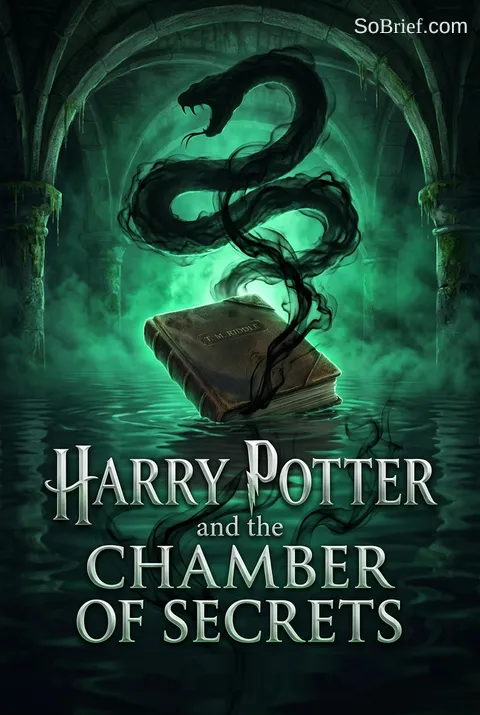
Harry1 discovers a waterlogged black diary in Myrtle's18 flooded bathroom, its pages completely blank. The name on the cover — T. M. Riddle5 — matches a fifty-year-old Special Award for Services to the School. When Harry1 writes in the diary, it absorbs the ink and responds with Riddle's5 own words.
The diary offers to show Harry1 how the Chamber was opened before and pulls him into a stored memory: Hogwarts fifty years earlier, where the teenage Riddle5 corners a large, young Hagrid10 who is hiding a creature in the dungeons. The boy begs that his spider never hurt anyone. Riddle5 turns him in anyway. Hagrid10 is expelled, and Riddle5 wins his award. Harry1 emerges shaken, wondering whether the gamekeeper he trusts truly opened the Chamber.
Hermione Turned to Stone
Minutes before a Quidditch match, Harry1 hears the murderous voice a third time. Hermione's3 eyes widen — she gasps that she's understood something and sprints for the library. The match never begins.
Professor McGonagall17 cancels it to announce another double attack: Hermione3 and a Ravenclaw prefect have been found Petrified near the library, a small mirror on the floor between them. Harry1 stares at Hermione's3 rigid form, her eyes glassy and unseeing, and feels the investigation shift from puzzle to personal emergency.
Without her mind driving the search, Harry1 and Ron2 are adrift. The school tightens every rule — students escorted everywhere, activities canceled. McGonagall17 warns the school may close. For Harry,1 that means a lifetime back with the Dursleys.
Hogwarts Without Dumbledore
Harry1 and Ron2 hide under the Invisibility Cloak in Hagrid's10 cabin as visitors arrive. Cornelius Fudge,24 the Minister of Magic, apologetically explains he must take Hagrid10 to Azkaban prison — the governors demand action, and Hagrid's10 record makes him the obvious scapegoat. Then Lucius Malfoy11 sweeps in with an Order of Suspension signed by all twelve school governors, removing Dumbledore9 from his post.
Dumbledore9 accepts calmly but delivers a parting promise: he will only truly have left this school when none here remain loyal to him, and help will always be given at Hogwarts to those who ask for it. Before Hagrid10 is led away, he drops a coded hint loud enough for the hidden boys: anyone wanting answers need only follow the spiders.
Into Aragog's Hollow
Armed with Harry's1 wand and Hagrid's10 boarhound Fang, Harry1 and Ron2 follow a trail of spiders into the Forbidden Forest. The trail leads deep into darkness and ends in a hollow teeming with spiders the size of horses.
Their patriarch, Aragog20 — blind, ancient, enormous — confirms he was Hagrid's10 pet but was never the Chamber's monster. Something else lives in the castle, something so terrifying that spiders refuse to name it. The girl who died fifty years ago was found in a bathroom. This clue points squarely at Moaning Myrtle.18
Having answered their questions, Aragog20 calmly announces his children will now devour them. The feral Ford Anglia, living wild in the forest since its crash, bursts from the trees headlights blazing, scattering spiders and carrying them to safety.
Hermione's Final Clue
Visiting Hermione's3 Petrified body in the hospital wing, Harry1 notices her right fist clenched around a scrap of paper. He pries it free: a torn library page describing the Basilisk, a giant serpent whose gaze kills instantly, which travels through plumbing and whose mortal enemy is the rooster.
Scribbled in Hermione's3 handwriting is one word: Pipes. Everything aligns. Harry1 hears the creature through walls because he speaks Parseltongue. Nobody has died because nobody looked it directly in the eye — they saw reflections, cameras, ghosts.
Hagrid's10 roosters were slaughtered to eliminate the one sound that could destroy it. The entrance must lie in Moaning Myrtle's18 bathroom. Before they can act, McGonagall's17 magically amplified voice announces a student has been taken into the Chamber. It is Ginny Weasley.6
Lockhart's Last Fraud
The teachers confront Lockhart7 with the task of facing the monster, and he crumbles. Harry1 and Ron2 find him frantically packing to flee. Cornered, Lockhart7 confesses: every adventure in his books belonged to someone else, and his only real talent is the Memory Charm he used to steal their credit.
They march him to Moaning Myrtle's18 bathroom, where Harry1 asks the ghost how she died — she remembers only a pair of great yellow eyes near the sink. Harry1 finds a tiny snake scratched into a tap, speaks Parseltongue, and the sink descends to reveal a pipe plunging beneath the school.
Deep underground, Lockhart7 seizes Ron's2 broken wand and attempts a Memory Charm — it detonates backward, erasing his own mind and triggering a cave-in. Harry1 presses on alone.
I Am Lord Voldemort
In the Chamber, Ginny6 lies barely alive at the foot of a towering stone statue. Tom Riddle5 stands beside her — no longer ink on a page but a figure solidifying as he feeds on her life force.
He reveals that he possessed Ginny6 through the diary all year: she strangled roosters, wrote the messages, and released the Basilisk without knowing what she did. Then he rearranges the letters of his name — TOM MARVOLO RIDDLE becomes I AM LORD VOLDEMORT. He summons the Basilisk. Fawkes22 the phoenix arrives and blinds the great serpent.
Harry1 draws the Sword of Gryffindor from the Sorting Hat and drives it through the creature's mouth. A fang pierces his arm, but Fawkes's22 tears neutralize the venom. Harry1 plunges the fang into the diary. Riddle5 screams into oblivion. Ginny6 wakes.
Dobby Is Free
Fawkes22 carries them back through the pipe. Dumbledore9 has returned — the governors reinstated him the moment Ginny6 was taken. He assures her parents she won't be punished; wiser wizards have been deceived by Voldemort. Privately, he tells Harry1 that his Parseltongue was transferred through the lightning scar.
When Harry1 confesses the Sorting Hat saw Slytherin potential in him, Dumbledore9 points to the engraved sword — only a true Gryffindor could have drawn it from the Hat. It is our choices that show what we truly are, not our abilities.
From Dobby's4 frantic signals when Lucius Malfoy11 storms in, Harry1 realizes Lucius11 slipped the diary into Ginny's6 schoolbooks months ago. He stuffs a sock into the ruined diary and hands it to Lucius,11 who hurls it aside — into Dobby's4 waiting hands. A garment from his master means freedom.
Epilogue
The Mandrake potion revives every Petrified victim. Hermione3 dashes toward Harry1 shouting that he solved it. Hagrid10 returns from Azkaban to a standing ovation at a midnight feast where everyone wears pajamas and the celebration stretches till dawn. Exams are canceled. Lockhart,7 his memory permanently erased, is sent away for treatment.
Lucius Malfoy11 is sacked as school governor, and Draco8 loses his swagger. On the Hogwarts Express home, Ginny6 reveals Percy's16 great secret: he has been sneaking around the castle all year to meet his girlfriend. Harry1 scribbles his telephone number for Ron2 and Hermione,3 begging them to call over the summer — he cannot face another silent stretch at the Dursleys with only Dudley for company.
Analysis
The Chamber of Secrets operates simultaneously as a mystery and a psychological inquiry into identity formation. Harry's1 central crisis is not the monster but the mirror: he speaks Parseltongue like Slytherin, the Sorting Hat nearly placed him in Slytherin's house, and the school's suspicion forces him to confront whether inherited traits constitute destiny. Rowling's answer, delivered through Dumbledore,9 is both simple and philosophically radical for children's literature: identity is not inherited but enacted through choice. Harry1 chose Gryffindor. He chose to enter the Chamber. The Sword materialized not because of his bloodline but because of his decisions.
Tom Riddle's diary functions as a devastatingly precise metaphor for predatory grooming. Ginny,6 an eleven-year-old overwhelmed by loneliness, finds in the diary a listener who never judges — and that listener systematically devours her. Riddle5 mirrors empathy while consuming agency. The psychological realism is striking: Ginny's6 family is loving but busy, her brothers dismiss her feelings, and she confides in the one presence that seems to understand. That the predator disguises itself as friendship — a pocket companion, a diary that writes back — makes the metaphor chilling.
The book also interrogates institutional failure under crisis. Fudge24 arrests Hagrid10 for political optics rather than evidence. Lucius Malfoy11 weaponizes school governance to remove Dumbledore.9 Lockhart7 sustains an entire career on stolen accomplishments and erased memories. Every adult system — Ministry, school board, teaching staff — fails the children. The actual investigation is conducted by twelve-year-olds, not because they possess superior power but because they are willing to act without institutional permission.
Lockhart's7 exposure mirrors the diary's threat from a different angle: both involve narratives that consume their sources. Riddle5 steals Ginny's6 story; Lockhart7 steals other wizards' stories. In a book whose central mystery revolves around a text that rewrites its reader, Rowling warns that storytelling itself can be an instrument of appropriation, manipulation, and erasure.
Review Summary
Harry Potter and the Chamber of Secrets is widely praised as an engaging and magical sequel. Readers appreciate the expanded wizarding world, new characters like Dobby and the Weasleys, and the mysterious plot surrounding the Chamber of Secrets. Many find it funnier and more exciting than the first book, with standout scenes like the flying car and the dueling club. While some consider it their least favorite in the series, most still rate it highly for its charm, character development, and clever foreshadowing of future events.
People Also Read
Characters
Harry Potter
The boy who survived twiceA twelve-year-old wizard entering his second year at Hogwarts, already famous for surviving Voldemort as an infant. Orphaned and raised by hostile Muggle relatives, he finds his true home at Hogwarts — which makes threats against the school feel existential. This year Harry discovers he speaks Parseltongue, Salazar Slytherin's signature ability, throwing his sense of identity into crisis. The Sorting Hat once considered placing him in Slytherin, and the entire school now suspects he is the Heir. Harry's deepest fear isn't the monster but the possibility that the darkness others perceive in him is real. Fiercely loyal, instinctively brave, and deeply uncomfortable with celebrity, Harry must reconcile inherited powers with chosen values — and learn that what he decides matters more than what he was born with.
Ron Weasley
Loyal best friend with bad luckHarry's1 best friend, the sixth of seven Weasley children, insecure about his family's poverty but fierce in loyalty. His broken wand — snapped crashing into the Whomping Willow — becomes an emblem of his year: everything misfires, from a slug-vomiting curse to classroom spells that produce only smoke. Yet Ron never wavers when it matters. He flies an illegal car to rescue Harry1 from captivity, follows giant spiders into the forest despite crippling arachnophobia, and descends into the Chamber without hesitation. Ron's psychology is defined by the gap between how he sees himself — inadequate, overshadowed by brothers — and what he consistently proves: courageous, steadfast, and willing to face his worst fears for his friends. His humor is armor; his loyalty is substance.
Hermione Granger
Brilliant Muggle-born investigatorThe trio's intellectual engine — Muggle-born, brilliant, and relentless in her need to understand. She proposes the Polyjuice Potion scheme, obtains the restricted book, brews the potion, and ultimately identifies the Basilisk as the Chamber's monster. Her Muggle-born status makes her a direct target of the Heir of Slytherin, lending personal urgency to every discovery. Hermione's need for control through knowledge drives the investigation. She follows rules instinctively and breaks them deliberately when stakes justify it. Her Petrification midway through the story removes the trio's strongest strategic mind, forcing Harry1 and Ron2 to fumble toward answers she had already found. Even frozen, she delivers the turning point — a torn page clutched in her rigid hand.
Dobby
Enslaved elf, desperate protectorA house-elf enslaved to a wealthy wizarding family, compelled to obey and forbidden from naming his masters or their plans. Small, bat-eared, and dressed in a filthy pillowcase, he punishes himself for every act of disobedience — slamming his head against walls, ironing his own hands. His adoration of Harry1 stems from what Harry1 represents to the oppressed: hope after Voldemort's fall. Dobby's methods are catastrophic — intercepting mail, sealing barriers, enchanting Bludgers — yet every destructive act springs from genuine devotion. He cannot name the danger directly, bound by magical servitude, so he communicates through frantic hints and self-harm. Dobby embodies the tension between institutional bondage and individual conscience, between loving someone and trying to control them for their own good.
Tom Riddle
A brilliant ghost in inkA preserved memory inhabiting a fifty-year-old diary — a sixteen-year-old Hogwarts prefect, brilliant, orphaned, and charismatic. Half-blood, raised in a Muggle orphanage, Riddle remade himself into a model student while secretly researching the Chamber of Secrets for five years. His psychology is defined by the compulsion to control narrative: he framed another student for his crimes, turned accusation into award, and preserved his younger self in enchanted pages. He presents himself as a trustworthy confidant to anyone who writes in the diary, mirroring their loneliness while feeding on their emotional energy. Riddle is manipulation incarnate — patient, intelligent, and without empathy. His apparent hunger for connection disguises a hunger for power, wrapped in the language of friendship.
Ginny Weasley
Ron's shy, vulnerable sisterRon's2 younger sister, starting her first year at Hogwarts, overwhelmed by the transition and nursing an intense crush on Harry1 that renders her nearly mute in his presence. Lonely, somewhat overlooked in a large family, and desperate for a confidant, Ginny is emotionally vulnerable in precisely the way that makes her susceptible to predatory intimacy. Her feelings are genuine; her isolation is what makes them dangerous. She tries several times to confide in Harry1 and Ron2 but is always interrupted or loses her nerve.
Gilderoy Lockhart
Celebrity professor, all smileThe new Defense Against the Dark Arts teacher — dazzlingly handsome, five-time winner of Witch Weekly's Most-Charming-Smile Award, and author of bestselling adventure memoirs. Lockhart is all surface: toothy grins, autographed photos, and a classroom quiz about his favorite color. His incompetence manifests in every lesson, from pixies he cannot control to spells that backfire spectacularly. He assumes Harry1 flew to school for publicity and offers unsolicited career advice. The gap between his reputation and reality widens with every chapter.
Draco Malfoy
Sneering rival, pure-blood bullyHarry's1 Slytherin rival — pale, sneering, and vocally prejudiced against Muggle-borns. Draco buys his way onto the Quidditch team with his father's11 money, publicly celebrates the attacks, and openly wishes Hermione3 dead. Yet beneath the bluster he is more spectator than actor — he craves credit for the Chamber's opening but lacks the power or knowledge to claim it. He is the obvious suspect and, for exactly that reason, the wrong one.
Albus Dumbledore
Wise headmaster, moral anchorHogwarts' headmaster — ancient, gentle, with half-moon spectacles and an unshakable moral compass. Dumbledore alone believed in Hagrid's10 innocence fifty years ago. His removal from the school midway through the crisis leaves students unprotected, but his parting promise — that help will always come to those who ask — proves prophetically true. He sees through deception in students and colleagues alike, and his guidance on identity and choice provides the story's philosophical resolution.
Hagrid
Gentle giant under suspicionHogwarts' gamekeeper — enormous, warm-hearted, and fatally fond of dangerous creatures. Expelled fifty years ago when blamed for a student's death, Hagrid has lived under that shadow ever since. His love for monstrous beings is genuine and undiscriminating, from three-headed dogs to giant spiders. This year his past becomes a weapon wielded against him as the authorities need a scapegoat. Even in crisis, his instinct is to protect — leaving coded hints for Harry1 as he's led to prison.
Lucius Malfoy
Wealthy power broker in shadowsDraco's8 father — a wealthy, politically connected pure-blood supremacist who wields power through institutional channels. A school governor, he orchestrates Dumbledore's9 suspension and publicly demands Arthur Weasley's14 dismissal from the Ministry. Cold, calculating, and dripping with contempt for those he considers beneath him, Lucius operates through proxies and paperwork rather than direct confrontation, making him considerably more dangerous than his son.
Severus Snape
Hostile Potions masterPotions master and head of Slytherin House — gaunt, greasy-haired, and openly hostile toward Harry1. Snape seizes every opportunity to punish or humiliate, from lobbying for expulsion to trying to remove Harry1 from the Quidditch team. His antagonism is personal and unrelenting, yet he operates within institutional boundaries. At the Dueling Club he effortlessly blasts Lockhart7 across the room, revealing genuine skill beneath his malice.
Molly Weasley
Fierce, loving Weasley matriarchRon's2 mother — short, plump, and fierce. She rages at her sons for stealing the car, then piles Harry's1 plate with food. Her love is loud, physical, and unconditional.
Arthur Weasley
Muggle-obsessed Ministry officialRon's2 father, a Ministry employee fascinated by Muggle technology. His enchanted Ford Anglia and political feud with Lucius Malfoy11 both drive key plot events.
Fred and George Weasley
Prankster twins, Quidditch BeatersRon's2 older twin brothers — irrepressible pranksters who mock the idea of Harry1 as Slytherin's heir by loudly escorting him through corridors as a joke.
Percy Weasley
Pompous prefect with secretsRon's2 rule-obsessed older brother, a prefect whose secrecy about a girlfriend creates a running subplot and accidentally interrupts Ginny6 at a critical moment.
Professor McGonagall
Stern Gryffindor head of houseGryffindor's head of house — strict, fair, and deeply emotional beneath her severity. She enforces school rules firmly but defends her students when it counts.
Moaning Myrtle
Weeping ghost in the bathroomA ghost who haunts a girls' bathroom, weeping perpetually. She died at Hogwarts decades ago under mysterious circumstances, and her bathroom conceals a hidden entrance.
Colin Creevey
Starstruck first-year photographerA Muggle-born first-year obsessed with photographing Harry1. His starstruck devotion makes him a target, and his Petrification through his camera provides a crucial clue.
Aragog
Blind spider patriarch in exileA giant spider living in the Forbidden Forest, raised by Hagrid10 from an egg. He provides key information about the true Chamber monster but refuses to name it.
Argus Filch
Bitter, magicless caretakerHogwarts' caretaker and a Squib — born to a wizarding family but possessing no magic. His cat Mrs. Norris is the first victim, deepening his existing bitterness.
Fawkes
Dumbledore's immortal phoenixA crimson-and-gold phoenix that cyclically dies in flame and is reborn from ashes. Its tears possess healing powers, and its loyalty to Dumbledore9 extends to those he trusts.
Nearly Headless Nick
Gryffindor ghost, party hostThe Gryffindor ghost, whose deathday party diverts the trio on Halloween night. His Petrification proves even the dead are not safe from the Chamber's creature.
Cornelius Fudge
Anxious Minister of MagicThe Minister of Magic — politically cautious, more concerned with appearances than justice. He arrests Hagrid10 as a precaution, prioritizing the optics of action over evidence.
Plot Devices
Tom Riddle's Diary
Vessel for Voldemort's memoryA small black diary enchanted to preserve the sixteen-year-old Tom Riddle's5 consciousness. Its blank pages absorb handwritten ink and respond with Riddle's5 words, creating intimate dialogue that gradually steals the writer's emotional energy and willpower. Over months of confiding, the writer becomes a puppet — opening the Chamber, releasing the Basilisk, and killing roosters without conscious memory. The diary also contains stored memories that Riddle5 can project, pulling others into curated visions of the past. It functions simultaneously as a tool of possession, a weapon of manipulation, and a distorted historical record. Physically resilient to ordinary damage, the diary can only be destroyed by substances powerful enough to damage objects beyond magical repair, such as Basilisk venom.
Polyjuice Potion
Transforms drinker into anotherA complex potion requiring a month of brewing, restricted ingredients including boomslang skin stolen from Snape's12 stores, and a physical sample — typically hair — from the target person. When consumed, it painfully reshapes the drinker's body into an exact physical copy lasting approximately one hour. Hermione3 conceives the plan to impersonate Slytherin students and interrogate Draco Malfoy8 about the Chamber. Harry1 and Ron2 successfully transform into Malfoy's8 sidekicks Crabbe and Goyle, gaining access to the Slytherin common room. The potion is strictly limited to human transformations — Hermione's3 accidental use of cat hair produces a catastrophic half-feline result requiring weeks of hospital treatment. The scheme's greatest revelation is negative: Malfoy8 is not the Heir, eliminating the trio's primary suspect and deepening the mystery.
The Basilisk
Ancient serpent in the ChamberAn enormous serpent — the King of Serpents — born from a chicken's egg hatched beneath a toad, capable of living for centuries. Its primary weapon is its gaze, which kills anyone who meets its eyes directly. Those who see it indirectly — through a camera, a ghost, a mirror, or reflected water — are Petrified instead, which explains why nobody has died this time. It travels through the castle's plumbing system, accounting for its unseen movement and why Harry1, as a Parseltongue speaker, hears its voice within the walls while no one else can. Its mortal weakness is the crowing of a rooster, which is why the school's roosters have been systematically killed. Only the Heir of Slytherin can command it, and spiders flee in its presence.
Sword of Gryffindor
Appears to a true GryffindorA gleaming silver sword with a ruby-encrusted hilt, engraved with Godric Gryffindor's name. It materializes inside the Sorting Hat when a true Gryffindor is in desperate need. Its appearance resolves the book's central identity question: despite Harry's1 Parseltongue ability and the Sorting Hat's observation that he would have thrived in Slytherin, his choice to fight for Gryffindor's values summons Gryffindor's own blade. The sword functions as both a practical weapon — Harry1 drives it through the Basilisk's mouth — and a symbolic verdict on the nature of identity. Dumbledore9 explains that only someone truly belonging to Gryffindor could have drawn it, confirming that choices define a person far more than inherited abilities or latent traits.
The Flying Ford Anglia
Enchanted car with wild loyaltyArthur Weasley's14 turquoise Ford Anglia, secretly enchanted to fly and fitted with an Invisibility Booster and magically expanded interior. It serves first as Harry's1 rescue vehicle from Privet Drive, then as unauthorized transport to Hogwarts when the platform barrier is sealed. After crashing into the Whomping Willow, the car ejects its passengers and trundles into the Forbidden Forest, where it goes feral — living wild among the trees, accumulating scratches and mud. Its crash snaps Ron's2 wand, a consequence that ripples through the entire plot: the damaged wand backfires repeatedly, culminating in a misfired Memory Charm at the climax. The car returns to rescue Harry1 and Ron2 from Aragog's20 children, acting on some residual loyalty or wild automotive instinct.
FAQ
Synopsis & Basic Details
What is Harry Potter and the Chamber of Secrets about?
- Second year at Hogwarts: Harry returns to Hogwarts for his second year, but strange things are happening. Students are being attacked, and a mysterious voice is haunting the castle.
- Unraveling a mystery: Harry, Ron, and Hermione investigate the attacks, uncovering a hidden chamber and a dark secret from the school's past.
- Confronting the past: The trio faces dangerous creatures and uncovers a connection to Lord Voldemort, forcing Harry to confront his own fears and abilities.
Why should I read Harry Potter and the Chamber of Secrets?
- Intriguing mystery: The book presents a compelling mystery with clues, red herrings, and a satisfying resolution, keeping readers engaged.
- Character development: The characters, especially Harry, Ron, and Hermione, grow and develop, facing new challenges and strengthening their bonds.
- Exploration of themes: The story explores themes of prejudice, identity, and the power of choice, making it thought-provoking and relevant.
What is the background of Harry Potter and the Chamber of Secrets?
- Magical world: The story is set in a hidden magical world, coexisting with the Muggle world, with its own history, rules, and social structures.
- Hogwarts School: The main setting is Hogwarts School of Witchcraft and Wizardry, a centuries-old castle with a rich history and many secrets.
- Lord Voldemort's legacy: The story is deeply influenced by the legacy of Lord Voldemort, whose past actions continue to affect the present, creating a sense of unease and danger.
What are the most memorable quotes in Harry Potter and the Chamber of Secrets?
- "It is our choices, Harry, that show what we truly are, far more than our abilities.": Dumbledore's quote emphasizes the importance of character over inherent talent, a key theme in the series.
- "There is no need to call me 'sir,' Professor.": Snape's sarcastic remark to Lockhart highlights his disdain for the Defense Against the Dark Arts teacher and his own complex personality.
- "It is not our abilities that show what we truly are... it is our choices.": This quote, spoken by Dumbledore, underscores the importance of free will and moral decisions in shaping one's character.
What writing style, narrative choices, and literary techniques does J.K. Rowling use?
- Third-person limited: Rowling uses a third-person limited perspective, primarily focusing on Harry's thoughts and experiences, creating a sense of intimacy and suspense.
- Foreshadowing and mystery: She employs foreshadowing and subtle clues to build suspense and intrigue, keeping readers guessing about the true nature of the Chamber of Secrets.
- Humor and heart: Rowling balances the darker elements of the story with humor and heartwarming moments, creating a rich and engaging reading experience.
Hidden Details & Subtle Connections
What are some minor details that add significant meaning?
- The basilisk's gaze: The fact that the basilisk's gaze is deadly only when direct, and that reflections or indirect views only petrify, is a crucial detail that allows the victims to survive.
- The spiders' behavior: The spiders' unusual behavior, fleeing the castle and heading towards the Forbidden Forest, foreshadows the basilisk's presence and its connection to the Chamber.
- The broken wand: Ron's broken wand, a seemingly minor detail, becomes a source of both humor and danger, highlighting the unpredictable nature of magic.
What are some subtle foreshadowing and callbacks?
- Dobby's warnings: Dobby's desperate warnings to Harry, though initially confusing, foreshadow the true danger at Hogwarts and the reopening of the Chamber of Secrets.
- The voice in the walls: The mysterious voice Harry hears, initially dismissed as a figment of his imagination, is later revealed to be the basilisk, foreshadowing its presence and Harry's connection to it.
- Lockhart's incompetence: Lockhart's constant boasting and incompetence foreshadow his inability to handle the real dangers at Hogwarts, highlighting his fraudulent nature.
What are some unexpected character connections?
- Harry and Voldemort: The revelation that Harry and Voldemort share a connection through Parseltongue and the scar highlights their intertwined destinies.
- Ginny and Riddle: The connection between Ginny and Tom Riddle through the diary reveals the manipulative power of Voldemort's past and his ability to influence others.
- Hagrid and Aragog: The friendship between Hagrid and Aragog, though seemingly harmless, reveals Hagrid's tendency to befriend dangerous creatures, which ultimately leads to his expulsion.
Who are the most significant supporting characters?
- Dobby: Dobby's role as a house-elf seeking freedom and his desperate attempts to protect Harry highlight the themes of slavery and loyalty.
- Aragog: Aragog's revelation about the basilisk and his loyalty to Hagrid provide crucial information and add depth to the story's mystery.
- Moaning Myrtle: Myrtle's unique perspective as a ghost and her connection to the bathroom where the Chamber's entrance is located make her a key figure in the plot.
Psychological, Emotional, & Relational Analysis
What are some unspoken motivations of the characters?
- Lockhart's insecurity: Lockhart's constant need for attention and praise stems from his deep-seated insecurity and fear of being exposed as a fraud.
- Malfoy's prejudice: Malfoy's prejudice against Muggle-borns is rooted in his family's beliefs and his own desire for power and superiority.
- Dobby's self-punishment: Dobby's self-punishment reveals his deep-seated belief in his own unworthiness and his desire to atone for perceived transgressions.
What psychological complexities do the characters exhibit?
- Harry's internal conflict: Harry struggles with his identity, grappling with his connection to Voldemort and his fear of being placed in Slytherin.
- Ron's insecurities: Ron's insecurities about his family's financial struggles and his own abilities are highlighted, leading to moments of jealousy and self-doubt.
- Hermione's rule-breaking: Hermione's willingness to break rules for the greater good reveals her internal conflict between her desire for order and her loyalty to her friends.
What are the major emotional turning points?
- Harry's discovery of Parseltongue: The revelation of Harry's ability to speak Parseltongue leads to fear and suspicion, causing him to question his own identity.
- The attack on Hermione: The attack on Hermione, a close friend, intensifies the stakes and motivates Harry and Ron to take more risks.
- The confrontation with Riddle: The confrontation with Tom Riddle in the Chamber of Secrets forces Harry to confront his fears and his connection to Voldemort.
How do relationship dynamics evolve?
- Harry, Ron, and Hermione's bond: The trio's friendship is tested by the challenges they face, but their loyalty and support for each other grow stronger.
- Harry and Dumbledore's trust: Harry's trust in Dumbledore is tested by the headmaster's absence, but ultimately reaffirmed by Dumbledore's faith in him.
- The Weasley family's support: The Weasley family's unwavering support for Harry highlights the importance of family and belonging, providing a stark contrast to the Dursleys.
Interpretation & Debate
Which parts of the story remain ambiguous or open-ended?
- The nature of Voldemort's power: The exact nature of Voldemort's power and how he transferred some of it to Harry remains somewhat ambiguous, leaving room for future exploration.
- The long-term effects of the basilisk venom: The long-term effects of the basilisk venom on the Petrified victims are not fully explored, leaving some questions about their recovery.
- The future of house-elves: The story raises questions about the ethics of house-elf servitude and the possibility of their liberation, but does not provide a definitive answer.
What are some debatable, controversial scenes or moments in Harry Potter and the Chamber of Secrets?
- The use of Polyjuice Potion: The trio's decision to use Polyjuice Potion, despite its dangers and ethical implications, raises questions about the lengths they are willing to go to for their goals.
- Dumbledore's absence: Dumbledore's absence during the attacks raises questions about his role as headmaster and his responsibility to protect the students.
- The treatment of house-elves: The portrayal of house-elves and their treatment by wizards raises ethical questions about slavery and the abuse of power.
Harry Potter and the Chamber of Secrets Ending Explained: How It Ends & What It Means
- Voldemort's defeat: Harry's destruction of the diary and the basilisk represents a symbolic victory over Voldemort's past and his attempts to regain power.
- Dobby's freedom: Dobby's liberation from the Malfoys symbolizes the possibility of freedom and self-determination for the oppressed.
- The triumph of good: The ending reinforces the themes of good triumphing over evil, highlighting the importance of courage, loyalty, and the power of choice.
Harry Potter Series
About the Author
Other books by J.K. Rowling
Download PDF
Download EPUB
.epub digital book format is ideal for reading ebooks on phones, tablets, and e-readers.








































