

Key Takeaways
Careers are built by getting to know people, not just knowing them
Networking is an active verb. Matthews reframes the tired adage "it's not what you know, it's who you know" into something more aggressive: if you don't know the right person, go make yourself known. Lyndon Johnson embodied this. His first night in a Washington boarding house in 1931, the 22-year-old took four showers just to keep walking to the communal bathroom and meet the 75 other congressional secretaries living there. Within three months he was elected Speaker of their staff organization.
One human being unlocks each door. Matthews traces his own career to a chain of single individuals: a Peace Corps stint, a phone call from Senator Moss, a friend at the OMB. Every opportunity, he insists, comes from an identifiable person whose "vote" you must win.
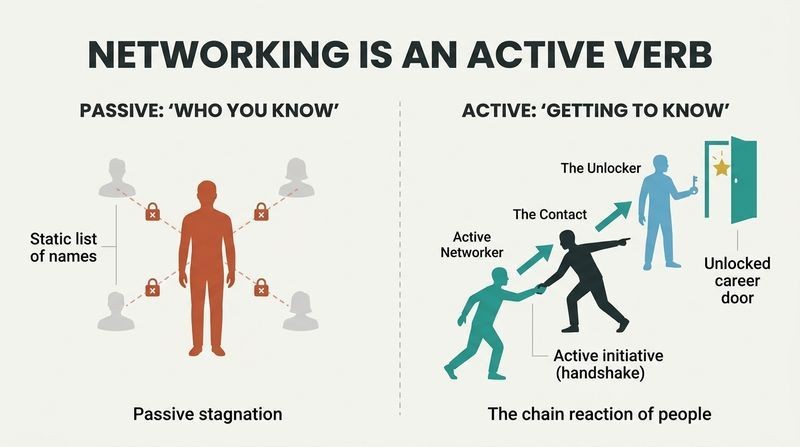
The insight anticipates what sociologist Mark Granovetter later called "the strength of weak ties": acquaintances, not close friends, most often deliver job leads because they bridge into new networks. Matthews adds a behavioral wrinkle. The barrier is rarely opportunity, it is the reluctance to ask and impose. Modern research on "networking discomfort" confirms people systematically underestimate how willing strangers are to help. One caution: the Johnson model rewards relentless extroversion, which can curdle into transactional social climbing. The best practitioners, as Matthews shows through Tip O'Neill, paired the hustle with genuine curiosity about others, making the pursuit feel like friendship rather than harvesting.
People judge every issue through the prism of their own kitchen table
All politics is local. Tip O'Neill's signature phrase means that to influence someone, ignore grand abstractions and hit what touches them personally. When a freshman congressman told a constituent he handled federal budgets, not her uncollected trash, she shot back that she "didn't want to start that high." Voters tell you what to worry about, not the reverse.
Hit rivals where they live. O'Neill once defended a jobs bill by reading aloud, on cable TV piped into his opponent's district, the names of unsafe bridges in that Republican's hometown of Peoria. The national debate instantly became a local one. Machiavelli made the same point in 1513: a ruler present in person spots trouble "in the bud," while a distant one learns of problems only when they are incurable.
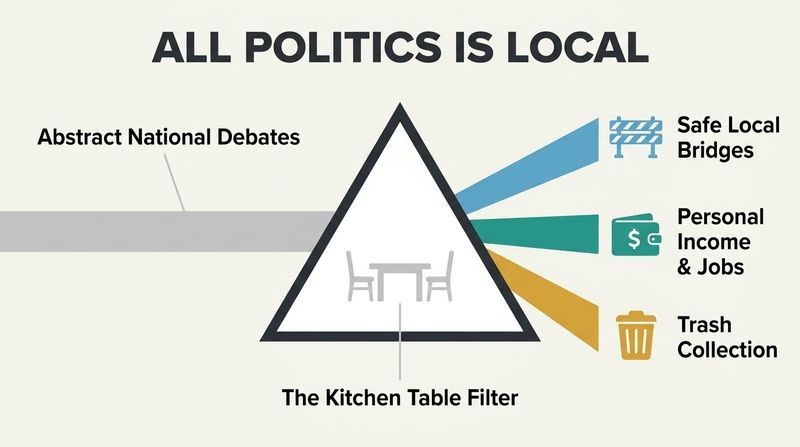
This is emotional proximity theory dressed in cigar smoke. Behavioral economics backs it: people weigh vivid, personal, near-term stakes far more heavily than diffuse or distant ones, a bias Daniel Kahneman links to the availability heuristic. Matthews uses Hillary Clinton's 1994 health plan as counter-example, arguing it failed because it seemed aimed at the non-working poor rather than the insured middle class who felt their hard-won benefits threatened. The framing is contestable and politically loaded, but the underlying mechanism is sound. The lesson generalizes well beyond politics: persuade a boss, a customer, or a spouse by translating your ask into their felt self-interest.
To win loyalty, let people do favors for you, not the reverse
Receiving beats giving. Counterintuitively, the surest way to bind someone to your cause is to ask them for help. Benjamin Franklin noticed that a rival who lent him a rare book became a lifelong friend. Machiavelli observed that citizens who sacrificed their homes defending a prince grew more devoted, not less. The act of investing creates commitment.
Deputize an army. Ross Perot told supporters he would only run in 1992 if they got him on all fifty ballots, turning passive fans into an owned movement that delivered 19 percent of the vote. Jimmy Carter wrote personal letters to every Democrat who lost a 1974 primary, recruiting a "Trojan peanut" brigade of grateful outsiders who powered his 1976 rise. People who bet on you cannot afford to see you fail.
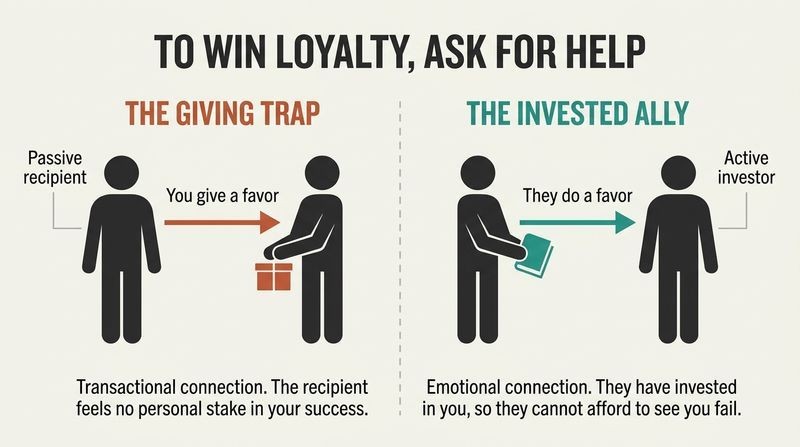
This is cognitive dissonance in action, later formalized as the "Ben Franklin effect" and validated by Jecker and Landy's 1969 experiments: doing someone a favor makes us like them more, because the mind rationalizes the effort. Fundraisers exploit the same asymmetry with donor lists, since past givers reliably give again. The deeper wisdom is that dependence, framed as inclusion, is a gift. Matthews notes the reluctance most feel to ask, mistaking self-reliance for strength. One nuance worth adding: over-asking without ever reciprocating breeds resentment, so the effect works best inside a broader sense of shared mission where contributors feel like stakeholders, not marks.
Nobody trusts a traitor, so dance with the one that brung ya
Loyalty is political capital. In a city that produces only currency and deals, your word is your collateral. Betray a patron and you become a Benedict Arnold whose future promises are worthless. Matthews shows two charismatic, telegenic men, John Connally and John Lindsay, both destroyed presidential hopes by switching parties. Voters may not grasp ideological nuance, but they smell an opportunist instantly.
Two corollaries sharpen the rule. First, you hire your boss: choose whom to serve carefully, because loyalty, once given, is hard to exit. Second, "what have you done for me lately?" A relationship decays without regular maintenance. Senator Barkley recounted a constituent who, reminded of decades of favors, still asked what Barkley had done for him recently. Machiavelli advised inflicting injuries all at once but doling out benefits slowly.
The traitor penalty maps onto game theory's reputation dynamics: in repeated games, defectors get frozen out because other players share information about who breaks deals. Robert Axelrod's tournaments showed that durable success comes from being provokable but fundamentally cooperative, exactly the O'Neill profile Matthews admires. The "benefits little by little" advice foreshadows behavioral findings on hedonic adaptation, since spreading rewards out sustains gratitude longer than a lump sum. The uncomfortable edge: this ethic can trap people inside failing alliances out of tribal fealty. Phil Gramm's honorable model, resigning his seat before switching parties, shows the one legitimate exit: give back what was given before you leave.
Keep your enemies so close they cannot wiggle against you
Co-opt, don't banish. Reagan's masterstroke was hiring James Baker, the man who had run two rival campaigns against him, as White House chief of staff. Placed inside the tent with his fortunes chained to Reagan's success, Baker had no room to build a competing empire. Lincoln did the same, stacking his cabinet with rivals who each thought themselves fit to be president, keeping their resignation letters in his safe like "a melon in each corner of my sack."
Position them so they can't secede. Carter's opposite error is instructive. He gave HEW Secretary Joseph Califano free rein to run his own department, and Califano pursued antismoking and antidiscrimination crusades that cost Carter politically in tobacco states, all while Carter felt powerless to rein him in. Johnson's rule: hug enemies so tight they can't move.
The principle echoes the counterintuitive management logic behind "a team of rivals," the Doris Kearns Goodwin framing of Lincoln's cabinet, and it aligns with organizational research showing that dissent contained inside a decision structure produces better outcomes than dissent left outside to snipe. The crucial mechanism Matthews isolates is incentive alignment, not mere proximity: Baker succeeded only because his rewards were structurally leveraged to Reagan's. Modern principal-agent theory says exactly this. Where the advice gets risky is when the co-opted rival is more skilled at internal politics than the principal, in which case the tent becomes a Trojan horse. Carter's Califano episode is really a story about failing to complete the co-optation.
Don't get mad, don't get even, get ahead
Revenge is a bad investment. Matthews tells of "Sully," who spent eight obsessive years engineering the defeat of a congressman who fired him, recruiting spoiler candidates to bleed off votes. He won, but confessed his target had "lived rent-free in my head" the entire time. Congressional veterans dismiss the get-even ethic as too expensive and too slow.
Outgrow your rivals instead. When Governor Bowles snubbed party chairman John Bailey for a Senate seat, Bailey swallowed the insult, made peace, and methodically built power until he became Democratic National Committee chairman under Kennedy. Nelson Mandela, after 27 years in prison, invited his former jailers to his inauguration. Reagan quipped that he always threw his golf club toward the hole, so he could retrieve it on the way to his goal.
The neuroscience of grudges supports Matthews: rumination keeps stress-hormone circuits active, and the target of your obsession, as Sully learned, occupies mental real estate you could spend elsewhere. Positive psychology research on forgiveness links letting go to lower cortisol and better cardiovascular health. Mandela's magnanimity was not saintly softness but strategic genius: reconciliation stabilized a country that vengeance would have torn apart. The Gingrich anecdote (shutting down the government partly because Clinton made him deplane from the rear of Air Force One) is the cautionary flip side, showing how wounded ego, publicly confessed, can vaporize political leverage overnight. The through-line: energy spent on retaliation is energy not spent climbing.
A lie left unanswered becomes the truth within twenty-four hours
Leave no shot unanswered. Michael Dukakis entered the summer of 1988 with a 17-point lead and lost because he let the Bush campaign define him. Willie Horton, the Pledge of Allegiance, the tank photo: each attack went unrebutted until a nuts-and-bolts centrist had been repainted as an un-American softie on crime. Bill Clinton learned the lesson, building a 1992 "war room" whose mission was to rebut every charge before the reporter had even finished writing it.
Fight back with wit, not whining. Matthews catalogs counterattack methods: catch them in a lie (Moynihan exposed his opponent's inflated war record), ridicule (FDR's mock-solemn defense of his dog Fala turned the tables on Dewey), and jujitsu (redirecting an attacker's own force). Claude Pepper lost his 1950 Senate seat by refusing, on principle, to answer smears he later realized he should have hit head-on.
This anticipates the "illusory truth effect," the well-documented finding that mere repetition raises perceived truthfulness, even for claims people initially know are false. Silence in the face of accusation reads, to most audiences, as tacit admission, a bias prosecutors and PR crisis managers both exploit. The 1988 campaign became the textbook case taught in political science courses precisely because Dukakis's failure was so total and so avoidable. The nuance Matthews underplays: rapid-response culture can also trap campaigns in reactive spirals, amplifying attacks by dignifying them. The art, which FDR's Fala speech exemplifies, is answering in a way that reframes rather than merely repeats the charge.
Only talk when it improves the silence
Listening is a power tool. Tip O'Neill began each day demanding "whaddaya hear?" then let a heavy silence pull information out of his aides like a vacuum. Lyndon Johnson's motto: "I never learned anything talking." Dick Gephardt rose by being an audience for his colleagues, becoming the best vote-counter in the House. Senator Muskie, nicknamed "Iron Pants," won landmark legislation not by brilliance but by being the last man in the room, patiently collecting the proxies of colleagues who left for lunch.
Silence forces the other hand. At the pivotal moment in May 1940, Churchill stayed mute when asked whether a peer could be prime minister, letting the long pause push his rival Halifax to disqualify himself. JFK resolved the Cuban Missile Crisis by simply ignoring Khrushchev's belligerent second cable and answering the conciliatory first.
Negotiation scholarship strongly validates this. Studies of skilled negotiators find they tolerate silence far longer than novices, who rush to fill pauses with concessions. The tactic works because of the human aversion to conversational voids, an anxiety FBI hostage negotiators deliberately weaponize. Muskie's "last man in the room" strategy is really about time preference: whoever can outlast the other captures the surplus, a dynamic visible in everything from labor strikes to divorce settlements. The Churchill example adds a subtler layer, that strategic silence lets a rival talk himself out of contention while you keep your hands clean. The limit: silence only intimidates when backed by evident competence, otherwise it reads as having nothing to say.
Concede the grand principle, then quietly pocket the actual stakes
Give them the words, keep the substance. Matthews's sharpest deal-making insight: separate the principle at issue from the tangible result, then surrender loudly on principle while taking the chips. Reagan sold the vulnerable MX missile in 1983 by adopting his critics' own language, agreeing the arms race should end and small mobile "Midgetmen" were the future, framing the MX as a mere "bargaining chip" toward that goal. Congressional moderates, flattered that they had "educated" the president, voted him the fifty missiles he wanted.
Speak the opponent's language. For Nicaragua aid, Reagan literally had a speech drafted by a former Mondale and Carter speechwriter, conceding America's "sorry history" in the region and rebel abuses, then won 30 flipped votes. Machiavelli's lion and fox: sometimes you win by making your opponent's argument for him.
This is a rhetorical judo that modern framing theory, particularly George Lakoff's work, would recognize instantly: adopt the other side's moral vocabulary and you disarm their emotional resistance while the underlying policy sails through. Sales training teaches the same move as "feel, felt, found." The tactic is ethically double-edged, since Matthews is candid that Reagan's concessions were often theatrical, with no intent to deliver on the conceded principle, as the abandoned Midgetman program showed. That crosses from persuasion into bad faith, and repeated use erodes exactly the reputational trust the loyalty chapter prizes. Still, as a diagnostic, the principle-versus-stakes distinction is invaluable: in any negotiation, know which you actually care about.
Announce your own bad news before your enemy weaponizes it
Hang a lantern on your problem. Rather than hide a liability, brandish it and set the terms of judgment yourself. Jimmy Carter turned "not a lawyer, not from Washington, a peanut farmer" into 1976 assets. JFK confronted anti-Catholic fear head-on before Protestant ministers in Houston in 1960, leaving opponents only bigotry as their argument. Jay Rockefeller disarmed a press corps resentful of his wealth by joking it cost him twelve million dollars to reach their dinner.
Spin extends the move. Once you gain credibility by admitting a problem, exploit it. Clinton crowned himself the "Comeback Kid" after finishing second in New Hampshire. Nixon's 1952 "Checkers speech" bared his modest finances, then counterattacked by demanding his opponents disclose theirs. Reagan killed the age issue in 1984 by joking he wouldn't exploit Mondale's "youth and inexperience."
Social psychologists call the underlying mechanism "stealing thunder," and controlled studies (notably in mock-jury research) confirm that revealing damaging information about yourself first measurably reduces its impact, because it signals honesty and denies opponents the drama of exposure. Crisis communication after the 1982 Tylenol tampering became the corporate gold standard for the same reason. The move works because audiences reward apparent candor and can hold only one narrative at a time. Reagan's Iran-Contra fumble is Matthews's counter-case: months of denial before admission produced a slow, credibility-draining torture that immediate confession, JFK-style after the Bay of Pigs, would have avoided. The skill is timing plus self-deprecation, not mere disclosure.
Lowball expectations so that mere survival looks like triumph
Manage the scoreboard, not just the score. Because performance is judged against expectations, set them artificially low. Eugene McCarthy "beat" LBJ in the 1968 New Hampshire primary despite actually losing 42 to a write-in incumbent, because the press had primed everyone to expect a rout. Mondale's manager packed a partitioned ballroom and pre-sold reporters on the idea that winning Georgia meant winning nationally, spinning a seven-of-nine-state loss into a comeback.
Sandbagging is the twin trick. Inflate a rival's expected strength so their real result disappoints. Carter's team convinced reporters Ted Kennedy had the "best organization ever seen in Iowa," then beat him three-to-one, collapsing the Kennedy campaign. Reagan spent decades playing the underdog "citizen amateur." As strategist Lee Atwater put it, David still gets good press for beating Goliath.
This is expectations management, the same discipline that drives quarterly earnings theater on Wall Street, where a company beating a deliberately soft forecast is rewarded even as revenue falls. Behavioral economics ties it to reference-point dependence: satisfaction is the gap between outcome and expectation, not the outcome itself, a core insight of prospect theory. Political scientists studying the "expectations game" in primaries have documented how media-defined benchmarks matter more than raw vote totals, exactly Matthews's point about McCarthy. The manipulation has limits: it requires a compliant press willing to accept your framing, and in a fragmented modern media landscape, competing spin operations can neutralize each other, making the raw numbers reassert themselves.
Position yourself between the people and the institution you run
Reagan redefined the presidency. Matthews's capstone: the "Great Wholesaler" governed the largest bureaucracy in history while positioning himself as a visiting citizen critical of government. He mastered the medium, using seating charts and closed-circuit monitors to greet reporters by first name, wide-set TelePrompTers to appear unscripted, and a ranch in jeans to seem off-duty. Where Carter absorbed blame as pure head of government, Reagan stayed head of state, rejecting failures "the way some organisms reject foreign tissue."
Positioning is a choosable stance. Clinton's 1996 "triangulation" blended both parties' positions to win reelection while congressional Democrats sank. Gary Hart threw an axe in flannel to position himself as the fresh outsider. Like Avis embracing "We're No. 2," you decide where to stand relative to your audience, then engineer every signal to plant yourself there.
Positioning, borrowed from Al Ries and Jack Trout's marketing theory, is really about occupying a distinct coordinate in the audience's mental map, and Matthews's genius is recognizing that a sitting president could brand himself as an outsider to his own government. That paradox foreshadowed decades of "run against Washington" campaigns by the very people who run it. The insight connects to construal-level theory: keeping psychological distance from institutional failures insulates personal approval, which is why Reagan's ratings survived events that would sink a leader seen as "the government." The critique, which Matthews half-acknowledges, is that this severs accountability from power, letting leaders claim credit while outsourcing blame to commissions and staff, a maneuver corrosive to democratic responsibility even as it is politically brilliant.
Analysis
Hardball is a work of applied Machiavellianism disguised as Washington memoir. Written in 1988 by a former Carter speechwriter and O'Neill aide, and expanded across editions, it distills observed political behavior into transferable rules of power. Its structure, four parts (Alliances, Enemies, Deals, Reputations) built from anecdote, is closer to Plutarch than to political science: Matthews teaches by portrait, using Johnson's showers, Reagan's TelePrompTers, and Nixon's Checkers speech as parables.
The book's enduring value is its insistence that power is a learnable craft, not a gift of charisma or birth. Matthews democratizes ambition, arguing that the habits which lift politicians (asking boldly, listening strategically, managing expectations) work in any organization. This is genuinely useful, and much of it anticipates findings later formalized by social psychology and behavioral economics: the Franklin effect, illusory truth, stealing thunder, expectations as reference points. Matthews was a shrewd empiricist before the research caught up.
The book's blind spots are equally instructive. Written in the twilight of the retail-politics era, it treats the press as a bounded, gentleman's-agreement institution, a model shattered by the fragmented, algorithmic media it did not foresee. Its spin and positioning chapters, ethically candid about manipulation, read differently in an age of disinformation where "a lie unanswered becomes truth" describes not tactics but civilizational threat. Matthews admires the game more than he interrogates whether the game serves the governed.
His later editions strain to fold Clinton and Gingrich into the original frame, sometimes with partisan editorializing (the Hillary healthcare passage) that dents the "no Republican way to collect garbage" neutrality he professes. Yet the core holds. As a field guide to how influence actually operates, in offices, faculties, and campaigns alike, Hardball remains sharp precisely because it describes human nature rather than policy. Its final image, the man in charge of the butter, is the whole thesis: real power hides in unglamorous leverage.
Review Summary
Hardball receives mixed reviews, with ratings ranging from 1 to 5 stars. Some readers appreciate Matthews' insider perspective on politics and find the anecdotes entertaining, while others criticize his writing style and repetitiveness. The book is seen as a guide to political strategies, offering insights into how politicians operate. Some readers find it informative and applicable to everyday life, while others view it as outdated or biased. Overall, opinions are divided, with some praising its political insights and others finding it self-aggrandizing or difficult to follow.
People Also Read








Glossary
Hardball
Clean, aggressive Machiavellian politicsMatthews's term for the disciplined, unsentimental practice of gaining and holding power. Not corruption or dirty tricks, but the aggressive yet legitimate craft of alliances, deals, and reputation-building. He frames it as a skill useful in any profession, most nakedly visible in public life, and distinct from idealized "civics book" notions of how leaders ought to behave.
Retail politics
Persuading one person at a timeWinning support through direct, personal, one-on-one contact rather than mass media. Lyndon Johnson was its master, working colleagues individually with the tailored "Johnson treatment." Contrasted with "wholesale" politics, which reaches large audiences at once via radio and television. Matthews argues retail skills remain the foundation of influence even in the media age.
All politics is local
People judge issues by self-interestTip O'Neill's maxim that voters and colleagues filter every issue through their immediate personal concerns rather than grand abstractions. To persuade or pressure someone, focus on what touches them at home. To attack a rival, hit them where they live, in their own district or backyard.
Hang a lantern on your problem
Publicize your own weakness firstThe tactic of openly acknowledging your liability before an opponent can exploit it, thereby controlling how it is judged. By naming the problem yourself (Carter's outsider status, JFK's Catholicism, Rockefeller's wealth), you gain credibility and deflate the attack. Often the first step before "spin."
Spin
Reframing events in your favorA media-savvy extension of hanging a lantern: first admit a problem to build credibility, then exploit that credibility to define events in the most self-serving way. Clinton spinning a second-place primary finish into being the "Comeback Kid" is the classic case.
Lowballing
Setting expectations artificially lowDeliberately minimizing expectations of your own performance so that a modest result looks like a triumph. Because outcomes are judged against expectations, a candidate who is expected to lose badly but merely loses narrowly is declared a winner, as with McCarthy against LBJ in 1968.
Sandbagging
Inflating a rival's expected strengthThe mirror image of lowballing: exaggerating an opponent's anticipated strength so their actual result disappoints and deflates them. Carter's team talked up Ted Kennedy's Iowa organization, then beat him three-to-one, collapsing Kennedy's momentum. Also used to build a rival up beyond his capabilities so he inevitably falls short.
Positioning
Choosing your stance toward audienceConsciously deciding where you want to stand in the public's mind relative to your audience and rivals, then engineering every signal to plant yourself there. Reagan positioned himself as a citizen-outsider critical of the very government he led; Clinton's "triangulation" positioned him between both parties.
The Johnson treatment
LBJ's overwhelming personal persuasionLyndon Johnson's famous technique of concentrating his entire attention on a target's individual needs, ego, and pressure points, then pressing his case at close physical range until resistance collapsed. Built on exhaustive research into what each person cared about, it made subjects feel their smallest concern was the most important thing in the world to Johnson.
Keep your enemies in front of you
Co-opt rivals into your campThe rule that a shrewd leader does not banish adversaries but brings them inside, positioning them so their success depends on his own. Reagan made rival James Baker his chief of staff; Lincoln built a cabinet of rivals. Derived from Johnson's earthier line about keeping people inside the tent.
FAQ
What's Hardball: How Politics Is Played, Told by One Who Knows the Game about?
- Insider's Perspective: The book offers an insider's view of the political landscape in Washington, D.C., focusing on strategies and tactics used by politicians.
- Machiavellian Politics: Chris Matthews defines "hardball" as "clean, aggressive Machiavellian politics," emphasizing strategic maneuvering.
- Real-Life Examples: Matthews uses anecdotes from notable political figures to illustrate how they navigate political complexities.
Why should I read Hardball?
- Practical Political Wisdom: The book provides practical advice applicable in politics and other professional or personal situations.
- Engaging Storytelling: Matthews combines humor and storytelling, making complex political strategies accessible and entertaining.
- Understanding Power Dynamics: Readers gain insights into power dynamics, enhancing their ability to navigate similar situations.
What are the key takeaways of Hardball?
- Importance of Relationships: Building connections is crucial, as highlighted by the theme "It’s not who you know; it’s who you get to know."
- Local Focus: The phrase "All politics is local" underscores the need to address constituents' immediate concerns.
- Responding to Attacks: Matthews advises to "Leave no shot unanswered," advocating for proactive responses to criticism.
What are the best quotes from Hardball and what do they mean?
- "Keep your enemies in front of you": Maintain communication with adversaries for better understanding and potential collaboration.
- "Don’t get mad; don’t get even; get ahead": Focus on goals rather than revenge, promoting a forward-thinking mindset.
- "It’s better to receive than to give": Asking for help strengthens relationships, creating a network of support.
How does Chris Matthews define "hardball" politics in Hardball?
- Aggressive Tactics: "Hardball" involves aggressive and strategic political maneuvering to achieve goals.
- Machiavellian Influence: The book draws on Machiavellian principles, emphasizing understanding human nature and power dynamics.
- Real-World Application: Illustrated through political anecdotes, showing how successful politicians employ hardball tactics.
How does Hardball illustrate the importance of alliances?
- Building Relationships: Forming alliances is crucial for political success, as seen in the chapter "It’s Not Who You Know; It’s Who You Get to Know."
- Retail Politics: Personal connections and face-to-face interactions lead to stronger alliances and support.
- Historical Examples: Examples like Lyndon Johnson's alliances demonstrate the power of strategic relationships.
What strategies does Matthews recommend for dealing with enemies in Hardball?
- Keep Communication Open: "Keep your enemies in front of you" suggests maintaining dialogue with adversaries for opportunities.
- Focus on Strength: Strengthen your position rather than retaliating, as advised in "Don’t get mad; don’t get even; get ahead."
- Use of Humor: Humor and camaraderie can diffuse tension and foster collaboration.
How does Hardball address the concept of reputation?
- Reputation as Power: A politician's reputation is a critical asset, influencing negotiation and alliances.
- Managing Perceptions: Controlling the narrative and managing public perception is crucial for maintaining reputation.
- Consequences of Betrayal: Betraying trust can damage reputation and support, hindering political goals.
What role does media play in the strategies discussed in Hardball?
- Media as a Tool: Politicians can use media to shape public perception and control narratives.
- Responding to Media Attacks: Quick and effective responses to media attacks are essential.
- Leveraging Coverage: Successful politicians use media coverage to amplify messages and counteract negatives.
How does Matthews suggest handling political setbacks in Hardball?
- Learn from Setbacks: View setbacks as learning opportunities and focus on getting ahead.
- Strategic Retreat: Sometimes stepping back and reassessing strategy is more beneficial than confrontation.
- Building Resilience: Successful politicians often bounce back stronger from challenges.
What are some specific methods or advice from Hardball?
- "Catch 'Em in a Lie": Exposing opponents' falsehoods can undermine their credibility.
- "Hang a Lantern on Your Problem": Address weaknesses openly to control the narrative.
- "Spin" Defined: Shaping public perception through strategic communication is crucial.
How does Hardball relate to current political dynamics?
- Timeless Strategies: Strategies like spin and reputation management remain relevant today.
- Media Influence: Insights into media dynamics are pertinent in the age of social media.
- Political Polarization: The book's exploration of hardball tactics reflects current political polarization.
Download PDF
Download EPUB
.epub digital book format is ideal for reading ebooks on phones, tablets, and e-readers.








































