

Key Takeaways
Everyone radiates a measurable energy field that mirrors your health
The aura is not mysticism, it is anatomy. Barbara Brennan, a former NASA atmospheric physicist turned healer, argues that a luminous energy field surrounds and penetrates every body. She calls it the Human Energy Field (HEF), a personal slice of a Universal Energy Field that connects everything. She points to laboratory support: Kirlian photography, Kilner's colored-screen aura studies, and Valerie Hunt's UCLA experiment that recorded skin frequencies matching the exact colors a psychic reported (blue near 250 Hz, red near 1000-1200 Hz).
Health shows up as light. A healthy person displays bright, balanced, flowing colors. Illness appears first as dark, stagnant, or torn energy, often years before physical disease. Brennan claims she saw a cancer patient's tumor as a black spot matching a later CAT scan.
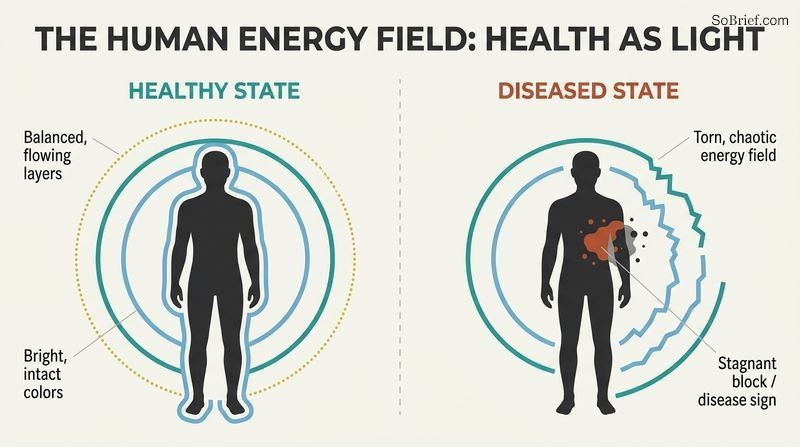
What's striking is Brennan's attempt to bridge subjective clairvoyance with objective instrumentation, a rare move in New Age literature. The Hunt UCLA correlation is genuinely intriguing, though skeptics note that electromyographic signals and reported colors can both be shaped by suggestion. The broader claim that fields predate physical tissue echoes Rupert Sheldrake's morphogenetic fields and Harold Burr's Yale bioelectric research on frog eggs. The weak link is repeatability: single anecdotal CAT scan matches are compelling stories but not controlled evidence. Readers can hold two truths at once, that subtle bioenergetic phenomena deserve investigation, and that Brennan's confidence outruns her documentation.
Illness begins in your energy field long before your body
Disease flows downhill through seven layers. Brennan maps the aura into seven bodies, alternating structured layers (etheric, mental, etheric template, ketheric) with fluid ones (emotional, astral, celestial). A distorted belief in the highest layer, for example 'I am superior,' cascades downward: it corrupts feelings, then thoughts, then creates a mental impasse, then blocked emotion, then a tangle in the etheric grid, and finally physical disease like ulcers.
Blocks are frozen feelings. When a child is repeatedly rejected while giving love, they clamp down the heart chakra to stop the pain. That stagnant, clogged energy, held for years, eventually degrades the physical organ. Every hiatal hernia she observed showed the same sprung-spring shape in the solar plexus chakra; every cancer patient showed a torn chakra.
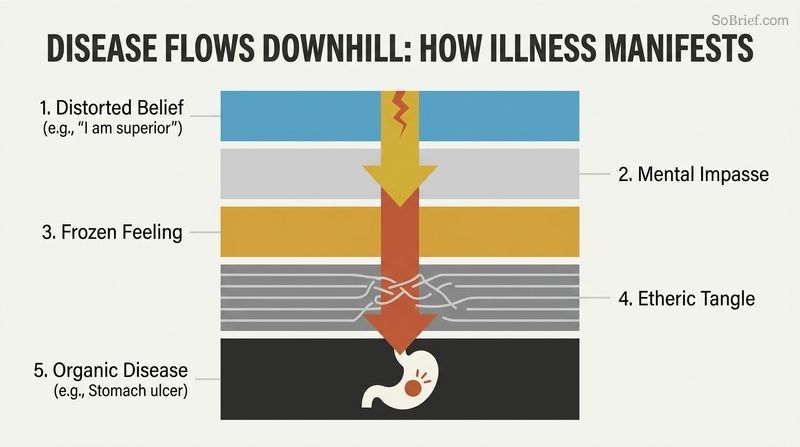
This is essentially a spiritualized psychosomatics, and Brennan explicitly credits Wilhelm Reich, Franz Alexander, and Flanders Dunbar. The claim that emotion precedes pathology has real support: chronic stress measurably raises cortisol, suppresses immunity, and correlates with ulcers, cardiovascular disease, and delayed wound healing. Where mainstream medicine says 'psychosocial stress modulates disease,' Brennan says 'blocked energy causes disease.' The danger is the corollary that patients somehow authored their cancer, which can slide into blame. Brennan tries to preempt this by distinguishing responsibility from fault, but the framework still risks burdening the sick with guilt over illnesses that are often stochastic or environmental.
Your seven chakras each govern a specific psychological capacity
Spin direction reveals function. Chakras are spinning vortices that draw energy from the field. Brennan and psychiatrist John Pierrakos diagnosed people by dowsing chakras with a pendulum: clockwise means open and healthy, counterclockwise means closed and projecting outward. Each center rules a life domain.
1. Root: will to live, physical vitality, grounding
2. Sacral and pubic: sexuality, pleasure
3. Solar plexus: your place in the universe, human connection
4. Heart: capacity to love without demanding return
5. Throat: taking responsibility for your own needs
6. Third eye: clarity of concepts about reality
7. Crown: connection to spirituality and integration
Front and back split feeling from will. Each center has a front aspect (emotions) and rear aspect (will), so imbalances reveal whether someone is too aggressive or too passive in that domain.
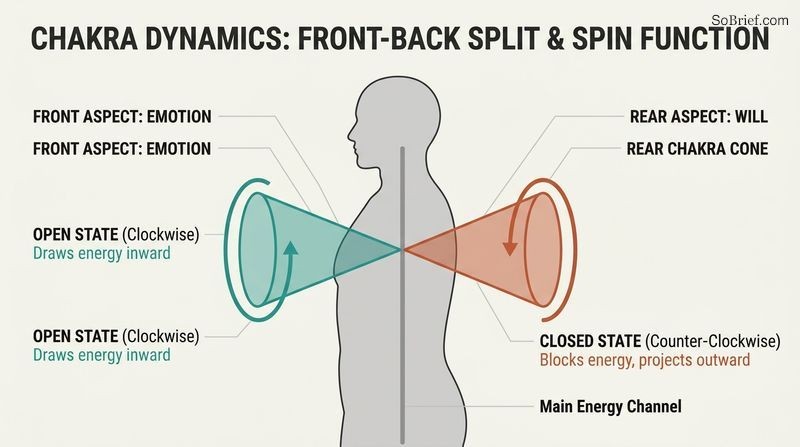
The chakra-as-diagnostic-grid is Brennan's most systematic contribution, translating a Sanskrit yogic map into a psychodynamic assessment tool. The pendulum method is where empiricists balk: ideomotor effect, tiny unconscious hand movements, fully explains pendulum motion, meaning the healer may be reading their own intuition rather than an external field. That does not make the readings useless, since a skilled clinician's intuition carries real information, but it relocates the source. The front (feeling) versus back (will) distinction is genuinely useful as a coaching lens, resonating with modern work on approach versus avoidance motivation and the passive-aggressive spectrum in personality psychology.
Your childhood wound crystallized into a body type and character
Five armor patterns, five life stages. Building on Wilhelm Reich and Alexander Lowen, Brennan links each character structure to the developmental moment the trauma struck and to a distinctive body and aura.
1. Schizoid: prenatal or birth hostility, thin fragmented body, flies out of body, core fear of annihilation
2. Oral: early abandonment, collapsed undernourished body, clings, feels empty
3. Psychopathic: seductive controlling parent, inflated upper body, needs to dominate
4. Masochistic: smothering control, compacted heavy body, whines and provokes
5. Rigid: rejection of sexual love, proud upright body, holds back feelings
The body is a crystallized problem. Brennan's radical claim: the deepest malady beneath all five is self-hatred, and your body is a schoolroom you designed to teach yourself the exact lesson your soul incarnated to learn.
Bioenergetic character theory is one of the more clinically grounded strands here, with a real lineage through Reich and Lowen. The mapping of posture to psychology has partial support: trauma does register somatically, as van der Kolk's work on how 'the body keeps the score' documents through chronic muscular guarding and dysregulated autonomic patterns. The overreach is typological rigidity, since sorting humans into five armored types can become a Barnum exercise where everyone recognizes bits of themselves in all five. Brennan hedges by having readers estimate percentages of each. The reframe of symptoms as self-designed lessons is spiritually consoling but empirically unfalsifiable.
Anyone can learn High Sense Perception by quieting the mind
Perception, not imagination. Brennan calls clairvoyant seeing High Sense Perception (HSP), perceiving beyond the normal five senses. She insists it is a trainable skill, not a mystic gift, that begins by entering an expanded state through meditation, jogging, or sitting silently as she did as a child in Wisconsin woods.
Each sense routes through a chakra. Kinesthetic feeling comes through the root, sound and smell through the throat, images through the third eye, whole concepts through the crown. She recommends starting with whichever ordinary sense you already favor. Her simplest exercise: point a finger near your palm in dim light against a plain background and watch for the haze that connects them. About 95% of people, she claims, see something on the first try.
The democratizing move here, that clairvoyance is learnable rather than innate, is rhetorically powerful and echoes contemplative traditions that treat perceptual sensitivity as a muscle. The neuroscience of expanded states is real: meditation reliably shifts brainwave activity, and prolonged sensory quieting produces genuine perceptual phenomena, from entoptic light to hypnagogic imagery. The honest question is whether trainees perceive an external field or generate internally consistent imagery, a distinction Brennan herself worried about as a trained physicist. Her remedy, correlating perceptions with independent verification like medical scans, is exactly the right instinct, though the book offers testimonials rather than blinded trials.
Discomfort is your body's guidance system, so stop ignoring it
The simplest guidance is a signal. Brennan's spirit guide, whom she calls Heyoan, teaches that everyday discomfort, physical, emotional, or situational, is a precise message that you have drifted out of alignment with your true self. Rest when tired, eat when hungry, change the circumstance that gnaws at you. Most people override these signals constantly.
Illness asks a question. When you get sick, the useful question is not only 'how do I kill this symptom' but 'what does this mean, what have I refused to hear?' Brennan's client Jenny, told to get a hysterectomy for abnormal uterine cells, instead took a month alone by the ocean with diet and meditation, released her self-blame over a miscarriage, and returned to normal test results.
Reframing symptoms as information rather than enemies aligns with a growing clinical appreciation of interoception, the brain's sensing of internal bodily states, which predicts emotional regulation and wellbeing. Antonio Damasio's somatic marker hypothesis makes a compatible case that bodily signals guide sound decisions. The obvious hazard is the same one that shadows the whole book: Jenny's story is a survivorship anecdote, and treating precancerous cells with meditation instead of surgery could be catastrophic advice for most readers. Brennan's own publisher inserts a warning to work under a physician. The wise synthesis is to honor the signal and still get the biopsy.
You create your reality, so responsibility beats victimhood and blame
Individuation is not separation. Brennan leans on quantum physics, Bell's theorem, Bohm's implicate order, and the holographic model, to argue we are not separate objects but inseparable parts of one interconnected whole. The Newtonian habit of seeing ourselves as isolated billiard balls is, she says, the root illusion that generates fear and eventually illness.
Two wrong responses, one right one. When a child gets AIDS from a transfusion, separation-thinking says either 'poor helpless victim' or the cruel 'they created it, their fault.' Holism says: what a hard lesson that brave soul chose, how can I help them love themselves? Responsibility grants power, because if you unconsciously shaped your reality, you can consciously reshape it. Blame only reinforces powerlessness.
The distinction between responsibility and blame is philosophically the sharpest tool in the book, and it maps onto locus-of-control research showing internal locus correlates with resilience and better health outcomes. The quantum framing, however, is where physicists wince: Bell's theorem and entanglement are real, but they do not license claims that individual minds instantaneously heal distant bodies, and 'quantum' has become New Age shorthand for 'interconnected magic.' The steelman is that Brennan uses physics as metaphor for a genuine ethical stance. The critique is that borrowing the authority of hard science for unproven healing claims blurs the line between inspiration and misinformation.
Healers rebalance the field they never generate the energy themselves
You are a conduit, not a battery. In her full spectrum healing method, the healer raises her own vibration to match what the patient needs, then plugs into the Universal Energy Field and lets it flow, like current from high voltage to low. Trying to radiate your own energy causes rapid burnout. The heart chakra is the crucible where spiritual energy converts to physical and back.
Work layer by layer. The healing sequence moves from chelation (clearing and charging the lower layers hand over hand from the feet up), through spine cleaning, then spiritual surgery on the fifth etheric template layer, then restructuring the seventh golden ketheric grid, then bathing the sixth celestial layer in universal love.
The conduit model is psychologically shrewd regardless of the field's literal existence, because it protects practitioners from the empathic depletion that drives caregiver burnout, a documented occupational hazard for nurses and therapists. Framing yourself as a channel rather than a source also reduces ego inflation and performance anxiety. The therapeutic touch lineage Brennan cites, Dolores Krieger's work introduced to nurses, later faced a famous debunking when a child's 1998 experiment showed practitioners could not detect a hand near theirs above chance. That does not settle whether relaxation, attention, and compassionate presence produce real benefits, which they plausibly do, only whether the mechanism is an energy field.
Do the inner work first, or the illness simply returns
Two healings, and inner comes first. Brennan splits healing into outer (applying energy, drugs, herbs, surgery to rebalance layers) and inner (confronting the faulty belief system, reliving and releasing the originating trauma, changing how you live). Outer methods can save a life fast, but if the corrupt belief stays, disease precipitates back into the body after symptoms clear.
Healing means remembering who you are. The deeper aim is not a symptom-free organ but a realigned soul. Her patient David, chronically ill for years, needed months of field repair before his body could even tolerate the drug chloroquine that finally cleared his liver. Each dose sank him into another buried emotional layer he had to feel and release.
The insistence that symptom removal without root change invites relapse is one of Brennan's most defensible claims, and it parallels evidence-based medicine on lifestyle disease: bariatric surgery or statins without behavioral change often disappoint, and relapse rates in addiction hinge on addressing underlying patterns. The integrative vision, healers and physicians collaborating, prefigures today's growing (if contested) field of integrative oncology. The caution is sequencing and dosage: the David case involves self-adjusting a prescription antimalarial by pendulum reading, which is genuinely dangerous. The sound kernel, that durable healing engages belief, behavior, and biology together, deserves separation from the risky specifics of how Brennan applies it.
Guard your own field, or you will absorb your patient's illness
Self-care is the first prerequisite. Because healing runs your field like a roller coaster of shifting frequencies, a depleted healer with lower voltage than the patient can pick up disease energy. Brennan prescribes exercise, clean diet, extra minerals, sunlight, and above all guarding private time. Her golden rule: first the self and what nourishes it, then careful pause, then the nourishment of others.
Clear the space and yourself. She recommends salt-and-soda baths to draw out dead orgone energy, drinking spring water after every session, never working under fluorescent lights or without ventilation, and using crystals matched to your field strength. A crystal vibrating faster than you drags and depletes you; one slightly stronger enhances you.
Strip away the orgone vocabulary and this is a rigorous burnout-prevention protocol that any helping professional could adopt: boundaries, rest, nutrition, and refusing to give from an empty cup. The insight that caregivers unconsciously start extracting their own unmet needs from clients if they neglect themselves is textbook countertransference and a leading cause of ethical lapses in therapy. The fluorescent-light warning has a kernel of legitimacy given flicker sensitivity and circadian disruption from certain lighting. The crystal and salt-bath specifics are unfalsifiable ritual, but rituals themselves reduce anxiety and signal transition, which is why even secular clinicians benefit from consistent pre- and post-session routines.
Your deepest lifelong longing is literally your reason for living
Longing points to your task. Brennan claims each soul incarnates with a personal task (a lesson like learning leadership) and a world task (a gift to give). You built your body and energy system as the precise tool for that work, and the thing you have wanted to do more than anything since childhood is your life task. Blocking that flow blocks your purpose and eventually manifests as illness.
Follow it to get well. Since energy blocks lead to disease, and blocks are how you separate yourself from your calling, your specific illness is directly linked to your unlived longing. Her prescription: find how you stop yourself, clear the blocks, and do what you most long to do.
The equation of vocation with health resonates with robust findings that sense of purpose predicts longevity, lower cardiovascular risk, and slower cognitive decline, as shown in large cohort studies by Patricia Boyle and others. Viktor Frankl's logotherapy made the parallel case that meaning is a survival variable. Where Brennan overreaches is the tight causal loop that unlived purpose produces your particular disease, which converts a statistical association into a personal indictment and ignores genetics, pathogens, and accident. The actionable residue is sound and stirring: chronic self-suppression is corrosive, and orienting a life around genuine longing is among the better-evidenced routes to durable wellbeing.
Death is a transition, not a failure, even for the healer
The wall of forgetting is the real death. Heyoan teaches that we already died by walling off parts of ourselves in childhood, and that we incarnate to retrieve them. Physical death is a washing of the field: the three lower bodies dissolve as opalescent clouds, energy flushes up the spine, all blocks release, and the person's whole life passes before them as the aura turns white-gold.
Healing the soul, not just the body. This reframe changes the healer's job. She must not abandon a dying patient, because death may be healing rather than failure. Brennan describes seeing an angel of death, Azrael, guarding a patient and waiting for orders, and dying patients resting in white light, tended in what looked like a hospital on the other side.
Detaching death from the concept of medical failure is quietly one of the book's most humane contributions, anticipating the palliative care movement's insistence that a good death is a legitimate goal, not a defeat. The near-death experience details Brennan reports, the tunnel, the life review, the being of light, and reluctance to return, match the phenomenology cataloged by Raymond Moody and later studied by Bruce Greyson, though whether these reflect an afterlife or dying-brain neurochemistry (endorphins, temporal-lobe activity, oxygen changes) remains open. Believer or skeptic, the practical wisdom holds: fear of death distorts care, and presence with the dying is itself a form of healing.
Analysis
Hands of Light occupies an unusual niche: a 1987 New Age classic written by someone with genuine scientific training, an M.S. in atmospheric physics and years as a NASA researcher, who then became a psychotherapist and self-described clairvoyant healer. This hybrid pedigree is both the book's strength and its central tension. Brennan wants to have it both ways, invoking Faraday, Einstein, Bell's theorem, and Bohm's implicate order to legitimize claims about auras, chakras, spirit guides, and past-life surgery. The physics is deployed as metaphor and authority-borrowing rather than as evidence, and a trained reader should treat the scientific scaffolding as inspirational analogy, not proof.
Structurally the book is a hybrid textbook, part phenomenological memoir, part psychodynamic theory, part hands-on healing manual. Its most defensible material is the psychosomatic and bioenergetic lineage from Reich, Lowen, and Pierrakos: the idea that emotional trauma registers somatically, that chronic defensive patterns shape posture and physiology, and that symptom suppression without addressing root causes invites relapse. These claims have real, if partial, support in modern research on stress physiology, interoception, trauma somatics, and purpose-and-longevity studies.
The weakest material is the literal ontology of the seven-layer field, pendulum diagnostics (readily explained by the ideomotor effect), and etheric surgery performed by spirit guides. Therapeutic touch, which Brennan's lineage helped popularize, failed a famous controlled test. Yet dismissing the whole enterprise misses why it endures. Brennan offers a coherent language for subjective experience, a compassionate reframe of illness and death, and a burnout-prevention ethic for caregivers. Her responsibility-versus-blame distinction and her vocation-as-health thesis are genuinely valuable.
Read as literal medicine, the book is hazardous, especially where it implies meditation can substitute for surgery. Read as a phenomenology of healing presence, embodied psychology, and meaning-making, it retains real worth. The mature stance holds both: take the biopsy and honor the signal.
Review Summary
Hands of Light receives mostly positive reviews, with readers praising its comprehensive approach to energy healing. Many find it informative, life-changing, and essential for those interested in chakras and auras. The book's scientific basis and detailed explanations are appreciated, though some find it dense and technical. Readers value the author's combination of physics, psychology, and spirituality. While some consider it a must-read for healers, others find certain sections challenging to grasp without prior knowledge. Overall, it's viewed as a profound resource for understanding human energy fields and healing practices.
People Also Read



FAQ
What's Hands of Light about?
- Exploration of Human Energy Field: Hands of Light by Barbara Ann Brennan explores the Human Energy Field (HEF) and its impact on health and healing. It combines personal experiences with scientific observations to explain the interaction between the aura and physical and emotional well-being.
- Healing Through Energy Work: The book emphasizes spiritual healing, particularly through the laying-on of hands, and shares insights on manipulating energy for healing and self-discovery.
- Integration of Science and Spirituality: Brennan connects scientific views with metaphysical concepts, suggesting that understanding the energy field can lead to greater self-awareness and healing.
Why should I read Hands of Light?
- Unique Perspective on Healing: It offers a fresh approach to healing beyond conventional medicine, focusing on the body's energy dynamics and encouraging exploration of personal energy fields.
- Practical Exercises Included: The book contains exercises to help readers develop High Sense Perception (HSP) and understand the aura, making the concepts accessible and applicable.
- Personal Growth and Transformation: Emphasizes self-healing and personal transformation, teaching readers to identify and release energy blocks for a more fulfilling life.
What are the key takeaways of Hands of Light?
- Understanding the Aura: The aura is a manifestation of the HEF, connected to physical and emotional states, with colors and patterns providing health insights.
- Role of Chakras: Chakras are significant in the energy system, each corresponding to different psychological functions, helping address emotional or physical issues.
- Healing as a Process: Healing involves both the healer and the individual, emphasizing intention, awareness, and the connection between spiritual and physical realms.
What are the best quotes from Hands of Light and what do they mean?
- “Love is the face and body of the Universe.”: Love is the fundamental energy connecting all beings, suggesting healing and wholeness come from recognizing this universal love.
- “All suffering is caused by the illusion of separateness.”: Emotional and physical ailments stem from feeling disconnected, and understanding this can lead to deeper healing.
- “You are the master of your life.”: Encourages taking responsibility for health and well-being, emphasizing self-healing and transformation through awareness and intention.
How does Barbara Ann Brennan define the Human Energy Field (HEF)?
- Energy Surrounding the Body: The HEF is a luminous body surrounding and interpenetrating the physical body, often referred to as the aura, with distinct layers and functions.
- Connection to Health: Imbalances in the HEF can lead to physical or emotional issues, and understanding it can facilitate healing.
- Dynamic and Fluid Nature: The HEF is dynamic, constantly changing based on thoughts, emotions, and interactions, allowing healing through energy and awareness shifts.
What are the seven major chakras and their functions according to Hands of Light?
- Root Chakra (1): Located at the spine's base, associated with physical vitality and safety, governing our earth connection.
- Sacral Chakra (2): Linked to emotions and sexuality, influencing pleasure, intimacy, relationships, and creative expression.
- Solar Plexus Chakra (3): Associated with personal power and self-esteem, governing identity and confidence.
- Heart Chakra (4): Center of love and compassion, essential for emotional healing and forming deep relationships.
- Throat Chakra (5): Governs communication and self-expression, crucial for authenticity and connection.
- Third Eye Chakra (6): Associated with intuition and insight, key for spiritual awareness.
- Crown Chakra (7): Connects to higher consciousness and spiritual awareness, representing divine and universal connection.
How can I develop High Sense Perception (HSP) as described in Hands of Light?
- Meditation Practices: Regular meditation helps quiet the mind and enhances sensitivity to subtle energies.
- Observation of Nature: Observing energy fields of plants and animals strengthens energy perception and fosters a deeper natural connection.
- Practice with Others: Engaging in exercises with others helps practice sensing and seeing auras, enhancing learning and providing feedback.
What are energy blocks and how do they affect the Human Energy Field?
- Definition of Energy Blocks: Stagnations or disruptions in the HEF's energy flow, manifesting as physical or emotional issues from unresolved feelings or traumas.
- Impact on Health: Energy blocks can lead to physical ailments if not addressed, creating imbalances affecting the physical body.
- Identification and Release: Recognizing and working through blocks is essential for healing, using techniques like bodywork, meditation, and energy healing.
How does Hands of Light connect spiritual healing with psychological well-being?
- Holistic Approach: Healing involves addressing both spiritual and psychological aspects, considering the whole person.
- Interconnectedness of Mind and Body: Emotional issues can manifest physically and vice versa, crucial for effective healing.
- Empowerment Through Awareness: Awareness of one's energy field and psychological patterns empowers individuals to take charge of their healing process.
What exercises are included in Hands of Light for self-healing?
- Visualization Techniques: Exercises aimed at opening chakras and enhancing energy flow, connecting with inner selves for healing.
- Breathing Exercises: Techniques to charge and open chakras, facilitating energy flow throughout the body.
- Daily Practices: Encourages regular engagement with energy awareness and self-care exercises for well-being improvements.
How does Hands of Light address the relationship between illness and the aura?
- Illness as Energy Blockage: Illness arises from blockages or distortions in the aura, addressable through energy healing techniques.
- Psychosomatic Connection: Emotional and mental states can manifest as physical ailments, emphasizing the psychosomatic nature of illness.
- Healing as a Journey: Healing is a journey of self-discovery, understanding, and addressing root causes of health issues.
What is the role of the healer according to Hands of Light?
- Channeling Energy: The healer channels energy from the universal energy field to facilitate the patient's healing process.
- Maintaining Clarity: Healers must maintain their own energy clarity and health to effectively support patients, emphasizing self-care.
- Guiding the Patient: The healer guides the patient through their healing journey, helping them connect with inner wisdom and body messages.
About the Author
Other books by Barbara Ann Brennan
Download PDF
Download EPUB
.epub digital book format is ideal for reading ebooks on phones, tablets, and e-readers.








































