

Key Takeaways
The way of the warrior is found in embracing death daily
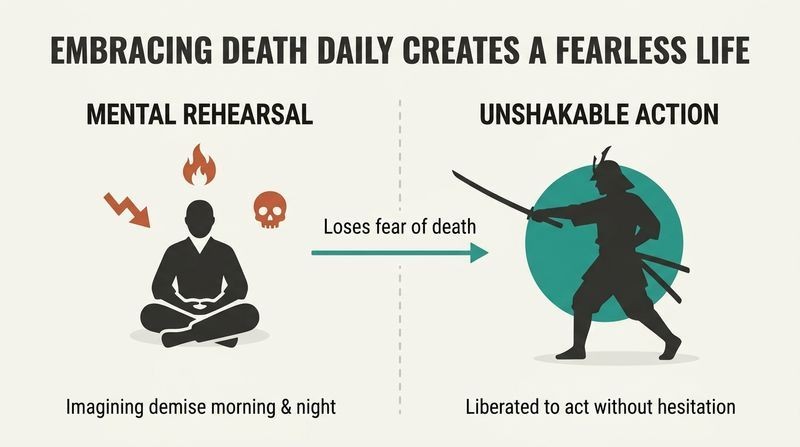
Hagakure's most famous line declares that bushido lives in dying. Yamamoto Jocho, a retired samurai dictating memories to a junior clansman around 1710, argued that when torn between life and death, a warrior should simply choose death without agonizing. This sounds suicidal, but the deeper meaning is paradoxical. By rehearsing your own death every morning and night, imagining yourself pierced by arrows, swept away by waves, or consumed by fire, you become joju shinimi, living as though already a corpse.
Once liberated from the fear of dying, you act freely, without the hesitation that ruins decisive moments. The samurai who accepts that the worst fate is merely becoming a masterless ronin or committing seppuku becomes unshakable. Death, faced squarely, becomes the source of a fully lived life.
What's striking is how closely this tracks Stoic memento mori and Heidegger's being-toward-death: confronting mortality clarifies action. Modern psychology echoes it too, with terror-management research showing mortality awareness reshapes behavior. The danger is obvious. Stripped of context, this creed fueled kamikaze recruitment in the 1940s, which is why the text was treated as inflammatory. Read charitably, Jocho is not glorifying suicide but attacking the paralysis of self-preservation. The insight generalizes: fear of loss, not loss itself, corrupts decisions. Athletes, surgeons, and entrepreneurs all know that hesitation at the decisive instant is fatal, and that acceptance of the worst outcome frees you to perform.
Rehearse tomorrow tonight so no moment catches you unprepared
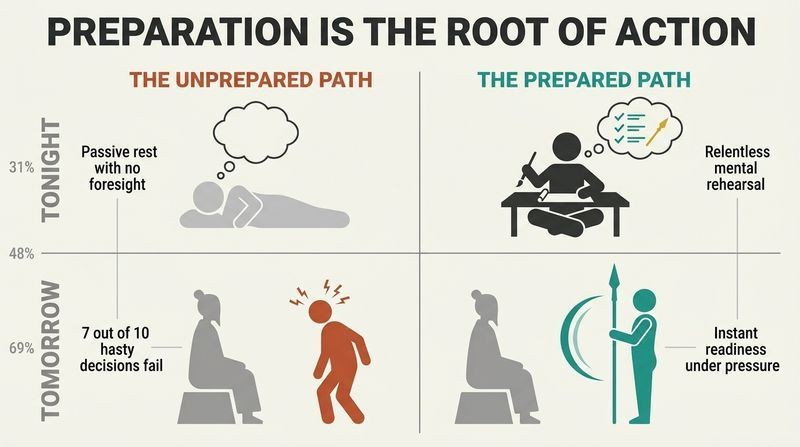
Jocho practiced relentless mental preparation. Before meeting anyone, he planned the greetings, likely topics, and points of etiquette the night before. He wrote down the next day's tasks so he stayed a step ahead. His governing principle: the present moment and the critical moment are one and the same. A retainer suddenly summoned to advise his lord who stammers and freezes has failed, not from stupidity, but from never grasping that now is always the time to act.
This readiness applies everywhere, from wielding a spear to answering an official. Jocho illustrated it with the bodyguard's spear, always positioned to protect the lord in a flash. He argued that solving problems requires anticipating them years ahead. Decisions made hastily without prior thought turn out badly seven times in ten.
This is essentially deliberate practice and scenario planning centuries before the terms existed. Elite performers rehearse contingencies until responses become automatic under pressure, exactly Jocho's point that the critical moment must feel like the present. Chess masters calculating eight moves ahead, pilots drilling emergency checklists, and negotiators war-gaming counterarguments all embody it. There is tension with the previous takeaway's celebration of reckless death-frenzy, and Jocho never fully reconciles calculated preparation with mad abandon. The resolution seems to be sequencing: prepare exhaustively beforehand, then abandon all calculation at the moment of execution. Plan like a strategist, strike like a berserker.
Serve with single-minded devotion, not clever talents you can showcase
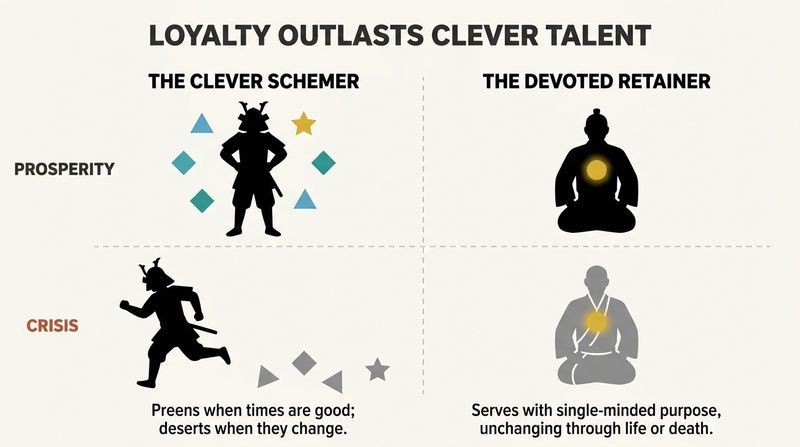
Jocho ranked wholehearted loyalty above skill. A useless retainer whose allegiance is total outranks a thousand gifted men who preen when times are good and desert their lord the moment he dies or retires. Jocho proved this with bitterness: when his own Lord Mitsushige died in 1700, he alone renounced his status to become a monk, while distinguished men who had pontificated grandly turned their backs instantly.
He distilled service into ichinen, single-minded purpose in the present moment. Life is a succession of one will at a time. A retainer needs no special wisdom, only to place his lord at the center of his heart and delight in the humdrum of serving. Talent devoid of devotion is a lower form of service. The dependable man who has already resolved to cast away his life is worth more than any clever schemer.
The loyalty ideal is culturally specific and troubling to modern readers who prize autonomy over blind fealty. Yet the underlying psychology is robust: intrinsic commitment outperforms transactional cleverness. Organizational research consistently finds that engagement and mission-alignment predict performance better than raw talent, and that mercenary high-performers who job-hop damage teams. Jocho's contempt for fair-weather retainers mirrors what happens in any institution during crisis, when the truly committed reveal themselves. The concept of ichinen, total presence in the now, anticipates modern flow states and mindfulness. The obvious limit: devotion to an unworthy cause becomes complicity, a danger Jocho never adequately confronts.
Correct others by first confessing your own faults
Jocho devoted extraordinary attention to the art of giving advice, arguing that pointing out someone's flaws to shame them is worse than useless. Anyone can spot faults and criticize. The skill lies in whether the correction is actually received. He prescribed a method: first ensure the person trusts you and is in the right frame of mind, begin with topics they care about, mention your own failures to evoke understanding, and time it so they take your advice as naturally as a thirsty man reaches for water.
His favored technique was mutual confession. Admit you struggle to overcome your own shortcomings and ask a friend to exchange honest opinions in confidence. Then bad habits can be mended without humiliation. Humiliating a man, Jocho insisted, never makes him better.
This is remarkably modern feedback theory. Contemporary research on criticism confirms that defensiveness blocks learning, and that psychological safety determines whether feedback lands. Jocho's mutual-confession technique prefigures peer coaching and the vulnerability-based trust Patrick Lencioni describes in team dynamics. His emphasis on timing and framing anticipates the behavioral science of the messenger effect, where who says something and how matters more than what is said. There is even a Confucian humility here: knowing the Way means knowing your own faults first. The approach demands patience most people lack, and Jocho admits ingrained habits of many years resist even the best-delivered counsel.
Mastery has no finish line; the moment you feel complete, you have strayed
Jocho rejected any notion of arriving. A man who believes he has reached a consummate level and stopped training has already erred. He relayed a swordmaster's account of ascending stages: the beginner obviously useless, the middle-level aware of his defects, the upper-level proud and skilled, and beyond them a master who feigns ignorance while others sense his unmatched skill. Yet even that master realizes his skill can never be perfect, and so continues traveling the path, neither conceited nor contemptuous.
Lord Yagyu captured it: I do not know how to defeat others; I only know the path to defeat myself, being better today than yesterday and better tomorrow than today. Jocho kept a diary of his daily mistakes, finding twenty or thirty every day, until he concluded a perfect day was impossible.
This is the growth mindset framed in swordsmanship, predating Carol Dweck by three centuries. The staged model of expertise closely resembles the Dreyfus model of skill acquisition, where true experts operate intuitively yet remain humble about limits. The paradox that the greatest masters feel least accomplished appears across domains, from the Dunning-Kruger effect (incompetence breeds overconfidence) to the impostor feelings common among high achievers. Jocho's mistake diary is a precursor to deliberate reflection practices and error logs used in medicine and aviation. The insight cuts against modern credentialism, which treats mastery as a certificate rather than an endless discipline of self-correction.
Excellence in an art can ruin you as a samurai
Counterintuitively, Jocho warned that becoming accomplished in an art could destroy a warrior. A specialist in an art is an artist, not a samurai. His own lord Mitsushige became so obsessed with poetry that his grandfather burned all his poetry books and dismissed the attendants who enabled the fixation. Jocho argued that to become truly accomplished in any art requires such preoccupation with it that all else is neglected, making the man useless in genuine service.
He conceded arts could be enjoyed as diversions once duties were done, and that skills like calligraphy, speech, and bearing should be refined daily. But the moment an art becomes your identity, you have traded warriorhood for entertainment. Aim to be called that samurai, he urged, not a martial artist who breaks his bones for nothing.
This is a provocative attack on specialization that resonates oddly in an age that worships expertise. Jocho's real target is identity capture: when a skill becomes who you are, it crowds out your primary duty. The modern parallel is the professional who becomes so absorbed in a narrow craft that broader responsibility withers, or the manager who keeps coding instead of leading. There is genuine tension with the deep-practice ethos of takeaway five, and Jocho's resolution is about hierarchy of purpose, not against skill itself. Skeptics would note that many samurai valued bunbu-ryodo, the twin path of literary and martial arts, suggesting Jocho's stance was contested even in his own tradition.
Never decide big matters when your mind is troubled or rushed
Jocho inverted conventional wisdom about deliberation. Lord Naoshige, the domain's founder, taught that judgment diminishes with prolonged deliberation and that military affairs must be executed swiftly, deciding within seven breaths. But this speed depends entirely on prior preparation and inner steadiness. Decisions made when the heart is adrift will be difficult and wrong. With an unperturbed, invigorated, dignified mind, resolutions come cleanly within seven breaths.
Separately, Jocho quoted the maxim to deliberate lightly on weighty matters, with Ishida Ittei's addition to be meticulous on minor ones. The logic: serious matters are few and should be anticipated far in advance so they can be handled quickly when they arrive. Everyday small matters, by contrast, deserve careful attention because they cannot be pre-planned. Prepare the big things early; attend carefully to the small.
This elegantly resolves an apparent contradiction between speed and care through the mechanism of preparation. Modern decision science supports it: Gary Klein's research on recognition-primed decision-making shows experts make rapid, accurate calls precisely because deep prior experience lets them pattern-match instantly. The seven-breaths rule is not recklessness but compressed expertise. The complementary maxim, decide big things lightly and small things carefully, sounds backward but reflects that major decisions should already be resolved through advance reflection, leaving only execution. Kahneman's work adds a caveat: rapid intuition fails in low-validity environments lacking clear feedback, so Jocho's rule holds best in domains where hard-won experience is genuine.
Fall down seven times, get up eight; ronin status is a lesson, not a disgrace
Jocho dismissed the idea that dismissal or hardship should crush a man. The domain saying held that you cannot become a true retainer until you have been a masterless ronin seven times. Fall seven times, rise eight, like a self-righting doll. Naridomi Hyogo had been a ronin seven times. A man of willpower quickly overcomes setbacks that were not caused by his own selfish desires.
Jocho reframed adversity as instruction from one's lord. He counseled a struggling ronin to be grateful he was forbidden from leaving the domain, because it proved the lord still valued him and planned eventual reinstatement. Only those who have endured hardship become useful; samurai who have never erred will never have what it takes. Revel in being discarded, he urged, for suffering forges the resilience that comfort cannot.
This is antifragility in samurai dress, the idea that certain systems and people grow stronger from stressors rather than merely surviving them. The self-righting daruma doll is a perfect visual for resilience psychology, which finds that post-traumatic growth is real and that adversity, when it does not overwhelm, builds coping capacity. Jocho's crucial distinction, that setbacks not caused by selfish desires are recoverable, hints at attribution theory: how you explain failure predicts whether you bounce back. The framing of hardship as a lord's deliberate test is a meaning-making strategy that Viktor Frankl would recognize. The limit is real, though, since crushing, meaningless suffering breaks people rather than tempering them.
Loyalty means shielding your lord's reputation, never grandstanding your own
Jocho drew a sharp line between real loyalty and performed loyalty. The retainer who dramatically remonstrates with his lord, forcing his own reasoning to win praise as a hero, commits great disloyalty, because when the details become known, the lord's honor is stained while the retainer's name shines. True counsel is delivered privately, discreetly, at a well-timed moment, so no one ever knows it happened.
He pointed to Nakano Shogen, who devised the solution to a dangerous feud among the domain's branch families yet let his lord take all credit, revealing the truth to no one. If a lord errs, a faithful retainer obscures the failing, advocates for him, and ensures no rumors spread. Making a public commotion when a lord ignores counsel is the most treacherous behavior a retainer can display.
This anticipates a durable principle of institutional stewardship: the best advisors are invisible, and credit-seeking corrodes trust. Modern chief-of-staff and consigliere roles embody exactly this ethic, where influence flows from discretion. Behavioral research on advice-giving confirms that public correction triggers reactance and reputational defense, while private counsel preserves the relationship. There is a darker reading, of course, since reflexively concealing a leader's faults enables the very cover-ups that destroy organizations, from corporate fraud to political scandal. Jocho's ethic assumes a fundamentally worthy lord and a closed community of honor. In transparent, accountable modern institutions, the line between loyal discretion and complicit silence becomes genuinely hard to draw.
The dependable one vanishes in good times and appears in crisis
Jocho's ideal was the kusemono, a word that in modern Japanese means a shady weirdo but which he redefined as the supreme, all-reliable warrior. Quoting his father Jin'uemon, he described the kusemono as the man who keeps away when things are going well but comes to your aid without fail when you are truly in need. Dependable men are exceptional warriors, and exceptional warriors are dependable men.
This unnamed hero is the archetype running through the entire book, the warrior Jocho aspired to become. The kusemono does not fuss over victory or defeat. He whips himself into a death-frenzy, shini-gurui, and acts. His value is precisely that he is not always visible or self-promoting. He is the friend who disappears when you are thriving and materializes when catastrophe strikes.
This is a beautiful character ideal that inverts the modern attention economy, where visibility is currency and self-promotion is constant. The kusemono is the opposite of the personal brand: valuable precisely because unobtrusive. It echoes the concept of the sleeping reserve, the person who conserves energy and credibility for the moment it truly matters. Research on social capital distinguishes fair-weather ties from the crisis-tested relationships that actually predict wellbeing, exactly Jocho's distinction. There is wisdom here for anyone drowning in performative busyness: real reliability is measured at the moment of need, not by daily visibility. The idea that showing up in emergencies defines character is both ancient and permanently relevant.
Analysis
Hagakure is not a treatise but a shattered mirror, roughly 1,300 vignettes dictated by Yamamoto Jocho, a middle-ranking retainer turned hermit-monk, to the younger clansman Tashiro Tsuramoto between 1710 and 1716. This makes it uniquely hard to summarize: it is contradictory by design, praising both reckless death-frenzy and patient prudence, both blind obedience and disobeying unjust orders. Alexander Bennett's translation and framing argue that many contradictions dissolve once you identify which rank of samurai each vignette addresses. Low-ranking retainers were expected to offer symbolic service through self-sacrifice; high-ranking ones offered loyalty of counsel requiring diplomacy and restraint.
The historical irony is central. Jocho wrote during the Pax Tokugawa, when samurai had become salaried bureaucrats with no wars to fight. His nostalgia for a bloodier, purer age and his cult of death were partly a lament for lost purpose. Tragically, the text he asked Tsuramoto to burn was resurrected in the 1930s and 1940s as militaristic propaganda, its most famous line, bushido is found in dying, weaponized for kamikaze indoctrination. Reading it today requires holding both its startling psychological wisdom and its capacity for abuse.
What endures is a proto-existentialist philosophy of action. Jocho anticipated Stoic memento mori, Dweck's growth mindset, Klein's rapid expert cognition, and modern feedback theory. His core move is counterintuitive: contemplating death produces not morbidity but freedom and decisiveness. Strip away the feudal specifics and blood, and you find a manual for living with total presence, single-minded purpose, and radical acceptance of loss. The recurring hero, the kusemono, embodies quiet reliability over self-promotion. The book's deepest tension, between devotion so absolute it forbids moral judgment and its scattered defenses of disobedience, remains unresolved, which is precisely why it still provokes.
Review Summary
Hagakure receives mixed reviews, with an overall rating of 4.01/5. Many readers appreciate its insights into samurai philosophy and way of life, finding wisdom in its teachings on death, honor, and duty. Some view it as a valuable historical document, while others criticize its extreme views and outdated principles. The book's structure and contradictions are noted, with some finding it disorganized or difficult to apply to modern life. Despite its controversial aspects, many readers find the book fascinating for its unique perspective on Japanese culture and samurai traditions.
People Also Read


Glossary
Bushido
The way of the warriorLiterally the Way of the warrior, the ethical code and lifestyle of the samurai. Hagakure is one of the few Tokugawa-era texts to use the term extensively. Jocho famously located its essence in the readiness to die, though the concept as a unified national ideal was largely constructed and romanticized in the late nineteenth and twentieth centuries.
Joju shinimi
Living as an already-dead corpseThe mental discipline of constantly living as though one were already dead. By rehearsing death every morning and night, the samurai frees himself from the fear of dying, achieving equanimity and the ability to act decisively without the hesitation that self-preservation causes. It is the practical method behind the maxim that the warrior's way is found in dying.
Ichinen
Single-minded purpose in the momentSingle-minded purpose or pure will focused entirely on the present moment. Jocho taught that life is a succession of one will at a time, and that a retainer who lives with unwavering focus on now, especially in service to his lord, needs no special talent. Loyalty and right action arise naturally from this state of total presence.
Kusemono
The supremely dependable warriorOrdinarily meaning an eccentric or shady person, but redefined in Hagakure as the ideal warrior: utterly dependable, staying out of the way when things go well but appearing without fail in a crisis. He acts without concern for victory or defeat, giving himself over to a death-frenzy. He is the unnamed hero embodying the book's ideal of bushido.
Shini-gurui
Frenzied determination to dieA death-frenzy or state of desperate, single-minded fury in which the warrior abandons all calculation and throws himself at his task or enemy with total disregard for consequences. Jocho argued that great deeds are impossible in a normal frame of mind and that even many men cannot stop one who has entered this state, resolved to perish.
The Four Oaths (shiseigan)
Jocho's daily morning-night pledgesFour vows Jocho recited morning and night: never to fall behind others in the Way of the warrior, always to be ready to serve his lord, to honor his parents, and to serve compassionately for the benefit of others. He claimed that chanting them daily doubled a man's strength and that meditating on them yielded wisdom and resolved problems.
Junshi (oibara)
Ritual suicide following one's lordThe practice of a retainer committing ritual suicide to follow his deceased lord in death, considered the highest expression of loyalty. It was banned in the Nabeshima domain in 1661 and nationally by 1663. Denied this death, Jocho instead took the tonsure and became a monk as a form of social junshi when Lord Mitsushige died in 1700.
Giri
Binding obligation and dutyThe obligation to act in accordance with established social protocols, especially a retainer's duty of service to his lord even at the cost of his life, repaying the favor (on) bestowed on his family. Broader than a contract, it carries deep emotional weight; Lord Naoshige claimed he could weep from giri toward ancestors he had never known.
Shudo
Samurai male-love bondThe Way of the young, a formalized homosexual bond between an older samurai and a younger man, considered a pure relationship of loyalty and mutual sacrifice in warrior culture. Hagakure treats it seriously, advising a five-year test of devotion and framing its ideal, to love and not love at once, as analogous to the secret devotion owed to one's lord.
FAQ
What's Hagakure: The Secret Wisdom of the Samurai about?
- Samurai Philosophy: Hagakure is a collection of reflections on the samurai way of life, focusing on loyalty, honor, and the acceptance of death. It serves as a guide to understanding the ethical framework of samurai behavior during the Tokugawa period.
- Historical Context: Written by Yamamoto Tsunetomo, the text captures the essence of bushido, or the way of the warrior, in the early 18th century. It consists of approximately 1,300 vignettes reflecting the social and political milieu of the Saga domain in Japan.
- Complex Ideals: The content often presents contradictory views, exploring the tension between loyalty to one’s lord and personal desires. This duality invites readers to delve into deeper philosophical questions about duty and honor.
Why should I read Hagakure: The Secret Wisdom of the Samurai?
- Insight into Samurai Culture: The book provides a unique perspective on the samurai ethos, which has influenced Japanese culture and martial arts. It offers insights into the values that shaped the behavior and mindset of warriors.
- Timeless Wisdom: The principles of loyalty, courage, and acceptance of death resonate with universal themes of honor and duty. These lessons encourage readers to reflect on their own values and commitments.
- Cultural Significance: Referenced in various media and literature, understanding Hagakure enriches one’s appreciation of samurai culture and its legacy, making it significant for those interested in Japanese history and philosophy.
What are the key takeaways of Hagakure: The Secret Wisdom of the Samurai?
- Four Oaths of the Samurai: Jōchō emphasizes commitments like pursuing the Way of the warrior, serving one’s lord, honoring parents, and serving others compassionately. These oaths encapsulate loyalty, filial piety, and selflessness.
- Acceptance of Death: A central theme is that “The Way of the warrior is to be found in dying,” reflecting the samurai's acceptance of death as integral to their duty, encouraging a mindset of living fully and fearlessly.
- Contradictions in Service: The text explores the complexities of loyalty and service, illustrating that true devotion may require navigating conflicting emotions and circumstances.
What are the best quotes from Hagakure: The Secret Wisdom of the Samurai and what do they mean?
- “The Way of the warrior is to be found in dying.”: This emphasizes the samurai's acceptance of death as a noble aspect of their existence, suggesting that true valor lies in the willingness to sacrifice oneself for honor and duty.
- “A samurai should be excessively obstinate.”: Reflects the idea that determination and resolve are crucial traits for a warrior, implying that a samurai must be unwavering in their commitment to their duties and ideals.
- “All that matters is having single-minded purpose.”: Underscores the importance of focus and dedication in a samurai's life, suggesting that clarity of purpose is essential for achieving one’s goals and fulfilling obligations.
How does Hagakure: The Secret Wisdom of the Samurai define bushido?
- Bushido as a Way of Life: Hagakure defines bushido as the ethical code governing samurai behavior, emphasizing loyalty, honor, and acceptance of death. It shapes a warrior's actions and decisions.
- Interconnectedness of Life and Death: Bushido is deeply intertwined with the concept of death, suggesting that a true warrior must live with constant awareness of mortality, encouraging decisive and honorable actions.
- Moral and Ethical Framework: Bushido serves as a moral compass for samurai, guiding their interactions and responsibilities to their lords and families, encompassing virtues like courage, compassion, and self-discipline.
What is the significance of loyalty in Hagakure: The Secret Wisdom of the Samurai?
- Absolute Loyalty to One’s Lord: Loyalty is portrayed as the highest virtue for a samurai, with a warrior prepared to die for their lord, essential for maintaining honor and integrity.
- Complexity of Loyalty: The text explores nuances of loyalty, illustrating potential conflicts with personal desires or moral dilemmas, encouraging navigation of these complexities with wisdom and resolve.
- Loyalty as a Reflection of Character: Loyalty is depicted as a measure of a samurai's character, requiring selflessness and dedication, determining a samurai’s worth by their fidelity to their lord and clan.
How does Hagakure: The Secret Wisdom of the Samurai address the concept of death?
- Death as a Noble End: Jōchō emphasizes embracing death as a natural part of life, particularly for samurai, viewing acceptance of death as a source of strength, allowing warriors to act without fear.
- Living as if Already Dead: Advises samurai to “live as though already a corpse,” encouraging a mindset free from fear of death, fostering urgency and purpose in fulfilling duties.
- Ritual Suicide and Honor: Discusses seppuku (ritual suicide) as a means of preserving honor in failure or disgrace, viewing it as a final demonstration of loyalty and integrity.
What is the concept of giri in Hagakure: The Secret Wisdom of the Samurai?
- Definition of Giri: Giri refers to the obligation or duty a samurai has towards their lord and society, embodying the idea of fulfilling responsibilities and maintaining honor.
- Cultural Significance: Deeply rooted in Japanese culture, influencing social interactions and relationships, with Tsunetomo emphasizing its profound emotional weight.
- Impact on Behavior: Giri shapes samurai actions and decisions, often leading to prioritizing duty over personal desires, resulting in self-sacrifice, as seen in the willingness to commit seppuku for their lord.
How does Hagakure: The Secret Wisdom of the Samurai view the role of women in samurai society?
- Supportive Role: Women are seen as supportive figures within the samurai household, managing domestic affairs while husbands engage in battle, maintaining household stability.
- Virtuousness and Conduct: Emphasizes the need for women to uphold virtues and conduct themselves with dignity, valuing character and resilience.
- Influence on Samurai: Women’s actions and attitudes significantly influence samurai behavior, with anecdotes illustrating how a woman’s virtue can reflect on her husband’s honor.
What practical advice does Hagakure: The Secret Wisdom of the Samurai offer for samurai conduct?
- Mindfulness in Service: Emphasizes being present and attentive in service to one’s lord, maintaining respect and engagement.
- Sincerity in Actions: Advocates for sincerity in all dealings, ensuring genuine intentions in interactions.
- Preparation for Duty: Stresses the need for constant readiness and preparation, highlighting diligence and commitment in every action.
What insights does Hagakure: The Secret Wisdom of the Samurai provide on personal growth and self-improvement?
- Continuous Self-Reflection: Encourages ongoing self-reflection and pursuit of personal growth, highlighting adaptability and learning.
- Purging Limitations: Urges readers to identify and shed faults to achieve progress, emphasizing overcoming personal barriers.
- Courage to Change: Advocates for courage to change and improve oneself, inspiring readers to strive for excellence.
What is the significance of seppuku in Hagakure: The Secret Wisdom of the Samurai?
- Honor in Death: Seppuku is portrayed as a means of preserving honor, allowing samurai to die with dignity rather than face disgrace.
- Cultural Ritual: Treated as a cultural ritual with specific protocols, emphasizing the gravity and respect associated with the act.
- Expression of Loyalty: Often seen as the ultimate expression of loyalty to one’s lord, highlighting profound commitment involved in this practice.
Download PDF
Download EPUB
.epub digital book format is ideal for reading ebooks on phones, tablets, and e-readers.








































