
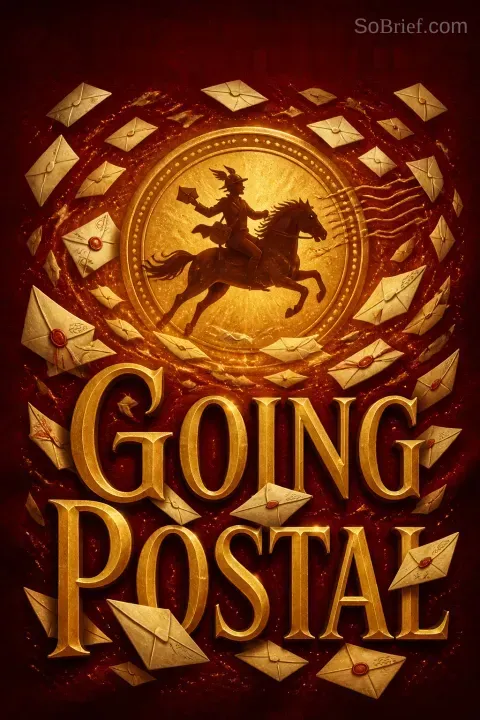


Plot Summary
Prologue
For nine thousand years, Anghammarad8 the golem sat on the ocean floor, watching dead ships sail past on underwater currents. He had been a messenger for King Het of Thut, but the island kingdom sank before he could deliver his clay tablet warning. He waited, patient as stone.
Once an anchor dropped nearby, the most interesting event in millennia. Far above, a young clacks engineer named John Dearheart fell to his death from a semaphore tower. He had been checking a stuck shutter when his safety rope came unclipped.
As he plunged, the tower's shutters kept rattling, carrying messages across the continent. The clacksmen believed the souls of dead linesmen traveled the lines forever. They kept John Dearheart's name moving in the Overhead, because a man is not dead while his name is still spoken.
The twin prologues introduce the novel's central preoccupation: messages, waiting, and what survives death. Anghammarad embodies absolute fidelity to a task across geological time; his nine-millennia vigil is both absurd and sublime. The dead ships sailing endlessly on underwater currents mirror the dead letters piling up in the Post Office: both are communication frozen, meaning stalled but not destroyed. John Dearheart's fatal fall establishes the human cost of the Grand Trunk's corruption and introduces the folk belief that becomes the plot's engine. The clacksmen's saying that a man remains alive while his name is spoken will, by the novel's end, be transformed from superstition into a weapon. Both prologues ask the same question: what duty do the living owe to the undelivered words of the dead?
The Hanging That Wasn't
Moist von Lipwig,1 known to the courts as Albert Spangler,1 faces the gallows at dawn. He has spent five weeks tunneling through his cell wall with a spoon, only to discover the escape route was bait. Lord Vetinari2 believes condemned men should possess Hope, that greatest of treasures.
Moist1 treats his hanging like a showman, signing the rope for the executioner's souvenir business. The trapdoor drops. Expert hangman Daniel Trooper has calculated the noose to stop Moist's1 heart for mere seconds. He wakes in Vetinari's2 office, where the Patrician2 discusses angels.
Sometimes, Vetinari2 explains, an angel offers a doomed man a second chance. The job: Postmaster General of the derelict Ankh-Morpork Post Office. Behind Moist,1 a door stands open to freedom. He opens it and finds a lethal drop to the cobblestones below. He accepts the job.
Vetinari's cruel pedagogy establishes the novel's philosophical framework: there is always a choice, but freedom includes the freedom to take the consequences. Moist's spoon-scraping labor was never escape; it was occupational therapy, managing despair through the illusion of agency. Vetinari's angel metaphor and his later observation that you only get one angel frame the entire narrative as a test of whether Moist can recognize and seize genuine transformation. The open door that leads to death is the perfect symbol of Vetinari's governance: options are always available, but only one leads to life. Moist's decision, motivated by survival rather than moral awakening, begins his reluctant journey from fraudster to public servant.
A Golem's Unblinking Pursuit
Moist1 flees within minutes of his reprieve, buying a horse and working cons in nearby towns. He sells a fake diamond ring to a greedy jeweler in Hapley. At three in the morning, his inn door splinters open. Moist1 dives out the window, twists his ankle, and hobbles to the stable, only to find his horse immobilized with a bright yellow clamp.
A golem3 fills the doorway, furnace-red eyes glowing. It introduces itself as Mr Pump,3 his parole officer. The golem slings Moist1 over one shoulder and the horse over the other, walking all night back to Ankh-Morpork.
Vetinari2 explains that Mr Pump3 never sleeps, eats, or stops. He can follow Moist1 across oceans. To demonstrate his absolute control, Vetinari2 orders Mr Pump3 to break one of Moist's1 fingers, then reveals the full directive: golems must not harm humans unless ordered by duly constituted authority.
The golem as parole officer literalizes the inescapability of consequence. Mr Pump's mechanical relentlessness (carrying the horse as well as the man) is both comic and terrifying: he is an embodied superego, incapable of being reasoned with, bribed, or tired out. Vetinari's finger-breaking demonstration is a psychological masterstroke; he does not actually permit violence, but the threat alone establishes absolute power. The revelation of the golem's full directive introduces a moral framework that will later challenge Moist deeply. Mr Pump's eventual calculation that Moist's frauds have caused 2.338 indirect human deaths will force Moist to confront consequences he has always evaded through the abstraction of financial crime.
Catacombs of Paper
The Ankh-Morpork Post Office is a gaunt, graffiti-smeared ruin. Its bronze motto reads 'NEITHER RAIN NOR SNOW NOR GLO M OF NI T' because thieves stole several letters years ago. Inside, pigeons nest in darkness and generations of guano crust every surface.
Moist1 meets Junior Postman Tolliver Groat,6 an elderly man in a grotesque toupee who has filled the inkwells daily for decades despite no customers. Apprentice Postman Stanley,7 an orphan raised by peas, obsessively collects pins and experiences unsettling 'Little Moments.' The cat Mr Tiddles, twenty years old, adheres to rigid schedules.
Groat6 reveals the mounds covering every floor are not droppings but undelivered letters, packed floor to ceiling. Four previous postmasters have died here recently, all in 'accidents.' A locked door leads somewhere no one dares enter. Stanley7 whispers the last one's head was all over a wall.
The Post Office is a mausoleum of communication, physically manifesting decades of broken promises and deferred connections. Groat and Stanley are not merely eccentric grotesques but institutional survivors, maintaining devotional rituals (filled inkwells, polished brass, nightly Regulation readings) for a dead religion. Their madness is proportionate to their fidelity: only the obsessive would remain faithful to an institution that has forgotten itself. The missing letters from the motto suggest that purpose itself has been stolen. The four dead postmasters transform the building from a ruin into a predator. The locked door, the whispers, and the chalk outlines promise that the past is not merely preserved here but actively dangerous. Pratchett explores how institutions fail: not through dramatic collapse but through gradual neglect, until only the most damaged souls remain to tend the ruins.
The Stolen Letters Return
Moist1 spots the Post Office's missing bronze letters adorning a hairdresser's shop called 'Hugos.' With Mr Pump3 looming silently behind him, he persuades the owner to pay for their reinstallation. Later, noticing an old street name on a letter he pocketed from the piles, Moist1 delivers the crumbling pink envelope to Antimony Parker, a greengrocer.
The letter is a marriage acceptance from Parker's sweetheart Aggie, mailed forty-one years earlier. Believing she had rejected him, Parker joined the Klatchian Foreign Legion while Aggie married someone else. Now elderly and reunited, they announce their wedding.
They credit Moist1 with divine intervention. News spreads. A crowd gathers at the Post Office. That night, the undelivered letters begin whispering to Moist,1 millions of trapped messages pressing against his consciousness, demanding to be read, demanding release from their paper tombs.
This turning point demonstrates Moist's unique genius applied to legitimate ends. He retrieves the stolen letters using the same skills of confident persuasion he once used for fraud. The Parker letter delivery is the novel's emotional hinge: one piece of paper, delayed forty years, transforms two lives. It proves concretely that the Post Office matters, that history is not irrevocable, that delayed connection is still connection. The public's reaction reveals how starved Ankh-Morpork is for stories of hope amid its cynicism. The letters' whispering represents the accumulated emotional energy of all those trapped messages, now finding a voice through Moist. He is becoming a conduit for their release, whether he wants the role or not. The supernatural element blurs the line between metaphor and manifestation: undelivered words have real power.
The Postman's Trial
The retired postmen of the secret Order of the Post blindfold Moist1 and subject him to the Postman's Walk. He stumbles over roller skates, endures ice water dumped down his neck, dodges swinging buckets. Groat6 slips him a dog whistle. At the climax, two large dogs are unleashed.
Moist1 uses commands learned from his grandfather's kennel of Lipwigzer fighting dogs to control them. He wraps his hood around his hand to defeat the razor-edged letterbox. The postmen grudgingly accept him. Mr Pump3 then presents the ancient winged postman's hat, found buried in the mail. When Moist1 dons it, the letters erupt.
Glowing words fill the air: 'Moist von Lipwig,1 deliver us!' Golden light suffuses him as the accumulated psychic energy of millions of trapped messages finds a voice. Moist1 shouts that he will move the mail. Groat6 weeps with vindication: the prophecy of a true postmaster is fulfilled.
The initiation ritual parodies every secret society while functioning as a genuine rebirth. Moist must physically reenact the postman's daily ordeal: dogs, hazards, sharp edges. His triumph comes not through heroism but through applied trickery (the hood wrap, the dog commands, the confident gibberish he spouts when caught without his hood). This is precisely what makes him the right man: he understands that ritual is theater and that theater has power. The hat is both ridiculous (pigeon wings, peeling gold paint) and numinous. When the letters speak, Pratchett literalizes a metaphor: undelivered words do distort reality, do haunt the living, do demand resolution. The golden light remains deliberately ambiguous: genuine supernatural event, mass hallucination, or Moist's own inner conviction finally ignited. The narrative wisely refuses to settle the question.
Stamps, Golems, and Ancient Messengers
Needing reliable postmen, Moist1 visits the Golem Trust and meets Adora Belle Dearheart,5 a chain-smoking cynic in grey who immediately pegs him as a fraud. She hires out golems, including Anghammarad,8 a golem nineteen thousand years old who once carried messages for drowned kingdoms.
Anghammarad8 wears a bronze box on his arm containing a warning for King Het of Thut, whose island sank nine millennia ago. He will wait for the universe to cycle around again before attempting delivery. Moist1 also partners with Teemer and Spools printers to create perforated postage stamps.
The stamps become an instant sensation, collected and traded as miniature currency. Stanley's7 obsession transfers from pins to stamps. The golem postmen, painted royal blue and gold, stride through streets impervious to dogs, their ancient messenger Anghammarad8 heralded as history's first courier.
The introduction of golems as postmen tests the boundaries of personhood and purpose. Anghammarad's cosmic patience (waiting for the universe to cycle around to deliver one message) reframes the Post Office's mission as something sacred and timeless. The stamp invention is Moist's con-man genius channeled productively, creating artificial scarcity and collectibility where none existed. Stanley's transfer of obsession from pins to stamps is both funny and poignant: some minds need to collect and categorize, and stamps offer a more socially useful outlet. Adora Belle is introduced as Moist's equal and opposite: equally sharp, equally guarded, but motivated by genuine loyalty to the golems rather than self-interest. Her immediate perception of Moist as a phoney establishes their relationship's central dynamic of mutual, wary recognition.
The Pirated Trunk
Over dinner at Le Foie Heureux, obtained by forging Gilt's4 signature on Grand Trunk stationery, Adora Belle5 explains the truth. Her father Robert Dearheart designed and built the clacks system with fellow engineers, borrowing money and mortgaging homes. Reacher Gilt's4 consortium appeared offering friendly advice and easy capital.
Through layered financial manipulation, they acquired controlling interest and forced the founders out. The Dearhearts lost everything. Adora Belle's5 brother John tried building a competing clacks system to recover their fortunes. He died falling from a tower, his fingers broken, though he always clipped his safety rope.
Now Gilt's4 company starves maintenance, overworks staff, and lets workers die. Gilt4 himself enters the restaurant: a piratical figure with flowing black hair, an eyepatch, and a cockatoo shrieking about twelve and a half percent. Moist1 meets his dark twin, a fraud more skilled and far more ruthless than himself.
This section transforms the novel from redemption story into revenge narrative. Gilt is Moist's shadow self: both are frauds who understand that people want to be fooled, both weaponize charisma and misdirection. The difference is that Moist's cons targeted individuals' greed, while Gilt's cons destroy institutions, families, and lives. The Dearheart tragedy provides the emotional stakes that Moist's Post Office revival previously lacked. Gilt's theatrical self-presentation (the eyepatch, the parrot, the name) advertises his villainy with a wink: he dares the world to stop him because he knows it rarely does. The tension between Moist and Gilt crackles with mutual recognition. Each man sees the other for what he truly is, which makes them more dangerous to each other than any honest enemy could be.
The Sorting Engine's Madness
Groat6 leads Moist1 to the cellar, where a blue glow emanates from the Sorting Engine. Designed by Bloody Stupid Johnson, this device was meant to sort letters but instead sorted reality. Johnson considered pi being irrational untidy, so he built a wheel where pi equaled exactly three, twisting the universe to accommodate his preference.
Letters began arriving before they were written, from alternate presents, from futures that never happened. The Post Office flooded with undeliverable mail from impossible senders. Chief Postal Inspector Rumbelow finally smashed the machine with a crowbar, reasoning that destroying the whole universe would leave no one to complain.
The wizards later determined the universe was destroyed and instantly remade, so everything was fine. The engine still glows, still warps anything placed too near it. Objects enter different space-time coordinates and emerge as splinters. This property will prove useful for disposing of a banshee.
The Sorting Engine is a perfect Pratchett invention: an absurd joke (pi equals exactly three) that doubles as a meditation on information, reality, and madness. The letters from alternate presents literalize the novel's theme: every unsent letter, every unspoken word, exists somewhere in possibility space. The machine's continued operation, even after being smashed, suggests that certain kinds of brokenness cannot be fixed, only managed. Rumbelow's pragmatic violence against the machine is the engineer's counterpoint to wizardly caution: sometimes you just hit the thing and see what happens. The engine also serves as Chekhov's gun, its reality-warping field becoming the means of Gryle the banshee's eventual destruction. The Post Office's decline began here: the machine broke the staff's spirit by demonstrating that the mail was literally infinite.
Fire, Claws, and Shattered Clay
Gilt4 dispatches Mr Gryle,10 a feral banshee, to eliminate Moist.1 The creature10 enters through the broken dome, slaughters pigeons, and attacks Groat6 (who is wearing Moist's1 winged hat). Stanley7 drives Gryle10 off by hitting him in the mouth with a sack of pins, but Groat6 is badly clawed. Gryle10 sets the building ablaze with lamp oil.
Moist1 rushes inside, rescues Groat,6 Stanley,7 and Mr Tiddles the cat, then confronts Gryle10 in the cellar. Using hard-won knowledge of banshee anatomy, he throws the creature10 onto the sorting engine. Gryle10 is torn apart as different parts of his body enter different space-time coordinates.
But fire rages. The rooftop water tank, superheated, collapses onto Anghammarad,8 who has been glowing cherry-red from the flames. The ancient golem8 explodes into dust. His ghost meets Death and chooses to remain in the void, finally free of all orders. He waited nineteen millennia. Now he waits for nothing.
This is the novel's darkest turning point, where Gilt's ruthlessness becomes fully tangible. Gryle's attack on the wrong target (Groat in the winged hat) underscores the novel's recurring concern with identity and disguise. Anghammarad's death is devastating because it is so utterly random: nineteen thousand years of patience, undone by firefighting physics. His choice to refuse an afterlife, preferring the void where there are no orders, is the novel's most radical statement about freedom. For a golem, the absence of command is paradise. Moist's rescue of the cat is both genuinely brave and cynically self-aware: he knows a hero must emerge carrying the cat. The fire destroys the old Post Office but also purges its accumulated madness. The banshee's death on the Sorting Engine is poetic justice: a predator undone by the warped physics that the Post Office has been struggling against for decades.
Gold from the Gods
With the Post Office in ruins, Moist1 sends prayer-letters to the temples of Offler, Om, Blind Io, and the minor goddess Anoia, asking for $150,000. Then, in public, he feigns divine revelation, drops to his knees, and announces the gods have shown him buried treasure.
He leads a crowd, including watchmen and a Times reporter, to a cabbage field where, years ago as Albert Spangler,1 he hid his criminal proceeds. His shovel strikes the chest. The priests of each temple claim their deity provided the money and demand tithes.
Vetinari2 advises Moist1 to donate $50,000 split four ways and use the rest for reconstruction. Newspapers print the miracle. Queues form at temples as citizens send their own money prayers. Kitchen drawers across the city begin sticking shut as Anoia, goddess of things that catch in drawers, gains a sudden influx of worshippers.
This is Moist's most characteristic con, and the one that most blurs the line between fraud and miracle. He launders his stolen fortune into legitimate civic funds by exploiting the public's hunger for divine intervention. The scheme only works because everyone wants it to be true: the priests want credit and tithes, the public wants proof that the gods care, Vetinari wants the Post Office rebuilt without spending taxes. But the money was genuinely his (stolen, certainly, but from banks and merchants), and his willingness to sacrifice his entire hidden fortune for the Post Office marks a genuine transformation. He is no longer hoarding for escape; he is investing in a future he intends to inhabit. Anoia's sudden popularity is a joke about how easily cults form around the inexplicable and the hopeful.
Rooftop Conspirators
At Adora Belle's5 urging, Moist1 climbs to the Post Office roof at night. In the old pigeon loft, he finds three men: Mad Al, Sane Alex, and Undecided Adrian, who call themselves the Smoking Gnu.9 They are former Grand Trunk engineers who worked on John Dearheart's failed Second Trunk.
Using a portable clacks tower and insider access codes, they have been secretly sabotaging the Grand Trunk for months, causing the breakdowns that let Moist's1 coaches compete. Now they offer 'the Woodpecker,' a message exploiting a resonance flaw in the tower design.
When sent through the system, every tower would shake itself apart in a cascade of structural failures. Total destruction. The Gnu9 want vengeance for John Dearheart and all the workers Gilt's4 greed has killed. Moist1 is tempted by the elegant finality of it, but total destruction would leave nothing for the Dearhearts to reclaim.
The Smoking Gnu represent the hacker ethos applied to a pre-digital world: they understand the system so deeply they can subvert it, viewing the Grand Trunk not as private property but as a commons that the current owners have forfeited through abuse. The Woodpecker confronts Moist with a moral dilemma he has never faced: do you destroy evil if the destruction also annihilates what is good? His usual con-man calculus (maximize personal gain, minimize risk) provides no guidance. The scene deepens the novel's treatment of the clacks as a living system, haunted by its dead and defended by its true believers. The Gnu's friendship with Adora Belle connects them to the emotional core: they are not anonymous saboteurs but John Dearheart's former colleagues, still loyal to his memory and to the idea of the Trunk as it should have been.
The Impossible Wager
Moist1 announces in the Times that his mail coach will race the Grand Trunk to Genua: two thousand miles of road against messages at lightspeed. At the starting ceremony, he performs theatrical gamesmanship: tearing pages from the test message book, granting the clacks a head start, demanding horse relays be banned if his broomstick is forbidden.
He proposes a personal wager of $100,000. Gilt,4 enraged beyond caution, accepts. Moist1 then spots Adora Belle5 in the crowd and shouts a marriage proposal over the cheers. She exhales smoke and says, calm as granite, 'Not yet.'
The coach thunders out of the city as the crowd roars. Moist1 jumps off at the old wizarding tower, leaving the coach to continue its doomed run while he joins the Smoking Gnu9 for his real plan. The coach is a decoy, the race a pretense. The true contest will be decided in code, not speed.
Moist's challenge is psychological warfare disguised as spectacle. Every gesture (the torn pages, the head start, the broomstick controversy) is designed to unsettle Gilt by suggesting Moist has a secret plan that makes the impossible possible. The $100,000 bet raises the stakes from professional rivalry to personal annihilation. Moist knows he cannot beat the clacks by speed; he is betting on his ability to destroy the Trunk before the message arrives. His public proposal to Adora Belle is simultaneously genuine and performative, perfectly capturing his divided nature. Gilt's acceptance, driven by ego rather than calculation, demonstrates how successfully Moist has provoked his enemy into emotional rather than rational decisions. The coach departs as pure theater: Moist never intended to reach Genua by road.
A Weapon Refused
At the wizarding tower, the Smoking Gnu9 have erected a massive canvas sail and are ready to send the Woodpecker. Moist1 argues against destruction. Annihilating the towers would leave nothing for the Dearhearts to reclaim and would let Gilt4 blame sabotage for all the Trunk's failures.
Instead, Moist1 proposes inserting a fake message from the dead clacksmen, listing Gilt's4 crimes in the voice of those his greed has killed. The Gnu9 are appalled by the manipulation but recognize its effectiveness.
While Undecided Adrian hangs from the tower's edge (an owl attempts to push a dead mouse into his ear), Mad Al and Sane Alex reluctantly configure their portable tower to intercept the test message and replace it with Moist's1 ghostly accusation. Words, not fire. A lie that speaks truth. The canvas sail blocks the real signal; their smaller tower mimics the distant one, inserting the fake message into the flow of code.
The pivot from the Woodpecker to the fake ghost message is the novel's moral climax. Moist chooses deception over destruction, words over fire. The Woodpecker would be a clean, technological solution; the fake message is a messy, psychological solution that exploits human credulity and grief. Moist is doing what he has always done (convincing people to believe a story) but now in service of justice rather than profit. The Gnu's reluctance acknowledges the queasiness of the method while accepting its necessity: the dead cannot speak, but someone must speak for them. The message is a work of rhetorical craft designed to bypass rational skepticism and activate the listeners' hunger for cosmic fairness. The scene on the tower, with Adrian dangling and the surreal owl, maintains the novel's comic register while the serious sabotage unfolds.
Words of the Dead
At Unseen University, wizards and dignitaries gather where the race results will be announced. The omniscope connects to Devious Collabone, a young wizard stationed in Genua. Instead of the test message, Collabone receives Moist's1 fake communication and reads it aloud: a list of charges from the dead clacksmen, detailing theft, embezzlement, breach of trust, and corporate murder.
Directors erupt in protests, lawsuits, and one man's sudden amnesia. Vetinari2 silences all, then dispatches Commander Vimes to seize the Grand Trunk's offices and the Mercantile Credit Bank.
The board is arrested. Gilt4 slips away during the chaos. Across the continent, tower operators pass the message along without question, recognizing its truth even if they suspect its origin. The dead, at last, are heard. The Grand Trunk falls silent as the investigation begins.
The public reading of the message is a staged trial by public opinion, more devastating than any legal proceeding because it bypasses the technicalities Gilt's lawyers would exploit. The message works not because it presents new evidence but because it articulates what everyone in the industry already knows. The dead clacksmen are the perfect messengers because they cannot be cross-examined, sued, or bribed; their authority is absolute because it is unverifiable. Vetinari's swift action shows he was waiting for exactly this pretext: a public crisis that makes intervention politically unassailable. Gilt's silent flight, abandoning his confederates, reveals the essential cowardice beneath his piratical bravado. He is not a true believer in his own philosophy; he is simply a predator who runs when the prey fights back.
The Unraveling
While wizards untangle the financial fraud through a vast chalk-diagram of clerks and ledgers, Mr Pump3 is released from his parole duties and dispatched after the fleeing Gilt.4 Vetinari2 assigns Moist1 to administer the Grand Trunk alongside the Post Office. Moist1 negotiates: the Trunk should return to the Dearhearts and the other founders.
Vetinari2 agrees to leave ownership in abeyance. That evening, Adora Belle5 finds Moist1 at the ruined Post Office. The Gnu9 have told her everything. He confesses: the fraud, the fake message, his entire criminal past. Expecting disgust, he receives instead her hand on his.
She tells him he is fooling no one but himself. A delivery arrives: Gilt's4 cockatoo, sent with no note. The bird shrieks its old refrain. Moist1 has been given the bird, a surrender token. The Post Office, still a burned shell, bustles with customers. White feathers drift from the rafters, angel wings or pigeon remains.
Moist's confession to Adora Belle marks his final break from his old identity. He no longer wants admiration for a false persona; he wants to be known fully, even if that means rejection. Her acceptance suggests his transformation is more complete than he believes: he has become, in practice if not in self-perception, the man he was pretending to be. The cockatoo's arrival is Gilt's final gesture, a surrender token that acknowledges defeat while preserving a shred of style. Vetinari's decision to give Moist responsibility for both systems is pragmatic (no one else could manage both) and psychologically acute: more responsibility will anchor Moist more firmly to his new life. The falling white feathers capture the novel's tonal balance: the transcendent and the mundane, the sacred and the ridiculous, always coexisting.
Epilogue
Some time later, Reacher Gilt4 wakes in Vetinari's2 office, having been carried for three days by the tireless Mr Pump.3 The Patrician2 delivers his angel speech once more: sometimes a man ruins his life so thoroughly that an angel offers a second chance.
The Royal Mint, Vetinari2 explains, needs a director who understands the dream of money. Stamps have become a parallel currency, and the century demands a financial visionary. There will be a salary and a hat. Behind Gilt,4 a door stands open to freedom.
Vetinari2 promises that stepping through it means never hearing from him again. Gilt,4 unlike Moist,1 does not believe in angels. He chooses the door of his own free will. Vetinari2 later remarks that one must admire a man who truly believes in freedom of choice, even when it kills him.
The epilogue completes the novel's symmetrical architecture with austere precision. Gilt is offered exactly what Moist was offered (a job, a second chance, the angel metaphor) and makes the opposite choice. Moist chose life and service, however reluctantly; Gilt chooses death and the freedom to define himself as irredeemable. The difference is not moral superiority (Moist is equally a fraud, equally a manipulator) but plasticity of identity. Moist can bend; Gilt can only break. The open door that Moist feared becomes the door Gilt embraces, each man consistent with his deepest nature. Vetinari's final comment is both epitaph and philosophical judgment: freedom is real only when it includes the freedom to choose annihilation. Gilt, for all his crimes, at least dies refusing to be remade into someone else's instrument. The cockatoo's earlier delivery to Moist confirms Gilt knew his fate in advance and chose it anyway.
Analysis
Going Postal is a novel about the metaphysics of communication. Terry Pratchett treats messages not as abstractions but as physical entities with moral weight: undelivered letters warp reality, dead clacksmen persist in the semaphore lines, and a nineteen-thousand-year-old golem8 waits for the universe to cycle around so he can deliver one clay tablet. The central question is not how fast information can travel but what we owe to the words entrusted to us. The two systems at war, the Post Office and the Grand Trunk, embody competing philosophies of value. The clacks are fast, efficient, and profitable; the post is slow, personal, and unprofitable. But speed, Pratchett argues, is not the highest good. A clacks message you can afford says GRANDADS DEAD FUNERAL TUES; a letter you can afford says S.W.A.L.K. and encloses a pressed flower. The clacks treats messages as commodities; the post treats them as sacred objects. Moist von Lipwig's1 redemption arc is structured around this distinction. He begins as a man who treats words purely as instruments of manipulation, someone who can fake sincerity so perfectly that even he cannot tell the difference. The Post Office forces him to become a steward of other people's words, and in doing so, he becomes responsible for their consequences. His climactic deception, the fake message from dead clacksmen, is morally complex: it is a lie that tells the truth, a fraud that delivers justice. It works because the dead cannot be cross-examined and because everyone already knows what the message says. The novel's political critique is savage but not cynical. Gilt's4 corporate language (synergistically, mission statement, core competencies) is exposed as a tool for evading accountability, while the Post Office's ancient motto, restored letter by letter, becomes a genuine moral commitment. The golems provide the philosophical counterweight: they are property who buy their own freedom, tools who understand duty better than humans do. The novel concludes that what matters is not how fast words travel but whether they arrive at all, and that the true measure of a messenger is fidelity across any distance of time.
Review Summary
Going Postal is widely praised as one of Pratchett's best Discworld novels. Readers love the clever humor, vivid characters, and satirical take on bureaucracy and corporations. The story follows con artist Moist von Lipwig as he reluctantly takes on the task of reviving Ankh-Morpork's defunct post office. Many reviewers highlight Pratchett's witty writing style, engaging plot, and the book's ability to stand alone while still connecting to the larger Discworld universe. Some found the start slow but overall enjoyed the novel's charm and depth.
People Also Read
Characters
Moist von Lipwig
Con Artist Turned Postmaster GeneralA consummate fraudster who has spent his adult life behind false identities, Moist is rescued from the gallows by Lord Vetinari2 and forced into the role of Postmaster General. His genius lies in reading people, projecting unshakeable confidence, and making audiences believe what they want to believe. He has never used violence, preferring charm, misdirection, and the victim's own greed as his tools. Beneath the bravado, he is a man fleeing genuine self-knowledge; his endless motion and refusal to stay in one identity masks a terror of being truly seen. Vetinari's2 assignment traps him in a single role, forcing him to discover whether the man behind the masks actually exists. His transformation from fraudster to genuine public servant is powered by his growing investment in the Post Office, his rivalry with Reacher Gilt4, and his complicated courtship of Adora Belle Dearheart5, the only person who sees through him completely.
Lord Havelock Vetinari
The Manipulative Patrician of Ankh-MorporkThe absolute ruler of Ankh-Morpork, Vetinari governs through intelligence rather than force, arranging circumstances so people choose what he wants them to choose. He saved Moist1 from execution not out of mercy but because he recognized in a brilliant con man the skills needed to revive a dead institution. He understands human nature with clinical precision: offering Hope is more effective than inflicting pain, the illusion of choice more powerful than command, and a reformed criminal may serve better than a righteous man. His methods are manipulative but not cruel; he genuinely believes in the city's flourishing and deploys his pawns accordingly. His relationship with Moist1 is that of a chess player with an unpredictable new piece: potentially powerful, requiring careful development. He never raises his voice because he never needs to, and his favorite maxim is that freedom includes the freedom to take the consequences.
Mr Pump (Pump 19)
Golem Parole Officer and Moral CompassA golem who spent two hundred and forty years pumping water at the bottom of a well, Mr Pump was reassigned by Vetinari2 to serve as Moist's1 parole officer. Made of fired clay and animated by a sacred scroll, he cannot sleep, eat, or tire, and will follow Moist1 across deserts or under oceans if necessary. His understanding of morality is absolute and literal: he obeys orders unless they contradict his primary directive. Yet he also possesses deeper ethical intelligence, calculating that Moist's1 frauds have caused 2.338 indirect human deaths, challenging Moist's1 assumption that nonviolent crime is victimless. Mr Pump speaks in a rumbling monotone, never hurrying because he has all the time in the world. His eventual freedom from parole and his declaration that he was happy to have met Moist1 represent the closest thing to friendship a creature of pure duty can offer.
Reacher Gilt
Piratical Corporate Raider and ChairmanThe chairman of the Grand Trunk Company and Moist's1 dark mirror: a con artist elevated to corporate scale. With his flowing black hair, eyepatch, cockatoo, and piratical style, he advertises his villainy so openly that people refuse to believe he could be what he appears. He acquired the clacks system through financial manipulation, exploiting the founders' trust and their incomprehension of the instruments they signed. Where Moist1 conned individuals, Gilt cons institutions, stripping them of value while the law protects him. His philosophy reduces everything to property and freedom: his freedom to acquire, never anyone else's freedom from harm. Charismatic, intelligent, and utterly without conscience, his fatal flaw is ego. Moist's1 public mockery provokes him into emotional decisions his calculating mind would never otherwise make. He understands money as a shared dream but fails to understand the human cost of his dreaming.
Adora Belle Dearheart
Cynical Golem Advocate and HeiressThe director of the Golem Trust and daughter of the Grand Trunk's founder. She chain-smokes with a fury that suggests she is daring the universe to object. Her cynicism is earned: she watched her father's life work stolen by Gilt4, lost her brother John to a suspicious tower fall, and now lives in reduced circumstances while the thieves prosper. Beneath the defensive armor of smoke and sarcasm, she is fiercely loyal to the golems, whose literalness provides the constancy humans denied her. She sees through Moist's1 charm immediately, calling him a phoney on first meeting, which paradoxically draws him to her. Both are sharp enough to see everyone else's angles, both are too guarded to admit vulnerability. She is the only person Moist1 cannot fool, and therefore the only person he can truly trust.
Tolliver Groat
Devoted Junior Postman and Institutional MemoryAn elderly man who has spent his entire life in the Post Office, refusing to abandon it even as the institution collapsed. He wears a toupee so unconvincing it seems to have a life of its own, coats his body in goose grease and bread pudding to ward off illness, and fills his socks with sulphur. He has memorized every Post Office Regulation and performs nightly rituals decades after they served any practical purpose. His deepest desire is promotion from Junior Postman; the shame of facing his postman ancestors without a gold button haunts him. Groat is both comic and tragic: his obsessive devotion keeps him sane in an insane environment, and his knowledge of the building's secrets makes him indispensable to Moist's1 revival.
Stanley
Obsessive Apprentice Postman and CollectorRaised by peas at a charity home after his parents died of Gnats, Stanley is a young man of unsettling intensity who fixates on collecting: first pins, then stamps, cataloguing their every variation with exhaustive precision. He experiences 'Little Moments' of manic focus during which he becomes capable of surprising violence, as when he drives off a banshee10 by hitting it in the mouth with a sack of pins. His social understanding is limited; he speaks in monologues about his obsessions and struggles with context. Moist's1 gift of a rare pin wins Stanley's absolute loyalty, a loyalty that transfers seamlessly to stamps when they become his new passion. Underneath his strangeness, Stanley is deeply good: he rescues Groat6 from the fire, keeps calm per Regulations, and slowly learns to connect with the wider world through his work.
Anghammarad
Nineteen-Thousand-Year-Old Messenger GolemA golem messenger baked from clay nineteen thousand years ago by the priests of Upsa. He carries on his arm a bronze box containing a message for King Het of Thut, whose kingdom sank into the sea nine millennia ago. Anghammarad does not consider the message undeliverable; he will wait for the universe to cycle around to deliver it on the next iteration. He spent nine thousand years on the ocean floor, watching dead ships sail overhead. His voice sounds like surf in a fossil shell, his body is a patchwork of different clays from different eras, and his patience is literally geological. He becomes a postman, the ancient messenger who validates the postal ideal across all of human history. His motto, older than any Post Office Regulation, is the original sacred duty of all couriers.
The Smoking Gnu
Rogue Clacks Engineers and SaboteursA trio of former Grand Trunk engineers: Mad Al, Sane Alex, and Undecided Adrian. They worked on John Dearheart's failed Second Trunk and invested their savings in it. Now they operate from the Post Office roof, using a portable clacks tower to secretly access and sabotage the Grand Trunk. They caused the breakdowns that let Moist's1 coaches compete. Their weapon, 'the Woodpecker,' exploits a resonance flaw that could destroy every tower on the network. They represent the hacker ethos: they understand the system so deeply they can subvert it, and they view the Trunk not as private property but as a commons that the current owners have forfeited. Their willingness to abandon destruction and instead help Moist1 insert the fake ghost message demonstrates that even the most technically minded souls can be moved by the right story.
Mr Gryle
Feral Banshee AssassinA wild banshee employed by Reacher Gilt4 to eliminate Moist1. Unlike civilized banshees who merely scream to portend death, Gryle kills directly. His species evolved as flying hunters with leathery wings and armor-like flight muscles, but a fatal vulnerability to neck injuries. His assault on the Post Office fails when he cannot resist slaughtering pigeons and when Stanley7 hits him in the mouth with a sack of pins. He is ultimately thrown onto the Sorting Engine by Moist1, his body torn into different space-time fragments.
Crispin Horsefry
Gluttonous Corrupt Board MemberA member of the Grand Trunk's board, Horsefry is greedy, gluttonous, and cowardly. He wears flamboyantly expensive pink shirts and eats with sauce splattering. He maintains a secret ledger of the board's illegal transactions, which he entrusts to Gilt4 during a drunken panic. His terror of exposure makes him the weak link that Gilt4 exploits. His fate demonstrates how the consortium devours its own when they become liabilities.
Miss Maccalariat
Stern Counter MatriarchA fifth-generation Post Office counter clerk who emerges from retirement to work for Moist1. She is a stern woman with hair coiled in 'snail' buns, sensible shoes, and a voice that could strip paint. She enforces moral propriety, demanding the female-presenting golem 'Gladys' be properly clothed. Her fierce devotion to Post Office traditions and her terror at losing the institution reveal deep emotional investment beneath her frosty exterior.
Jim 'Leadpipe' Upwright
Loyal Coachman and AllyOne of the brothers who run the mail coach service from the Post Office yard. Jim is a big, red-faced man who carries a length of lead pipe for highwaymen and a silver flask for himself. He drives the Genua coach in Moist's1 impossible race, cheerfully accepting whatever scheme Moist1 has planned. His loyalty to the Post Office is grounded in his hatred of the Grand Trunk, which he has watched kill workers for years from his coachman's seat.
Mr Pony
Harried Chief Engineer of the TrunkThe chief engineer of the Grand Trunk, an elderly man who has served since its founding. He knows every tower's weaknesses and has been warning management for months about the deteriorating infrastructure, his concerns documented in meticulous pink flimsies. Gilt's4 board ignores his reports, cuts his budget, and forces him to operate with skeleton crews. He is a decent man trapped in a corrupt system, doing his best with inadequate resources.
Plot Devices
The Sorting Engine
Reality-Warping Mail Sorter That KillsDesigned by Bloody Stupid Johnson, this machine was built to sort letters but instead sorts reality. Johnson considered pi being irrational untidy, so he built a wheel where pi equaled exactly three, twisting the universe to accommodate his preference. The engine caused letters to arrive before being written, from alternate presents, from futures that never happened. Even after being smashed with a crowbar by Chief Postal Inspector Rumbelow, it continues to glow and warp anything placed near it. Objects caught in its field enter different space-time coordinates and emerge as splinters. Moist1 uses this property to kill the banshee Gryle10, throwing him onto the engine so his body is torn into fragments across divergent space-time frames. The engine symbolizes the Post Office's madness: the mail became literally infinite, breaking the spirits of workers who could never catch up with the impossible volume.
Postage Stamps
Collectible Miniature Currency That Funds RevivalMoist's1 signature innovation, developed in partnership with Teemer and Spools printers. By adding perforations (inspired by Stanley's7 pin papers), he makes stamps easy to tear and use. The stamps feature local landmarks and Lord Vetinari's2 portrait and quickly become collectibles and a de facto secondary currency, with citizens buying them to keep rather than use. People mail letters to themselves just to obtain officially cancelled stamps. By the novel's end, other cities commission their own stamp designs, and stamps function as a parallel monetary system so efficient that Vetinari2 later recruits Gilt4 to reform the Royal Mint around the concept of lightweight, portable, symbolic currency that carries value through trust rather than precious metal content.
The Grand Trunk (Clacks)
Continent-Spanning Semaphore Network Under SiegeA network of semaphore towers stretching two thousand miles across the continent, transmitting messages via coded shutter patterns. Built by Robert Dearheart and fellow engineers, it was stolen through financial manipulation by Reacher Gilt's4 consortium. The system operates continuously, with operators working in brutal conditions for low pay. Failures are frequent because Gilt's4 board refuses to fund proper maintenance, preferring to extract maximum profit. The Trunk also carries folklore: clacksmen believe dead operators' souls travel the lines forever, and their names are kept circulating in the 'Overhead' in a ritual called 'Sending Home.' This belief, that a man is not dead while his name is still spoken, becomes the emotional and strategic basis for Moist's1 climactic deception, when he inserts a fake message purportedly from the dead workers themselves.
Golems
Tireless Clay Servants Who Embody Duty and FreedomClay beings animated by sacred scrolls placed in their heads, golems are tireless, obedient, and nearly indestructible, yet also capable of a strange form of personhood. The free golems of the Golem Trust buy other golems' freedom, and liberated golems then work to purchase their own freedom from the Trust in turn, making them simultaneously property and persons, tools and moral agents. As postmen, they are ideal: they never tire, ignore weather, terrify dogs, and embody the sacred duty of message delivery across geological timescales. Their required day off (insisted upon by the Trust to distinguish them from mere hammers) introduces the concept that even tools deserve recognition of their personhood. Anghammarad's8 cosmic patience and Mr Pump's3 moral reasoning both derive from the golem nature: absolute fidelity to purpose across any span of time.
Mr Robinson's Box
Portable Forgery Kit for DeceptionMoist's1 portable forgery kit, stored with a cooperative publican under the alias 'Mr Robinson.' It contains multiple paper types, specialty inks, stains, solvents, and reference samples of various official documents, along with pens, paints, and thirty-six different paper stocks. The box represents Moist's1 old life and skills: a comprehensive toolkit for deception that he gradually abandons as his Post Office identity becomes more real. In the narrative, he accesses it to forge Reacher Gilt's4 signature on Grand Trunk letterhead, securing a last-minute reservation at Le Foie Heureux, the city's most exclusive restaurant. This single use of the box for a relatively benign deception marks his transition: he still has the skills, but he is using them in service of connection rather than extraction.
FAQ
Synopsis & Basic Details
What is Going Postal about?
- Conman's Forced Redemption: A con artist, Moist von Lipwig, is given a choice between death and reviving Ankh-Morpork's defunct Post Office.
- Battle of Communication: The story explores the conflict between the old postal system and the new, technologically advanced clacks system.
- Unexpected Transformation: Moist's journey involves not only rebuilding the Post Office but also confronting his own past and finding a new purpose.
Why should I read Going Postal?
- Pratchett's Signature Wit: The book is filled with Terry Pratchett's trademark humor, satire, and clever wordplay.
- Unique Worldbuilding: It offers a fascinating look at the Discworld, with its quirky characters and absurd situations.
- Themes of Redemption: The story explores the possibility of change and finding purpose in unexpected places.
What is the background of Going Postal?
- Technological Transition: The story is set against a backdrop of technological change, with the clacks system representing a new form of communication.
- Social Commentary: Pratchett satirizes corporate greed, government bureaucracy, and the human tendency to embrace new technologies without considering the consequences.
- Ankh-Morpork Setting: The book is set in the vibrant and chaotic city of Ankh-Morpork, a recurring location in the Discworld series.
What are the most memorable quotes in Going Postal?
- "The prospect of freedom?": This quote, repeated by Lord Vetinari, highlights the theme of choice and its consequences.
- "There is always a choice.": This phrase, also from Vetinari, emphasizes the idea that even in seemingly hopeless situations, individuals have agency.
- "A man's not dead while his name is still spoken": This quote, spoken by Grandad, reflects the power of memory and the enduring legacy of those who have passed.
What writing style, narrative choices, and literary techniques does Terry Pratchett use?
- Third-Person Omniscient: Pratchett employs a third-person omniscient narrator, allowing him to provide insights into the thoughts and feelings of multiple characters.
- Frequent Footnotes: The use of footnotes adds to the humor and provides additional context or commentary on the story.
- Satirical Tone: Pratchett uses satire to critique societal norms and institutions, often through exaggeration and absurdity.
Hidden Details & Subtle Connections
What are some minor details that add significant meaning?
- The Spoon: Moist's initial escape attempt using a spoon highlights his resourcefulness and determination, even in the face of seemingly insurmountable odds.
- The S.W.A.L.K. Letter: The letter Moist delivers to Antimony Parker reveals the power of delayed communication and the impact of seemingly small actions.
- The Toupee: Groat's ill-fitting toupee symbolizes his clinging to a past that no longer exists, and his desperate desire for recognition.
What are some subtle foreshadowing and callbacks?
- The Anchor: The prologue's description of a falling anchor foreshadows Moist's own fall from the scaffold and his subsequent "landing" in Vetinari's office.
- The Broomstick: Vetinari's joke about a broomstick foreshadows Moist's later use of a broomstick as a symbol of his new role.
- The "You should have been there!": Groat's repeated phrase about the Post Office's past glory foreshadows the eventual return of its former grandeur.
What are some unexpected character connections?
- Dearheart and the Golems: Adora Belle Dearheart's dedication to the golems reveals a hidden depth and a shared sense of being marginalized.
- Groat and the Pigeon Fanciers: Groat's renting out the pigeon loft to the clacks enthusiasts reveals a hidden connection to the technology he claims to despise.
- Moist and the Watch: Moist's past encounters with the Watch, though not explicitly detailed, create a sense of unease and foreshadow his eventual confrontation with them.
Who are the most significant supporting characters?
- Mr. Pump: As Moist's parole officer, Mr. Pump's presence is a constant reminder of Vetinari's control and the consequences of disobedience.
- Tolliver Groat: Groat's deep knowledge of the Post Office and his unwavering belief in its importance make him a crucial ally for Moist.
- Stanley: Stanley's obsession with pins and his encyclopedic knowledge of them provide both comic relief and a source of unexpected expertise.
Psychological, Emotional, & Relational Analysis
What are some unspoken motivations of the characters?
- Vetinari's Control: Vetinari's actions are driven by a desire to maintain control over Ankh-Morpork, using Moist as a pawn in his larger game.
- Moist's Self-Worth: Moist's actions are motivated by a need to prove his worth, both to himself and to others, despite his past as a conman.
- Groat's Longing: Groat's desire for promotion and his attachment to the Post Office stem from a deep-seated longing for recognition and purpose.
What psychological complexities do the characters exhibit?
- Moist's Internal Conflict: Moist struggles with his past and his desire to change, often battling his cynical nature with his growing sense of responsibility.
- Dearheart's Anger: Adora Belle Dearheart's anger and cynicism stem from her brother's death and her frustration with the injustices of the world.
- Stanley's Obsession: Stanley's intense focus on pins reveals a need for order and control in a chaotic world.
What are the major emotional turning points?
- Moist's Acceptance: Moist's acceptance of the Postmaster General role marks a turning point in his character arc, as he begins to embrace his new responsibilities.
- The S.W.A.L.K. Letter: The delivery of the S.W.A.L.K. letter and its impact on Antimony Parker's life shows Moist the power of his actions.
- The Fire: The fire at the Post Office forces Moist to confront his fears and commit to his new role, solidifying his transformation.
How do relationship dynamics evolve?
- Moist and Vetinari: Their relationship evolves from one of manipulation to a grudging respect, as Moist proves his resourcefulness.
- Moist and Dearheart: Their relationship develops from mutual suspicion to a complex mix of respect, attraction, and shared purpose.
- Moist and the Post Office Staff: Moist's relationship with Groat and Stanley evolves from one of reluctant leadership to a genuine camaraderie.
Interpretation & Debate
Which parts of the story remain ambiguous or open-ended?
- The Nature of the Golems: The extent of the golems' sentience and their capacity for free will remain open to interpretation.
- The Source of the Voices: The origin of the voices in the letters and their connection to the Post Office's history is left somewhat ambiguous.
- Vetinari's True Motives: Vetinari's ultimate goals and his true feelings about Moist remain open to debate, as he is a master of manipulation.
What are some debatable, controversial scenes or moments in Going Postal?
- Moist's Initial Crimes: The extent to which Moist's past actions should be forgiven or forgotten is a point of contention.
- Vetinari's Methods: Vetinari's use of manipulation and coercion raises questions about the ethics of his leadership.
- The Golems' Freedom: The golems' quest for autonomy and their ability to harm humans raises questions about the nature of free will and responsibility.
Going Postal Ending Explained: How It Ends & What It Means
- Moist's Transformation: Moist's journey culminates in his acceptance of his role as Postmaster General, embracing his new identity and responsibilities.
- The Power of Words: The ending emphasizes the power of communication and the importance of delivering messages, both literally and figuratively.
- Hope and Change: The story concludes with a sense of hope for the future, as the Post Office is rebuilt and the city's communication networks are restored.
Discworld - Industrial Revolution Series
About the Author
Download PDF
Download EPUB
.epub digital book format is ideal for reading ebooks on phones, tablets, and e-readers.








































