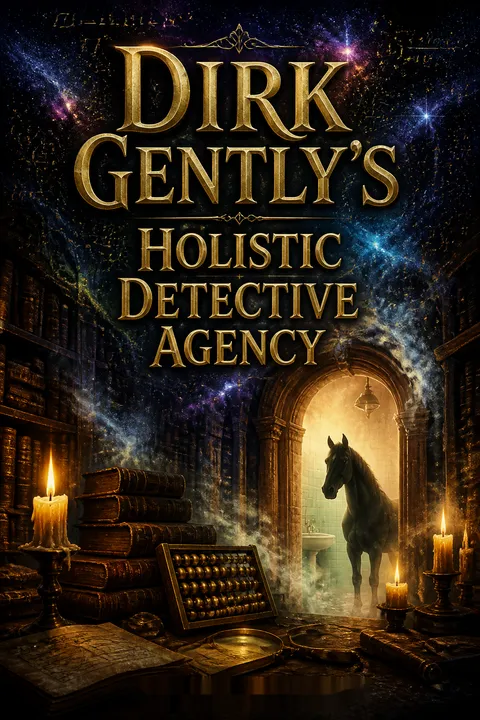

Plot Summary
Thunder, Mud, and Light
In a desolate, rain-soaked valley, a strange tower stands alone, battered by storms and time. As night falls, a sequence of eerie lights and sounds erupts from the tower, culminating in a blinding explosion of color and energy. By morning, the landscape is transformed: the river runs clear, the sun shines, and time seems to begin anew. This enigmatic prologue sets the stage for a story where the boundaries of reality, time, and causality will be tested, hinting at ancient mistakes and the possibility of cosmic consequences. The mood is one of awe and foreboding, as if the world itself is holding its breath for what comes next.
The Electric Monk's Belief
High on a rocky promontory, an Electric Monk sits astride his horse, lost in a malfunctioning haze of random beliefs. Designed to believe things for people, the Monk's circuits have gone awry, causing him to accept absurdities—like the valley being pink—as absolute truth. His horse, more sensible, endures the Monk's whims with stoic patience. The Monk's faith is unshakeable, even as it drifts from one preposterous idea to another. Eventually, the Monk is drawn by a powerful conviction that a mysterious door will soon appear in the valley below—a belief that, for once, is entirely correct. The Monk's journey is both comic and poignant, a meditation on faith, purpose, and the absurdity of existence.
Susan's Frustration Grows
Susan Way, a talented cellist, is stood up yet again by her boyfriend, Richard MacDuff. Her irritation simmers as she flips through television channels and contemplates her relationship. Deciding she's had enough, she calls an old acquaintance, Michael, and arranges to meet him instead. Susan's independence and wit shine through her frustration, but beneath her sharp exterior lies a longing for connection and reliability. Her actions set off a chain of events that will entangle her fate with Richard's, Gordon's, and the mysterious forces at play. The emotional undercurrent is one of disappointment, resolve, and the search for meaning in a world that often seems arbitrary.
Candlelit Coleridge Dinner
At St Cedd's College, Cambridge, Richard attends a candlelit dinner honoring Samuel Taylor Coleridge. The hall is filled with eccentric dons, lively conversation, and the peculiar Professor Urban Chronotis (Reg). Amidst academic banter and conjuring tricks, a young girl's ancient pot becomes the centerpiece of a magical illusion. Reg's sleight of hand—embedding a salt cellar in the pot—baffles the table, hinting at deeper mysteries. The dinner is a microcosm of Cambridge's timeless oddity, blending tradition, intellect, and the supernatural. Richard's nostalgia and unease mingle as old acquaintances and unresolved questions resurface, foreshadowing the unraveling of reality itself.
The Monk Finds a Door
The Electric Monk, driven by an unshakable belief, descends into the valley and discovers a door set into the rock—just as he had foreseen. Overcoming doubt and thirst, he opens the door and steps through, pulling his horse behind him. The moment is surreal and transformative, as the Monk's faith manifests in tangible reality. The door is ordinary yet impossibly out of place, a portal to another world or time. The Monk's journey is both literal and metaphorical, embodying the power and peril of belief unchecked by reason. The landscape itself seems to hold secrets, waiting for the right believer to unlock them.
Dirk's University Schemes
During the Coleridge Dinner, Richard reminisces about his university days and the infamous Svlad "Dirk" Cjelli. Dirk, a master of rumor and denial, cultivated a reputation for psychic abilities, exploiting the credulity of his peers. His greatest scam involved "predicting" exam questions, leading to his expulsion when the predictions matched the actual papers exactly. Dirk's blend of laziness, cunning, and denial made him both notorious and enigmatic. The narrative explores the power of myth, the ambiguity of truth, and the ways in which perception shapes reality. Dirk's legend foreshadows his later role as a holistic detective, seeking connections where others see chaos.
Gordon's Last Drive
Gordon Way, Susan's brother and Richard's employer, drives to his country cottage, leaving a rambling message on Susan's answering machine. Preoccupied with business and personal anxieties, Gordon is oblivious to the danger lurking in his car's boot. Suddenly, he is shot dead by a hidden assailant—his own shotgun turned against him. In death, Gordon's consciousness persists, bewildered and unable to interact with the world. His ghostly state is marked by confusion, regret, and a desperate need to communicate. The chapter blends dark comedy with existential dread, as Gordon's spirit becomes a catalyst for the unfolding mystery.
Reg's Eccentric Hospitality
Richard visits Reg's rooms at St Cedd's, seeking comfort and advice. The evening is marked by Reg's absent-minded charm, discussions of time, and the revelation of a horse inexplicably lodged in the bathroom. The surreal becomes mundane as Reg shrugs off the impossibility, and Richard's rationality is tested. The conversation turns to the nature of decision-making, the Pentagon's purchase of dubious software, and the peculiarities of Reg's professorship. The atmosphere is one of cozy absurdity, masking deeper secrets. The horse, the stuck sofa, and Reg's conjuring tricks all hint at a reality more flexible—and more dangerous—than Richard suspects.
Gordon's Ghostly Awakening
Gordon's ghost awakens beside his own corpse, struggling to comprehend his new existence. Unable to interact with the physical world, he is tormented by impotence and isolation. His attempts to communicate—especially with Susan—are futile, and his sense of self begins to fade. The narrative delves into the psychology of loss, regret, and the search for meaning after death. Gordon's ghost becomes a symbol of unfinished business, his presence lingering as a silent witness to the chaos his death has unleashed. The emotional tone is one of bewilderment, sorrow, and the desperate hope for redemption.
A Horse in the Bathroom
Richard's night grows stranger as he discovers the horse in Reg's bathroom is real. The impossibility of the situation forces Richard to confront the limits of logic and the intrusion of the fantastic into everyday life. Reg's nonchalance only deepens the mystery, and Richard's attempts to find rational explanations are thwarted at every turn. The horse becomes a symbol of the inexplicable, a harbinger of the deeper disruptions to come. The chapter balances humor and unease, as the boundaries between the ordinary and the extraordinary blur beyond recognition.
Ghosts, Guilt, and Messages
As Gordon's ghost drifts through the world, he becomes increasingly desperate to communicate with Susan and Richard. His attempts to manipulate phones and answering machines are met with frustration. Meanwhile, Richard's guilt over his relationship with Susan and his work for Gordon intensifies. The narrative weaves together themes of regret, longing, and the unseen forces that shape our actions. Ghostly presences, both literal and metaphorical, haunt the characters, driving them toward choices they barely understand. The emotional landscape is one of confusion, yearning, and the search for connection across the boundaries of life and death.
Richard's Night of Chaos
Richard's night spirals into chaos as he becomes entangled in the aftermath of Gordon's murder. Lost in the mist, pursued by guilt and suspicion, he narrowly avoids a car accident and a police encounter. His attempts to reach Susan are thwarted by answering machines and misunderstandings. The world seems to conspire against him, each event more improbable than the last. The chapter captures the disorientation of crisis, the fragility of reason, and the relentless pressure of fate. Richard's journey is both physical and psychological, a descent into the heart of the mystery.
Dirk's Watchful Eyes
Dirk Gently, now a holistic detective, observes Richard's actions with keen interest. His methods are unorthodox, relying on intuition, interconnectedness, and a belief in the fundamental unity of all things. Dirk's investigation brings him into contact with Richard, Susan, and the tangled web of events surrounding Gordon's death. The narrative explores the nature of detection, the limits of logic, and the power of belief. Dirk's presence is both comic and unsettling, a force of chaos and insight that propels the story toward its climax.
Lovers, Rivals, and Regrets
Richard's relationship with Susan is tested by misunderstandings, jealousy, and the intrusion of Michael Wenton-Weakes. Old grievances and unspoken feelings come to the surface, exposing the vulnerabilities and strengths of each character. Michael's own sense of loss and resentment festers, setting him on a path toward possession and violence. The chapter delves into the psychology of love, rivalry, and the longing for significance. The emotional stakes are heightened as personal dramas intersect with cosmic ones, and the characters are forced to confront their deepest fears and desires.
Michael's Brooding Grievance
Michael Wenton-Weakes, embittered by the loss of his magazine and his sense of purpose, becomes increasingly isolated and unstable. His fixation on past injustices and his mother's cold pragmatism drive him to the brink. As his identity erodes, he becomes susceptible to possession by the ancient ghost seeking to undo its mistake. Michael's transformation is both tragic and chilling, a portrait of a man consumed by grievance and longing for relevance. The narrative explores the dangers of nostalgia, the corrosive power of resentment, and the ease with which the self can be lost.
Ghosts and Detectives Awaken
As the investigation into Gordon's death intensifies, Dirk and Richard join forces to unravel the impossible events surrounding them. Hypnosis, post-hypnotic suggestion, and the possibility of possession are explored as explanations for Richard's bizarre behavior. The boundaries between the rational and the supernatural blur, and the characters are drawn inexorably toward the heart of the mystery. The emotional tone is one of urgency, curiosity, and the dawning realization that the fate of the world may hinge on their actions.
The Monk's Wandering Faith
The Electric Monk, now lost and hungry, reflects on his journey and the consequences of his actions. His faith, once a source of strength, has become a burden, leading him into confusion and regret. The Monk's reunion with his horse brings a moment of solace, a reminder of the simple pleasures of existence. The chapter is a meditation on belief, responsibility, and the search for meaning in a world that often defies understanding. The Monk's story echoes the larger themes of the novel, as faith and doubt collide in the face of the inexplicable.
Dirk's Hypnotic Interrogation
Dirk hypnotizes Richard to uncover the hidden motives behind his actions. Under trance, Richard reveals details he could not consciously recall, shedding light on the impossible conjuring trick and the influence of the ghost. The process exposes the fragility of memory, the power of suggestion, and the interconnectedness of seemingly unrelated events. Dirk's methods are both scientific and mystical, blending logic with intuition. The emotional impact is profound, as Richard confronts the possibility that his will is not entirely his own, and that larger forces are at work.
Michael's Possession
Michael Wenton-Weakes, weakened by loss and resentment, becomes the perfect host for the ancient ghost seeking to undo its cosmic mistake. The possession is both literal and symbolic, a merging of two wounded souls in search of redemption. Michael's transformation is marked by a sense of purpose and inevitability, as the ghost's plan takes shape. The narrative explores the psychology of possession, the allure of surrender, and the dangers of unchecked longing. The emotional tone is one of dread, empathy, and the recognition of shared vulnerability.
The Impossible Conjuring Trick
Dirk and Richard confront Reg about the impossible conjuring trick, leading to the revelation that Reg possesses a time machine disguised as an abacus. Reg's use of the machine to cheer up a child by embedding a salt cellar in an ancient pot exposes the dangers and temptations of altering the past. The conversation delves into the ethics of time travel, the unpredictability of cause and effect, and the personal cost of meddling with history. The emotional stakes are heightened as the characters realize the magnitude of the forces they are dealing with.
The Ghost's Desperate Plea
The ghost, now speaking through Michael, reveals its tragic history: an alien engineer who, relying on an Electric Monk's belief, caused a catastrophic accident that stranded his people on Earth and led to his eternal torment. The ghost's plea is for Reg to use the time machine to undo the mistake and free him from his suffering. The narrative explores themes of guilt, responsibility, and the longing for absolution. The emotional impact is profound, as the characters grapple with the possibility of rewriting history and the consequences of their actions.
The Time Machine Revealed
Reg uses the time machine to transport Dirk, Richard, and the ghost to the ancient alien ship in orbit above the primordial Earth. The ship is a repository of memory, music, and lost hope. Richard is overwhelmed by the music of life itself, a symphony that embodies the interconnectedness of all things. The journey is both literal and metaphorical, a passage through the layers of reality and consciousness. The emotional tone is one of awe, wonder, and the recognition of the beauty and fragility of existence.
The Dodo's Last Stand
The group's actions threaten to unravel the fabric of history, risking the extinction of humanity and the erasure of all that has come before. Reg's earlier attempts to save extinct species have already caused unintended consequences, and the stakes are now cosmic. The narrative explores the paradoxes of time travel, the limits of intervention, and the necessity of sacrifice. The emotional climax is one of tension, regret, and the bittersweet recognition that some losses cannot be undone.
Undoing the Ancient Mistake
In a final act of mercy, Reg and Dirk work to prevent the ghost from altering the past in a way that would erase humanity. Dirk's intervention with Coleridge ensures that the story of the ancient mariner—and the warning it contains—will be forgotten, preserving the timeline. The ghost is released from its torment, and the world is restored to its proper course. The narrative resolves the cosmic and personal threads, offering redemption, closure, and the hope of new beginnings.
The Music of Life
In the aftermath, Richard returns to Susan, Reg retires his time machine, and Dirk resumes his detective work. The music of life—once heard in the alien ship—echoes in the world, transformed into the works of Bach and the rhythms of existence. The characters reflect on the interconnectedness of all things, the beauty of the ordinary, and the necessity of letting go. The story ends with a sense of harmony, possibility, and the quiet miracle of being alive.
Analysis
Douglas Adams's Dirk Gently's Holistic Detective Agency is a genre-defying blend of science fiction, comedy, and metaphysical mystery, using the absurd to probe profound questions about causality, belief, and the nature of reality. At its heart, the novel is a meditation on interconnectedness: every event, no matter how trivial or bizarre, is part of a larger web of meaning. Adams satirizes the conventions of detective fiction, replacing linear logic with holistic intuition, and challenges the reader to embrace uncertainty and paradox. The characters—each flawed, searching, and haunted—embody the struggle to find purpose in a world that resists explanation. Time travel and ghosts serve as metaphors for regret, longing, and the desire to undo past mistakes, while the motif of music suggests that harmony can emerge from chaos. The novel's lesson is both humbling and hopeful: we are all part of a vast, intricate pattern, and our actions—however small—ripple through the fabric of existence. In a modern context, Adams's work resonates as a call to recognize the complexity of the world, to question easy answers, and to find beauty in the unexpected connections that shape our lives.
Review Summary
Reviews for Dirk Gently's Holistic Detective Agency are largely positive, with most praising Douglas Adams' witty, quotable writing style and the novel's intricate, interconnected plot. Many readers enjoy its absurdist humor and philosophical undertones, comparing it favorably—sometimes even preferably—to the Hitchhiker's Guide series. Common criticisms include a slow introduction of the titular character, a convoluted ending, and occasionally dense plotting. Several reviewers highlight memorable elements like the stuck sofa, the Electric Monk, and clever character interactions as standout features.
People Also Read

Characters
Dirk Gently (Svlad Cjelli)
Dirk Gently is a former Cambridge student notorious for his psychic scams and now operates as a "holistic detective," believing in the fundamental interconnectedness of all things. His methods are unorthodox, blending intuition, hypnosis, and a flair for the absurd. Dirk's psychological complexity lies in his oscillation between skepticism and credulity, logic and mysticism. He is both a trickster and a seeker of truth, driven by a need to find meaning in chaos. His relationships are marked by manipulation and genuine care, especially toward Richard, whom he both exploits and protects. Dirk's development is a journey from self-serving mythmaker to reluctant hero, confronting the limits of his own understanding and the responsibilities of power.
Richard MacDuff
Richard is a talented but absent-minded computer programmer, caught between the demands of work, love, and the inexplicable events that overtake his life. His relationship with Susan is strained by his distractions and insecurities, while his loyalty to Gordon is tested by guilt and suspicion. Psychologically, Richard embodies the struggle between reason and wonder, skepticism and faith. He is both a victim and an agent of the story's mysteries, his actions shaped by forces he barely comprehends. Richard's arc is one of awakening, as he learns to accept the impossible, confront his fears, and embrace the interconnectedness of his own life with the cosmos.
Professor Urban Chronotis (Reg)
Reg is the Regius Professor of Chronology at St Cedd's, a position as mysterious as his true nature. Beneath his absent-minded exterior lies a being of immense age and power, possessor of a time machine disguised as an abacus. Reg's psychological depth is rooted in his loneliness, nostalgia, and the burden of responsibility. He is tempted by the possibility of undoing past wrongs but is haunted by the unintended consequences of his actions. His relationship with Richard and Dirk is paternal, guiding them through the mysteries while seeking their understanding and forgiveness. Reg's development is a journey from whimsical meddler to wise guardian, accepting the limits of intervention and the necessity of letting go.
Susan Way
Susan is Richard's girlfriend and Gordon's sister, a woman of intelligence, wit, and emotional depth. Her frustration with Richard's unreliability masks a deep longing for connection and meaning. Susan's psychological complexity lies in her balance of independence and vulnerability, her pursuit of artistic excellence, and her navigation of familial and romantic pressures. Her role in the story is both catalyst and anchor, grounding the narrative's cosmic chaos in the realities of love, loss, and forgiveness.
Gordon Way
Gordon is the founder of WayForward Technologies, driven by ambition and haunted by regret. His sudden murder transforms him into a ghost, trapped between worlds and desperate to communicate with the living. Gordon's psychological journey is one of bewilderment, guilt, and the search for redemption. His relationships—with Susan, Richard, and his company—are marked by control, anxiety, and a longing for significance. As a ghost, Gordon becomes a symbol of unfinished business, his presence shaping the destinies of those he left behind.
The Electric Monk
The Electric Monk is a machine designed to believe things for people, but its malfunctioning faith leads it on a surreal journey across worlds and times. The Monk's psychology is both simple and profound, embodying the dangers and comforts of unquestioning belief. Its relationship with its horse is one of comic contrast, highlighting the absurdity of faith without reason. The Monk's arc is a meditation on purpose, doubt, and the search for meaning in a universe that resists explanation.
Michael Wenton-Weakes
Michael is a privileged but aimless man, embittered by the loss of his magazine and his sense of purpose. His psychological vulnerability makes him the perfect host for the ancient ghost seeking to undo its cosmic mistake. Michael's journey is one of possession—both literal and metaphorical—as his identity is subsumed by forces beyond his control. His relationships are marked by resentment, longing, and the desperate need to matter. Michael's fate is a cautionary tale about the dangers of nostalgia, grievance, and surrendering the self.
The Ancient Ghost (Salaxalan Engineer)
The ghost is the spirit of an alien engineer whose reliance on an Electric Monk's belief caused a catastrophic accident, stranding his people on Earth and dooming him to eternal torment. Psychologically, the ghost is consumed by guilt, loneliness, and the longing to undo his mistake. His possession of Michael is both an act of desperation and a search for absolution. The ghost's arc is one of confession, plea, and eventual release, embodying the novel's themes of responsibility, forgiveness, and the interconnectedness of all things.
Janice Pearce
Janice is Dirk's secretary, perpetually exasperated by his eccentricities and financial irresponsibility. Her psychological role is that of the grounded observer, providing comic relief and a counterpoint to Dirk's flights of fancy. Janice's relationship with Dirk is marked by frustration, loyalty, and a grudging affection. She represents the ordinary world struggling to make sense of the extraordinary, and her presence anchors the narrative's more surreal elements.
Sergeant Gilks
Sergeant Gilks is a police officer investigating Gordon's murder, embodying the rational, procedural approach to mystery. His psychological complexity lies in his skepticism, professionalism, and occasional flashes of insight. Gilks's relationship with Dirk is adversarial but respectful, each recognizing the other's strengths and limitations. Gilks's development is a journey from suspicion to reluctant acceptance, as he witnesses the inexplicable and is forced to expand his understanding of what is possible.
Plot Devices
Holistic Detection and Interconnectedness
The central narrative device is Dirk's holistic approach to detection, which posits that all events—no matter how trivial or bizarre—are fundamentally interconnected. This philosophy drives the plot, allowing seemingly unrelated incidents (a horse in a bathroom, a stuck sofa, a conjuring trick) to converge in a coherent, if improbable, resolution. The device challenges the reader's expectations of causality, logic, and narrative structure, inviting a playful engagement with the absurd. Foreshadowing is achieved through recurring motifs and echoes, while the narrative structure mirrors the web of connections Dirk seeks to unravel.
Time Travel and Paradox
Reg's time machine introduces the possibility of altering history, with all the attendant paradoxes and unintended consequences. The device is used both for comic effect (embedding a salt cellar in an ancient pot) and for cosmic stakes (preventing the extinction of humanity). The narrative explores the ethics of intervention, the unpredictability of cause and effect, and the resilience of the universe in the face of disruption. Paradoxes are treated as "scar tissue," evidence of the world's capacity to heal around uncertainty.
Possession and Hypnosis
The themes of possession and hypnosis are woven throughout the story, blurring the boundaries between free will and external control. Characters are manipulated by ghosts, suggestions, and their own unconscious desires, raising questions about responsibility and identity. The device is used to explore the psychology of belief, the vulnerability of the self, and the ways in which we are shaped by forces beyond our understanding.
Ghosts and Unfinished Business
Ghosts—both literal and figurative—populate the narrative, embodying the idea of unfinished business and the longing for redemption. Gordon's ghost, the ancient alien, and the lingering effects of past actions all serve as reminders that the past is never truly gone. The device allows for a meditation on guilt, forgiveness, and the possibility of closure, grounding the cosmic in the personal.
Music and Mathematics
The motif of music—especially as it relates to mathematics and natural patterns—serves as a metaphor for the interconnectedness of all things. Richard's experiments with translating natural phenomena into music mirror the novel's structure, where disparate elements combine to create unexpected harmony. The device underscores the beauty and complexity of existence, suggesting that meaning can be found in the patterns that underlie chaos.
Dirk Gently Series
About the Author
Other books by Douglas Adams



Download PDF
Download EPUB
.epub digital book format is ideal for reading ebooks on phones, tablets, and e-readers.








































