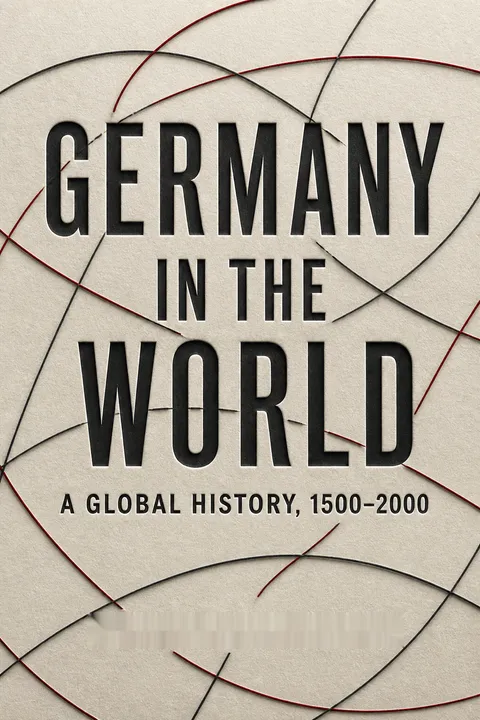

Key Takeaways
1. Early Global Engagement (1500-1700): Germany, despite being "landlocked," was deeply intertwined with early European global expansion through trade, finance, and skilled labor.
Germans were ubiquitous in the expanding worlds of the Portuguese, Spanish, Dutch, French, and British, as soldiers, ships’ gunners, merchants, surgeons, scientific travelers, missionaries, and settlers.
Ubiquitous presence. Despite the common misconception of "landlocked" Germany being marginal to early European global expansion, Germans were remarkably present across the burgeoning empires of Portugal, Spain, and later the Dutch, French, and British. This involvement spanned various roles, from skilled labor to finance, demonstrating a deep integration into the nascent global economy. Their presence was so pervasive that they often blended into the local background, becoming "chameleons" in the empires of others, a fact that obscured their significant contributions.
Economic drivers. German merchant houses, like the Fuggers and Welsers of Augsburg and Nuremberg, were central to the new global trade routes. They established extensive networks in Lisbon and Seville, financing voyages, trading in commodities like spices and sugar, and playing a crucial role in the transatlantic slave trade by supplying goods for exchange. Furthermore, German expertise in mining was indispensable, with German miners and mercury from their controlled mines in Spain fueling the silver production in the Americas, which in turn lubricated global commerce.
Skilled labor and knowledge transfer. Beyond finance and trade, Germans provided vital technical and military skills. They served as ship gunners on Portuguese vessels exploring Africa and Asia, and as soldiers in Spanish conquistador expeditions in the Americas, including the controversial Welser venture in Venezuela. German cartographers and printers were also instrumental in disseminating knowledge about newly discovered lands, with cities like Augsburg and Nuremberg becoming centers for publishing world geographies and maps that shaped European understanding of the expanding globe.
2. Reformation's Global Reach & Intellectual Networks: The German Reformation had a transformative global impact, and German scholars were central to the "Republic of Letters," fostering transnational knowledge exchange.
The Reformation was an explosive movement out of Germany and Switzerland, which shaped European and world history.
Explosive global impact. The Reformation, originating in Germany and Switzerland, was not merely an internal German affair but a world-historical event that profoundly reshaped Europe and beyond. It triggered waves of religious emigration, with figures like Samuel Hartlib fleeing the Thirty Years War to become influential intellectual brokers in England. Conversely, the Catholic Counter-Reformation, spearheaded by German Jesuits, launched global missions to the Americas and Asia, demonstrating the widespread reach of religious zeal.
Transnational religious networks. The spread of Lutheranism and Calvinism across Scandinavia, Eastern Europe, and Britain was facilitated by German theologians, preachers, and printers, often educated in Wittenberg. These movements fostered new church orders, hymnody, and educational institutions, creating a distinctly German stamp on Protestantism abroad. The Catholic response, while initially focused on internal renewal, saw over a thousand German Jesuits join overseas missions, establishing vast networks of learning and conversion in Latin America and China.
Republic of Letters. Beyond religious movements, German scholars, scientists, and artists were central to the "Republic of Letters," a transnational network of learned individuals. Figures like Athanasius Kircher, a German Jesuit in Rome, became a global clearinghouse for scientific and ethnographic discoveries. German universities, despite wartime disruptions, became magnets for students and a source of intellectual energy, while German printers and publishers played a decisive role in disseminating knowledge, with the Frankfurt Book Fair serving as a vital hub for the exchange of books and ideas across Europe.
3. Enlightenment Exploration & the Invention of Race: German scientists and thinkers were pivotal in exploring the natural world for European empires and in shaping modern concepts of race, often with critical perspectives on colonialism.
Germans played a central role in these undertakings, sometimes moving from one foreign empire to another.
Scientific exploration for empires. In the 18th century, German naturalists and scientists were indispensable to European empires, particularly the Russian, British, and Danish. Figures like Johann Georg Gmelin, Georg Steller, and Peter Simon Pallas undertook ambitious expeditions across Siberia and the Pacific, cataloging flora and fauna. Johann Reinhold and Georg Forster accompanied Captain Cook's second voyage, contributing significantly to botany and ethnography, often with a critical eye on the environmental and human costs of imperial expansion.
Ethnography and the invention of race. German scholars played a leading role in developing ethnography, the systematic description of peoples. Figures like Gerhard Friedrich Müller and Johann Friedrich Schöpperlin laid the groundwork for this discipline. However, this era also saw the "invention of race" as a scientific concept, with Immanuel Kant and Johann Friedrich Blumenbach at its forefront. While Blumenbach, despite coining "Caucasian," emphasized human equality and the fluidity of racial markers, others like Samuel Thomas Soemmering and Christoph Meiners used these nascent ideas to construct overtly racist hierarchies.
Critique of colonialism and slavery. Despite their involvement in imperial projects, many German intellectuals, including Georg Forster and Johann Gottfried Herder, were vocal critics of colonial exploitation and the transatlantic slave trade. They condemned the degradation of Indigenous peoples and the environmental impact of European expansion. This critical stance, often rooted in a perceived German "outsider" status from direct colonial rule, allowed them to articulate early forms of environmental consciousness and anti-colonial sentiment, even as some of their own racial theories contained implicit biases.
4. Revolutionary Eras & German Identity: German responses to the American and French Revolutions, and the subsequent Napoleonic Wars, shaped a complex national identity, oscillating between cosmopolitan ideals and assertive nationalism, while influencing global political thought.
From this place and from this day a new epoch in world history begins and you can say you were there to see it.
Witnessing global upheaval. The late 18th and early 19th centuries were a period of profound global upheaval, marked by the American and French Revolutions and the Napoleonic Wars. Germans, often as observers or participants in these conflicts, grappled with new ideas of liberty, nation, and self-determination. Goethe's famous remark at Valmy captured the sense of a new epoch, while figures like Christoph Heinrich Korn and Joachim Heinrich Campe eagerly reported on the "great revolution" unfolding across the Atlantic and in France.
Cosmopolitanism and nascent nationalism. Initial German reactions to the French Revolution were often enthusiastic, embracing its ideals of freedom and reason. Figures like Klopstock, Fichte, and Hegel celebrated it as a "glorious sunrise." However, the Terror and subsequent Napoleonic occupation led to a hardening of German identity, fostering a more assertive, often anti-French nationalism. This period saw the rise of language purification movements, the gymnastics movement, and student fraternities, all contributing to a nascent sense of German nationhood, sometimes with xenophobic undertones.
Political and intellectual transformation. The Napoleonic Wars fundamentally reshaped the German lands, leading to the dissolution of the Holy Roman Empire and the rise of larger, more centralized states. This era spurred reforms from above, often influenced by French models, aimed at modernizing administration and society. Intellectually, Kant's "Copernican revolution" in philosophy, followed by the explosion of German Idealism and Romanticism, profoundly influenced global thought on ethics, selfhood, and the human condition, establishing Germany as a leading intellectual force.
5. Mass Migration & Colonial Ambitions (19th Century): The 19th century saw a vast German diaspora, leading to the formation of distinct communities abroad, alongside growing colonial aspirations driven by economic and nationalistic concerns.
Mass emigration can easily seem like an abstract affair. One way to counter that is to zoom in on one place.
A global diaspora. The 19th century witnessed an unprecedented "exit revolution," with 5.5 million Germans emigrating, primarily to the United States, but also to Australia, Canada, and Latin America. This mass migration, driven by economic hardship, land hunger, and sometimes religious or political persecution, created a vast German diaspora. These emigrants, ranging from impoverished peasants and craftsmen to professionals and political radicals, formed distinct communities that often maintained their language and cultural practices, creating hybrid identities in their new homelands.
"Germans abroad" and colonial dreams. The sheer scale of emigration led to anxieties in Germany about the "loss" of national energy, prompting the creation of the term "Auslandsdeutscher" (Germans abroad) to maintain a connection. This concern fueled colonial ambitions, with many advocating for German settler colonies, initially in the American West, and later in South America, Australia, and Africa. These colonial fantasies, often imbued with a sense of German civilizing mission and racial superiority, reflected a desire to assert Germany's place on the world stage.
Formal empire and its complexities. Germany's formal colonial empire, acquired rapidly in the 1880s and 1890s in Africa and the Pacific, was driven by economic interests, nationalist prestige, and social imperialist arguments. While some colonies were managed with paternalistic care (e.g., Samoa), others, particularly in Africa, were marked by brutal exploitation, land expropriation, and genocidal violence against indigenous populations, as seen in Southwest Africa. This short-lived empire, though economically marginal, profoundly shaped German self-perception and its engagement with global power dynamics.
6. Cultural Ascendancy & Modernity's Crossroads: Germany became a global leader in education, music, and scientific thought, while also serving as a crucial hub for modernist and alternative cultural movements, reflecting a dynamic engagement with global trends.
The dominance of the German repertoire would be hard to exaggerate.
Global cultural influence. The 19th century marked a period of immense German cultural ascendancy, particularly in music, education, and science. German composers like Beethoven, Mozart, and Wagner formed the core of the classical and Romantic canon, dominating concert halls worldwide. German universities, epitomized by the "Humboldtian idea" of combining research and teaching, became a global model, attracting thousands of foreign students and shaping academic disciplines from medicine to philology.
Modernity's crucible. Germany also emerged as a vibrant crossroads for modernist and alternative cultural movements around 1900. Cities like Berlin and Munich became centers for avant-garde art (Expressionism), theater (Ibsen's influence, Max Reinhardt's innovations), and modern dance (Mary Wigman). This era also saw the rise of "Lebensreform" (life reform) movements, advocating for natural living, and pioneering discussions on sexuality, including the "German invention of homosexuality," reflecting a profound engagement with the challenges of modernity.
Contested cultural landscape. This cultural dynamism, however, was not without its tensions. The "Oriental renaissance" saw German scholars like Friedrich Schlegel make groundbreaking contributions to linguistics while also laying the groundwork for racist "Aryan" theories. The embrace of foreign influences, from Shakespeare to jazz, often coexisted with nationalist assertions of German cultural superiority. The rise of commercialized mass culture (cinema, popular music, sports) further challenged traditional notions of "Kultur," leading to debates about "Americanization" and "degeneration" that reflected deeper anxieties about Germany's place in a rapidly globalizing world.
7. World Wars & the "German Century" Confounded: The 20th century, initially seen as Germany's, was instead defined by two devastating world wars, leading to unprecedented destruction, the Holocaust, and a profound redefinition of Germany's global role.
The German century became synonymous instead with military aggression and Nazi dictatorship, above all with the Holocaust.
The "seminal catastrophe." The 20th century, once envisioned as Germany's, was tragically defined by two world wars that reshaped global history. World War I, triggered by German actions and its "blank check" to Austria, became a global conflict of unprecedented scale and carnage, leading to the collapse of empires and the rise of new ideologies. The subsequent Treaty of Versailles, perceived as a punitive "victors' peace," fueled resentment and instability, creating fertile ground for the rise of Nazism.
Nazi aggression and the "New Order." Hitler's regime, influenced by European fascism and American racial policies, pursued an aggressive foreign policy aimed at establishing a German "New Order" in Europe. The invasion of Poland in 1939 marked the beginning of World War II, a conflict driven by racial ideology and the quest for "living space" in the East. German military successes initially created a vast empire, but its brutal exploitation of resources, systematic starvation policies, and extreme violence against civilian populations, particularly in Eastern Europe, alienated potential collaborators and fueled widespread resistance.
Total war and its consequences. World War II became a total war, with unprecedented civilian suffering due to the British blockade, German occupation policies, and Allied area bombing. The conflict culminated in Germany's defeat, leaving the country in ruins and occupied by the Allied powers. This era of unparalleled destruction, marked by the Holocaust, fundamentally redefined Germany's image in the world, transforming it from a potential hegemon into a divided nation grappling with an immense moral and historical burden.
8. The Holocaust: A Unique Crime in a Global Context: The systematic extermination of European Jewry, while rooted in Nazi ideology, was a pan-European operation with global implications, influenced by and influencing other genocides and racial policies.
The Holocaust was not one event, but thousands of events.
Systematic mass murder. The Holocaust, the systematic extermination of at least 5.7 million Jews, stands as a unique crime in human history, defining the Nazi regime. While persecution and violence against Jews escalated after 1933, the decision for a "Final Solution" to the "Jewish Question" crystallized in 1941, driven by Hitler's ideology, the war in the East, and the "self-created problems" of ghettoization. This policy led to mass shootings by Einsatzgruppen and the construction of death camps like Auschwitz, where Jews from across Europe were murdered with horrifying speed and scale.
Pan-European complicity and global echoes. The Holocaust was a German-directed but pan-European operation, relying on the active complicity of non-German collaborators, from allied states like Romania and Hungary to local militias and civilian officials across occupied territories. The methods employed, including concentration camps and racial laws, drew inspiration from colonial practices and American eugenics, highlighting the transnational nature of racial thinking. The scale of the killings, meticulously documented by perpetrators and victims alike, profoundly altered the global Jewish diaspora.
A unique crime amidst broader atrocities. While the Holocaust was part of a larger Nazi program of demographic engineering that claimed millions of non-Jewish lives (Slavs, Roma, disabled persons, POWs), its systematic intent to annihilate an entire race sets it apart. The world's response, from Allied declarations condemning the genocide to the postwar Nuremberg Trials, established "crimes against humanity" as a legal concept. The Holocaust became a universal symbol of evil, prompting global reflection on human rights and the dangers of unchecked hatred, even as its memory continues to be debated and universalized.
9. Divided Germany in a Bipolar World: Post-WWII, Germany's division became a central symbol of the Cold War, with two states developing distinct identities and global engagements within their respective blocs.
In a moment of clarity shortly before his suicide in April 1945, Hitler recognized that Germany’s defeat would leave just two great powers confronting each other.
The Cold War's frontline. Germany's defeat in 1945, as Hitler presciently observed, left two superpowers, the US and USSR, confronting each other, with Germany becoming the central symbol and frontline of the Cold War. The initial Allied cooperation quickly dissolved into mutual suspicion, leading to the unplanned division of Germany into the Federal Republic of Germany (FRG) in the West and the German Democratic Republic (GDR) in the East in 1949. This division, while provisional, lasted for forty years, shaping distinct national identities and global alignments.
Two Germanys, two systems. The FRG, under Konrad Adenauer, aligned firmly with NATO and the Western bloc, embracing a social market economy and democratic values. It became an economic powerhouse, the "economic miracle," driven by exports and integrated into the global capitalist system. The GDR, led by Walter Ulbricht, became a loyal member of the Warsaw Pact and Comecon, pursuing Soviet-style socialism with centralized planning and state ownership. This "double vision" manifested in every aspect of life, from rearmament and espionage to cultural diplomacy and youth movements.
Global competition and internal dynamics. The two Germanys engaged in intense global competition, particularly for influence in the Third World, using aid, cultural programs, and sporting achievements as diplomatic tools. While West Germany's economic prosperity and democratic freedoms attracted millions of East German refugees, the GDR struggled with economic stagnation and political repression, leading to the construction of the Berlin Wall in 1961. The presence of foreign workers in the West and the absence of independent social movements in the East further highlighted the divergent paths and internal contradictions of the two German states.
10. Reunification & a New Global Role: The fall of the Berlin Wall and German reunification marked the end of the Cold War, ushering in a new era where Germany, now a unified economic and political power, navigated its complex past and asserted a more active, yet often cautious, role in global affairs.
The German question, as it presented itself for much of the twentieth century, had been laid to rest.
The "turn" and reunification. The fall of the Berlin Wall on November 9, 1989, a global media event, marked "Die Wende" – a pivotal moment in German and world history. Fueled by mass exodus and popular protests, particularly the Leipzig Monday demonstrations, the East German regime collapsed. Helmut Kohl's swift political maneuvering, coupled with Gorbachev's non-intervention policy and US support, led to German reunification on October 3, 1990. This process, though dominated by West German institutions and creating economic and social challenges in the East, was a remarkably successful project of nation-building in a post-Cold War world.
A new global power. Unified Germany emerged as a major economic and demographic power, the largest in Europe, and a central player in the European Union. While initially cautious about asserting military power due to its Nazi past, Germany gradually adopted a more active role in international conflicts, notably committing troops to NATO campaigns in the Balkans. Its "checkbook diplomacy" and leadership in multilateral organizations, combined with its economic dominance, positioned Germany as a "reluctant hegemon" in global governance.
Navigating a complex identity. Post-unification Germany embraced a multicultural identity, reflected in its diverse population, vibrant cultural scene (e.g., Turkish-German literature, hip-hop), and openness to refugees. However, this transformation also brought xenophobic backlashes and debates about national identity, citizenship, and the integration of immigrants. Germany's commitment to human rights and its confrontation with the Holocaust became central to its global image, even as its economic ties to authoritarian regimes and its "austerity" policies in Europe raised new questions about its moral and geopolitical responsibilities in the 21st century.
People Also Read




Download PDF
Download EPUB
.epub digital book format is ideal for reading ebooks on phones, tablets, and e-readers.








































