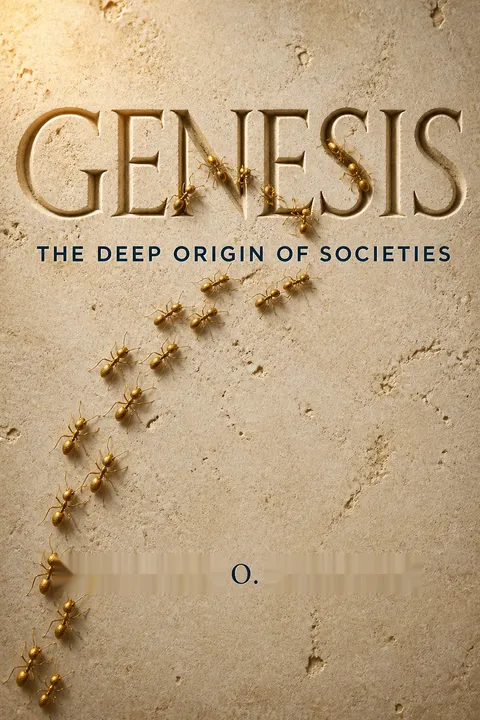

Key Takeaways
1. Science Unlocks the True Meaning of Human Existence
By and large, philosophers have lacked confirmable answers to the first two questions, which concern the deep prehuman and human past, thereby remaining unable to answer the third question, which addresses the human future.
Existential questions. Humanity grapples with three fundamental questions: what are we, what created us, and what do we wish to become. For most of history, these questions have been dominated by religious and political dogma, offering fantasies that appeal to tribalism and promise immortality. However, science, with its exponential growth, has only recently begun to provide objective and persuasive answers, particularly concerning our deep past.
The real creation story. Charles Darwin's hypothesis in The Descent of Man (1871) that humans descended from African apes, though initially shocking, has been confirmed and refined by a consortium of modern disciplines. Paleontology, anthropology, psychology, evolutionary biology, and neuroscience now offer an increasingly clear, factual account of how humanity originated. This scientific narrative reveals a story vastly different from traditional beliefs, aligning with the evolutionary histories of other species that developed advanced societies based on altruism and cooperation.
Physical basis of being. Every aspect of the human body and mind has a physical foundation, governed by the laws of physics and chemistry, and all of it originated through evolution by natural selection. Understanding this deep history is crucial for accurate self-understanding, allowing us to confidently address our destiny and replace ancient gods with a scientific understanding of the forces that shaped us. This objective perspective is essential for humanity's long-term survival and for fulfilling our role as stewards of the biosphere.
2. Evolution by Natural Selection Operates on Multiple Levels
Natural selection simultaneously operates at the level of the group, affecting how well each group performs in competition against other groups.
Genetic change. Evolution is fundamentally a change in the frequency of genes (or alleles) within populations over generations. Natural selection, the driving force, works by favoring traits prescribed by certain genes that enhance survival and reproduction in a given environment. Mutations, which are random changes in genes, propose new traits, and the environment disposes of them, determining their success or failure.
Multilevel selection. Crucially, natural selection is not solely focused on individual competition. It also operates at the group level, especially in the biological organization of societies. While individuals within a group compete for rank, mates, and resources, the group itself competes against other groups. The success of a group in this inter-group competition can drive the spread of genes that foster cooperation and organization, even if those genes might impose a cost on individuals within the group.
Heritability and flexibility. The expression of traits is a complex interplay of heredity and environment, measured by heritability. While some traits like eye color are highly hereditary, others like personality and intelligence have middling heritability, influenced by both genes and experience. Furthermore, phenotypic flexibility—the ability of a gene to produce different traits based on environmental cues—is itself a genetic trait that can evolve. This flexibility allows organisms to adapt to diverse challenges, as seen in the Nile bichir, which can modify its anatomy and behavior for land or water, illustrating how major evolutionary transitions can be eased by such plasticity.
3. Life's Journey: Six Great Transitions Shaped All Organisms
Earth’s biological history began with the spontaneous origin of life. It led across billions of years through the formation of cells, then organs and organisms, and finally, in an episode lasting a relatively mere two to three million years, it created species able to understand what had been going on.
Milestones of complexity. Earth's biological history is marked by six "great transitions" that progressively increased life's complexity, culminating in humanity's capacity for abstract thought and self-understanding. These transitions are:
- The origin of life itself, likely in primordial seas near underwater volcanic vents.
- The invention of complex eukaryotic cells, formed by the fusion of simpler microbial cells.
- The invention of sexual reproduction, enabling controlled DNA exchange and species diversification.
- The origin of multicellular organisms, allowing for specialized organs and tissues.
- The origin of societies, leading to advanced cooperation and division of labor.
- The origin of language, unique to humans, enabling infinite messages and abstract thought.
Residues in our bodies. Our own bodies are living history books, carrying the products of every step. From the bacteria in our gut (representing early microbes) to our eukaryotic cells (with their mitochondria and nuclear membranes), to our organs (built from these cells), and finally to our social selves, we embody this 3.8-billion-year lineage. This journey, however, was not preordained for us; it was a series of "vagaries of mutation and natural selection."
The human condition. The widespread belief that all of prehistory and history, including every great transition, somehow served the purpose of placing humanity on Earth to rule it as we please, is a profound mistake. This anthropocentric view blinds us to the true, undirected nature of evolution. Understanding these transitions objectively allows us to grasp our place in the world, not as its destined rulers, but as a product of these immense, undirected forces, now tasked with the moral intelligence to steward the biosphere.
4. Altruism: The Evolutionary Dilemma Solved by Group Selection
What process of evolution can simultaneously increase the welfare of the group at the expense—sometimes fatal—of its individual group members?
The transitions dilemma. A central paradox in biology and the humanities is how altruism, where individuals sacrifice personal longevity or reproduction, can arise through natural selection. This "dragon challenge" appears at every major evolutionary transition, from cells programmed to die for the organism (failure leading to cancer) to soldiers dying in battle or monks taking vows of poverty. Such self-negating acts seem to defy the logic of individual survival and reproduction.
The second dilemma. Adding to this, there's the puzzle of why major transitions, despite natural selection's potential for rapid change, took millions to billions of years to occur. This suggests a powerful counterforce against altruism. At every level, from a selfish cell to a psychopathic dictator, individual self-interest can undermine the group. The group must overcome the "absolute priority of selfish personal success" to evolve higher organization.
Multilevel solution. The solution lies in multilevel selection, where natural selection acts simultaneously on individuals and groups. While selfish individuals may win within a group, groups composed of altruists often outperform and outcompete groups of selfish individuals. This group-level advantage drives the spread of altruism genes, even if they impose a cost on the individual. This process, though difficult and requiring vast numbers of components and immense time, has been demonstrated through genetic theory, experimentation, and field research, finally bringing the "big picture" of altruism's origin into focus.
5. Eusociality: A Rare Path to Ecological Dominance
Eusociality may be a relatively rare condition in evolution, but it has resulted in the most advanced levels of individual altruism and social complexity.
Defining eusociality. Eusociality represents the highest level of social organization, characterized by a division of labor where some individuals (the "royal" caste) specialize in reproduction, while others (the non-reproductive "worker" caste) perform the colony's labor. This extreme form of cooperation and altruism, where some reproduce less or not at all, is a hallmark of advanced societies.
Rarity and success. Despite the dramatic ecological success it confers—ants, termites, and humans dominate their respective terrestrial environments—eusociality has arisen only rarely in evolutionary history. Out of millions of animal species, only seventeen independent origins are known, including:
- Three lines of alphaeid shrimp
- Two lines of vespid wasps
- Two lines of bark beetles
- Two species of naked mole rats
- One line each for ants, termites, sphecid wasps, allodapine bees, augochlorine bees, thrips, and aphids.
A plausible case is also made for humans, citing postmenopausal grandmothers, homosexuality, and monastic orders as forms of eusocial castes.
Late arrival. Eusociality also appeared relatively late in geological time, long after other major insect innovations like winged flight and complete metamorphosis. This rarity and late emergence suggest that the transition to eusociality is exceptionally difficult, requiring specific preadaptations and a powerful driving force to overcome the inherent challenges of individual self-interest.
6. Fortified Nests and Progressive Care: The Crucial Preadaptation for Advanced Societies
All that is needed to cross the threshold from the solitary way of life to the eusocial way of life is the silencing by mutation of one or more alleles that prescribe the tendency of parents to care for their offspring at first, then separate and disperse when their offspring reach maturity.
Unlikely origins. Eusociality did not evolve from the most obvious candidates, such as mating swarms or persistent feeding groups, despite their existing social structures. Instead, its ancestors are found in species with a different life cycle: those that provide progressive care for their young within fortified nests. This preadaptation, involving regular feeding, inspection, and protection of offspring from egg to maturity, is the critical prerequisite.
The evolutionary sequence. The path to eusociality typically follows a specific sequence:
- Step 1: Adults build nests, store food, lay eggs, seal the nest, and depart (e.g., some bethylid wasps).
- Step 2: Adults build nests, lay eggs, and then care for young throughout development by periodic feeding or cleaning (e.g., some sphecid wasps).
- Step 3 (Primitively Eusocial): Mother and adult offspring remain together at the nest, with the mother as primary reproductrix and offspring as non-reproductive workers (e.g., ancestors of ants and eusocial wasps).
This sequence highlights that close kinship is often a consequence of eusociality, not its initial cause.
The "solitary-genome barrier." The rarity of eusociality, even with the preadaptation of progressive care, is explained by the "solitary-genome barrier." While a single mutation might inhibit dispersal, the rest of the genome remains adapted for solitary life. These newly formed "workers" lack the complex genetic programming for communication, labor division, and cooperation needed to compete effectively. Overcoming this barrier requires extensive genetic changes, driven by group selection, to build intricate gene networks that support advanced social behavior and caste differentiation.
7. Group Selection, Not Kin Selection, Drives Eusocial Evolution
For group-level traits as for individual-level traits, the unit of selection is the gene that prescribes the trait. The targets of natural selection, which determine whether genes do either well or poorly, are the traits prescribed by the genes.
The core mechanism. Group selection is the process where natural selection favors genes that prescribe social traits, particularly those that enhance cooperation and organization within groups. While individuals within a group compete, groups themselves compete against other groups. The success of a group in this inter-group competition drives social evolution, leading to the spread of altruism and division of labor. This mechanism is well-documented in social insects and other animals.
Critique of kin selection. For decades, kin selection, particularly William D. Hamilton's rule (BR - C > 0), was widely accepted as the primary explanation for altruism and eusociality, suggesting that altruism evolves if the benefit to relatives (B) multiplied by their relatedness (R) outweighs the cost to the altruist (C). However, Wilson and others argue that Hamilton's rule is mathematically flawed:
- It cannot make predictions because B and C are only known retrospectively.
- The terms B, R, and C are all functions of population structure, and information about who interacts with whom cancels out.
- No experiment can test or invalidate it, as it's a statistical rearrangement, not a biological prediction.
This renders "inclusive fitness" theory, based on Hamilton's rule, largely vacuous for explaining the genesis of societies.
Empirical evidence for group selection. Real-world examples strongly support group selection:
- Wolves: Larger packs with more adult males win territorial conflicts, demonstrating group-level competitive advantage.
- Fire Ants: Cooperating queens initially rear more workers, but workers later eliminate all but the most fecund queen, prioritizing colony growth over individual survival, even for their own mother.
- Clonal Ants: Policing of non-reproductive individuals and the failure of "cheater" colonies highlight the importance of colony efficiency, even in genetically identical groups.
- Social Wasps: Reproductive queues, where the oldest worker assumes queen status peacefully, demonstrate colony-level adaptations that reduce conflict and ensure continuity.
These examples show that group selection is a powerful, observable force shaping social evolution.
8. Humanity's Unique Ascent: Fire, Campsites, and Rapid Brain Growth
Humanity arose on the African savanna from a line of australopiths by essentially the same route as the other known eusocial animals.
The African cradle. Humanity's unique journey began 5-6 million years ago in eastern and southern Africa, when a single ape species split, leading to humans and chimpanzees/bonobos. Early human ancestors like Ardipithecus ramidus and australopithecines developed bipedalism, refashioning their bodies for terrestrial life. This led to an adaptive radiation of australopithecines, specializing in diet and behavior, and exhibiting mosaic evolution where different traits evolved at different rates.
Savanna and meat. The most pivotal event was the origin of Homo habilis 3-2 million years ago, coinciding with the spread of savannas. Hominids shifted from a tree/shrub diet to include C4 photosynthesis plants and, crucially, meat. Scavenging and predation provided high-energy, digestible food. This dietary shift, combined with the frequent lightning-struck ground fires of the savanna, set the stage for rapid brain growth.
Fire and campsites. Around a million years ago, controlled use of fire was achieved. Firebrands allowed for cooking, which made meat and vegetables more digestible and nutritious, leading to shared meals and powerful social bonding. Campsites, protected by fire and group members, became refuges—the "nests" that are the precursor to eusociality in all other animal species. This adaptation fostered cooperation and a complex division of labor, spring-loaded by existing predispositions like male/female differences and leadership variations. This combination fueled the fastest evolution of a complex biological organ on record: the human brain, expanding from 400-500 cc to 1400 cc.
9. Warfare and Storytelling: The Dual Forces Forging Human Social Intelligence
Lethal violence during warfare is so common in human societies as to suggest that it is an adaptive instinct of our own species.
Chimpanzee parallels. The role of group selection in human evolution is primary, intertwined with individual selection. Our closest relatives, chimpanzees, offer a chilling parallel: their communities engage in lethal border raids and territorial conquest, which directly increases the survival and reproduction of winning groups. This suggests that inter-group warfare is an adaptive, genetically influenced behavior, driving group selection in primates.
Human tribal aggression. Similarly, lethal violence and warfare have been commonplace throughout human history, from hunter-gatherer societies to modern times, with mortality rates comparable to chimpanzee conflicts. This suggests that human tribal aggression is also an adaptive instinct, shaped by group selection. While human aggression is more complexly organized, involving intricate coalitions and alliances (as seen in the Yanomamö's unokai caste), these alliances ultimately serve to enhance group-level competition and survival.
The power of storytelling. Alongside warfare, another crucial force in human social evolution was storytelling. As brain size increased, so did the time devoted to social interactions. Early Homo campsite talk, as inferred from contemporary hunter-gatherers like the Ju/’hoansi San, involved "day talk" for practical matters and "night talk" for stories and myths. These narratives, often humorous and emotionally engaging, fostered social bonding, transmitted cultural knowledge, and reinforced group identity. This "social selection for the manipulation of language" to convey characters and emotions was a key component in the evolution of a larger brain and higher intelligence, making humans the unique, intensely social, and often conflicted species we are today.
Review Summary
Reviews for Genesis are mixed, averaging 3.81/5. Readers appreciate Wilson's accessible exploration of eusociality and group selection as explanations for altruism's evolution, praising his insect expertise and clear prose. Common criticisms include the book's brevity, abrupt ending, and lack of new material for existing Wilson fans. Many feel the human eusociality argument is underdeveloped. The central thesis — that groups of altruists outcompete groups of selfish individuals — resonates widely, though some dispute Wilson's rejection of Hamilton's Rule and kin selection theory.
People Also Read

About the Author
Other books by Edward O. Wilson
Download PDF
Download EPUB
.epub digital book format is ideal for reading ebooks on phones, tablets, and e-readers.








































