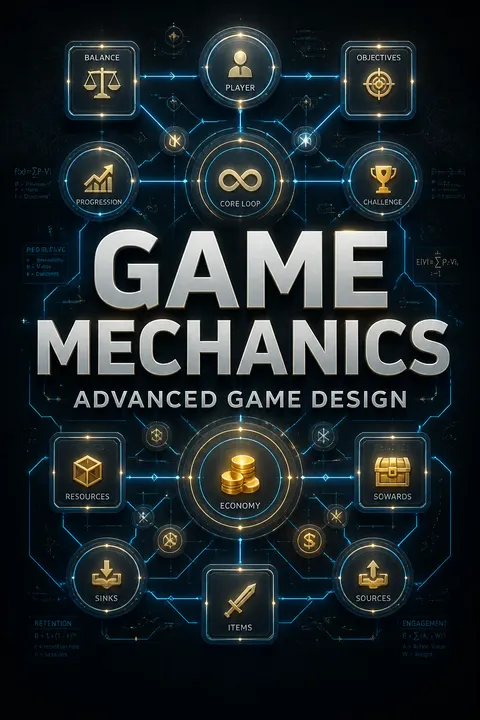

Key Takeaways
1. Game Mechanics are the Deep Structure of Play
Rules and mechanics are related concepts, but mechanics are more detailed and concrete.
Games are rule-based systems. At their core, games are defined by rules that dictate player actions and game reactions. While rules are the explicit instructions players understand, game mechanics are the underlying, often hidden, software implementations that govern every detail of the game's operation. These mechanics specify everything from property prices in Monopoly to the physics of a jumping character.
Five types of mechanics. Game mechanics can be broadly categorized into five types, each contributing to different aspects of gameplay:
- Physics: Governs motion, force, and collisions (e.g., gravity in a platformer).
- Internal Economy: Manages resources like money, health, or ammunition (e.g., Link's hearts in Zelda).
- Progression Mechanisms: Controls player advancement through levels or story (e.g., keys unlocking doors).
- Tactical Maneuvering: Dictates unit placement and movement for strategic advantage (e.g., chess piece movement).
- Social Interaction: Governs player-to-player dynamics in multiplayer settings (e.g., alliances in strategy games).
Discrete vs. continuous. Mechanics can be either discrete (whole numbers, like inventory items) or continuous (fractional values, like physics calculations). While continuous mechanics often require computing power for realism, discrete mechanics offer more innovation opportunities and are central to strategic gameplay. Prototyping these mechanics early and iteratively is crucial, as it allows designers to test and refine the core fun before investing heavily in development.
2. Emergence and Progression Drive Gameplay
Emergence is the primordial game structure.
Two fundamental structures. Gameplay is primarily driven by two contrasting yet often integrated structures: emergence and progression. Emergence refers to games with relatively simple rules that produce a vast array of unpredictable outcomes and player strategies, like chess or Civilization. The challenges aren't pre-planned but arise from the complex interactions of simple parts.
Progression offers structured experiences. In contrast, progression involves many predesigned challenges, ordered sequentially, often through sophisticated level design. Games like classic adventure titles or story-driven shooters guide players through a controlled sequence of events, ensuring a coherent narrative and learning curve. While emergence offers player freedom and replayability, progression excels at delivering structured, story-like experiences.
Hybrid designs are common. Most modern video games blend these two. For instance, Grand Theft Auto offers an emergent open world but structures player activity through progressive missions. The challenge for designers is to integrate these structures harmoniously, allowing emergent player actions within a progressively revealed narrative. Understanding the structural differences—emergence often having few rules but many interactions, progression having many rules but fewer interactions—is key to mastering their integration.
3. Internal Economies Shape Game Dynamics
To understand a game’s gameplay, it is essential to understand its economy.
Beyond money. A game's internal economy is a system where resources are produced, consumed, and exchanged. This extends beyond traditional currency to include anything quantifiable, such as health, experience points, ammunition, or even abstract concepts like "strategic advantage." These resources are stored in "entities" (like a player's inventory or a unit's health bar) and manipulated by four core economic functions:
- Sources: Create new resources (e.g., gold generation in a city-builder).
- Drains: Remove resources permanently (e.g., ammunition consumption).
- Converters: Transform one resource into another (e.g., wood into lumber).
- Traders: Exchange resources between entities (e.g., buying items from a shop).
Economic shapes and feedback. The interplay of these elements creates distinct "economic shapes" over time, visible in graphs of resource accumulation or player strength. These shapes are heavily influenced by feedback loops:
- Negative feedback creates equilibrium, stabilizing resource levels (e.g., city population growth slowing as food demands increase).
- Positive feedback leads to exponential growth or decline, creating "arms races" or "downward spirals" (e.g., investing minerals to build more mining units in StarCraft).
Strategic depth. By carefully designing these economic structures, designers can complement physics-based gameplay, influence progression (e.g., power-ups as keys), add strategic depth (e.g., long-term investments vs. short-term gains), and expand the game's probability space for greater replayability. Understanding these economic dynamics is crucial for balancing and enriching any game.
4. Machinations: A Visual Language for Mechanics
Machinations diagrams are designed to represent game mechanics in a way that is accessible yet retains the structural features and dynamic behavior of the games they represent.
Visualizing game systems. The Machinations framework provides a visual language and an online tool to design, document, simulate, and test a game's internal economy. It allows designers to see the invisible flows of resources and the intricate feedback structures that drive emergent gameplay, offering a level of clarity often missing in code or traditional design documents.
Core elements: Machinations diagrams use various nodes and connections to model game mechanics:
- Pools: Store resources (e.g., player's money, health).
- Resource Connections: Represent the flow of resources between nodes, with specified rates.
- State Connections: Show how changes in one node's state affect others (e.g., a full health bar activating a bonus).
- Activation Modes: Determine when a node fires (automatically, interactively, passively, or once).
- Advanced Nodes: Specialized nodes for sources, drains, converters, traders, gates (for probabilistic or conditional distribution), and end conditions.
Dynamic simulation. The Machinations Tool brings these diagrams to life, allowing real-time simulation of the game's economy. Designers can observe resource movements, track changes over time, and even introduce randomness to test system resilience. This dynamic visualization helps identify imbalances, unintended consequences, and emergent behaviors that would be difficult to predict from static descriptions alone, making it an invaluable prototyping and balancing tool.
5. Design Patterns Offer Reusable Solutions
We call recurrent patterns in the structure of game mechanics design patterns.
Leveraging proven structures. Just as architects and software engineers use design patterns, game designers can benefit from recognizing and applying recurring structures in game mechanics. These "design patterns" represent generic solutions to common game design problems, offering a shared vocabulary and a toolkit for building better games.
Key pattern categories: The book organizes these patterns into several categories, each addressing different design challenges:
- Engines: Generate resources (e.g., Static Engine for steady flow, Dynamic Engine for adjustable flow, Engine Building for complex production systems).
- Friction: Consume or reduce resources (e.g., Static Friction for constant drain, Dynamic Friction for adaptive consumption, Stopping Mechanism to reduce action effectiveness, Attrition for player-on-player resource destruction).
- Escalation: Increase challenges (e.g., Escalating Challenge for rising difficulty with progress, Escalating Complexity for growing system intricacy, Arms Race for competitive investment in offensive/defensive capabilities).
Combining and elaborating patterns. Games rarely use just one pattern; they often combine several to create rich, complex gameplay. Patterns can also be "elaborated," meaning a simpler pattern can be replaced by a more complex, specialized version (e.g., a Dynamic Engine is an elaboration of a Static Engine). This allows designers to scale complexity up or down, focusing on the most impactful mechanics. By studying and applying these patterns, designers can improve their designs, brainstorm new ideas, and communicate more effectively with their teams.
6. Simulate and Balance with Artificial Players
Artificial players aren’t supposed to be smart enough to beat a game that is unfair to the player or has other weaknesses. Their purpose is to reveal issues, not to obscure them.
Automated playtesting. Balancing complex game mechanics often requires countless playtests, a time-consuming process for human players. The Machinations Tool addresses this by allowing designers to create "artificial players" (APs) that execute simple, scripted strategies automatically. These APs can "virtually click" nodes, simulating player actions and enabling rapid, large-scale playtesting.
Designing AP strategies. APs are not designed for sophisticated AI but for representing caricatures—consistent, predictable strategies (e.g., a "rushing" player vs. a "turtling" player in a strategy game). By running hundreds or thousands of simulations with different AP strategies, designers can:
- Collect statistical data: Track win rates, game lengths, and resource distributions.
- Identify dominant strategies: Uncover strategies that consistently outperform others, indicating an imbalance.
- Test system resilience: See how mechanics behave under various, often extreme, player approaches.
Iterative balancing. The process involves tweaking game parameters (e.g., unit costs, production rates) and re-running simulations to observe the impact on balance. Removing randomness during initial balancing can help isolate the effects of specific mechanics. While AP simulations don't perfectly replicate human play, they provide invaluable insights into the underlying system, guiding designers toward a more robust and fair game before full implementation.
7. Levels Integrate Mechanics and Progression
The game trains the player to use his avatar’s abilities through increasingly difficult and complex challenges.
From toy to playground. While core mechanics create the "toy," level design transforms it into a "playground" by structuring player experience and introducing goals. Levels organize challenges, pace the gameplay, and incrementally teach players the game's mechanics, ensuring a smooth learning curve.
Measuring progress: Progress in games can be measured in several ways:
- Completed tasks: A percentage of missions or sub-goals achieved.
- Distance to target: How close a player is to a numerical victory condition (e.g., population size in SimCity).
- Character growth: Advancement in avatar abilities or levels (common in RPGs).
- Player growth: The player's own increasing skill and mastery of the game.
Missions and game spaces. Level design involves two intertwined perspectives: the mission (the sequence of tasks) and the game space (the physical layout). Mechanics connect these:
- Mapping mechanics to missions: Tasks are derived from available actions, with challenges added through enemies or subtasks.
- Mapping mechanics to game spaces: Player location can activate mechanisms, and game state can unlock new areas, often through lock-and-key mechanisms. These can be simple (e.g., a keycard for a door) or dynamic (e.g., a resource-intensive challenge to "unlock" an area).
Learning principles. Games effectively teach mechanics by breaking down skills into "skill atoms" (action, simulation, feedback, modeling) or by following martial arts training principles (Kihon, Kihon-kata, Kata, Kumite). This incremental learning, exemplified by games like The Legend of Zelda, ensures players are prepared for escalating challenges and fosters a sense of accomplishment.
8. Meaningful Mechanics Convey Deeper Messages
To use a game to communicate, you don’t just produce a clever signal to convey your message. Instead, you construct a machine—the game’s mechanics—that produces the signal for you.
Games as communication. Beyond entertainment, games can teach, persuade, and enlighten, acting as powerful communication media. Unlike passive media like film, games involve active audience participation, where players infer messages by interacting with the game's systems and observing their consequences. This is the essence of "serious games," designed to achieve real-world effects.
Mechanics as message-senders. Game mechanics, not just visuals or narrative, are crucial for conveying meaning. For example, SimCity's mechanics, which punish both extreme high-tax socialism and low-tax libertarianism, subtly convey a message about the need for balanced policies. PeaceMaker explicitly demonstrates that only constructive engagement, not hardline attitudes, leads to peace. The effort players expend to win, and the behaviors the game rewards, are key to transmitting these messages effectively.
Semiotics and simulation. Semiotics (the study of signs) helps analyze how games represent meaning:
- Iconic simulation: Resembles reality closely (e.g., a realistic flight simulator).
- Analogous simulation: Represents complex real-world factors with simpler, causally related mechanics (e.g., Diablo's inventory slots representing item size/weight).
- Symbolic simulation: Uses arbitrary conventions to represent complex systems (e.g., dice rolls for battle outcomes in Risk).
Analogous and symbolic simulations, by abstracting details, make games easier to learn and more broadly applicable, allowing for "discrete infinity" – endless meaningful combinations from limited means. This enables games to create rich, multi-layered meanings, from Bioshock's political satire to September 12's critique of the "war on terror," often through "intertextual irony" that contrasts appearance with underlying mechanics.
Review Summary
Game Mechanics receives strong praise (4.12/5) for its systematic approach to game design, particularly the Machinations framework for analyzing feedback loops and economic systems. Reviewers appreciate its practical depth and formal language for design discussions, serving well as a reference guide. The book focuses intensively on mechanics over other design aspects. Common criticisms include excessive focus on the Machinations tool, limited coverage of real-time mechanics, and the Flash-based tool becoming obsolete. Most readers find it essential for understanding emergent systems and recommend it for practicing designers seeking practical knowledge.
People Also Read





Download PDF
Download EPUB
.epub digital book format is ideal for reading ebooks on phones, tablets, and e-readers.








































