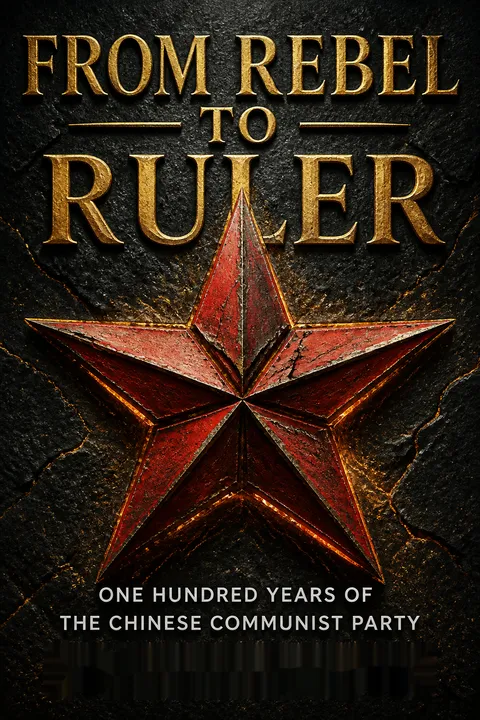

Key Takeaways
1. The CCP's Unique Genesis: Imperial Legacies and Foreign Catalysts.
There is no other po liti cal party quite like the CCP.
A distinct entity. The Chinese Communist Party (CCP) emerged from a unique blend of China's ancient imperial legacies and the transformative influence of foreign ideas and actors. Its longevity, size, and ability to overcome immense odds set it apart. The collapse of the Qing dynasty in 1911 left a political and intellectual vacuum, creating fertile ground for radical theories like Marxism.
Imperial echoes. Traditional Chinese political culture, characterized by a unitary state, hierarchical governance, and the state as a moral arbiter, profoundly influenced the CCP. Concepts like tianxia (all under heaven) and Zhongguo (Middle Kingdom) reinforced a sense of Chinese centrality and cultural superiority, which the CCP later adapted to legitimize its own rule. This legacy also contributed to the party's suspicion of external influences and its ambivalence towards private enterprise.
Soviet midwifery. While indigenous factors were crucial, Soviet Russia played a pivotal role in the CCP's early years, providing financial, organizational, and ideological support. Comintern agents like Grigori Voitinsky and Henk Sneevliet were instrumental in pulling together disparate study groups to form a Bolshevik-style party and in advocating for the crucial alliance with the Nationalist Party (GMD), despite internal CCP resistance. This foreign assistance was vital for the fledgling party's survival and initial growth.
2. Mao's Revolutionary Path: Peasant Power and Military Primacy.
Po liti cal power grows out of the barrel of a gun.
A unique strategy. Mao Zedong's most significant contribution to the Chinese revolution was his early recognition of the revolutionary potential of the peasantry and the indispensable role of armed force. While orthodox Marxist-Leninist theory emphasized the urban proletariat, Mao, observing the failures of urban uprisings and the strength of rural discontent, shifted the CCP's focus to the countryside.
Forging a new army. The catastrophic defeat of the CCP in 1927 by the GMD underscored the critical need for an independent military force. Mao's forces, retreating to remote mountain strongholds like Jinggangshan, began to experiment with guerrilla warfare and land redistribution policies. This period saw the Red Army evolve from a loose collection of outcasts into a disciplined fighting force, capable of defending base areas and mobilizing local populations.
Beyond ideology. Mao's approach was not purely ideological; it was deeply pragmatic, adapting Soviet theories to Chinese realities. He understood that survival in the wilderness required flexibility, local accommodation, and a willingness to compromise with diverse groups, including bandits and secret societies. This indigenous development of a peasant-based military revolution, often in defiance of Moscow's directives, laid the groundwork for Mao's eventual supremacy within the party.
3. Yan'an: Forging Ideological Unity and Mao's Unchallenged Authority.
The arrow of Marxism-Leninism must be used to hit the target of the Chinese revolution.
A new orthodoxy. The Yan'an period (1935-1945) was crucial for the CCP's survival and Mao's consolidation of power. Faced with a heterogeneous influx of recruits and the need to unify diverse revolutionary experiences, Mao launched the Rectification Campaign (1942-1944). This movement aimed to instill a coherent party apparatus and a singular interpretation of history, placing Mao and his thought at its core.
Silencing dissent. The campaign systematically attacked "subjectivism, sectarianism, and formalism," effectively targeting intellectuals who retained May Fourth ideals and Moscow-trained cadres like Wang Ming. Mao's "Talks at the Yan'an Forum on Literature and Art" (1942) explicitly defined the role of intellectuals as serving the party's revolutionary tasks, not offering independent critique. This process, often involving public "struggle sessions" and coercion, ensured ideological conformity.
Mao's ascendancy. The Rectification Campaign culminated in the 1945 "Resolution on Party History," which formally enshrined Mao's "correct line" and his preeminence as the architect of the Chinese revolution. This narrative, which linked China's humiliation to its redemption under CCP leadership, became a powerful tool for binding individual experiences to the grand sweep of history, cementing Mao's unchallengeable position and laying the foundation for his personality cult.
4. Civil War Victory: GMD's Self-Inflicted Wounds and CCP's Strategic Gains.
The road to victory for the Chinese Communist Party in 1949 lay within the devastated landscape of China created by the years of war with Japan.
A war of attrition. The Japanese invasion of China (1937-1945) proved to be the CCP's salvation, diverting the GMD's annihilation campaigns and allowing the Communists to recuperate and expand. While the GMD bore the brunt of the fighting, suffering heavy losses and widespread corruption, the CCP shrewdly preserved its forces, primarily engaging in guerrilla warfare behind Japanese lines.
GMD's strategic blunders. Chiang Kai-shek's unwavering priority to eradicate the Communists before fully resisting Japan severely undermined his credibility as a national leader. His government's inefficiency, corruption, and inability to implement meaningful social reforms alienated urban intellectuals and peasants alike. The GMD's reliance on an inefficient military and its failure to build a mass social base contrasted sharply with the CCP's disciplined organization and adaptive local policies.
Post-war advantage. After Japan's surrender in 1945, the CCP skillfully exploited the power vacuum, particularly in Manchuria, where Soviet delays in withdrawing troops allowed Communist forces to infiltrate and seize Japanese military equipment. Despite initial setbacks in the civil war, the GMD's overextension, logistical failures, and continued internal divisions ultimately led to its collapse on the mainland, paving the way for the CCP's decisive victory in 1949.
5. Post-1949: Soviet Model, Repression, and the Great Leap's Catastrophe.
Some of our comrades, tottering along like a woman with bound feet, are complaining all the time, ‘ You’re going too fast, much too fast.’
Stalinist blueprint. After 1949, the CCP, with no other socialist model, adopted a Soviet-style state and economic system. This involved a centrally planned economy, state ownership of production, and a hierarchical political structure. Initial years focused on stability, land reform, and suppressing opposition through campaigns like the Campaign to Suppress Counterrevolutionaries (1950-1953) and the Three-Anti/Five-Anti Campaigns (1951-1953), which solidified party control and eliminated perceived enemies.
Mao's impatience. By 1955, Mao Zedong, dissatisfied with the pace of collectivization and the perceived conservatism of the party bureaucracy, pushed for accelerated socialist transformation. He criticized those advocating caution as "right opportunists" and "women with bound feet," leading to a rapid collectivization of agriculture and the launch of the Great Leap Forward (GLF) in 1958.
Disastrous consequences. The GLF, driven by Mao's voluntarism and unrealistic production targets, proved catastrophic. Peasants were forced into massive communes, private plots were abolished, and resources were diverted to inefficient backyard steel furnaces. The campaign-style implementation, coupled with exaggerated reporting and suppression of dissent (e.g., Peng Dehuai's purge at Lushan in 1959), led to a devastating famine that claimed tens of millions of lives and severely damaged the economy.
6. Cultural Revolution: Mao's Assault on the Party and Societal Upheaval.
The main target of the pre sent movement is those within the Party who are in authority and are taking the cap i tal ist road.
Revolutionary renewal. By the early 1960s, Mao, convinced that revisionism was taking root within the CCP and that the party bureaucracy had become entrenched, launched the Great Proletarian Cultural Revolution in 1966. His aim was to purge "capitalist roaders" within the party, prevent a Soviet-style "capitalist restoration," and train a new generation of revolutionaries through a "baptism of fire."
Chaos unleashed. Mao mobilized students as "Red Guards" to "bombard the headquarters," leading to widespread attacks on party officials, intellectuals, and traditional culture ("Four Olds"). This resulted in unprecedented social chaos, violence, and the near-total collapse of party and state institutions. The movement shattered the social fabric, turning students against teachers, children against parents, and colleagues against each other.
Military intervention and Lin Biao's fall. As the chaos spiraled out of control, the military, under Lin Biao, became the dominant force, tasked with restoring order and establishing "revolutionary committees." Lin, initially anointed Mao's successor, saw his influence grow, but his ambition and the military's increasing political role eventually led to his mysterious death in 1971 while allegedly fleeing after a coup attempt. The Cultural Revolution left deep scars, a shattered bureaucracy, and a generation disillusioned with politics.
7. Deng's Pragmatic Turn: Economic Reform and Controlled Political Opening.
It doesn’t matter whether a cat is white or black, as long as it catches mice, it is a good cat.
Reversing course. Following Mao's death in 1976 and the arrest of the "Gang of Four," Deng Xiaoping emerged as paramount leader, initiating a radical shift away from Maoist radicalism. His philosophy, encapsulated by the "black cat, white cat" adage, prioritized pragmatic economic development over ideological purity. The Third Plenum of the Eleventh Central Committee in 1978 marked this decisive turn, focusing on "socialist modernization" and "seeking truth from facts."
Economic liberalization. Deng dismantled collective agriculture, introducing the household responsibility system, which dramatically boosted rural incomes. He cautiously opened China to foreign investment and technology, establishing Special Economic Zones. Urban industrial reforms aimed to grant greater autonomy to state-owned enterprises (SOEs) and introduce market mechanisms, though these proved more challenging.
Limited political reform. While promoting economic liberalization, Deng maintained strict political control. He allowed a brief "Democracy Wall" movement (1978-1979) but swiftly suppressed it when criticisms challenged party rule, articulating the "Four Cardinal Principles" (adherence to socialism, people's democratic dictatorship, CCP leadership, and Marxism-Leninism-Mao Zedong Thought) as non-negotiable boundaries. This era saw the rehabilitation of many purged cadres, but also the dismissal of two of Deng's chosen successors, Hu Yaobang and Zhao Ziyang, for perceived ideological laxity.
8. Tiananmen: A Crisis of Legitimacy and Authoritarian Restoration.
The Fifth Modernization: Democracy.
Seeds of discontent. The economic reforms of the 1980s, while generating growth, also led to rising inflation, corruption, and widening social inequalities. Intellectuals and students, inspired by a brief period of political relaxation and the global wave of democratization, began to demand greater political freedoms and accountability. The death of former General Secretary Hu Yaobang in April 1989, a symbol of reform and openness, ignited widespread student-led demonstrations.
A nationwide protest. Millions of students and citizens occupied Tiananmen Square and other cities across China for weeks, protesting corruption, demanding democratic reforms, and calling for press freedom. The movement, characterized by its peaceful nature and calls for dialogue, gained significant public sympathy, including from within the party and state apparatus, exposing deep divisions within the CCP leadership.
Brutal suppression. Despite initial attempts at conciliation by General Secretary Zhao Ziyang, Deng Xiaoping and conservative elders ultimately decided on a forceful crackdown. Martial law was declared, and on the night of June 3-4, 1989, troops violently cleared Tiananmen Square and surrounding areas, resulting in numerous casualties. The suppression led to Zhao Ziyang's purge for "splitting the party" and a period of political repression and economic austerity, reaffirming the party's authoritarian control.
9. WTO Era: Economic Boom, Social Costs, and Party Adaptation.
Even if the state- owned sector accounts for a smaller proportion of the economy, this will not affect the socialist nature of our economy.
Jiang's consolidation. Following the Tiananmen crackdown, Jiang Zemin, initially seen as a transitional figure, consolidated power, navigating a period of international isolation and domestic economic uncertainty. He balanced calls for ideological purity with Deng Xiaoping's renewed push for rapid economic reform, famously articulated during Deng's Southern Tour in 1992.
Zhu's reforms and WTO entry. Premier Zhu Rongji spearheaded ambitious structural reforms, tackling fiscal decentralization, banking system weaknesses, and the massive state-owned enterprise (SOE) sector. These reforms, often painful, led to widespread layoffs and social unrest. China's entry into the World Trade Organization (WTO) in 2001, a key objective for Jiang and Zhu, provided external discipline for domestic reforms and fueled an unprecedented economic boom, integrating China deeply into the global economy.
Hu-Wen's social focus. The Hu Jintao-Wen Jiabao leadership (2002-2012) shifted focus to "scientific development" and a "harmonious society," aiming to address the growing social costs of rapid growth:
- Widening urban-rural inequality
- Environmental degradation
- Inadequate social welfare (especially in rural areas)
- Rampant corruption
They introduced policies like abolishing agricultural taxes and expanding rural healthcare, but faced persistent challenges in implementation and controlling corruption.
10. Xi Jinping's New Era: Centralized Power, Anti-Corruption, and Global Assertion.
We cannot be a bystander but must be a participant, a leader.
Power consolidation. Xi Jinping, assuming leadership in 2012, swiftly centralized power, breaking from the collective leadership style of his predecessors. He launched an aggressive anti-corruption campaign, targeting both "tigers and flies," which served to clean up the party's image and eliminate political rivals like Bo Xilai and Zhou Yongkang. This drive for discipline and unity was deemed essential for the CCP's survival and to push through the next phase of reforms.
The China Dream. Xi articulated the "China Dream" – the great rejuvenation of the Chinese nation – linking it to the CCP's historical mission and a vision of China as a prosperous, powerful, and globally influential socialist country by 2050. This narrative, combined with a selective embrace of traditional Chinese culture and a reassertion of Marxism, aimed to bolster party legitimacy and national pride.
Global assertion and domestic control. Under Xi, China adopted a more assertive foreign policy, exemplified by the Belt and Road Initiative (BRI) and a willingness to challenge perceived Western dominance. Domestically, control over society tightened significantly, with increased censorship, repression in Xinjiang (re-education camps), and a crackdown on human rights lawyers and independent organizations. The abolition of presidential term limits in 2018 further cemented Xi's personal authority, signaling his intent to lead China into this "new era" for an extended period.
People Also Read





Download PDF
Download EPUB
.epub digital book format is ideal for reading ebooks on phones, tablets, and e-readers.








































