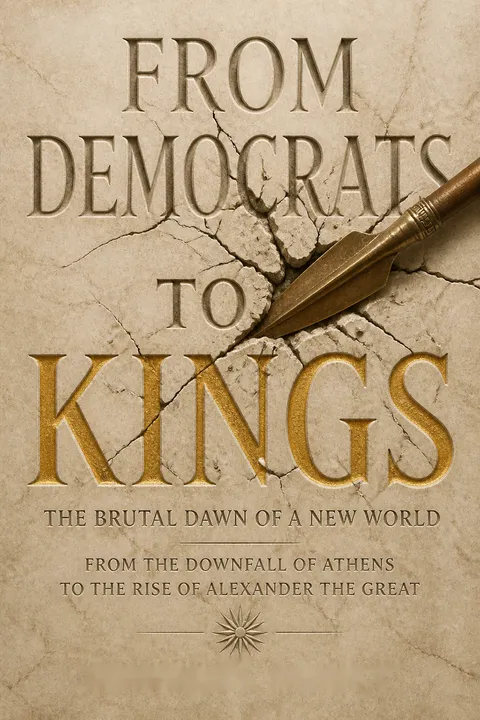

Key Takeaways
1. Athens' Post-War Turmoil and Democratic Resilience
On the same day as, 76 years earlier, democratic Athens with its allies had won its own famous victory against the Persians at the sea battle of Salamis, democratic Athens (somewhat) democratically voted itself out of existence.
A city humbled. In 404 BC, after 30 years of the devastating Peloponnesian War, Athens, once the glorious democratic empire, lay defeated. Plagued by disease, internal strife, and strategic blunders, it was forced to dismantle its walls and accept Spartan terms. This humiliation culminated in the assembly voting to replace its democracy with an oligarchic rule by thirty men, ironically on the anniversary of a great democratic victory.
Revolution and restoration. The "30 Tyrants" quickly proved brutal, leading to widespread fear and the flight of democratic supporters. A daring rebellion, launched from Thebes by exiles like Thrasyboulus, eventually liberated Athens' port, Piraeus, and led to a civil war. Remarkably, a Spartan king intervened to broker a settlement, leading to the restoration of democracy in 403 BC.
- Key events: Peloponnesian War defeat, plague, 30 Tyrants, Thrasyboulus' rebellion, Spartan intervention.
- Democratic reforms: Laws revised, public display of laws, oath to kill democracy's overthrowers.
Socrates' tragic fate. The restored democracy, eager to solidify its power and settle old scores, became fiercely militant. This vengeful atmosphere led to the trial and execution of the philosopher Socrates in 399 BC on trumped-up charges. His death, despite his unwavering respect for Athenian law, highlighted the dark side of a democracy grappling with its past and asserting its renewed authority.
2. Sparta's Brief, Brutal Hegemony and Self-Inflicted Decline
Sparta, the celebrated democracy, was denounced as the tyrant of Greece by Sparta – a city, ironically enough, itself ruled by two kings.
Unsuited for empire. After defeating Athens, Sparta became the dominant power in Greece, a role it was ill-prepared for. Its traditional isolationism and austere warrior culture clashed with the demands of managing an empire. Spartan generals like Lysander pursued personal power, alienating former allies and even their own government, leading to a two-front war against Persia and a coalition of Greek cities.
Internal decay. Sparta's rigid social structure, based on equality and a limited number of elite warriors, began to crumble under the influx of wealth from its new conquests. This led to growing inequality, with land concentrated in fewer hands and many Spartan men losing their citizenship due to inability to meet communal dining obligations. The constant warfare further depleted its already dwindling warrior class.
- Diplomatic blunders: Alienated Thebes, Argos, Corinth; abused the King's Peace.
- Leadership struggles: Lysander's ambition vs. King Pausanias' moderation; King Agesilaus' warmongering.
- Social issues: Declining citizen numbers, wealth inequality, helot unrest.
The helot threat. Sparta's reliance on enslaved Messenian Greeks (helots) was a constant source of fear and instability. Spartan soldiers were increasingly deployed abroad, leaving their homeland vulnerable to helot revolts. This internal weakness, combined with external overstretch and poor diplomacy, set the stage for Sparta's eventual downfall, despite its initial military supremacy.
3. The King's Peace: Persia's Imposed Order and Greek Disunity
The Persian king thinks …
Persia's strategic intervention. The ongoing conflicts among Greek city-states, particularly Sparta's expansion into Asia Minor, prompted the Persian king to reassert his influence. Through shrewd diplomacy by Spartan ambassador Antalcidas, Persia shifted its support from Athens to Sparta, leading to the "King's Peace" in 386 BC. This treaty, dictated by Persia, aimed to stabilize the region and secure Greek mercenaries for Persian campaigns.
Autonomy as a weapon. The core of the King's Peace was the declaration that all Greek cities must be "autonomous." While seemingly promoting freedom, this clause was a tool for Persia and its enforcer, Sparta, to prevent any single Greek power from becoming too strong. Sparta, under King Agesilaus, ruthlessly exploited this ambiguity, disbanding rival alliances while maintaining its own control over surrounding territories.
- Key terms: Greek cities in Asia Minor ceded to Persia, all other Greek cities autonomous.
- Sparta's role: Appointed enforcer, used power to bully and occupy cities like Thebes.
- Impact: Undermined Greek unity, fostered resentment against Sparta.
A fragile, manipulated peace. The King's Peace, far from bringing lasting stability, became a source of constant manipulation and renewed conflict. It highlighted the deep divisions among Greek cities and their willingness to seek external powers for advantage, even if it meant sacrificing genuine independence. This era demonstrated that peace imposed by an outside power, without genuine internal consensus, was inherently unstable.
4. Thebes' Meteoric Rise and the Dawn of Federalism
The Boeotian confederacy was spreading like a virus and reaching ever closer to the borders of Athenian territory, until Athens and Thebes – supposed allies – were locked in conflict over the rights to control individual towns on the border itself.
Rebellion and innovation. Thebes, chafing under Spartan occupation, launched a daring rebellion in 379 BC, led by Pelopidas and Epaminondas. This act of defiance, initially supported by Athens, marked the beginning of Thebes' rise. They reformed the Boeotian Confederacy into a highly democratic federal state, granting equal voting rights to all citizens and creating a massive, unified fighting force.
- Key figures: Pelopidas (philanthropist, Sacred Band leader), Epaminondas (philosopher, military strategist).
- Military innovation: The Sacred Band (300 male couples), deep phalanx formation.
Leuctra: Sparta's fall. Thebes' military prowess culminated in the Battle of Leuctra in 371 BC. Epaminondas' innovative tactics, including a deep phalanx and positioning his elite Sacred Band on the left flank, shattered Sparta's legendary invincibility. This decisive victory ended Spartan hegemony and ushered in an era of Theban dominance, transforming the political map of Greece.
- Tactical genius: Epaminondas' deep phalanx and left-flank deployment.
- Consequences: End of Spartan military supremacy, rise of Theban power.
A new political model. The Theban project, characterized by federalism and military innovation, offered a new model for Greek political organization beyond the traditional city-state or empire. While its expansionist tendencies eventually strained relations with Athens, Thebes demonstrated that a unified, democratically structured alliance could challenge and defeat established powers, even if its own leaders eventually succumbed to internal rivalries and external pressures.
5. A Century of Innovation Amidst Constant Conflict
The 4th century BC was the century for serious investigations, across a wide range of fields such as philosophy, drama, science and art, into the systems and creatures of the natural world as well as the nature of human knowledge and interaction, love, wisdom, law, purity, political activity and the soul.
Warfare's evolution. The constant state of conflict in the 4th century BC spurred significant military innovation. Manuals like Aeneas the Tactician's guide to siege warfare became essential, reflecting a shift from traditional set-piece battles to more complex strategies involving sieges, guerrilla tactics, and mercenary armies. Cities invested heavily in fortifications, creating impressive walled cities like Mantinea and Messene.
- Military advancements: Siege warfare, permanent armies, mercenary forces, new defensive architecture.
- Aeneas the Tactician: Handbook on war, secret messages (cow's bladder).
Cultural flourishing. Despite the turmoil, this era was a period of immense cultural creativity. Sculpture moved beyond traditional forms, producing works like the statue of Eirene and Ploutus, and the first fully naked Aphrodite. Theatre boomed, with new plays and restagings of classics, providing a vital space for public debate and reflection on societal issues. Grand new theatres were built across Greece, from Athens to Megalopolis.
- Artistic achievements: Innovative sculpture, elaborate funerary monuments (Mausoleum).
- Theatrical boom: New plays, restagings, actors as superstars and diplomats.
Religious and intellectual shifts. The uncertainty of the age led to a surge in religious activity, including massive temple-building projects like Epidaurus and the rebuilding of Delphi, often through international collaboration. Simultaneously, philosophical and scientific inquiry challenged traditional beliefs, fostering skepticism and new religious movements like Pythagoreanism and Orphism. This era saw a profound introspection into human nature, society, and the divine, laying foundations for future thought.
- Religious trends: Rise of healing cults (Asclepius), increased use of oracles and curses, new religious beliefs (Pythagoreanism, Orphism).
- Intellectual growth: Philosophy (Plato, Aristotle, Epicurus), early economic theory (Xenophon), medical skepticism.
6. Philip II: The Architect of Macedonian Power
Philip soon stood at the head of a highly organised system of government, which, for the first time in Macedon, had everyone gunning in the same direction.
From backwater to powerhouse. Macedon, a northern Greek kingdom previously plagued by internal instability and weak leadership, was transformed under Philip II. He consolidated power by eliminating rivals, united the two Macedonian mini-kingdoms, and secured his borders through a mix of military force and strategic marriages to neighboring tribes. This created a stable, unified state ready for expansion.
- Consolidation of power: Eliminated rivals, united Macedon, strategic marriages.
- Diplomatic genius: Cultivated friendships across Greece, used lavish gifts and parties to win allies.
Military revolution. Philip revolutionized the Macedonian army, creating a permanent, highly trained force. He developed the sarissa, an 18-foot pike, and perfected the Macedonian phalanx, a dense, fast-moving infantry formation. He also integrated cavalry and infantry tactics and established a corps of engineers for siege warfare, making Macedon's military unmatched in Greece.
- Sarissa: 18-foot pike, key to the Macedonian phalanx.
- Army reforms: Permanent, highly trained force, merit-based promotion, combined arms tactics, corps of engineers.
A new kind of king. Philip's leadership combined military acumen with diplomatic cunning and a deep understanding of human nature. He established a patronage system that bound nobles to his service, ensuring loyalty and efficient governance. His victories, including an Olympic triumph, elevated his status, making him a celebrity ruler who commanded respect and fear across the Greek world. By 352 BC, Philip had become the dominant power, poised to reshape Greece.
7. Athens' Economic Revival and Political Polarization
Athens cried out across the ancient world: ‘Give us your riches and we will make your name immortal as a citizen of the greatest city in the world.’
Economic recovery. Following a severe financial crisis in the 350s BC, Athens, under the astute management of figures like Eubulus and Lycurgus, engineered a remarkable economic turnaround. This recovery was driven by internal revenue generation, rather than foreign tribute, leading to a doubling of its GDP and the refilling of its sacred temple vaults. Athens actively courted wealthy foreigners, offering citizenship and privileges in exchange for investment.
- Financial policies: Eubulus' austerity, Lycurgus' investment.
- Economic indicators: Doubled GDP, refilled temple vaults, increased wages.
- Immigration policy: Attracted rich foreigners with citizenship offers.
Architectural renaissance. This period of prosperity fueled a new wave of public building in Athens. Lycurgus oversaw significant improvements to the city's fortifications, expanded its navy, and invested in religious and cultural infrastructure. The Theatre of Dionysus was rebuilt in stone, new temples and sanctuaries were refurbished, and Aristotle's Lyceum was established, showcasing Athens' renewed cultural vibrancy.
- Public works: City walls, navy, Theatre of Dionysus, new temples, stadium.
- Cultural institutions: Plato's Academy, Aristotle's Lyceum.
Demosthenes vs. Philip. Despite its internal resurgence, Athens remained deeply divided over the rising power of Philip II. Orators like Demosthenes vehemently opposed Philip, viewing him as a tyrant threatening Greek liberty. His rival, Aeschines, advocated for cooperation with Macedon, leading to a bitter and often personal political struggle that polarized Athenian society. This internal conflict, fought in the assembly and law courts, ultimately shaped Athens' fateful confrontation with Philip.
- Key figures: Demosthenes (anti-Philip), Aeschines (pro-Philip), Phocion (pragmatic general).
- Political climate: Intense oratorical battles, accusations of treason and bribery.
8. Chaeronea: The End of City-State Autonomy
Demosthenes fanned the flames of Theban courage and inflamed their upstanding ambition and obscured all other considerations so that, throwing to the winds their fear and rational minds … they were swept up by his words into following a course of honour.
Philip's strategic encirclement. Philip, having secured Thessaly and Delphi, strategically moved to outflank the Thermopylae pass, threatening Athens' vital grain routes and stirring revolts on Euboea. His diplomatic overtures for peace, while genuine, also served to isolate Athens and undermine Demosthenes' anti-Macedonian rhetoric. This culminated in Philip's march into central Greece, seizing Elatea, just two days' march from Athens.
Demosthenes' finest hour. In Athens' moment of crisis, with Philip at its doorstep, Demosthenes delivered a powerful, impromptu speech, convincing the assembly to ally with Thebes against Macedon. Despite past betrayals and overwhelming odds, his impassioned plea for Greek liberty swayed Thebes, setting the stage for a final, decisive confrontation. This alliance, however, was a desperate gamble against an unstoppable force.
- Philip's tactics: Diplomatic isolation, military encirclement (Euboea, Elatea).
- Demosthenes' influence: Convinced Athens and Thebes to unite against Philip.
The Battle of Chaeronea. On August 2, 338 BC, Philip's Macedonian army, including his young son Alexander leading the cavalry, clashed with the combined forces of Athens and Thebes at Chaeronea. The battle was a brutal slaughter, particularly for Thebes' elite Sacred Band. Philip's victory was absolute, ending the independence of the Greek city-states and establishing Macedonian hegemony over Greece.
- Decisive battle: Philip's victory over Athens and Thebes.
- Consequences: End of Greek city-state autonomy, Demosthenes' flight, Philip's undisputed control.
A new order. In the aftermath, Philip showed magnanimity to Athens, sending his son Alexander and general Antipater to negotiate peace. Athens, relieved, erected a statue of Philip. Isocrates, the long-serving political commentator, died, having seen his dream of a unified Greece under a strong leader realized. Chaeronea marked not the death of Greece, but the brutal dawn of a new world order, where city-states would now serve kings.
9. Alexander's Unstoppable Conquest and Cultural Clash
Alexander, the invader trying to conquer Persia, makes himself out to be the man freeing Persia from its unjust usurper.
Consolidating power. Upon Philip's assassination in 336 BC, his 20-year-old son Alexander swiftly crushed internal rivals and Greek rebellions, most notably razing Thebes to the ground. This brutal display of force re-established Macedonian control over Greece, ensuring the League of Corinth remained intact for his grand ambition: the invasion of Persia. Alexander's first 100 days defined his reign.
- Swift action: Crushed rivals, destroyed Thebes.
- Propaganda: Presented himself as liberator, avenger of Greek wrongs.
Conquest of Persia. Alexander's campaign, beginning in 334 BC, was a relentless march across Asia. He defeated Persian forces at Granicus and, crucially, confronted and routed King Darius III himself at Issus and Gaugamela. His strategic brilliance, personal bravery, and flair for propaganda (e.g., cutting the Gordian Knot, visiting the oracle at Siwah to claim divine parentage) shattered the myth of Persian invincibility.
- Key battles: Granicus, Issus, Gaugamela.
- Symbolic acts: Troy, Gordian Knot, Siwah oracle, burning Persepolis.
Clash of cultures. As Alexander conquered the vast Persian Empire, he began to adopt Persian customs, including dress and the practice of proskynesis (prostration before the king). This policy of integration deeply alienated his Macedonian and Greek troops, who viewed it as a betrayal of their Hellenic identity and a dangerous step towards tyranny. This cultural clash led to internal dissent, plots, and even the murder of close companions like Cleitus.
- Integration policies: Persian dress, proskynesis, marriage to Roxane, training Persian soldiers.
- Macedonian discontent: Philotas' plot, Cleitus' murder, troops' refusal to advance in India.
Limits of ambition. Despite his insatiable "pothos" (desire for conquest), Alexander eventually faced the limits of his army's endurance at the Hydaspes River in India. Forced to turn back, he led his troops through the brutal Gedrosian Desert, a march that decimated his forces. Returning to the heart of his empire, he redoubled his integration efforts, but his increasingly erratic behavior and the death of his closest friend, Hephaisteion, foreshadowed his own demise.
10. The Hellenistic Dawn: Kings, Empires, and a New World Order
As the tumultuous century came to a close, Athens, the birthplace of democracy, had begun openly to worship a living man as a god, and had willingly given him the title of king.
Alexander's sudden death. Alexander the Great died in Babylon in 323 BC, just shy of his 33rd birthday, leaving no clear male heir. His vast, newly conquered empire, lacking a stable administrative structure and a designated successor, immediately plunged into a power struggle among his ambitious generals, known as the Diadochi. This vacuum of power led to widespread instability and fragmentation.
Greek rebellions and suppression. News of Alexander's death sparked renewed hopes for independence in Greece. Demosthenes, recalled from exile, once again rallied Greek cities against Macedon, but their rebellion was brutally suppressed by Alexander's lieutenant, Antipater. Athens suffered the humiliation of a Macedonian garrison and the execution of its leading orators, including Demosthenes and Hyperides, marking the definitive end of its independent city-state era.
- Post-Alexander chaos: Generals' power struggle, Roxane's son, Antipater's control of Greece.
- Athens' fate: Demosthenes' final rebellion and suicide, Phocion's execution, imposition of Macedonian rule.
The rise of Hellenistic kingdoms. The struggle among the Diadochi continued for decades, marked by assassinations, shifting alliances, and constant warfare. Eventually, Alexander's empire was carved into several large, independent kingdoms, each ruled by one of his generals who declared themselves kings. These "Hellenistic" kingdoms, such as the Ptolemaic dynasty in Egypt and the Seleucid Empire in Asia, blended Greek and local cultures, defining the political landscape for centuries.
- Diadochi: Ptolemy (Egypt), Antigonus (Asia), Lysimachus (Thrace), Cassander (Macedon/Greece).
- New political model: Large, centralized monarchies replacing city-states.
A new world order. The 4th century BC, beginning with the decline of city-state democracies and ending with the establishment of vast Hellenistic monarchies, fundamentally reshaped the ancient world. Athens, once the beacon of democracy, eventually worshipped its new Macedonian rulers as gods and kings. This era, from democrats to kings, marked a profound shift in political thought, identity, and the scale of human ambition, laying the groundwork for the Roman Empire and beyond.
Review Summary
From Democrats to Kings receives mixed reviews averaging 3.83/5 stars. Readers appreciate its coverage of an understudied period between the Peloponnesian War and Alexander's rise, praising its accessibility and narrative clarity. However, criticisms include forced modern analogies disrupting flow, oversimplified characterizations, weak military descriptions, repetitive writing, and lack of scholarly depth. Some find the informal "History Channel" style engaging, while others consider it too pop-historical. The book successfully explains complex shifting alliances but divides readers between those seeking entertainment versus rigorous academic analysis.
People Also Read







Download PDF
Download EPUB
.epub digital book format is ideal for reading ebooks on phones, tablets, and e-readers.








































