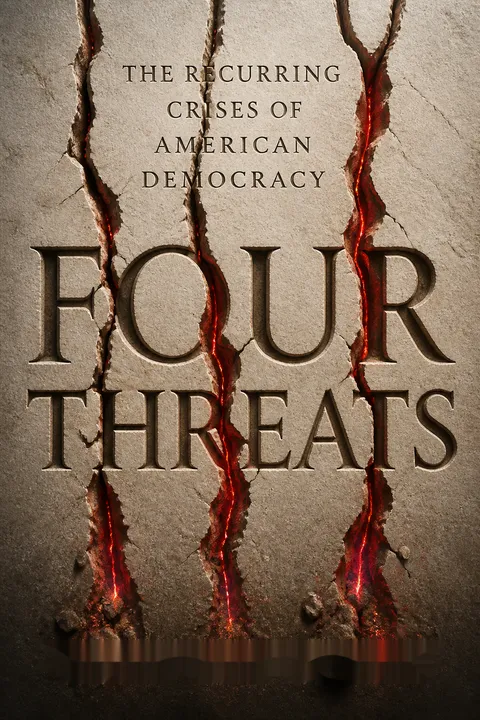

Key Takeaways
1. American Democracy: A Fragile Experiment, Not an Invincible Ideal
This book delves into our history in order to try to understand whether democracy today is in danger or not.
Challenging assumptions. Many Americans view their nation as synonymous with democracy, believing its institutions are bulwarks against tyranny and that its history is a steady march toward democratic ideals. However, a closer look reveals a far more tumultuous past, where democracy has been repeatedly under threat and often proven fragile. The nation's journey toward full democracy has been neither straight nor smooth, marked by decay and derailment.
Historical fragility. From its inception, the United States has endured crises where popular government was in peril. These moments include the intense political conflicts of the 1790s, the divisions over slavery in the 1850s that led to civil war, the widespread disenfranchisement of African Americans in the 1890s, and concerns about executive power during the Great Depression and Watergate. In each instance, the promise of "we the people" was severely tested.
Democracy's continuum. Rather than an on-off switch, democracy exists on a continuum. A regime can move towards more complete democracy (like during Reconstruction or the 1960s Civil Rights era) or towards less democracy, a process known as "backsliding." There is no guarantee of forward progress, and assuming automatic democratic endurance or steady advancement is a grave mistake, as history clearly demonstrates.
2. Four Converging Threats Endanger Democracy's Pillars
These crises of democracy did not occur randomly; rather, they developed in the presence of four specific threats: political polarization, conflict over who belongs in the political community, high and growing economic inequality, and excessive executive power.
Identifying vulnerabilities. The authors, drawing on global studies of democratic rise and fall, pinpoint four major threats that consistently endanger democracy. When these conditions are absent, democracy tends to flourish; when one or more are present, democracy is prone to decay. The combination of these threats has historically proven particularly dangerous.
Pillars of democracy. A well-functioning democracy relies on four key attributes:
- Free and fair elections: Allowing citizens to choose and hold rulers accountable.
- Rule of law: Ensuring all, including government, adhere to impartial rules.
- Legitimacy of the opposition: Recognizing opponents as fellow citizens with equal rights to participate.
- Integrity of rights: Protecting civil liberties (speech, press, religion) and civil rights (equal standing, voting).
These pillars provide standards to assess democracy's health.
Compounding danger. Historically, American democracy has faced these threats individually or in pairs, leading to significant harm. For example, the 1850s saw extreme polarization and conflict over membership, resulting in civil war. The 1890s combined polarization, white supremacy, and economic inequality to produce widespread democratic backsliding. Today, for the first time, all four threats are present simultaneously, creating an unprecedented confluence of danger.
3. Polarization: When Political Competition Becomes Mortal Combat
Yet when parties divide both lawmakers and society into two unalterably opposed camps that view each other as enemies, they can undermine social cohesion and political stability.
Beyond healthy competition. While vibrant political parties are essential for democracy, polarization transforms this competition into a zero-sum game. It divides citizens into "teams" more focused on defeating opponents than on effective governance, making cooperation, negotiation, and compromise costly for public officials who fear electoral punishment. This "us versus them" mentality fosters hostility and impedes problem-solving.
Historical patterns. Polarization emerged early in the 1790s, with Federalists and Republicans viewing each other as existential threats, leading to actions like the Alien and Sedition Acts. It resurfaced intensely in the 1850s over slavery, making reconciliation impossible. In the late 19th century, it peaked again, driven by fierce electoral competition. After a period of decline in the mid-20th century, polarization began a dramatic resurgence in the 1980s.
Modern drivers. Contemporary polarization is fueled by:
- Voter realignment: Liberals increasingly identify as Democrats, conservatives as Republicans.
- Republican strategy: Leaders like Newt Gingrich adopted confrontational tactics, attacking institutions and using inflammatory rhetoric to mobilize their base.
- Conservative media: Outlets like Fox News and talk radio amplify partisan narratives, portraying politics as a battle of heroes and villains, fostering anger and distrust.
- Negative partisanship: Voters are increasingly motivated by dislike for the opposing party, rather than strong affection for their own.
4. "Who Belongs?": The Perilous Power of Social Division
Unless such rifts are purposely eliminated, conflict over them can habitually resurface and spur deep divisions, making democracy vulnerable.
Formative rifts. Democracy thrives when citizens broadly agree on who belongs in the national community and on what terms. However, "formative rifts"—deep social divisions along lines of race, gender, religion, or ethnicity—can persist from a nation's founding, habitually resurfacing to spur conflict. In the U.S., the commitment to white supremacy, codified in the Constitution's sanctioning of slavery, has been a persistent antidemocratic force.
Asymmetrical conflict. Conflicts over membership are fundamentally asymmetrical: one side champions equality and inclusion, while the other seeks to restore or maintain old hierarchies. The latter may be willing to undermine democratic norms, such as civil liberties and voting rights, to achieve their goals, believing it necessary to preserve their preferred social order. This was evident in the 1850s and 1890s.
Trump's activation. Donald Trump's candidacy and presidency have explicitly fanned these flames:
- Nativism and racism: His rhetoric on Mexican immigrants ("rapists"), "shithole countries," and the "birther" conspiracy energized a base yearning for a white-dominated society.
- Sexist appeals: His derogatory remarks about women and the "Access Hollywood" tape resonated with voters who opposed gender equality, contributing to his electoral success.
- Party divergence: The Republican Party has become increasingly white and racially resentful, while the Democratic Party embraces a more diverse, egalitarian vision.
5. Economic Inequality: The Affluent's Silent Undermining of Democracy
Fearful of such policy changes, the rich take action to protect their interests and preserve their wealth and advantages.
Skewing the system. While not always leading to direct uprising, high economic inequality can distort democracy by giving the affluent an outsized voice. Fearing redistributive policies and higher taxes, the wealthy mobilize effectively to protect their interests, often tolerating damage to democratic processes if it secures their privileged position. This can transform democracy into an oligarchy.
Historical context. The U.S. has long been one of the most economically unequal wealthy democracies. After a "Great Compression" in the mid-20th century, inequality began to soar in the 1970s, with the top 1%'s share of national income increasing dramatically. This rise was not just due to market forces but also political choices, such as tax cuts for the wealthy and deregulation.
The politically active rich. In recent decades, the affluent and major corporations have significantly increased their political engagement:
- Campaign contributions: Wealthy donors contribute vast sums, disproportionately to conservative causes and Republican candidates.
- Lobbying: Corporations spend billions annually on lobbying, far outstripping labor unions and public interest groups.
- Organized networks: Groups like the Koch network actively push conservative policy agendas at state and national levels.
This mobilization allows the rich to pursue their agenda, often unnoticed by the public, while politicians use social divisions (like racism) to consolidate support and divert attention.
6. Executive Aggrandizement: The Presidency's Growing Power to Harm
The final threat to democracy is “executive aggrandizement,” the enlargement of the powers wielded by a nation’s top leader.
Eroding checks and balances. Executive aggrandizement occurs when powerful leaders expand their authority relative to legislatures and courts, often through legal means like filling agencies with allies or circumventing the rule of law. This concentration of power, precisely what the framers sought to avoid, weakens democratic accountability and can enable unilateral action.
Historical trajectory. The presidency, initially a limited office, began to grow in the early 20th century. Franklin D. Roosevelt dramatically expanded its powers during the Great Depression, using national emergency as justification to:
- Grant direct policymaking authority: As seen in trade policy (Reciprocal Trade Agreements Act).
- Delegate authority from Congress: Leading to a vast expansion of the federal bureaucracy.
- Strengthen presidential management: Creating the Executive Office of the President.
This set a precedent for future presidents to wield immense power.
Weaponized presidency. The Cold War further expanded the national security state, providing presidents with tools for surveillance and political repression. Richard Nixon "weaponized" this apparatus, using it for political espionage and to punish enemies, as revealed in the Huston Plan and Watergate. While checks and balances eventually held Nixon accountable, the underlying expansion of presidential power remained, creating a template for future abuses, especially in a highly polarized environment.
7. The 1790s: Polarization's First Havoc, Resolved by Racial Compromise
The early beginnings of democracy in the United States were fragile—even at a time when some of the Constitution’s framers themselves, along with other luminaries of the era, held public office.
Foundational conflict. The 1790s saw the rapid emergence of intense political polarization between Federalists and Republicans, who viewed each other as existential threats to the new nation. Federalists, in power, used the Alien and Sedition Acts to suppress dissent, target immigrants, and prosecute critical journalists, harming freedom of speech and press. Republicans, led by Jefferson and Madison, responded with the Kentucky and Virginia Resolutions, asserting states' rights to nullify federal laws.
Near collapse. The 1800 presidential election resulted in a deadlock between Jefferson and Aaron Burr, throwing the decision to the Federalist-controlled House. Rumors of plots, assassinations, and civil war spread. Federalists considered usurping the presidency, but ultimately, after 36 ballots, Jefferson won, marking the first peaceful transfer of power between opposing parties.
Racial compromise. This "victory for democracy" was deeply flawed, as it hinged on the three-fifths clause, which disproportionately empowered the slaveholding South. Without these "extra" electors, John Adams would likely have won. The crisis was resolved by preserving a version of democracy for white men, while explicitly perpetuating racial hierarchy and the enslavement of African Americans, laying the groundwork for future conflicts.
8. The 1850s: Slavery's Rift and the Disintegration of Democracy
As the conflict grew deeper, national politics gradually decayed.
Unbridgeable divide. The 1850s witnessed the dangerous reemergence of extreme polarization, coalescing around the "formative rift" of slavery. The Missouri Compromise had temporarily defused the issue, but the acquisition of new territories reignited the conflict. The Wilmot Proviso, seeking to ban slavery in new lands, shattered bipartisan silence and exposed the South's dilemma: democratic means threatened slavery's future.
Bleeding Kansas. The Kansas-Nebraska Act (1854) introduced "popular sovereignty," allowing territories to decide on slavery. This democratic solution quickly devolved into chaos:
- Electoral fraud: Missouri "Border Ruffians" illegally crossed borders to vote, stuffing ballot boxes and intimidating free-state voters.
- Breakdown of rule of law: Violence, including the "Sack of Lawrence" and John Brown's Pottawatomie massacre, became rampant.
- Illegitimate opposition: Free-state Kansans formed a rival government and constitution, rejecting the fraudulent proslavery legislature.
The conflict demonstrated democracy's inability to resolve the slavery question peacefully.
National decay. The violence spilled into Congress, notably with Preston Brooks's caning of Charles Sumner. The Lecompton Constitution, a proslavery document for Kansas, further polarized national politics, splitting the Democratic Party. The 1860 election saw a sectional divide, with Lincoln winning without appearing on southern ballots. To the South, Lincoln's victory was a mortal threat, leading to secession and ultimately, civil war—the ultimate repudiation of the rule of law and legitimate opposition.
9. The 1890s: White Supremacy's Coup and Democracy's Backsliding
The establishment of racial segregation in all aspects of social life—American apartheid—followed.
Multiracial democracy's rise. Following the Civil War, Reconstruction brought significant democratic progress, with black men gaining voting rights and holding public office across the South. Despite setbacks and Klan violence, African Americans remained a political force through the 1880s, often swinging elections and forming "Fusion" coalitions with white Populists and Republicans. This multiracial alliance threatened the dominance of white Southern Democrats.
Strategic disenfranchisement. Faced with rising opposition, Southern Democrats, led by elites, devised a new strategy: legally disenfranchising African Americans and poor whites. Mississippi pioneered this in 1890 with poll taxes, literacy tests, and residency requirements, effectively crippling black voter turnout. The Supreme Court's Williams v. Mississippi (1898) decision upheld these measures, sanctioning democratic backsliding.
The Wilmington Coup. In North Carolina, the Fusionist coalition's success in 1896 spurred Democrats to action. They launched a white supremacy campaign, using racist rhetoric, paramilitary groups (Red Shirts), and electoral fraud. In November 1898, a white mob destroyed a black-owned newspaper, massacred hundreds, and forced the resignation of the biracial city government in Wilmington, installing white Democrats. National leaders, including President McKinley, acquiesced. This marked the end of multiracial democracy in the South for 70 years, replaced by authoritarian rule and Jim Crow segregation.
10. The 1930s & 1970s: Executive Power's Rise and Its Weaponization
But it also opened the door not only to heightened conflict between the president and Congress but also to the temptation on the part of presidents to use their growing power to stifle the opposition and undermine democracy.
FDR's expansion. The Great Depression and the rise of totalitarianism abroad led Americans to question their system. Franklin D. Roosevelt responded by dramatically expanding presidential power through the New Deal, often with congressional acquiescence. He gained direct policymaking authority (e.g., trade), delegated vast powers to new federal agencies, and strengthened White House management. While averting economic collapse, this set a precedent for a more powerful, executive-centered government.
Compromised ideals. Despite strengthening democracy in some ways (social and labor rights), FDR's expansion of power came with costs. New Deal benefits often excluded women and African Americans, perpetuating racial and gender hierarchies. During WWII, FDR ordered the internment of over 100,000 Japanese Americans, a direct violation of civil liberties, demonstrating the potential for executive power to harm rights even in a democracy.
Nixon's weaponization. By the 1970s, the presidency had amassed immense power, including a vast national security apparatus. Richard Nixon, facing anti-war protests and paranoia about leaks, sought to "weaponize" this power for political gain. The Huston Plan aimed to expand domestic surveillance (wiretaps, break-ins) against perceived enemies. The Pentagon Papers leak led to the creation of the "Plumbers" unit, which engaged in illegal activities like the break-in at Daniel Ellsberg's psychiatrist's office and the Watergate burglary.
Checks and balances prevail (for now). Watergate exposed Nixon's sustained efforts to obstruct justice and abuse power. A combination of investigative journalism, judicial action (Judge Sirica, Supreme Court ordering release of tapes), and bipartisan congressional efforts (Senate hearings, House impeachment inquiry) ultimately held Nixon accountable. His resignation in 1974, though a crisis, demonstrated the resilience of democratic institutions when other threats (polarization, inequality, racial conflict) were relatively low.
11. Today's Unprecedented Convergence: All Four Threats at High Velocity
Now, for the first time in American history, we face all four threats at the same time.
A perfect storm. The late 20th and early 21st centuries have seen all four threats—polarization, conflict over who belongs, economic inequality, and executive aggrandizement—escalate and converge to unprecedented levels. This creates a highly combustible environment, where each threat intensifies the others, making American democracy profoundly vulnerable.
Trump as catalyst. Donald Trump, a political outsider, masterfully exploited these converging threats:
- Polarization: He thrived on division, viciously attacking opponents and energizing a loyal base.
- Membership conflict: He fanned racial resentment and nativism with derogatory remarks about immigrants and minorities, appealing to those yearning for older social hierarchies.
- Economic inequality: His administration enacted policies (e.g., 2017 tax cuts, deregulation) that disproportionately benefited the wealthy and corporations, who in turn provided steadfast support.
- Executive aggrandizement: He viewed the presidency as a personal tool, flouting the rule of law, undermining institutions (Justice Department, FBI), and challenging congressional oversight.
Pillars under attack. This convergence has directly harmed democracy's core pillars:
- Free and fair elections: Trump's unsubstantiated claims of voter fraud, attempts to involve foreign governments in elections, and efforts to add a citizenship question to the census undermine public confidence and ballot access.
- Rule of law: His refusal to separate from businesses, claims of presidential immunity, and stonewalling of congressional subpoenas erode the principle that no one is above the law.
- Legitimacy of opposition: Trump consistently portrays opponents as illegitimate "enemies," fostering an "us versus them" mentality that hinders cooperation and justifies extreme tactics.
- Integrity of rights: His attacks on the press and verbal assaults on marginalized groups, coupled with policy changes like the travel ban and fast-track deportations, threaten civil liberties and civil rights.
12. Putting Democracy First: A Call to Action for All Americans
The most important thing we can do is to insist on strong protection for free and fair elections, the rule of law, the legitimacy of competition, and the integrity of rights.
Beyond historical compromises. American democracy has often survived past crises by compromising its ideals, particularly by reinforcing racial hierarchies. These historical "settlements" are no longer acceptable. Today's challenges demand a new path that embraces the foundational value of equality for all Americans, moving beyond the limitations of the past.
Shared values, urgent action. Despite deep partisan divides, most Americans value democratic principles like free and fair elections, the rule of law, and equal opportunity. This shared commitment offers a crucial starting point for collective action. Protecting democracy's pillars—the fundamental "rules of the game"—must become the top priority, transcending ideological, material, and partisan considerations.
The Democratic Party's role. In the current environment, where one party (the Republican Party) has increasingly abandoned its commitment to protecting democratic pillars, the opposition (the Democratic Party) bears the obligation to champion democracy itself. This means actively defending free and fair elections, upholding the rule of law, respecting legitimate competition, and safeguarding the integrity of rights for all citizens, ensuring that "government of the people, by the people, for the people, shall not perish from the earth."
Review Summary
Four Threats receives mixed reviews, averaging 4.03/5 stars. Readers praise its historical analysis of American democracy's recurring crises through the 1790s, Civil War, Gilded Age, Depression, and Watergate, identifying four threats: political polarization, racism/nativism, economic inequality, and executive power. Many appreciate the insight that all four threats now exist simultaneously for the first time. However, critics find the writing dry and academic, the framework incompletely substantiated, and the Trump-focused final chapters partisan or outdated. Some desired more actionable solutions. Overall, readers value the historical perspective but debate its contemporary application.
People Also Read




About the Author
Download PDF
Download EPUB
.epub digital book format is ideal for reading ebooks on phones, tablets, and e-readers.








































