

Key Takeaways
An eighty-year life is just four thousand weeks, so stop pretending otherwise
The math is brutal. Live to eighty and you get roughly 4,000 weeks. All of human civilization since ancient Sumer spans about 310,000 weeks. On any cosmic scale, Burkeman notes, we are all dead any minute. Seneca made the same complaint two thousand years ago: life feels short because we finally get ready to live just as it ends.
Yet modern time management ignores this entirely. The productivity industry obsesses over cranking through tasks, perfect morning routines, and batch-cooking Sundays, while never asking what the frantic doing is for. Burkeman's radical move is to build a philosophy of time around the fact of death rather than pretending we can optimize our way past it. Facing finitude, he argues, is not depressing but liberating.
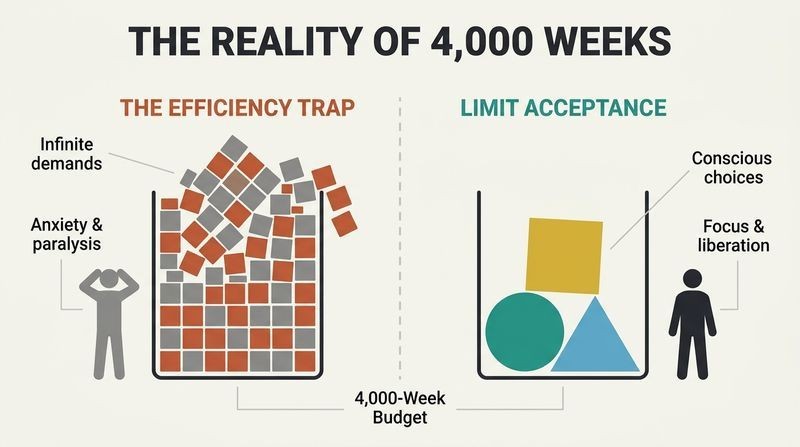
What's striking is how Burkeman weaponizes mortality against the self-improvement genre that usually denies it. The framing echoes Heidegger's "being-toward-death" and Stoic memento mori, but repackaged for burned-out knowledge workers. The 4,000-weeks figure is a rhetorical masterstroke, converting an abstract fact into visceral scarcity, similar to how behavioral economists show people save more when retirement is framed in days rather than years. One caution: the arithmetic assumes a fixed lifespan, and some readers may find the relentless death-focus more paralyzing than freeing. The genius is inverting the usual promise: instead of helping you do more, the book helps you accept you never will.
Getting more efficient just breeds more work, so stop trying to clear the decks
The efficiency trap is self-defeating. Burkeman conquered his inbox with "Inbox Zero" only to discover that answering email fast generates more email. Reply promptly and people learn you reply promptly, so they message you more. The input side is infinite; your output is finite. This is Sisyphus with a smartphone.
Demands expand to fill any capacity you create. When washing machines arrived, standards of cleanliness simply rose, so no time was saved (historian Ruth Cowan's finding). Parkinson's law, that work expands to fill available time, applies to everything that needs doing. The cruelest twist is qualitative: chasing efficiency, you rush the trivial urgent stuff (the "PLEASE READ" password email) while the meaningful work (the letter from an old friend) waits forever. The fix is refusing to clear the decks and tolerating that discomfort.
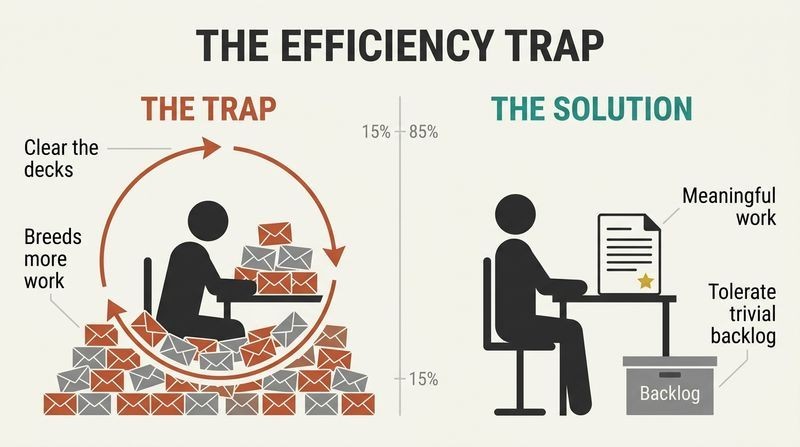
This connects to what economists call induced demand: widen a highway and more cars appear, so congestion returns. Burkeman applies the same logic to personal productivity, which is genuinely useful. It also rhymes with the hedonic treadmill in happiness research, where rising expectations neutralize gains. The prescriptive weakness is that many workers cannot simply decline to answer email without real consequences, a limit Burkeman acknowledges but cannot fully resolve. Still, the reframe is powerful: the problem is not your inadequate system but the false belief that any system could ever let you finish. Naming that belief is the first act of resistance.
Every yes is a thousand noes, and that is what makes choices meaningful
Missing out is not a bug, it is the whole point. Because time is finite, choosing to do anything means sacrificing every other thing you could have done with that stretch. The Latin decidere means to cut off, a cousin of homicide. Any finite life is a ceaseless waving goodbye to possibility.
But this converts dread into meaning. Burkeman flips "fear of missing out" into the "joy of missing out." It is precisely because marrying one person forecloses everyone else that the commitment means something. He cites Daniel Gilbert's experiment: people given a poster they could exchange later valued it less than those stuck with their final choice. Irreversibility breeds contentment. So settle deliberately, make big daunting commitments, and stop keeping options open, since keeping options open is itself a disguised way of accomplishing nothing.
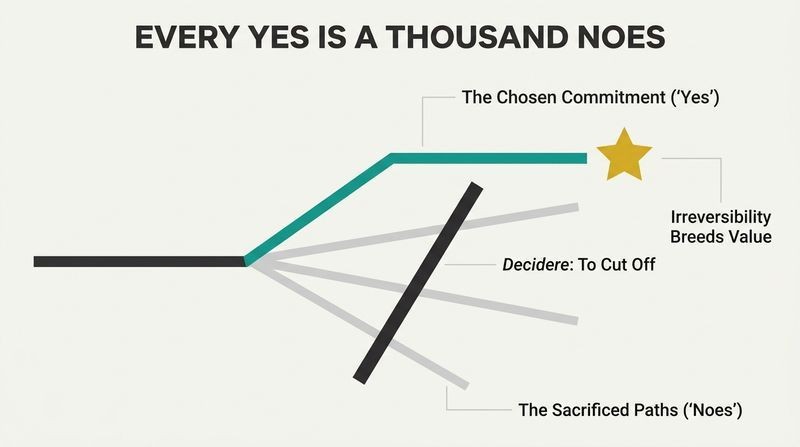
Gilbert's research on "synthetic happiness" supports this well: our psychological immune system rationalizes locked-in decisions but stays restless with reversible ones. It dovetails with Barry Schwartz's paradox of choice, where more options produce more regret. Burkeman's spin on Kafka, who spent five years and hundreds of letters failing to commit to Felice Bauer, dramatizes commitment-phobia as fantasy-preservation: an imagined future can hold contradictory desires that reality never could. The provocative claim that you should settle cuts against a culture worshipping optionality and "never settle" memes. The nuance worth adding: some settling is genuinely premature, and distinguishing wise commitment from resignation requires judgment the framework alone cannot supply.
Distraction is you fleeing the discomfort of confronting your own limits
You are a willing collaborator, not a victim. Three million people watched BuzzFeed reporters explode a watermelon with rubber bands, many thinking "what am I doing with my life?" The attention economy is engineered to hijack you, but Burkeman insists the deeper truth is that something in us wants to be distracted. The calls are coming from inside the house.
We flee because focus forces us to face finitude. Shinzen Young, training as a Buddhist monk, poured freezing water over himself and found the pain unbearable only when his attention wandered; full attention dissolved the suffering. Concentrating on what matters means confronting your limited talent, limited control, and the chance of failure. Boredom feels aggressively unpleasant because it makes you meet reality as it is. Digital detoxes fail because they treat the symptom, not the underlying urge to escape.
This reframing is more sophisticated than typical "phones are ruining us" arguments. It aligns with Acceptance and Commitment Therapy, which holds that suffering compounds when we struggle against unpleasant internal experience rather than allowing it. Young's ice-water insight parallels pain research showing that catastrophizing amplifies pain signals while acceptance dampens them. Burkeman is careful not to let Silicon Valley off the hook (persuasive design borrows slot-machine variable rewards), yet he locates ultimate agency in the user. A fair challenge: this can shade into blaming the victim of genuinely addictive design. The balanced reading is that both the manipulation and our complicity are real, and only the second is within your control.
You cannot manage time because you don't have it, you are it
Time is not a resource you possess. As writer David Cain notes, we never have three hours the way we have cash in a wallet; we only expect them. Your boss interrupts, the subway breaks, or you die. You only feel certain about a stretch of time once it has already become the past. Heidegger's cryptic claim is that we do not have time, we are time, so mastering it would require standing outside ourselves, which is impossible.
Worry is a doomed demand for certainty. Burkeman's family were obsessive planners, shaped partly by his grandmother's escape from Nazi Germany. But no amount of arriving fourteen hours early buys reassurance, because the frontier of uncertainty just moves to the next thing. Krishnamurti's secret: "I don't mind what happens." Plans are useful, but a plan is just a present-moment thought, not a lasso around the future.
The distinction between influencing the future and demanding certainty about it is quietly profound and maps onto cognitive behavioral therapy's treatment of generalized anxiety, where the target is intolerance of uncertainty rather than any specific worry. Burkeman's point that we navigated our entire past without control (Simone de Beauvoir marveling at the improbable chain of chance that made her) is a neat antidote to prospective anxiety. The Heideggerian "we are time" claim is philosophically contested and admittedly slippery, but as a practical stance it dissolves the illusion of a controlling self hovering above the flow. The takeaway lands even if the metaphysics stays debatable.
Living for the future drains meaning from the only moment you ever get
Instrumentalizing time is a trap. Treat every moment as a stepping-stone and you live mentally in a future that never arrives. Alan Watts likened it to education: nursery school preps you for kindergarten, which preps you for college, for a career, for retirement, for death, always chasing a carrot. Fatherhood exposed Burkeman's own habit: he nearly reduced his newborn son to a means to his own future peace of mind.
Adam Gopnik's "causal catastrophe" is judging childhood only by the adult it produces, which strips childhood of intrinsic worth. Tom Stoppard's Herzen: a child's purpose is to be a child, not to grow up. The same applies to your whole life. Corporate lawyers billing in sixty-minute chunks lose the capacity to value anything uncommodifiable. Trying too hard to "be present" fails too, since it just instrumentalizes the moment for a different payoff.
Burkeman threads a needle here that mindfulness culture often botches. The critique of forced presence (his "screen saver" reaction to the northern lights) is refreshingly honest and echoes psychological findings that effortful pursuit of happiness can backfire, the so-called paradox of hedonism. The billable-hour example connects to sociologist Arlie Hochschild's work on how market logic colonizes intimate life. One extension: Keynes foresaw a fifteen-hour workweek by now, and its failure to materialize shows how thoroughly we internalized "purposiveness," using future goals to fend off the fact of mortality. The unresolved tension is that some future-orientation is survival, not neurosis; the art is calibration, not abolition.
Rest only counts when it earns you nothing at all
Leisure has been colonized by productivity. We now feel we must use time off well, training for a 10K rather than just running, or backpacking to stockpile experiences. To the ancient Greeks, leisure was the whole point of life, the end to which work was a mere means; the Latin for business, negotium, literally means not-leisure. Industrialization inverted this, making leisure a recharge station for more work.
Genuine rest requires wasting time on purpose. Burkeman argues idleness with no future payoff is practically an obligation if you want to actually inhabit your life. Weber's "Protestant work ethic" traces our idleness-aversion to Calvinists proving their salvation through relentless work. The antidote is atelic activities (from telos, aim): hobbies with no endpoint, like Rod Stewart's decades-long model railway. It helps to be mediocre at them, since that kills the urge to optimize.
The atelic activity, borrowed from philosopher Kieran Setiya, is the practical jewel here. It resonates with self-determination theory in psychology, which finds intrinsic motivation more durable than extrinsic reward. Burkeman's celebration of being bad at hobbies inverts the "passion economy" pressure to monetize every interest into a side hustle. The Danielle Steel example (179 books, twenty-hour days, work as refuge from grief) reframes hyperproductivity as possible avoidance rather than pure virtue. A useful challenge: the sabbath's power came from collective enforcement, and purely private "digital sabbaths" lack that social scaffolding, so individual willpower alone often fails. Rest, like meaning, may be partly a coordination problem.
Hurrying is an addiction that speeds up the faster you chase control
Impatience is rage at reality's pace. The pointless honking in gridlocked Brooklyn is a howl at not being able to make the world move faster. Technology fuels this: once a microwave heats dinner in a minute, waiting that minute feels intolerable, because each advance seems to promise we might finally transcend our limits. Amazon estimates a one-second slower homepage would cost 1.6 billion dollars in sales.
Speed works like alcoholism. Therapist Stephanie Brown noticed Silicon Valley overachievers self-medicating with velocity exactly as she once did with drink. You move faster to quell anxiety, which reveals you can never move fast enough, which breeds more anxiety. The only exit, borrowed from Alcoholics Anonymous, is surrender: admit you cannot force reality's pace. That "second-order change" transforms drudgery into a chosen, even relishable, act.
The addiction analogy is bold and mostly earns its keep. Brown's clinical framing connects to research on "hurry sickness" and Type A behavior linked to cardiovascular risk, suggesting the cost is physiological, not just spiritual. The AA surrender model maps onto acceptance-based therapies again: paradoxically, releasing the demand for control restores agency. Where Burkeman could be pressed: not all speed is pathological, and some domains (emergency medicine, competitive markets) genuinely reward velocity. The distinction he implies but underdevelops is between chosen speed and compulsive speed. Still, the observation that our culture praises the speed addict as "driven" while it would intervene on the drinker is a sharp cultural diagnosis.
Patience is the superpower of staying put when everything urges you to bolt
Surrendering to a thing's natural pace is power. Art historian Jennifer Roberts makes students stare at a single painting for three hours. It takes her nine minutes to notice a squirrel's belly echoing a boy's ear, forty-five to see hidden folds. The reward for abandoning the fantasy of controlling speed is a real grip on reality. Three principles: develop a taste for having problems (a problem-free life would be meaningless), embrace radical incrementalism (write in short daily sessions and stop even when energized), and accept that originality lies on the far side of unoriginality.
Photographer Arno Minkkinen's bus parable captures the last principle. Every bus from Helsinki station shares the same early route, so your early work looks derivative. The solution: stay on the bus. Keep going and the routes diverge into genuinely original territory. Quitters hail a cab back to the start and repeat the pattern forever.
Robert Boice's research on academic writers, that the most productive worked in brief daily sessions and stopped on time, contradicts the romantic myth of the binge-writing genius and aligns with modern findings on spaced practice and deliberate rest. The bus parable is essentially an argument against premature differentiation, echoing how expertise research (Ericsson) shows mastery emerges only after long imitation. Burkeman rehabilitates patience from its passive, often gendered connotations into active engagement, a worthwhile reframe. The subtle risk is using "stay on the bus" to justify staying too long on a genuinely wrong path; the parable assumes the routes eventually diverge, but some buses just loop. Discernment still required.
Total control over your schedule buys you loneliness, not freedom
Time is a network good. Like a telephone, its value depends on others having it too and syncing theirs with yours. Mario Salcedo has lived on cruise ships for two decades with total time sovereignty and seems hollow, insisting to strangers he is "the happiest guy in the world." Digital nomads confess the real problem is crushing loneliness; one wept watching Japanese families bike together in a park.
Synchrony creates meaning and joy. Researcher Terry Hartig found Swedes used fewer antidepressants when more of the country vacationed simultaneously, so shared time off beat solitary time off. The Soviets learned this by accident: Stalin's staggered five-day week, designed for efficiency, destroyed social life because friends and spouses never had the same day free. William McNeill felt a "strange sense of personal enlargement" marching in unison as a soldier. Choirs, sports teams, and Swedish coffee breaks (fika) all trade autonomy for belonging.
The "network good" framing is the chapter's analytic backbone and it is genuinely illuminating, drawing on economics to explain why individually rational time-optimization produces collectively impoverished lives, a tragedy of the commons applied to human connection. Hartig's antidepressant study and the Soviet nedelya experiment are striking natural experiments. This connects to Robert Putnam's Bowling Alone thesis on collapsing social capital and to Durkheim's "collective effervescence," the electricity of synchronized ritual. The political extension, that atomized, desynchronized populations become fodder for autocrats (Arendt), is provocative and timely. The honest limitation: the least privileged, stuck with algorithmic on-demand scheduling, cannot simply choose synchrony, making this partly a structural problem individual choice cannot fix.
Your cosmic insignificance is the best therapy you will ever get
You matter far less than you think, and that frees you. Philosopher Bryan Magee noted the whole of civilization spans only about sixty centenarian lifetimes laid end to end, the number of guests at a drinks party. The pharaohs were thirty-five lifetimes ago. Your life is a flicker. This sounds terrifying but works as "cosmic insignificance therapy": relationship worries, status battles, even pandemics shrink to irrelevance against the indifferent universe.
The relief exposes a hidden grandiosity. We secretly hold our lives to an impossible standard, that they must be remarkable, put a dent in the universe, or leave a Tolstoy-sized legacy. Philosopher Iddo Landau notes we do not fault a chair for failing to boil water. Drop the inflated standard and ordinary things qualify as meaningful: cooking for your kids, a novel that moves a handful of readers, any job that helps those it serves.
This is Burkeman's most consoling move, and it inverts the usual self-help promise of significance. It resembles the "overview effect" astronauts report seeing Earth from space, and Stoic cosmic perspective (Marcus Aurelius imagining the vastness of time). The insight that despair and grandiosity are secretly the same mistake, both applying an impossibly high bar, is genuinely original and clinically useful; it echoes cognitive therapy's work on perfectionism. The critique worth noting: cosmic insignificance can cut both ways, sliding into nihilism ("nothing matters") rather than liberation ("small things matter"). Burkeman's careful distinction, that insignificance lowers the bar for meaning rather than abolishing meaning, is what keeps it therapeutic rather than corrosive.
Give up hope of mastering time and just do the next necessary thing
The struggle to master time is doomed because you are time. You will never handle every demand or predict every event, so insecurity is the default state, not a solvable problem. Zen teacher Charlotte Joko Beck: the human predicament is unbearable only while you believe it can be cured. Accept the affliction and freedom follows.
Abandon hope, which is quietly disempowering. Environmentalist Derrick Jensen argues hope means placing faith in something outside yourself and this moment to fix things, which surrenders your own power. Things are already not okay, the ice is already melting, so you are free to simply do the work. Carl Jung's advice to a distressed correspondent: quietly do the next and most necessary thing. That is all any of us can do, and fortunately, because it is all you can do, it is also all you ever have to do.
Ending on Jung's "next most necessary thing" (which AA compresses into "do the next right thing") gives the book an actionable floor beneath its philosophical ceiling. Jensen's reframing of hope as disempowerment is counterintuitive and draws on Buddhist teacher Pema Chodron's "getting the hang of hopelessness"; it parallels Stoic distinction between what is and is not in our control. There is a real tension with psychology research showing hope predicts resilience and goal-attainment (Snyder's hope theory), so Burkeman is redefining hope narrowly as passive outcome-attachment rather than agency. Read that way, the paradox resolves: releasing attachment to guaranteed outcomes frees energy for present action. A fittingly modest, non-triumphant close to an anti-productivity book.
Analysis
Four Thousand Weeks is a philosophy book wearing a time-management disguise, and that bait-and-switch is its central achievement. Burkeman, a recovering "productivity geek" who once wrote a newspaper column on the subject, turns the genre against itself: instead of promising to help you do more, he argues that the entire project of getting on top of everything is the disease, not the cure. The structure moves from diagnosis (the efficiency trap, the impossibility of control) to a reorientation around finitude, drawing on Heidegger, Stoicism, Zen, and a wide cast of thinkers rather than offering a proprietary system.
What distinguishes the book intellectually is its refusal of the two available cultural scripts: the hustle-optimization script and the reactive "slow living" script. Burkeman shows that fetishized presence and digital detoxes are just optimization in disguise, still instrumentalizing the moment for a payoff. His deeper claim is quasi-existentialist: our time troubles are avoidance strategies, ways of refusing to accept that we are finite, mortal, and largely not in control. The productivity industry sells the fantasy of eventual mastery precisely because that fantasy soothes death anxiety.
The book's limitation is one Burkeman half-concedes: much time pressure is structural, arising from precarious labor markets, eroded safety nets, and gendered domestic burdens that no change of attitude dissolves. His most communal insight, that synchronized time creates meaning, points toward collective solutions the individualist self-help frame cannot deliver. There is also a class dimension: the freedom to "decide what to fail at" presumes discretion many workers lack.
Still, as a work of applied philosophy for anxious moderns, it is unusually honest and well-read. Its lasting contribution is the reframe that limitation is not the obstacle to a meaningful life but its precondition. Missing out, settling, and insignificance become, in Burkeman's hands, the very things that let choice, commitment, and ordinary meaning exist at all.
Review Summary
Four Thousand Weeks challenges traditional time management advice, arguing that life's finite nature makes it impossible to do everything. Burkeman encourages readers to embrace their limitations, focus on what truly matters, and find meaning in the present moment. Many reviewers found the book's philosophy refreshing and liberating, appreciating its counterintuitive approach to productivity. Some felt it was repetitive or contradictory at times, but overall, readers found valuable insights about accepting life's constraints and prioritizing meaningful experiences over endless task completion.
People Also Read

Glossary
Efficiency trap
Getting faster generates more workThe self-defeating dynamic whereby becoming more productive or efficient fails to produce a feeling of having enough time, because demands expand to offset any gains. Clearing your inbox invites more email; meeting more obligations invites more obligations. Both the quantity of tasks and the proportion of trivial ones increase, so the more efficient you become, the busier and emptier you feel.
Joy of missing out
Meaning from sacrificing alternativesBurkeman's deliberate inversion of "fear of missing out." The recognition that because time is finite, every choice sacrifices countless alternatives, and that this sacrifice is precisely what makes a choice meaningful. Committing to one path (a marriage, a career, an afternoon) matters only because you could have chosen otherwise. Missing out on nearly everything is guaranteed, so it stops being a problem.
Cosmic insignificance therapy
Relief from realizing you barely matterBurkeman's term for the liberating effect of grasping how trivial your life is on the scale of the universe and history. All civilization spans roughly sixty centenarian lifetimes. Rather than causing despair, this exposes the hidden grandiosity behind our impossibly high standards for a meaningful life and frees us to value ordinary, modest activities as genuinely worthwhile.
Atelic activity
Action valued for itselfA concept from philosopher Kieran Setiya (telos meaning aim or goal) describing activities with no endpoint or outcome that completes them, such as going for a walk, listening to music, or a hobby. Their value lies entirely in the doing, not in a future result. Burkeman contrasts them with telic, goal-driven activities that lose meaning once the relationship with time becomes purely instrumental.
Causal catastrophe
Judging things only by resultsAdam Gopnik's phrase for the error of believing the rightness of some activity is proven only by the future results it produces, for example judging a way of raising children solely by the adults it yields. The effect is to drain the present of intrinsic value, treating childhood, or life itself, as mere preparation for a payoff that may never come.
Time as a network good
Value depends on others syncingBurkeman's economic reframing of time, borrowed from goods like telephones whose worth depends on how many others have them and how well coordinated they are with yours. Having abundant free time is nearly useless, even unpleasant, if experienced alone. Meaning and joy require synchrony, so surrendering some individual control over your schedule to align with others is often more valuable than hoarding time sovereignty.
Fixed volume productivity
Cap your tasks and hoursBurkeman's practical method that starts from the assumption that hard choices are inevitable. Keep two to-do lists, one open (everything) and one closed (ten items maximum), adding a new task only when one is finished. Combine with predetermined daily time boundaries so all decisions are made within accepted limits, rather than chasing the impossible goal of getting everything done.
Radical incrementalism
Small daily sessions, stop earlyA patience principle drawn from psychologist Robert Boice's study of academics: the most productive writers worked in brief daily sessions, often ten minutes to a few hours, and stopped even when energized, taking weekends off. Tolerating that you produce little on any given day, and resisting the impatient urge to push on, sustains output and prevents burnout over the long term.
FAQ
What's "Four Thousand Weeks" about?
- Exploration of time management: "Four Thousand Weeks" by Oliver Burkeman examines time management through the lens of human finitude, highlighting the average human lifespan of around four thousand weeks.
- Philosophical perspective: The book challenges traditional productivity methods by exploring philosophical ideas about how humans perceive and use time.
- Focus on meaningful living: Burkeman encourages readers to embrace the limitations of time and prioritize living a meaningful life over controlling every aspect of it.
Why should I read "Four Thousand Weeks"?
- Reframe time management: The book offers a fresh perspective, moving away from traditional productivity hacks to a more philosophical approach that emphasizes meaningful living.
- Address modern busyness: It tackles the modern epidemic of busyness and the pressure to be constantly productive, providing insights into finding peace and fulfillment.
- Practical and philosophical insights: Burkeman combines practical advice with philosophical insights, making it valuable for anyone looking to rethink their relationship with time.
What are the key takeaways of "Four Thousand Weeks"?
- Embrace limitations: Accepting the finite nature of time can lead to a more fulfilling life by forcing us to prioritize what truly matters.
- Avoid the efficiency trap: Becoming more efficient often leads to more busyness and stress, rather than the peace of mind we seek.
- Live in the present: Focusing on the present moment, rather than constantly planning for the future, can lead to a more meaningful and satisfying life.
How does Oliver Burkeman suggest we manage our time?
- Prioritize what matters: Focus on a few important tasks rather than trying to do everything, which often leads to stress and inefficiency.
- Limit work in progress: Set a hard limit on the number of projects you work on at any given time to ensure focus and completion.
- Embrace imperfection: Accept that not everything will be perfect or completed, and that making choices about what to neglect is crucial.
What is the "efficiency trap" in "Four Thousand Weeks"?
- Definition: The "efficiency trap" refers to the paradox where becoming more efficient leads to more tasks and responsibilities, rather than freeing up time.
- Increased busyness: As you become more efficient, you often take on more work, increasing busyness and stress rather than reducing it.
- Focus on meaningful tasks: Burkeman suggests focusing on meaningful tasks and accepting that not everything can be done to avoid this trap.
What does Burkeman mean by "living in the present"?
- Present moment focus: Living in the present means focusing on the current moment rather than constantly planning for the future or dwelling on the past.
- Avoiding instrumentalization: It involves avoiding the tendency to treat every moment as a means to an end, which can lead to a lack of fulfillment.
- Embrace life's flow: By embracing the flow of life and accepting its impermanence, we can find more joy and meaning in everyday experiences.
How does "Four Thousand Weeks" address the concept of busyness?
- Modern busyness epidemic: The book discusses how modern society is plagued by an epidemic of busyness, driven by the pressure to be constantly productive.
- Cultural expectations: Burkeman explores how cultural expectations and the desire to achieve more contribute to this sense of busyness.
- Finding peace in busyness: He offers insights into how to find peace and fulfillment by focusing on what truly matters and letting go of the need to do everything.
How does Burkeman suggest we handle procrastination?
- Embrace procrastination: Burkeman suggests viewing procrastination as a natural part of life rather than something to be eradicated.
- Focus on important tasks: Prioritize the most important tasks and accept that not everything can be accomplished.
- Manage effectively: By prioritizing and accepting our limitations, we can manage procrastination more effectively.
What is "cosmic insignificance therapy" in "Four Thousand Weeks"?
- Embrace smallness: "Cosmic insignificance therapy" helps readers embrace their smallness in the grand scheme of things.
- Relieve pressure: By recognizing our insignificance, we can relieve the pressure of trying to achieve monumental success.
- Focus on meaning: This perspective allows us to focus on meaningful activities without the burden of unrealistic expectations.
How does "Four Thousand Weeks" redefine productivity?
- Shift focus: The book redefines productivity by shifting the focus from efficiency to meaningful engagement with life.
- True productivity: Burkeman argues that true productivity involves doing things that matter, rather than simply getting more done.
- Prioritize joy and fulfillment: He encourages readers to prioritize activities that bring joy and fulfillment, even if they don't lead to tangible outcomes.
What are some practical tips from "Four Thousand Weeks" for better time management?
- Fixed volume approach: Adopt a "fixed volume" approach to productivity, limiting the number of tasks you take on.
- Serialize projects: Focus on one project at a time to completion.
- Minimize distractions: Embrace "boring and single-purpose technology" to enhance focus and minimize distractions.
What are the best quotes from "Four Thousand Weeks" and what do they mean?
- "The average human lifespan is absurdly, terrifyingly, insultingly short." This quote highlights the book's central theme of the finite nature of human life and the importance of using our limited time wisely.
- "Time management is all life is." Burkeman suggests that managing our time effectively is crucial to living a meaningful life, as time is the essence of our existence.
- "The spirit of the times is one of joyless urgency." This quote reflects the modern obsession with busyness and productivity, which often leads to stress and a lack of fulfillment.
About the Author
Download PDF
Download EPUB
.epub digital book format is ideal for reading ebooks on phones, tablets, and e-readers.








































