

Key Takeaways
Trade digital connectivity for real-world connection to actually find love
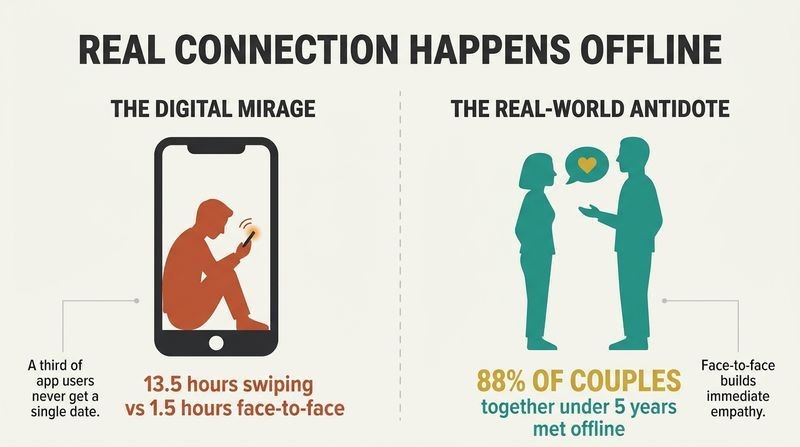
The screen is a mirage. Jean Smith, a social anthropologist who calls herself a Flirtologist, opens with a blunt statistic: despite 91 million people using dating apps, roughly 88% of couples together five years or less met offline. The average online dater burns 13.5 hours a week on their profile for just 1.5 hours of face time, and a full third never go on a single date.
Apps profit from your loneliness. The industry, worth over 2 billion pounds globally, thrives on you not finding a match so you keep paying. Meanwhile merely having a phone nearby makes two strangers rate their conversation as less meaningful and each other as less empathetic. Flirtology argues the antidote is the oldest technology we have: talking to a person standing in front of you.
What's striking is how Smith reframes convenience as the enemy of intimacy rather than its enabler. Her pizza analogy (delivered pizza is convenient but never the best pizza) captures a deeper behavioral-economics truth: friction sometimes signals value. Sherry Turkle's research in Alone Together reaches a similar verdict, that constant connectivity breeds a new solitude. One caveat worth noting: correlation is not destiny. Apps have matured since 2018, and for marginalized groups or the geographically isolated they genuinely widen the pool. The sharper point survives scrutiny: a screen cannot transmit the physiological feedback loop of touch, scent, and mutual gaze that attraction actually runs on.
Flirting is just asking a question, then reading the answer
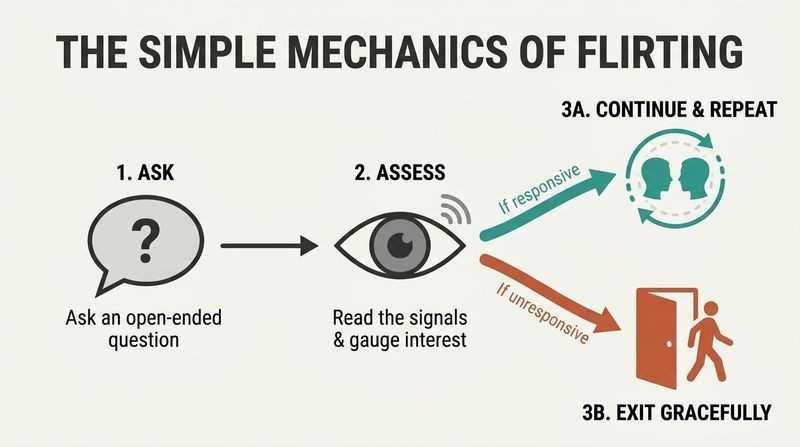
Ask, assess, repeat. Smith's entire method dismantles the myth that flirting requires a killer line or innate charisma. The mechanic is almost embarrassingly simple: ask an open-ended question, gauge whether the person is responsive, then decide whether to continue or exit gracefully. No Ferrari acceleration from zero to sixty, just a single question that opens a door.
Skill, not gene. She insists flirting is a learned behavior like piano or French, improvable with practice and initially awkward by necessity. On her flirting tours, when she asks someone who was just approached to recall the opener, nine times out of ten they cannot remember it. The line is a device to start, nothing more. The real skill is the attitude behind it: genuine curiosity about the other person, communicated through a question they can answer with more than yes or no.
The demotion of the opening line is quietly radical. A generation of pickup culture sold scripted routines; Smith's research shows the words evaporate from memory while the vibe persists. This aligns with psychology's finding that people remember how you made them feel, not what you said. Her open-ended question tactic also borrows from motivational interviewing, where clinicians use open prompts to elicit self-disclosure and build rapport. One tension: reducing flirting to information-gathering risks stripping the playful ambiguity that makes it flirting rather than an interview. Smith seems aware of this, which is why the assess step matters as much as the ask.
You are not the center of anyone's stage, so stop fearing rejection
Rejection is data, not verdict. At 25 in a Tokyo nightclub, Smith asked a man to dance and got a curt head shake. She spiraled through self-loathing and anger until she spotted his arriving girlfriend and realized his no had nothing to do with her. The lesson: a stranger lacks the information to judge your worth, so surrendering your self-esteem to their reaction is irrational.
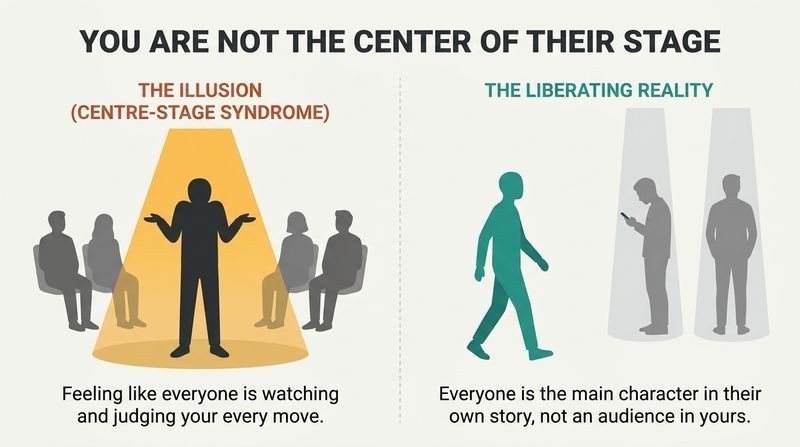
Centre-stage syndrome. Smith invokes the psychological tendency to assume everyone is watching and grading us, when in reality we are extras in other people's lives. She reframes rejection as a weeding-out mechanism: someone who does not want you is doing you a favor by clearing the path. A Parisian interviewee captured the healthy stance perfectly, treating a no as clarity that lets him move on rather than a defeat.
Smith is repackaging what social psychologists call the spotlight effect, the documented overestimation of how much others notice us. Gilovich's experiments (subjects wearing embarrassing shirts assumed twice as many people noticed than actually did) give her intuition empirical teeth. Her deeper move is attributional: reassigning the cause of rejection from internal and stable (I am unlovable) to external and unknowable (who knows what's going on with them). That is textbook cognitive reframing. The framing of rejection as a filter rather than a failure also echoes Stoic thought, distinguishing what is in our control (the approach) from what is not (the response).
Change your mental model and the outcome changes with it
Thoughts become behavior become outcome. Borrowing from teacher Srikumar Rao, Smith defines a mental model as the lens through which you interpret a situation. We unconsciously filter out roughly 98% of reality and keep only evidence that confirms our existing model, which then hardens into what we call the truth.
Self-fulfilling prophecy in action. Consider the man who believes I cannot talk to attractive people. He approaches tensely, poised for flight, mutters a half-hearted line, gets a lukewarm response, and leaves certain he was right. His behavior, not his worth, produced the result. Swap the model to something like it is nice to find out about people, and the approach becomes curious, relaxed, and natural, generating warmer responses that confirm the new belief. The chain is simple:
1. Hold a thought
2. The thought shapes behavior
3. Behavior shapes the outcome
4. The outcome confirms the thought
This is a lucid, applied version of cognitive behavioral therapy's core insight that interpretation, not event, drives emotion and action. Smith's contribution is showing how belief operates as a behavioral primer in real time during social approach. The idea also rhymes with Rosenthal's Pygmalion research, where teachers' expectations measurably altered student performance. A fair challenge: mental models are stickier than a swap-it-out metaphor suggests, since they are often forged by genuine painful experience and defended by confirmation bias. Smith's own point about filtering 98% of evidence cuts both ways, making a new model hard to install without deliberate, repeated behavioral proof.
Being attractive beats looking attractive, and it starts from inside
Genes cap the looks game. Smith notes that about 80% of height and, per researcher Traci Mann, roughly 75% of weight are genetically determined, meaning the beauty standard society sells is unreachable for most. She recounts a stunning model-adjacent woman at a dinner party who felt like the ugly duckling, proof that even genetic lottery winners lose the attractiveness game.
Attraction is a vibe, not a face. She distinguishes looking attractive (a one-dimensional projection) from being attractive (energy, charm, confidence, passion others can feel). Her rule: only do things that make you feel good, with people who make you feel good. Confidence from a great haircut once sparked a real coffee-shop romance, not because the hair was magnetic but because feeling good changed her openness. Stop rating people out of ten, she urges, and stop rating yourself.
The move from aesthetics to energy is supported by research on the halo effect and on how dynamic cues (expressiveness, warmth, animation) predict perceived attractiveness better than static features in live interaction. Smith's citation of weight heritability is directionally right though contested; estimates range widely and environment still matters at the margins. What elevates this section is the ethical turn: she indicts the rating economy that dating filters industrialize, arguing it turns humans into rock collections. That connects to objectification research showing that being reduced to appearance degrades wellbeing for the rated and empathy in the rater. Feeling good becomes both self-care and a genuine attraction strategy.
Anyone can approach anyone, so drop the men-hunt-women myth
The hunter story is bad history. Smith dismantles the claim that men must make the first move by attacking its supposed foundations. Hunter-gatherer societies were highly egalitarian, and women hunted too (Aeta women in the Philippines have a 31% solo success rate, higher when hunting with men). We selectively adopted the man-as-hunter narrative while ignoring the 15 to 20 hour work week. Chimps are cited for male dominance, but our equally close relative the bonobo runs female-led, sexually egalitarian societies, so that gets left out.
It was economics, not biology. The custom of men asking (and paying) tracked men's historic monopoly on money, which bought them the real prize: choice. In Stockholm, where women approach parity in income and politics, both sexes approach freely and men welcome it. As one Swedish man put it, he would rather run alongside a woman than chase her.
Smith's evolutionary revisionism lands squarely with contemporary anthropology, which has steadily dismantled the tidy man-the-hunter model (recent reanalyses find women hunted across most foraging societies studied). Her cherry-picking critique cuts deep: the bonobo omission exposes how we retrofit primate data to justify existing norms rather than derive norms from data. The economic-power thesis also aligns with sociological work showing courtship scripts track resource asymmetry, not hardwiring. The Sweden case is her strongest evidence, a natural experiment where reducing economic dependence loosened gender scripts. A modest caveat: Sweden's homogeneity and welfare state make it an imperfect universal template, but as a proof of concept that scripts are contingent, it holds.
Write five deal-breakers that would still matter in five years
Deal-breakers beat wish lists. A deal-breaker is a trait, value, belief, or context that is genuinely crucial to your compatibility, not a nice-to-have like red hair or good abs. Smith caps the list at five and applies a test: if a person had four of your five, would the missing one matter in five years? If yes, it is a real deal-breaker; if no, cut it. Physical attributes never count, and good sense of humor becomes shared sense of humor.
They free you and others. Most men she coaches arrive with only two criteria, pretty and nice, while some women invent tricky tests (make him skip, watch if he shares food). Both fail. A well-built list keeps you focused on long-term fit and lets you release nice-but-wrong people back into the pool guilt-free. Pair it with a three-date rule, giving anyone with four of five traits three chances, since attraction often grows with familiarity.
Smith threads a genuine needle here, defending deal-breakers while condemning dating-app filters, and her distinction is philosophically sound: filters quantify the other person on arbitrary external metrics (height, income, age), whereas deal-breakers clarify your own values. The five-year test is a clever debiasing tool against present-focused hedonic reactions. Decision science supports pre-committing to criteria before evaluation to counter the halo effect and infatuation-driven rationalization. The three-date rule guards against thin-slice snap judgments, which research shows are confident but often wrong for predicting relationship success. One friendly extension: deal-breakers work best when they name underlying needs (autonomy, curiosity) rather than proxies (loves their job), which Smith's interrogation exercise wisely pushes toward.
Read flirting signals with the H.O.T. A.P.E. checklist
Six observable signs. From cross-cultural research in New York, London, Paris, and Stockholm, Smith built the H.O.T. A.P.E. acronym to decode whether someone is friendly or flirting, and to broadcast your own interest:
1. Humour aimed at you specifically, not the room
2. Open body language, feet and shoulders squared toward you
3. Touch, the least deniable sign, which releases oxytocin
4. Attention that makes the rest of the room melt away
5. Proximity, moving closer or leaning in to share space
6. Eye contact, the most powerful signal her respondents named
Escalate by matching. A New York interviewee described it as upping the ante: you look, they look, they move closer, you move closer, they touch your arm, you laugh. Touch and eye contact are the heavyweights for conveying romantic intent, but touch only escalates existing rapport, it never starts it. One London myth she debunks: men swore women flirt by touching their hair, yet no woman reported doing it on purpose.
The acronym's value is diagnostic, converting a fuzzy anxiety (are they into me?) into discrete, checkable cues, which reduces the ambiguity that stalls approaches. It maps neatly onto the nonverbal-immediacy literature, where behaviors like proximity, eye contact, and touch reliably signal liking across cultures. The hair-touching debunk is a lovely methodological flex, exposing how folk theories of flirting can be pure projection unsupported by self-report. A caution Smith herself embeds: touch is culturally and individually calibrated, and misreading it carries real consequences, so her test-then-assess safeguard is essential rather than optional. The framework's honesty about cross-cultural variation (Paris versus London subtlety) keeps it from overpromising universal codes.
You owe no one a conversation, so master the graceful exit
Niceness can be unkindness. Many people stay trapped in dead-end encounters out of politeness. Smith's friend spent an hour in a kitchen with a man she found dull because she did not want to be rude, and another endured 400 photos of a colleague's daughter's ballet recital. But prolonging a spark-free encounter wastes the other person's time too, time they could spend making a real connection elsewhere.
Exit lines are simple. You are not the guardian of a stranger's emotional wellbeing. A clean, friendly It was nice to meet you, enjoy the rest of your evening does the job, repeated if needed. You do not have to flee the venue or hide behind a potted plant afterward. Ending a conversation is allowed. The flip side: when someone signals no to you, accept it immediately, because no means no, always.
Smith reframes the exit as an act of respect rather than rejection, which dissolves the guilt that keeps people stuck. This connects to research on emotional labor and people-pleasing, where the compulsion to manage others' feelings erodes authenticity and breeds resentment. Her insistence that you are responsible only for yourself echoes boundary theory in clinical psychology: healthy relationships require the capacity to disappoint. The symmetry she draws (your right to exit implies their right to reject) is the ethical backbone of the whole book, a reciprocal freedom. The wine-bar harasser anecdote, where a man claimed it was his job to hassle women, sharpens the point that persistence dressed as flattery is a boundary violation.
Use commonality, proximity, and mere exposure to meet people everywhere
Everywhere is the venue. Asked where to find people, Smith answers everywhere, then makes it practical with two tools. Commonality means living a full life around genuine interests (film clubs, running clubs, softball) so you meet aligned people without reeking of desperation. Proximity means physical closeness breeds psychological closeness, which is why you befriend the person at the next desk, not the one three floors up.
Familiarity is Cupid. The mere exposure effect, from Bob Zajonc's research, shows we prefer faces we have simply seen before. In one study, women who silently attended a class 15 times were rated more attractive than one who never appeared, despite zero interaction. So smile at the same coffee-shop regulars and commuters; repeated exposure warms them to you before you say a word. Smith met her husband as his Pilates teacher, warmed by a year of Thursday nights and chance run-ins around the neighborhood.
The trio of commonality, proximity, and mere exposure is essentially the sociology of relationship formation in plain clothes. Festinger's classic Westgate housing study (which Smith cites) found friendships clustered by staircase and mailbox placement, showing that architecture shapes intimacy more than personality does. Zajonc's mere-exposure finding is one of psychology's most replicated effects, extending even to nonsense syllables and Chinese characters. Smith's practical genius is weaponizing passive familiarity: become a known face before you approach. The subtle risk is over-reliance on exposure with someone fundamentally incompatible, but her deal-breakers act as the corrective filter. The desperation point is also well-taken; pursuing hobbies as bait rather than for their own sake tends to backfire.
Manufacture chemistry rather than waiting for instant sparks
Chemistry is not a verdict at first sight. Smith caused near-riots lecturing that instant chemistry is overrated, calling the belief that you will just know a bunch of malarkey. For short-term flings, chemistry is mandatory. For lasting partnerships, deal-breakers matter far more, because chemistry ebbs, flows, and can arrive weeks in.
The friend zone is self-inflicted. People land there because they show up as friends, playing agony aunt instead of accessing their flirtatious side. One client dispensed such good career advice his date quit her job but never called back. The fix: chemistry can be built. Touch and laughter release feel-good brain chemicals, and shared thrilling activities (roller coasters, scary films) heighten arousal that transfers into attraction, per Dutton and Aron's research. Accessing your own flirty, sexual energy is the prerequisite, since others can only see in you what you first see in yourself.
Smith's assault on love-at-first-sight is her most contrarian and valuable stance. Dutton and Aron's shaky-bridge study, where men who crossed a scary suspension bridge misattributed fear-arousal as attraction to a woman interviewer, is the empirical cornerstone: arousal is malleable and context-transferable. This dovetails with Aron's later work on self-expanding activities boosting relationship quality. The deeper claim, that attraction grows from familiarity plus deliberate arousal rather than a fixed spark, aligns with the slow-burn reality of most enduring couples. A nuance worth flagging: misattribution of arousal is real but not infinitely elastic, and manufacturing chemistry has limits where genuine aversion exists. Still, dethroning the spark frees people from discarding promising matches over a quiet first meeting.
Write your own happy ending instead of society's default script
Step outside the structure. Smith closes by challenging the packaged life story of perfect partner, children, looks, and bank balance. She quit her own two-decade weight obsession once she realized she was obeying rules she did not believe in. Happiness comes not from any relationship but from a healthy, equal one, and from many quality connections: friends, neighbors, colleagues, the checkout worker.
Ayesha's rewrite. A 42-year-old Malaysian CEO wanted a child more than a husband, so rather than chase the older provider-type man tradition prescribed, she decided to have a child on her own as an economically independent woman. Freed from the old script, she then met a younger man on a diving trip and ended up pregnant and in love. The point is not the fairytale ending but that she designed her own route. Flirtology, ultimately, is a tool for navigating your own path, and it all begins with a single question.
The book resolves into something larger than dating advice: a critique of what sociologists call the standard life-course script and its tightening grip in the age of curated social feeds. Smith's observation that she only posted idealized highlights connects to research linking social-comparison on Instagram to lower wellbeing. Ayesha's story illustrates decoupling once-bundled goals (partnership and parenthood), a real demographic shift as women's economic independence rises. The Japanese Christmas cake and New Year noodle metaphors for a woman's expiring marriage value expose how culturally arbitrary these scripts are. What grounds the uplift is agency: Smith is not promising love but returning authorship, which is a more honest and durable offer than happily-ever-after.
Analysis
Flirtology is a self-help book wearing an anthropologist's coat, and that disciplinary hybrid is its distinguishing feature. Jean Smith built her method from a master's dissertation comparing flirting behavior across New York, London, Paris, and Stockholm, then stress-tested it through a decade of Fearless Flirting tours and private coaching. The result reads less like seduction advice and more like applied social science: mental models drawn from cognitive psychology, the mere exposure effect from Zajonc, misattribution of arousal from Dutton and Aron, and a running critique of evolutionary just-so stories about hunters and chimps.
The book's spine is a single reframe repeated in a dozen registers: you are responsible only for your own action (the approach, the question, the smile), never for the other person's response. From this axiom everything follows. Rejection loses its sting because it was never yours to control. Gender scripts collapse because nothing biological assigns the approach to men. Anxiety dissolves because you are not on center stage. It is a Stoic dichotomy of control smuggled into a dating book, and it is genuinely liberating.
Where the book is strongest is its debunking work: the hair-touching myth exposed by data, the man-the-hunter narrative dismantled with egalitarian foraging societies, the takeaway that opening lines are forgotten nine times out of ten. Where it is more debatable is its blanket hostility to online dating, written in 2018 and already dated as apps became the dominant way couples meet, particularly for older and marginalized daters.
Ultimately Smith's ambition exceeds romance. The closing chapters reframe flirting as a general capacity for human connection and a rebellion against society's default life script. The through-line, that authentic self-presentation attracts the right people while filtering the wrong ones, is both a dating strategy and a philosophy of living. It all reduces to one repeatable act: ask someone a question.
Review Summary
Flirtology receives mostly positive reviews, with readers praising its practical advice on communication and human connection. Many appreciate the book's emphasis on mindset shifts, confidence-building, and engaging with others beyond romantic contexts. Readers find the author's insights on flirting myths, deal breakers, and in-person interactions particularly valuable. Some reviewers wish for more male perspectives and online dating strategies. Overall, the book is seen as a refreshing guide to improving social skills and creating meaningful connections in everyday life.
People Also Read







Glossary
Flirtology
Science and art of flirtingA term Jean Smith coined over a decade before the book, combining the science of flirting (grounded in social anthropology and psychology) with the art of interaction. It treats flirting as a learnable skill rather than an innate gift, aimed at authentic self-presentation that attracts compatible people rather than games, tricks, or lines.
H.O.T. A.P.E.
Six-sign flirting checklistAn acronym from Smith's cross-cultural research listing the six ways people signal and detect flirtation: Humour, Open body language, Touch, Attention, Proximity, and Eye contact. It works both as a diagnostic tool for reading whether someone is friendly or flirting and as a guide for conveying your own romantic interest.
Mental model
Interpretive lens shaping outcomesBorrowed from teacher Srikumar Rao, a mental model is the lens through which you interpret a situation. Smith argues we filter reality to confirm our existing models, so thoughts shape behavior, behavior shapes outcomes, and outcomes reinforce the original thought, often as a self-fulfilling prophecy. Changing the model deliberately changes the result.
Deal-breakers
Five essential partner criteriaA capped list of five traits, values, beliefs, or contexts that are genuinely crucial to your long-term compatibility with a partner. Unlike superficial wish lists or dating-app filters, deal-breakers reflect your own core values, exclude physical attributes, and pass the test of still mattering in five years. They keep you focused and free nice-but-wrong matches guilt-free.
Centre-stage syndrome
Believing everyone judges youThe psychological tendency to assume you are constantly being watched and evaluated by others, when in reality people pay little attention to you because they are absorbed in their own lives. Smith uses it to defuse the fear of rejection: a stranger has neither the interest nor the information to judge your worth.
Mere exposure effect
Familiarity breeds likingA well-replicated psychological phenomenon, documented by Bob Zajonc, whereby people develop a preference for things and faces simply because they have encountered them repeatedly. Smith applies it to flirting: becoming a familiar face through smiles and repeated presence warms others to you before conversation even begins.
Social contagion
Catching others' positive emotionsThe psychological transfer of emotions from one person or topic to another. Smith advises asking people about subjects they love, because their excitement spills over and envelops you, making them more open and receptive. Talking about things they feel passionate about literally improves their mood toward you.
Props
Objects that spark conversationObjects in the immediate environment (a coffee, a painting, a dog, groceries) that you anchor a question to, so you never have to invent a line from thin air. Props make openers feel natural and spontaneous because they arise from a shared present moment rather than a rehearsed pickup gambit.
FAQ
What is "Flirtology" by Jean Smith about?
- Modern flirting guide: "Flirtology" is a step-by-step guide to mastering the art of flirting in the 21st century, focusing on real-life, face-to-face interactions rather than digital communication.
- Anthropological approach: Written by social and cultural anthropologist Jean Smith, the book uses research and fieldwork from cities like New York, Paris, London, and Stockholm to decode flirting behaviors.
- Debunking myths: The book aims to debunk common myths about flirting, build confidence, and provide practical tools for making genuine connections.
- Practical exercises: It includes actionable challenges, quizzes, and exercises to help readers practice and improve their flirting skills in everyday life.
Why should I read "Flirtology" by Jean Smith?
- Replace connectivity with connection: The book addresses the loneliness and superficiality of online dating, teaching readers how to create meaningful, in-person connections.
- Confidence-building: It offers strategies to overcome fear of rejection, social anxiety, and self-doubt, making flirting accessible to everyone.
- Applicable to all genders: "Flirtology" is designed for both men and women, challenging outdated gender roles and encouraging proactive behavior from everyone.
- Life-enhancing skills: The principles of Flirtology can improve not just romantic prospects but also everyday social interactions, friendships, and professional relationships.
What are the key takeaways from "Flirtology" by Jean Smith?
- Flirting is a learnable skill: Anyone can become a better flirt through practice, self-awareness, and the right mindset.
- Authenticity over games: The best flirting comes from presenting your real, confident self, not from using tricks or manipulative tactics.
- Rejection is useful: Rejection is reframed as a positive filtering tool, helping you find better matches and avoid wasting time.
- Face-to-face matters most: Despite the prevalence of dating apps, meaningful relationships are most often formed offline, through real-world interactions.
How does Jean Smith define "Flirtology" and what makes it unique?
- Science and art of interaction: Flirtology is both the scientific study of flirting and the art of human connection, blending research with practical advice.
- Anthropological foundation: Smith’s approach is rooted in social anthropology, using observation and analysis of real-world behaviors across cultures.
- No games or rules: Unlike many dating guides, Flirtology rejects manipulative strategies, focusing instead on authenticity and mutual enjoyment.
- Everyday application: The book encourages integrating flirting into daily life, not just in romantic contexts but in all social interactions.
What are the seven biggest myths about flirting according to "Flirtology"?
- Flirting is difficult: Flirting is actually simple and starts with something as basic as asking a question.
- Good flirts are born, not made: Flirting is a skill that can be learned and improved with practice.
- Flirting is frightening: The fear of flirting is often based on imagined scenarios; in reality, it’s low-risk and can be fun.
- Rejection is a bad thing: Rejection is a helpful tool for filtering out incompatible matches.
- The perfect flirt can attract anyone: The goal is to attract the right people, not everyone.
- Men have to make the first move: Both men and women can and should initiate flirting.
- The internet is the answer: Online dating offers the illusion of choice but rarely leads to meaningful connections compared to real-life encounters.
How does "Flirtology" by Jean Smith help readers overcome the fear of rejection?
- Reframes rejection: The book teaches that rejection is not a personal failure but a way to clarify compatibility and save time.
- Empowerment through action: Taking initiative and experiencing rejection firsthand often feels less painful than the fear of it.
- Self-worth is internal: Smith emphasizes that your value isn’t determined by strangers’ reactions; only you control your self-esteem.
- Practical exercises: Readers are encouraged to practice small, low-stakes interactions to build resilience and confidence.
What is the H.O.T. A.P.E. system in "Flirtology" and how does it work?
- Acronym for flirting signals: H.O.T. A.P.E. stands for Humour, Open body language, Touch, Attention, Proximity, and Eye contact.
- Recognizing interest: These six cues help you identify when someone is flirting with you versus just being friendly.
- Conveying interest: Using these behaviors yourself signals your attraction and helps escalate interactions naturally.
- Cross-cultural validity: The system is based on Smith’s research in multiple cities, making it broadly applicable.
How does "Flirtology" by Jean Smith suggest you identify your ideal partner?
- Deal-breakers list: The book guides readers to create a personalized list of five essential qualities or values they need in a partner.
- Beyond superficial traits: Physical attributes are discouraged as deal-breakers; focus is on core values, lifestyle, and compatibility.
- Self-reflection: The process helps clarify what truly matters to you, preventing wasted time on mismatched relationships.
- Three-date rule: Smith recommends giving someone up to three dates to see if they meet your deal-breakers before making a decision.
What practical exercises and challenges does "Flirtology" include to improve flirting skills?
- Daily questions: Readers are tasked with asking a stranger a question each day to build comfort with initiating contact.
- Giving compliments: Practicing genuine, specific compliments helps break the ice and spread positivity.
- Rapport-building: Exercises focus on moving beyond small talk to create real connections through open-ended questions and self-disclosure.
- Observation skills: Activities encourage shifting focus from self-consciousness to observing and engaging with others.
How does "Flirtology" address the role of online dating and technology in modern relationships?
- Critique of digital dating: Smith argues that online dating creates an illusion of endless choice but rarely leads to deep connections.
- Superficial filters: The book highlights how dating apps encourage judging by superficial criteria, often missing out on great matches.
- Real-world focus: Flirtology advocates for using technology as a tool, not a substitute, and prioritizes face-to-face interaction.
- Practical advice: If using online platforms, Smith suggests moving to in-person meetings quickly and not investing too much emotionally in digital exchanges.
What are the most common obstacles and mental models that block successful flirting, according to "Flirtology"?
- Internal and external excuses: People often blame circumstances or personal flaws for their lack of success, rather than examining their beliefs and behaviors.
- Negative mental models: Unhelpful beliefs like "I’m too shy" or "I’m not attractive enough" become self-fulfilling prophecies.
- Traps and syndromes: Over-busyness, perfectionism, and waiting for the "right moment" are common traps that limit opportunities.
- Changing perspective: The book teaches readers to challenge and reframe these mental models to open up new possibilities.
What are the best quotes from "Flirtology" by Jean Smith and what do they mean?
- "Flirting is not just a means to an end; you don’t only flirt if you want something." – Flirting should be about enjoying human connection, not just pursuing a goal.
- "You are not trying to find the great love of your life every time. You’re just trying to spark up a pleasing human interaction." – Reduces pressure and encourages a playful, relaxed approach.
- "Rejection is one of the most powerful tools we have." – Reframes rejection as a positive, necessary part of finding the right match.
- "Flirtology is not about games, it’s not about rules and it’s not about tricks. It’s a way of presenting your most confident and authentic self." – Emphasizes authenticity and self-acceptance as the foundation of successful flirting.
Download PDF
Download EPUB
.epub digital book format is ideal for reading ebooks on phones, tablets, and e-readers.








































