
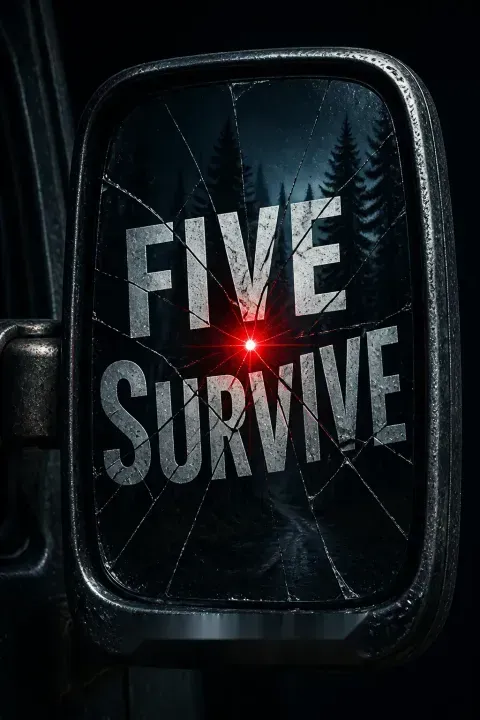


Plot Summary
The Road to Nowhere
Six Philadelphia teenagers are driving the RV to Gulf Shores for spring break. Red Kenny,1 perpetually distracted and guilt-ridden over her mother's murder five years ago, sits with her best friend Maddy Lavoy,2 playing Twenty Questions while Maddy2's older brother Oliver,3 his girlfriend Reyna,5 their friend Simon Yoo,6 and Simon6's basketball teammate Arthur Moore4 fill the thirty-one-foot vehicle.
They lose cell service, miss their exit, and Reyna,5 following confused directions, steers down a narrowing dirt road into rural South Carolina scrubland. A sharp crack splits the night: the front left tire blows out.
They change it with the spare, take a victory selfie, and attempt a three-point turn to escape. Then four more cracks, rapid and final. All remaining tires burst. The gas tank empties onto the road. Red1 notices a tiny red dot gliding along the RV's exterior. A bullet hole appears. She screams that someone is shooting at them with a high-powered rifle.
The opening establishes the ensemble dynamic through Red's guilt-ridden consciousness. Her financial precarity, her habit of writing to-do lists on her hands, and her obsessive replaying of her mother's death all surface before the first gunshot. The RV functions as both sanctuary and trap, a liminal space where ordinary teenage social hierarchies will buckle under extreme pressure. The red dot, appearing first as a curiosity then as a death sentence, is a perfect thriller image: intimate, precise, and utterly dehumanizing. Before any character understands the game, they have already been reduced to targets.
A Voice Names Six Names
After scrambling back inside and boarding up shattered windows with a mattress and a gutted suitcase, the group discovers a walkie-talkie clipped to the driver's side mirror. Arthur4 reaches through broken glass to retrieve it.
A cold, metallic voice crackles through: the unseen sniper reads out all six of their full names, dates of birth, and addresses, proving this ambush was meticulously targeted. He demands a secret one of them is hiding. Oliver,3 drawing on his prelaw confidence and his mother Catherine7's high-profile position as assistant district attorney prosecuting a Mafia murder case, becomes convinced this is about the Frank Gotti9 trial.
He theorizes they are hostages to force Catherine7 to reveal the identity of her anonymous eyewitness. The sniper warns he has disabled all cell service in the area and will shoot anyone attempting escape. The game has rules, and the first rule is that no one leaves.
Oliver's immediate assumption that the crisis centers on his family reveals his narcissistic worldview: everything must be about the Lavoys. This is the narrative's first major misdirection, one the reader is encouraged to share. The walkie-talkie becomes a psychological weapon, its static filling the silence between threats. The sniper's omniscience, reading out full names and addresses with clinical precision, creates a theological terror. The story now operates on two tracks: the external threat of the rifle and the internal pressure of concealed truth among friends who do not trust each other as much as they believed.
The Mirror Bait Works
Red,1 drawing on childhood knowledge from playing with walkie-talkies alongside her police captain mother, takes charge of cycling through the walkie-talkie's channels seeking outside interference.
Oliver3 devises an escape plan: they will use a full-length mirror from the bedroom closet to reflect one of them standing at the RV door, baiting the sniper to shoot so they can record the muzzle flash and locate his position. Simon6 acts as the reflection while the others film through windows. The shot shatters the mirror, and Red1's phone captures the flash, confirming the shooter is several hundred yards to the right rear.
Oliver3 plans an escape out the driver's side window, away from the sniper. He is halfway out when the walkie-talkie crackles with a new warning: there is a second shooter. Oliver3 scrambles back inside. The escape plan is dead before it began.
The mirror scene is darkly theatrical, Simon the aspiring actor playing his most dangerous role in a reflection that could become a corpse. Red's radio expertise, born from obsessive disassembly and reconstruction of her dead mother's walkie-talkie, marks her first emergence from passive guilt into active capability. Every seeming victory is undercut: the second sniper reveal punishes the group's hope, teaching them the game is rigged. Oliver's near-escape and forced retreat begin the slow erosion of his leadership, exposing the gap between his self-image as a hero and the reality of his selfish calculus.
Don and Joyce Stop to Help
Headlights approach through the darkness. Don and Joyce Wright,8 an elderly couple returning from meeting their newborn grandson in Jacksonville, stop to offer assistance. The sniper orders the group to send them away or he will kill them.
While Arthur4 and Simon6 chat with the couple at the door, Oliver3 secretly scribbles a note asking them to call the police about an active shooter. He folds it, writes a warning not to read it until they have left this road, and shakes Don8's hand to pass the note. Red1 and Arthur4 try to stop him but fail.
The couple drives off. Moments later, two shots crack through the night. Don and Joyce8 collapse beside their truck, executed. The sniper's voice confirms through the walkie-talkie that he knew about the note. Two people are dead, and Oliver3's judgment has now cost innocent lives.
Don and Joyce function as sacrificial figures, their innocence heightened by Joyce's chattering pride about her new grandchild and her peeling blue nail polish. Oliver's catastrophic decision crystallizes the central tension: his belief in his own exceptionalism literally kills people. Red's failed intervention, her inability to stop him despite knowing better, mirrors her lifelong guilt pattern of watching catastrophe unfold and feeling responsible. The sniper's apparent omniscience creates a terrifying new rule: nothing happens inside the RV that the shooter does not know.
The Secret of Jack Harvey
After a futile search for hidden microphones, Oliver3 accuses Red,1 Simon,6 and Arthur4 of being moles working with the sniper. He forces them to strip to prove they are not wearing wires and seals all phones in a pot in the oven.
Reyna,5 unable to bear the escalating paranoia, reveals the secret she and Oliver3 have been hiding. In January, at a bar near Dartmouth, a man named Jack Harvey bothered Reyna5 in the parking lot. Oliver3 punched him once. Jack was knocked unconscious but seemed to recover. Two days later, Jack died of an epidural hematoma, a slow brain bleed.
Reyna5 then makes a deeper confession: Jack was her secret boyfriend. She had been cheating on Oliver3 for four months but was too afraid to leave him. The sniper, however, dismisses this story. It is not the secret he is looking for.
Reyna's confession is a masterclass in layered revelation, each admission peeling back another level of guilt. Her culpability is not just about Jack's death but about her own moral cowardice, choosing the 'smart choice' of Oliver's future status over love. Oliver's response is chilling: he blames Reyna entirely, revealing his incapacity for genuine accountability. The sniper's rejection of this secret narrows the possibility space while deepening the mystery. Someone else in the RV is hiding something even darker, and the pressure to find it intensifies.
Red Is the Witness
The sniper fires two random shots through the RV walls, accelerating the pressure. Oliver3 attacks Arthur,4 choking him against the refrigerator, demanding to know whose secret this is. Red1 screams that it is hers.
She confesses she is the anonymous eyewitness in the Frank Gotti9 trial, claiming she saw Frank Gotti9 leaving the scene of Joseph Mannino's murder. Oliver,3 enraged she did not speak sooner, calls a vote on whether Red1 should leave the RV to face the sniper. The secret ballot yields three NO votes and two YES votes: Red1 stays.
But Oliver3 immediately betrays the result. He grabs Red,1 wrenches open the door, and hurls her out into the darkness. She lands on her knees in the dirt, the red dot circling her chest. Three minutes pass. The sniper does not shoot. Arthur4 drags her back inside, alive but shattered.
The vote sequence is agonizing in its procedural cruelty, democratic process perverted into a death sentence. Oliver's immediate betrayal of the results exposes democracy as a performance he was never willing to honor. Red's survival, kneeling in the gasoline-soaked road exactly as her mother knelt before execution five years earlier, is the novel's most haunting image. The sniper's refusal to shoot Red when he killed the Wrights without hesitation is the key that will eventually unlock the entire mystery: Red is not the target, she is the bait.
Maddy Wears Red's Clothes
Oliver3 seizes on Red1's inexplicable survival as proof she is immune to the sniper. His new plan: Maddy2 resembles Red1 in height and build. If she dresses in Red1's clothes and walks to the Wrights8 'abandoned truck to drive for help, the sniper will mistake her for Red1 and hold fire.
Red1 protests but Oliver3 holds a knife to her throat. Maddy,2 terrified, swaps clothes with Red1 and cuts her hair to match the messy ponytail. Arthur4 warns the sniper is unpredictable, but Oliver3 pushes Maddy2 out the door. She walks slowly toward the truck, Red1's blue-and-yellow flannel shirt glowing in the headlights.
She nearly reaches the driver's door. A shot cracks through the night. Maddy2 collapses screaming, a bullet torn through her thigh, blood gushing onto the road. Red1 sprints out, drags her back inside, and Reyna5 frantically applies a tourniquet. Maddy2 is bleeding out.
Oliver's willingness to sacrifice his sister, however 'calculated' the risk, completes his moral disintegration. Maddy's compliance, born from lifelong conditioning to obey her charismatic older brother, is a study in family dynamics as coercion. The image of Maddy wearing her best friend's clothes while bleeding on the road literalizes the novel's theme of substitution: throughout the night, people keep being forced to stand in for others, pay for sins they did not commit. Red's mad dash to drag Maddy back, promising she will never leave her, is the emotional turning point of the entire novel.
Arthur Smashes the Radio
While Reyna5 fights to keep Maddy2 alive, Red1 cycles through the walkie-talkie's channels searching for help. On channel six, she finds workers discussing the damaged cell tower and calls out for police. Before she can finish, Arthur4's hand swings down and smashes the walkie-talkie to pieces.
Oliver3 tackles him and searches his pockets, finding a small remote control device. Arthur4 confesses: his real name is Arthur Gotti. He is Frank Gotti9's son. He befriended Simon6 and the group months ago to get close to Red1 because she is the key witness against his father.
The remote controlled a light on the RV roof, letting him signal his brother, the sniper, via coded flashes. But Arthur4 reveals the deeper truth: his father did not kill Joseph Mannino. Red1 is a false witness, paid by someone to lie under oath and send an innocent man to prison.
Arthur's unmasking recontextualizes every kindness he showed Red throughout the night, every soft-spoken question, every moment she thought he genuinely saw her. His confession that he tried to keep her safe while orchestrating the siege creates a paradox of protective violence. The revelation reframes the story's moral universe entirely: if Frank Gotti is innocent and Red's testimony is bought, then the real criminal is the person who purchased a teenager's perjury. That answer is about to tear the group, and the Lavoy family, apart.
Catherine Lavoy's Perfect Scheme
Red1 reveals the full truth. Catherine Lavoy,7 Oliver3 and Maddy2's mother, approached her last August and offered twenty thousand dollars to falsely testify that she saw Frank Gotti9 commit murder. Catherine7 told Red1 that Frank Gotti9's crime family likely killed her police captain mother, giving Red1 a motive beyond money: vengeance for the mother she lost.
Arthur4 explains his family has a corrupt contact inside the DA's office who leaked Red1's identity via an email sent from Mo Frazer's account. Red1 and Arthur4 piece together the chilling architecture of Catherine7's win-win plan.
If Red1 testifies and Frank9 is convicted, Catherine7 becomes district attorney. If the Gotti family kills Red1 to stop the trial, the leaked email frames Mo Frazer, Catherine7's political rival, and she still becomes DA. In either scenario, Catherine7 wins. Red1 was always disposable.
Catherine's scheme is a masterpiece of cynicism, turning the justice system into a career ladder built on her dead best friend's orphaned daughter. The win-win structure mirrors the Lavoy family philosophy Oliver has parroted all night: always have a plan with two parts, always ensure you win regardless. The revelation that Catherine weaponized Red's grief about her mother's death, dangling the false promise of identifying the killer, is psychological abuse of the highest order. Red's realization that she was a pawn, not a partner, shatters the last adult relationship she trusted.
The Doorbell Ringtone
Oliver,3 refusing to believe his mother is corrupt, mentions in passing that Catherine7 once used a doorbell sound as a personalized ringtone for Maddy.2 Red1 freezes. She unlocks her phone, navigates to the classic ringtones, and plays the doorbell chime.
She recognizes it instantly: this is the sound she heard in the background of her final phone call with her mother five years ago. The police had always insisted it was impossible, that Grace Kenny died in an abandoned power station with no houses nearby. They told Red1 she was confused, a traumatized child imagining things. But it was never a real doorbell.
It was Catherine7's phone, ringing while she stood behind Grace Kenny, moments before executing her. Maddy,2 bleeding on the floor, sobs out her own hidden truth: she has always known her mother's alibi was false. Catherine7 was not home that evening. She came home late with a stain on her shirt. Catherine Lavoy7 murdered Grace Kenny.
The doorbell ringtone is a brilliant Chekhov's gun, planted in casual conversation about family quirks and detonating five years of suppressed truth. Red's memory, dismissed by authorities as the confusion of a grieving child, is vindicated in the most devastating way possible. Maddy's confession that she has carried this knowledge for five years, allowing doubt and her mother's gaslighting to silence her, adds a terrible layer of complicity to her love for Red. Every kindness Maddy ever showed was also penance. The two best friends, bound since infancy by their mothers' friendship, are now bound by one mother murdering the other.
Red Shields the Cop
Dawn breaks and blue and red lights flash through the trees. A female sheriff's deputy pulls up to the scene. Arthur,4 Oliver,3 and Reyna5 spill outside. Oliver3 charges at Arthur4 with the kitchen knife, slashing his neck. Reyna5 tries to stop Oliver3 but is thrown aside.
The sniper fires: Oliver3 crumples dead on the road. Red1 sees the deputy stepping from her car and knows the sniper might kill her too. She sprints toward the woman, positioning her body as a shield, the broken walkie-talkie in her raised hand. The deputy, hearing a gunshot and seeing a dark object in Red1's grip, fires twice.
Both bullets hit Red1 in the chest. She falls on her back, watching the pale dawn sky, and hallucinates a final walkie-talkie conversation with her dead mother: Grace Kenny's voice telling her it was never her fault, that she is going to survive.
Red's final act is the ultimate rejection of Oliver's survival-of-the-fittest ethos. She chooses to protect a stranger, her body literally becoming a barrier between the sniper and an innocent mother. The hallucinated conversation with Grace Kenny is the novel's emotional and psychological climax. Red finally releases the guilt she has carried for five years, understanding her mother's death was not her fault. The childhood game of 'Cops and Cops,' transformed from a grief trigger into a portal for forgiveness, lets Red's arc complete: from self-blame to self-sacrifice to self-forgiveness.
Epilogue
A police radio transcript records the chaos: three dead, two critically injured, one suspect arrested fleeing the scene. A news article reports that Catherine Lavoy7 was assassinated by a sniper outside the hospital where she was visiting Maddy,2 shot through the head from a high-rise apartment building.
Then comes Arthur4's letter, left in Red1's bedroom while she was still in a coma. He apologizes for every lie, every hurt. He confesses that, believing Red1 was dying, he took one of his brother's rifles and killed Catherine7 himself.
He leaves cash hidden in a shoebox in Red1's closet to cover her medical bills and more. He tells her Mike, his brother the sniper, has been arrested. And he asks her to meet him at Pier 68 on May 8th at 8:00 PM. He includes two hand-drawn boxes: YES and NO. The choice is hers.
The epilogue fractures into three distinct textual forms: the clinical police transcript, the dispassionate news article, and Arthur's raw, emotional letter. This formal shift mirrors the novel's movement from external action to interior reckoning. Arthur's voice, carefully controlled throughout the siege, finally breaks open, revealing the depth of his feelings and his moral anguish. His decision to kill Catherine, mirroring her execution of Grace Kenny with a rifle shot to the head, creates an uncomfortable symmetry: justice as revenge, revenge as love. The final checkboxes, echoing the ones he drew on Red's hand during that terrible night, transform a gesture of care into an invitation for a future, asking whether Red can forgive the unforgivable and whether survival entitles anyone to love.
Analysis
'Five Survive' is a pressure-cooker thriller that weaponizes claustrophobia, paranoia, and grief to dismantle a group of teenagers trapped in a single location. The RV functions as a microcosm of society, where Oliver3's assumed leadership based on age, class, and gender proves catastrophic, while Red,1 the most wounded and marginalized member, emerges as the story's moral center. Each escape plan that fails, each secret that surfaces, peels back another layer of the group's collective innocence until the truth stands exposed and unavoidable.
The narrative structure cycles through revelations like trauma recovery itself: you cannot heal what you cannot name. Red1's journey from self-blame to self-forgiveness is the novel's true arc. For five years, she has believed her final words to her mother caused her mother's death, a burden that has shaped every aspect of her life from her chronic lateness to her refusal to let anyone get close. The external threat of the sniper becomes the crucible that finally forces her to confront the truth: she was never responsible. Her mother was murdered by her best friend,7 and Red1 was a child caught in an impossible situation.
The book's most subversive move is making the real villain not the Mafia family seeking vengeance but the respected prosecutor Catherine Lavoy.7 Her win-win scheme, in which a teenage girl's life is an acceptable sacrifice for career ambition, is a damning portrait of institutional corruption. Catherine7 weaponized Red1's grief, offering her money and the false promise of identifying her mother's killer, all while being the killer herself.
Arthur,4 caught between his family's code of violence and his own conscience, embodies the novel's central question: can you be born into evil and choose to be good? His letter's checkboxes, echoing the ones he drew on Red1's hand during that terrible night, leave the ending beautifully unresolved. The choice is Red1 's: YES or NO, forgiveness or rejection, love or self-protection. The novel insists that forgiveness, like survival, must be freely chosen.
Review Summary
Five Survive received mixed reviews, with praise for its fast-paced plot and unexpected twists. Many readers found it gripping and emotional, particularly enjoying the character development and intense atmosphere. However, some felt it dragged in parts or lacked the depth of Jackson's previous work. The confined setting and limited timeframe were both praised and criticized. Characters, especially Oliver, elicited strong reactions. While some readers were disappointed, others found it a thrilling and satisfying read, showcasing Jackson's talent for crafting engaging mysteries.
People Also Read







Characters
Red Kenny
Grief-stricken teen seeking redemptionRed is a high school senior consumed by guilt over her mother's murder. Captain Grace Kenny of the Philadelphia Police was executed five years ago, shot twice in the back of the head, and Red has never forgiven herself for their final argument, when she told her mother she hated her and hung up the phone. She lives in a cold house with her struggling father, perpetually scrambling for money and writing to-do lists on her hands to keep her scattered mind organized. She loses everything, zones out mid-conversation, and can never remember what she was about to ask. Yet she is sharp, observant, and carries an encyclopedic knowledge of walkie-talkies from childhood games of 'Cops and Cops' with her mom. Her best friend Maddy Lavoy2 has been her lifeline, covering her expenses and finding her lost things, but Red guards her secrets fiercely, convinced she does not deserve love or happiness.
Maddy Lavoy
The loyal best friend with an unspoken burdenMaddy is Red1's best friend since infancy, their mothers having been college roommates and then colleagues in Philadelphia's justice system. She is neat, organized, and quietly protective of Red1, often covering expenses Red1 cannot afford and telling small lies to make Red1's life easier. She has been accepted to UPenn and projects the calm competence of someone raised in a warm, successful, and ambitious home. But beneath her composed surface, Maddy carries a suppressed memory she has spent five years trying to convince herself was a misunderstanding. Her relationship with her domineering older brother Oliver3 is complicated: she loves him, relies on him, and chafes under his control. She is the peacemaker of the group, always smoothing tensions, but she has a breaking point she has never reached.
Oliver Lavoy
Ambitious eldest son who must leadOliver, 21, is a prelaw student at Dartmouth who views himself as the natural authority in any room. He is fiercely proud of his mother Catherine7's career as assistant district attorney and her impending run for DA, and he sees his own future as US attorney general as inevitable. His confidence borders on arrogance, and he treats group decisions as his alone to make, delegating tasks with crisp commands. Under pressure, his need for control escalates rapidly, revealing a capacity for violence that his polished surface normally conceals. He carries a Zippo lighter and projects the assurance of someone who has never faced a problem that could not be solved by intelligence, money, or social status.
Arthur Moore
The gentle newcomer with a guarded pastArthur joined the friend group six months ago through Simon6, his basketball teammate. He attends a different high school in South Philly and seems to prefer this group to his own friends. He wears gold-framed glasses, has tan skin and curly dark hair, and speaks with a soft, deliberate cadence that stands out among the louder personalities. He is claustrophobic, the result of a childhood incident with his older brother that he does not like to discuss. He is unusually attentive to Red1, asking questions about her life and remembering details others overlook, and she finds herself drawn to him despite her instinct to keep everyone at a distance. His family runs what he calls a 'flipping houses' business, and he is expected to join after graduation.
Reyna Flores-Serrano
Oliver's girlfriend questioning her choicesReyna is a premed student at Dartmouth, calm under pressure and competent in crisis. She has been dating Oliver3 for two and a half years but has recently been keeping secrets from him that weigh heavily on her conscience. She is observant and compassionate, often serving as a buffer between Oliver3's intensity and the younger teenagers in the group. She packed the first aid kit for the trip and takes charge when medical emergencies arise. She carries guilt over a secret involving a man named Jack and her relationship with Oliver3.
Simon Yoo
The class clown with future anxietySimon is the group's comic relief, an aspiring actor who masks deep anxiety with inappropriate jokes and movie references. He started the night drunk on Oliver3's tequila but sobers up as the crisis deepens. He borrowed the RV from his uncle, who runs a used-car dealership with questionable practices. Simon wants to apply to drama schools but has not told his Korean American parents, who expect him to work in finance. His humor is both armor and insight, and he proves more perceptive than anyone gives him credit for.
Catherine Lavoy
The prosecutor with everything to winCatherine is Oliver3 and Maddy2's mother, the assistant district attorney in Philadelphia prosecuting a high-profile murder case against Mafia figure Frank Gotti9. She is ambitious, running for district attorney in the upcoming election, and her career has been going from strength to strength. She has been a maternal figure to Red1 since Red1's own mother died, attending the funeral and looking after Red1 in small ways. She uses personalized ringtones for her family members, cuts sandwiches into triangles, and seems to embody the perfect balance of professional power and maternal warmth.
Don and Joyce Wright
Grandparents in the wrong placeAn elderly couple in their late sixties, married for decades, who live on a farm near the remote road where the RV is stranded. They are returning late from Jacksonville where their daughter just had their first grandchild, a boy named Jacob. Don is practical and observant; Joyce is warm and chatty, with peeling blue nail polish and an overflowing joy about becoming a grandmother that she cannot stop sharing with strangers.
Frank Gotti
Imprisoned Mafia boss claiming innocenceThe head of a Philadelphia organized crime family, currently in custody awaiting trial for the execution-style murder of his rival Joseph Mannino. He maintains he is innocent of the killing and that there could not have been an eyewitness because he was not there. He has two adult sons who are deeply involved in the family's operations in very different capacities.
Plot Devices
The RV
Mobile prison and stage for revelationsA thirty-one-foot GetAway Vista 31B borrowed from Simon6's uncle. Its confined interior becomes an inescapable trap after all four tires and the gas tank are shot out by the sniper, rendering it immobile. The close quarters amplify every argument, every fear, and every confession, forcing six people with interconnected secrets to remain in physical proximity with no escape and no privacy. The RV's layout, with windows on all sides, means there is no truly safe zone from the sniper's rifle, turning the vehicle from a spring break adventure into a claustrophobic death trap where the walls offer only the illusion of protection.
The Walkie-Talkie
The sniper's voice in the roomA two-way FRS radio on channel 3, placed on the driver's side mirror by the sniper and retrieved by Arthur4. It allows the unseen shooter to communicate threats, demands, and psychological manipulation directly into the RV. Red1 becomes its keeper, cycling through all 22 channels seeking interference from outside that might bring rescue. Her childhood expertise with the device, born from years of obsessively disassembling and reassembling her dead mother's matching walkie-talkie, makes her its natural custodian. The radio's constant static becomes an auditory symbol of the group's isolation and the sniper's watchful presence.
The Sniper's Rifle
Invisible death with a red eyeA high-powered hunting rifle equipped with a telescopic sight, laser sight, and suppressor, wielded by Mike Gotti from a concealed position in the scrubland. The red dot from the laser sight is a constant psychological threat, appearing on the RV's walls, on furniture, and on bodies. The suppressor keeps the shots quiet enough that the teenagers initially mistake gunfire for tires bursting. The rifle's bullets pass through the RV's thin walls, furniture, and human flesh with equal ease, meaning there is no true cover inside the vehicle. Twenty-four remaining rounds hang over every decision the group makes.
The Remote Control Light
Arthur's secret signaling deviceA small remote control hidden in Arthur4's pocket that activates a light mounted on the RV's roof. Arthur4 attached the light while pretending to survey the area from the roof early in the night. The device allows him to send coded messages to his brother Mike, the sniper, using flashes of light in a prearranged code, including Morse for more detailed information. Through this device, Arthur4 informed Mike about Oliver3's note to the Wrights8, about the escape plans, and about the mirror decoy, maintaining the illusion that the sniper was omniscient. Oliver3 eventually discovers it, seizes it, and throws it out the window into the darkness.
The Doorbell Ringtone
The five-year-old clue that solves a murderA classic iPhone ringtone, found under Settings > Sounds > Classic > Doorbell, that Catherine Lavoy7 once used as a personalized alert for her daughter Maddy2. Red1 hears Oliver3 mention the old ringtone in passing and plays the sound on her own phone. She recognizes it instantly as the exact sound she heard twice in the background during her final phone call with her mother five years ago, the sound police dismissed as impossible because Grace Kenny was found in an abandoned power station with no doorbells nearby. It was Catherine7's phone ringing. The ringtone proves Catherine7 was present at the murder scene.
FAQ
Synopsis & Basic Details
What is Five Survive about?
- Road trip turns deadly: Six friends embark on a spring break RV trip that quickly devolves into a terrifying fight for survival when they are targeted by a sniper.
- Trapped and isolated: Stranded in a remote area with no cell service, the friends must confront not only the external threat but also the secrets and tensions within their group.
- Psychological thriller: The story explores themes of trust, betrayal, and the lengths people will go to when faced with life-or-death situations, all while trying to uncover the sniper's motives.
Why should I read Five Survive?
- Intense suspense: The novel is a high-stakes thriller that keeps readers on the edge of their seats with its constant tension and unexpected twists.
- Complex characters: The story delves into the psychological depths of its characters, revealing their hidden motivations and vulnerabilities under extreme pressure.
- Exploration of morality: "Five Survive" raises thought-provoking questions about morality, loyalty, and the choices people make when faced with impossible situations.
What is the background of Five Survive?
- Contemporary setting: The story is set in the present day, with characters using modern technology like cell phones and social media, which are rendered useless by the remote location.
- Geographical isolation: The remote, wooded setting of the story plays a crucial role, emphasizing the characters' vulnerability and isolation from the outside world.
- Cultural context: The story touches on themes of organized crime and the legal system, reflecting contemporary concerns about justice and corruption.
What are the most memorable quotes in Five Survive?
- "You can't see me but I can see you.": This quote, spoken by the sniper, highlights the power imbalance and the characters' vulnerability, creating a sense of dread and paranoia.
- "One of you knows something. A secret. You know who you are and you know what it is.": This line introduces the central mystery of the story, forcing the characters to confront their hidden truths and suspicions.
- "We make our own luck.": This Lavoy family saying, repeated by Oliver, underscores the characters' attempts to control their fate in a situation where they are largely powerless.
What writing style, narrative choices, and literary techniques does Holly Jackson use?
- Fast-paced and suspenseful: Jackson employs a quick, engaging style with short chapters and frequent cliffhangers to maintain a high level of tension and keep the reader hooked.
- Multiple perspectives: The story is primarily told from Red's perspective, but shifts in focus to other characters, offering glimpses into their thoughts and motivations, enhancing the psychological depth.
- Foreshadowing and misdirection: Jackson uses subtle clues and red herrings to create a sense of unease and keep the reader guessing about the true nature of the threat and the characters' secrets.
Hidden Details & Subtle Connections
What are some minor details that add significant meaning?
- Red's hand markings: The to-do lists written on Red's hands, such as "Call AT&T" and "Pack," highlight her anxieties and the pressures she faces in her daily life, contrasting with the carefree nature of the trip.
- The RV's extra foot: The repeated mention of the RV being "thirty-one feet long, not just thirty" emphasizes the characters' confinement and the claustrophobic nature of their situation.
- The pattern in the curtains: Red's obsession with the pattern in the curtains, which she can't quite place, symbolizes her fragmented memories and the hidden truths she is trying to uncover.
What are some subtle foreshadowing and callbacks?
- Maddy's comment about flying: Maddy's comment about flying and renting a condo foreshadows the group's regret about choosing the RV trip, highlighting the dangers they face.
- Arthur's claustrophobia: Arthur's discomfort with tight spaces foreshadows the group's entrapment in the RV and his own internal struggles with his family's expectations.
- Simon's "Chekhov's knife": Simon's reference to "Chekhov's knife" foreshadows the use of the kitchen knife later in the story, highlighting the importance of seemingly minor details.
What are some unexpected character connections?
- Red and Catherine Lavoy: The close relationship between Red and Catherine Lavoy, Maddy's mother, is revealed to be more complex, with Catherine's betrayal adding a layer of personal hurt to Red's ordeal.
- Arthur and Frank Gotti: The revelation that Arthur is Frank Gotti's son creates a complex dynamic, blurring the lines between friend and foe and highlighting the influence of family ties.
- Reyna and Jack Harvey: Reyna's past relationship with Jack Harvey, the man Oliver killed, adds a layer of guilt and complexity to her character, revealing her hidden emotional struggles.
Who are the most significant supporting characters?
- Catherine Lavoy: As the assistant district attorney and Maddy's mother, Catherine's actions and motivations drive much of the plot, making her a key figure in the conspiracy.
- Don and Joyce Wright: The couple's brief appearance and tragic deaths serve as a catalyst for the group's descent into despair, highlighting the sniper's ruthlessness and the consequences of their choices.
- Mike (Arthur's brother): Though unseen, Mike's actions as the sniper and his connection to Arthur's family are central to the plot, revealing the extent of the organized crime network.
Psychological, Emotional, & Relational Analysis
What are some unspoken motivations of the characters?
- Oliver's need for control: Oliver's desire to be in charge stems from his insecurities and a need to prove himself, often leading him to make reckless decisions that endanger the group.
- Red's desire for truth: Red's introspective nature and her need to uncover the truth about her mother's death drive her actions, even when it puts her in danger.
- Maddy's loyalty: Maddy's unwavering loyalty to Red and her family often leads her to make sacrifices, even when it puts her own life at risk.
What psychological complexities do the characters exhibit?
- Red's survivor's guilt: Red's guilt over her mother's death and her belief that she is to blame create a complex psychological burden that affects her decisions and relationships.
- Oliver's inflated ego: Oliver's inflated sense of self-importance and his need to be seen as a leader mask his insecurities and his fear of losing control.
- Arthur's internal conflict: Arthur's struggle between his loyalty to his family and his feelings for Red creates a complex internal conflict that drives his actions and ultimately leads to his betrayal.
What are the major emotional turning points?
- The death of Don and Joyce: The couple's deaths mark a significant emotional turning point, shattering the group's hope and highlighting the deadly consequences of their situation.
- The revelation of Arthur's identity: The reveal of Arthur's true identity as Frank Gotti's son shatters the group's trust and creates a sense of betrayal and paranoia.
- Maddy's shooting: Maddy's injury is a major emotional turning point, highlighting the group's vulnerability and the lengths they will go to for survival.
How do relationship dynamics evolve?
- Red and Maddy's bond: The bond between Red and Maddy is tested by the night's events, but their friendship remains a source of strength and support, even as they face betrayal and loss.
- Oliver and Reyna's relationship: The relationship between Oliver and Reyna is strained by the revelation of Reyna's past with Jack Harvey, highlighting the fragility of trust and the impact of secrets.
- The group's unity: The group's unity is tested by the sniper's game and the revelation of hidden truths, leading to suspicion and conflict among friends who once trusted each other.
Interpretation & Debate
Which parts of the story remain ambiguous or open-ended?
- The sniper's true motives: While the sniper's connection to Frank Gotti is revealed, his personal motivations and the full extent of his involvement remain somewhat ambiguous.
- The future of the characters: The ending leaves the future of the surviving characters open-ended, with questions about their ability to heal and move forward from the trauma they experienced.
- The extent of Catherine Lavoy's corruption: While Catherine's betrayal is revealed, the full extent of her corruption and her motivations for manipulating Red remain open to interpretation.
What are some debatable, controversial scenes or moments in Five Survive?
- Oliver's decision to send Maddy out: Oliver's decision to send Maddy out of the RV, believing she would be safe, is a controversial moment that highlights his recklessness and willingness to sacrifice others.
- Red's decision to trust Arthur: Red's decision to trust Arthur, despite his connection to Frank Gotti, is a debatable moment that raises questions about her judgment and her ability to see the truth.
- The ending: The ending, with Red's survival and the deaths of Oliver and the couple, is open to interpretation, raising questions about justice, redemption, and the consequences of violence.
Five Survive Ending Explained: How It Ends & What It Means
- Red's survival: Red survives the night, but is left with physical and emotional scars, highlighting the lasting impact of trauma and the challenges of healing.
- Oliver's death: Oliver's death underscores the consequences of his actions and his inability to escape the cycle of violence and betrayal.
- Arthur's escape: Arthur's escape leaves his fate uncertain, highlighting the complexities of his character and the blurred lines between good and evil.
- Catherine Lavoy's death: Catherine Lavoy's death at the hands of the sniper, while visiting Maddy in the hospital, underscores the consequences of her actions and the cycle of violence she set in motion.
- A new beginning: Despite the tragedy, the ending offers a glimmer of hope for the surviving characters, suggesting the possibility of redemption and new beginnings, even in the face of loss and betrayal.
About the Author
Other books by Holly Jackson


Download PDF
Download EPUB
.epub digital book format is ideal for reading ebooks on phones, tablets, and e-readers.








































