
Plot Summary
Dancing on the Spire
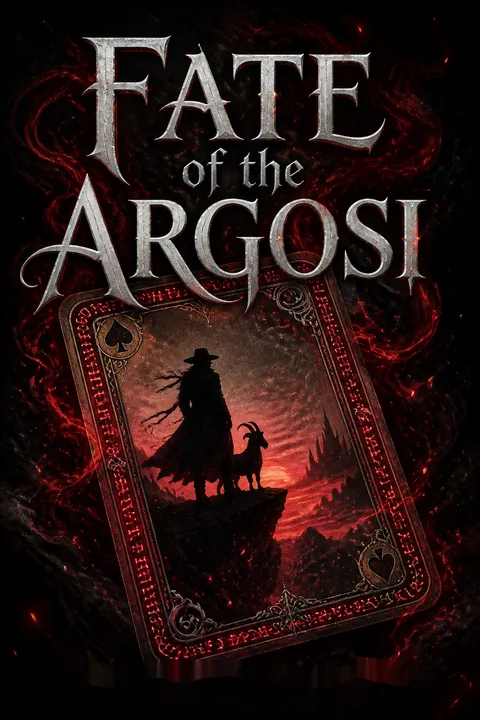
Perched atop a six-hundred-foot spire, Ferius Parfax, an eighteen-year-old Argosi, reflects on the meaning of "glorious" and the debts she carries. With her spire goat companion, Conch, she shuffles her deck of disharmonies—cards representing debts owed to those she's wronged. The city below is alive with possibility, but Ferius is weighed down by the need to make restitution. Her path is not just about adventure, but about paying what she owes to the world, and to herself. The chapter sets the tone: a blend of humor, longing, and the burden of responsibility, as Ferius draws the card that will set her next journey in motion.
Debts and Disharmonies
Ferius's journey leads her to Soul's Grave, a notorious prison, to repay a debt to Arissa, a thief she once failed. The prison is a hellish place, reserved for foreign criminals, and Ferius's attempts at negotiation and cunning are met with cruelty and indifference. The Red Scream, a mind-plague she carries, tempts her toward violence, but she resists, clinging to the Argosi ways. Her spire goat, Conch, both hinders and helps, and Ferius's resilience is tested as she faces the moral dilemmas of prison breaks, the weight of her debts, and the darkness within herself.
Soul's Grave Descent
Ferius's attempt to rescue Arissa goes awry when she's paralyzed by Conch's gas and captured by brutal guards. Facing assault and death, she relies on her Argosi training and the chaos Conch creates to survive. In a desperate struggle, she kills a guard, then chooses mercy over vengeance, tending his wounds and offering him a chance at redemption. The encounter is a crucible, forcing Ferius to confront the violence she's capable of and the hope that even in darkness, a seed of change can be planted.
The Living and the Lost
After navigating the horrors of Soul's Grave, Ferius discovers Arissa alive, having faked her death to survive. Their reunion is bittersweet: Arissa is scarred, both physically and emotionally, and Ferius must help her reclaim her sense of self. The two share memories, pain, and the awkward intimacy of survival. Ferius gives Arissa a red frontier hat—a symbol of hope and identity. Their bond is tested by trauma, but also strengthened, as they prepare to face the next challenge together.
Reunion in Chains
Ferius and Arissa encounter Chedran, a prisoner accused of murdering children. Arissa wants vengeance, but Ferius's Argosi insight reveals Chedran's confession is a ruse to protect Mahdek runaways—children of a persecuted people, like Ferius herself. The trio's uneasy alliance is forged in necessity, as they break free from Soul's Grave. The escape is fraught with tension, old wounds, and the realization that debts are not just personal, but collective—tied to the fate of an entire people.
The Snake Charmer's Truth
As they journey across the desert, Chedran's bitterness and pride clash with Ferius's empathy and Arissa's pragmatism. The Mahdek, once powerful mages, are now refugees, hunted and despised. Chedran's devotion to his people is both noble and corrosive, and Ferius must navigate the complex web of guilt, resentment, and hope that binds them. The trio's dynamic is volatile, but their shared purpose—to find and protect the Mahdek runaways—gives them direction.
Escape and Unpaid Debts
The group's escape from Soul's Grave is aided by a Zhuban guard who chooses truth over survival, and by Ferius's willingness to pay her debts in unexpected ways. The journey is marked by small mercies, hard choices, and the realization that freedom is never free. Chedran's injuries and pride are a constant challenge, and Ferius's Argosi ways are tested by the need to balance kindness with cunning. The chapter ends with the group on the run, debts unpaid but hope rekindled.
Horse Thieves and Heroes
To continue their journey, the group must steal horses—a task that tests Arissa's skills and Ferius's ethics. The heist is a blend of chaos and ingenuity, with Conch's scream as a key distraction. Ferius's attempt to make restitution to the horse trader reveals her commitment to the Way of Water, even as Chedran accuses her of cowardice. The group's victories are bittersweet, and the bonds between them are strained by secrets, pride, and the ever-present weight of the past.
The Mahdek Runaways
The group finds the Mahdek runaways, a ragtag band of teenagers led by Kievan. Chedran is their hero, but Ferius is a legend—a symbol of hope and defiance. The reunion is fraught with tension, as the runaways' dreams clash with the elders' despair. Ferius's presence forces everyone to confront the stories they tell about themselves, and the reality of what it means to be Mahdek in a world that wants them gone. The chapter is a meditation on identity, belonging, and the power of myth.
The Spell Warrant
Remeny, one of the runaways, is revealed to bear a Jan'Tep spell warrant—a magical brand that allows mages to track him across the continent. The group must unravel the mystery of the spell, facing the threat of Jan'Tep hextrackers and the trauma of past violence. Ferius's Argosi talents are pushed to the limit as she tries to break the spell's hold, risking her own sanity and safety. The spell warrant becomes a symbol of the Mahdek's vulnerability—and their resilience.
The Mind Cage
The group is lured into a Jan'Tep mind cage—a silk magic trap that turns their own memories and guilt against them. Forced to relive their worst moments, Ferius, Arissa, and Chedran must confront the violence, shame, and pain that define them. The mind cage is both a literal and metaphorical prison, and escape requires not just cunning, but forgiveness and self-acceptance. The experience leaves them scarred, but also more deeply connected.
The Shadowblack Voyage
Ala'tris, a Jan'Tep mage and old ally, offers the Mahdek a chance at a new homeland: a magical island hidden in the shadowblack, accessible only by a spellship. The journey is both wondrous and perilous, as the Mahdek's collective trauma threatens to anchor the ship in a necropolis of despair. Ferius must use her Argosi talents—and the dangerous power of the Scarlet Verses—to break the spell and lead her people forward. The voyage is a test of will, faith, and the possibility of redemption.
The Necropolis of Despair
As the spellship becomes trapped in a graveyard of their own making, the Mahdek are overcome by fatalism and begin to surrender to oblivion. Ferius, herself nearly lost, is saved by the intervention of Quadlopo and Conch. Drawing on the madness of the Scarlet Verses and the resilience of the Argosi, she shatters the necropolis, awakening hope in her people. The chapter is a battle between despair and daring, with Ferius's wild daisy spirit as the key to survival.
Daisies in the Dark
Ferius rides through the necropolis, using the Scarlet Verses to break the death arches and awaken the Mahdek. The act is both a triumph and a sacrifice, as Ferius risks her sanity and soul to save her people. The Mahdek are freed from the grip of despair, and the spellship is able to continue its journey. The chapter is a testament to the power of will, the danger of unchecked despair, and the possibility of beauty blooming even in darkness.
The Island's Threshold
The spellship reaches the magical island, a place of color and life in the midst of the shadowblack. The Mahdek disembark, carrying their hopes and fears into a new future. Ferius, exhausted and changed by her ordeal, is offered leadership by Stoika, but refuses, believing the Mahdek must find their own way. The chapter is a moment of arrival, but also of uncertainty, as the past cannot be left behind so easily.
Sovereign Diplomacy
The Mahdek elders, led by Stoika, must negotiate their place on the island and their relationship with the Jan'Tep restitutionists. Old wounds and new possibilities collide, as Ferius navigates the politics of exile, leadership, and the burden of history. The chapter explores the tension between hope and cynicism, the need for sovereignty, and the challenge of building a future on the ruins of the past.
Love and Farewell
As the Mahdek prepare to settle the island, Ferius and Arissa confront their feelings for each other. Their love is real, but shaped by loss, longing, and the knowledge that their paths must diverge. The farewell is painful, honest, and unresolved—a recognition that freedom and love are often at odds, and that the debts we owe to others can never be fully repaid. Ferius chooses to stay with her people, while Arissa goes her own way, leaving open the possibility of reunion.
The Path of the Wild Daisy
Ferius writes a letter to Arissa, reflecting on the journey, the debts paid and unpaid, and the meaning of the Argosi path. The island is a new beginning for the Mahdek, but also a challenge—a place where hope must be cultivated, and the wounds of the past healed. Ferius embraces the Path of the Wild Daisy: to find beauty in unexpected places, to wander, to gamble, to tell stories, and to keep moving forward, no matter how heavy the debts or how uncertain the road ahead.
Analysis
Sebastien de Castell's Fate of the Argosi is a meditation on debt, exile, and the search for meaning in a world defined by loss. Through the lens of Ferius Parfax—a wanderer, debtor, and reluctant leader—the novel explores the tension between freedom and responsibility, hope and despair, love and farewell. The Argosi philosophy, with its emphasis on talents, ways, and the refusal to be bound by fate, offers both a guide and a challenge: to find beauty in unexpected places, to pay one's debts not out of guilt but gratitude, and to keep moving forward even when the road is uncertain. The story's structure—episodic, reflective, and deeply psychological—mirrors the journey of healing from trauma, the difficulty of building community, and the necessity of letting go. The use of magical devices—the deck of disharmonies, the mind cage, the spellship—externalizes internal struggles, making the characters' battles with despair, guilt, and hope both literal and universal. Ultimately, the novel suggests that the debts we carry are not just burdens, but opportunities for connection, transformation, and the creation of something glorious from the ruins of the past.
Review Summary
People Also Read

Characters
Ferius Parfax
Ferius is the heart of the story: an eighteen-year-old Argosi whose life is defined by debts—both literal and emotional. She is fiercely independent, loquacious, and driven by a need to make restitution for the harm she's caused. Her Argosi training gives her a unique perspective, blending empathy, cunning, and resilience. Ferius is haunted by the Scarlet Verses, a mind-plague that tempts her toward violence, but she resists, clinging to hope and the possibility of beauty. Her relationships—with Arissa, Chedran, Ala'tris, and the Mahdek—are complex, marked by longing, guilt, and the search for belonging. Ferius's journey is one of self-discovery, as she learns that debts can be gifts, and that the path forward is always uncertain, but worth walking.
Arissa (Arelisa Talédra)
Arissa is Ferius's oldest friend and the catalyst for her journey. Once a daring thief, Arissa is scarred by her time in Soul's Grave, but retains her wit, charm, and defiance. Her relationship with Ferius is fraught with tension—part friendship, part unspoken love, part rivalry. Arissa is both a mirror and a foil for Ferius: where Ferius seeks restitution, Arissa seeks freedom; where Ferius is burdened by debts, Arissa refuses to owe the world anything. Their farewell is a testament to the difficulty of choosing between love and the open road.
Chedran
Chedran is a complex figure: a Mahdek who has survived by embracing violence and cunning, but whose devotion to his people is absolute. He is both admired and resented by the Mahdek runaways, and his relationship with Ferius is marked by rivalry, suspicion, and grudging respect. Chedran's past is filled with trauma and sacrifice, and his inability to let go of old wounds makes him both a valuable ally and a dangerous liability. His journey is one of learning to trust, to forgive, and to accept that leadership requires more than strength.
Ala'tris
Ala'tris is a rare Jan'Tep who seeks redemption for her people's crimes against the Mahdek. She is graceful, idealistic, and burdened by the knowledge that her own magic is both a gift and a curse. Her relationship with Ferius is one of mutual respect and sisterhood, and her willingness to risk everything for the Mahdek is both inspiring and tragic. Ala'tris's struggle is to reconcile her heritage with her conscience, and to find a way to build a future on the ruins of the past.
Stoika
Stoika is the embodiment of Mahdek endurance: stern, pragmatic, and unyielding. She has led her people through exile and despair, but is haunted by the knowledge that her generation has failed to secure a future for the next. Her relationship with Ferius is adversarial but ultimately respectful, as she comes to see that leadership requires humility, adaptability, and the willingness to learn from the young. Stoika's arc is one of letting go—of power, of bitterness, and of the past.
Conch
Conch is more than comic relief: his unpredictable behavior, paralyzing gas, and loyalty to Ferius make him both a hindrance and a hero. He represents the wild, uncontrollable forces that shape the journey, and his interventions are often the difference between survival and disaster. Conch's presence is a reminder that help can come from unexpected places, and that even the smallest creature can make a difference.
Quadlopo
Quadlopo is Ferius's long-suffering horse, whose endurance and occasional heroics are essential to the group's survival. He is a symbol of loyalty, resilience, and the unglamorous work of carrying burdens—literal and metaphorical. Quadlopo's relationship with Ferius is one of mutual exasperation and deep, unspoken trust.
Kievan
Kievan is the de facto leader of the Mahdek runaways: intelligent, resourceful, and determined to find a future beyond despair. She challenges both the elders and the Jan'Tep, refusing to accept easy answers or false hope. Kievan's arc is one of coming of age, as she learns to balance idealism with pragmatism, and to lead her people into the unknown.
Sar'ephir
Sar'ephir is a Jan'Tep mage marked by the shadowblack, whose unique abilities make the spellship's journey possible. She is both powerful and vulnerable, respected and feared by her own people. Sar'ephir's struggle is to find acceptance, to use her gifts for good, and to survive in a world that sees her as a threat.
Remeny
Remeny is a Mahdek boy marked by a Jan'Tep spell warrant, making him both a target and a key to the group's journey. His innocence, curiosity, and resilience are a source of inspiration, and his struggle to control his own fate mirrors the larger struggle of the Mahdek. Remeny's arc is one of transformation—from victim to agent, from burden to hope.
Plot Devices
The Deck of Disharmonies
Ferius's deck of disharmonies—cards representing unpaid debts—serves as both a literal and metaphorical plot device. Each card is a story, a wound, a promise to make things right. The deck structures the narrative, driving Ferius from one act of restitution to the next, and framing the story as a series of moral choices. The device allows for episodic storytelling, while also building a cumulative sense of responsibility and growth.
The Argosi Talents and Ways
The Argosi philosophy—embodied in talents like arta loquit (eloquence), arta precis (perception), arta forteize (resilience), and the four ways (Water, Wind, Thunder, Stone)—provides both a narrative framework and a lens for character development. These concepts shape Ferius's decisions, her interactions with others, and her internal struggles. The talents are both tools and temptations, offering power but also the risk of losing one's path.
The Scarlet Verses
The Scarlet Verses, a mind-plague of destructive language, are a constant presence in Ferius's mind. They serve as both antagonist and plot device, tempting her toward violence, offering power at a price, and ultimately becoming the means by which she breaks the necropolis's spell. The Verses externalize Ferius's internal conflict, making her struggle with despair, madness, and hope both literal and dramatic.
The Spellship and Shadowblack
The spellship's voyage through the shadowblack is both a physical journey and a metaphor for the Mahdek's search for home. The mechanics of the journey—anchored by collective will, threatened by despair—mirror the psychological and cultural challenges of exile. The shadowblack is a liminal space, a testing ground for the characters' resilience, and a crucible for transformation.
The Mind Cage
The Jan'Tep mind cage, a magical trap that turns memories against the victim, is a powerful plot device for exploring trauma, shame, and the possibility of forgiveness. The mind cage forces characters to confront their worst selves, to relive pain, and to find a way out through acceptance and connection. It is both a literal obstacle and a metaphor for the burdens we carry.
Letters and Cards
The story ends with a letter from Ferius to Arissa, and the exchange of cards—symbols of debt, memory, and hope. The letter provides both closure and ambiguity, allowing the story to end on a note of possibility rather than certainty. The cards are tokens of connection, reminders that the journey is ongoing, and that the debts we owe are also the gifts we give.
Spellslinger Series



About the Author


Download PDF
Download EPUB
.epub digital book format is ideal for reading ebooks on phones, tablets, and e-readers.








































