
Plot Summary
Red Scream in the Sand
Seventeen-year-old Ferius Parfax, a wandering Argosi, stumbles upon a terrified boy fleeing across the desert, pursued by his own father and a woman, both transformed into blood-soaked, mindless killers. Ferius, haunted by her own violent past and a vow never to draw her sword again, is forced to break her oath to save the boy. The encounter is brutal and strange—the attackers are immune to pain, driven by a madness that manifests as a hissing, wordless scream. Ferius barely survives, aided by her stolen horse, Quadlopo. This is her first brush with the Red Scream, a plague of madness that will soon threaten the entire continent. The event sets her on a path of violence, guilt, and reluctant heroism.
The Silent Language
Ferius discovers the boy, Binta, is deaf and communicates through a complex fingertongue. Patiently, she learns his language, uncovering his trauma: his father and the monks of his monastery were driven mad by a visitor's stolen notes, singing until they tore themselves and each other apart. Binta alone survived, immune to the madness, but now orphaned and hunted. Ferius, herself a refugee and outsider, forms a fragile bond with Binta, vowing to protect him. Their shared isolation and need for understanding create a deep connection, as Ferius teaches and learns, and Binta's silent resilience becomes a source of strength for them both.
Monastery of Madness
Through Binta's halting signs, Ferius learns the full horror: a mysterious woman visited the Monastery of the Garden-Without-Flowers, left cryptic notes, and soon after, the monks began singing uncontrollably, mutilating themselves and each other. Binta's father and his companion became the first to turn, hunting Binta across the sands. The madness is contagious, spreading through words and song, and Binta's immunity is a mystery. Ferius realizes the threat is not just personal but potentially catastrophic. The trauma bonds them, but also foreshadows the scale of the coming disaster.
Village of Kindness
Ferius brings Binta to the village of Tinto Rhea, hoping to find him safety. The villagers, led by the kindly Orphanus and his daughter Lyrida, welcome them with open arms, offering Binta a home. For a moment, hope and community seem possible. But the village has already been touched by the same mysterious visitor, and the seeds of the Red Scream are sown. Ferius, ever wary, senses something amiss but is drawn in by the warmth and the possibility of belonging. The chapter is a bittersweet interlude, highlighting both the best and worst of human nature.
The Plague Spreads
During a village celebration, the mayor reads aloud a poem left by the visitor—a sequence of words in many languages. The villagers, including Lyrida, are overtaken by the Red Scream, turning into frenzied killers. Only Binta's scream, a sound he cannot hear himself, protects Ferius from infection. The village descends into chaos and bloodshed. Ferius, forced to fight for survival, is saved at the last moment by a mysterious Argosi woman, the Path of Thorns and Roses, who destroys the infected with fire and arrows. The cost of kindness is devastation, and Ferius is left with guilt and questions.
The Scarlet Verses
The Path of Thorns and Roses, a formidable and enigmatic Argosi, explains the nature of the Red Scream: a plague transmitted through language, perfected by a woman known only as the Traveller. The infected are compelled to spread the madness, but a flaw causes them to destroy their own tongues, limiting the contagion. Binta's immunity is unique and precious. Ferius, Binta, and the Path of Thorns and Roses set out to trace the origins of the Scarlet Verses, seeking answers at the Convent of Scarlet Words, where language itself is a weapon and a mystery.
The Path of Thorns
Ferius and the Path of Thorns and Roses (Rosie) become uneasy companions, joined by Binta. Rosie is brilliant, disciplined, and cold, her Argosi talents honed to a razor's edge. Ferius, by contrast, is improvisational, emotional, and self-doubting. Their journey is marked by friction, mutual respect, and a growing, complicated intimacy. Rosie's past is shrouded in secrets, her connection to the Traveller unclear. As they climb towards the convent, Ferius learns that Rosie is barred from entry, and that the nuns' mastery of language is both a source of power and peril.
The Convent's Secrets
Inside the Convent of Scarlet Words, Ferius and Binta face the seven Mothers Superior, masters of language who can manipulate minds with words alone. Ferius is forced to relive her greatest shame—the accidental stabbing of her foster mother, Enna—while the nuns probe her psyche for secrets. In return, Ferius uncovers the truth: the Traveller infiltrated the convent, stole their most dangerous knowledge, and erased all memory of her true identity. The Scarlet Verses are revealed as a weaponized form of language, capable of reshaping minds and reality itself.
The Dance of Survival
Ferius, Rosie, and Binta follow the Traveller's trail through a series of desecrated temples, each a site of massacre and madness. Rosie, increasingly tormented by guilt and doubt, leaves Ferius to face the burden of mercy killings—ending the lives of those left infected but not yet dead. The journey is a crucible, forging Ferius's resilience and forcing her to confront the darkness within herself. The trio's bonds are tested, and the cost of survival becomes ever more personal and profound.
The Traveller's Shadow
Rosie's past is laid bare: she was once Yarisha Fal, a child assassin from a distant land, trained to be heartless. The Traveller, Penta Corvus, was her Argosi maetri and lover, corrupted by doubt and the pursuit of perfection. Rosie's own philosophical experiments unwittingly helped create the Enrajo, a new, ruthless path that the Traveller now follows. Rosie, wracked by guilt, betrays Ferius, binding her and taking Binta to the Traveller, believing it is the only way to save the world from a greater catastrophe.
The Road of Temples
Ferius, freed from her bonds, pursues Rosie and the Traveller along the Great Temple Road, a string of holy sites now turned into charnel houses by the Red Scream. Each temple is a message, a test, and a torment, designed to break the will of the pursuers. Ferius is forced to kill the last survivors in each, painting "disharmony" cards to mark her debts. The journey strips her of innocence, but also forges her into something new—a survivor who can bear the unbearable.
The Way of Enrajo
The Traveller's true plan is revealed: to perfect the Scarlet Verses and unleash them upon the Jan'Tep, a nation of mages whose arrogance and cruelty she deems unforgivable. The Enrajo, a philosophy of preemptive violence and manipulation, is her answer to the failures of the Argosi. Rosie, realizing too late the consequences of her own ideas, is left broken and complicit. Ferius, with the help of her foster mother Enna, discovers that the Traveller herself is the first victim of the Red Scream, her mind reshaped by the very verses she sought to control.
The Final Confrontation
At the border of the Jan'Tep lands, Ferius confronts Rosie, now infected with the Scarlet Verses and compelled to kill or infect Ferius. Through sheer force of will, humor, and the unique improvisational "arta valar" that defines her, Ferius resists the plague, dancing with the words and twisting their meanings until they lose their power. She faces the Traveller, who tries to break her with one final, personal verse—her hatred for her Jan'Tep tormentor, Shadow Falcon. Ferius, at last, lets go of her hate, breaking the cycle and freeing herself from the verses' grip.
The Path of the Wild Daisy
With the Traveller dead by her own hand, the Red Scream is ended. Rosie and Binta are saved, but forever changed. Ferius, now fully herself, claims her own path—the Path of the Wild Daisy—embracing imperfection, resilience, and the unpredictable beauty of life. She returns Binta to Enna and Durral, her foster parents, and chooses to wander on, carrying her debts and her hope. The story ends not with triumph, but with the hard-won wisdom that survival, kindness, and laughter are their own forms of victory.
Burials and Beginnings
In the aftermath, Ferius, Rosie, and Binta bury the dead, honor their debts, and begin to heal. The bonds of found family—between Ferius, her foster parents, and Binta—are reaffirmed. Rosie, changed by her ordeal, sets out on her own path, while Ferius, now at peace with her past and her choices, rides into the unknown. The cycle of violence is broken not by force, but by compassion, forgiveness, and the courage to choose one's own way, even in a world of madness.
Analysis
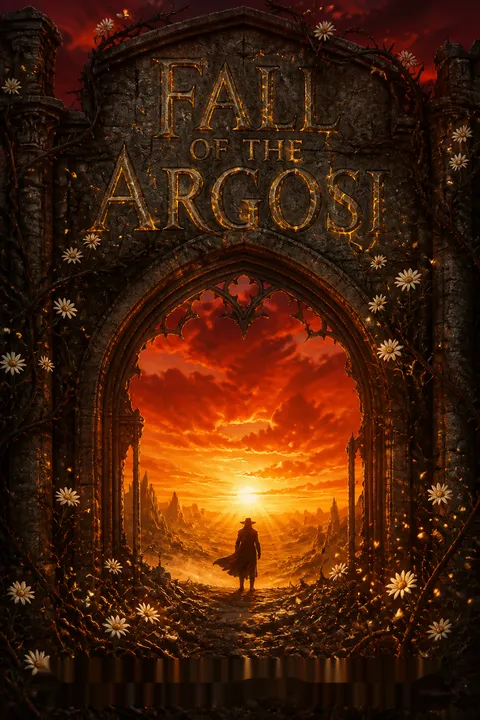
Sebastien de Castell's Fall of the Argosi is a meditation on the power and peril of language, the necessity of forging one's own path, and the cost of survival in a world beset by violence and doubt. Through the journey of Ferius Parfax—a wounded, improvisational, and deeply human protagonist—the novel interrogates the limits of philosophy, the dangers of perfectionism, and the redemptive potential of compassion and humor. The Red Scream, as both a literal plague and a metaphor for the infectiousness of hate and despair, challenges the characters to resist not through force, but through resilience, adaptability, and the courage to let go of old wounds. The book's structure—alternating between action, introspection, and philosophical debate—mirrors the Argosi's own teachings: that survival is not about mastery, but about dancing with uncertainty, embracing imperfection, and choosing kindness even when the world offers none. In the end, Fall of the Argosi is a story about the debts we carry, the families we choose, and the wild, unpredictable beauty of a life lived on one's own terms.
Review Summary
People Also Read

Characters
Ferius Parfax
Ferius is a seventeen-year-old Argosi, marked by trauma, guilt, and a fierce sense of justice. Orphaned and persecuted for her Mahdek heritage, she is both a survivor and an outsider, haunted by the violence she has committed and the love she fears she does not deserve. Her relationship with her foster parents, Durral and Enna, is a source of both strength and pain. Ferius's journey is one of self-forgiveness and growth: she learns to wield the Argosi talents in her own improvisational, emotional way, ultimately forging her own path—the Path of the Wild Daisy. Her resilience, humor, and capacity for compassion are her greatest weapons against the darkness.
Binta ("Bluebird")
Binta is a nine-year-old deaf boy, the sole survivor of the massacre at the Monastery of the Garden-Without-Flowers. Communicating through fingertongue, he is both vulnerable and remarkably brave, carrying the trauma of his family's destruction and his own immunity to the Red Scream. Binta's unique mind and language make him the target of the Traveller's schemes, but also the hope for a cure. His bond with Ferius is deep and transformative, and his journey is one of learning to trust, to grieve, and to find a new home.
The Path of Thorns and Roses (Rosie/Yarisha Fal)
Rosie is a brilliant, cold, and fiercely disciplined Argosi, shaped by a childhood as an Arkyan logician and assassin. Her relationship with her maetri, Penta Corvus, is both formative and destructive, leading her to question the Argosi ways and inadvertently help create the Enrajo philosophy. Rosie's journey is one of self-discovery, guilt, and the search for redemption. Her bond with Ferius is complex—rivalry, mentorship, and a brief, painful romance. Ultimately, Rosie is forced to confront the consequences of her own ideas and the limits of discipline without compassion.
Penta Corvus (The Traveller, Path of Five Ravens)
Penta is a legendary Argosi, once loving and idealistic, now the creator and first victim of the Red Scream. Her pursuit of perfection and her doubts about the Argosi ways lead her to develop the Scarlet Verses, a weaponized language plague. Penta's mind is ultimately consumed by her own creation, turning her into a vessel for the Enrajo philosophy and a force of destruction. Her relationship with Rosie is tragic—a love twisted by obsession and guilt. Penta embodies the dangers of unchecked intellect and the loss of empathy.
Enna Brown
Enna is Ferius's foster mother, a master of the Argosi ways, and a source of unconditional love and wisdom. Her teachings emphasize adaptability, resilience, and the importance of choosing one's own path. Enna's relationship with Ferius is both nurturing and challenging, pushing her to confront her guilt and embrace her own identity. Enna's survival after being wounded by Ferius is a testament to forgiveness and the enduring power of found family.
Durral Brown
Durral is Ferius's foster father, a larger-than-life Argosi whose teachings blend humor, paradox, and practical wisdom. He is a master of arta valar (daring) and arta eres (defence), and his love for Enna and Ferius is unwavering. Durral's role is that of mentor and moral anchor, challenging Ferius to find her own way and to laugh in the face of despair. His presence, even in absence, shapes Ferius's choices and growth.
Orphanus
Orphanus is the mayor of Tinto Rhea, embodying the best of human decency and community. His willingness to take in Binta and his trust in Ferius highlight the power of compassion. Orphanus's tragic fate—falling victim to the Red Scream—underscores the vulnerability of goodness in a world beset by madness.
Lyrida
Lyrida is Orphanus's daughter, a kind and gentle soul who forms a brief romantic connection with Ferius. Her warmth and acceptance offer Ferius a glimpse of happiness and belonging, but her transformation into a victim of the Red Scream is a devastating loss, reinforcing the story's themes of impermanence and the cost of violence.
The Mothers Superior
The seven Mothers Superior of the Convent of Scarlet Words are masters of language as power, able to manipulate minds with words alone. They are both formidable and flawed, their arrogance and secrecy making them vulnerable to the Traveller's schemes. Their interactions with Ferius force her to confront her own guilt and the limits of persuasion and perception.
Shadow Falcon
Shadow Falcon is a Jan'Tep mage and Ferius's childhood tormentor, the living symbol of her trauma and hatred. His appearance at the climax is the final test for Ferius: to let go of her hate and break the cycle of violence. Shadow Falcon's role is less as a character and more as a crucible for Ferius's transformation.
Plot Devices
The Red Scream (Scarlet Verses)
The Red Scream is the central plot device—a contagious madness transmitted through a sequence of words, perfected by the Traveller. It is both a literal and metaphorical weapon, representing the power of language to shape, destroy, and remake reality. The plague's evolution—from a flawed, self-limiting curse to a near-perfect tool of genocide—drives the narrative and forces the characters to confront the limits of their own philosophies and talents.
The Seven Argosi Talents and Four Ways
The Argosi talents (defence, eloquence, strategy, perception, persuasion, resilience, daring) and the four ways (Water, Wind, Thunder, Stone) structure both the characters' development and the story's progression. Each talent and way is tested, subverted, and ultimately redefined by Ferius and her companions, reflecting the book's themes of adaptability, imperfection, and the necessity of forging one's own path.
Found Family and Chosen Bonds
The relationships between Ferius, her foster parents, Binta, and Rosie are the emotional core of the story. The tension between loyalty, guilt, and the need for independence drives much of the character development. The found family motif is both a source of healing and a crucible for the hardest choices.
Disharmony Cards and Debts
The painting of "disharmony" cards to mark debts and unpayable wrongs is a recurring motif, symbolizing the burden of guilt and the hope for eventual redemption. The cards serve as both a narrative device (tracking Ferius's journey) and a thematic one (the necessity of remembering and honoring the past).
Narrative Structure and Foreshadowing
The story is structured as a journey, both literal and psychological, with each chapter revealing new layers of character, philosophy, and threat. Foreshadowing is used extensively—early encounters hint at later betrayals, and the evolution of the Red Scream mirrors the characters' own transformations. The use of first-person narration, interspersed with teachings and memories, creates intimacy and immediacy.
Spellslinger Series

About the Author


Download PDF
Download EPUB
.epub digital book format is ideal for reading ebooks on phones, tablets, and e-readers.








































