
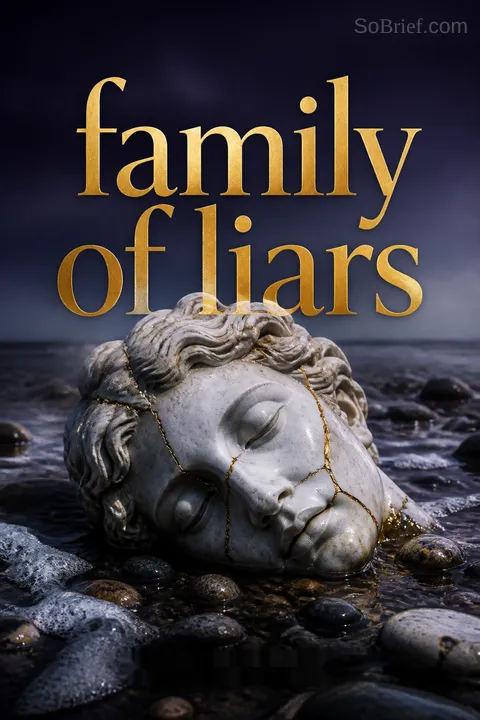


Plot Summary
Prologue
In her kitchen on Beechwood Island, late at night, Carrie1 pours whiskey and talks to the ghost of her dead son. Johnny died at fifteen in a fire, and he returns asking about the family's history — what the Sinclairs did, why they act the way they do, why he died. He wants to know the worst thing his mother ever did as a teenager.
Carrie,1 who has been a liar all her life, agrees to tell him. The story she offers is her seventeenth summer, 1987 — the year the boys came to the island, the year she first saw a ghost, and the year everything she understood about herself was broken apart and badly reassembled.
The Youngest Doesn't Surface
The Sinclair family summers on their private Beechwood Island — four blonde sisters, old money, sailboats and sparklers. When Carrie1 is sixteen, her youngest sister Rosemary,4 age ten, drowns in the cove while swimming with the au pair. No family member was there. The Sinclairs do not grieve openly; they keep stiff upper lips and busy schedules.
That same year, Carrie's father Harris6 forces her into jaw surgery to fix what he calls her weak, foolish face. Doctors break her jawbone, rebuild it, wire it shut. A severe infection follows. Prescribed codeine for the pain, Carrie1 discovers it also numbs the loss of Rosemary,4 the foreignness of her own restructured face. She begins taking the pills to sleep. Then earlier. Then always.
The Ghost and the Gatecrashers
The summer Carrie1 is seventeen, she wakes one morning to find Rosemary's4 ghost sitting on her bedroom floor, solid and warm, making Scrabble words and eating potato chips. The ghost says she visited their mother Tipper5 first but was turned away — Tipper5 told her not to follow, that she had to keep it together for the family.
Rosemary4 has chosen Carrie1 instead. Meanwhile, Uncle Dean12 arrives with his daughter Yardley,8 his son Tomkin, Penny's2 friend Erin,11 and three uninvited college-age boys: George,10 Yardley's8 boyfriend; Major,9 a redhead from Brooklyn; and Pfeff,3 a broad-shouldered charmer with a broken nose and dark hair. Tipper5 is furious at Dean12 for bringing guests without warning, but Carrie1 argues the boys will brighten their grieving household. Tipper5 relents.
Lemons in the Moonlight
Tipper5 stages the family's annual Lemon Hunt — a hundred lemons and one lime hidden across Beechwood, everyone dressed in yellow or white, fairy lights along the porch. Carrie1 gives the ceremonial speech, then sets out alone.
She encounters Pfeff3 on the perimeter path above dangerous rocks, moonlit surf crashing below. He leans down and presses his lips to hers — barely there, her first kiss ever. She reaches up and kisses him back, and for the first time since her surgery, her mouth feels like pure connection rather than something scarred and reconstructed.
He calls her clever and impressive, says it would be a shame to waste the moonlight. Then he vanishes into the dark to hunt more lemons. He wins with twenty, kneeling at Tipper's5 feet to present them.
Five Hours at the Dock
Carrie1 plans a shopping trip to Edgartown with Pfeff.3 He oversleeps, then swims to the departing boat in his hoodie — a grand gesture that melts her resolve. They spend the morning buying lobster socks, boxer shorts, books for his friends. He is effervescent, flirting with every shopkeeper.
Then he spots Sybelle, an ex from a wilderness program, and tells Carrie1 he'll meet her at the dock. She waits five hours. She takes codeine to dull the ache of being forgotten. When Pfeff3 finally returns with a breezy story about renting bikes and eating pizza, Carrie1 tells him he's a selfish fraud who only cares about his own image of specialness. She drives them home in furious silence.
The Scratched-Out Face
Carrie1 has been haunted by a photograph hidden beneath her mother's jewelry drawer — a young Tipper5 laughing beside a man whose face has been scraped to white paper. She finally confronts Tipper,5 who locks the door and tells her: Harris6 is not Carrie's1 biological father.
The man was Buddy Kopelnick,13 Tipper's5 Jewish college sweetheart, whom her family forbade her to marry. Tipper5 chose Harris6 but continued the affair. She got pregnant while Harris6 was in London for three weeks. They agreed to raise Carrie1 as his own and never speak of it.
The black pearls Harris6 gave Tipper,5 supposedly a meaningful anniversary gift, were really his way of forgiving infidelity. Buddy13 later died of illness. Carrie1 feels her place in the family is suddenly conditional — Harris6 doesn't have to love her.
The Tire Swing Collapse
At a parlor game where everyone wears a famous person's name on their back, Penny2 unknowingly tells Carrie1 that her character's father is not really his father — Carrie1 is Luke Skywalker. Worse, Penny2 is wearing the black pearls, the necklace Tipper5 promised to Carrie,1 the one that holds the secret of Buddy Kopelnick.13
Drunk on bourbon, Carrie1 realizes Harris6 broke her jaw to erase Buddy's13 features from her face. She careens on the tire swing, sobbing, until Pfeff3 finds her in the dark. He kisses her and asks her to come to his room. She goes. They sleep together for the first time — Carrie1 desperate to feel chosen, Pfeff3 offering warmth without knowing the wound he's bandaging.
The Ping-Pong Table Betrayal
Weeks of happiness follow — Carrie1 and Pfeff3 sailing alone, tangled together on the deck, sneaking touches during movie nights. Then one evening, Carrie1 and Yardley8 walk into the Goose Cottage garden and find Penny2 pressed against the Ping-Pong table, kissing Pfeff.3 His hand is on her bare skin; her fingers are knotted in his hair. Carrie's1 face feels like hot wax sliding off her bones.
She covers it with her hands and runs into the dark. The betrayal cuts deeper than romance — it confirms what she's feared since learning about Buddy Kopelnick:13 she is not enough. Her reconstructed jaw, her intelligence, her devotion — none of it competes with Penny's2 effortless magnetism. The stepsister's foot will always bleed in the glass slipper.
Everyone Leaves Beechwood
Carrie1 confronts Penny2 on the windswept perimeter path. Penny2 confesses she's been in a secret romantic relationship with Erin,11 who now wants to end it. She kissed Pfeff3 to make Erin11 jealous, to prove she could still want boys, or perhaps just to wound someone the way she'd been wounded. Carrie1 refuses to accept the explanation — some lines cannot be uncrossed.
Meanwhile, Yardley8 has discovered her father Dean12 advises white-collar criminals whose schemes ruined people she knew. She told Harris,6 who plans to sever ties. Yardley8 departs the island; so does Erin,11 then Dean12 and his son Tomkin. George10 refuses to support Yardley's8 moral stand, so she dumps him. In days, Carrie's1 world shrinks to parents, sisters, and the remaining boys.
Pfeff Swims Away
After days hiding in her room, Carrie1 goes to the Tiny Beach to demand an explanation. Pfeff3 stands knee-deep in the water, keeping a boogie board between them. He says he's impulsive, always has been, and she knew that from the start. He calls their time together a surreal, enchanted summer — a fling before college, nothing more.
Carrie1 insists this is her life, not a movie scene. He turns and paddles toward the open water without looking back. She bites her lip, climbs the staircase, doubles her Halcion dose, and sobs until the drug erases consciousness. She has asked for accountability she will never receive — at least, not in the form she imagined.
The Board with Rusty Nails
Carrie1 first tells the story this way: Bess7 wakes her at one in the morning. On the dock, Pfeff3 lies dead, his shirt off, his pants partially pulled down. Penny2 is knee-deep in the water, scrubbing her face. Bess7 explains that she followed them, saw Pfeff3 forcing himself on Penny2 despite her repeated refusals, grabbed a warped board with protruding nails that Harris6 had pulled from the dock weeks ago, and struck.
Penny2 confirms: Pfeff3 kept saying please while ignoring every no. Carrie1 accepts the role her sisters assign her — the eldest, the fixer, the protector. She decides immediately: no police, no parents, no exposure. She sends Bess7 for supplies and Penny2 to stage Pfeff's3 room at the guesthouse. The cover-up begins.
Three Sisters Row to Sea
They load Pfeff's3 body into the motorboat and row away from the dock in silence to avoid engine noise. Far from shore, they weight him with rocks shoved into his pockets, then tie the boat's anchor around his waist with nylon rope cut by a Swiss Army knife. They lift him onto the gunwale and drop him into the black water. Penny2 murmurs Shakespeare about coral bones and pearl eyes.
Then comes the erasure: burning bloodied paper towels over the waves, pouring whiskey into a staged thermos, sinking stained clothes wrapped around a stone. At six-forty-eight in the morning they motor home, burst into the Clairmont kitchen, and tell their parents a story about an early-morning boat ride, a drunk boy, and a shark.
The Confession Beneath the Confession
Carrie1 stops the story. She has been lying — doing what she always does, casting herself as the heroic eldest sister. The truth: she woke and heard Pfeff3 whispering to Penny2 on the dock. No one came for her.
She went downstairs alone, consumed by jealousy that Penny2 was with him again despite knowing how devastated Carrie1 was. She picked up the warped board and brought it down with the full force of her softball swing, unsure whether she was striking the boy who abandoned her or the sister who stole him.
Penny2 interpreted the violence as rescue. Bess7 arrived moments later. Neither sister ever learned the truth. When Pfeff's3 ghost later visited to apologize, he blamed Penny2 for not truly meaning her refusals — proof he would never have changed.
Harris Burns the Board
Weeks later, Harris6 summons Carrie1 to his study. He reveals that the night Pfeff3 died, he was out of Halcion — Carrie1 had stolen his supply. Sleepless, he checked on his daughters, found all three beds empty, and watched them rowing the motorboat into darkness. He went to the dock and found it reeking of bleach, the warped board soaking wet with something sticky on the nails.
He took the board, scrubbed it, hid it in the attic. On Bonfire Night, he burned it alongside Carrie's1 own written confession. He tells Carrie1 he knows about Buddy Kopelnick,13 and that she is a Sinclair regardless. He protected her because that is what family means to him. He asks only that she stop stealing his pills and carry on.
Shampoo the Lion, Goodbye
Over four summers, Rosemary's4 ghost grows weaker. When Carrie1 is twenty-one, fresh from her second stay in rehabilitation, Rosemary4 finally tells her the truth: she has been coming back because she feared Carrie1 would kill herself — first with despair, then with pills. She knows about Pfeff.3 She has loved Carrie1 while knowing the worst thing about her.
Carrie1 promises she will live, will feel the sadness instead of numbing it, will take it one day at a time. Rosemary4 nods, exhausted. She leads Carrie1 to the turret attic, retrieves her favorite stuffed lion Shampoo from a box, climbs onto the windowsill, and calls back that she loves her. Then she jumps — and vanishes. Not on the rocks. Not in the sky. Simply gone.
Epilogue
Back in the Red Gate kitchen, Johnny absorbs the story in quiet shock, then kisses his mother's cheek and says he needs to think. He leaves to join other ghosts elsewhere on the island. Alone, Carrie1 takes stock: she is Cinderella's jealous stepsister, the unpunished ghost, Mr. Fox.
But she chooses a different story now — a woman whose sisters stood by her, whose father claimed her despite everything, who recovered from addiction and found love again. She resolves to live a joyful but conscious life. Morning comes. She calls her family to breakfast. Someone makes eggs; the dogs steal sausages; teenagers dose their coffee with sugar. Her sisters join her on the porch. They are very small, next to the ocean, beneath the open sky.
Analysis
Family of Liars operates as a structural trap that mirrors its narrator's psychology. Carrie1 tells us on page one that she is a liar, yet we trust her account because she narrates with such emotional specificity — the lobster socks on a dead boy's feet, the conditioner smell of a ghost's tangled hair. Lockhart weaponizes this intimacy, training readers to identify so thoroughly with Carrie's1 victimhood that when the reversal comes, we experience the same disorientation she must feel: the sudden recognition that our protector narrative was self-serving mythology all along.
The novel examines how privilege functions as infrastructure for impunity. The Sinclairs' wealth doesn't merely provide comfort — it provides an attic for hiding evidence, a bonfire for destroying it, money for rebuilding a dock, and social capital that makes police accept a wealthy family's story without scrutiny. The cover-up succeeds not because the sisters are clever but because the system is designed to believe people who look like them. Lockhart weaves this critique through the family's layered dirty money — plantation wealth, exploited workers, Dean's12 white-collar fraud — showing that the capacity to escape consequences is itself inherited.
Lockhart also deconstructs the eldest-sister-as-hero archetype. Carrie's1 identity as the indispensable fixer — the one who sets up umbrellas, reinstates tennis memberships, makes speeches — becomes the mask she wears over jealousy and violence. Her fairy-tale retellings reveal this duality: she is simultaneously Cinderella and the mutilating stepsister, Lady Mary and Mr. Fox. The stories families tell about their members — who is the good one, the beauty, the baby — are not descriptions but active constructions with lethal consequences.
Rosemary's4 ghost represents the cost of emotional suppression. A family that refuses to grieve produces literal hauntings. Rosemary4 returns not because she needs closure but because Carrie1 needs a witness. The ghost can finally rest only when Carrie1 promises to feel instead of numbing — to stop being a Sinclair in the way that matters most. Confession, not comfort, is what sets the dead free.
Review Summary
Family of Liars received mixed reviews, with an average rating of 3.77 out of 5. Many readers enjoyed the prequel, finding it captivating and emotionally impactful. Some praised the character development, nostalgic summer vibes, and exploration of family dynamics. Others felt it was unnecessary or didn't live up to the original. The book's writing style and atmospheric storytelling were generally well-received. While some readers found it less shocking than its predecessor, many appreciated the deeper insight into the Sinclair family's history and the complex relationships between characters.
People Also Read






Characters
Carrie
Eldest sister, unreliable narratorCaroline Lennox Taft Sinclair is the eldest of four sisters and the self-proclaimed liar narrating this story. A strong softball player with a confident public presence, she privately crumbles under grief, body shame, and growing addiction. After her youngest sister drowns and her father forces reconstructive jaw surgery, she becomes dependent on codeine and stolen sleeping pills. She hungers to be seen as unique and worthy—to be kissed, to be chosen, to matter—and this desperation makes her both fiercely protective of her siblings and dangerously volatile when that protection isn't reciprocated. She positions herself as the family's fixer, the one who solves problems and speaks in front of crowds, but her heroic self-image masks impulses she barely understands. A mourner, a leader, a liar—often simultaneously.
Penny
Beautiful, guarded second sisterPenelope Sinclair is the acknowledged beauty of the family—cream-haired, magnetically attractive, never without admirers. Her surface calm conceals a person terrified of vulnerability. She prefers smooth surfaces and changes the subject whenever emotions run deep. She dismisses grief with cold pragmatism and never lets anyone see how she truly feels, describing emotional exposure as unbearable nakedness. Yet beneath her apparent selfishness lies confusion about her own desires and identity, a struggle she cannot articulate to her family. She is capable of devastating carelessness, but also of surprising loyalty when the stakes demand it. Her relationship with Carrie1 oscillates between dependence and rivalry, deepened by tensions neither can fully resolve.
Pfeff
Charismatic, reckless love interestLawrence Pfefferman arrives on Beechwood Island as a charming, impulsive eighteen-year-old who makes everyone feel special. Broad-shouldered with a broken nose and thick dark hair, he is voracious about food, conversation, and attention. He flirts with shopkeepers, buys gifts for friends, and kneels before his hosts. Beneath the magnetism lies deep insecurity: he failed to earn his college admission, and his parents' marriage is collapsing. He carries shame about both but wears self-deprecation like armor, as though acknowledging his flaws inoculates him against accountability. He genuinely craves connection yet treats people as renewable resources—always reaching for the next source of warmth while the previous one cools. His entitlement extends to bodies as well as affection.
Rosemary
Ghost of the drowned youngestThe youngest Sinclair sister, drowned at age ten, returns as a ghost the summer Carrie1 is seventeen. In life she loved potato chips, stuffed lions, swimming, Simple Minds, and fairy tales before bed. In death she is warm, solid, humorous—she wants to watch Saturday Night Live, play card games, make friendship bracelets. She visits only Carrie1, after their mother5 turned her away. Despite being a child, she carries intuitive understanding of her family's fractures. She functions as Carrie's1 conscience and anchor, the one person who loves her without competition or condition. Her ghost is both comfort and burden—a reminder that the family's refusal to grieve has real, lingering costs that manifest in the most literal way possible.
Tipper
Hostess mother hiding griefThe Sinclair matriarch who runs Beechwood Island with party-planning precision and emotional avoidance. She stages Lemon Hunts and Midsummer Ice Cream parties to fill silence with joy, refusing to discuss grief, illness, or the past. Kind but narrow-minded, she hides a secret that could fracture her family. Her love manifests through action—muffins, jewelry, beautifully set tables—rather than honesty. She believes wallowing helps no one.
Harris
Commanding, quotation-armored fatherThe Sinclair patriarch, a Harvard-educated publisher who governs his family with quotations and rigid expectations. He believes complaining adds nothing, that looking strong matters more than being honest, and that being a credit to the family is the highest moral imperative. Decisive and controlling, he forced Carrie's1 jaw surgery over her objections. Yet beneath his severity lies a protectiveness that runs deeper and reaches further than anyone suspects.
Bess
Overlooked, observant third sisterThe third Sinclair sister, fourteen, a people-pleaser who sorts lip gloss by shade and practices curling her hair for school. She inserts herself where she's not invited and always says the right thing at the right time. Beneath her martyr's brightness, she harbors sharp observations about her sisters' failings and a deep resentment at being perpetually dismissed as too young. She is far more observant than anyone credits.
Yardley
Morally unflinching cousinCarrie's1 eighteen-year-old cousin, sporty and confident with thick brown hair and a firm voice. She plans to become a doctor and approaches life with practical directness. She is the only person who sees Carrie's1 pain clearly and names it aloud. She is funny, loyal, and morally uncompromising—qualities that put her at odds with her own father and the family's comfortable arrangements.
Major
Perceptive outsider from BrooklynJeremy Majorino, a redheaded art-school product from Brooklyn, openly gay. He reads Armistead Maupin, wears black, and avoids physical exertion. Quiet and sharp-eyed, he sees through social performances others miss.
George
Affable boyfriend, comfort-firstYardley's8 beige, toothy boyfriend, a canoe racer who mixes Lucky Charms with pretzels and wears seersucker. Loyal to his friends but unwilling to sacrifice comfort or certainty for someone else's moral stand.
Erin
Penny's sharp-eyed best friendPenny's2 best friend from boarding school, angel-faced and analytical. She favors black turtlenecks and Doc Martens. Her presence on the island carries more emotional weight than anyone initially suspects.
Uncle Dean
Charming, compromised co-ownerHarris's6 younger brother, a Philadelphia lawyer who co-owns Beechwood. Gregarious and divorced, the fun dad—he brings guests without permission and expects charm to paper over consequences.
Buddy Kopelnick
Tipper's erased college loveA figure from Tipper's5 past whose scratched-out face in a hidden photograph becomes the center of a family secret. His identity connects to Carrie1 in ways she never imagined.
Plot Devices
The Black Pearls
Symbol of conditional belongingHarris6 gave Tipper5 a double strand of dark gray pearls for their second anniversary, when she was pregnant with Carrie1. They represent his forgiveness of infidelity and his claim on a child who isn't biologically his. Tipper5 promises them to Carrie1, but when Penny2 casually wears them to a party game, Carrie1 feels her promised inheritance—and her place in the family—slipping away. The pearls encode the Sinclairs' deepest secret: that love in this family is earned through silence, beauty, and compliance. They pass between mother and daughters like a test of belonging, measuring who is trusted with the family's hidden truths and who is merely decorative.
The Warped Dock Board
Weapon, evidence, and ashA warped plank that Harris6 pulls from the dock early in the summer, noting its rusty protruding nails, and sets aside for repair. It sits in plain sight for weeks—through the Lemon Hunt, through beach days—until the night it becomes the instrument of death. Its journey traces the family's approach to ugly truths: it is wielded, bleached, hidden in the attic, and finally burned at the annual bonfire. Each family member who handles it—the daughter who swings it, the sister who scrubs it, the father who conceals it—adds another layer of complicity. The board's destruction on Bonfire Night makes the Sinclair credo literal: erase the evidence, rebuild the surface, carry on as if nothing happened.
The Fairy Tales
Thematic mirrors for Carrie's truthCarrie1 reads her family's old fairy-tale books to Rosemary's4 ghost, then retells three stories as allegories for her own life. In Cinderella, she identifies as both the overlooked stepsister and the jealous one who mutilates herself for love. In The Stolen Pennies, she is both the truth-seeing guest and the ghost-child whose unresolved crime prevents rest. In Mr. Fox, she is Lady Mary, who discovers her lover's violent nature—but admits she may also be Mr. Fox, the charming murderer with a closet full of bodies. These nested stories let Carrie1 approach truths she cannot yet speak plainly, each retelling edging closer to her eventual confession about what she did and why.
Codeine and Halcion
Addiction as emotional armorCarrie's1 codeine dependence begins with legitimate prescriptions after jaw surgery but quickly becomes her primary tool for avoiding grief, jealousy, and moral reckoning. She steals Harris's6 Halcion sleeping pills to expand her numbing arsenal. The drugs allow her to be present without feeling, functional without processing—the pharmaceutical equivalent of the Sinclair family's emotional denial. Her addiction parallels Tipper's5 compulsive entertaining and Harris's6 quotation-armored stoicism: different strategies for the same refusal to sit with pain. The pills also create conditions for catastrophe—dulling judgment, loosening impulse control, and leaving Harris6 sleepless on a critical night when his missing Halcion leads him to discover what his daughters have done.
The Scratched Photograph
Catalyst for identity crisisHidden beneath the velvet liner of Tipper's5 jewelry drawer lies an old photograph of a young Tipper5 laughing beside a man whose face has been scraped to white paper. Carrie1 glimpses it early in the summer and becomes obsessed. Penny2 theorizes the face belongs to Harris6, scratched in anger. The truth—that it depicts Buddy Kopelnick13, Tipper's5 forbidden college lover and Carrie's1 biological father, defaced by Harris6 in fury—reframes Carrie's1 understanding of her family and herself. The photograph embodies what the Sinclairs do with uncomfortable truths: they don't fully destroy them but keep them hidden, damaged, in a place that can be accessed but never displayed.
FAQ
Synopsis & Basic Details
What is Family of Liars about?
- Summer on Beechwood Island: The novel centers on Carrie Sinclair's recounting of her seventeenth summer (1987) on her wealthy family's private island, Beechwood. This seemingly idyllic setting becomes the backdrop for a series of events that shatter the family's carefully constructed facade.
- A Prequel's Dark History: Serving as a prequel to We Were Liars, the story delves into the earlier generations of the Sinclair family, revealing the origins of their secrets, privilege, and the emotional damage passed down through the years.
- Tragedy, Secrets, and Cover-Up: The narrative follows Carrie and her sisters, Penny and Bess, as they navigate complex relationships, including Carrie's romance with a visiting boy, Pfeff. A tragic death occurs, leading the sisters to commit a desperate act and weave a web of lies to protect themselves and their family name.
Why should I read Family of Liars?
- Unravels Sinclair Family Origins: Readers of We Were Liars will gain deep insight into the history and patterns of behavior that shaped the family in the original novel, particularly the roots of their dysfunction and secrecy.
- Masterful Psychological Suspense: E. Lockhart employs unreliable narration and subtle foreshadowing to create a compelling mystery that explores themes of guilt, trauma, and the lengths people go to protect themselves and their loved ones.
- Explores Complex Sisterhood: The novel offers a raw and unflinching look at the bonds and betrayals between sisters, examining rivalry, loyalty, and the impact of shared trauma on their relationships.
What is the background of Family of Liars?
- Setting on Beechwood Island: The story is primarily set on the fictional Beechwood Island off the coast of Massachusetts, a private retreat owned by the wealthy Sinclair family since 1926, highlighting themes of inherited privilege and isolation.
- Time Period Specificity: Set in the summer of 1987, the novel incorporates cultural touchstones of the era, such as specific music (R.E.M., Prince, Madonna), movies (Ferris Bueller, Mary Poppins), and references to contemporary events like the AIDS crisis and flooding, grounding the story in a particular historical moment.
- Legacy of Wealth and Exploitation: The Sinclair family's fortune is revealed to have origins in morally questionable practices, including money from a sugar plantation that used enslaved labor and profits from a publishing house with a history of exploiting workers, underscoring the theme of "ugly money."
What are the most memorable quotes in Family of Liars?
- "I have been a liar all my life, you see. It's not uncommon in our family.": This opening line immediately establishes Carrie's unreliable narration and introduces the central theme of deception that permeates the Sinclair family history.
- "Be a credit to the family.": Repeated frequently by Harris Sinclair, this motto encapsulates the family's obsession with appearances, reputation, and upholding a facade of perfection, often at the expense of genuine emotional expression or honesty.
- "No way out but through.": Attributed to Robert Frost by Harris, this phrase is initially presented as a stoic approach to overcoming difficulty, but it takes on darker significance as Carrie applies it to the cover-up, suggesting that the only path forward is through the terrible act itself.
What writing style, narrative choices, and literary techniques does E. Lockhart use?
- Unreliable First-Person Narration: The story is told from the perspective of an older Carrie, who admits her lifelong tendency to lie and struggles with recounting the truth, creating suspense and forcing the reader to question her account, particularly regarding the central tragedy.
- Integration of Fairy Tales and Symbolism: Carrie intersperses her narrative with retellings of classic fairy tales ("Cinderella," "The Stolen Pennies," "Mr. Fox"), using them as metaphorical frameworks to process her experiences, explore character archetypes, and reveal hidden truths about herself and her family dynamics.
- Fragmented Structure and Time Manipulation: The narrative jumps between the present (Carrie talking to Johnny's ghost) and the past (the summer of 1987), sometimes blurring the lines between memory, dream, and reality, reflecting Carrie's fractured state of mind and the difficulty of confronting traumatic events.
Hidden Details & Subtle Connections
What are some minor details that add significant meaning?
- Harris's Vulnerable Nightstand: A brief description of Harris's bedside table reveals prescription sleeping pills, nasal spray, and discarded tissues, subtly hinting at his underlying anxieties, discomfort, and perhaps hidden struggles beneath his outwardly decisive and controlled demeanor (Chapter 18).
- The Black Pearls' Symbolism: Tipper's black pearls, given by Harris when she was pregnant with Carrie, are described as a "very meaningful gift" from a time when "things weren't easy" (Chapter 7). This seemingly minor detail later becomes a potent symbol of Harris's knowledge of Carrie's true parentage and his choice to accept her as his own, making their eventual transfer to Penny deeply significant and hurtful to Carrie (Chapter 38).
- The Warped Dock Board: The loose, warped board on the dock, initially noted by Harris as needing repair (Chapter 23), becomes the murder weapon. Its subsequent disappearance and Harris's later confession of burning it (Chapter 79) reveal his immediate suspicion and complicity in the cover-up, highlighting his protective instincts and the family's ingrained secrecy.
What are some subtle foreshadowing and callbacks?
- Rosemary's "Hey hey hey hey" Song: Rosemary's ghost singing "Hey hey hey hey," a phrase from a Simple Minds song she loved (Chapter 11), is a direct callback to her life and personality, but also subtly foreshadows her ghostly presence and connection to the island's sounds.
- Carrie's Jaw Surgery as Foreshadowing: Carrie's forced jaw surgery, described as breaking and rebuilding her bone (Chapter 6), serves as a physical metaphor and foreshadowing for the violent act she will later commit with the dock board, which also involves breaking bone, and the subsequent attempt to rebuild and reshape the truth.
- Yardley's Warning about Pfeff: Yardley's seemingly casual warning to Carrie, "Watch out... Pfeff is a lot" (Chapter 15), and later, "Just watch out, is all," subtly hints at Pfeff's complex or potentially problematic nature beyond his initial charm, foreshadowing the trouble he will bring.
What are some unexpected character connections?
- Rosemary's Ghostly Knowledge: Rosemary's ghost reveals she knows about Carrie's pill use ("You take way too many pills, Carrie. You used to, I mean.") and even about Pfeff's death ("You did him instead.") (Chapter 81), suggesting a level of awareness and presence far beyond simple memory or imagination, and highlighting the deep, unspoken connection between the sisters, even in death.
- Buddy Kopelnick's Connection to the Sisters: The revelation that Buddy Kopelnick, Carrie's biological father, took Carrie, Penny, and Bess camping when they were very young (Chapter 61) is an unexpected connection that shows he was briefly a physical presence in all their lives, not just Carrie's, adding a layer of shared history they were unaware of.
- Harris's Protective Instincts Towards Carrie: Despite not being her biological father, Harris's immediate and decisive actions to protect Carrie (and her sisters) by removing and destroying the murder weapon (Chapter 79) reveal a fierce, unexpected loyalty and paternal love that transcends biology, challenging Carrie's earlier fears about her place in the family.
Who are the most significant supporting characters?
- Rosemary Sinclair (Ghost): More than a memory, Rosemary's ghost is a character who interacts with Carrie, seeking stories and expressing worry. She represents unresolved grief, lost innocence, and the haunting nature of the past, acting as a catalyst for Carrie's confession and eventual healing (Chapters 1, 12, 13, 25, 30, 40, 43, 58, 66, 81, 82).
- Yardley Sinclair: Carrie's cousin provides an outside perspective on the insular Sinclair family and serves as a confidante. Her own struggles with her father's "ugly money" and her decision to leave the island highlight the moral compromises within the family and act as a parallel to Carrie's own disillusionment (Chapters 15, 20, 49).
- Harris Sinclair: As the patriarch, Harris embodies the family's values of control, reputation, and moving forward. His mottos and actions, particularly his role in Carrie's surgery and the cover-up, reveal the patriarchal power dynamics and the lengths he will go to protect the family name, profoundly impacting Carrie's sense of identity and belonging (Chapters 2, 3, 5, 6, 15, 16, 23, 31, 35, 36, 37, 50, 65, 78, 79).
Psychological, Emotional, & Relational Analysis
What are some unspoken motivations of the characters?
- Tipper's Need for Joy and Control: Tipper's elaborate parties and insistence on "living a joyful life" (Chapter 35) are unspoken coping mechanisms to mask her deep grief over Rosemary's death and her past trauma related to Buddy Kopelnick and Harris, allowing her to maintain a sense of control and normalcy.
- Penny's Desire for External Validation: Penny's constant need for attention, her string of boyfriends, and her actions with Pfeff are driven by an unspoken desire for external validation, perhaps stemming from feeling less "good" or hardworking than Bess or less "clever" or "impressive" than Carrie, seeking affirmation through her beauty and desirability (Chapter 8, 47).
- Harris's Need for Control and Legacy: Harris's insistence on Carrie's jaw surgery, his rigid mottos, and his protection of the family name are motivated by an unspoken need to control his environment and ensure his legacy, particularly sensitive to anything that might be perceived as weakness or imperfection, including Carrie's non-biological connection to him (Chapters 3, 6, 50, 78).
What psychological complexities do the characters exhibit?
- Carrie's Dissociation and Addiction: Carrie exhibits psychological complexities related to trauma and addiction, using painkillers and alcohol to numb herself from grief (Rosemary's death) and emotional pain (jaw surgery, betrayal, guilt). Her unreliable narration stems from this numbing and her struggle to confront difficult truths (Chapters 6, 24, 31, 40, 52, 81).
- The Sisters' Varied Grief Responses: The sisters display complex and contrasting responses to Rosemary's death: Carrie is openly mournful and fixated on memory, Bess suppresses her feelings to appear "good" and "normal," and Penny avoids the topic entirely, highlighting how trauma manifests differently and the family's lack of healthy coping mechanisms (Chapters 5, 11, 35, 60).
- Pfeff's Entitlement and Insecurity: Pfeff presents a complex mix of charm, entitlement ("everything belonged to him... just toys" - Major, Chapter 64), and deep insecurity (not getting into college, feeling like a "fake" - Chapter 34). This duality suggests a psychological need to constantly prove his worth and desirability, leading to reckless and hurtful behavior.
What are the major emotional turning points?
- Carrie Overhearing Her Parents Discuss Her Jaw: Overhearing her parents discuss her jaw as a "strike against her" and her face as "wrong" (Chapter 2) is a major emotional turning point for Carrie, shattering her self-image and introducing deep insecurity about her appearance and worthiness.
- Rosemary's Ghost Revealing Tipper's Rejection: Rosemary's ghost telling Carrie that Tipper "turned away" and asked her not to visit (Chapter 13) is a devastating emotional turning point, revealing the depth of Tipper's suppressed grief and fear, and causing Carrie to question her mother's love and capacity for emotional support.
- Carrie Witnessing Penny and Pfeff Kissing: Discovering Penny and Pfeff kissing (Chapter 45) is a pivotal emotional turning point, triggering intense feelings of betrayal, jealousy, and a resurgence of Carrie's insecurities about being unlovable and less worthy than Penny, leading directly to the tragic climax.
How do relationship dynamics evolve?
- Sisterhood Under Strain: The relationship between Carrie, Penny, and Bess evolves from a seemingly close, protective bond ("We need you") to one strained by secrets, rivalry, and betrayal. While the shared trauma of the cover-up forces a new, albeit complicated, loyalty, it also leaves their bond "stained with the blood on our hands" (Chapter 81), preventing a full return to their earlier closeness.
- Carrie and Harris's Complex Paternal Bond: Carrie's relationship with Harris evolves from one based on perceived biological connection and patriarchal authority to one complicated by the revelation of her true parentage. Despite her initial fear of being unloved, Harris's actions in protecting her solidify a bond based on choice and fierce loyalty, redefining their father-daughter relationship (Chapters 36, 78, 79).
- Tipper and Harris's Marriage of Compromise: Tipper and Harris's marriage is revealed to be one built on compromise and secrets (Tipper's affair, Harris's knowledge and acceptance). Their dynamic involves navigating unspoken truths and maintaining a facade, showing how their relationship, while perhaps lacking deep emotional honesty, is held together by shared history, mutual dependence, and a commitment to the family unit (Chapters 7, 16, 36, 65).
Interpretation & Debate
Which parts of the story remain ambiguous or open-ended?
- The Extent of Pfeff's Actions Towards Penny: While Penny claims Pfeff was "forcing himself" on her and calls him a "fucking rapist" (Chapter 55), Pfeff's ghost later claims Penny was saying "no, but not like she means it" and "put me in that situation" (Chapter 68). The narrative leaves the definitive truth of the encounter ambiguous, allowing for debate about consent, misinterpretation, and who bears responsibility.
- Rosemary's Ghostly Reality: The nature of Rosemary's ghost remains open to interpretation. Is she a literal ghost, a manifestation of Carrie's trauma and guilt, or a combination? Her interactions, knowledge, and eventual departure can be read in multiple ways, reflecting the psychological impact of grief and the process of healing (Chapters 1, 12, 13, 81, 82).
- Carrie's True Motivation for Killing Pfeff: Carrie herself questions whether she intended to kill Pfeff or Penny, or if it was a spontaneous act fueled by rage and jealousy (Chapter 74). The narrative doesn't provide a single, clear answer, leaving her primary motivation open to interpretation and highlighting the complex, tangled nature of her emotions in that moment.
What are some debatable, controversial scenes or moments in Family of Liars?
- Harris Forcing Carrie's Jaw Surgery: Harris's insistence on Carrie's jaw surgery despite her initial refusal and the subsequent complications (Chapters 3, 6) is a controversial moment, raising questions about parental authority, bodily autonomy, and whether his motivation was truly for her well-being or to make her conform to the Sinclair image.
- The Sisters' Decision to Cover Up the Murder: The sisters' immediate decision to cover up Pfeff's death and dispose of his body (Chapters 56, 60) is highly debatable from a moral standpoint, forcing readers to confront the ethical implications of their actions and whether protecting family justifies such extreme measures.
- Carrie Abandoning Rosemary's Ghost: Carrie leaving Rosemary's ghost alone in the basement to retrieve the whiskey needed for the cover-up (Chapter 58) is a controversial moment, highlighting the difficult choices forced by the crisis and the painful reality that even in death, Rosemary's needs were sometimes secondary to the immediate, life-altering consequences facing the living sisters.
Family of Liars Ending Explained: How It Ends & What It Means
- Confession and Partial Healing: The novel ends with Carrie finally confessing the full truth of Pfeff's death – that she killed him in a fit of rage and jealousy, not in self-defense of Penny – to her son Johnny's ghost (Chapters 72-76). This act of confession, prompted by Yardley's words and Johnny's presence, is presented as the beginning of her healing process after years of denial and addiction.
- Acceptance of a Flawed Family: Carrie accepts her place within the deeply flawed Sinclair family, recognizing their loyalty and protection despite their secrets, privilege, and emotional limitations (Chapter 79, 80, 83). She chooses to stay connected to them, understanding that while they are the source of much of her pain, they are also her anchor.
- Moving Forward with Scars: The ending signifies Carrie's decision to move forward with her life, embracing sobriety and pursuing her own path (jewelry making, living in New York), while acknowledging that she will never fully escape the consequences of her actions or the complexities of her family history (Chapter 81, 83). Rosemary's ghost finds rest, suggesting that confronting the truth allows the past to finally settle.
We Were Liars Series

About the Author
Other books by E. Lockhart
Download PDF
Download EPUB
.epub digital book format is ideal for reading ebooks on phones, tablets, and e-readers.








































