
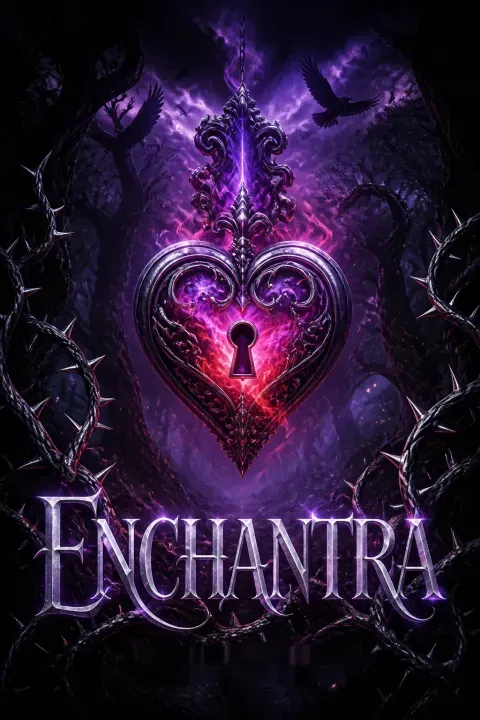


Plot Summary
Prologue
A woman is pinned to a labyrinth wall by shadows that coil around her wrists and throat like sentient smoke. She tells the man before her that she loathes him. He presses closer, chest to chest, and murmurs that love and loathing are the same passion, separated by a blade's edge.
When he leans to her ear and demands she prove her hatred, the dare hangs in the air like a thrown gauntlet. This is Genevieve1 and Rowin2 in the heart of Enchantra's maze, caught in a moment of feigned cruelty that will decide the fate of his entire family. The darkness between them is both a prison and the strangest form of intimacy they have ever known.
The prologue frames the entire novel as an eroticized power struggle where hatred and passion are twins. By opening with the climax's imagery, Smith primes the reader to view every subsequent hostile exchange between Genevieve and Rowin as a form of foreplay, every act of resistance as a step toward surrender. The shadows function as an extension of Rowin's will but also as a boundary between them, a tangible representation of the secrets and manipulations that define their relationship. The challenge to 'prove it' is the gauntlet that drives Genevieve's arc: she must discover whether her feelings are real or merely the byproduct of a game designed to blur every emotional line.
Omens Over Rome
Genevieve Grimm1 is in Rome, trying and failing to stick to her sister14's itinerary. Crows appear: first one watching her at a pasticceria, then a pair, then a whole squawking murder that chases her through the Colosseum's ruins. She knows it is a hex.
Hidden in her trunk is an invitation from a man named Barrington Silver,3 addressed to her late mother Tessie, written in sapphire ink on velvety parchment. The letter hums with magic. Genevieve1 has spent years nursing a dangerous curiosity about the photograph she found of her mother and Barrington,3 both wearing matching heart-shaped lockets.
The crows are the sign she asked for. She packs her gowns, her perfumes, her sister's14 grimoire, and boards a train to Florence, abandoning the itinerary to chase a stranger's promise of answers.
The crows are a hex designed to rush Genevieve toward Enchantra, but she experiences them as an answer to a prayer she was too proud to speak aloud. Her decision to follow them reveals her deepest conflict: she craves direction but cannot tolerate being directed. The invitation, addressed to her mother, is an inheritance she steals, an identity she tries on. This act of impersonation, pretending to be Tessie Grimm to get what she wants, sets up the novel's central theme of performance and authenticity. Genevieve will spend the entire story learning the difference between the roles she plays for others and the person she actually is when no one is watching.
The Gate of Thorns
A driver named Morello leaves Genevieve1 before a silver gate that reads 'Enchantra,' beyond which lies empty field. She eats the purple demonberries dripping from the thorns, and a magical veil lifts: a glittering villa wrapped in snow and a sprawling hedge maze appear.
A black fox12 steals her invitation. When she bangs the silver knocker, a man with disheveled black hair, golden eyes, and a hoop through his bottom lip opens the door. Rowin Silver2 tells her she is trespassing and slams the door in her face.
She phases through in her Specter form. He finds her, enraged, just as his father Barrington3 arrives. They explain that today is the one day of the year when Knox4's magic locks in the Hunt's players. She is trapped until she either wins or dies.
The gate is the novel's ultimate threshold: invisible until consumed, painful to touch, impossible to pass back through. Genevieve's choice to eat the berries is her first act of willing self-endangerment, a pattern that will define her character arc. Rowin's immediate hostility is both defensive and diagnostic; he sees her as a problem to be solved by expulsion, not realizing she is the solution he has been waiting for. Barrington's revelation converts Genevieve's personal quest into a survival crisis, punishing her desire to escape her ordinary life with an extraordinary trap. The locked wards that nullify her Specter abilities strip her of her primary coping mechanism, forcing her to become solid in every sense.
Marry or Die
Barrington3 explains that Genevieve1 cannot survive the Hunt as a mortal; soul extraction from her body would mean true death. The only safety is a marriage loophole Knox4 once offered: a Silver sibling can bring a spouse into the game as a partner, and if the couple wins, both are freed forever. Genevieve1 runs through the snow, trying to reach the front gate, but Rowin2 proposes a wager.
She loses because he cheats with his shadows. When she grabs the gate's bars, the wards sear her skin and nullify her Specter abilities, sending her sprawling. She vomits in the snow, realizing there is no escape. With spite as her only fuel, she agrees to the wedding, but she swears she will never truly be his.
This is the point of no return, and it is laden with coercive paradox. Genevieve's consent is extracted under threat of death, yet the narrative asks both her and the reader to invest in the marriage as the foundation for genuine love. Her loss in the wager (Rowin's cheat) establishes the asymmetry of their power while also demonstrating that he will break rules to keep her alive. The gate that burns her skin is a physical manifestation of her entrapment, but her internal rebellion, the promise that she will 'never be yours,' preserves a kernel of autonomy. That kernel is what Rowin must learn to court rather than capture.
Vows in the Snow
Ellin7 laces Genevieve1 into an opalescent gown with pearl details, and Sevin6 walks her down a velvet runner through candlelit snow. Rowin2 waits in an obsidian suit, golden eyes steady. Barrington3 officiates with 'Aeternitas' vows, binding their souls, hearts, and blood eternally. The Devil Knox4 arrives mid-ceremony, his oppressive presence settling over the garden like a weighted shroud.
When Barrington3 says 'kiss your bride,' Rowin2 pulls her close and kisses her with a thoroughness that makes her knees buckle. She tells herself it is performance, even as her body betrays her with its heat. At midnight, the clock tolls and her magic locks away. She collapses into Rowin2's arms, and he catches her.
The wedding scene marries beauty and horror with deliberate precision: the candles and roses exist because Knox's patrons expect a spectacle. The kiss, ostensibly the climax of their performance, is where the line between acting and feeling first blurs beyond recognition. Genevieve's fainting is her body's refusal to process the cognitive dissonance; she cannot hold the contradiction of feeling genuine attraction within a fabricated union. Rowin's automatic catch is instinctive, not performative, the first crack in his stoic mask. The locking of her magic at midnight symbolizes her full entry into the Hunt's world, where she can no longer disappear from her problems, including the problem of her own heart.
Hunted by the Void
The first Hunt round begins. Grave,5 the eldest Silver and a Void Wraith who can stop time, is the Hunter. Genevieve,1 stripped of her Specter magic during the hunting hours, buries herself in a gap behind the frozen lattice outside the villa. Grave5 stalks past, stabs through the vines with the Hunting Blade, missing her face by inches.
Later, trapped in the library, she taunts him into pinning her shoulder to a bookshelf with the blade, buying time until noon. When the safe hours arrive and her magic returns, she vanishes from under his blade. Rowin,2 recovered from his own wounds, drags her to safety. Genevieve1 has survived her first round, and the siblings can no longer call her a fluke.
This round establishes Genevieve's physical resilience and tactical cunning. Her strategy (allowing herself to be stabbed to run out the clock) is a calculated gamble that transforms her body into a sacrifice and a weapon simultaneously. Grave is the most dangerous sibling because his rage has moral logic: he believes Rowin's freedom will trap the rest of them forever. His antagonism cannot be dismissed as mere cruelty, which forces Genevieve to engage with the ethical complexity of her own survival: winning for herself and Rowin may doom others. The frozen setting mirrors her emotional withdrawal; she is literally stiff with fear but refuses to break.
A Twin's Deception
When Remi8 becomes the Hunter, he pierces his own lip to match Rowin2's ring and corners Genevieve1 in their bedroom, pressing close for a kiss. Her signet ring burns hot with danger, exposing the ruse. She rips the hoop from his mouth with her bare hands and flees. Later, she topples a bookshelf onto Remi8 to save Rowin2 from a losing fight.
The round ends with them retreating to an enchanted meadow room, where they solve a puzzle of glowing fish and silver bridges to retrieve a crimson token. But the puzzle demands a sacrifice: Genevieve1 must dive into piranha-infested water to save Umbra,12 the fox Familiar, an act that nearly kills her but earns the creature's eternal devotion.
Remi's deception tests Genevieve's ability to read beyond surfaces, a skill essential for surviving a family that has weaponized performance. The ring's heat becomes a prosthetic for her intuition, signaling danger when her heart might be fooled. Her rescue of Umbra marks a crucial shift: she risks her life for someone else's Familiar, an act of pure altruism without strategic benefit. This selflessness, witnessed by Rowin, rewires their dynamic; he begins to see her not as a burden to manage but as a partner whose impulsive bravery fills his carefully calculated gaps. The token, the product of that sacrifice, becomes their shared asset, blurring the line between her contribution and his.
Scarred in the Mirror Forest
Solitary confinement with Sevin6 as Hunter traps Genevieve1 and Rowin2 in a forest of mirrors, each reflecting twisted versions of herself: black-eyed, white-haired, horned. In full view of Knox4's spectators, they have raw, consuming sex on the forest floor, a performance that also breaks the last walls of pretense between them.
When Sevin6's wolf Familiar attacks, Genevieve1 escapes into a mirror where a shadow monster guards a black-heart token. She thrusts her hand into its chest to claim the prize, and it claws a four-inch scar from her brow to her chin. The wound will never fully heal, but the token buys another round of immunity and her scar becomes a badge of belonging in this world of beautiful monsters.
The mirror forest externalizes Genevieve's fractured self-perception, each reflection a role she has tried on or feared becoming. Stepping through the mirror to fight the monster is an act of integration: she accepts that she contains darkness alongside light. The scar is the visible cost of that acceptance, and Rowin's unwavering desire for her afterward confirms that her worth was never in her unblemished surface. Their public intimacy reclaims her sexuality from the shame Farrow weaponized; here, being watched is not a violation but a declaration. She is no longer the girl who hides from her own desire, and the scar is proof that she can survive the most painful kinds of revelation.
Letters Never Sent
While Rowin2 is absent, Genevieve1 discovers a hidden drawer in his desk: fifteen years of unsent letters to each sibling, each one apologizing, reporting dead ends in the hunt for their mother's11 cure. Beneath them, she finds the envelope from Grimm Manor, recognizing his handwriting on the invitation.
When she confronts him, Rowin2 admits he sent the hex of crows. He thought he was writing to Ophelia,14 a Necromancer who might help cure Crimson Rot. He never knew Genevieve1 existed. She rages at the manipulation but sees the truth in his unsent letters, the loneliness of a man who could write his heart but never deliver it. She chooses to trust him anyway.
This revelation recontextualizes the entire plot. The crows that felt like fate were a calculated lure; the stranger she was chasing had been chasing her. Rowin's confession humanizes him by exposing the desperation behind his control. The unsent letters are artifacts of profound isolation: he has been screaming into a void for fifteen years, unable to bridge the distance between himself and his family. Genevieve becomes the first person to read him not as an opponent or a sibling but as a flawed, lonely man. Her forgiveness is not absolution but recognition: she too has kept secrets, performed roles, and hidden her true self. They are equals in emotional cowardice learning to be brave.
The Devil's Trophy Room
Using their immunity token, Rowin2 takes Genevieve1 through the Hellmouth to visit his mother Vira,11 who is bedridden and coughing black blood in Knox4's castle. The Devil then shows Genevieve1 his treasure trove, a glittering hoard of magical artifacts. He offers her a vial of glowing blue liquid, the cure for Crimson Rot, but the price is her soul-deep betrayal: she must convince Prince Salem13 to return to Hell.
She refuses to sacrifice her sister's14 happiness. Knox4 crushes the vial in his fist, glass and salvation splintering across the floor, and then, per the trove's rules, erases her memory of the entire exchange. She forgets the cure exists, but something lingers, a splinter of knowledge lodged too deep to extract.
Knox's trove is temptation distilled to its cruelest form: the thing you most want, destroyed because you wouldn't pay the price. Genevieve's refusal is morally unambiguous but emotionally devastating, forcing her to choose her sister's love over a chance to heal Rowin's mother, the wound that has defined his existence. The memory erasure is a narrative violation that places the reader in a superior position of knowledge, creating dramatic irony that aches: we know what Genevieve lost, even as she moves forward with only a hollow intuition. Yet her subconscious retains the choice as a compass point; she chose integrity over expedience, and that choice, even forgotten, shapes every decision that follows.
Freedom Refused
After Hell, Rowin2 grows distant, haunted by a secret. Pressed by Genevieve,1 he reveals that Knox4 offered him a deal: betray her, deliver her soul, and Knox4 would free him and his siblings from the Hunt forever. He refused without a second's hesitation.
He tells her she has ruined him, that the thought of severing their vows feels like the Hunting Blade through his heart, that he was made for her because she brought light into his shadows. Genevieve1 counters that she deserves to be the center of her own story. He agrees. They are no longer predator and prey, fox and rabbit, but two people who have chosen each other inside a cage designed to make every choice feel coerced.
This is the emotional climax where the performance becomes irrevocably real. Rowin's admission of vulnerability costs him the control he has hoarded for fifteen years; his refusal of Knox's deal proves that his protective instinct has matured into genuine devotion. Genevieve's insistence on being the protagonist of her own narrative is crucial: she refuses the passive role of either rescued damsel or villainous seductress. Their love becomes possible only when they both claim agency, not as rescuer and rescued but as equals choosing each other freely, even within a game that has scripted every other aspect of their lives. From this moment, they are true partners, plotting a counter-game to outwit the Devil who thinks he owns them.
The Blade Through Her Heart
The final Hunt begins. Knox4 announces a new rule: if Genevieve1 dies within the hour, all the Silvers are released forever, but her soul will be his to torment. He restores Grave5's and Rowin2's magic, expecting them to compete for the kill. Instead, in the labyrinth's heart, Rowin2 pins Genevieve1 with shadows as Knox4 watches, playing the betrayer.
She spits hatred at him, and he whispers their code, 'two truths and a lie,' then stabs her. But Genevieve1 has guided his hand. The Hunting Blade extracts her soul into the Soul Lock she claimed from Knox4's trove. Her body falls, her soul safe in the locket. The contract is fulfilled, and every Silver sibling is freed. Grave5 holds Knox4 frozen in time just long enough for the deception to stick.
The climax subverts the sacrificial heroine trope by making Genevieve the author of her own 'death.' She scripts the scene, delivers the lines, and selects the prop. The tableau of Rowin killing her while Knox gloats is theater turned back on the impresario. The Soul Lock, foreshadowed from the photograph in chapter one, becomes the key that picks the Devil's own lock. Genevieve's ability to deceive Knox demonstrates how thoroughly she has learned the Silver family art of performance. Grave's role, the brother who once tried hardest to kill her now holding the Devil frozen while she escapes, completes his arc from antagonist to reluctant ally, proving that the family's bonds, however twisted, are stronger than Knox's games.
Memory Floods the Riverwalk
Genevieve1 wakes in Grimm Manor. Salem13 revived her body, but the cost of the magic was all memory of the person she loved most: Rowin.2 For months, letters arrive from him, retelling their entire story, but she reads them like a stranger's biography. An inexplicable ache lives in her chest, a hollow where he should be.
Then, in the French Quarter, a golden-eyed man2 hands her a ring she doesn't recognize. Two weeks later, she puts it on. Everything floods back. She bolts through midnight New Orleans to the Riverwalk, where Rowin2 waits in the shadows. He gave up his immortality to the King of Hell so she could remember him. She runs into his arms, saying his name like a prayer.
The memory-loss sequence poses the novel's deepest question: if you forget loving someone, does the love still exist? The letters function as external evidence, but the persistent ache in Genevieve's chest suggests that love leaves a somatic trace immune to magical erasure. Her eventual choice to put on the ring, even without knowing its significance, is the final proof of agency: she chooses the mystery because her body recognizes what her mind cannot. Rowin's trade of immortality for mortality redefines his arc from seeking eternal freedom to choosing a finite life with meaning. The Riverwalk, the site of her worst trauma (Farrow's betrayal), becomes the site of her greatest restoration, a geographical redemption that closes the circle of her pain.
Epilogue
Genevieve1 and Rowin2 have found their light. He is mortal now, his lifespan bound to hers by the Devil King's bargain, and they stroll New Orleans together as spring turns to summer. The Silver siblings visit Grimm Manor: Grave5 is obsessed with finding the Crimson Rot cure before their mother's11 time runs out.
Sevin6 plans to infiltrate the Daemonica, an elite Demon society, to locate a rumored vial. Ellin7 sends gossipy letters; Covin9 and Wells10 manage the estate.
Ophelia14 and Salem13 orbit the new couple with cautious affection: Salem13 still hasn't forgiven Rowin2 for delivering Genevieve1's corpse, but he eats black licorice he hates because Ophelia14 loves to share the bag. The cure exists. They will hunt it together, not as prisoners of a game but as a family finally choosing each other.
The epilogue redefines eternity as something chosen rather than cursed. Rowin's mortality is framed not as loss but as liberation: he traded an endless solitude for a finite life with the person who sees him. The Silver family's continued quest for the cure shifts the stakes from personal survival to communal healing, suggesting that freedom from Knox was only the first step in a longer process of repair. Genevieve's homecoming to Grimm Manor, now expanded to include her found family, closes the loop on her initial quest: she left looking for others like her and returned with a husband, seven in-laws, and a purpose. The licorice detail crystallizes the epilogue's thematic argument: love is doing things you dislike for someone else's joy, over and over, until it becomes the thing you cannot live without.
Analysis
Enchantra explores what happens when the performance of love becomes indistinguishable from love itself. The Silver siblings have been actors in Knox4's theater of cruelty for so long that they can no longer tell where the game ends and their real feelings begin. Genevieve1 enters this house of mirrors not as a savior but as a fellow pretender: she has spent years performing the carefree socialite, hiding her Specter nature, burying her heartbreak beneath flirtation and wit. What makes her dangerous to Knox4's system is not her power but her refusal to accept that the script is immutable. She rewrites the rules from within, using the Devil4's own love of spectacle against him.
The novel's romance functions as a mutual unmasking. Rowin2 and Genevieve1 are both guarded to the point of isolation; their initial hostility is the sound of two people who have built elaborate walls recognizing a matching architecture in the other. The slow erosion of those walls, through shared danger, physical intimacy, and the reading of unsent letters, suggests that love is not a feeling that happens to you but a series of choices: to stay, to speak, to believe someone when they show you their worst self.
Knox4's defeat by theatrical trickery is thematically perfect. He designed a game that turns pain into entertainment, and Genevieve1 beats him by putting on a better show. Her 'death' in the labyrinth is the final act of a woman reclaiming authorship of her own story. The cost of this victory, memory loss, is a gut-punch that raises the stakes of the entire romance: if you forget loving someone, did you ever really love them? The answer, the book argues, is written in the body's hollow ache, in the inexplicable pull toward a stranger's golden eyes, in the choice to put on a ring whose meaning you cannot recall but whose weight feels like home. Rowin2's trade of immortality for mortality, binding his lifespan to hers, completes his arc from a man who could not let himself care because caring meant losing, to a man who understands that the only eternity worth having is the one you choose, moment by moment, with the person who sees you even when you are invisible to everyone else, including yourself.
Review Summary
Enchantra received mostly positive reviews, praised for its engaging plot, compelling characters, and steamy romance. Readers enjoyed the gothic setting, deadly games, and the enemies-to-lovers trope. Many found it even better than its predecessor, Phantasma. The book's fast pace, witty banter, and well-developed side characters were frequently mentioned. Some critics found it formulaic or lacking in world-building. Overall, fans of dark fantasy romance appreciated the book's blend of danger, magic, and passion.
People Also Read


Characters
Genevieve Grimm (Silver)
Specter bride and protagonistA Specter with the ability to turn invisible and intangible, Genevieve is impulsive, witty, and deeply lonely. As the younger sister of a powerful Necromancer, she grew up feeling invisible in her own family, her mother's entire focus trained on Ophelia14's inheritance. She copes through charm, promiscuity, and a carefully cultivated carelessness, but underneath runs a desperate need to belong. Betrayed by her ex-lover Farrow15, who tried to burn her alive after learning of her paranormal blood, she guards her heart behind walls of cynicism and sharp humor. Her journey through the Hunt forces her to confront her pattern of running from pain, teaching her that staying, fighting, and trusting are far braver than disappearing.
Rowington Silver
Shadow Wraith husbandA Shadow Wraith with the power to manipulate darkness, Rowin has won the Hunt fifteen consecutive years, not for glory but to buy time to research a cure for his mother's11 Crimson Rot. His stoicism and sharp tongue mask profound guilt over leaving his siblings trapped in Hell each year. He has spent the last decade and a half in near-total solitude at Enchantra, writing letters he never sends, his only companion his fox Familiar Umbra12. Brilliant, pragmatic, and emotionally repressed, he initially sees Genevieve1 as a dangerous complication. Her stubborn refusal to be managed, and the light she brings into his shadows, slowly unravels his isolation, teaching him that vulnerability is not weakness.
Barrington Silver
Guilt-ridden patriarch and FamiliarOnce a mortal who became Knox4's Familiar in exchange for immortality, Barrington is a man drowning in remorse. His desperate bargain to save his dying wife Vira11 trapped their seven children in an eternal game of bloodsport. He spends most of his time avoiding Enchantra, unable to face what he has done. His youthful appearance (purple eyes, salt-white hair) belies centuries of grief. His past friendship with Tessie Grimm holds keys to Genevieve1's family history, and his paternal warmth toward her offers a mirror of the father figure she never had.
Knox
Devil master of the HuntA Devil with violet eyes and obsidian hair crowned by horns, Knox is equal parts showman and sadist. He created the Crimson Rot that plagues the Silver matriarch11 and designed the Hunt as both punishment for Barrington3's disloyalty and entertainment for Hell's gamblers. His power rivals that of Hell's royalty; his vanity is his most exploitable flaw. He delights in poetic cruelty: dressing Genevieve1 as a hare, drugging newlyweds with aphrodisiacs, offering impossible bargains. Underestimating mortals is his blind spot, and Genevieve1's ability to weaponize his arrogance becomes his undoing.
Gravington Silver
Void Wraith eldest brotherThe largest and most volatile Silver sibling, Grave is a Void Wraith capable of stopping time and creating portals. His fury at Rowin2's winning streak stems from a conviction that the marriage loophole will doom the rest of them to eternal servitude. He is his mother's11 favorite and the sibling most visibly scarred by the Hunt. Beneath the rage lies a fierce protectiveness that eventually makes him an unlikely ally. His power to freeze time directly counters Genevieve1's Specter abilities, making him her most dangerous pursuer.
Sevington Silver
Blood Wraith and charming jesterA Blood Wraith with a silver wolf Familiar and a perpetual lollipop (made from vampire blood), Sevin is the family's designated comic relief. He has won the title of Favored (audience favorite) nine times, understanding better than anyone how to play to the spectators. But his constant humor masks a deep well of loneliness and a past heartbreak that left him lingering on the outskirts of his own life. He walks Genevieve1 down the aisle, offers cryptic advice, and ultimately risks himself to help her scheme succeed.
Ellington Silver
Light Wraith healer sisterThe only Light Wraith among the siblings, Ellin can heal wounds and project blinding light. Her snow leopard Familiar Sapphire reflects her aloof but fiercely loyal nature. She is perpetually annoyed by her brothers' chaos but drops everything to save Genevieve1's life multiple times. Her platinum hair, chopped into a sharp bob, and her affinity for making ugly crafts (masks of her Familiar) make her an endearingly prickly presence. She becomes a genuine friend to Genevieve1, the sister she never had.
Remington Silver
Rowin's apathetic twinRowin2's identical twin, Remi is a Shadow Wraith who gave up hoping for freedom long ago. He copes through apathy and recreational substances, viewing the Hunt as a tedious obligation rather than a tragedy. His impersonation of Rowin2 during one round nearly gets Genevieve1 killed. The rift between the twins is a wound neither knows how to heal, though Rowin2's unsent letters reveal he has been trying to bridge the distance for years.
Covington Silver
Blood Wraith hedonist brotherA Blood Wraith with a forked tongue and a giant serpent Familiar named Satan, Covin is the family's unapologetic hedonist. He indulges in multiple lovers, scandalous affairs, and a high tolerance for pain. Behind the debauchery is sharp observational skill and a sincere affection for his siblings that he expresses through teasing rather than tenderness. His blood magic requires regular 'releasing' (cutting himself), a gruesome necessity he treats with casual nonchalance.
Wellington Silver
Shadow Wraith spy brotherEllin7's twin, Wells is quieter and more enigmatic than his siblings. A Shadow Wraith who runs errands for Knox4 in Hell, including a reconnaissance mission to Nocturnia that confirms Prince Salem13's connection to Genevieve1's family. He is eliminated early in the Hunt, but his intelligence work provides crucial information for the final plan.
Vira Silver
Mother consumed by Crimson RotA Demon with white hair, a single black streak, and crimson eyes, Vira is bedridden in Knox4's castle, coughing black blood as the Rot consumes her. She is warm despite her frailty, overjoyed to meet Genevieve1. Her illness is the engine of the family's suffering; the temporary 'Fix' Knox4 provides each year is the chain that binds them all to the Hunt.
Umbra
Rowin's fox FamiliarA sleek black fox with glowing amber eyes, Umbra is an extension of Rowin2's shadow magic. She can melt in and out of darkness at will, steal objects with her jaws, and communicate silently with her master. Initially wary of Genevieve1, she becomes fiercely devoted after Genevieve1 dives into piranha-infested water to save her, cementing the bond between Familiar and new mistress.
Salem (Salemaestrus)
Prince of Devils in exileThe Prince of Devils and Ophelia14's devoted partner, Salem appears in the aftermath of Genevieve1's death and revival. He is sarcastic, powerful, and deeply protective of Ophelia14. He uses his immense magic to return Genevieve1's soul to her body, though the cost is her memory of Rowin2. He has a running joke about eating black licorice he despises because Ophelia14 loves sharing a mixed bag.
Ophelia Grimm
Necromancer sister in waitingGenevieve1's older sister, a Necromancer who inherited their mother's magic and the Grimm family locket (a Soul Lock). She is practical, loving, and furious when she learns Genevieve1 got married without her. Her relationship with Salem13 provides the family connection that Genevieve1 leverages against Knox4. She represents the life and legacy Genevieve1 has been running from.
Farrow Henry
Heartless ex-lover who burned herGenevieve1's wealthy first love who courted her for years, promised marriage, then rejected her for her paranormal blood. When she humiliated him by sleeping with his friend Basile, Farrow set the Mardi Gras float on fire with both of them inside. His parents' money bought him immunity from prosecution. He is the scar on Genevieve1's psyche, the reason she believes herself unworthy of lasting love.
Plot Devices
The Hunt
Annual deadly family gameA curse-binding game designed by Knox4: every year on the spring equinox, the seven Silver siblings must hunt each other with the Hunting Blade. Kills transport the victim's soul and body to Hell, where they serve Knox4 for the remainder of the year. The sole winner earns a year of freedom at Enchantra. The game features multiple modes (Roaming Rooms, Random Starts, Solitary Confinement, Birds and Stones, Ready or Not) and enchanted rooms that transform into perilous landscapes containing immunity tokens. A marriage loophole allows a sibling who weds to bring their spouse in as a partner; if the couple wins, both are permanently freed. Spectators in Hell wager and vote for the 'Favored' player, who receives a boon from Knox4's treasure trove.
Soul Lock
Soul-containing enchanted locketAn enchanted artifact, typically a locket, designed to collect and contain souls. In the photograph of young Barrington3 and Tessie Grimm, both wear matching Soul Locks. Tessie's locket, passed to Ophelia14, contains something 'powerful and disastrous' according to family lore. Genevieve1 spots a Soul Lock in Knox4's treasure trove and later chooses it as her Favored prize. She uses it in the climax to extract her own soul during the Hunt, faking her death to fulfill Knox4's contract without actually dying, thus freeing all the Silver siblings from the game.
Crimson Rot
Demon-wasting disease with hidden cureA disease created by Knox4 that slowly rots Demons from the inside out, their own life force turned against them. The Fix, an elixir Knox4 controls, temporarily cleanses the Rot for about a year. The promise of continued Fixes is what forces the Silver children to play the Hunt: if they refuse, their mother Vira11 dies. Rumors of a permanent cure have driven Rowin2's fifteen-year research effort. Knox4 reveals he created the disease and has cure vials in his trove, but he destroys one in front of Genevieve1 and erases her memory of the encounter. The search for a cure continues into the epilogue.
Rowin's Signet Ring
Danger detector and memory vesselA thick silver band with a swirling onyx stone, originally chosen by Rowin2 from Knox4's trove fifteen years ago as his Favored boon. The ring heats up when anyone who means the wearer harm is nearby, becoming scorching at close proximity. Rowin2 gives it to Genevieve1 after their wedding as a trust offering. After the climax, Rowin2 trades his immortality to the King of Hell, who imbues the ring with Genevieve1's lost memories. When Genevieve1 puts it on months later, everything she forgot about Rowin2 floods back, triggering their reunion.
Demonberries
Magical veil-lifting fruitPurple berries that grow on the thorned vines covering Enchantra's gates and estate. Eating them reveals the hidden mansion (which is otherwise invisible behind a magical glamour), but also causes memory loss and unconsciousness. The effects reverse upon re-entering the estate grounds the next time. Rowin2 uses the berries as a security measure: trespassers who wander in, see the estate, and are escorted out will forget what they witnessed. Genevieve1's consumption of the berries initiates her entry into the story.
FAQ
Synopsis & Basic Details
What is Enchantra about?
- A Supernatural Invitation: Enchantra follows Genevieve Grimm, a young woman from New Orleans haunted by dark omens (crows) that lead her to a mysterious invitation addressed to her deceased mother, Tessie Grimm, from a man named Barrington Silver. Driven by a desire to uncover family secrets and find others like herself, Genevieve travels to Italy, seeking answers at Barrington's secluded estate, Enchantra.
- Entering a Cursed Game: Upon arriving at Enchantra, Genevieve discovers the estate is home to Barrington and his seven children, the Silvers, who are bound by a centuries-old curse orchestrated by a powerful Devil named Knox. This curse forces them to participate in a deadly annual competition called the Hunt, where they must fight and kill each other for a chance at temporary freedom.
- A Marriage of Survival: Genevieve, a mortal Specter with the ability to turn non-corporeal, finds herself unexpectedly trapped within Enchantra's magical wards just before the Hunt begins. To survive, she enters a strategic marriage of convenience with Barrington's son, Rowington Silver, exploiting a loophole that allows couples to play the Hunt together, hoping to secure their mutual freedom from the deadly game.
Why should I read Enchantra?
- Intense Romantic Tension: The novel features a compelling enemies-to-lovers dynamic between Genevieve and Rowin, filled with witty banter, forced proximity, and undeniable chemistry as they navigate a life-or-death situation together. Their relationship evolves from strategic alliance to deep emotional connection under extreme pressure.
- Dark Fantasy World: Enchantra offers a unique blend of gothic atmosphere, Italian countryside charm, and the brutal reality of Hellish politics, introducing a complex hierarchy of paranormal beings and the insidious nature of Devilish bargains. The enchanted estate itself becomes a character, full of hidden passages and deadly illusions.
- High-Stakes Plot: The core conflict revolves around the deadly Hunt, providing constant suspense and unpredictable twists as Genevieve and Rowin must outwit not only Knox but also Rowin's own siblings, who are forced to hunt them. The narrative explores themes of survival, family loyalty, and the fight for freedom against seemingly insurmountable odds.
What is the background of Enchantra?
- A Devil's Ancient Curse: The central conflict stems from a bargain made centuries ago by Barrington Silver with the Devil Knox to save his wife, Vira, from a rare illness called Crimson Rot. This bargain trapped their children, the Silver siblings, in an annual deadly Hunt, a spectacle for Knox's patrons in Hell, with the winner gaining a year of freedom while the losers are forced to serve Knox on the Other Side.
- Hidden Paranormal Society: The story is set in a world where various paranormal beings (Devils, Demons, Wraiths, Vampires, Shapeshifters, Ghosts, etc.) exist alongside mortals, often interacting in secret societies or through figures like Necromancers (like Genevieve's sister, Ophelia) who act as problem-fixers. Enchantra serves as a nexus point where these different realms and beings intersect during the Hunt.
- Familial Legacy and Trauma: The narrative is deeply rooted in the complex and often traumatic legacies passed down through families. Genevieve grapples with her mother's secrets and perceived abandonment, while the Silver siblings are defined by the curse placed upon them by their father's bargain, leading to deep-seated bitterness, rivalry, and complicated loyalties among them.
What are the most memorable quotes in Enchantra?
- "Love. Loathing. Same passion, different names.": Spoken by Rowin in the prologue and echoed throughout the story, this quote encapsulates the blurred lines between intense emotions, particularly relevant to Genevieve's initial feelings towards Rowin and the complex dynamics within the Silver family. It highlights the novel's exploration of passion in its various forms, both destructive and constructive.
- "The light isn't something you need to chase, Genevieve. The light is wherever you are.": Rowin offers this profound insight to Genevieve during a moment of vulnerability, directly addressing her feelings of being lost and searching for belonging. This quote becomes a central theme, emphasizing self-acceptance and the idea that inner strength and worth are inherent, not found externally. It is later physically symbolized by the bracelet he gives her.
- "I am yours... Take good care of my soul, alright?": Genevieve's declaration to Rowin just before their plan to trap Knox is enacted. This line signifies her complete trust and commitment to him, even in the face of death. It subverts the traditional power dynamic, with the mortal entrusting her very essence to the supernatural being, highlighting the depth of their bond forged through shared trials and vulnerability.
What writing style, narrative choices, and literary techniques does Kaylie Smith use?
- First-Person Perspective: The story is told primarily from Genevieve's first-person point of view, offering immediate access to her thoughts, feelings, and witty internal monologue. This choice allows readers to deeply connect with her emotional journey, her trauma, and her evolving perceptions of the world and the characters around her.
- Sensory and Atmospheric Detail: Smith employs rich sensory descriptions, particularly of Enchantra's opulent yet decaying setting, the contrasting landscapes of the enchanted rooms, and the visceral experiences of the Hunt and Hell. This creates a strong atmosphere, immersing the reader in the magical and often dangerous environments.
- Dialogue and Banter: A significant portion of the character development and relationship building, especially between Genevieve and Rowin, occurs through sharp, often sarcastic dialogue and playful banter. This serves to highlight their personalities, their initial antagonism, and the gradual shift towards mutual understanding and affection.
Hidden Details & Subtle Connections
What are some minor details that add significant meaning?
- The Demonberries' Effect: The strange purple berries on the Enchantra gate, initially just a peculiar detail Genevieve samples, are revealed to have a magical effect causing memory loss upon leaving the grounds. This subtle detail explains why Genevieve forgets her initial entry and sets up the later plot point of her memory erasure after the Hunt, highlighting the pervasive, often unnoticed, magic of the estate.
- The Hierarchy of Paranormal Beings: The brief "Hierarchy of Paranormal Beings" list at the beginning of the book is more than just world-building; it subtly foreshadows the nature of the Silver family (Demons + Mortal = Wraiths) and explains why Genevieve (Specter, a type of Ghost) has her specific abilities and limitations, adding depth to her identity and place in the world.
- The Significance of Names: The consistent "-ington" suffix in the Silver siblings' names (Rowington, Gravington, Covington, etc.) is a subtle detail that emphasizes their shared lineage and collective identity, reinforcing the theme of family unity and shared fate under the curse, despite their individual rivalries.
What are some subtle foreshadowing and callbacks?
- The Prologue's Echo: The intense, charged interaction between the unnamed "she" and "he" in the prologue, featuring shadows wrapped around wrists and a debate about love and loathing, is a direct callback to Genevieve and Rowin's dynamic and Rowin's shadow magic, subtly foreshadowing their complex relationship and the power dynamics that will unfold.
- The Hunting Blade's Burn: The description of the Hunting Blade burning Rowin when he touches it after Grave stabs him is a subtle hint that the blade is not just a weapon but is tied to the Silver family's curse or nature, foreshadowing its specific function in the Hunt and its connection to their souls being ripped from their bodies.
- Knox's Mirror Obsession: Knox's insistence on mirrors being uncovered and his use of them for viewing the Hunt is foreshadowed by the numerous covered mirrors throughout Enchantra upon Genevieve's arrival, hinting at the Devil's pervasive surveillance and control over the estate and its inhabitants.
What are some unexpected character connections?
- Barrington and Tessie Grimm's Past: The deep friendship between Barrington Silver and Genevieve's mother, Tessie Grimm, revealed through a photograph and letters, is an unexpected connection that drives Genevieve's initial journey to Enchantra and provides a poignant link between the two families, highlighting a hidden history unknown even to Ophelia.
- Salem's Connection to the King of Devils: The revelation that Salem, Ophelia's partner and the Prince of the Devils, is the King of Hell's son adds a significant layer of intertextual connection to the previous book (Phantasma) and raises the stakes of Knox's manipulations, as Genevieve's connection to Salem becomes a powerful leverage point for Knox and later for Genevieve and Rowin.
- Sevin's Hidden Sadism/Pain Tolerance: Sevin, initially presented as charming and flirtatious, is subtly revealed to have a darker side and an unusually high tolerance for pain, hinted at by his "sadistic and unavailable" type and his casual comments about injuries. This adds unexpected depth to his character beyond the "jester" persona.
Who are the most significant supporting characters?
- Barrington Silver: As the patriarch who made the original bargain, Barrington is crucial to understanding the history of the Hunt and the Silver family's curse. His regret, his past with Tessie, and his efforts to protect Genevieve provide emotional depth and drive key plot points, including the strategic marriage.
- Grave Silver: Rowin's eldest brother and a Void Wraith, Grave is a formidable antagonist within the Hunt, driven by bitterness and a pragmatic desire to survive, even if it means killing his siblings or Genevieve. His eventual, albeit reluctant, alliance with Rowin and Genevieve is pivotal to their plan against Knox, highlighting the complex family dynamics.
- Ellin Silver: As a Light Wraith, Ellin possesses unique healing abilities that are crucial to Genevieve's survival multiple times. Her complex relationship with her brothers, her moments of genuine kindness towards Genevieve, and her eventual decision to sacrifice herself for the plan demonstrate her significance beyond just being a player in the Hunt.
Psychological, Emotional, & Relational Analysis
What are some unspoken motivations of the characters?
- Genevieve's Need for Belonging: Beyond seeking answers about her mother, Genevieve is subtly motivated by a deep-seated need to find a place where she truly belongs, feeling like an outcast in her own family compared to Ophelia. Her initial hope that Barrington's family might be "like hers" and her later connection with the Silvers reveal this underlying desire for acceptance and understanding.
- Rowin's Guilt and Self-Punishment: Rowin's relentless pursuit of the cure and his avoidance of his family in Hell are driven by unspoken guilt over his winning streak keeping his siblings trapped. His willingness to sacrifice his own freedom and immortality for Genevieve suggests a deep-seated need for redemption or self-punishment for his perceived failures towards his family.
- The Silver Siblings' Complex Bitterness: While they express bitterness towards Rowin for his freedom, there's an unspoken layer of complicated love and loyalty. Their taunts and rivalries are intertwined with shared trauma and a deep understanding of each other's pain, hinting that their animosity is a coping mechanism for their cursed existence and Rowin's absence.
What psychological complexities do the characters exhibit?
- Genevieve's Trauma Response: Genevieve's past trauma with Farrow manifests in her difficulty trusting men, her self-destructive tendencies (recklessness, seeking numbness), and her struggle to reconcile her past self with her present experiences. Her journey involves confronting these psychological scars and learning to trust again, particularly with Rowin.
- Rowin's Emotional Masking: Rowin consistently hides his true emotions behind a mask of apathy or irritation, a coping mechanism developed over centuries of enduring the Hunt and familial conflict. His vulnerability is revealed in rare moments, particularly concerning his mother, his guilt, and his growing feelings for Genevieve, highlighting the psychological toll of his cursed existence.
- The Siblings' Adaptation to Trauma: Each Silver sibling exhibits different psychological adaptations to the trauma of the Hunt. Grave's ruthlessness and focus on survival, Sevin's use of charm and hedonism as a distraction, Ellin's pragmatic resilience, and Remi's apathy all represent distinct ways of coping with their inescapable, violent reality.
What are the major emotional turning points?
- Genevieve's Confrontation with Farrow's Trauma: Genevieve recounting the full story of Farrow's betrayal and the fire to Rowin is a major emotional turning point. It forces her to articulate her deepest pain and shame, allowing for vulnerability and fostering a deeper connection and trust with Rowin, who validates her feelings and offers genuine comfort.
- Rowin's Sacrifice of Immortality: Rowin's decision to trade his immortality for Genevieve's memories is the most significant emotional turning point for his character. It demonstrates the depth of his love and commitment, proving his willingness to sacrifice everything for her, fundamentally changing his nature and solidifying their bond beyond the constraints of the Hunt.
- Genevieve's Choice to Live for Herself: Genevieve's realization in the maze that she needs to find a reason to live for herself, not just survive for others, marks a crucial emotional shift. This internal turning point empowers her to take agency in her own story and actively fight for her own desires, including helping the Silvers, rather than just reacting to circumstances.
How do relationship dynamics evolve?
- Genevieve and Rowin: From Strategy to Love: Their relationship begins as a purely transactional marriage of convenience to survive the Hunt. Through shared danger, forced intimacy, vulnerability, and unexpected moments of connection (like the "Fox Says" game), their dynamic evolves into genuine partnership, trust, and eventually, deep love, culminating in Rowin's ultimate sacrifice and Genevieve's fight to regain her memories of him.
- Silver Siblings: Beneath the Rivalry: While the Hunt forces them into brutal conflict, the interactions between the Silver siblings reveal underlying layers of complex familial bonds. Moments of shared history, inside jokes, concern for each other's well-being (Ellin healing Genevieve, Covin's regret over Ellin's injury, Sevin's protectiveness), and shared bitterness towards their father and Knox show that their relationships are not purely antagonistic but are shaped by centuries of shared trauma and a twisted form of loyalty.
- Genevieve and the Silver Family: Genevieve's relationship with the siblings evolves from being an unwanted intruder and target to a complex mix of wary alliances, unexpected camaraderie (with Ellin and Sevin), and deep-seated animosity (with Grave). Her presence disrupts their established dynamic but also offers a potential catalyst for change, particularly in Rowin's relationship with his family.
Interpretation & Debate
Which parts of the story remain ambiguous or open-ended?
- The Future of the Crimson Rot Cure: While Genevieve regains the knowledge that the cure exists and Knox created it, the actual method of creating or obtaining it remains unknown. The story ends with Rowin, Grave, and Sevin actively searching, leaving the success of their quest and the ultimate fate of Vira and the remaining siblings uncertain.
- Barrington Silver's Fate: After Knox's Hellmouth disappears from Enchantra, Barrington is unreachable. His fate and whether he is still alive or trapped elsewhere remain ambiguous, leaving a loose end regarding the patriarch who initiated the curse and his relationship with his children.
- The Full Extent of Salem's Power and Intentions: While Salem is shown to be incredibly powerful and protective of Ophelia and Genevieve, the full scope of his abilities as the Prince of the Devils and his long-term intentions regarding Hell and his father remain somewhat mysterious, hinting at potential future conflicts or complexities.
What are some debatable, controversial scenes or moments in Enchantra?
- The "Fox Says" Game: The scene where Rowin and Genevieve engage in the "Fox Says" game, which involves Rowin giving sexual commands while Genevieve is nude and performing for an unseen audience, is highly debatable. Readers might interpret it as a powerful display of Genevieve reclaiming her sexuality and agency in a controlled environment, or as a potentially uncomfortable scene highlighting power imbalances and objectification, even within their evolving relationship.
- The Silver Siblings' Brutality: The casual descriptions of the Silver siblings injuring and killing each other during the Hunt, and their seemingly nonchalant attitude towards it (e.g., Sevin killing Remi over a bet), can be controversial. It forces readers to grapple with the normalization of violence within their cursed reality and debate whether their actions are purely survival-driven or indicative of a deeper desensitization.
- Knox's Bargain with Rowin: Knox offering Rowin freedom for his family in exchange for Genevieve's death is a morally complex moment. While Rowin's refusal is presented as heroic, the debate lies in the impossible choice presented and the question of whether sacrificing one life for the freedom of many could ever be justified, highlighting the brutal nature of Devilish morality.
Enchantra Ending Explained: How It Ends & What It Means
- The Soul Lock Gambit: The Enchantra ending explained reveals that Genevieve and Rowin orchestrated a plan to trick Knox. Leveraging Knox's greed and desire for a spectacle, they convinced him to agree to a bargain: if Genevieve "died" within the final hour, Knox would release the entire Silver family from the Hunt. Their plan involved Genevieve using the Soul Lock (the locket from Knox's trove) to capture her soul as Rowin stabbed her with the Hunting Blade, faking her death.
- Salem's Intervention and Memory Loss: After Genevieve's "death," Grave and Rowin delivered her body and the Soul Lock to Salem in New Orleans. Salem, using his power as the Prince of the Devils, was able to extract Genevieve's soul from the locket and return it to her body, reviving her. However, the immense magic required to sustain this process necessitated taking something in return: all of Genevieve's memories of the person she loved most – Rowin.
- Memory Restoration and New Beginning: Genevieve returns to her life in New Orleans with no memory of Enchantra or Rowin, feeling a strange hollowness. Rowin, now mortal and free from the Hunt, waits for her, eventually encountering her in the French Quarter. A chance touch of the signet ring (his former wedding band, which the King of Hell enchanted to hold her memories and link their lifespans) triggers the return of her memories. The ending signifies their enduring bond, the successful freeing of the Silver family (except Barrington, whose fate is unknown), and a hopeful, albeit mortal, future for Genevieve and Rowin as they embark on a new life together, now truly choosing each other.
Wicked Games Series Series
About the Author
Other books by Kaylie Smith

Download PDF
Download EPUB
.epub digital book format is ideal for reading ebooks on phones, tablets, and e-readers.








































