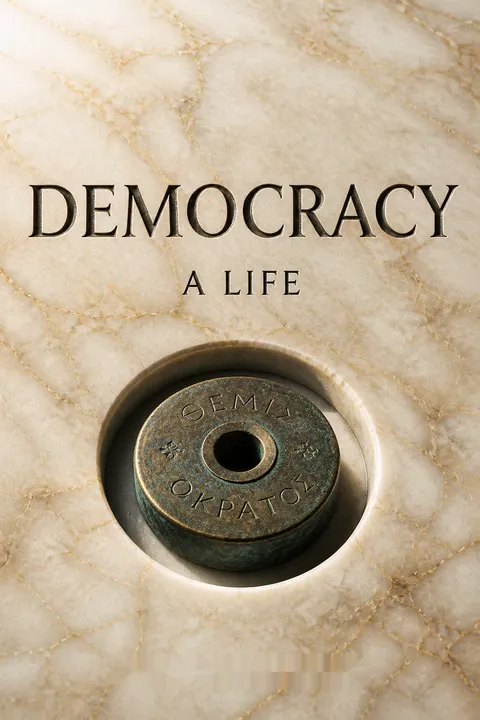

Key Takeaways
1. Democracy's Ancient Greek Birth and Contested Meaning
Whatever view one takes of these positions, the dissonance or even contradiction in applied political terminology undoubtedly does raise the not unimportant question of why exactly it is— and how it has come about— that we (and not only Anglophones, of course) today gaily use as a loan- word a term that in its original Greek context or contexts bore quite such a radically opposed signification.
A contested term. The word "democracy" (demokratia) originated in ancient Greece, combining "demos" (people) and "kratos" (power). However, the meaning of "demos" was ambiguous from the start, referring either to "the people" broadly or, more controversially, to "the majority of poor citizens." This inherent ambiguity fueled debates about who truly held power and for whose benefit.
Power, not just deliberation. Unlike some modern interpretations that emphasize public argument or deliberation, ancient Greek demokratia fundamentally denoted political power and control. It was about the demos grasping and wielding authority, whether over the organs of state governance or, more pointedly, over the wealthy minority of citizens. This focus on power, rather than mere discussion, is crucial for understanding its original context.
Aristotle's definition. The philosopher Aristotle, a "giant thinker" of the ancient world, provided a foundational definition: democracy is the rule of the poor, and oligarchy is the rule of the rich. This class-based analysis highlights that the essence of democracy was not merely numerical rule by the many, but the political empowerment of the economically disadvantaged majority over the elite. This perspective reveals the radical, even revolutionary, nature of early democracy.
2. Athens: The Pioneering, Radical Outlier
No constitution has ever given more weight to the decisions of the ordinary man than did the Athenian.
Founding moment. Athenian democracy, particularly after the reforms of Cleisthenes in 508/7 BCE, marked the true birth of this political system. Cleisthenes' innovations, such as the creation of ten new tribes based on local demes and the establishment of the Council of 500 (chosen by lot), fundamentally restructured Athenian society to ensure broader citizen participation and dilute aristocratic power. This was a deliberate move to empower the ordinary citizen.
Intensified participation. The reforms of Ephialtes and Pericles in 462/1 BCE further radicalized Athenian democracy. They stripped the aristocratic Areopagus council of its remaining political powers, transferring them to the popular jury courts (Dikasteria), and introduced pay for jury service. This enabled poorer citizens to actively participate in governance, making Athens an exceptionally inclusive and participatory direct democracy.
A way of life. Athenian democracy was not just a set of institutions; it was a comprehensive "way of life" (politeia). This ethos permeated all aspects of society, from religious festivals like the Panathenaea and Dionysia, which integrated citizens and showcased civic identity, to the pervasive culture of litigation in the People's Courts. Even the navy, powered by the poorest citizens (thetes), became a "school of democracy," reinforcing their political significance.
3. Direct vs. Representative: The Great Divide
Constant’s point was a rather different one, and spoke to what I shall call the great divide between all ancient and all modern democracies: all ancient ones are direct, all modern ones representative.
Fundamental distinction. The most profound difference between ancient and modern democracies lies in their mode of governance. Ancient Greek democracies, especially Athens, were direct: citizens personally participated in the Assembly and courts, making decisions themselves. In contrast, modern democracies are representative, where citizens elect others to make decisions on their behalf.
Citizen engagement. In ancient Athens, "the Athenians" (meaning the collective body of adult male citizens) ruled themselves directly. This involved:
- Attending the Assembly (Ecclesia) to debate and vote on laws and policies.
- Serving as jurors (dicasts) in the People's Courts, which held immense judicial and political power.
- Holding public office, often selected by lot, ensuring broad participation.
This direct engagement fostered a strong sense of civic responsibility and collective ownership.
Modern compromise. The shift to representative democracy, articulated by thinkers like Benjamin Constant in the early 19th century, was a pragmatic response to the scale and complexity of modern nation-states. It prioritized individual, private liberties over the public-political freedoms of antiquity. While modern systems may incorporate elements of directness (e.g., referendums), the core principle remains delegation, not direct rule.
4. The Anti-Democratic Tradition in Western Thought
Of the articulate and extant witnesses to that political world the number who can with any confidence be called ideologically pro-democratic can be counted on the fingers of only one hand.
Elite opposition. From its inception, democracy faced fierce opposition from the intellectual and social elites of the ancient world. Figures like Plato and Aristotle, despite their profound contributions to political thought, were fundamentally anti-democratic. Plato, in his Republic, famously placed democracy near the bottom of his hierarchy of political systems, viewing it as a degenerate form prone to license and mob rule.
Fear of the masses. Critics often equated democracy with "mob rule" (ochlocracy), arguing that the uneducated and fickle masses were incapable of rational governance. This sentiment was echoed by the "Old Oligarch" (Pseudo-Xenophon), who grudgingly admitted that the Athenian demos effectively pursued its own self-interest, albeit in a morally debased way. This fear of popular power persisted for centuries.
Philosophical arguments. Anti-democratic thinkers deployed sophisticated arguments:
- Two kinds of equality: "Arithmetic" (all equal, favored by democrats) versus "geometric" (proportional equality based on merit, favored by oligarchs).
- Democracy as tyranny: The idea that the collective rule of the masses could be a form of tyranny over the elite minority, as suggested by Xenophon's Socrates.
This intellectual tradition profoundly shaped Western political thought, making pro-democratic advocacy a rarity until much later periods.
5. Democracy's Imperial Paradox and Spread
It did not do so consistently, nor with a consistent ideological commitment.
Athenian imperial democracy. While Athens championed democracy at home, its foreign policy often presented a paradox. The Delian League, initially an anti-Persian alliance, evolved into an Athenian empire. Athens sometimes intervened to install or support democratic regimes in allied cities like Erythrae, but this was often driven by strategic interests rather than a consistent ideological commitment to spreading democracy.
Hellenistic adaptations. Following Alexander the Great's conquests and the rise of successor kingdoms, the meaning of "democracy" in the Hellenistic world became even more diluted. Kings like Alexander and Antigonus the One-Eyed would tactically "restore" or "proclaim" democracies in Greek cities, but this often meant little more than granting local autonomy from rival dynasts, with real power remaining firmly in imperial hands.
Devaluation of the term. In this new geopolitical landscape, demokratia often became a slogan for:
- Republic: Signifying merely the absence of monarchy or tyranny.
- Independence: Freedom from direct foreign rule, even if internal governance remained oligarchic.
This marked a significant "devaluation" or "degradation" of the word's original force, as the core elements of internal freedom and civic equality were often absent or severely curtailed.
6. Rome: An Aristocratic Republic, Not a Democracy
For the Roman Republic to qualify as any sort of demokratia, in any sense other than that of not- monarchy, there were simply too many checks and balances on the initiative and power of ordinary citizens, and far too much power in the hands of what the first- century bce Roman historian Sallust called the ‘the few potentates’.
Polybius's "mixed constitution." The Greek historian Polybius, writing in the 2nd century BCE, famously described the Roman Republic as a "mixed constitution," combining elements of monarchy (consuls), aristocracy (Senate), and democracy (the Roman People). He attributed Rome's imperial success to this balanced system, which he believed prevented the excesses of pure forms of government.
Systematic elite control. Despite Polybius's analysis and the formal role of the Roman People in electing officials and passing laws, the Republic was fundamentally an aristocratic-oligarchic system. Key features ensured elite dominance:
- Group voting: Assemblies were structured (e.g., Comitia Centuriata) to give disproportionate power to the wealthy, effectively nullifying the votes of the poor.
- No sortition: All magistrates were elected, not chosen by lot, favoring established families and influence.
- Senate's power: The Senate, composed of ex-magistrates, held effective control over finance and foreign policy, vetting all legislative proposals.
- Lack of accountability: Magistrates were not regularly accountable to the people in the Greek democratic sense.
Suppression of popular movements. Roman history is replete with instances where politicians advocating for genuinely popular reforms (like the Gracchi brothers) were violently suppressed. The existence of an organized "mob" in Rome, capable of influencing politics through mass violence, further underscores the deep-seated inequalities and the absence of a truly democratic framework.
7. The Word's Decline and Rebirth
For the Byzantines, demokratia continued to carry the negative charge of political unrest, even riot, that it had been debited with in the sixth century.
Imperial degradation. Under the Roman Empire, the term demokratia underwent a profound semantic collapse. By the 2nd century CE, figures like Aelius Aristeides paradoxically praised the Roman Empire as a "democracy under one man," highlighting how far the word had strayed from its original meaning. In the early Byzantine Empire, demokratia became synonymous with "riot," "mob violence," or "insurrection," reflecting a complete inversion of its initial sense of ordered popular power.
Mediaeval eclipse. For centuries after the fall of the Western Roman Empire, the concept of democracy largely disappeared from Western political discourse. The European Middle Ages were characterized by:
- Feudal hierarchies: Rigid social and political structures.
- Christian theology: Emphasizing divine right monarchy and passive obedience to authority.
While Italian city-states saw the emergence of active "popolo" and some republican ideals, the term "democracy" itself, when used, was often in a negative Aristotelian sense, referring to the tyranny of the poor.
Renaissance rediscovery. The Renaissance saw a renewed interest in classical antiquity, but primarily in Roman republicanism rather than Greek democracy. Thinkers like Machiavelli, while exploring civic greatness and liberty, focused on Roman models and constitutional mixtures, not direct popular rule. The idea of popular sovereignty began to re-emerge, but it would take centuries for "democracy" to shed its negative connotations and be actively championed again.
8. Modern Reinvention: Liberal and Representative
But the main point to emphasise here is that, not just organisationally but ideologically too, parties as such are antithetical to any ancient Greek notion of citizenship: that is, citizenship in the active, participatory sense, enjoying both the legal and the pragmatic capacity to exercise an automatically prescribed share in ruling and in passing judgment.
Rejection of direct rule. The American and French Revolutions, while pivotal in reviving the concept of popular sovereignty, consciously rejected ancient Greek direct democracy. The US Founders, influenced by thinkers like Montesquieu and Locke, favored a Roman Republican model with checks and balances, explicitly designed to prevent the "tyranny of the majority" and the perceived instability of mass participation.
Liberal principles. Modern democracy, as reinvented in these revolutions, became fundamentally liberal and representative. Key tenets included:
- Individual rights: Emphasizing life, liberty, and property (including, controversially, slavery in the US context).
- Representative government: Citizens elect representatives to govern, rather than participating directly.
- Separation of powers: Dividing governmental authority into legislative, executive, and judicial branches to prevent concentration of power.
This framework prioritized stability and individual freedoms within a large-scale state, a stark contrast to the small, direct, and often class-driven democracies of ancient Greece.
Party politics. The emergence of political parties, like Jefferson's Democratic-Republican Party, further distinguished modern democracy from its ancient predecessor. Ancient Greek citizenship was individualistic and participatory, with no formal party structures. Modern parties, however, became essential for organizing political action and representing diverse interests within a representative system, fundamentally altering the nature of citizen engagement.
9. Enduring Challenges and Future Prospects
We live under this system, democracy, even though paradoxically those who founded it in the late eighteenth and early nineteenth centuries were adamant that it was not democracy in any ancient sense and were just as adamant that— happily— it kept the masses from exercising direct influence on it, and indeed that this was precisely why it should be preferred.
Contemporary paradox. Modern democracy faces a profound paradox: it is widely adopted, yet its founders explicitly rejected the direct, participatory model of ancient Greece. Today, "democracy" often serves as a broad label for any legitimate government, even those with limited popular influence, leading to questions about its true meaning and efficacy.
Pessimistic outlook. Several factors contribute to a pessimistic view of democracy's future:
- Global complexity and scale: Direct democracy is impractical for large, diverse nation-states.
- "Iron Law of Oligarchy": The tendency for all political organizations to develop elite rule.
- "Managed" democracy: Concerns about the hollowing out of democratic participation and the dominance of unelected experts.
- Re-injection of religion: The rise of political arguments based on transcendental, non-empirical sources, challenging secular democratic norms.
These challenges suggest that the gap between democratic ideals and lived reality remains significant.
Glimmers of hope. Despite these challenges, there are ongoing efforts to revitalize democracy by drawing inspiration from ancient models and leveraging modern technology. Concepts like "teledemocracy," deliberative democracy, and the reintroduction of sortition (lottery) for public roles are explored. However, the fundamental tension between individual human rights and collective civic rights, coupled with movements like "They Can't Represent Us!", highlights the continuous struggle to achieve a "fuller expression of the concept of democracy itself."
Review Summary
Democracy by Paul Cartledge examines democratic systems from ancient Greece to modern times, with heavy focus on Athens and various Greek city-states. Reviewers praise Cartledge's extensive knowledge and scholarly rigor, noting his detailed analysis of how ancient direct democracy differs from modern representative systems. The book explores how Greeks viewed democracy as rule by the poor, often through lottery selection rather than voting. Most critics find the Greek sections thorough but dense, while later chapters covering post-classical periods feel rushed and underdeveloped. The writing style is academic and challenging, though highly informative.
People Also Read



About the Author

Download PDF
Download EPUB
.epub digital book format is ideal for reading ebooks on phones, tablets, and e-readers.








































