
Key Takeaways
1. Humanity's Journey: From Savagery to Civilization
Upon their skill in this direction, the whole question of human supremacy on the earth depended.
Evolutionary stages. Engels, drawing heavily on Lewis Henry Morgan's research, posits that human history progresses through three fundamental epochs: savagery, barbarism, and civilization. This progression is fundamentally driven by advancements in the production of food and the tools employed for this purpose, which in turn dictate the prevailing social organization. The ability to secure and increase subsistence is presented as the primary engine of human development.
Stages of development. Each epoch is further subdivided into lower, middle, and upper stages, marked by specific technological and social innovations:
- Lower Savagery: Characterized by reliance on fruits, nuts, and roots, with early humans likely being tree-dwellers. The key development is articulate speech.
- Middle Savagery: Marked by the utilization of fish as food and the discovery of fire, enabling wider geographical spread and the cooking of farinaceous foods. Crude stone tools (palaeoliths) are prevalent.
- Upper Savagery: Defined by the invention of the bow and arrow, making hunting a regular food source. Sharpened stone tools (neoliths) and early village settlements emerge.
- Lower Barbarism: Begins with pottery. In the Eastern Hemisphere, animal domestication starts; in the Western, irrigation agriculture and adobe/stone building.
- Middle Barbarism: Sees the full domestication of animals for milk and meat in the East, leading to pastoral life. In the West, advanced cultivation of maize and other plants. Metalworking (excluding iron) appears.
- Upper Barbarism: Initiated by iron smelting, enabling large-scale agriculture with the iron plow. This stage is characterized by walled cities, advanced handicrafts, and the invention of alphabetic writing, leading directly into civilization.
Materialistic basis. This framework underscores the materialistic conception of history, where the production and reproduction of life's immediate essentials—food, clothing, dwellings, and human beings themselves—are the ultimate determining factors. Social organization, from kinship groups to the state, is seen as a direct consequence of these material conditions and their evolution.
2. The Evolving Family: From Group Marriage to Monogamy
The family represents an active principle. It is never stationary, but advances from a lower to a higher form as society advances from a lower to a higher condition.
Dynamic family forms. Engels argues that the family is not a static institution but undergoes a series of historical transformations, evolving from simpler to more complex forms in parallel with societal development. He utilizes systems of consanguinity, particularly those found among the Iroquois and Hawaiians, as crucial evidence, likening them to "social fossils" that reveal earlier, now extinct, family structures.
Stages of family evolution. The progression of the family is characterized by a continuous narrowing of the marriage circle:
- Consanguine Family: The earliest hypothetical form, where marriage groups are separated by generations. All grandfathers and grandmothers are mutual spouses, as are their children (fathers and mothers), and so on. Only direct ancestors and descendants are excluded from sexual relations.
- Punaluan Family: Represents the first significant advance, excluding own brothers and sisters from sexual intercourse, and later extending this prohibition to collateral siblings. Groups of sisters become common wives to groups of non-brother husbands, and vice-versa. This form provides a rational explanation for the American system of consanguinity.
- Pairing Family: One man lives with one woman, forming a relatively stable but easily dissolvable union. Polygamy for men is common, while women are expected to be strictly faithful. Children belong to the mother, reflecting the lingering influence of mother-right. This stage marks the widespread appearance of marriage by capture and purchase.
Social selection. This progressive exclusion of blood relatives from marriage, driven by an unconscious impulse to prevent inbreeding, is seen as a form of natural selection. Tribes that adopted these restrictions were likely to develop more vigorously, both physically and mentally, gaining an advantage over those that maintained broader inbreeding practices. This process ultimately paved the way for the single, loosely linked pair, though individual sex-love played a minimal role in its initial emergence.
3. Mother-Right's Fall: Private Property and Male Supremacy
The overthrow of mother-right was the world historical defeat of the female sex.
Economic revolution. The advent of new forms of wealth, primarily domesticated animals and later slaves, fundamentally reshaped the economic landscape and, consequently, the social standing of men and women. While women traditionally held supremacy in the communal household and owned its implements, men, as the primary agents in acquiring and managing these new, mobile forms of property, gained unprecedented economic power.
Shift in inheritance. Under the prevailing system of mother-right, descent and inheritance were exclusively traced through the female line. This meant that a man's accumulated wealth, such as herds, would pass not to his own children (who belonged to their mother's gens) but to his sister's children or other maternal relatives.
- This created a direct conflict between the man's economic interest and the traditional inheritance system.
- To ensure his wealth passed to his own offspring, mother-right had to be abolished.
- This "revolution," often achieved through a simple social decree, replaced matrilineal descent with patrilineal descent and paternal inheritance.
Subjugation of women. This epochal shift marked a "world historical defeat" for the female sex. Men assumed command in the home, and women were degraded, becoming subservient and primarily valued for their role in producing legitimate heirs. The patriarchal family, characterized by the absolute power of the father, became the dominant form, establishing a system of domestic subjugation that would persist and evolve throughout civilization.
4. The Gens: Society's Primitive Foundation
Liberty, equality, and fraternity, though never formulated, were cardinal principles of the gens.
Kinship as social unit. The gens, a kinship group tracing common descent (initially maternal, later paternal), served as the fundamental social and organizational unit for savage and barbarian peoples. Morgan's detailed study of the Iroquois gens provided the crucial insight for understanding similar, albeit more evolved, structures in ancient Greece and Rome, revealing a widespread pattern of primitive social organization.
Characteristics of the gens. The Iroquois gens, serving as a classic example, exhibited several key features:
- Exogamy: A strict prohibition against marriage within the gens, ensuring genetic diversity and broader tribal cohesion.
- Mutual Aid: Members were bound by obligations of help, protection, and collective responsibility, including blood revenge for injuries.
- Common Names: Each gens possessed unique names, signifying membership and shared identity.
- Adoption: Strangers, including prisoners of war, could be adopted into a gens, granting them full tribal rights.
- Democratic Council: All adult members, both men and women, participated with equal votes in electing sachems (peace chiefs) and war chiefs, and in making important decisions.
- Common Burial Place: A shared sacred ground for deceased members.
Primitive democracy. The gentile constitution embodied principles of liberty, equality, and fraternity, operating without a formal state apparatus, police, or codified laws. Disputes were resolved by the community, and there was no concept of rich or poor, or of ruler and ruled. While impressive in its democratic character, this system was inherently limited to small, sparsely populated tribes and proved incapable of managing the complexities arising from increased population and economic differentiation.
5. Athens: The State's Purest Birth from Class Conflict
The state was invented.
Gentile decline. In ancient Athens, the gentile constitution, based on kinship and communal traditions, gradually disintegrated under the pressure of evolving economic conditions. The growth of private property, the expansion of commodity production and trade, and the increasing intermingling of different gentes and tribes led to a breakdown of the old social order. The emergence of distinct economic classes—nobles, farmers, and artisans—and a growing population of non-gentile residents (immigrants, slaves) rendered the kinship-based system inadequate for governance.
Economic pressures. The rise of money and usury became a corrosive force, penetrating the traditional natural economy of rural communities. This led to widespread indebtedness, the mortgaging and loss of peasant lands, and even the sale of Athenian citizens into slavery to satisfy creditors. The gentile constitution, lacking mechanisms to address these new economic conflicts and the resulting social stratification, proved powerless to stem the tide of exploitation. New needs, such as regulating commerce, managing a burgeoning slave population, and protecting trade routes, demanded new forms of social organization.
State formation. Solon's reforms in 594 B.C. marked the decisive transition to a state based on territorial divisions (demes) and property qualifications, rather than kinship. This new constitution established a central authority in Athens and created a public force (army, navy, and later a slave-based police force) distinct from the armed populace. This force was designed to maintain order among the increasingly antagonistic classes and to protect the property of the wealthy. Athens thus provides a classic example of the state emerging directly from internal class antagonisms, as a necessary instrument for the ruling class to perpetuate its dominance.
6. Rome: State Formation Amidst Plebeian-Patrician Strife
The Roman state had become a huge, complicated machine, exclusively for bleeding its subjects.
Artificial tribes. Rome's legendary origins describe a foundation built upon three tribes, each composed of a hundred gentes, with ten gentes forming a curia. While the Roman gens shared fundamental characteristics with its Greek counterpart, such as exogamy and mutual inheritance, the overall tribal and curial structures were somewhat artificial, indicating a society already moving beyond purely natural kinship groupings.
Rise of the plebs. Initially, only members of the gentes, curiae, and tribes constituted the Populus Romanus, holding all political rights. However, a rapidly growing class of free individuals—immigrants and inhabitants of conquered territories—formed the plebs. These plebeians bore the burdens of taxation and military service but were excluded from political office, participation in assemblies, and shares in conquered lands. Their increasing numbers and military strength made them a formidable challenge to the privileged patrician Populus.
Territorial state. The protracted struggles between the patricians and plebeians ultimately led to the dismantling of the old gentile constitution. The Servian constitution, influenced by Greek models like Solon's, replaced kinship-based divisions with a system based on territorial residence and property qualifications (the centuries). This new state, with its public power and taxation, became an instrument for the ruling class to maintain order and exploit its subjects. The Roman state's expansion and internal class conflicts eventually led to the ruthless exploitation of provinces, the decline of agriculture, and widespread impoverishment, paving the way for its eventual collapse.
7. Germanic Barbarians: Rejuvenating Europe with Gentile Roots
Only barbarians are able to rejuvenate a world in the throes of collapsing civilization.
Barbaric vitality. The Germanic tribes, still operating under a robust gentile constitution at the upper stage of barbarism, invaded and conquered the decaying Roman Empire. Unlike the Romans, who had lost their societal vitality and democratic spirit, the Germans brought a fresh, dynamic social structure rooted in principles of freedom, equality, and communal solidarity. Their "barbarism" was, in fact, their strength, providing the impetus for a new historical trajectory.
Gentile influence. The Germanic gentile constitution profoundly influenced the formation of new European societies:
- Family Structure: They reshaped monogamy, moderating male supremacy and granting women a more respected position than known in classical antiquity, a legacy of their mother-right past.
- Land Ownership: They introduced the mark communities (village communes) into the feudal system, preserving elements of communal land ownership and providing a local basis for peasant solidarity and resistance against feudal lords.
- Servitude: Their milder form of servitude, distinct from Roman chattel slavery, allowed for the gradual, collective emancipation of serfs, offering a path to freedom unknown in the ancient world.
New social order. The Germans' gentile institutions, with their emphasis on collective action, personal freedom, and democratic decision-making, provided the essential foundation for the emergence of new states and nationalities from the ruins of the Roman world. This infusion of barbarian vitality, rather than any inherent racial superiority, was the "mysterious magic" that revitalized Europe, laying the groundwork for feudalism and a new era of social development.
8. Civilization's Core: Class Division, Private Property, and the State
The state is therefore by no means a power imposed on society from without... Rather, it is a product of society at a particular stage of development; it is the admission that this society has involved itself in insoluble self-contradiction and is cleft into irreconcilable antagonisms which it is powerless to exorcise.
Economic transformations. Civilization is characterized by the full maturation of the division of labor, individual exchange, and commodity production. This process gives rise to a distinct merchant class, which, without directly participating in production, becomes an indispensable intermediary, accumulating immense wealth and power. The introduction of metallic money as the universal commodity further solidifies the merchant's dominance, transforming all products into exchangeable goods.
Property and class. The expansion of private property in land, coupled with the rise of money, interest, and usury, leads to a rapid concentration of wealth in the hands of a small, exploiting class. Society becomes sharply divided into rich and poor, freemen and slaves. The gentile constitution, inherently designed for a society without internal contradictions, proves utterly incapable of managing these new class antagonisms and is consequently shattered by the forces it cannot contain.
The state's function. The state emerges as a necessary power, seemingly standing above society, to moderate these inherent class conflicts and maintain a semblance of "order." It is distinguished by its territorial organization of citizens and the establishment of a public force (army, police, prisons) that is separate from the armed populace and funded by taxes. This state apparatus, in essence, serves as the instrument of the economically dominant class, enabling it to maintain its political rule and perpetuate the exploitation of the oppressed classes.
9. The Future: Dissolution of the State and True Equality
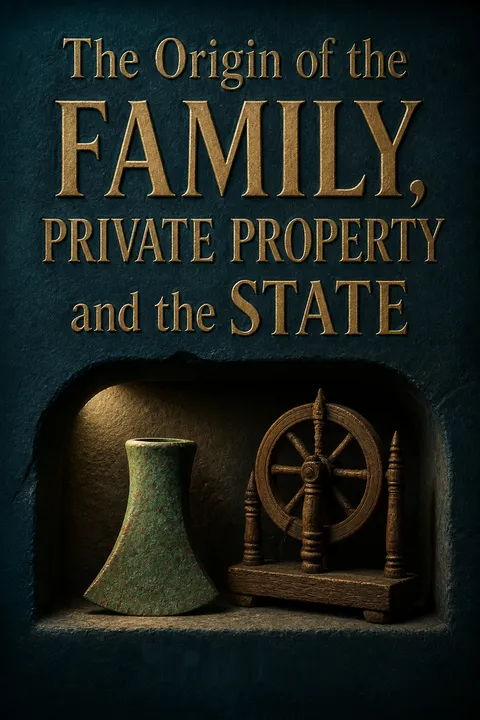
The state inevitably falls with them. The society which organizes production anew on the basis of free and equal association of the producers will put the whole state machinery where it will then belong–into the museum of antiquities, next to the spinning wheel and the bronze ax.
Capitalism's contradictions. Engels predicts that the economic foundations of monogamy and the state, which are rooted in private property and class antagonisms, are destined to disappear with the impending social revolution. The transformation of the means of production into social property under communism will eliminate the need for inheritance and the economic pressures that have historically shaped traditional family structures and male supremacy.
Emancipation and new relations. With the abolition of wage-labor and, consequently, prostitution, monogamy will finally become a reality for men as well as women. Women's emancipation will be achieved through their full participation in social productive labor, transforming private domestic work into a public industry. This will remove the economic "consequences" that currently constrain sexual freedom and lead to a more tolerant public opinion regarding individual sexual relationships, unburdened by societal judgment or economic fear.
Beyond the state. The state, having arisen as a tool to manage and perpetuate class divisions, will become obsolete once these classes disappear. A future society, organized on the basis of a free and equal association of producers, will have no need for a coercive state apparatus. Individual sex-love, unburdened by economic considerations or male dominance, will become the sole basis for marriage, which will be dissolvable if love ceases, leading to a truly egalitarian and liberated human society where the state belongs in a museum.
Review Summary
The Origin of the Family, Private Property and the State by Engels examines how societies evolved from communal, matrilineal structures to patriarchal systems with private property and state formation. Based on Lewis Henry Morgan's anthropological work, Engels argues that the family, monogamy, and the state emerged from economic changes rather than natural necessity. Reviewers note the book's outdated anthropology but praise its materialist analysis connecting women's oppression to property relations. Many find it essential for understanding Marxist feminist theory, though some criticize its reliance on colonial sources and lack of attention to sexuality and gender essentialism.
People Also Read


Download PDF
Download EPUB
.epub digital book format is ideal for reading ebooks on phones, tablets, and e-readers.








































