
Key Takeaways
1. Neoclassical Economics Failed to Predict the Crisis Because Its Foundations Are Flawed.
"The complete failure of neoclassical economics to anticipate the crisis also meant, as I expected, that economic theory and economists are under public attack as never before."
A stunning oversight. The 2007-2008 financial crisis, dubbed the "Great Recession," caught the vast majority of neoclassical economists by surprise. Leading figures like Ben Bernanke and Robert Lucas had confidently declared that major depressions were a thing of the past, attributing recent economic stability to their successful policy management. This hubris was shattered when the crisis hit, revealing a profound disconnect between their theoretical models and economic reality.
Ignoring warnings. Despite the widespread belief among mainstream economists that "no one could have seen this coming," a small minority of non-neoclassical economists had publicly warned of an impending crisis for years. These warnings, often dismissed or ignored by the academic establishment, highlighted critical factors that neoclassical models systematically overlooked. The crisis exposed neoclassical economics as a "degenerate scientific research program," more concerned with defending its flawed core beliefs than with understanding the actual economy.
Fundamental flaws. The core problem lies in the unrealistic and often contradictory foundations of neoclassical theory. Concepts like rational agents, market equilibrium, and the neutrality of money and debt are central to their models, yet they fail to capture the complexities of a real-world capitalist economy. This book argues that these foundational flaws rendered neoclassical economists uniquely ill-equipped to foresee or explain the crisis, necessitating a radical overhaul of economic thought.
2. The "Law of Demand" and Market Supply Curves Are Logically Inconsistent.
"The true situation is honestly stated in a leading research book, the Handbook of Mathematical Economics: ‘market demand functions need not satisfy in any way the classical restrictions which characterize consumer demand functions […] The utility hypothesis tells us nothing about market demand unless it is augmented by additional requirements’."
Aggregation fallacy. Neoclassical economics asserts that market demand curves always slope downwards, meaning consumers buy more as prices fall. While this can be proven for an isolated individual, it cannot be proven for an entire market. The attempt to aggregate individual preferences into a coherent market demand curve fails, as demonstrated by the Sonnenschein-Mantel-Debreu conditions.
Absurd conditions. For a market demand curve to behave like an individual one, neoclassical theory requires absurd conditions:
- All Engel curves (showing how demand changes with income) must be straight lines.
- All consumers' Engel curves must be parallel.
These conditions effectively mean there is only one consumer and one commodity, which is a "proof by contradiction" that the Law of Demand does not apply to markets.
Non-existent supply. Similarly, the concept of an upward-sloping supply curve, where higher prices elicit greater supply, is also flawed. The neoclassical theory of the firm, which claims profit-maximizing competitive firms produce where marginal cost equals price, is based on a mathematical error. When corrected, it shows that competitive firms behave like monopolies, setting prices above marginal cost, thus invalidating the very existence of an independent supply curve.
3. Capital and Labor Incomes Do Not Reflect Marginal Productivity.
"The distribution of income is to some significant degree determined independently of marginal productivity and the impartial blades of supply and demand."
Flawed income distribution. Neoclassical economics claims that wages and profits reflect the marginal productivity of labor and capital, respectively. This implies a meritocratic distribution of income. However, this theory relies on the same flawed assumptions as demand and supply curves, making its conclusions about income distribution equally unsound.
Capital's paradox. The concept of "capital" as a homogeneous, measurable factor of production is problematic. The "Cambridge Controversies" demonstrated that the monetary value of capital depends on the rate of profit, rather than the other way around. This "reswitching" phenomenon means there's no consistent relationship between the "amount" of capital and the rate of profit, undermining the idea that profit is a reward for capital's contribution.
Labor's reality. The labor market is also misrepresented. The idea that workers freely choose between leisure and income, leading to an upward-sloping labor supply curve, is often false; labor supply can be "backward-bending" as higher wages allow for more leisure. Furthermore, in a world of imperfect competition, workers' wages are influenced by bargaining power, not just their marginal product. Income distribution is thus a social and political outcome, not a purely market-driven one.
4. Neoclassical Assumptions Are Unrealistic and Its Methodology Is Flawed.
"The relevant question to ask about the ‘assumptions’ of a theory is not whether they are descriptively ‘realistic,’ for they never are, but whether they are sufficiently good approximations for the purpose in hand."
Friedman's F-twist. Milton Friedman's influential argument, the "F-twist," claimed that the realism of a theory's assumptions doesn't matter; only its predictive accuracy does. This "instrumentalism" is a smokescreen. Assumptions do matter, especially when they are "domain assumptions" that define the conditions under which a theory applies.
Types of assumptions:
- Negligibility assumptions: Ignore minor, irrelevant details (e.g., air resistance for a falling cannonball). These can be valid.
- Domain assumptions: Specify conditions for a theory's applicability (e.g., risk as a proxy for uncertainty). If these are unrealistic, the theory is irrelevant.
- Heuristic assumptions: Known to be false, but used as a temporary step towards a more general, realistic theory. These should be eventually dropped.
A degenerate program. Neoclassical economics frequently uses unrealistic domain assumptions (like "rational expectations" or "representative agents") and treats them as if they were negligibility or heuristic assumptions. This behavior, coupled with the rejection of contradictory empirical evidence and logical critiques, marks neoclassical economics as a "degenerate scientific research program," more focused on defending its "hard core" beliefs than on genuine scientific progress.
5. Equilibrium is a Dangerous Illusion; Economies Are Inherently Dynamic and Unstable.
"A mathematically unstable system does not fluctuate; it just breaks down."
The static trap. Neoclassical economics is obsessed with equilibrium, modeling economic processes as if they instantly adjust to a stable, optimal state. This "comparative statics" approach ignores the dynamic path an economy takes, assuming that any disequilibrium is merely a temporary deviation from a stable equilibrium. This is a fundamental misrepresentation of reality.
Unstable equilibria. Research in dynamic systems, particularly chaos theory, has shown that economic equilibria are often unstable. A small deviation from equilibrium can lead to the system moving further away, not returning. This means that economies are inherently in disequilibrium, constantly fluctuating in complex, unpredictable ways, even without external shocks.
The "long run" fallacy. The notion that "in the long run we are all dead" highlights the irrelevance of long-run equilibrium for understanding current economic affairs. Real economies are dynamic, constantly changing systems where "transient" disequilibrium states are the norm. Ignoring these dynamics, as neoclassical models do, leads to dangerously misleading policy advice, as seen in the failure to anticipate the Great Recession.
6. Macroeconomics Cannot Be Reduced to Microeconomics.
"The correct inference from that research is that, not only is macroeconomics not applied microeconomics, but even microeconomics itself can’t be based on a simple extrapolation from the alleged behavior of individual consumers and firms."
The reductionist fallacy. Neoclassical macroeconomics attempts to derive the behavior of the entire economy from the actions of individual "rational" agents. This "strong reductionism" is a fallacy. Complex systems exhibit "emergent properties"—behaviors at the aggregate level that cannot be predicted or explained by studying their individual components in isolation.
Microfoundations crumble. The failure to aggregate individual demand curves into a coherent market demand curve (Sonnenschein-Mantel-Debreu conditions) is a prime example of this emergent behavior within microeconomics itself. If even market-level phenomena cannot be simply derived from individual behavior, then macroeconomics, which deals with far greater aggregation, certainly cannot.
The "representative agent" absurdity. Modern neoclassical macroeconomics, particularly "Dynamic Stochastic General Equilibrium" (DSGE) models, often simplifies the entire economy into a single "representative agent" who is simultaneously a consumer, worker, and capitalist, with rational expectations and perfect foresight. This extreme abstraction, as criticized by Nobel laureate Robert Solow, is a "sleight-of-hand" that rules out real-world phenomena like recessions and involuntary unemployment by definition.
7. The Efficient Markets Hypothesis is Empirically False and Based on Absurd Assumptions.
"What economists describe as ‘efficient’ actually requires that investors be prophetic."
A flawed definition of efficiency. The Efficient Markets Hypothesis (EMH) claims that financial markets are "efficient" because asset prices accurately reflect all available information and investors' correct expectations of future earnings. This definition is misleading. It implies that price changes are random, driven only by unpredictable new information, and that "you can't beat the market."
Prophetic investors and unlimited credit. To "prove" market efficiency, the EMH makes three absurd assumptions:
- All investors have identical expectations about future company prospects.
- These identical expectations are always correct.
- All investors have equal access to unlimited credit at a risk-free rate.
These conditions are impossible in reality, where investors have diverse, often incorrect, expectations and face credit constraints.
Empirical invalidation. Even the EMH's originators, Eugene Fama and Kenneth French, have conceded that its empirical record is "poor enough to invalidate the way it is used in applications." Real markets exhibit "fat tails" (more extreme events than predicted by random walks), overreactions, and endogenous volatility driven by investor sentiment and feedback loops, not just random information.
8. Private Debt Dynamics, Not Monetary Policy, Drive Economic Crises.
"Thus over-investment and over-speculation are often important; but they would have far less serious results were they not conducted with borrowed money."
Fisher's ignored wisdom. Irving Fisher, initially a proponent of market efficiency, lost his fortune in the 1929 crash. He then developed the "Debt Deflation Theory of Great Depressions," arguing that excessive private debt and subsequent deflation were the primary causes of economic collapse. This crucial insight was largely ignored by neoclassical economists, who dismissed debt as a mere redistribution of wealth with no aggregate impact.
Debt-fueled demand. In a credit-driven economy, aggregate demand equals income (GDP) plus the change in debt. When debt grows rapidly, it significantly boosts demand, creating a "false prosperity." However, this growth is unsustainable. A slowdown in debt growth, or an outright contraction, leads to a sharp fall in aggregate demand, triggering recessions or depressions.
The Great Recession's true cause. The Great Recession was not caused by the Federal Reserve's mismanagement of the money supply, as Ben Bernanke argued for the Great Depression. Instead, it was the bursting of an unprecedented private debt bubble. The exponential rise in private debt-to-GDP ratios, fueled by speculative lending, created a fragile economy that collapsed when debt growth decelerated, leading to a massive drop in aggregate demand and soaring unemployment.
9. The "Money Multiplier" is a Myth; Banks Create Money and Debt Endogenously.
"The narrow, textbook money multiplier does not appear to be a useful means of assessing the implications of monetary policy for future money growth or bank lending."
A flawed model of money creation. Neoclassical economics relies on the "Money Multiplier" model, which posits that central banks control the money supply by setting reserve requirements, and commercial banks then lend out a multiple of these reserves. This model suggests that central bank injections of "base money" should lead to a proportional increase in broader money supply and lending.
Reality of endogenous money. In reality, banks create money and debt simultaneously when they make loans. They do not wait for reserves; they create loans first and then acquire the necessary reserves later. This means the money supply is largely "endogenous"—determined by the private banking system's lending decisions and borrowers' demand for credit—rather than "exogenous" and controlled by the central bank.
Bernanke's failed experiment. During the Great Recession, Ben Bernanke's massive "Quantitative Easing" (QE1) injected trillions into bank reserves, expecting the Money Multiplier to stimulate lending. It failed spectacularly. Excess reserves skyrocketed, but private lending fell, demonstrating that the Money Multiplier is a myth and that banks' willingness to lend, and borrowers' willingness to borrow, are the true drivers of credit creation.
10. Mathematics is Not the Problem; Bad Mathematical Practice and Ignorance of Its Limits Are.
"Mathematics is therefore not the reason why conventional economics is so bad. Instead, bad economics is supported by bad mathematical practice."
Misuse of mathematics. Critics often blame mathematics for economics' failures, arguing it leads to excessive formalism and obscures social realities. However, the issue is not mathematics itself, but its misuse by economists. Neoclassical economics frequently employs "bad mathematics," characterized by logical contradictions, omitted variables, false equalities, and unexplored conditions.
Logical flaws. Examples of bad mathematical practice include:
- Logical contradiction: Assuming conditions that contradict the very phenomenon being proven (e.g., aggregation of demand curves).
- Omitted variables: Ignoring crucial factors like time, uncertainty, money, and debt in models.
- False equalities: Treating infinitesimally small quantities as zero, leading to erroneous conclusions (e.g., competitive firm's demand curve).
- Unexplored conditions: Presuming relationships without examining the necessary underlying conditions (e.g., upward-sloping labor supply).
Ignoring mathematical limits. Economists also fail to appreciate the limits of mathematics. While modern mathematics acknowledges the existence of chaos and the impossibility of predicting complex dynamic systems with certainty, neoclassical economics clings to a "clockwork universe" where equilibrium is paramount. This isolation from mainstream scientific and mathematical advancements has hindered economics' progress.
11. Alternative Economic Theories Offer More Realistic Frameworks.
"There are many alternative schools of thought within economics."
Beyond the mainstream. Despite neoclassical dominance, several alternative schools offer more realistic approaches to understanding capitalism. These include:
- Austrian economics: Emphasizes disequilibrium, entrepreneurship, and uncertainty.
- Post-Keynesian economics: Focuses on uncertainty, endogenous money, and macroeconomic instability.
- Sraffian economics: Provides rigorous analysis of production, critiquing neoclassical capital theory.
- Complexity theory/Econophysics: Applies nonlinear dynamics and physics methods to economic systems.
- Evolutionary economics: Views the economy as an evolving system, emphasizing diversity and adaptation.
Strengths of alternatives. These schools collectively address many of neoclassical economics' weaknesses:
- They acknowledge inherent instability and disequilibrium.
- They integrate money, debt, and financial markets as central.
- They recognize the importance of uncertainty and expectations.
- They often employ more appropriate dynamic and computational methods.
Towards a new synthesis. While no single alternative is fully developed, there is significant overlap and potential for cross-fertilization. A future economics could synthesize the strengths of these diverse perspectives, moving beyond the ideological constraints and unrealistic assumptions that have crippled neoclassical thought. This shift is crucial for developing an economics relevant to the complexities of modern capitalism.
12. Systemic Reforms, Like Debt Jubilees, Are Needed to Prevent Future Crises.
"Debts that can’t be repaid, won’t be repaid."
Unsustainable debt. The Great Recession highlighted that capitalism's inherent instability is exacerbated by the financial sector's tendency to create excessive, unproductive debt. This debt, often fueled by speculative bubbles in asset markets, eventually becomes unserviceable, leading to widespread deleveraging and economic collapse. Current debt levels remain dangerously high, making future crises likely.
Beyond conventional policy. Traditional neoclassical policy responses, like central bank liquidity injections or fiscal stimulus, address symptoms but not the root cause of debt-driven crises. These measures often prop up the financial sector without forcing necessary deleveraging, merely delaying and potentially worsening future downturns. A more radical approach is needed to break the cycle of debt accumulation and crisis.
Proposals for reform:
- Debt Jubilee: A unilateral write-off of unpayable debts, similar to ancient practices, to reduce the aggregate debt burden and restore economic activity. This would impose losses on the financial sector, forcing accountability.
- Jubilee Shares: Redefine shares so that secondary market shares expire after a fixed period (e.g., 50 years), discouraging speculative trading and forcing valuations to reflect productive earnings.
- Property Income Limited Leverage (PILL): Limit property debt to a multiple of annual rental income, linking asset prices to fundamental income-generating capacity rather than speculative leverage.
These reforms aim to fundamentally alter the incentives for debt creation and speculation, fostering a more stable and productive capitalism.
Review Summary
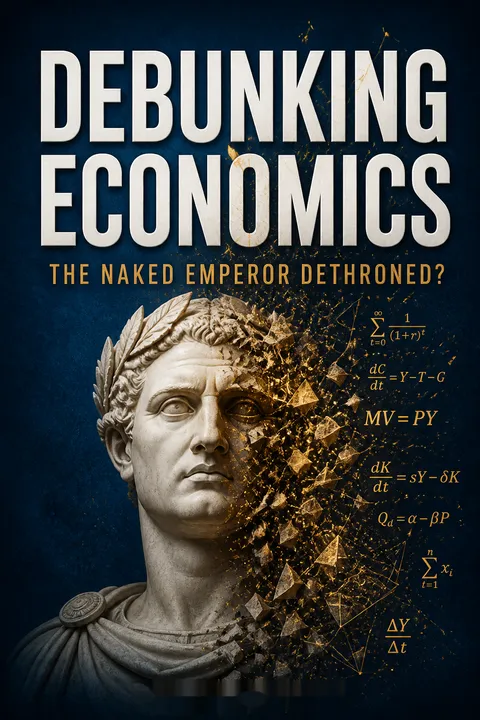
Debunking Economics receives predominantly positive reviews (4.04/5) for its thorough critique of neoclassical economic theory. Readers praise Keen's systematic dismantling of mainstream economics using mathematical rigor, though many note the technical difficulty and dense presentation. Reviewers particularly value his exposure of flawed assumptions, mathematical contradictions, and the discipline's resistance to acknowledging empirical failures. Common criticisms include excessive complexity for non-economists, repetitive content, missing visual aids, and unclear organization. Several readers recommend it as essential reading for understanding economic crises, though some warn it requires significant concentration and background knowledge to fully appreciate.
People Also Read









About the Author
Other books by Steve Keen

Download PDF
Download EPUB
.epub digital book format is ideal for reading ebooks on phones, tablets, and e-readers.








































