
Key Takeaways
1. Theology's Ultimate Aim: To Know, Enjoy, and Walk with God
The goal of theology must never be reduced to merely getting right ideas into our head.
Beyond bare facts. Theology is not just an academic exercise in dissecting God as an object of study. Its true purpose is transformative: to deepen our knowledge, enhance our enjoyment, and guide our obedience to God. This pursuit is both profound and practical, aiming for a blessed life forever.
Fourfold approach. Engaging in theological study requires a specific posture.
- Biblically: Every conviction must be tested against Scripture.
- Rationally: Reason serves as an instrument of faith, ensuring truth is never nonsensical.
- Humbly: We approach God in prayerful dependence, eager to learn from tradition.
- Doxologically: Learning doctrine should lead to higher worship and greater love for God.
Not just "religion." While "religion" can be misconstrued as mere ritual or works-righteousness, true Christian faith embraces commands, doctrines, structures, and rituals as expressions of a relationship with God. Jesus himself participated in religious practices, demonstrating that genuine piety is not antithetical to structured faith.
2. God's Incomprehensible Yet Knowable Nature: Simple, Self-Existent, Unchanging
Although not fully comprehensible by his creatures, God has given us the ability to know him truly and savingly.
Incomprehensible, not unknowable. While God's essence is beyond our full grasp, He has chosen to reveal Himself, making true and saving knowledge possible. This revelation is objective, found in His Word, and apprehended by faith, guarding against rationalism (reason as ultimate authority) and mysticism (subjective inner light).
God's unique attributes. God is a simple being, meaning He is not composed of parts; His attributes are identical with His essence, not additions. He is also marked by aseity, existing entirely in and of Himself, dependent on nothing. This self-existence means He is the Great I Am, the ultimate source of all being.
Immutable and impassible. God does not change in His essence, knowledge, will, or purpose; He is pure being, not becoming. Furthermore, divine impassibility means God does not suffer or undergo inner change from external forces. This safeguards His perfection and underscores the profound condescension of Christ's incarnation, where God freely chose to suffer as man.
3. The Triune God: One Essence, Three Distinct and Inseparable Persons
This is the catholic faith: That we worship one God in trinity and the trinity in unity, neither blending their persons, nor dividing their essence.
The core of Christianity. The doctrine of the Trinity is fundamental to Christian faith, asserting one God in three distinct persons: Father, Son, and Holy Spirit. This truth is summarized by seven statements:
- There is only one God.
- The Father is God, the Son is God, the Holy Spirit is God.
- The Father is not the Son, the Son is not the Holy Spirit, the Holy Spirit is not the Father.
Biblical foundation. Though the word "Trinity" isn't in the Bible, its theology is pervasive. Scripture affirms God's oneness (Deut. 6:4), the deity of the Father, Son, and Spirit, and their distinct personhood (Matt. 28:19; Eph. 4:4-6). These biblical propositions are defended by precise theological terms, not obscured by them.
Mutual indwelling and order. The three persons of the Trinity mutually indwell one another (perichoresis), meaning each is fully in the others without merging. There is also an eternal order (taxis) in their relations and operations: all works originate from the Father, through the Son, by the Holy Spirit. This order does not imply hierarchy in essence, but in their economic roles, ensuring their inseparable operations.
4. God's Sovereign Will: Orchestrating All Things for His Glory, Including Our Salvation
God’s existence is the starting place for human knowledge, not the end point of human deduction.
One eternal decree. God's decrees are His eternal purpose, a single, all-comprehensive, and immutable act by which He foreordains whatsoever comes to pass for His own glory. These decrees are absolute, not contingent on human actions, and are always wise and good, even when they involve permitting evil.
Two aspects of God's will. The "will of God" can refer to His will of decree (what He has ordained, which always comes to pass) and His will of desire (what He commands and desires us to do, which can be disobeyed). This distinction helps reconcile God's sovereignty with human responsibility, as His permissive decree for sin is not a bare permission but a wise ordering for holy ends.
Election and reprobation. God's predestination encompasses both election (choosing some for eternal life in Christ) and reprobation (determining others not to be saved). This "dreadful decree" is not arbitrary but righteous, demonstrating God's mercy and justice. It serves as a foundation for evangelism, assuring us that God has a people who will believe, rather than undermining missionary zeal.
5. Humanity's Fallen State: Utterly Depraved and Incapable Apart from Divine Grace
No one can say, “I have made my heart pure; I am clean from my sin.”
Sin's pervasive nature. Sin is not merely missing the mark; it is lawlessness, idolatry, rebellion, and pollution that pervades every faculty of our being. Original sin, inherited from Adam, renders us guilty before God and corrupts our nature, leading to actual sins in thought, word, and deed.
Total inability. As a result of the Fall, humanity is in a state of total inability, meaning we are utterly powerless to choose spiritual good or save ourselves. We are "dead in trespasses and sins," unable to return to God or reform our distorted nature without the regenerating grace of the Holy Spirit. This inability is moral, not natural, meaning our sinful choices are voluntary and culpable.
The doctrine's impact. A robust doctrine of sin fosters realism about the world, recognizing the inherent fallenness in all people and institutions. It cultivates humility, reminding us that "the line separating good and evil passes... right through every human heart." Crucially, it magnifies the glory of salvation, making us rejoice in God's miraculous grace.
6. Jesus Christ: The One Person with Two Natures, Fully God and Fully Man
In Christ all the fullness of God dwells bodily.
The God-man. Christ's person is a hypostatic union: the joining of a complete divine nature and a complete human nature in His one person. He is truly God (eternal, omniscient, omnipotent, immutable) and truly man (born, grew, suffered hunger, thirst, fatigue, temptation, and death), without confusion, change, division, or separation of these natures.
Incarnation's purpose. The divine Son of God assumed human nature not to cease being God, but to become what He was not, without ceasing to be what He was. This was necessary so that as the God-man, He could conquer death, defeat the devil, and make propitiation for our sins, fulfilling the principle: "Whatever is not assumed cannot be healed."
Divine self-consciousness. Jesus knew His divine and messianic identity, frequently referring to Himself as the Son of Man and making "I am" statements that echoed Yahweh's self-declaration. While His human mind grew in wisdom and did not know all things, His divine consciousness remained omniscient, demonstrating a twofold consciousness in His unified person.
7. Christ's Atoning Work: Humiliation and Exaltation for Penal Substitution
It was the will of the Lord to crush him.
Two states of Christ. Christ's work is understood in two states: humiliation (incarnation, suffering, death, burial, descent into hell) and exaltation (resurrection, ascension, session, return). His entire life was one of suffering, culminating in the cross where He experienced the absence of divine comfort and the weight of divine wrath, bearing the curse for us.
Penal substitution. At the heart of the atonement is penal substitution: Christ's death was a substitutionary sacrifice to satisfy the demands of God's justice. He bore our sins in His body on the tree, enduring the penalty we deserved. This act was motivated by God's love, justice, and good pleasure, reconciling us to God by not counting our sins against us.
Perfection and triumph. Christ's atonement was perfect, lacking nothing, and requiring no human contribution. His death was an expiation (removing guilt) and a propitiation (appeasing God's wrath), making God "pro-us." His resurrection, ascension, and session confirm His triumph over sin, death, and the devil, securing our justification and establishing His eternal reign.
8. Salvation's Divine Order: God's Monergistic Work from Calling to Glorification
Effectual calling is where the grace decreed in eternity begins to find expression in time.
The ordo salutis. The "order of salvation" describes the logical sequence of God's saving acts, from predestination to glorification, all applied through the Holy Spirit. This monergistic work means God alone effects salvation, with humanity being passive in regeneration, yet actively responding in faith and repentance.
Effectual calling and regeneration. God's effectual calling is an internal, irresistible work of the Spirit that penetrates the heart, enlightens the mind, and renews the will, enabling us to embrace Christ. This leads to regeneration, the new birth, where sinners are endowed with new spiritual life, making faith possible.
Glorification: the final stage. Glorification is the culmination of salvation, the completion of sanctification, and the full enjoyment of adoption. It entails the redemption of our bodies, perfect holiness, and a clear, beatific vision of God. This final state is a fuller humanity, renewed in Christ's image, reigning with Him forever.
9. Justification by Faith Alone: Righteousness Imputed, Not Earned or Infused
Justification is an act of God’s free grace, wherein he pardons all our sins, and accepts us as righteous in his sight, only for the righteousness of Christ imputed to us, and received by faith alone.
Forensic declaration. Justification is a once-for-all judicial verdict from God, declaring us righteous. It is not a process of becoming righteous, but a legal pronouncement of innocence based solely on Christ's righteousness. This declaration involves both the forgiveness of our sins and the imputation of Christ's perfect obedience to our account.
Imputation, not infusion. The core of justification is imputation: Adam's sin was imputed to us, our sin was imputed to Christ, and Christ's righteousness is imputed to believers. This is distinct from infused righteousness, which is the ongoing work of sanctification. Our justification is based on an "alien righteousness"—Christ's—not any inherent goodness in us.
Sola Fide. We are justified by faith alone, apart from any works of the law. Faith is the instrumental cause, the empty hand that receives Christ's righteousness. While the faith that justifies is never alone (it produces good works), these works are the fruit, not the root, of our justification. James and Paul do not contradict; Paul addresses how we are right with God, while James addresses what genuine faith looks like.
10. The Church's Enduring Identity: One, Holy, Catholic, Apostolic, and Gospel-Centered
The church is not an optional extra but an essential element of what it means to be a Christian and to grow in Christ.
Attributes of the Church. The church is one (unified in Spirit, Lord, and faith), holy (set apart by Christ and called to live righteously), catholic (universal across time, place, and people), and apostolic (built on the apostles' teaching, not a succession of bishops). These attributes define its nature and mission.
Preaching as the primary mark. The true church is fundamentally marked by the pure preaching of God's Word. This verbal proclamation of Jesus Christ as Savior and Lord is central to its worship and mission. The sacraments and discipline are also essential, but they are dependent on the Word's authority.
Mission: The Great Commission. The church's mission is the Great Commission: to make disciples by bearing witness to Jesus Christ. This involves intentional movement and verbal proclamation, aiming for the conversion of hearts and minds, and the incorporation of new believers into mature, duly constituted churches.
11. Sacraments as Means of Grace: Visible Signs and Seals of Christ's Covenant Benefits
A sacrament is a holy ordinance instituted by Christ; wherein, by sensible signs, Christ, and the benefits of the new covenant, are represented, sealed, and applied to believers.
Signs and seals. Sacraments are visible signs and seals of God's special grace, instituted by Christ to represent, confirm, and apply the benefits of the new covenant to believers. They are not mere symbols but objective means through which God communicates grace, adapted to our senses.
Two sacraments. Christ instituted only two sacraments: baptism and the Lord's Supper.
- Baptism: A sign of initiation, spiritual cleansing, forgiveness of sins, and union with Christ, administered once to believers and their children. It does not confer grace by mere external application (no baptismal regeneration).
- Lord's Supper: A family meal, a covenantal meal, and a communion with Christ's body and blood, to be partaken of by sincere, instructed, and accountable believers.
Spiritual presence. In the Lord's Supper, Christ is spiritually present, not physically (transubstantiation or consubstantiation). As we feast in faith, we are lifted up by the Spirit to enjoy fellowship with the living Christ in glory, remembering His finished work and proclaiming His death until He returns.
12. Eschatological Hope: Awaiting Resurrection, Eternal Life, and Christ's Glorious Return
All those who love this appearing wait for it as their blessed hope.
Death and the intermediate state. Death is the last enemy, but for believers, it means being "at home with the Lord." The intermediate state is a conscious existence of blessedness for the righteous (and punishment for the wicked) before the final resurrection. This rejects purgatory and soul sleep, affirming immediate fellowship with Christ.
Judgment and rewards. At the end of the age, there will be a final judgment according to works, not to determine salvation, but to corroborate that we have been saved. Good works serve as evidence of true faith. While there are rewards, the Bible does not teach variable eternal rewards, but one glorious reward: eternal life with Christ, perfectly happy and without regret.
Christ's glorious appearing. Christ will return visibly, bodily, and personally as King and Judge. This "glorious appearing" will bring about the bodily resurrection of all, the final judgment, and the full establishment of the new heavens and new earth. This renewed creation will be our eternal home, free from suffering, sin, and separation from God.
Review Summary
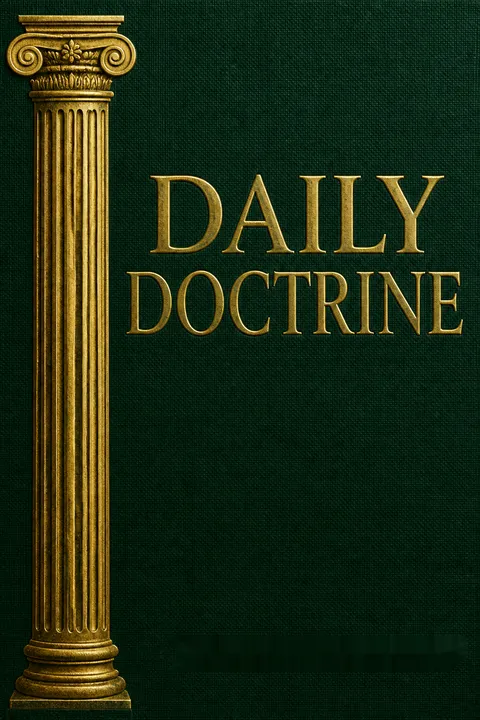
Daily Doctrine by Kevin DeYoung receives overwhelmingly positive reviews (4.61/5 stars). Readers praise its accessible approach to systematic theology, with bite-sized daily readings covering complex doctrines clearly and concisely. The book's beautiful design, structured format, and devotional quality are highly valued. Many appreciate DeYoung's ability to distill deep theological concepts into 1-2 pages. While written from a Presbyterian perspective, even Reformed Baptist readers recommend it. Some note it requires theological engagement and may be challenging for casual readers. Reviewers consistently mention using it as both a devotional and reference resource.
People Also Read



About the Author


Download PDF
Download EPUB
.epub digital book format is ideal for reading ebooks on phones, tablets, and e-readers.








































