
Key Takeaways
1. The "No Creed but the Bible" Stance Is Naive and Unbiblical
I argued in an earlier chapter that creeds and confessions actually fulfill a vital role in a function that Paul makes an imperative for the church and her leadership, that of the stable transmission of the gospel from one generation to another.
Universal synthesis. Every Christian and every church, whether they admit it or not, operates with a creed or confession. When asked what the Bible teaches, no one simply reads the entire Scripture; instead, they offer a summary or synthesis of its message. This inherent need to articulate biblical truth in a coherent, summarized form is itself a creedal act.
Hidden frameworks. Those who claim "no creed but the Bible" often unknowingly operate with private, unwritten creeds. This approach is ironically more authoritarian, as it makes their personal interpretations unassailable and immune to public scrutiny or biblical critique. Without a public document, there's no transparent way to assess if their understanding aligns with Scripture or if it's merely idiosyncratic.
Biblical imperative. The Bible itself, particularly Paul's instructions to Timothy, implies the necessity of "forms of sound words" for the stable transmission of the gospel. To reject creeds while claiming biblical fidelity is a contradiction, as it ignores the very mechanisms the New Testament suggests for preserving and propagating truth.
2. Modern Culture Actively Undermines Creedal Faith
It would be a tragic irony if the rejection of creeds and confessions by so many of those who sincerely wish to be biblically faithful turned out to be not an act of faithfulness but rather an unwitting capitulation to the spirit of the age.
Expressive individualism. Contemporary Western culture, dominated by expressive individualism, prioritizes inner feelings and personal autonomy over external authority. This mindset views institutions, traditions, and objective truth claims—all foundational to creeds—as repressive or irrelevant, making confessionalism seem implausible or distasteful.
Devaluing the past. Science and technology foster a narrative of constant progress, implying the past is inferior and irrelevant to present problems. This cultural bias extends to historical documents like creeds, leading to questions like:
- Why should ancient texts speak to modern ministry?
- How can "dead white men" offer relevant truth today?
This attitude often overlooks the universal aspects of human nature and God's unchanging revelation.
Suspicion of words and authority. A pervasive cynicism about language, fueled by political spin and marketing, coupled with a general distrust of traditional institutions, further erodes the credibility of creeds. When truth is seen as subjective ("I just know in my heart") or pragmatic ("it works for me"), the objective, propositional nature of creeds is marginalized, and their institutional authority is dismissed.
3. The Bible Itself Mandates "Forms of Sound Words"
The Pauline imperatives of holding fast to a form of sound words and of guarding the apostolic teaching both push the church toward creedal or confessional formulations and documents.
God's speaking nature. The Bible consistently portrays God as a speaking God whose words are creative, definitive, and a means of his presence. From creation to covenant, divine speech is central, establishing words as an adequate and chosen medium for revelation and communication between God and humanity.
Human response and transmission. Just as God uses words, so too are humans called to use words to respond to God and transmit his truth. The Passover narrative, for instance, emphasizes verbal explanation of historical events to convey their significance. This highlights the necessity of interpreting and proclaiming God's saving acts through clear, verbal statements, not just ritual or experience.
Apostolic charge. Paul's instructions to Timothy to "hold fast the form of sound words" (2 Tim. 1:13) are a direct mandate for creedalism. This "form" refers to a normative standard of teaching, a specific content and vocabulary, that elders must maintain and pass on. This ensures continuity of apostolic doctrine in the post-apostolic church, making theological synthesis and established terminology essential for orthodoxy.
4. Early Church Creeds Defined God and Christ for All Time
The Nicene Creed and the Chalcedonian Formula are two key results of that; and the fact they have proved their ability to last for so many centuries as such widely accepted accounts of the biblical teaching is surely not something we should take lightly.
Rule of Faith. In the immediate post-apostolic period, facing challenges like Docetism and Marcionism, the church developed the "Rule of Faith"—a stable conceptual summary of Christian essentials. This informal rule evolved into more formalized baptismal creeds, demonstrating an early need for clear doctrinal statements.
Ecumenical consensus. The First Council of Nicaea (325 AD) and the First Council of Constantinople (381 AD) produced the Nicene Creed, defining Christ's full deity ("of one substance with the Father") and the Holy Spirit's divinity. These councils established foundational Trinitarian theology, setting normative language and concepts for all subsequent orthodox Christian thought.
Christological precision. The Councils of Ephesus (431 AD) and Chalcedon (451 AD) further refined Christology, asserting the unity of Christ's person while maintaining his two distinct natures (divine and human) "without confusion, without change, without division, without separation." These definitions, though complex, provided essential boundaries for understanding Christ's saving work, demonstrating that doctrinal stability often requires intricate theological formulation.
5. Reformation Confessions Provided Comprehensive Doctrinal Identity
The theology of the Standards is basically consistent with that of the Three Forms of Unity, articulating a theology that is Trinitarian and anti-Pelagian.
Post-schism identity. The Reformation era saw the fragmentation of the Western church, necessitating new confessional documents to define distinct theological identities. These confessions served both theological purposes—articulating specific doctrines—and political ones, as territories aligned with particular Protestant expressions.
Key Protestant traditions. Major confessions emerged, each reflecting its unique context and theological emphasis:
- Anglican Articles (Thirty-Nine Articles, Homilies): A middle way between Rome and Anabaptism, emphasizing justification by faith and connecting to ancient creeds.
- Lutheran Book of Concord: A collection including Luther's catechisms and Melanchthon's Augsburg Confession, stressing sacramental theology and pedagogical concerns.
- Reformed Three Forms of Unity (Belgic Confession, Heidelberg Catechism, Canons of Dordt): Known for pastoral tone, emphasis on assurance, and detailed articulation of Calvinistic doctrines.
- Westminster Standards (Confession, Catechisms): A comprehensive Reformed statement, influencing Presbyterian and some Baptist traditions (e.g., 1689 Baptist Confession), covering doctrine, ethics, and church order.
Continuity and distinctives. These confessions consciously affirmed the Trinitarian and Christological foundations of the early church while elaborating on distinct Protestant doctrines like justification by faith, the sacraments, and predestination. They demonstrated that while the gospel remains constant, its articulation and defense require ongoing, context-specific theological work.
6. Confessions Are Acts of Doxology and Countercultural Witness
For Paul, doctrine and doxology are not separated: the truths of the gospel drive him again and again to praise.
Inseparable doctrine and praise. Christian praise is not a contentless emotional outpouring; it is rooted in and constituted by doctrinal truth. The biblical cry "Jesus is Lord!" is both a public declaration of praise and a profound doctrinal commitment. Paul's doxological outbursts, like in Philippians 2 or 1 Timothy 1, seamlessly intertwine theological statements with fervent worship, demonstrating that true praise is inherently doctrinal and often polemical against false claims.
Liturgical function. From the Didache's early eucharistic prayers to the inclusion of the Apostles' and Nicene Creeds in historic liturgies, creeds have always served a doxological purpose. Reciting a creed corporately is an act of:
- Corporate unity: Members publicly identify with each other and with Christians throughout history.
- Countercultural defiance: It asserts God's sovereign kingship, denying the claims of worldly idols and challenging cultural conformity.
- Ascribing glory: It reminds believers of God's nature and acts, giving Him the honor due to Him alone.
Beyond formalism. While any set form can become formalistic, the issue lies with the heart of the worshiper, not the form itself. Creeds, as tried-and-tested forms of sound words, offer a robust framework for worship that ensures biblical content and Trinitarian priorities are upheld, guiding congregants towards mature, informed praise.
7. Confessions Delimit Church Power and Protect Members
Good confessions properly applied by appropriately qualified and ordained elders do actually hinder despotic church power and protect the members; they do not facilitate it.
Defining boundaries. Confessions serve as a clear, public statement of what the church believes and what it stands for. This explicitly defines the church's mission and, crucially, limits the scope of its authority. Just as a seminary's mission statement guides its curriculum, a church's confession delineates the legitimate areas of its teaching and governance.
Preventing arbitrary rule. In churches without a public confession, the congregation is vulnerable to the arbitrary opinions or whims of its leadership. If a pastor's "creed" is only what he believes the Bible says at any given moment, there's no objective standard for members to challenge overreach or inconsistent teaching. This creates a system where the minister's power is effectively unlimited.
Accountability and transparency. A public confession provides a framework for accountability. If elders or ministers overstep their bounds—for example, by dictating personal choices not addressed in the confession—members can appeal to the church's own stated standards. This transparency protects members from despotic power and ensures that church authority remains ministerial and subordinate to the agreed-upon biblical summary.
8. Confessions Foster Doctrinal Depth, Unity, and Accountability
Any church needs to avoid two things in this context. First, the church must not send the signal that issues that are actually important are matters of indifference.
Comprehensive summaries. Creeds and confessions offer succinct yet thorough summaries of Christian doctrine, covering essential topics like the nature of God, creation, Christ's person and work, salvation, and the church. They focus the church's mind on perennial truths, preventing distraction by fleeting cultural fads and ensuring a balanced theological understanding.
Necessary complexity. Christian theology, to be stable and coherent, requires a certain level of inherent complexity. Doctrines like the Trinity or justification are not isolated but interconnected, forming a "doctrinal matrix." Confessions articulate this complexity, ensuring that individual doctrines are understood within a broader, biblically faithful framework, which is crucial for maintaining orthodoxy.
Pedagogical aspiration. Confessions serve as pedagogical tools, setting an aspirational standard for doctrinal competence within the congregation. They provide a curriculum for Christian education, guiding members from basic faith to a deeper understanding of God's whole counsel. This also establishes clear accountability for office-bearers, who are sworn to uphold and teach these standards, ensuring consistent and robust theological instruction.
9. Confessional Revision Requires Extreme Caution and Ecclesiastical Process
Thus, any process of confessional revision must take account of the following: as confessions are ecclesiastical documents, they can be revised only by the church.
Subordination to Scripture. While confessions are "normed norms" (subordinate to Scripture), they are not infallible. They can be corrected or supplemented if found to be unbiblical or inadequate. However, this process must be undertaken with extreme caution, recognizing the profound implications of altering documents that have guided the church for centuries.
Ecclesiastical authority. Revision is not a private matter but an ecclesiastical one, requiring formal action by the church's duly appointed officers (e.g., presbyteries, synods, assemblies). This ensures that changes reflect corporate discernment and commitment, not individual whims or transient cultural pressures.
Considerations for revision:
- Conceptual error: Revision is justified only if the confession is demonstrably wrong on a biblical point, not merely for stylistic preferences.
- Ecumenical impact: Altering a confession can isolate a denomination from others sharing the original standard, as seen with the filioque clause.
- Historical lessons: Extensive revisions have often led to theological decline rather than renewal, highlighting the wisdom embedded in long-standing formulations.
Officers facing confessional changes have three options: active concurrence, passive submission, or peaceable withdrawal, underscoring the gravity of confessional commitment and the need for integrity.
Review Summary
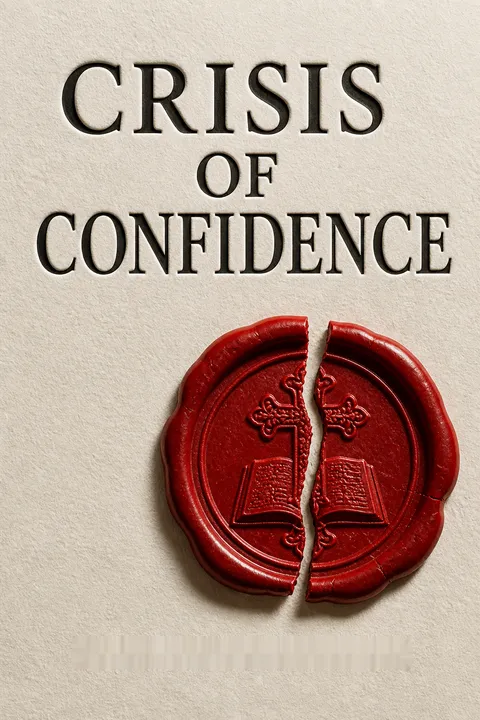
Readers widely praise Crisis of Confidence as a compelling, well-argued defense of confessional Christianity. Trueman effectively dismantles the "no creed but the Bible" mindset, demonstrating that every church already has a creed, whether written or not. Reviewers appreciate his blend of theological, historical, and cultural analysis, particularly his insights on modern individualism. The book is considered an update and expansion of his earlier work, The Creedal Imperative. Most found it persuasive and practically valuable, recommending it especially to those from non-confessional backgrounds.
People Also Read


About the Author
Other books by Carl R. Trueman

Download PDF
Download EPUB
.epub digital book format is ideal for reading ebooks on phones, tablets, and e-readers.








































