

Key Takeaways
Reframe the UFO as a divine messenger, not a spaceship from Zeta Reticuli
The core claim inverts the alien narrative. Chris Bledsoe, a North Carolina homebuilder, argues the glowing orbs and small red-eyed beings he encountered starting January 8, 2007 are not extraterrestrials but angelic, God-sent intelligences (what a religious-studies professor he later befriends identifies with the biblical seraphim, literally the burning ones).
Evidence is experiential, not laboratory. When Bledsoe first saw two flaming forty-five-foot spheres over a field by the Cape Fear River, he instinctively dropped to his knees and called out to God. A being told him plainly, We are not here to hurt you, we are here to help you. Across sixteen years the phenomena arrive most often during prayer, respond to emotion, and carry a message of compassion, which convinced him this was a spiritual event dressed in technological clothing.
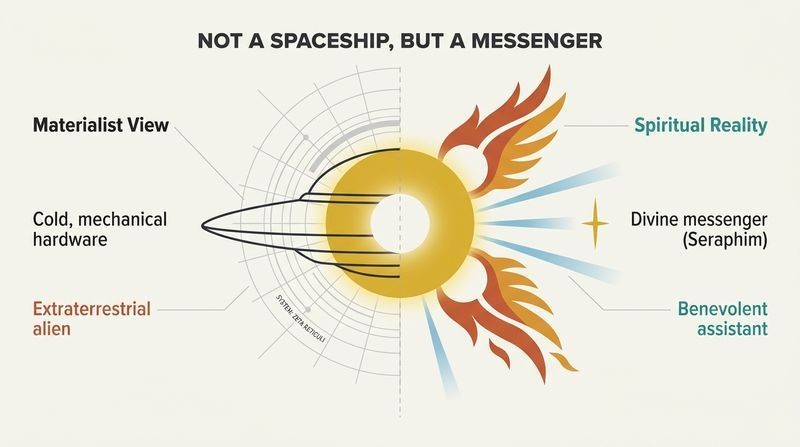
What is striking is how Bledsoe collapses the usual firewall between ufology and religion. Scholar Jeffrey Kripal, cited in the book, notes that pre-modern cultures read the same aerial anomalies as gods, angels, and demons, while moderns default to nuts-and-bolts spacecraft. Carl Jung made a parallel argument in 1958, calling flying saucers a technological projection of an ancient religious archetype. The reframing is intellectually generative but unfalsifiable: labeling an experience angelic explains everything and predicts nothing. Readers should treat this less as physics and more as phenomenology, a first-person account of meaning-making under extreme circumstances, valuable precisely for what it reveals about human interpretation.
The phenomena seek out the broken, not the worthy
Despair appears to be the doorway. Bledsoe's most consistent observation across hundreds of encounters is that contact favors people at rock bottom. When the orbs first came, he was bankrupt, chained to a bathroom by Crohn's disease, freshly poisoned into a coma by a reckless psychiatrist's five-drug cocktail, and treated as a pariah in his own town.
The pattern repeats in others. He notices that fellow experiencers almost always carry recent tragedy. His friend David Broadwell began seeing a disk near a Virginia government facility during his wife's health crisis. A painter, Doug Auld, saw his first orb on a church step after losing his wife to cancer. Bledsoe treats hopelessness less as punishment than as a kind of spiritual permeability, the state in which the veil thins.
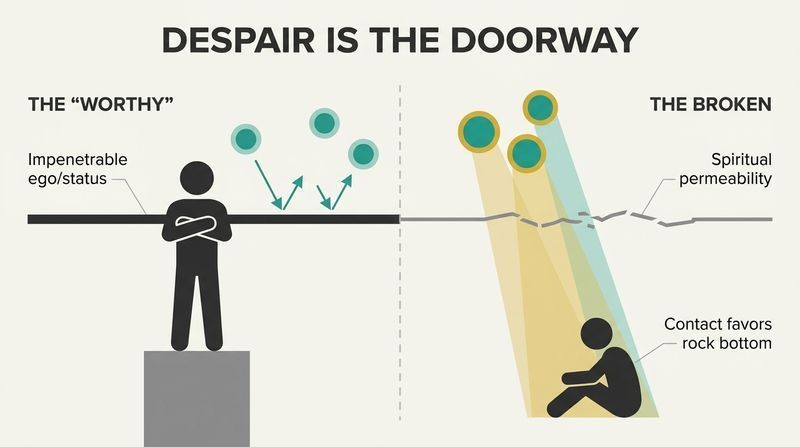
This maps neatly onto a well-documented psychology of anomalous experience. Grief, trauma, and sleep disruption reliably increase reports of visions, sensed presences, and sleep paralysis, which folklorist David Hufford (quoted in the foreword) studied as the Old Hag tradition. Skeptics read this as evidence the experiences are neurological artifacts of a stressed brain. Believers read the identical data as evidence that suffering opens perception. Both can be true. What Bledsoe adds is a compassionate reframe: rather than pathologizing the desperate, he treats their openness as a gift, echoing mystical traditions in which the dark night of the soul precedes illumination.
Sensational media does not investigate mystery, it strip-mines it
The Discovery Channel episode was an ambush. Told he was signing paperwork, Bledsoe was walked into a hotel conference room, seated before three cameras, and subjected to a surprise two-hour polygraph with thirty-four repeated questions administered by an ex-FBI examiner. Producers had promised trauma counseling for his children and editorial input. Neither materialized. His family, told to order Applebee's, was then informed they were not in the budget for lunch and made to watch the crew eat.
The real subject was never the UFO. Bledsoe realized the show's engine was a single manufactured question: is this honorable man secretly a liar or a lunatic? Every cliffhanger insinuated fraud. The aired result was a nationally televised character interrogation that followed his kids through school for years via biweekly reruns.
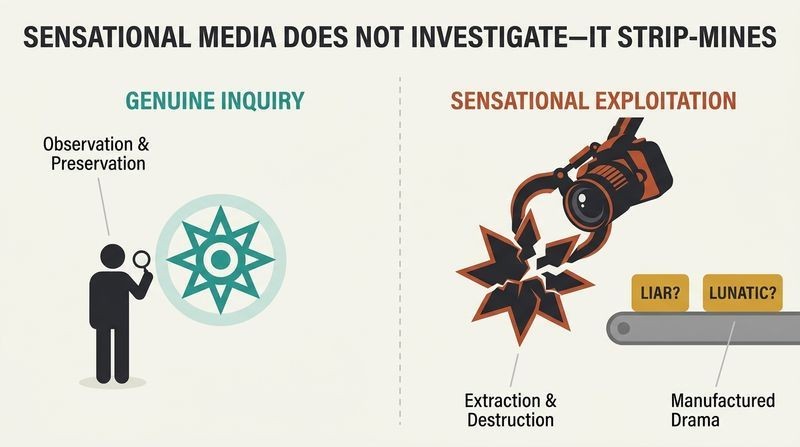
Bledsoe's account is a small case study in the incentives of unscripted television, where ambiguity is a feature to be exploited rather than a puzzle to be solved. Media scholars call this the epistemology of doubt as entertainment: the format profits from keeping the audience suspended between belief and ridicule, never resolving. The collateral damage to real families is rarely counted. It also illustrates a cruel asymmetry, that the burden of proof falls entirely on the witness while the platform bears no accountability. The lesson generalizes well beyond ufology to any story where vulnerable subjects hand their credibility to producers optimizing for ratings.
Telling an unbelievable truth can exile your whole family
Belief has a social price paid by bystanders. Once Bledsoe spoke publicly, the cost fell hardest on people who never chose it. His four children were mocked as the UFO guy's kids. Teachers joked about them in class. Church leaders showed up uninvited to sprinkle holy water on his property as if exorcising a curse. His oldest son, Chris Jr., who was paralyzed with terror the first night and later hospitalized, twice ran away, once ending up homeless in California.
Denial and disclosure both wound. His wife Yvonne, descended from founders of the Pentecostal Holiness Church, spent years unable to affirm or deny what she herself eventually witnessed, caught between protecting her children and belonging to her congregation. The family survived by clinging together, not by being believed.
The foreword by former CIA officer Jim Semivan makes an underappreciated point: anomalous experience is metabolized by the family, not just the individual. Sociologists of stigma, following Erving Goffman, call this courtesy stigma, the discredit that spreads to associates of a marked person. In tight religious communities, where reputation is social currency, a heterodox claim functions almost like contagion. What is quietly radical here is Bledsoe's honesty about his own guilt, refusing the martyr's halo and admitting he dragged his children into an ordeal they never consented to. That candor is the book's moral ballast and its most relatable thread for readers who will never see an orb.
Owls kept appearing at the edge of every near-death moment
A life bracketed by fire and rescue. Bledsoe survived being set alight at two, having his teeth knocked out at six, taking over three hundred shotgun pellets in the back at ten (seventeen remain lodged near his heart and spine), third-degree radiator burns at seventeen, and a four-story scaffolding fall at nineteen. He frames this improbable survival as evidence of a protective force that never abandoned him.
The owl is his recurring omen. A giant owl locked eyes with him outside a church a week before he was shot. Owls screeched over his roof during his darkest ostracism. One perched atop his radio antenna the morning before lightning struck his study chair, which he had just vacated. A white owl watched over his father's funeral procession from a branch above the road.
Whether one reads the owls as genuine sentinels or as a mind imposing narrative on coincidence, the pattern reveals how humans construct meaning through recurring motifs. Owls carry heavy symbolic freight across cultures, as death omens in some, wisdom and guardianship in others. Cognitively, this is apophenia, the tendency to perceive meaningful connections among unrelated events, the same faculty that lets us see constellations and hear our name in noise. Bledsoe's version is unusually literary, using the owl as a thread that stitches a chaotic life into a coherent story of protection. The device works emotionally even for a skeptical reader, because meaning-making under trauma is itself a survival skill.
The message beneath the strangeness was mundane: revere all living things
The revelation was ethical, not cosmic. On the second night of encounters, when Bledsoe crossed into a Christmas tree farm carrying a rifle to protect his son, two beings flooded him with an overwhelming understanding of the singular, ultimate importance of all living beings. The rifle in his hands sickened him. From that night he stopped hunting and fishing entirely, and says he never again killed so much as a bug.
A hunter's total conversion. This is remarkable given his biography. He had grown up shoveling manure, running hunting dogs, and once bagged a record 660-pound black bear. The phenomena did not hand him blueprints for warp drives or predictions of stock prices. They delivered a single, almost childlike moral imperative, compassion and non-violence toward everything alive.
The anticlimax is the point. Across contactee literature, the recurring payload is not advanced technology but ethical exhortation, be kind, stop warring, protect the earth. Skeptics find this suspicious, arguing that a genuinely alien intelligence would deliver something we could not already generate ourselves, whereas believers see confirmation that the source is moral rather than technical. Bledsoe's conversion from record-setting hunter to someone who will not squash an insect is behaviorally costly and therefore credible as a report of genuine transformation, whatever its cause. It resonates with the arc of figures like Francis of Assisi, whom the book explicitly invokes, whose encounter with the divine reorganized their entire relationship to nature.
A luminous woman gave him a mission he had already tried to quit
The Lady arrives at the breaking point. After vowing one night never to speak of the phenomena again to spare his family, Bledsoe was woken at 3 a.m. by a thunderous ARISE. He was led outside, handed a squirming headless creature described as an icon of directionless humanity, charged by a translucent bull, and then met a hovering, robed, blonde woman radiating light, whom he calls the Lady.
A contract sealed in light. She told him he had made an agreement he could not abandon, that his apocalyptic dreams were a possible future, and that if he kept speaking she would protect his family, let the orbs be photographed, and never leave his side. He treats her as the director behind the orbs, beings, and missing time, and his subsequent life as the keeping of that promise.
The Lady fits a deep template. Marian apparitions at Lourdes, Fatima, and Guadalupe share the grammar: a luminous female figure appears to a socially marginal witness, issues warnings, promises protection, and demands the message be spread despite ridicule. Semivan's foreword explicitly places her in this lineage as protector and guide. The headless creature and charging bull read like the surreal, dreamlike theater common to abduction and mystical narratives alike, what researchers call high strangeness. For readers, the useful abstraction is less about the literal figure than about the psychology of vocation: how a person reorganizes an entire life around a felt sense of being called, and finds that reversal harder to quit than to start.
He claims prayer became a conduit for physical healing
Healing episodes cluster around his prayer. Bledsoe reports that after the Lady touched him, a desperate cry for help could channel her energy through his hands. His black lab Nelly, spurting blood from a gash wide enough for three fingers, stopped bleeding and showed no wound after he prayed with a washcloth. A young woman named Sharon with chemo-resistant kidney cancer saw her tumor shrink to a speck days after he prayed and found a kidney-shaped hen's egg he took as a sign.
Chronic illness, oddly, was not spared. His Crohn's vanished overnight after the 2007 encounter, yet was replaced by crippling rheumatoid arthritis that dogged him for years. His own RA only eased when he finally, on advice, began praying for himself and quit his immunosuppressants during Covid.
These are anecdotes, uncontrolled and unverifiable, and Bledsoe honorably admits he cannot claim credit for any recovery. Spontaneous remission of cancer is medically real but rare, and the placebo and expectancy literature shows that hope and ritual measurably affect symptoms, immune markers, and pain perception. The compelling puzzle he himself raises is the asymmetry: why would a healing force cure a stranger's kidney yet leave its own messenger in agony for a decade? He offers no tidy answer, which is more honest than most faith-healing narratives. The takeaway for a secular reader is the documented power of meaning, belief, and communal support on the body, independent of any supernatural mechanism.
Spies and NASA scientists quietly believed him when neighbors would not
The credentialed came to his door. A striking reversal runs through the book: while his church cast him out, insiders sought him out. A NASA figure, Hal Povenmire, was sent to debunk him, spent four years failing, and became godfather to his kids. National Reconnaissance Office scientist Tim Taylor tested him with metallic samples said to be off-world, and Bledsoe's violent physical reaction was the strongest Taylor had seen. Retired Army Colonel John Alexander watched an orb flash overhead seconds after Bledsoe announced, I think they are here.
A rare trait: the temporal connection. Alexander told him this anticipatory, telepathic link with a nonhuman intelligence was the exact relationship he had chased for fifty years. Taylor's blunt explanation for the interest: they see the phenomena but it ignores them, and for some reason it does not ignore Bledsoe.
The involvement of named former officials, several of whom write the book's front matter, is its strongest claim to seriousness and also its trickiest. Institutional affiliation is not evidence of a phenomenon, only evidence that some insiders take the subject seriously, which the 2017 New York Times AATIP disclosures and subsequent congressional hearings confirm is true. The temporal connection, an alleged ability to sense the orbs before they appear, would be the single most testable claim in the book, yet it is reported anecdotally rather than under controlled conditions. A genuinely curious reader should notice how often verification stops just short: samples get classified, FOIA requests return nothing, cameras fail at the crucial moment.
To make contact, humble yourself, look up, and say I am here
The book ends as an invitation, not a report. Bledsoe's closing instruction is deliberately anti-technical. No jargon, acronyms, or equipment. Go outside, connect heart and mind, pick a spot in the night sky, surrender, and say aloud, I am here. He insists the divine did not make connection difficult, and that the whole apparatus of formal ufology obscures a simple, personal act.
Consciousness may be the medium. This dovetails with the book's intellectual backbone, drawn from physicist Max Planck's view that consciousness is fundamental and matter derivative. At the Monroe Institute, Bledsoe joined experiencers using sound frequencies designed to synchronize the brain's hemispheres, and reported that an orb appeared the instant two skeptics set aside their judgment and apologized. Openness, in his telling, is the actual instrument of contact.
The instruction is elegant precisely because it is testable by anyone and disprovable by no one, which is the recurring epistemological knot of the whole book. Framing consciousness as fundamental places Bledsoe alongside a live minority position in physics and philosophy of mind, from Planck to contemporary panpsychists like Philip Goff, though invoking quantum entanglement to explain synchronized orb sightings four hundred miles apart stretches the physics well past its actual claims. Still, the practical core is sound and secular: humility and non-judgmental attention change what a person is able to perceive. Whether that summons angels or simply quiets the debunking mind, the exercise costs nothing and asks only that the reader stop presuming to already know.
Analysis
UFO of God is best read not as evidence but as testimony, a genre closer to conversion narrative and Marian apparition literature than to science. Its structure is the classic hero's ordeal: a capable man is broken by fire, grief, illness, and bankruptcy, encounters the numinous at his lowest point, is exiled by his community, and slowly gathers unlikely allies before arriving at a mission of proclamation. That arc is ancient and powerful, which is exactly why it demands scrutiny. The book's greatest strength is its emotional honesty, particularly Bledsoe's refusal to sanitize the damage his disclosures did to his children, and his repeated admission that he cannot explain or verify what happened. That candor buys credibility that spectacle would have squandered. Its greatest weakness is the structural one endemic to the field: verification always stalls at the threshold. Metamaterials get classified and never returned, FOIA requests come back empty, the most decisive camera moment fails because he forgot to press record. Each gap has an innocent explanation, but their accumulation is itself a pattern. The involvement of named former intelligence and NASA figures is genuinely notable in the post-2017 landscape of official UAP acknowledgment, yet institutional interest establishes only that the subject is taken seriously, not that any particular interpretation is correct. The most defensible reading treats the book as a rich phenomenological document, evidence about human beings under extreme stress and how they construct meaning, protection, and vocation from anomalous experience. Its reframing of UFOs as spiritual rather than technological revives a pre-modern hermeneutic that Jung and Kripal both anticipated, and it lands a quietly subversive ethical point: the phenomena, whatever they are, favor the desperate and preach compassion. Read it for the human story and the questions it provokes, not for answers it cannot deliver.
Review Summary
UFO of God receives mixed reviews, with many praising its compelling narrative and the author's sincerity. Some readers find the story believable and inspiring, while others express skepticism about the lack of evidence for extraordinary claims. The book's religious aspects and writing quality are points of contention. Many appreciate Bledsoe's personal journey and the book's exploration of spiritual themes, but some criticize repetitive content and unexplained details. Overall, readers are intrigued by the government connections and the potential implications of Bledsoe's experiences.
People Also Read



FAQ
What's UFO of God: The Extraordinary True Story of Chris Bledsoe about?
- Personal Journey: The book chronicles Chris Bledsoe's extraordinary experiences with UFOs and otherworldly beings, beginning with a traumatic event in 2007. It explores his struggles with public perception and the impact on his family.
- Spiritual Exploration: Bledsoe delves into themes of spirituality and consciousness, reflecting on how these encounters have shaped his understanding of love, compassion, and the universe.
- Family Dynamics: The narrative highlights the effects of these experiences on his family, particularly his son, Junior, and their journey toward healing and understanding.
Why should I read UFO of God?
- Unique Perspective: The book offers a rare firsthand account of UFO experiences, blending personal narrative with broader philosophical questions about existence and consciousness.
- Emotional Depth: Bledsoe's story is about love, loss, and the quest for meaning in extraordinary circumstances, resonating with anyone who has faced adversity.
- Spiritual Awakening: The narrative encourages readers to consider their beliefs about the universe and their place within it, inspiring a deeper exploration of spirituality and consciousness.
What are the key takeaways of UFO of God?
- Interconnectedness of Life: Bledsoe emphasizes the profound connection shared by all living beings, urging readers to recognize the importance of compassion and understanding.
- The Nature of Reality: The book challenges conventional perceptions of reality, suggesting that there are forces and phenomena beyond human understanding.
- Healing Through Experience: Bledsoe illustrates how trauma can lead to personal growth and healing, showing that facing fears can lead to profound transformations.
What are the best quotes from UFO of God and what do they mean?
- “You cannot quit now. You made an agreement that must be kept.” Reflects commitment to a higher purpose and perseverance in adversity.
- “This is your burden. You must bear it.” Emphasizes the responsibility of sharing extraordinary experiences and the necessity of truth.
- “A new knowledge must arrive.” Encapsulates the theme of awakening to a deeper understanding of existence and the need for humanity to evolve.
How does Chris Bledsoe describe his first encounter with UFOs?
- Life-Altering Experience: Bledsoe recounts a dramatic encounter on January 8, 2007, witnessing two glowing orbs that changed his life forever.
- Shared Trauma: His son, Junior, also experiences fear and confusion, highlighting the familial impact of such events.
- Spiritual Awakening: The encounter leads Bledsoe to a deeper understanding of love and compassion, seeing these experiences as part of a larger spiritual mission.
What role does family play in UFO of God?
- Support System: Bledsoe’s family is central to his narrative, providing support and facing challenges together as they navigate the aftermath of his experiences.
- Shared Experiences: The phenomena affect not just Bledsoe but also his children, particularly Junior, creating a unique bond through shared trauma.
- Healing Together: Bledsoe emphasizes the importance of family in healing from trauma, showing that love and understanding can help overcome fear and confusion.
How does Bledsoe’s experience challenge societal norms?
- Breaking Taboos: Bledsoe’s account confronts the stigma surrounding UFO experiences, encouraging readers to question societal beliefs.
- Spiritual vs. Scientific: The book navigates the tension between spiritual experiences and scientific understanding, suggesting both can coexist.
- Personal Truth: Bledsoe advocates for sharing one’s truth, challenging readers to embrace their narratives beyond conventional boundaries.
What methods does Bledsoe use to cope with his experiences?
- Gardening as Therapy: Bledsoe finds solace in gardening, using it to connect with nature and provide for his family.
- CB Radio Community: He engages with a community of CB radio enthusiasts, finding companionship and understanding in shared experiences.
- Spiritual Reflection: Bledsoe turns to spirituality, using prayer and meditation to process his experiences and maintain a connection to the divine.
How does UFO of God address the concept of consciousness?
- Consciousness as Central Theme: Bledsoe posits that consciousness is fundamental to understanding the phenomena he experiences.
- Interconnected Experiences: The book explores how different phenomena may share a common thread in human consciousness.
- Awakening to New Realities: Bledsoe’s journey reflects a broader awakening to new realities and dimensions of existence.
What impact did the Discovery Channel episode have on Bledsoe and his family?
- Public Scrutiny: The episode led to increased public scrutiny and ridicule, affecting Bledsoe and his family’s reputation.
- Emotional Toll: The airing took an emotional toll, particularly on Junior, who struggled with the fallout at school.
- Missed Opportunities: The episode failed to provide vindication, instead perpetuating misunderstandings about their experiences.
What is the significance of the "lady" in UFO of God?
- Symbol of Hope: The lady represents a guiding force, offering messages of hope and encouragement during Bledsoe's darkest moments.
- Catalyst for Change: Her appearance coincides with pivotal moments, prompting Bledsoe to share his story and embrace his role as a witness.
- Connection to the Divine: The lady symbolizes the intersection of the spiritual and extraterrestrial, suggesting a larger cosmic plan.
How does Chris Bledsoe document his experiences?
- Use of Technology: Bledsoe employs cameras and recording devices to capture the phenomena, crucial for validating his claims.
- Personal Journals: He keeps detailed records of his encounters, helping him track patterns and gain insights.
- Sharing with Others: Bledsoe actively shares his recordings and stories, fostering connection and understanding among those with similar experiences.
Download PDF
Download EPUB
.epub digital book format is ideal for reading ebooks on phones, tablets, and e-readers.








































