
Key Takeaways
The "gift of gab" is a myth; charm is just learnable tools
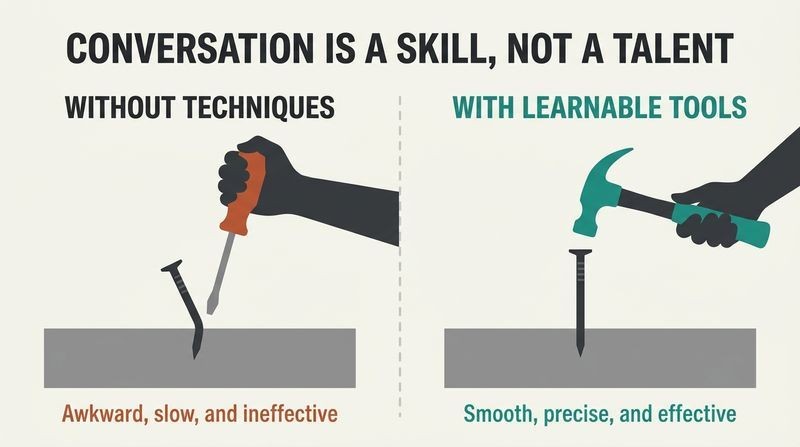
Conversation is a skill, not a personality trait. Garner rejects the popular belief that some people are simply born socially gifted while others are doomed to awkwardness. He compares conversational ability to using the right tool: trying to socialize without technique is like hammering a nail with a screwdriver. Slow, clumsy, and ineffective, no matter how hard you try.
Researchers in communication and psychology have isolated specific, teachable skills that drive social effectiveness, but these findings mostly stayed buried in academic journals. Over 50,000 students went through Garner's workshop learning them. The catch: reading alone changes nothing. Like skiing or bodybuilding, improvement demands consistent practice. Learn one skill, then use it immediately before moving to the next.
What's striking is how this reframing dissolves social anxiety at the root. If charisma is innate, a bad night is proof of permanent inadequacy. If it is a set of tools, a bad night is just a skills gap. This aligns with Carol Dweck's growth-mindset research: believing abilities are malleable improves performance. The book predates modern social-skills training for autism and social anxiety disorder, both of which validate Garner's core premise. One caveat: temperament matters more than Garner concedes. Introversion and social sensitivity are partly heritable, so the tools raise everyone's ceiling but do not erase individual differences in baseline comfort.
Swap closed questions for open ones to escape interrogation mode
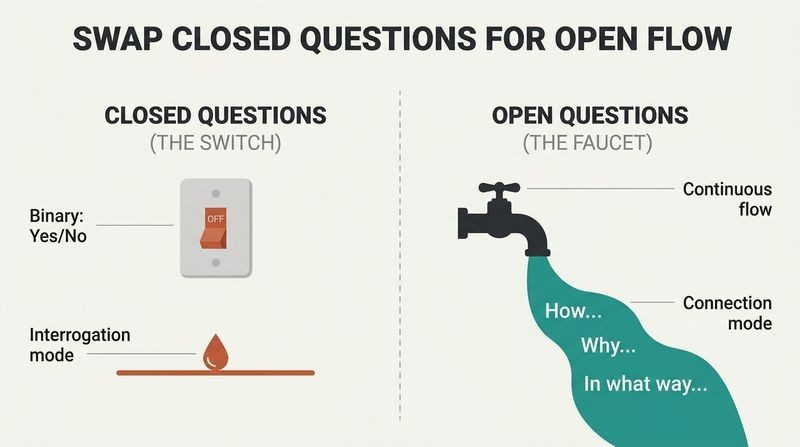
Open-ended questions turn faucets, not switches. Closed-ended questions ask for one or two words: "Where are you from?" or "Do you jog?" They pin down facts and positions but, used in sequence, make the other person feel like an FBI suspect. Garner opens with Scott, a contractor who fired question after question at neighbors and felt like an interrogator, and Lisa, who peppered Garner with a dozen disconnected closed questions.
The fix: follow closed questions with open ones that invite elaboration. Instead of jumping to a new topic, ask "How did you develop that idea?" or "What was the best part of growing up there?" Open questions typically start with how, why, or in what way. Two rules govern all of it:
1. Only ask when you genuinely want the answer.
2. Maintain dual perspective, considering the other person's interests, not just yours.
The faucet metaphor captures a real cognitive mechanism: open questions grant permission to expand, reducing the listener's uncertainty about how much to say. Modern journalists and therapists lean on the same principle. Notably, Garner warns against questions that are too open ("Tell me about yourself"), which paralyze rather than liberate, echoing the paradox of choice. His "dual perspective" anticipates what psychologists call theory of mind and perspective-taking, the engine of social intelligence. The cocktail-party bore who says "Enough about me, what do you think of me?" is the perfect caricature of its absence. The advice is timeless, though culturally calibrated: some cultures read rapid questioning as warmth, not interrogation.
Reward the behavior you want; ignore what you don't
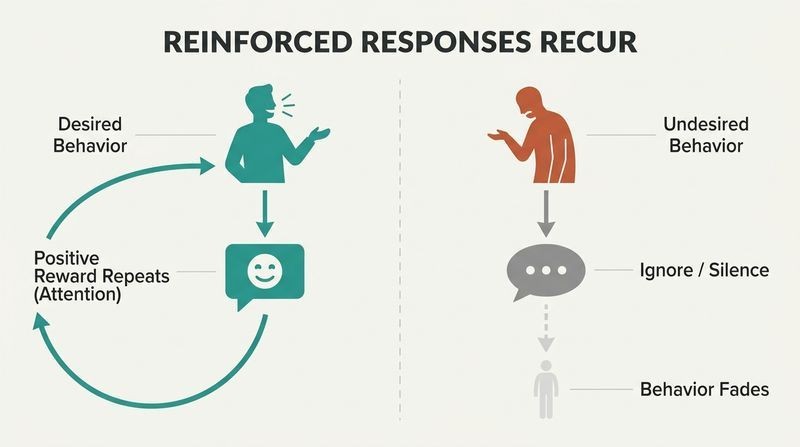
Reinforced responses recur. Drawing on behavioral learning theory, Garner argues that people treat you largely according to how you respond to them. Reward an action and it recurs; ignore it and it fades. Punishment backfires when someone craves attention, since negative notice beats none at all. He calls this the three Rs: reinforced responses recur.
He describes Tim, a chronically negative acquaintance. Garner smiled and asked questions when Tim was upbeat, and went quiet when Tim complained. Tim soon became cheerful around him. The contrast: parents who criticize endlessly, believing praise breeds laziness. Garner cites a mother who told her son that Phi Beta Kappa stopped meaning anything once he earned it. Such relentless negativity tends to produce anxious, self-doubting people who eventually give up rather than high achievers.
Garner applies operant conditioning to everyday relationships, which is both powerful and ethically slippery. The framing risks sounding manipulative, treating friends like pigeons in a Skinner box. Yet the underlying data holds: Gottman's marriage research found stable couples maintain roughly a 5-to-1 ratio of positive to negative interactions, strikingly close to Garner's thesis. The deeper insight is that most people run the opposite program, taking good behavior for granted and reserving attention for grievances, which inadvertently trains their loved ones toward conflict. One nuance: ignoring genuine distress, versus habitual negativity, can feel like abandonment. Garner's own example works only because Tim was not in real crisis.
Make compliments specific, personal, and easy to accept
Vague praise dies; specific praise lands. Garner calls straightforward compliments "direct positives" and upgrades them two ways: be specific and use the person's name. "Nice haircut" becomes "Alan, that layered styling really highlights your eyes." Specificity proves the praise applies to this person alone, and a name is, since Plato, the sweetest sound a person hears.
Because many people deflect compliments out of modesty, Garner adds a clever move: follow praise with a question. That gives the recipient something easy to do (answer) instead of squirming. To stay believable:
1. Start sparingly, then increase frequency.
2. Phrase praise conservatively at first.
3. Never compliment right before asking a favor.
4. Be mildly negative about trivial things.
5. Do not reflexively return the same compliment.
The compliment-plus-question technique is genuinely clever social engineering, defusing the awkward deflection reflex that kills positive exchanges. Garner's believability rules show sophistication about credibility: unrelenting positivity reads as flattery or agenda, so calibrated honesty carries more weight. This anticipates research on the "pratfall effect" and source credibility, where minor admitted flaws increase trustworthiness. The insistence on names finds support in studies showing personalized address boosts attention and compliance. A modern caution: in lower-context or professional settings, heavy name repetition can read as a sales tactic, exactly the manipulation Garner warns against. The line between warmth and technique is thin, and sincerity is the load-bearing wall.
Reflect back what you heard so people feel truly understood
Active listening confirms meaning, not words. Communication starts inside one person's head (encoding), travels through a noisy channel, and gets decoded by you, filtered through your expectations and biases. We hear half of what is said, listen to half of that, and remember half again. So misunderstanding is the default, not the exception.
Active listening means telling the speaker what their message means to you, then letting them confirm or correct it. Garner recounts a friend saying "maybe we won't still know each other by winter." Instead of assuming rejection, he asked what she meant. She wanted more time together. Two mistakes to avoid: parroting (mechanically rewording) and downplaying feelings. Reflect the emotion and content, not the vocabulary: "You're feeling frustrated, am I right?"
Active listening descends from Carl Rogers's client-centered therapy, where reflecting feeling builds the "unconditional positive regard" that lets people open up. Garner's genius is exporting a clinical tool into casual friendship and conflict. The encoding-decoding model he invokes is standard information theory (Shannon and Weaver), and his point that responses like "you shouldn't feel that way" shut people down is confirmed by research on emotional invalidation. The subtle payoff he names is underrated: active listening cures the tongue-tied, because focusing outward silences the anxious inner monologue about your own performance. The risk is mechanical overuse, which produces the parroting Garner explicitly flags as hollow.
Mine free information to keep any conversation alive
Every answer leaks extra data. Garner introduces "free information," the details people volunteer beyond what you literally asked. Ask where someone is from and they might add they just moved for a new job. That surplus is your runway for the next question or topic. He opens with Charlene, who runs out of things to say with a friend and plows every subject "into the dirt" until awkward silence forces an escape.
That dead-end is unnecessary. Listen for the volunteered fragment and follow it: someone mentions a tan, you ask about the camping trip they got it on. Free information also includes clothing, accents, and behavior, all valid launch points ("A Phillies shirt, are you from Philadelphia?"). Very few conversations stay on one topic more than a few minutes, and it is normal to hop between threads.
Free information reframes conversation as improvisation rather than interrogation, which lowers the cognitive load enormously. Improv comedians call this "yes, and": accept the offer, then build. The technique quietly solves the beginner's terror of "running out of things to say" by relocating the source of material from your own head to the other person's speech. Cognitively, it trains selective attention toward conversational hooks, a learnable perceptual skill. One limitation: pouncing on every stray detail can feel scattered or interrogative if not paired with genuine interest. The art is choosing which threads actually intrigue you, since feigned curiosity, Garner repeatedly stresses, eventually gets detected.
Reveal your feelings, not just facts, or seem cold and shallow
Self-disclosure moves through four deepening levels. People need to know you to care about you, and disclosure is how strangers become friends. It typically proceeds symmetrically, with both people revealing at similar rates, and passes through:
1. Clichés ("How's it going?")
2. Facts ("I'm a carpenter")
3. Opinions ("I prefer small towns")
4. Feelings ("I felt crushed when I lost that job")
Feelings give the deepest window into who you are. Garner shows Max, a banker whose vacation story ("we drove to Vegas, lost fifty dollars") bored everyone until he put himself in the scene: the thrill of a jackpot buzzer, clapping, feeling like a millionaire over $7.50. Avoid projecting a false image, which either attracts people to a mask or forces an exhausting charade. To stay believed, add names, dates, and vivid detail, and reveal a few negatives too.
Garner's four-level model mirrors Altman and Taylor's social penetration theory, where intimacy develops as disclosure moves from breadth to depth, like peeling an onion. His warning against the false self resonates with Winnicott's "true self versus false self": acceptance won under a mask can never feel like your own. The Vegas rewrite illustrates a craft point often missed, that emotional texture, not event summary, creates connection, which is why memoir beats resume. The reciprocity norm is well documented: disclosure invites disclosure. A modern caveat is calibration. Oversharing too fast (the "boundary crosser") repels rather than bonds, so symmetry and pacing, which Garner emphasizes, are doing quiet heavy lifting.
Openers barely matter; showing up and speaking does
What you say matters less than that you say something. Garner debunks the hunt for the perfect line. Research shows ordinary comments work fine; the real failure is staying silent. He confesses his own defeat: rehearsing brilliant openers for a woman on a bus, saying nothing, and watching her exit forever. You have only three topics (the situation, the other person, yourself) and three modes (ask, opine, state a fact).
Best practice: talk about the shared situation, since it provokes the least anxiety and invites involvement. Ask a question or offer an opinion rather than reciting a dead fact like "the bus is late," which leaves the other person no hook. Avoid negative openers; complaining about loud music sets a sour tone. Look for people who are alone, uncrossed, and glancing your way.
This is liberating precisely because perfectionism is the saboteur. The finding that opener content is nearly irrelevant matches later social-psychology work: warmth and approachability signals (smiling, open posture) carry more weight than verbal cleverness. Garner's three-topics-three-modes grid is a usable decision tree that beats freezing. The negativity warning has empirical backing, since first impressions anchor hard and negative affect is contagious. What the framework underplays is context: in dating or high-stakes networking, timing and nonverbal confidence dominate, and a genuinely funny or curious opener still outperforms "nice weather." Still, for the anxious majority, Garner's message is the right medicine: the flawed attempt beats the perfect thought never spoken.
Disarm criticism by asking for details, then agreeing
Defensiveness fails; a two-step response works. Garner catalogs four losing reactions to criticism: avoiding it, denying it, over-explaining excuses, and striking back. Each escalates conflict or forfeits useful information. His alternative has two moves.
First, ask for details like a reporter (who, what, when, where, how) to learn the real objection, since criticism arrives as vague generalities. Second, agree, using one of two forms: agree with the truth ("You're right, I did turn too sharply") or agree with the critic's right to an opinion ("I can see why you'd think that"). Both let you keep your position without branding anyone wrong. When hit with "you always" or "you never," agree with the accurate part and cite counter-evidence for the rest. Garner even improved his own course after a student's criticism surfaced through this method.
This framework, adapted from Manuel Smith's assertiveness work, is a masterclass in de-escalation. Asking for details reframes an attack as data-gathering, which cools the amygdala on both sides and often reveals the critic's true, unstated need (Garner's football-watching example exposed a friend who just wanted to play tennis). "Agreeing with the truth" resembles the modern therapeutic technique of validation and the negotiation tactic of tactical empathy in Chris Voss's work. It maps onto Transactional Analysis: staying in the "I'm okay, you're okay" position rather than getting dragged one-down or one-up. The limitation is that it assumes good faith; against a genuine bully, endless agreement can read as submission.
Beat manipulation by calmly repeating yourself like a broken record
Persistence meets persistence. When someone tries to wear you down through repeated asking, seductive reasons, and guilt, Garner deploys the "broken record" technique (developed by Zev Wanderer). After optionally asking for details and agreeing with whatever is true, you simply repeat your refusal in the same calm words, no matter what new argument comes.
In one dialogue, Genevieve keeps saying "I'd rather not collect from the neighbors" while Stan cycles through flattery, guilt, and appeals to charity. Each time she agrees with his point ("You're right, it would help you") then repeats her line. No one can argue with a broken record, so manipulators give up. Garner adapts a simpler version for teaching children to refuse drugs: stand straight, look the person in the eye, and repeat "No thanks" firmly, walking away under heavy pressure.
Broken record works because manipulation relies on generating novel counterarguments faster than you can rebut them; refusing to engage on the merits removes the oxygen. It short-circuits the "foot-in-the-door" and persistence-based compliance tactics documented by Cialdini. The pairing with agreement is what keeps it from sounding robotic or hostile, since you validate the person while holding the boundary. The drug-refusal application is prescient, anticipating decades of assertiveness-based prevention programs, though research on programs like DARE later showed that scripted refusal alone underperforms without broader social and emotional skills. Used bluntly, broken record can feel stonewalling, so Garner's insistence on genuine agreement plus warmth is essential to its non-abrasive power.
Own the problem with an "I have a problem" formula
Requesting change without triggering defensiveness. When your needs are unmet, passivity and aggression both fail. Garner offers a formula that starts by claiming ownership: whoever's needs are unmet owns the problem. Saying "I have a problem" instead of "you are inconsiderate" slashes the other person's defensiveness.
The template: "I have a problem. When you [specific behavior], [concrete consequence], and I feel [emotion]." For example: when clothes were left on the floor, I tripped, and I feel angry. Keep it specific and objective, avoid "always/never," skip guesses about motives, then pause and let them propose a solution. One manager thought no one ever offered solutions until she realized she gave only two seconds of silence; counting to twenty fixed it. If needed, add a direct request, and use repeated assertion, calmly restating your point when they deflect.
This is essentially Thomas Gordon's "I-messages" from Parent Effectiveness Training, and it remains the backbone of Nonviolent Communication (Marshall Rosenberg): observation, feeling, need, request. The mechanism is real, since "you" statements attack identity and provoke fight-or-flight, while "I" statements report data and stay hard to argue with. Garner's insistence on describing behavior objectively rather than inferring motive ("when you deliberately ignored me") is crucial, because mind-reading accusations reliably escalate conflict. The pause instruction is underrated behavioral wisdom: silence transfers responsibility. A limitation worth naming is that formulaic phrasing can sound scripted or therapized in real arguments; the skill is internalizing the structure until the words become your own.
Your anxiety comes from your beliefs, not the situation itself
Events don't cause emotions; beliefs do. Garner borrows from Albert Ellis and Aaron Beck: the same event produces different feelings in different people because of the beliefs between them. Big Al cheerfully approached woman after woman at Coney Island, shrugging off rejection, while Grant spent four years too terrified to speak to a classmate he adored, keeping only a secretly-taken photo. Same act, opposite emotions, driven by beliefs.
Four irrational belief patterns fuel social anxiety:
1. Copping out (blaming events for your feelings)
2. Catastrophizing (labeling a setback "horrible" and unsurvivable)
3. Overgeneralizing (calling yourself "shy" or "a failure" from limited evidence)
4. Demanding (rigid "shoulds" and perfectionism, what Ellis called "musturbation")
Challenge each by demanding proof. A rejection is unfortunate, not catastrophic. Failure, as one psychiatrist told Garner, is simply the price of success.
This is a clean popularization of Rational-Emotive Behavior Therapy and cognitive therapy, the ABC model where beliefs mediate between activating events and emotional consequences. It remains the empirical gold standard: CBT is among the most validated psychotherapies for social anxiety. Garner's applied twist is pairing cognitive restructuring with behavioral exposure, exactly how modern clinicians treat anxiety. The Big Al versus Grant contrast is a vivid natural experiment in attributional style. One nuance the framework can overstate: not all distress is distorted thinking, and some environments really are hostile, so relentlessly disputing feelings risks invalidating legitimate ones. Still, for the self-imposed prison of "everyone must like me," Garner's demolition is exactly right.
Turn vague dreams into concrete, weekly, self-scored goals
Cure the IFD Disease. Wendell Johnson's term names the trap: Idealization, Frustration, Demoralization. Chase a fuzzy goal like "be happier" and you cannot tell if you are succeeding, so you stall and quit. The remedy is concrete goals that are specific, verifiable, positive, measurable, and dependent only on your own action, not others' responses. "Get to know people" becomes "smile at five strangers daily and talk to one for two minutes."
Garner adds scaffolding: build an assertiveness hierarchy from easy to hard, break scary goals into subgoals, rehearse covertly (vividly imagine succeeding for five minutes a day), and reward yourself immediately on completion. Crucially, one study found assertive people habitually praise themselves while passive people criticize themselves, with no exceptions. So score success by whether you acted, not whether they said yes.
Garner's goal criteria anticipate SMART goals and the behavioral-activation core of modern therapy. Defining success as your action rather than others' reactions is quietly profound: it makes courage self-reinforcing and immunizes effort against outcomes you cannot control, echoing Stoic distinctions between what is and is not "up to us." Covert rehearsal is backed by sports-psychology research on mental practice, which measurably improves motor and social performance. The self-praise finding aligns with self-efficacy theory (Bandura): people who reward their own approximations persist longer. The hierarchy is graded exposure by another name. The one risk is over-engineering spontaneity, but for chronic avoiders, structure is precisely what dissolves the inertia that feeling alone never will.
Analysis
Conversationally Speaking is a 1980s self-help classic that succeeds by doing something unusual for its genre: it translates peer-reviewed communication and clinical psychology into plain, drillable technique. Garner is less an original theorist than a brilliant curator and popularizer. His toolkit is a greatest-hits compilation of mid-century behavioral and cognitive science: operant conditioning (Skinner), Rogerian reflective listening, social penetration theory, Thomas Gordon's I-messages, Manuel Smith's assertiveness training, and above all Ellis and Beck's cognitive therapy. What makes the book durable is not novelty but integration and sequencing. He organizes disparate findings into a coherent progression from opening a conversation, to deepening it, to defending yourself within it, to executing behavior change against internal anxiety.
The book's deepest and most defensible claim is philosophical: social competence is a skill, not a fixed trait, and skills yield to deliberate practice. This anti-essentialism was ahead of its time and has since been vindicated by growth-mindset research and the entire evidence base for social-skills training. Garner's second great contribution is treating anxiety and technique as a single system. He understands that knowing what to say is useless if catastrophizing beliefs prevent you from saying it, so he fuses cognitive restructuring with graded behavioral exposure, which is precisely how contemporary clinicians treat social anxiety disorder.
The book's limitations are the flip side of its strengths. Its relentless instrumentalism can feel manipulative, reducing warmth to reinforcement schedules and scripted formulas, and Garner's repeated insistence on sincerity functions as a necessary corrective he never fully reconciles with the mechanics. The examples are dated and heteronormative, and the framework underweights temperament, culture, and power asymmetry. Broken record and endless agreement assume a broadly cooperative social world. Yet for its target reader, the lonely, avoidant, or socially clumsy person convinced they simply lack the gene for connection, the book delivers exactly what it promises: proof that the gene does not exist, and a practice plan to replace it.
Review Summary
Conversationally Speaking receives mostly positive reviews, with readers praising its concise, practical advice on improving social skills. Many find the techniques helpful for overcoming shyness and anxiety in social situations. The book is commended for its clear examples and actionable tips. Some readers note that while the content may be common sense for socially adept individuals, it's particularly beneficial for those struggling with conversations. A few criticisms mention outdated references and occasionally awkward examples.
People Also Read










Glossary
Free information
Volunteered details beyond your questionThe extra data people offer beyond what you literally asked for, such as mentioning a new job when asked where they live. Garner treats these fragments as launch points to keep conversation flowing and shift topics naturally, since spotting and following up on them removes the fear of running out of things to say.
Direct positive
Straightforward, specific complimentGarner's term for a compliment that plainly states what you appreciate about someone's behavior, appearance, or possessions. Strengthened by being specific, including the person's name, and following it with a question so the recipient can answer instead of awkwardly deflecting the praise.
Active listening
Reflecting back a speaker's meaningTelling a speaker what their message means to you, then letting them confirm or correct it. It ensures accurate decoding of emotionally charged or ambiguous statements, demonstrates acceptance without judgment, and keeps conversation going. Distinct from parroting, which merely rewords; true active listening reflects the underlying feeling and content.
Dual perspective
Considering the other person's interestsThinking not only about what you want to say and hear but also about the other person's interests and needs. Garner treats it as foundational to every skill in the book, from choosing questions to issuing invitations, and the opposite of the self-absorbed bore.
Broken record
Calmly repeating a refusalA manipulation-resistance technique developed by Zev Wanderer in which you agree with whatever is true in the other person's argument while calmly repeating your refusal in the same words, regardless of new pressure. Because there is nothing to argue against, persistent manipulators eventually give up.
Copping out, catastrophizing, overgeneralizing, demanding
Four irrational anxiety-causing beliefsGarner's four categories of self-defeating beliefs drawn from Ellis and Beck. Copping out blames events for your feelings; catastrophizing labels setbacks horrible and unsurvivable; overgeneralizing pins global labels like "shy" from thin evidence; demanding imposes rigid shoulds and perfectionism. Challenging each with evidence reduces social anxiety.
SOFTEN
Six nonverbal warmth signalsAn acronym from Arthur Wassmer for the nonverbal behaviors that signal openness and interest: Smile, Open posture, Forward lean, Touch, Eye contact, Nod. Garner adds that performing these outward behaviors can trigger the corresponding inner feelings via cognitive dissonance.
IFD Disease
Idealization, frustration, demoralization cycleCoined by Wendell Johnson, the trap of pursuing vague idealistic goals without concrete form. Idealization leads to repeated Frustration because you cannot measure progress, ending in Demoralization and giving up. Garner's cure is setting concrete, measurable goals that depend only on your own action.
Reinforced responses recur (three Rs)
Rewarded behavior increases in frequencyGarner's shorthand for behavioral learning theory applied to relationships: actions you reward tend to increase, actions you ignore tend to fade, and punishment can backfire when someone craves attention. Rewarding desired behavior is more effective than punishing undesired behavior.
FAQ
What's "Conversationally Speaking" about?
- Purpose of the book: "Conversationally Speaking" by Alan Garner is designed to teach readers effective conversation skills to improve personal and social effectiveness.
- Skill development: The book focuses on practical skills that can be learned and applied in everyday interactions to enhance communication and build better relationships.
- Research-based techniques: It draws on research from communication and psychology to provide evidence-based strategies for improving conversational abilities.
Why should I read "Conversationally Speaking"?
- Improve social skills: The book offers tools and techniques to help you become more effective in social situations, making it easier to connect with others.
- Practical advice: It provides actionable steps and exercises that can be immediately applied to real-life interactions.
- Build confidence: By mastering the skills in the book, you can increase your confidence in starting and maintaining conversations.
What are the key takeaways of "Conversationally Speaking"?
- Conversation skills are learnable: The book emphasizes that effective conversation is not an innate talent but a skill that can be developed.
- Importance of active listening: Understanding and reflecting on what others say is crucial for meaningful interactions.
- Use of open-ended questions: Asking questions that encourage elaboration can keep conversations engaging and informative.
How does "Conversationally Speaking" suggest handling criticism constructively?
- Ask for details: When criticized, seek specific information to understand the other person's perspective.
- Agree with the truth: Acknowledge any valid points in the criticism to show openness and willingness to improve.
- Use constructive dialogue: Engage in a conversation that focuses on resolving the issue rather than becoming defensive.
What is the "SOFTEN" technique in "Conversationally Speaking"?
- Acronym meaning: SOFTEN stands for Smile, Open posture, Forward lean, Touch, Eye contact, and Nod.
- Purpose: It is a set of nonverbal behaviors designed to express interest and warmth in conversations.
- Application: By consciously using these behaviors, you can make others feel more comfortable and valued during interactions.
How does "Conversationally Speaking" recommend starting conversations?
- Focus on the situation: Use the current environment or context as a conversation starter.
- Talk about the other person: Show interest in the other person by asking questions about them.
- Be casual and open: Approach conversations with a relaxed attitude to make others feel at ease.
What are some common mistakes in asking questions according to "Conversationally Speaking"?
- Leading questions: Avoid questions that suggest a desired answer, as they can limit genuine responses.
- Questions that are too open-ended: Extremely broad questions can overwhelm the other person and lead to vague answers.
- Ignoring free information: Failing to follow up on details provided by the other person can stall the conversation.
How does "Conversationally Speaking" suggest using self-disclosure effectively?
- Be reciprocal: Share information about yourself to encourage others to open up in return.
- Start with facts and opinions: Gradually move from sharing basic facts to expressing opinions and feelings.
- Avoid projecting a false image: Be honest and authentic to build trust and meaningful connections.
What is the "Broken Record" technique in "Conversationally Speaking"?
- Definition: A method for resisting manipulation by calmly and persistently repeating your position.
- Application: Use it when someone tries to pressure you into doing something you don't want to do.
- Effectiveness: It helps maintain your stance without escalating the situation or becoming defensive.
What are the best quotes from "Conversationally Speaking" and what do they mean?
- "The deepest principle in human nature is the craving to be appreciated." This quote highlights the importance of acknowledging and valuing others in conversations.
- "Failure is the price you pay for success." It emphasizes that making mistakes is a natural part of learning and improving social skills.
- "Men are disturbed, not by things, but by the views they take of them." This quote underscores the book's focus on changing beliefs to reduce anxiety and improve interactions.
How does "Conversationally Speaking" address reducing anxiety in social situations?
- Challenge irrational beliefs: Identify and dispute beliefs that cause anxiety, such as catastrophizing or overgeneralizing.
- Use rational self-talk: Replace negative thoughts with realistic and positive affirmations.
- Practice covert rehearsal: Mentally rehearse social interactions to build confidence and reduce nervousness.
What is the process of setting concrete goals in "Conversationally Speaking"?
- Specific and measurable: Goals should be clear and quantifiable to track progress effectively.
- Positive focus: Frame goals in terms of increasing desired behaviors rather than eliminating negative ones.
- Action-oriented: Ensure goals depend solely on your actions, not on the responses of others.
Download PDF
Download EPUB
.epub digital book format is ideal for reading ebooks on phones, tablets, and e-readers.








































