


Key Takeaways
Name what you want, then claim it with unwavering belief
The core game is deceptively simple. Helene Hadsell claimed she submitted a winning entry for every contest prize she ever actually wanted: outboard motors, bicycles, a Hammond organ, six trips to Europe, and a fully furnished dream home from Formica (chosen from over two million entries). Her explanation was not luck, connections, or writing talent. She had none of those.
Winners share three mental moves. Studying consistent winners, she found they all:
1. Decide precisely what they want
2. Imagine they already have it
3. Know with calm certainty it will come
Most people fail because they scatter desire across too many wishes, generating no concentrated energy. The book reframes winning as a repeatable inner discipline anyone can practice, using contests merely as a visible scoreboard for a much larger claim: that thought shapes outcome.
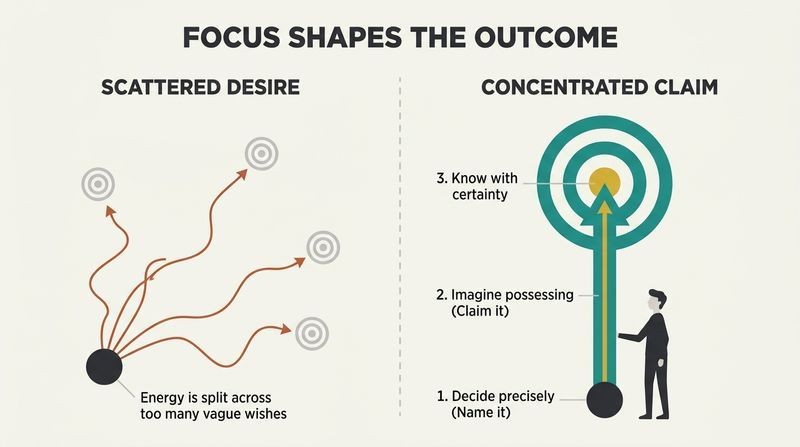
What's striking is how neatly Hadsell's 1971 formula anticipates the language of modern goal science. The idea that vague, shifting wants sabotage results echoes research on goal specificity by Locke and Latham, who found specific, committed goals reliably outperform "do your best" intentions. Her scoreboard is clever: contests supply fast, binary feedback (you win or you don't), which is exactly what habit and skill acquisition require. The obvious caution is survivorship bias. Millions entered those same sweepstakes with fervent belief and won nothing. Hadsell's account cannot separate genuine mental causation from selective memory. Still, as a practical posture, clarity plus expectancy plus action costs little and sharpens attention toward opportunities the distracted miss.
Run your goals through SPEC: Select, Project, Expect, Collect
SPEC is Hadsell's four-step engine. It works for anything physical, mental, or spiritual, not just prizes:
1. Select one clear goal so your energy stops scattering
2. Project it by vividly picturing the finished result, never the getting-there
3. Expect it as though it is already yours
4. Collect it, the joyful payoff
Project the end, not the process. Her metaphor: a rain dance visualizes rain hitting the ground, not clouds slowly gathering. A healer pictures the patient already whole. One Dallas woman built a cardboard "wheel of fortune" with cut-out pictures (a car, a couple holding hands, an organ, a nest egg marked $5,000) placed on her TV, car dash, desk, and nightstand. Within a year she got the car, remarried, received an organ, and won $10,000.
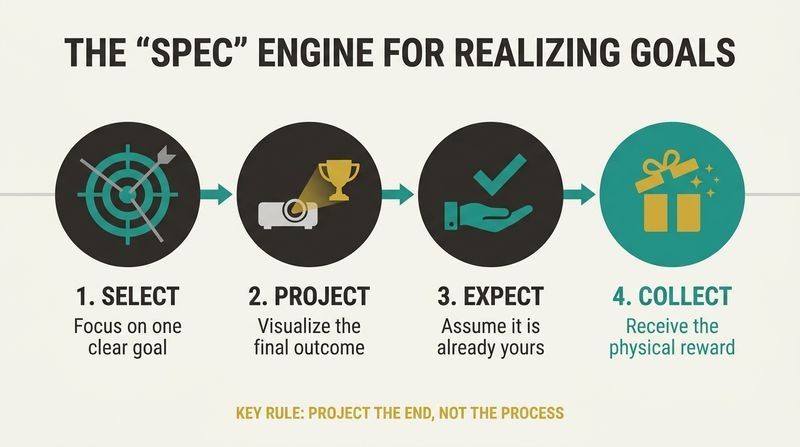
SPEC is essentially a mnemonic wrapper around visualization and expectancy, and its emphasis on imagining the outcome rather than the path has real cognitive teeth. Research by Pham and Taylor found that students who mentally rehearsed the outcome of an exam (getting a good grade) actually studied less and performed worse, while those who rehearsed the process studied more. That is a genuine tension with Hadsell's "see only the end result" rule. The reconciliation is that her fourth step quietly smuggles process back in: she insists you take physical action to signal seriousness. SPEC works best read as outcome-vision to sustain motivation, paired with process-behavior to actually deliver.
Doubt short-circuits desire, so refuse to entertain it
One negative thought cancels the current. Hadsell's second rule after setting a goal is to never entertain doubt, because it nullifies the positive energy you have accumulated. When she won her first outboard motor, she refused every skeptical script: the contest is rigged, only clever people win, I'm not lucky. Instead she rehearsed a single question: "I wonder when they'll tell me I've won?"
She witnessed doubt in action. In a TV studio audience, a mother and daughter who had entered contests for years without winning wanted a color TV and a refrigerator. Their problem was not pessimism but a sliver of doubt that leaked out their positive charge. Hadsell coached them to stay passive until their exact prize appeared, then to "know" they were chosen. Both won.
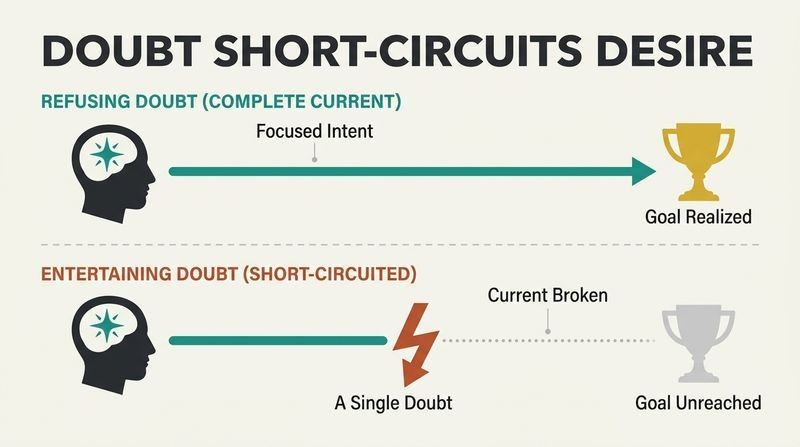
The mechanism here maps onto what psychologists call approach versus avoidance framing. Doubt directs attention toward failure scenarios, and attention is a scarce resource; time spent rehearsing "it's probably rigged" is time not spent noticing and acting on live opportunities. There is also an emotional-regulation angle: anxiety narrows cognition and degrades performance, a finding well established in test-anxiety literature. Where Hadsell overreaches is the implication that doubt magically leaks energy into the cosmos and blocks results. A more defensible reading is behavioral: chronic doubters enter fewer contests, quit sooner, and self-select out. Her own studio anecdote is unfalsifiable, but her prescription (starve the negative script) is sound attention hygiene.
Distinguish anxious Desire from the calm certainty of Knowing
These two feelings produce different outcomes. Hadsell defines Desire as excited anticipation, the jittery hope where you watch three of four lottery numbers hit and nearly explode, then miss. Knowing is calm assurance: all anxiety gone, the thing already done, only the physical delivery remaining. Desire means you have not yet projected enough energy. Knowing means you have.
A sigh gave it away. A businesswoman desperate to win a cruise to save her marriage told Hadsell she wanted it "so badly I can taste the salt water." After Hadsell assured her the cruise was already hers, the woman exhaled, and a calmness settled over her. She won it that night. Hadsell's warning: do not quit your job on Desire alone. Wait until you truly Know the difference, or you will act foolishly.
This is the book's most psychologically sophisticated distinction. It resembles the difference between anxious striving and what sport psychologists call quiet competence or flow: elite performers describe a settled, almost detached certainty rather than frantic wanting. It also rhymes with self-determination theory's contrast between ego-involved, outcome-anxious motivation and secure intrinsic engagement. The felt sense of a released sigh is a plausible somatic marker of a shift from sympathetic arousal to parasympathetic calm. The risk is circular reasoning: if you win you "Knew," if you lose you merely "Desired." Hadsell's practical guardrail (don't bet the mortgage on a feeling) shows she grasped the danger of confusing emotional confidence with actual probability.
You can talk yourself into anything through sheer repetition
Con yourself, deliberately and out loud. Hadsell's third step is that repeating an idea over and over eventually installs it in your thinking. She was terrified of flying and vowed never to accept a trip prize. When she began winning trips anyway, she launched what she jokingly called her "Die As You Fly" program, repeating that planes were safe and flying would be fun until the fear dissolved mid-flight.
Repetition is a teaching tool, not a trick. Her friend Dr. Joseph Murphy, who wrote over forty books on the mind, repeated identical examples across titles. His reasoning: if people read something forty-two times, they might finally absorb it. Hadsell cites research that we retain only about 2% of information after sixteen days, but hearing something six or more times lifts recall dramatically. She urged recording a fifteen-minute affirmation tape and playing it nightly for a month.
Hadsell intuited what neuroscience later formalized: repeated activation strengthens neural pathways, the principle behind "neurons that fire together wire together." Her affirmation-tape prescription overlaps with contemporary work on self-talk and cognitive restructuring in CBT, where deliberately rehearsed reframes gradually override automatic negative thoughts. The exposure element of "Die As You Fly" is legitimate psychology: repeatedly facing a feared stimulus while surviving it is textbook exposure therapy for phobias, though clinicians would add that avoidance, not the flight itself, sustains fear. Where affirmations get shaky is the evidence that repeating statements you don't believe ("I am wealthy") can backfire for low-self-esteem individuals, per research by Joanne Wood. Repetition works best when paired with plausibility and action.
Prove you mean it: prepare physically and sacrifice something
Act as if the win is already booked. Hadsell insists on physical action that signals seriousness to the subconscious. Her son Dike got his passport and vaccinations before being notified he had won a European tour. She calls this "prepare for your good." When she projected for a microwave for the lake cabin, she had her husband extend the counter and match the laminate so the oven would have a home when it arrived. It came February 22nd.
Deprivation as a signal. She recommends giving up a small pleasure until the goal manifests. One woman kept her TV off for weeks until unexpected repair money arrived. Another walked fifteen minutes daily on her treadmill, smelling the new-car interior in her mind, until she won a car three months later. Skip the ritual, she warns, and you tell your subconscious you never really cared.
This is where Hadsell quietly rescues her own philosophy from pure wishful thinking. Preparing a passport, clearing counter space, or completing a daily discipline are commitment devices, a concept from behavioral economics (Thaler and Shefrin) where present actions lock in future intentions. Such acts also generate what psychologists call behavioral confirmation: prepared people notice and seize relevant opportunities faster. The treadmill and TV-off rituals function as costly signals, aligning identity with goal. The weakness is attribution. Nothing proves the empty counter caused the microwave win rather than simply the dozens of entries she mailed. Still, "do something concrete or admit you don't want it" is bracing, testable, and immune to armchair fantasizing.
Treat quiet hunches as instructions and act on them
Follow the whisper even when logic objects. Hadsell claims her intuition paid off ten times out of ten. On a rainy day she felt compelled to drive nineteen miles to register for the Formica dream home despite two friends refusing to join her; she registered, sat in the model home, and simply knew she would win it. When one auto dealer failed to notify her of a grocery-certificate prize she was certain she had won, a hunch of dishonesty pushed her to phone repeatedly until the manager, cornered, admitted "Helene Hadsell" had won. The prize arrived, postmarked after her call.
Capture hunches before they fade. She kept a notebook and pen by her bed and in the car to jot a keyword the moment an impression struck, exploring it later. The inner voice is quiet, she says, so you must practice hearing it.
Hadsell's faith in hunches aligns with Gary Klein's research on expert intuition, where firefighters and nurses make accurate split-second calls from pattern recognition they cannot consciously articulate. Intuition is often compressed expertise, and after years of studying contest rules and odds, her gut may have encoded real signal. Her note-taking habit is genuinely smart: fleeting insights decay fast, and externalizing them mirrors techniques used by prolific creatives. The obvious counterweight is Daniel Kahneman's work showing intuition is also where systematic biases live, and "ten out of ten" almost certainly reflects forgotten misses. The healthiest synthesis: log hunches, act on the low-cost ones, but verify before betting anything expensive.
Never impose your win on another person; claim, don't manipulate
Rig nothing and no one. Hadsell is firm that you never need to control another person to get what you want. If you covet your boss's job, do not fantasize about him being fired; simply affirm "I desire the perfect job with perfect pay" and let the path arrange itself, whether by his transfer or a better offer elsewhere. Willing harm onto others is a hard "no" in her ethics.
Sow honestly, reap accordingly. She frames the universe as self-balancing: as you sow, so shall you reap. She also learned discretion socially, coining "no braggin' before baggin'." When she flaunted her son's essay to dinner guests before he won, it aroused suspicion she had pull. Later she refined her practice toward projecting only for a person's "highest good," adding "if it's meant to be," acknowledging she cannot know what another soul came to learn.
The ethical guardrail elevates the book above pure acquisitiveness. "Claim, don't manipulate" resembles the distinction in negotiation and leadership between influence and coercion, and the "highest good" caveat introduces genuine humility rare in manifestation literature, which often treats other people as obstacles or props. There is also practical wisdom in "no braggin' before baggin'": announcing goals prematurely can, per Peter Gollwitzer's research on identity goals, create a false sense of completion that saps follow-through. Where the reasoning is thinnest is the cosmic-justice claim that dishonesty always boomerangs; the world offers ample counter-evidence. But as a personal operating principle rather than a physical law, the restraint is admirable and self-protective.
The mind can override the body's pain and even bleeding
She tested belief under trauma. After a head-on collision on an icy bridge crushed her nose and left her swallowing blood, Hadsell used a Silva Mind Development technique to command the bleeding to stop, and credits it with saving her from bleeding out or dying of panic. Once the surgical anesthetic wore off, she refused pain medication for two weeks, mentally converting each throb into a "healing, healing, healing" pulse.
Pain comes in cycles, not constants. She noticed pain arrives in waves rather than steady agony, and that deep relaxation shrank its intensity. Decades later, facing bladder surgery, she told a baffled oncologist she would stop the bleeding herself, declined the self-medication button, and left the hospital in three days. She points to firewalkers and human pincushions as proof that disciplined thought can refuse pain.
The stronger, evidence-backed core here is real: expectation powerfully modulates pain. The placebo response is genuine neurochemistry, releasing endogenous opioids, and relaxation, attention redirection, and reframing are validated components of clinical pain management and childbirth programs like Lamaze. Reappraising throbbing as "healing" is essentially cognitive reframing, which measurably lowers perceived pain. The extraordinary claim, consciously stopping arterial bleeding by command, strains credibility; hemostasis is largely involuntary, and the body's own clotting plus the reduced blood pressure of a calm, non-panicked victim likely did the work she attributes to will. The safe, transferable lesson is that fear amplifies suffering, so a trained, relaxed mind genuinely eases it, without abandoning surgeons when you need them.
Make your goal unavoidable to see: build a wheel of fortune
Put your desire where your eyes keep landing. Because the subconscious thinks in images rather than words, Hadsell urges cutting out pictures of what you want and posting them everywhere you look, an early vision board she called a "wheel of fortune." On New Year's Day she listed her targets (a microwave, a white car with blue upholstery, a Hawaii trip, cash) and taped bold index cards to her car dashboard and desk. Each glance triggered a twenty-to-thirty-second visualization of already owning the item.
Specificity feeds the picture. She did not want just a car; she wanted white with blue interior until she could "smell the newness." She encouraged her grandson through coloring contests the same way, having him picture opening the envelope and finding a check. He won $100 three months later.
The visible-cue tactic is behaviorally shrewd regardless of any metaphysics. Environmental design shapes behavior more reliably than willpower, a central finding in habit research: what you see, you think about, and what you think about, you pursue. Posted reminders combat the simple problem that goals fade from working memory amid daily noise. The vividness rule, engaging smell and touch, aligns with imagery research showing multisensory mental rehearsal is more motivating and memorable than abstract wishing. The honest caveat, supported by Gabriele Oettingen's work, is that fantasizing about having the prize can drain the energy to earn it unless paired with confronting obstacles. Hadsell's saving grace is that she always mailed dozens of real entries alongside the daydream.
Belief needs legwork: enter often, follow rules, spread your mailings
Energy still requires postage. Hadsell insists winning takes patience, persistence, and postage, and warns that luck is "a rubber crutch" that collapses when you lean on it. She entered constantly, sometimes fifty entries for a coveted trip, and treated it as a system: pre-address stacks of envelopes during TV time, log every stamp and expense on a giant calendar for taxes, and charge each envelope with a winning thought as she mailed it.
Understand the machinery. Because sweepstakes draws were made by a blindfolded person pulling from numbered mail sacks, she spread her entries across the entry window rather than dumping them at once, aiming to land in multiple sacks. Roughly five in a hundred selected winners get disqualified for breaking rules: wrong paper size, cursive instead of printing, missing information. Her mantra: follow the rules exactly.
This chapter grounds the whole book, revealing Hadsell as a shrewd operator, not merely a mystic. The insight that most entries flood in during the final two weeks, so early and staggered mailing improves sack diversity, is genuine probabilistic thinking about how draws actually worked. Her disqualification statistic reframes "belief" into rigorous execution: reading fine print, using exact 3x5 paper, printing legibly. This is the manifestation genre's quiet secret, that its winners are usually also its hardest, most systematic workers. The volume strategy alone (fifty entries versus one) mathematically multiplies odds independent of any mindset. Read cynically, her metaphysics may be the motivating story she told herself to sustain unglamorous, high-volume diligence, which is arguably the real engine.
Analysis
Helene Hadsell's book, first published in 1971 and lovingly reissued by contest expert Carolyn Wilman, sits at the crossroads of Depression-era American optimism and the New Thought tradition that runs from Norman Vincent Peale back to Napoleon Hill. Its genius is packaging an abstract metaphysical claim (thought creates reality) inside a concrete, falsifiable hobby (winning sweepstakes). Contests give her philosophy a scoreboard, which is precisely what most manifestation literature lacks. When she says she won a dream home, an organ, and six European trips, the reader can at least picture the mechanism.
The book's enduring value is not its cosmology but its behavioral architecture. Strip away the spirit guides and the 72-hour energy claims, and SPEC reduces to a disciplined loop: choose one specific goal, rehearse the outcome vividly, act as if it is coming (prepare, sacrifice, enter in volume), and follow the rules meticulously. Modern psychology validates most of these moves independently: specific goals beat vague ones, environmental cues beat willpower, exposure dissolves phobias, reappraisal eases pain, and commitment devices convert intention into action. Hadsell arrived at these intuitively, decades before the research.
The honest critique is unfalsifiability and survivorship bias. "No failures, only delays" makes the theory unbreakable: a loss is never disconfirmation, merely a postponed win. Every hit is remembered, every miss forgotten or reframed. Her most extraordinary claims, telepathically steering game shows and stopping arterial bleeding by command, strain credulity and cannot be separated from selective recall.
Yet the practical posture is low-cost and quietly powerful. Clarity, expectancy, preparation, and persistence cost little and reliably improve outcomes through attention and effort, whatever one believes about the universe. Wilman's framing lands the truest note: this is a game, and the instruction is to play it with joy while releasing attachment to how and when the prize arrives.
Review Summary
Readers praise Contesting for its inspiring message on positive thinking and manifesting desires. Many found Hadsell's contest-winning experiences fascinating, though some felt the book lacked depth in explaining techniques. The SPEC method (Select, Project, Expect, Collect) is highlighted as a key concept. While some reviewers noted repetitive storytelling, most appreciated the book's motivational value. Several mentioned applying the principles to their own lives, with mixed results. Overall, readers recommend it for those interested in the power of positive thinking and manifesting goals.
People Also Read





Glossary
SPEC
Select, Project, Expect, CollectHadsell's four-step method for reaching any goal. Select one clear desire, Project it by vividly picturing the finished result (never the process), Expect it as though already yours, and Collect it. She stresses seeing only the end state, taking physical action to prove seriousness, and loving unconditionally during the Collect phase.
WISHcraft
Manifesting through directed positive energyHadsell's playful term (a pun on witchcraft) for consciously using focused, positive mental energy to attract desired outcomes. She frames it as harmless and lawful: prizes exist for anyone who wants them, and the person who projects the strongest positive energy claims them, while others retain free will.
Desire versus Knowing
Anxious wanting versus calm certaintyHadsell's distinction between two internal states. Desire is excited, anxious anticipation signaling insufficient projected energy. Knowing is calm, cool assurance that the outcome is already accomplished, with only physical delivery remaining. She warns against acting rashly (like quitting a job) on mere Desire before you can feel true Knowing.
No failures, only a delay in results
Setbacks are postponements, not defeatsHadsell's central mantra that reframes every apparent loss as a timing issue rather than a failure. As long as you keep projecting energy toward a goal, results are guaranteed eventually; the only variable is how long manifestation takes based on the energy and thought directed at it.
Wheel of Fortune
Early picture-based vision boardA homemade collage of cut-out pictures depicting one's goals, placed in high-visibility spots (TV, car dashboard, nightstand) to trigger frequent visualization. Because the subconscious works in images, glancing at it and imagining already owning each item continually feeds energy toward the goal until it manifests.
Effective Sensory Projection
Hadsell's redefinition of ESPHadsell reinterprets ESP not as rare extrasensory perception but as Effective Sensory Projection: simply projecting energy toward an end result by picturing yourself already having it. She argues anyone can do it, alongside Effective Sensory Perception, meaning heightened everyday awareness of people and surroundings.
Silva Mind Development
José Silva's mental-training courseA 48-hour course by José Silva teaching relaxation into the Alpha brain state, mental imagery for health and memory, intuition, and pain and bleeding control. Hadsell studied it in the early 1970s, credits it with helping her survive a car crash and later surgery, and cites it as the source SPEC was derived from.
Die As You Fly
Repetition to conquer fearHadsell's self-coined program for overcoming her fear of flying by repeatedly affirming that planes are safe and flying is enjoyable until the fear died during the actual experience. A practical illustration of her broader principle that you can 'con yourself into anything' through persistent repetition.
FAQ
What's "Contesting: The Name It & Claim It Game" about?
- Overview: "Contesting: The Name It & Claim It Game" by Helene Hadsell is a guide on how to win contests using positive thinking and mental projection techniques.
- Personal Success Story: The book is based on Hadsell's personal experiences, where she won every contest she entered, including a fully furnished home.
- Philosophy: It emphasizes the power of the mind and the importance of setting clear goals, visualizing success, and maintaining a positive attitude to achieve desired outcomes.
Why should I read "Contesting: The Name It & Claim It Game"?
- Practical Techniques: The book offers practical techniques for winning contests, which can be applied to other areas of life to achieve success.
- Inspiration: Helene Hadsell's success story serves as an inspiration for readers to believe in the power of positive thinking and mental projection.
- Life Skills: Beyond contesting, the book teaches valuable life skills such as goal setting, visualization, and maintaining a positive mindset.
What are the key takeaways of "Contesting: The Name It & Claim It Game"?
- SPEC Method: The book introduces the SPEC method—Select It, Project It, Expect It, Collect It—as a framework for achieving goals.
- Positive Thinking: Emphasizes the importance of positive thinking and visualization in manifesting desired outcomes.
- Persistence: Highlights the need for persistence and patience, as there are no failures, only delays in results.
What is the SPEC method in "Contesting: The Name It & Claim It Game"?
- Select It: Choose a clear and specific goal you want to achieve.
- Project It: Visualize yourself already having achieved the goal, using mental imagery and positive energy.
- Expect It: Maintain a calm assurance that the goal will manifest, without anxiety or doubt.
- Collect It: Be ready to receive the outcome, and take action when opportunities arise.
How does Helene Hadsell define success in "Contesting: The Name It & Claim It Game"?
- Personal Definition: Success is defined by each individual's personal goals and desires, whether it's material wealth, health, or personal fulfillment.
- Mindset: A successful person is one who cultivates and controls a positive attitude, leading to the manifestation of their goals.
- No Failures: Hadsell emphasizes that there are no failures, only delays in results, encouraging persistence and patience.
What are the best quotes from "Contesting: The Name It & Claim It Game" and what do they mean?
- "You’ll see it when you believe it." This quote emphasizes the power of belief in manifesting desired outcomes.
- "There is never any failure. Only a delay in results." Encourages persistence and patience, suggesting that setbacks are temporary.
- "Thoughts are things." Highlights the idea that thoughts have the power to shape reality and influence outcomes.
How does Helene Hadsell use visualization in her contesting strategy?
- Mental Imagery: Hadsell uses mental imagery to visualize herself already having won the contest or achieved the goal.
- Daily Practice: She incorporates visualization into her daily routine, reinforcing her goals with positive energy.
- End Result Focus: Focuses on the end result, rather than the process, to maintain a clear vision of success.
What role does positive thinking play in "Contesting: The Name It & Claim It Game"?
- Foundation of Success: Positive thinking is the foundation of Hadsell's success, enabling her to overcome doubts and setbacks.
- Energy Projection: Positive thoughts are seen as a form of energy that can be projected to influence outcomes.
- Mindset Shift: Encourages readers to shift from a mindset of doubt and negativity to one of confidence and positivity.
How can I apply the lessons from "Contesting: The Name It & Claim It Game" to my life?
- Goal Setting: Clearly define what you want to achieve and set specific goals.
- Visualization: Regularly visualize yourself achieving your goals, using mental imagery to reinforce your desires.
- Positive Attitude: Maintain a positive attitude, focusing on possibilities rather than limitations.
What is the difference between desire and knowing in "Contesting: The Name It & Claim It Game"?
- Desire: Described as excited anticipation, often accompanied by anxiety and impatience.
- Knowing: A calm assurance that the goal will manifest, without doubt or anxiety.
- Emotional State: Knowing is a more stable and confident emotional state, while desire can be more volatile.
How does Helene Hadsell address setbacks and failures in her book?
- No Failures: Hadsell emphasizes that there are no failures, only delays in results, encouraging persistence.
- Learning Opportunities: Setbacks are seen as learning opportunities and part of the journey to success.
- Positive Reframing: Encourages reframing setbacks in a positive light, maintaining focus on the ultimate goal.
What are some practical tips for entering contests from "Contesting: The Name It & Claim It Game"?
- Follow the Rules: Carefully read and follow the contest rules to ensure eligibility.
- Consistent Entry: Enter contests consistently and regularly to increase chances of winning.
- Creative Entries: Use creativity in entries, such as unique designs or thoughtful responses, to stand out.
Download PDF
Download EPUB
.epub digital book format is ideal for reading ebooks on phones, tablets, and e-readers.








































