


Key Takeaways
Your childhood wounds were installed, not inherited, so they can be uninstalled
CPTSD comes from nurture's absence, not bad genes. Pete Walker, a therapist who treated trauma survivors for three decades and lives with CPTSD himself, defines Complex PTSD as a more severe cousin of PTSD, caused by prolonged childhood abuse or abandonment rather than a single adult catastrophe. Because it is a learned set of survival responses, it can be unlearned.
It hides behind other labels. Walker argues survivors are routinely misdiagnosed with bipolar, borderline, ADHD, or panic disorder, which frame the problem as an innate character defect rather than an adaptation to danger. He compares treating CPTSD as "panic disorder" to calling food allergies chronically itchy eyes: you medicate the surface and leave the root untouched. Five features distinguish it: emotional flashbacks, toxic shame, self-abandonment, a vicious inner critic, and social anxiety.
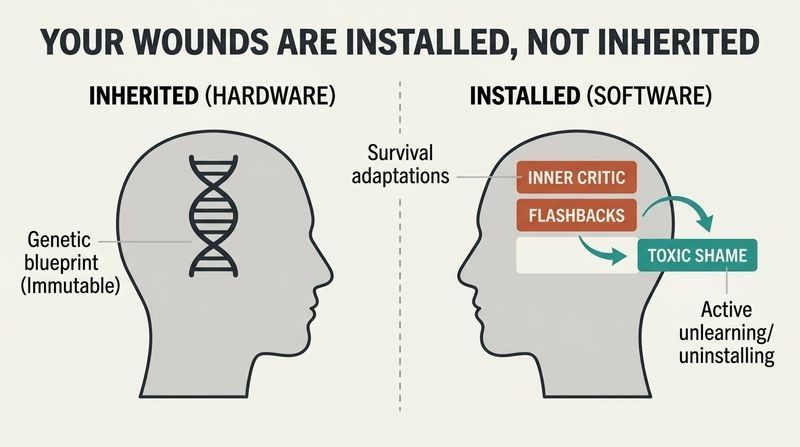
What is striking is how this reframe functions therapeutically before any technique is applied. Telling someone their suffering is a rational response to an irrational environment removes the meta-layer of shame about being "crazy." This aligns with modern trauma research by Bessel van der Kolk and Judith Herman, who coined the term Complex PTSD. One caution: the sharp nature-versus-nurture line understates gene-environment interaction. Temperament shapes which 4F type a child adopts, and epigenetics shows trauma can alter gene expression. Walker's optimism that what is learned can be unlearned is empowering, though neural pathways carved in early childhood resist change more stubbornly than the framing suggests.
Emotional flashbacks replay childhood feelings, not childhood images
The signature symptom has no picture. Unlike the cinematic flashbacks of combat PTSD, a CPTSD flashback is a sudden regression into the raw feeling-state of the abandoned child: overwhelming fear, shame, rage, or numb despair, usually with no visual memory attached. This is why survivors get blindsided. They feel tiny, helpless, and doomed without knowing why.
Walker's own example. Early in a relationship, his partner unexpectedly yelled at him. He describes feeling as if a hot wind had blown him out like a candle flame, unable to speak or think, shaking and small. Only ten years later did he recognize it as a flashback to his enraged mother. The first and most powerful management step is simply naming it: saying "I am having a flashback" restores the adult perspective that the danger is past.
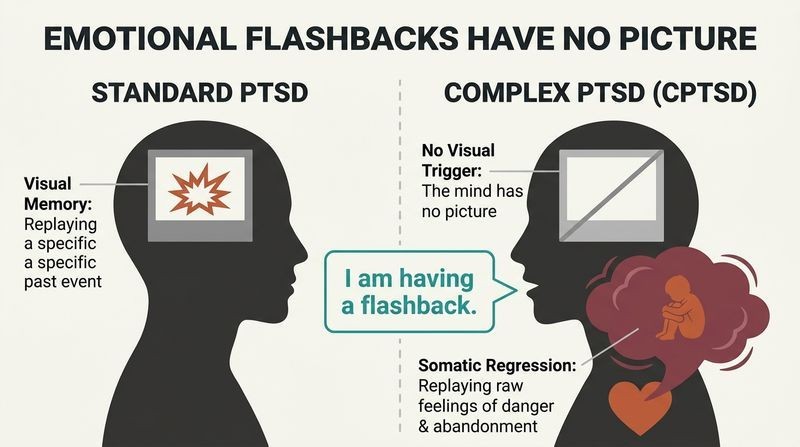
This concept is Walker's most cited contribution, and for good reason: it names an experience millions have without vocabulary. Neuroscience supports the mechanism. Daniel Goleman's "amygdala hijacking" describes how the emotional brain overrides the rational prefrontal cortex, and MRI work shows flashbacks over-activate the right hemisphere while the verbal left goes offline, explaining the absence of narrative or image. The practical genius is that labeling engages the very left-brain function that the flashback suppresses, a technique psychologist Matthew Lieberman calls "affect labeling." The limitation: for severe survivors, naming alone rarely stops the physiological surge, which is why the remaining twelve steps exist.
Trauma locks you into one of four survival modes: fight, flight, freeze, or fawn
Four instinctive responses to danger, frozen into personality. Walker expands the familiar fight-or-flight into a fourfold model. Traumatized children over-rely on one response and it hardens into a defensive structure:
1. Fight becomes a narcissistic defense (power and control equal safety)
2. Flight becomes obsessive-compulsive (perfection and busyness equal safety)
3. Freeze becomes dissociative (hiding and numbing equal safety)
4. Fawn becomes codependent (pleasing and serving equal safety)
One family, four children, four fates. He illustrates with siblings: Bob the favored bully (fight), Carol the driven scapegoat (flight), Maude the lost dissociator (freeze), and Sean the parentified caretaker (fawn). A friend later marveled it seemed each had different parents. Recovery means regaining flexible access to all four, using each only when genuinely appropriate.
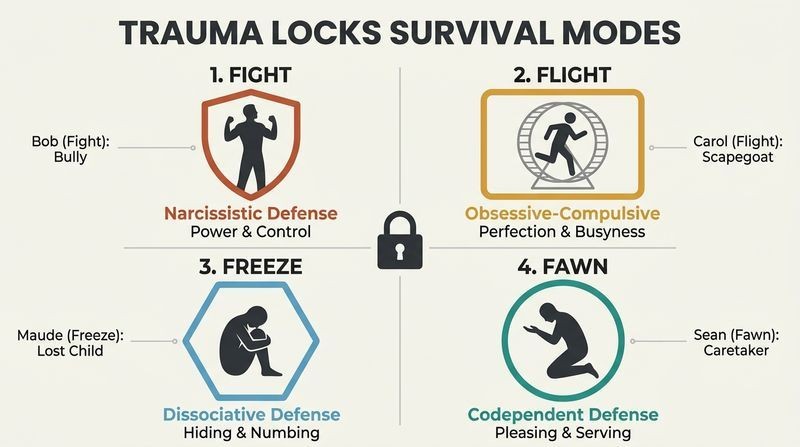
The 4F typology is clinically intuitive and maps loosely onto attachment styles and Karen Horney's earlier "moving against, away from, toward" people. Its strength is diagnostic: identifying your dominant type points you to your specific work (fight types need empathy practice, fawn types need assertiveness). The risk is the same as any typology, from Myers-Briggs to the Enneagram: people reify a fluid coping pattern into a fixed identity. Walker guards against this by insisting most survivors are hybrids on continuums, and that health means balance, not a better type. The model is descriptive and useful, though not empirically validated as discrete categories.
Chronic people-pleasing is a trauma response, not a generous personality
Fawn is Walker's original addition to the trauma canon. The fawn type learned as a toddler that protesting brought retaliation, so they deleted "no" from their vocabulary and bought safety through servitude, ingratiation, and forfeiting every need that might inconvenient a parent. They become experts at reading others' moods, often parentified into a caretaker or confidant for a narcissistic parent.
The chair that triggered a book. Walker realized his own fawn programming the night he caught himself apologizing to a chair he had bumped into. He had apologized to inanimate objects, to traffic lights, to other people's bad moods, all his life. In conversation, fawn types listen and ask questions to keep attention off themselves, because as children their words were used as evidence against them. Recovery centers on assertiveness: practicing saying no, tolerating disapproval, and grieving the buried anger underneath.
Naming fawn filled a genuine gap. Freeze and flight dominated trauma literature while the compulsively agreeable survivor was often dismissed as merely "nice" or pathologized as codependent without a trauma frame. This resonates with polyvagal theory, where appeasement is a documented survival strategy, and with research on tonic immobility and submission in threatened animals. The insight reframes a trait our culture rewards, especially in women, as a wound. One nuance worth holding: not all helpfulness is trauma, and the framework can tempt readers to pathologize healthy altruism. Walker's own test is useful: fawning forfeits the self, whereas generosity flows from a self that remains intact.
Get angry at your inner critic instead of agreeing with it
The inner critic is your superego gone malignant. In a dangerous home, a child's superego works overtime chasing an impossible goal: becoming perfect enough to finally win parental love. When that fails, it concludes the child is not flawed but IS a flaw. It runs two program families, perfectionism (self-hate, all-or-nothing thinking, comparison) and endangerment (catastrophizing, hypervigilance, drasticizing).
Fight it, do not embrace it. Walker cataloged 14 common critic attacks, each paired with a corrective response. His key technique is anger-powered thought-stopping: silently and forcefully saying "No!" or "Shut up!" to interrupt the tirade, then thought-substitution with a memorized list of your qualities. Because traumatizing parents crippled the child's fight response, reviving healthy anger is essential. He rejects popular advice to gently "accept" the critic, arguing that only works after the critic's venomous sting has already been removed.
Walker's stance directly challenges the mindfulness-and-self-acceptance orthodoxy that dominates much of therapy and Buddhist-influenced self-help. His claim that you must first fight the critic with anger before you can peacefully accept it is a meaningful sequencing insight, echoing Internal Family Systems, which distinguishes protective "parts" from the wounded self. The neuroplasticity argument is sound: repeated thought-correction does carve new pathways, as cognitive behavioral therapy demonstrates. The debatable edge is dosage. For some survivors, aggressive self-talk against an internal voice can escalate into a new internal war. Walker acknowledges this by insisting the anger be aimed at the parents who installed the critic, not the self.
Emotional neglect scars as deeply as abuse, often deeper
You do not need bruises to have CPTSD. Walker argues the core wound is emotional abandonment: a childhood without a single safe adult to turn to for comfort. He compares survivors who minimize their pain ("my mother never hit me") to peeling a caustic onion, where the innermost layer is the neglect nobody can point to as evidence. Ironically, some children endure active abuse without developing CPTSD, spared because one caretaker did not abandon them emotionally.
The failure-to-thrive evidence. He cites mid-century hospitals where germ-phobic rules forbade nurses from holding infants, and mortality climbed until the practice ended. Eastern European orphanages showed the same. Modern medicine now accepts that babies need touch and nurturing to survive. Walker calls emotional neglect "nearly dying of thirst outside the fenced-off fountain of a parent's warmth."
This is perhaps the book's most validating chapter for the reader who cannot explain why a materially adequate childhood left them broken. The failure-to-thrive research is real and haunting, and Harry Harlow's rhesus monkey experiments, where infants chose a soft cloth mother over a wire one that fed them, made the same point about contact comfort. The clinical challenge Walker names is diagnostic invisibility: neglect leaves no scar to point to, and most people remember little before age four, when much damage occurs. This can cut both ways, since an unfalsifiable wound is hard to distinguish from other sources of adult distress, requiring the intuitive reconstruction Walker describes.
Toxic shame is blame you were tricked into aiming at yourself
Shame is misdirected blame. Walker borrows Erik Erikson's equation: shame is blame turned against the self. Children cannot afford to blame the powerful parents they depend on, so they turn the verdict inward and conclude they are the problem. Toxic shame, distinct from healthy social shame, obliterates self-esteem with the conviction that one is loathsome, ugly, or fatally flawed, and unlike normal shame it needs no witness to strike.
The handsome actor who felt hideous. Walker recalls David, a strikingly attractive professional actor who was certain he was too ugly to look at. David had been the unwanted last child of an alcoholic father who looked at him with disgust, and a brother whose favorite taunt was that the sight of him induced vomiting. The cure is redirecting the blame back to its rightful owners and building self-compassion, which Walker calls the keystone of all recovery.
The David example is a vivid demonstration that self-perception is authored by others' voices, not by mirrors. This dovetails with research on the "looking-glass self" (Charles Cooley) and with shame researcher Brene Brown's distinction between guilt ("I did something bad") and shame ("I am bad"). Walker's move of externalizing blame back onto parents is therapeutically potent but ethically delicate: it risks trapping survivors in permanent grievance. He partly addresses this by framing blame as a transitional stage that grieving eventually metabolizes, not a final resting place. The deeper claim, that self-compassion is the single most important developmental repair, is well supported by Kristin Neff's self-compassion research.
Grieve childhood losses through anger, tears, words, and stillness
Grieving is the engine of deep recovery, and it has four gears.
1. Angering: railing against the injustice, and saying "No!" to the critic, which revives self-protection and drains the fear that fuels shame
2. Crying: releasing pain and triggering the parasympathetic relaxation response, awakening self-compassion
3. Verbal ventilating: speaking or writing from feeling, which Walker calls the golden path to intimacy
4. Feeling: passively staying present to painful sensations without reacting, letting awareness dissolve them
Why both anger and tears. When we are hurt, part of us is mad and part is sad, and Walker notes our culture assigns anger to men and tears to women, leaving each gender able to release only half the pain. He describes his six-year-old son bawling angrily up the stairs about homework, then laughing at a fallen toy at the top, a model of complete grieving that discharges loss and returns to joy in minutes.
Walker's four-process model usefully separates catharsis (emoting out) from mindful containment (feeling through), and insists mature recovery fluidly alternates between them. This bridges two often-warring therapeutic camps: cathartic release traditions and acceptance-based mindfulness. The son-on-the-stairs vignette elegantly shows what emotional intelligence looks like before it is socialized away. One caveat modern research raises: unstructured catharsis, especially anger venting, does not always discharge emotion and can rehearse it, as social psychologist Brad Bushman has shown. Walker's safeguard is that angering must be aimed at the past and paired with grief, not dumped on present-day people, which distinguishes therapeutic angering from mere rage rehearsal.
Become the parent you never had, and recruit a committee to help
Reparenting means meeting your own arrested needs. Walker splits it into a yin-yang pair. Self-mothering grows self-compassion, the unconditional positive regard every child deserves in its first years, delivered now through affirmations spoken to your inner child ("I am glad you were born; you do not have to be perfect for my love"). Self-fathering grows self-protection and assertiveness.
Two vivid tools. In the "time machine rescue operation," you imagine traveling back to pin your parents' arms, call the authorities, and shield your child-self, an image that often provides an exit from flashback fear and can even make the inner child laugh. And because we cannot fully reparent alone, Walker offers "reparenting by committee": a widening circle of friends, partners, therapists, pets, and even trusted authors who each supply a portion of the mothering and fathering we missed. He notes such support can even come from books when humans still feel too dangerous.
Reparenting by committee is a healthy corrective to two extremes: the self-help fantasy that you can heal entirely alone, and the therapy-dependency model that locates all healing in one professional relationship. Distributing the load across many imperfect sources is both realistic and resilient, echoing social-support research showing that a diverse network buffers stress better than a single tie. The inner-child affirmation work overlaps with schema therapy and Internal Family Systems. Skeptical readers may find inner-child language saccharine, and Walker anticipates this, offering the neutral alternative of nurturing "the developmentally arrested part of yourself." The underlying mechanism, learning emotional regulation by internalizing a caring other, is well grounded in attachment neuroscience.
Stop chasing a cure; manage CPTSD like diabetes instead
Recovery is progressive, not a finish line. Walker urges surrendering the "salvation fantasy" that you will one day be flashback-free forever. Clinging to it guarantees you will blame yourself every time a flashback returns. He compares CPTSD to diabetes: a condition requiring lifelong management that, when managed skillfully, becomes only infrequently bothersome while life grows steadily richer.
The surviving-thriving continuum. Progress is two steps forward, one step back, and often the backward step feels like six. Because the all-or-nothing critic refuses to count partial improvement ("either I'm cured or I'm hopelessly defective"), survivors routinely fail to notice their own gains: flashbacks growing shorter, less intense, less frequent. Walker even reframes minor flashbacks and difficulty as "optimal stress," the moderate challenge that neuroscience shows grows new neurons, making lifelong recovery a form of the lifelong learning that wards off cognitive decline.
The diabetes analogy performs real psychological work by lowering the bar from cure to management, it disarms the perfectionism that sabotages chronic-condition recovery, a pattern documented across addiction and mood-disorder treatment. Reframing recovery as progressive counters the "breakthrough" mythology of much pop-psychology, where one insight supposedly fixes everything. The optimal-stress point connects to hormesis and the Yerkes-Dodson curve, where moderate challenge improves performance while too little breeds atrophy. The honest downside Walker names is discouragement: a lifelong condition is unwelcome news. His counterweight, that survivors gain emotional intelligence and depth unavailable to the untraumatized, risks romanticizing suffering, though it usefully reframes the work as growth rather than mere damage control.
What was wounded in relationship must be healed in relationship
Verbal ventilation is the highway to intimacy. Because CPTSD is fundamentally an attachment disorder, born of growing up with no safe adult, Walker argues the deepest healing requires a reparative relationship, whether with a therapist, partner, or friend who can stay present to their own painful feelings. Sharing vulnerability, and having it met with empathy rather than contempt, rewires the belief that closeness is dangerous.
The four qualities that build trust. Walker identifies empathy, authentic vulnerability (a therapist who admits they too feel scared and sad), dialogicality (fluid back-and-forth talking and listening, not a narcissist's monologue), and collaborative repair after conflict. The goal is "earned secure attachment," the newly recognized state where a survivor forms at least one reliable, mutually supportive bond. He notes that mutual commiseration, two people reciprocally sympathizing with each other's troubles, is a deeper channel to intimacy than sex.
This chapter quietly overturns the "blank screen" psychoanalytic tradition, where the therapist withholds all personality. Walker's insistence on therapist vulnerability aligns with relational and intersubjective psychoanalysis and with attachment research by Daniel Siegel on the "coregulation of affect," the idea that we literally borrow another nervous system's calm to build our own. Earned secure attachment is an empirically supported category: adults with rough childhoods who nonetheless form coherent narratives and secure bonds show measurably better outcomes. The bracing realism is Walker's acknowledgment that some betrayals are so severe the survivor may never safely trust a human, in which case pets, nature, and books become legitimate, not consolation-prize, sources of relational repair.
Analysis
Pete Walker's 2013 book occupies a distinctive niche: it is simultaneously a clinical map, a self-help manual, and a disguised memoir. Structured as an overview followed by "fine points," it braids three decades of practice with Walker's own recovery, giving the reader both authority and companionship. Its enduring influence rests on two contributions that entered common vocabulary: the concept of the emotional flashback, which named an experience millions could feel but not articulate, and the fourth F, fawn, which legitimized the compulsive people-pleaser as a trauma survivor rather than a character type.
The book's intellectual backbone is the "cycle of reactivity" map: abandonment depression triggers fear and shame, which activate the inner critic, which launches a 4F behavior, in a self-perpetuating loop. This layered model is genuinely useful because it tells the reader where to intervene and in what sequence, cognitive work on the critic first, then emotional grieving, then somatic work on the depression itself. Few trauma books offer such an actionable topography.
Walker's boldest and most contestable stance is his rejection of pure acceptance-based approaches. He insists survivors must first fight the inner critic with revived anger before they can safely embrace it, directly challenging the mindfulness orthodoxy. This sequencing feels clinically wise, though it lacks controlled evidence, and the book throughout privileges accumulated case experience over research, which Walker openly concedes in his disclaimer.
The work's limitations are the mirror of its strengths. The framework can encourage readers to over-diagnose, retrofitting all adult distress onto childhood neglect, and the parent-blame stage, while therapeutically real, risks becoming a permanent residence. Yet Walker guards these edges better than most: recovery is progressive not perfect, blame is transitional not terminal, and healing is distributed across a committee rather than resting on a single savior. The result is unusually humane, and the reason survivors keep the 13 flashback steps in their wallets.
Review Summary
Complex PTSD: From Surviving to Thriving receives high praise for its insightful and compassionate approach to childhood trauma. Readers find it life-changing, offering practical tools for healing and understanding. Many appreciate Walker's personal experience and empathetic tone. The book is lauded for its accessibility and comprehensive coverage of C-PTSD symptoms and recovery. Some criticisms include outdated gender norms and potential triggers. Overall, it's considered an invaluable resource for trauma survivors and therapists alike, providing hope and validation for those struggling with complex trauma.
People Also Read









FAQ
What's Complex PTSD: From Surviving to Thriving about?
- Focus on Recovery: The book is a comprehensive guide for individuals recovering from Complex PTSD (CPTSD), particularly from childhood trauma. It emphasizes understanding symptoms and origins to facilitate healing.
- Multimodal Approach: Author Pete Walker integrates cognitive, emotional, spiritual, and somatic healing methods, offering a holistic perspective to address various trauma dimensions.
- Practical Tools: It includes practical tools like the "13 Steps for Managing Flashbacks," helping readers navigate their recovery journey effectively.
Why should I read Complex PTSD: From Surviving to Thriving?
- Empowerment Through Understanding: The book provides clarity on experiences and symptoms associated with CPTSD, empowering individuals by demystifying emotional flashbacks and toxic shame.
- Real-Life Testimonials: It features testimonials from readers who found solace and validation in Walker's insights, indicating its real-life impact.
- Comprehensive Resource: It serves as a valuable resource for both survivors and therapists, enhancing therapeutic practices and personal recovery efforts.
What are the key takeaways of Complex PTSD: From Surviving to Thriving?
- Understanding CPTSD: The book defines CPTSD and its symptoms, such as emotional flashbacks and toxic shame, crucial for recognizing and addressing trauma.
- Healing is Multifaceted: Recovery involves cognitive, emotional, spiritual, and somatic healing, each playing a vital role in holistic recovery.
- Importance of Relationships: Healthy relationships are significant in recovery, with "reparenting by committee" fostering supportive connections.
How does Pete Walker define emotional flashbacks in Complex PTSD: From Surviving to Thriving?
- Definition of Emotional Flashbacks: They are sudden regressions to overwhelming childhood trauma feelings, often lacking a visual component, evoking fear, shame, and helplessness.
- Triggers and Symptoms: Triggered by various stimuli, they lead to intense emotional responses, feeling small, fragile, and overwhelmed, often with toxic shame.
- Management Techniques: Strategies include recognizing them as past memories and employing grounding techniques to regain safety.
What is the "inner critic" in Complex PTSD: From Surviving to Thriving?
- Definition of Inner Critic: An internalized voice perpetuating shame and self-loathing, mirroring negative caregiver messages, dominating thoughts and feelings.
- Impact on Recovery: It hinders recovery by reinforcing toxic beliefs, making self-compassion and healing difficult, often leading to perfectionism and self-abandonment.
- Strategies to Shrink the Critic: Techniques include thought-stopping and perspective-shifting exercises, replacing negative self-talk with supportive affirmations.
How does Complex PTSD: From Surviving to Thriving define toxic shame?
- Understanding Toxic Shame: Described as an overwhelming sense of being loathsome or defective, often from childhood abuse or neglect, obliterating self-esteem.
- Connection to Flashbacks: Resurfaces during emotional flashbacks, exacerbating fear and helplessness, creating a cycle of self-criticism and isolation.
- Healing from Toxic Shame: Involves recognizing and addressing it through grieving and self-compassion, reclaiming self-worth, and understanding shame isn't one's true value.
What are the "Four F's" in Complex PTSD: From Surviving to Thriving?
- Definition of the Four F's: Instinctive responses to trauma: Fight, Flight, Freeze, and Fawn, each representing a survival strategy developed in response to childhood trauma.
- Impact on Behavior: These responses can become entrenched patterns affecting adult behavior and relationships, like aggression or codependency.
- Recovery Focus: Identifying dominant responses and working towards balanced use of all Four F's is essential for healthy relationships and self-protection.
What is the significance of grieving in Complex PTSD: From Surviving to Thriving?
- Role of Grieving: Portrayed as crucial for reconnecting with repressed emotions and healing from childhood trauma, allowing individuals to process pain and validate experiences.
- Types of Grieving: Includes crying, verbal ventilation, and expressing anger, each serving to release pent-up emotions and facilitate healing.
- Connection to Recovery: Leads to increased self-compassion and a healthier emotional state, vital for overcoming CPTSD effects and reclaiming one's sense of self.
What steps does Complex PTSD: From Surviving to Thriving suggest for managing flashbacks?
- Recognize the Flashback: Acknowledge experiencing a flashback by saying, “I am having a flashback,” to ground yourself in the present.
- Self-Reassurance: Remind yourself of safety and that feelings are remnants of past trauma, reducing emotional response intensity.
- Grieving and Emotional Release: Engage in grieving practices to process emotions associated with flashbacks, allowing crying or anger expression for emotional release.
What techniques does Complex PTSD: From Surviving to Thriving recommend for self-soothing?
- Grounding Exercises: Suggests deep breathing and focusing on physical sensations to manage anxiety and emotional distress, bringing awareness to the present.
- Mindfulness Practices: Encourages mindfulness to cultivate self-awareness and acceptance, reducing the inner critic's impact and promoting emotional regulation.
- Creating Safe Spaces: Advises creating safe spaces for retreat when overwhelmed, engaging in comforting activities, or seeking support from trusted friends.
How can I find a therapist who understands the concepts in Complex PTSD: From Surviving to Thriving?
- Research and Referrals: Suggests researching therapists specializing in trauma and CPTSD, using resources like www.creativegrowth.com for referrals.
- Interview Potential Therapists: Important to assess their approach and compatibility, asking about experience with CPTSD and therapeutic methods.
- Look for Empathy and Understanding: Choose a therapist demonstrating empathy and understanding, crucial for effective healing and recovery.
What are the best quotes from Complex PTSD: From Surviving to Thriving and what do they mean?
- "The journey of recovering from CPTSD is complex.": Emphasizes the multifaceted nature of healing, involving various life aspects and experiences.
- "Emotional flashbacks are a call from our psyche to address important developmental arrests.": Highlights flashbacks as signals for unresolved childhood issues needing attention and healing.
- "Mistakes do not make me a mistake.": Encourages self-acceptance, understanding imperfection as part of being human, letting go of perfectionism, and embracing flaws.
About the Author
Other books by Pete Walker

Download PDF
Download EPUB
.epub digital book format is ideal for reading ebooks on phones, tablets, and e-readers.








































