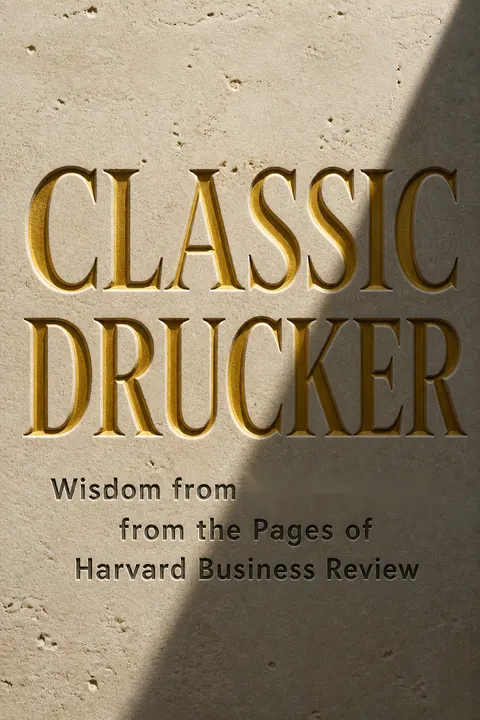

Key Takeaways
1. Double-Loop Learning: Overcoming defensive reasoning to learn from failure
Most people define learning too narrowly as mere “problem solving,” so they focus on identifying and correcting errors in the external environment.
The learning dilemma. Highly skilled, well-educated professionals are often excellent at single-loop learning—solving external problems—but fail miserably at double-loop learning, which requires looking inward. Because they have spent their lives succeeding, they rarely experience failure, meaning they have never learned how to learn from it. When their strategies go wrong, their ability to learn shuts down precisely when they need it most.
Defensive reasoning blocks. When faced with embarrassment or threat, professionals instinctively use defensive reasoning to protect themselves, blaming clients, managers, or unclear goals. This creates a closed loop that is impervious to objective testing and halts organizational learning.
Productive reasoning solutions. To break this cycle, organizations must teach employees to reason productively by treating human behavior with the same analytical rigor used in strategic analysis.
- Collect objective data to test assumptions.
- Make reasoning and inferences explicit.
- Encourage open, non-threatening questioning of behavior.
2. Life Strategy and Resource Allocation: Aligning personal resources with long-term happiness and integrity
If you give in to “just this once,” based on a marginal cost analysis, as some of my former classmates have done, you’ll regret where you end up.
The resource trap. High achievers naturally allocate their extra time and energy to activities that yield the most immediate, tangible accomplishments, such as their careers. Consequently, they systematically underinvest in their families and relationships, which require long-term, quiet nurturing to bear fruit.
The marginal cost mistake. People often choose between right and wrong by applying the economic doctrine of marginal cost, telling themselves "just this once is okay." This seductive logic leads down a slippery slope of compromise, making it far easier to hold to your principles 100% of the time than 98% of the time.
Defining your metric. True happiness and integrity require defining a clear purpose for your life and choosing the right yardstick to measure success.
- Focus on helping individuals become better people.
- Build a supportive family culture early on.
- Maintain humility by valuing and learning from everyone.
3. Catalytic Mechanisms: Translating big, hairy, audacious goals into results with non-bureaucratic devices
Catalytic mechanisms are the crucial link between objectives and performance; they are a galvanizing, nonbureaucratic means to turn one into the other.
Power of the mechanism. Instead of layering on stultifying bureaucracy to achieve Big, Hairy, Audacious Goals (BHAGs), effective leaders implement catalytic mechanisms. These are simple, concrete, and powerful devices that distribute power and force the right things to happen automatically.
Distributing power with teeth. A true catalytic mechanism has teeth and hurts those in power, shifting the default state of an organization from inertia to action. For example, Granite Rock's "short pay" policy allows unsatisfied customers to unilaterally deduct money from their invoices, forcing immediate service improvements.
Key characteristics of mechanisms. To build an effective catalytic mechanism, leaders must focus on organic, idiosyncratic designs rather than copying others.
- Produces desired results in unpredictable ways.
- Distributes power for the benefit of the overall system.
- Ejects organizational "viruses" (unsuitable employees).
- Produces an ongoing, persistent effect over decades.
4. Managing Oneself: Capitalizing on personal strengths, working styles, and core values
It takes far more energy and work to improve from incompetence to mediocrity than it takes to improve from first-rate performance to excellence.
Focus on strengths. Throughout history, people had little need to know their strengths because they were born into their lines of work. Today, knowledge workers must use feedback analysis—comparing expected results with actual outcomes—to discover their unique strengths and place themselves where they can make the greatest contribution.
Understanding performance styles. Equally important is knowing how you perform, which is a matter of personality formed long before entering the workforce. Trying to change your basic personality is futile; instead, you must work to improve the way you perform and avoid taking on work you cannot do well.
Key self-management questions. To manage yourself effectively over a 50-year working life, you must answer several critical questions:
- Am I a reader or a listener?
- How do I learn (by writing, talking, doing)?
- Do I work best as a decision maker or an adviser?
- What are my core values, and do they match my organization's?
5. The Theory of the Business: Aligning organizational assumptions with changing market realities
The root cause of nearly every one of these crises is not that things are being done poorly. It is not even that the wrong things are being done. Indeed, in most cases, the right things are being done—but fruitlessly.
The power of assumptions. Every organization operates on a "theory of the business"—a set of core assumptions about its environment, mission, and core competencies. When a highly successful company suddenly stagnates, it is rarely due to bureaucracy or complacency; rather, the reality has changed while the theory has remained stagnant.
Preventive care and abandonment. To prevent a theory from becoming obsolete, organizations must build systematic monitoring and testing into their routines. This requires the discipline of "purposeful abandonment," where every product, service, and policy is challenged regularly to free up resources for new opportunities.
Diagnosing a failing theory. Leaders must pay close attention to early warning signs that indicate their theory of the business is no longer valid:
- Attaining the organization's original objectives.
- Experiencing rapid, unexpected growth.
- Encountering unexpected success or failure (your own or a competitor's).
- Failing to govern or add value to new acquisitions.
6. Effective Executive Practices: Executing with discipline through actionable habits and systematic decision-making
Effectiveness is a discipline. And, like every discipline, effectiveness can be learned and must be earned.
Action-oriented knowledge. Effective executives do not need to be charismatic leaders; instead, they follow eight simple practices to get the right things done. They begin by asking "What needs to be done?" and "What is right for the enterprise?" to gain the knowledge they need to make smart decisions.
Converting plans to deeds. Knowledge is useless until translated into action through written plans that specify desired results, constraints, and check-in points. Executives take full responsibility for decisions and communication, ensuring that everyone affected understands the plan and what information is required.
Focusing on opportunities. To drive organizational performance, executives run productive meetings and focus on opportunities rather than problems.
- Match your best-performing people with your best opportunities.
- Treat change as an opportunity rather than a threat.
- Terminate meetings as soon as their specific purpose is accomplished.
- Think and say "we" rather than "I" to build trust.
7. Managing Upward: Building a productive relationship of mutual dependence with your boss
We are using the term to mean the process of consciously working with your superior to obtain the best possible results for you, your boss, and the company.
Mutual dependence. Many managers treat their relationship with their boss passively, failing to realize that it involves mutual dependence between two fallible human beings. Managing this relationship is a legitimate and crucial part of a manager's job to secure the information and resources needed to perform effectively.
Understanding the boss. To manage upward successfully, you must actively seek to understand your boss's goals, pressures, strengths, weaknesses, and preferred working style. Failing to clarify these objectives can lead to taking actions that directly conflict with your boss's priorities, resulting in frustration and failure.
Managing your own predispositions. Subordinates must also understand their own needs and predispositions toward authority, which typically range from counterdependence (rebelling against authority) to overdependence (seeing the boss as an all-wise parent). Highly effective managers take responsibility for the relationship by:
- Adapting their communication style to match the boss's preference (e.g., "readers" vs. "listeners").
- Establishing clear, mutual expectations.
- Maintaining a reliable, honest flow of information.
8. Emotional Intelligence in Leadership: Deploying flexible leadership styles to optimize organizational climate
The research indicates that leaders with the best results do not rely on only one leadership style; they use most of them in a given week—seamlessly and in different measure—depending on the business situation.
The power of EI. Emotional intelligence (EI)—consisting of self-awareness, self-management, social awareness, and social skill—is the sine qua non of leadership. While technical skills and IQ are important threshold capabilities, emotional intelligence is twice as important for outstanding performance at all levels.
Impact on climate. A leader's behavior directly drives organizational climate, which accounts for nearly a third of a company's financial performance. The most successful leaders master multiple leadership styles—authoritative, affiliative, democratic, and coaching—and switch between them fluidly as circumstances dictate.
The six leadership styles. Leaders must understand when to deploy each of the six distinct styles to maximize results:
- Authoritative: Mobilizes people toward a vision (most strongly positive).
- Affiliative: Creates harmony and builds emotional bonds.
- Democratic: Forges consensus through participation.
- Coaching: Develops people for the future.
- Coercive & Pacesetting: Use sparingly, as they can damage climate.
9. Strategic Intent: Leveraging resource constraints to fuel an obsessive, long-term will to win
Companies that have risen to global leadership over the past 20 years invariably began with ambitions that were out of all proportion to their resources and capabilities.
The power of intent. Traditional strategic planning focuses on maintaining "strategic fit" between existing resources and current opportunities, which often leads to incremental, defensive strategies. In contrast, global leaders begin with "strategic intent"—an obsessive, long-term ambition that stretches the organization far beyond its current capabilities.
Leveraging resource constraints. Strategic intent creates an extreme misfit between resources and ambitions, forcing the organization to be highly inventive and build new competitive advantages. This active management process focuses attention on the essence of winning, motivates employees through compelling targets, and leaves room for individual improvisation.
Competitive innovation approaches. To challenge larger, better-funded competitors, companies must change the rules of the game through competitive innovation:
- Build layers of advantage (e.g., combining low cost with global brands).
- Search for "loose bricks" (underdefended market segments).
- Change the terms of engagement (refusing to play by the leader's rules).
- Compete through collaboration (using strategic alliances to build scale).
10. The Discipline of Teams: Fostering mutual accountability through a common purpose and specific goals
A team is a small number of people with complementary skills who are committed to a common purpose, set of performance goals, and approach for which they hold themselves mutually accountable.
Teams vs. working groups. Many organizations use the word "team" loosely to describe any group working together, but real teams differ fundamentally from working groups. While a working group's performance relies on individual results, a team's performance includes both individual results and collective work products that require joint effort.
Purpose and specific goals. The essence of a team is a common commitment to a meaningful purpose that members help shape. This purpose must be translated into specific, measurable performance goals, which provide clear communication, facilitate constructive conflict, and allow the team to achieve small wins.
The discipline of mutual accountability. Mutual accountability cannot be coerced; it grows naturally when a team shares a common purpose, goals, and approach.
- Keep team size small (typically under ten members).
- Ensure a mix of complementary skills (technical, problem-solving, interpersonal).
- Establish clear rules of behavior and conduct at the outset.
- Focus relentlessly on performance results rather than team-building for its own sake.
11. Blue Ocean Leadership and Market Creation: Unlocking unexploited talent and demand by breaking traditional trade-offs
Blue ocean leadership, by contrast, focuses on what acts and activities leaders need to undertake to boost their teams’ motivation and business results, not on who leaders need to be.
Unlocking latent talent. Most organizations suffer from widespread employee disengagement, largely due to poor leadership. Blue ocean leadership applies the concepts of blue ocean strategy to leadership, treating leadership as a service that employees "buy" or "don't buy" to convert disengaged noncustomers into highly motivated contributors.
Focus on acts and activities. Unlike traditional leadership development that focuses on changing values and behavioral traits, blue ocean leadership focuses on concrete acts and activities. This makes it much easier to measure, assess, and change, allowing leaders to rapidly align their time with high-value activities.
The four-step process. To implement blue ocean leadership across all management levels, organizations follow a structured process:
- See your leadership reality by drawing "as-is" Leadership Canvases.
- Develop alternative Leadership Profiles by identifying "hot spots" and "cold spots."
- Select "to-be" Leadership Profiles through a democratic, transparent process.
- Institutionalize the new profiles and monitor progress continuously.
12. Customer-Centric Business Models: Designing learning relationships and writing business plans that focus on customer value
The strategist’s goal is not to find a niche within the existing industry space but to create new space that is uniquely suited to the company’s own strengths, space that is off the map.
Avoiding marketing myopia. Many companies fail because they define their business too narrowly around their products rather than customer needs. To survive and thrive, organizations must remain market-driven, recognizing that products are merely temporary vehicles for satisfying enduring customer desires.
Building learning relationships. In the interactive economy, companies can secure customers forever by establishing "learning relationships." By conducting ongoing dialogues and mass-customizing products to meet individual preferences, companies make it too costly for customers to switch to competitors, who would have to start the learning process from scratch.
Writing great business plans. To attract investors and guide a new venture successfully, a business plan must focus on the key drivers of value rather than fictional financial projections.
- Assess the people (what, whom, and how well they are known).
- Evaluate the opportunity (market size, growth, and structural attractiveness).
- Understand the context (macroeconomic and regulatory factors).
- Manage risk and reward by planning for multiple future scenarios.
Review Summary
Readers largely praise Classic Drucker as a timeless collection of management insights, noting its relevance despite being written decades ago. Many highlight its dry but persuasive writing style, recommending repeated readings for full absorption. Reviewers appreciate chapters on self-management, decision-making, and people management particularly. The book is frequently described as essential reading for managers and executives at all levels. Some readers noted translation quality issues in certain editions, while others found sections occasionally boring, though the consensus remains that Drucker's core principles continue to resonate in today's business environment.
About the Author
Other books by Peter F. Drucker





Download PDF
Download EPUB
.epub digital book format is ideal for reading ebooks on phones, tablets, and e-readers.








































