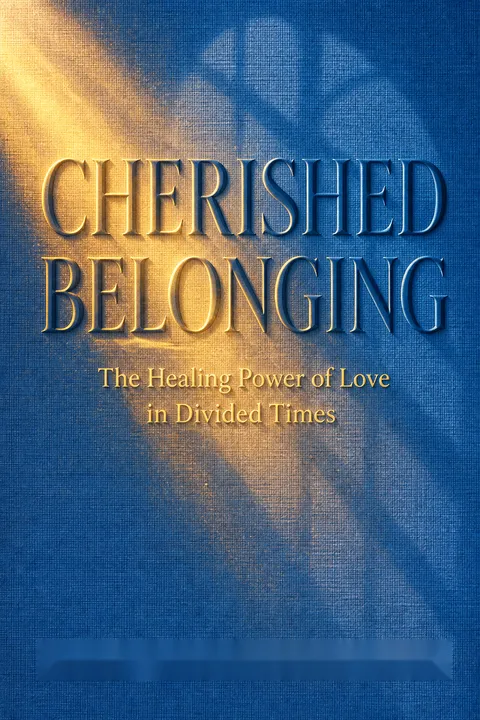
Key Takeaways
1. We Belong to Each Other: The Kinship of God
Mother Teresa tells us that the problem in the world is that we’ve just forgotten that we belong to each other.
Core principle. The fundamental truth of human existence, and indeed God's dream, is that "we belong to each other." This isn't a naive sentiment but a profound assertion that challenges the pervasive "us vs. them" mentality that corrodes community and prevents progress. When we forget this essential kinship, societal ills like homelessness, violence, and polarization proliferate, indicating a deep-seated amnesia about our interconnectedness.
God's dream. The author envisions a community where "Nobody VS. Anybody" is replaced by a shared sense of exquisite mutuality. This vision, inspired by figures like Taj Mahal's "Everybody is somebody. Nobody is nobody," suggests that true belonging is God's dream come true. It calls for a shift from normalization and polarization, which have proven corrosive, towards a recognition of our inherent connection.
Homeboy's foundation. At Homeboy Industries, this principle is one of two unwavering tenets: "We belong to each other (no exceptions)." This belief isn't just theoretical; it's the practical foundation for rolling up sleeves and making real progress in addressing complex social dilemmas. It transforms adversaries into allies, fostering a cherishing love that navigates obstacles and hazards, ensuring we remain on the "surest route" to a destination of collective well-being.
2. Everyone is Unshakably Good: Beyond Good and Bad
Everyone is unshakably good (no exceptions).
Inherent goodness. The second unwavering principle at Homeboy Industries is that "Everyone is unshakably good (no exceptions)." This challenges the conventional division of the world into "good people and bad people," a notion that the author argues impedes progress and ends all conversation. Instead, it posits that goodness is an undeniable, intrinsic part of every individual, regardless of their actions or circumstances.
Beyond judgment. This perspective encourages moving past moral judgments to a "health assessment." When people act in ways deemed "bad" or "evil," it's not a reflection of their inherent nature but rather an indication of underlying wounds, trauma, mental anguish, or profound illness. For example, the author states, "no one healthy storms the capitol or is a racist," suggesting these behaviors stem from a lack of well-being, not a lack of goodness.
Seeing as God sees. The author believes God only sees goodness, and we are invited to adopt this same "mystical filter." This means looking beyond surface behaviors—like a "Trust No One" tattoo or a "shenanigizer's" manipulation—to recognize the "precious soulfulness" within. This unshakable goodness is not something we can abandon; it's the "pilot light" waiting to burn brightly once the despair, trauma, or distraction covering it is peeled away.
3. Compassion is the Answer: Healing, Not Punishment
The answer to every question is, indeed, compassion.
Compassion as solution. The author asserts that compassion is the ultimate answer to every question, especially when facing complex social dilemmas and intractable impasses. This means shifting from a punitive mindset, which seeks to punish the wounded, to a therapeutic approach that aims to heal them. The current societal tendency to "medicalize and criminalize unlivable lives" and "outlaw the hopeless" is seen as counterproductive.
Dismantling the punishment system. Homeboy Industries advocates for dismantling the existing punishment system, which has led to mass incarceration and over-policing. Instead, the focus should be on healing, repair, and restoration. This involves creating alternatives to incarceration, such as "Hope Village," a neighborhood of services designed to soothe mental anguish, substance use disorder, and underlying despair, rather than relying on bars and cells.
Addressing root causes. The author argues that gang violence and crime are found in communities with high levels of concentrated disadvantage and disinvestment. True progress comes from raising advantage and making investments, which then addresses the rage, violence, and despair. Compassion, in this context, is not about excusing behavior but understanding its roots in trauma and illness, allowing for effective, person-centered interventions that lead to genuine healing.
4. The Cruelty Points: Understanding Underlying Wounds
It isn’t that “the cruelty is the point” but, rather, that “the cruelty… points.”
Beyond "cruelty is the point." The popular phrase "the cruelty is the point" is challenged, with the author arguing that cruelty is not an end in itself but a signpost. "The cruelty... points" beyond itself to underlying issues that demand our attention: mental anguish, wounds, damage, and trauma. This reframing moves us away from moral outrage and denunciation towards a deeper inquiry into the causes of harmful behavior.
Bad diagnosis, bad treatment. Assuming people are "bad" or "evil" leads to ineffective solutions. For instance, anti-Semitic tweets are described as "anti-Semitic" (description) but "mental illness explains it" (explanation). Explanations, while not excuses, are crucial for developing effective treatment plans. The author has "never met anyone evil," only "the broken, the despondent and damaged, the desperate and unwell, the traumatized, wounded, and injured."
Health assessment, not moral judgment. Behaviors like racism, misogyny, or storming the capitol are viewed not as character flaws or moral depravity, but as indicators of poor health.
- No one healthy longs for tyranny.
- No one healthy thinks Israel has no right to exist or that Hamas doesn't belong to us.
- No one healthy spreads disinformation or believes conspiracy theories.
This perspective allows for compassion and curiosity, enabling us to "get underneath" the behavior to address the wounds that compromise agency and block the capacity to love.
5. Embrace the Wild God: Adoration, Not Judgment
Eckhart speaks of the “Wild One,” the God ceaselessly surprising, whose care and delight in us is hugely outsized.
God's boundless delight. Meister Eckhart's "Wild One" represents a God of intimate welcome and generous hospitality, whose care and delight in humanity are "hugely outsized." This contrasts with traditional, often punitive, images of a distant or judgmental God. This Wild God is not "needy" or "fishing for a compliment" but is ceaselessly loving, choosing powerlessness in intervention to be uninterrupted in adoration.
Unshakable love. This God does not "bash" us or have a "range of responses" like pleasure or displeasure based on our actions. Instead, God's response is singular: "I will carry you and sustain you in love, no matter what. You are irreplaceable, unrepeatable, and of unlimited worth." This means God doesn't "test us with affliction" or "send" calamities; rather, God's power is in sustaining love that accompanies us through challenges, energizing us to act.
A reset in thinking. The author advocates for a "reset" in our image of God, moving away from an "Abusive Father God" to the "ceaselessly delighting and sustaining One." This involves unlearning old narratives, like Noah's ark story implying God regrets creation, and embracing wisdom that states, "Your imperishable spirit is in all things." This "Spacious One" invites us to surrender, find our authentic core, and recognize that "God is too busy loving them to have any time left for orchestration."
6. Remove the Blindfold: Seeing with God's Eyes
I think life is just removing the blindfold.
Seeing goodness. Life, as a homie puts it, is "just removing the blindfold." When this blindfold falls, what is revealed is "Goodness"—unshakable and undeniable. This "percipience" or "new eyewear" allows us to see beyond behavior to the "unmistakable, soulful preciousness" in everyone, just as God does. It's a shift from being "less than ourselves" due to trauma or distraction, to seeing our true, inherent worth.
Wholeness, not perfection. Jesus's call to "Be perfect, as your Heavenly Father is perfect" is reinterpreted to mean "Be whole," as the Aramaic root of "perfect" signifies wholeness. This is an invitation to joy and healing, not to an impossible standard of flawlessness. The rich young man's quest for "eternal life" is understood as a longing for wholeness, health, and healing in the present moment, not just salvation in the afterlife.
Beyond sin and evil. The concepts of "sin" and "evil" are seen as "Old World maps" that hinder progress. Instead of condemning, Jesus sought to heal, liberating individuals from their afflictions and isolation. The author argues that "sin has no substance," and that human suffering often stems from trauma, despair, or mental anguish, which "block our capacity to love." Removing the blindfold allows us to see these underlying wounds and respond with compassion, fostering connection and joy.
7. Cultivate Affectionate Awe: Acatamiento in Action
Acatamiento gets translated as “affectionate awe.”
A stance of attention. "Acatamiento," a word from Saint Ignatius of Loyola's spiritual journal, translates to "affectionate awe." It signifies looking at something with deep attention and delight, particularly towards those on the margins or "cut off." This isn't a passive admiration but an active disposition that shapes our lives around relationship, especially with those whose belonging has been severed. It's a "stance at the margins" that inaugurates a "fresh movement."
Beyond judgment and shame. Affectionate awe allows us to hold the pain of others without judgment, recognizing that suffering can be a teacher. It helps us see beyond labels like "good" or "bad" and instead embrace the full humanity of each person. For example, when a child doesn't recognize their incarcerated father, the response isn't blame but a willingness to "hold the pain of it," fostering a deeper understanding and connection.
Integrating trauma through cherishing. Acatamiento is the antidote to trauma, which often leaves individuals in a "habitual dissociative state." Cherishing, born of affectionate awe, helps integrate traumatic memories, coaxing people out of their "dark cave" into a "luminous room" of healing. It's about creating a "holding place" where individuals can withstand and integrate triggers, fostering reconnection to their authentic selves and allowing love to happen.
8. Make Windows: Conjuring Hope and Possibility
If the house of the world is dark, then love will find a way to make windows.
Creating transparency. Rumi's metaphor of "making windows" through love in a dark world speaks to creating transparency and possibility beyond fears and anxieties. This involves wiping clean the "panes of our lantern" to allow light to shine strongest, enabling us to imagine a future ("crumpets in London") that transcends the confines of past suffering or present limitations.
Loving is home. The author redefines "home" not as a place where one receives love, but where one gives love. "LOVING is home. LOVING is nutritious." This shift in focus from receiving to giving love liberates us from disappointment and frustration, anchoring our joy in selfless action. When loving becomes our home, we are never homesick, always finding nourishment and purpose in extending ourselves to others.
An ethic of love. An "ethic of love" must shape our political visions and radical aspirations, preventing us from being "seduced... into continued allegiance to systems of domination." This means prioritizing love's work over empire and control, and measuring progress by our proximity to the practice of love, not our distance from hate. It's about being "love-struck," moving through the world "unclenched and upheld by tenderness," and asking daily, "What would love have me do today?"
9. The Household of God: A Tribe to End All Tribalism
Then you are no longer strangers and aliens… but members of the household of God.
Beyond "Kingdom" or "Kin-dom." The author prefers "kinship" to "Kingdom" or "Kin-dom" of God, emphasizing it as a "stance," a "disposition," and a "temperament" rather than a place or position. This kinship is an active, inclusive way of life, a "Verb of God," that seeks to "upset the setup" of societal norms and economic arrangements, fostering a community of cherished belonging that aims to end tribalism itself.
Gospel over Catholicism. The author advocates for prioritizing "Gospel values" over mere "Catholic values," and "Gospel living" over "Catholicism." This means embracing movements like Black Lives Matter and Pride, which embody inclusion, compassion, and preferential care for the marginalized, even if they challenge traditional Church doctrine. The Church should be "Gospel practitioners, not museum curators," actively "taking Jesus to the streets" where people carry more than they can bear, rather than just performing rituals.
Warmheartedness and inclusion. The Dalai Lama's definition of "authentic religion" as "warmheartedness" resonates deeply. This involves both inner peace and being propelled into the world with compassionate loving-kindness. The "household of God" is a place where "everyone welcome" is not just a slogan but a lived reality, where people are seen, cherished, and reminded of their inherent goodness. It's a "spiritual bypass" around blocked arteries of exclusion, leading to "interbeing" and a "wider WE."
10. Love Never Fails: The Fastest Route to Wholeness
Love really does not allow us to do otherwise.
The unifying cloak. The assertion that there is no separation between God and us, and us and each other, acts as a "unifying cloak." This "milieu therapy" at Homeboy constantly reminds individuals of their "inter-abiding, mutual indwelling, profound kinship." This cherishing love flows from all to all, dissolving the illusion of separateness and allowing us to hear "another world... breathing," a world where "God makes no distinction between us and them."
Intention and atmosphere. The "secret sauce" of Homeboy is the powerful intention to be tender, even among rivals. This intention creates an "aroma" of belonging, an "atmospheric kindness," and a "frequency of tenderness." It catapults individuals out of self-absorption into the lap of belonging, replacing anxiety with sturdiness and emotional strength. This intentional cherishing is the "heartbeat of God," a constant reminder that we don't have enemies, only injuries; no hate, only wounds; no fear, only the shared ruin of human brokenness.
Rewiring for truth. Neuroscience suggests we are wired to think the worst, but cherishing rewires us to see the truth: "Love believes the best about people." This "love is large" perspective means there are no "good people" or "bad people," only "God's people." This journey of love, which "never stops loving" and "has no end," is the "fastest route" to an integrated wholeness. It's a daily decision to "re-up with every cherishing breath," finding joy in self-forgetting and allowing God to be God in us, ultimately leading to a "culmination" where "there is nothing missing here."
Review Summary
Cherished Belonging by Father Gregory Boyle receives overwhelmingly positive reviews (4.47/5 stars), with readers praising its timely message that everyone is unshakably good and we all belong to each other. Reviewers found the book especially relevant during divisive political times, though some struggled with fully embracing its challenging philosophy that no one is evil—only healthy or unhealthy. The anecdotes from Homeboy Industries are described as inspiring, funny, and tragic. Some critics found the writing repetitive or disjointed, while others were deeply moved and convicted by its radical message of love and acceptance.
People Also Read




About the Author
Other books by Gregory Boyle


Download PDF
Download EPUB
.epub digital book format is ideal for reading ebooks on phones, tablets, and e-readers.








































