
Key Takeaways
1. Exile is a Hopeful Pilgrimage, Not Homelessness
When we’re in exile, we have a home; we’re just not there right now.
A hopeful state. The concept of exile is often misunderstood as homelessness or a state of despair. However, for Christians, exile is a hopeful condition, signifying that our true home—the heavenly Jerusalem—awaits us. This perspective prevents us from becoming too comfortable in this world, reminding us that our ultimate allegiance and destination lie beyond earthly confines.
Life as an ascent. Our earthly existence is a pilgrimage, a slow and deliberate ascent towards our divine homeland. Each step of this journey, though sometimes arduous, gradually reveals the meaning of our path and brings us closer to God's eternal perspective. This journey is not fast-paced, but the process itself is as crucial as the arrival, shaping us for our ultimate destination.
Seeking a homeland. Drawing on Hebrews 11, the book emphasizes that biblical figures like Abraham "acknowledged that they were strangers and exiles on the earth" because they were "seeking a homeland." This fundamental reality applies to Christians of every age: we are called to live as strangers and exiles, actively seeking our heavenly home while engaging purposefully with the world God has placed us in.
2. Earthbound Horizons Breed Envy and Violence
In other words, the kind of home we’re seeking actually affects the way we treat our neighbors.
Cain's fatal flaw. The story of Cain and Abel illustrates the destructive consequences of an earthbound perspective. Abel's worship demonstrated hope beyond this world, while Cain's was limited to earthly concerns. This narrow vision bred envy in Cain, leading him to murder his brother and setting a pattern for the "City of Man" – a society built on self-interest rather than divine truth.
Envy vs. jealousy. The book distinguishes between jealousy, which can be good (like God's jealousy for our worship), and envy, which is always destructive. Envy desires harm or destruction for another's good, as seen in Cain's resentment of Abel's accepted sacrifice. When envy becomes systemic, it corrodes society's foundations, leading to widespread injustice and violence.
The City of Man. Societies that prioritize worldly goods and self-glory, like Cain's city or the decadent Sodom, inevitably fall into violence and destruction. John Lennon's "Imagine," with its call to "livin' for today," reflects this secular ethos, which, without a heavenly anchor, leads to a moral vacuum where "anything goes" and ultimately, to societal decay.
3. Liturgy and Obedience Drive Spiritual and Political Liberation
In other words, the continuing political liberty of Israel depended on the liturgies that sustained their spiritual liberty.
Liturgy's public purpose. Contrary to viewing liturgy as a private, insular activity, the book argues that it has profound public and political implications. Throughout salvation history, God commanded liturgical obedience not only for spiritual growth but also to advance His people politically and geographically, demonstrating that worship is the "engine of history."
Destroying idols. Deuteronomy 12 reveals God's command to Israel to destroy all pagan worship sites in the Promised Land. This wasn't mere malice but a necessary act to prevent spiritual backsliding and ensure Israel's liberation. Leaving vestiges of idolatry would tempt them back to spiritual slavery, undermining their political freedom and making them dependent on false gods.
Life-giving vs. death-bringing. The choice between life-giving liturgies (like the Mass) and false, cruel liturgies (like Canaanite child sacrifice, or modern abortion) remains stark. God's laws of liturgy are not petty restrictions but essential reminders that direct our sojourn, moving us towards our final destination and making true progress possible.
4. The Church as Diaspora: Scattered Leaven in a Secular World
This is the people of God at its very best: the spiritual connective tissue that holds everything together.
Scattering and sowing. The term "diaspora" signifies both a scattering and a sowing. For Christians, being a diaspora from heaven and Christendom means we are dispersed throughout the world, yet called to fruitfully seed culture and maintain our distinct identity. This situation, though often born of unhappy origins, can be a source of vitality for new societies.
Post-Christendom reality. The Church, particularly post-Vatican II, finds itself in a state akin to partially restored Israel, lacking the integrated political and spiritual rule of Christendom. We are called to a new spiritual integrity, working for the good of the lands we inhabit under secular powers, whether magnanimous or repressive.
The soul of the world. The Epistle to Diognetus describes Christians as "the soul of the world," dwelling in it but not of it. Like leaven, a small, scattered people can transform the world through grace. This means living with Christian integrity, strengthening what is good, and resisting evil, rather than succumbing to anger, cynicism, or passive acceptance of secularism.
5. Prolepsis: Heaven is Present in Our Exile
The entirety of Christian existence and of our efforts in this world can thus be understood as proleptic.
Anticipating the future. Prolepsis, meaning "anticipate," describes how a hoped-for future is already present. For Christians, this is profoundly experienced in the Eucharist, which makes the heavenly polis present in time, anticipating the eternal Feast of the Lamb. Our pilgrimage is not just moving towards something, but participating in it along the way.
Goodness diffuses. The medieval maxim "Bonum est diffusivum sui" (the good is diffusive of itself) explains how God's goodness, and by extension, our participation in it, spreads and transforms. Every kind act, beautiful object, or true statement anticipates the Kingdom of God and makes it present, allowing us to bring bits of heaven to earth.
Natives and foreigners. Because heaven is our true home, Christians can be "at home" anywhere on earth, simultaneously natives and foreigners. This allows us to ride out historical storms more successfully than those without a heavenly anchor. Our palpable hope, expressed through building up institutions and people, counters the despair of the world and offers a "striking mode of life."
6. The Incarnation Forged a New Reality of Grace and Hope
The one who has hope lives differently; the one who hopes has been granted the gift of a new life.
Time reset. The Incarnation of Christ fundamentally altered everything, permanently changing the relationship between God and man, heaven and earth. Our calendar, Anno Domini, acknowledges this new reality: we live in the age of grace, under the reign of Christ the King, where death is transformed from despair to hope.
Heaven in this life. Through Christ's grace, heaven is truly, though not completely, available to us during our exile. This means liberation from our fallen nature is possible now, not just after death. Our bodily actions, especially in the Eucharist, participate in the embodied reality of the Incarnate Lord, communicating grace and transforming our human experience.
Filial fear liberates. A filial "fear of the Lord" liberates us from worldly fears, including the fear of failure or death. This confidence allows us to live audaciously, courageously, and undaunted, knowing that God's reward for our efforts is greater than any earthly success. Our mission is to share this liberating grace, demonstrating what the new reality of the Incarnation makes possible.
7. Longanimity: The Virtue of Patient Perseverance in God's Plan
Hope, on the one hand, bids us to have confidence in God, reminding us that He will not deny us strength, however protracted our endeavor may be.
Wyszyński's example. Cardinal Stefan Wyszyński exemplified longanimity, or long-suffering, in his unwavering fidelity under Nazi and Soviet rule. His life demonstrated that even when the future is uncertain, patient perseverance in doing good, trusting in God's providence, can lay foundations for a better world, even if the fruits are not seen in one's lifetime.
Endurance is required. Pope Benedict XVI links hope with "hypo-mone" (patience, perseverance), emphasizing that knowing how to wait and endure trials is essential to "receive what is promised." This virtue is crucial in a world that contradicts faith, allowing us to live a life based on the certainty of hope, even when the distant goal seems overwhelming.
God reveals step-by-step. Like Frodo and Sam in Tolkien's epic, we are not shown the entire arduous journey ahead. God, in His wisdom, reveals our pilgrimage step by step, knowing that a full revelation might deter us. Our task is to take each "next right step" with confidence, trusting that each small act of holiness, even "death by installment" through self-sacrifice, conforms us to Christ.
8. Holiness is the Perfection of Self-Giving Love
The perfection of love begins, therefore, with the virtue of religion, by which we do justice to God.
Holiness as a process. Holiness is not an innate, ineffable quality but a process of maturation and progression—the "perfection of love" (charity). This love, rooted in God, involves the whole person, expressed through concrete actions and habits, both interior and exterior, towards God and our fellow human beings.
Trinity's inner life. The Holy Spirit embodies the infinite, perpetual self-giving love within the Trinity. God is love because each Person empties Himself into the others. Our call to holiness is to participate in this divine life, to imitate Christ's self-sacrificing love, which reveals the "great law of trinitarian life as the paradigm of perfected human existence."
Ordering our loves. To become holy, we must cultivate a proper ordering of love, placing God at the very top and all earthly loves in their rightful, subordinate places. This prioritization will inevitably clash with worldly powers that elevate secular concerns as ultimate goods. Our "hatred" of the world is only in comparison to the infinite worship and love we owe to God.
9. "Come to Me": The Invitation to Rest in Active Labor and Suffering
When we acknowledge Christ as the suffering servant, we penetrate to the bosom of the Father, we learn the Father’s inner meaning by existentially learning the meekness and lowliness of the Son.
Rest in Christ's yoke. Jesus' invitation, "Come to me, all who labor and are heavy laden, and I will give you rest," is an invitation to enter the inner life of the Triune God. This rest is not idleness but an active participation in God's divine life, where all challenges and sufferings of exile find their true meaning and become part of our sanctification.
Labor and burdens. The phrase "all who labor and are heavy laden" encompasses both our active initiatives (labors) and passive challenges (burdens). Our willing participation in the work of keeping the world going and growing in Christ, alongside the acceptance of unchosen sufferings, makes the reality of exile undeniable and our yearning for home tangible.
Ora et labora. The Benedictine motto "Ora et labora" (Pray and work) encapsulates the Christian pilgrimage. Work, understood as a participation in God's salvific effort, purifies the will and prepares us for virtue. Prayer, in turn, opens us to God's grace, making our work bearable and fruitful. This active rest, a paradox of peace and perfection, is the ultimate goal and present reality of our exile.
Review Summary
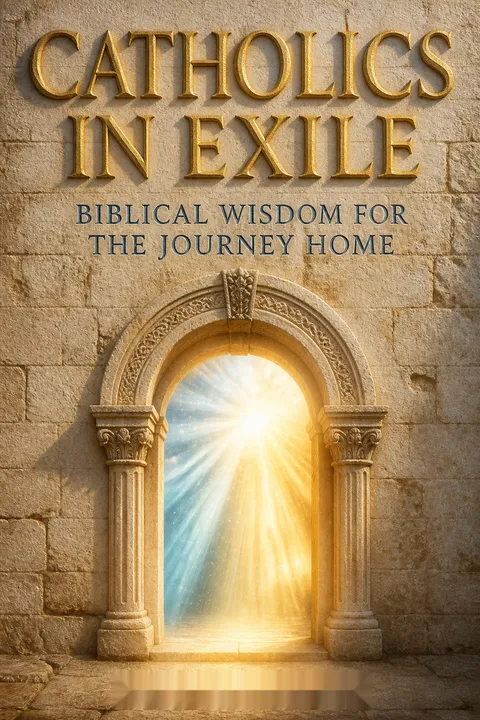
Catholics in Exile receives overwhelmingly positive reviews (4.44/5), with readers praising Hahn's scriptural insights and parallels between biblical exile and modern Catholic life. Many found the book encouraging and inspiring, appreciating its exploration of living faithfully in a secular world. Common praise includes beautiful prose, well-researched content, and the message that "we are not made for this world." Some noted repetitiveness, particularly in the second half and heavy use of quotes. Readers valued practical spiritual perspectives on work, Mass, and sacraments, though one desired more concrete cultural engagement strategies.
People Also Read


About the Author
Download PDF
Download EPUB
.epub digital book format is ideal for reading ebooks on phones, tablets, and e-readers.








































