
Key Takeaways
1. Capitalism's Inherent Contradictions Drive Cycles of Crisis and Adaptation
"Indeed, it is barely hyperbole to say that capitalism is always in crisis, recovering from crisis, or heading toward the next crisis."
Constant flux. From its earliest days, capitalism has been characterized by relentless change and recurrent crises, a dynamic process of expansion and contraction. This inherent instability, noted by critics from Marx to Kondratiev, is not an anomaly but a fundamental feature of the system. Periods of prosperity, driven by innovation and accumulation, inevitably give way to slumps, only for the system to rebound, often in a new guise.
Internal dynamics. Thinkers like Marx and Engels identified core contradictions, such as the tendency for production to outstrip demand and the concentration of capital, as drivers of these cycles. Rosa Luxemburg further argued that capitalism's survival depended on constantly expanding into non-capitalist territories to absorb its surplus. These internal pressures, rather than external shocks alone, shape capitalism's long-term trajectory.
Recuperative power. Despite dire predictions of its demise, capitalism has repeatedly demonstrated a remarkable capacity for recuperation. Governments, acting as "crisis managers," have intervened to prevent wholesale financial disintegration, as seen during the Panic of 1857 or the Global Financial Crisis of 2007–2009. This resilience, however, often comes at a cost, paving the way for future, potentially more destructive, crises.
2. The State: Both Architect and Regulator of Market Forces
"The road to the free market was opened and kept open by an enormous increase in continuous, centrally organized and controlled interventionism."
Market creation. Contrary to the myth of spontaneous emergence, the free market was actively constructed and maintained by state power. Karl Polanyi meticulously documented how the British state, through measures like the Poor Law Amendment Act of 1834, forcibly created a labor market and other conditions necessary for laissez-faire capitalism to flourish. This involved dismantling traditional social protections and imposing new rules.
Necessary interventions. As capitalism developed, its inherent instability and social costs necessitated further state intervention. From early factory acts limiting child labor to Keynesian demand management and social safety nets, governments have repeatedly stepped in to mitigate market failures and maintain social cohesion. These interventions, often driven by popular demand, represent a "double movement" of market expansion followed by societal self-protection.
Political capture. However, the state's role is not always benign or neutral. Critics like William Thompson and Paul Sweezy highlighted how powerful economic interests often capture the state, using its apparatus to secure their own property rights and privileges. This dynamic can lead to policies that exacerbate inequality or promote ventures like imperialism, serving sectional interests rather than the common good.
3. Colonialism and Slavery: The Dark Engines of Early Capitalist Accumulation
"Slavery was not born of racism: rather, racism was the consequence of slavery."
Economic imperative. The transatlantic slave trade and plantation economies were not peripheral to early capitalism but central to its development. Eric Williams argued that the demand for cheap labor in the Americas, initially met by Indigenous and white indentured workers, ultimately led to the systematic importation of enslaved Africans. This was an economic phenomenon, with racism evolving as a justification for the brutal exploitation.
Triangular trade's boost. The triangular trade, involving manufactured goods from Britain to Africa, enslaved people to the Americas, and colonial produce back to Britain, profoundly stimulated British industry. It created new markets for textiles and metal goods, supplied crucial raw materials like cotton, and generated immense profits that "fertilized the entire productive system of the country," as Williams noted. Port cities like Liverpool thrived on this trade.
Primitive accumulation. Marx termed this process "primitive accumulation," recognizing that the violent plunder of colonies and the enslavement of peoples provided the initial capital and resources for industrialization. Rosa Luxemburg further emphasized that imperialism, with its violent subjugation of non-capitalist societies, was a continuous, necessary feature of capital accumulation, not just its genesis.
4. Technology's Dual Nature: Progress and Profound Disruption
"The living artisan is driven from his workshop, to make room for a speedier, inanimate one."
Productivity engine. From Arkwright's spinning frame to Watt's steam engine and modern AI, technological innovation has been a relentless force driving capitalist development, vastly increasing productivity and output. This "mechanical genius," as Carlyle called it, has transformed production processes, created new industries, and enabled unprecedented material abundance.
Social upheaval. Yet, this progress has always come with profound social costs. The Luddites, smashing textile machinery, were an early manifestation of workers' resistance to technologies that threatened their livelihoods and traditional ways of life. Marx and Engels documented how mechanization created an "industrial reserve army" of unemployed, disciplining wages and intensifying exploitation.
Future uncertainties. Today, the rise of artificial intelligence presents a similar, perhaps even greater, challenge. While AI promises to boost productivity and create new possibilities, it also threatens to displace countless jobs, exacerbate inequality, and concentrate power in the hands of those who control the technology. The question remains whether technology will augment human capabilities or lead to a "technological dystopia."
5. Unpaid Labor: The Hidden Foundation of Capitalist Production
"If we were not at home doing housework, none of their factories, mines, schools and hospitals, could run, none of their profits could flow."
Invisible work. The capitalist system relies heavily on a vast amount of unpaid domestic labor, primarily performed by women, which is essential for maintaining and reproducing the workforce. Silvia Federici and the Wages for Housework movement argued that this "social production" is systematically undervalued and excluded from economic measures like GDP, effectively rendering women's work invisible.
Economic exploitation. This unpaid labor, from cooking and cleaning to child-rearing, directly supports the paid economy by ensuring workers are fed, rested, and ready for their jobs, and by raising future generations of laborers. Mariarosa Dalla Costa termed the nuclear family the "social factory," where women are exploited, their creative capacities stifled, and their sexual lives commodified for the reproduction of labor power.
Feminist critique. Early feminists like Charlotte Perkins Gilman and Crystal Eastman recognized the economic subjugation of women through their domestic roles. The Wages for Housework movement, however, explicitly tied this exploitation to the capitalist system, demanding payment not just for recognition, but as a means to dismantle the patriarchal structures that bind women to the home and discipline male workers through their wives' dependence.
6. The Illusion of Self-Regulating Markets and the Need for Intervention
"The 'tramp' comes with the locomotive, and almshouses and prisons are as surely the marks of 'material progress' as are costly dwellings, rich warehouses, and magnificent churches."
Inherent instability. The belief in self-adjusting markets, a cornerstone of classical economics, has been repeatedly challenged by capitalism's history of crises and social distress. Henry George observed that poverty advanced alongside progress, arguing that the market, left unchecked, inevitably leads to land speculation and rent extraction that impoverishes the working class.
Demand shortfalls. John Hobson and Rosa Luxemburg identified a chronic tendency for capitalist production to outrun effective demand, leading to overproduction and the need for external markets or state intervention. Keynes formalized this, demonstrating that economies could get stuck in "underemployment equilibrium" without active government management of aggregate demand through fiscal and monetary policy.
Financial fragility. Hyman Minsky's "Financial Instability Hypothesis" further exposed the illusion of market self-regulation, showing how financial systems, driven by profit and risk-taking, are inherently prone to speculative bubbles and catastrophic collapses. These critiques underscore that markets are not natural forces but human constructs requiring constant oversight and regulation to prevent self-destruction.
7. Inequality: A Persistent Feature Driven by Power and Ideology
"Accumulation of wealth at one pole is … at the same time accumulation of misery, the torment of labour, slavery, ignorance, brutalization and moral degradation at the opposite pole."
Polarizing force. From its inception, capitalism has generated vast disparities in wealth and income, creating a stark divide between the rich and the poor. Marx's "Law of Accumulation" described how capital concentration leads to the "absolute general law of capitalist accumulation," where wealth accumulates at one pole while misery accumulates at the other, even if wages rise.
Rent-seeking and power. Thomas Piketty's research, showing the "U-shaped" trajectory of inequality, highlights how the rate of return on capital (r) often exceeds economic growth (g), leading to wealth concentration. This is exacerbated by "supermanagers" who set their own exorbitant pay, and by political systems captured by wealthy interests who influence tax policies and regulations to their benefit.
Ideological justifications. Beyond economic mechanisms, inequality is sustained by dominant ideologies that justify existing power structures. Piketty argues that "inequality is neither economic nor technological; it is ideological." These narratives, whether based on "natural law" or "meritocracy," serve to legitimize wealth disparities and resist redistributive policies, as Stuart Hall observed in the rise of Thatcherism.
8. Globalization's Uneven Impact and the Erosion of Legitimacy
"The international market is the only market that is not regulated by an overarching political authority."
Borderless capitalism. The late 20th and early 21st centuries witnessed "hyperglobalization," driven by technological advances and neoliberal policies, creating a truly global capitalist system. This expansion, as Samir Amin noted, shifted economic power beyond national borders, yet lacked a coherent global political framework to manage its consequences.
Winners and losers. While globalization lifted hundreds of millions out of acute poverty in countries like China and India, it simultaneously led to wage stagnation and job losses in the lower-middle classes of developed nations, as Dani Rodrik and Branko Milanović documented. This uneven distribution of benefits fueled a political backlash, undermining globalization's legitimacy.
Systemic fragility. Joseph Stiglitz criticized the "Washington Consensus" for imposing market fundamentalism on developing countries, leading to financial instability and deeper slumps, as seen in the Asian Financial Crisis. The lack of effective global governance, coupled with the pursuit of narrow financial interests, created a system prone to crises and social disintegration, threatening its long-term viability.
9. The Ecological Imperative: Confronting Capitalism's Growth Addiction
"Any use of the natural resources for the satisfaction of non-vital needs means a smaller quantity of life in the future."
Finite planet. Nicholas Georgescu-Roegen fundamentally challenged the notion of perpetual economic growth by applying the Second Law of Thermodynamics to economic processes. He argued that all production converts "low entropy" (usable resources) into "high entropy" (unusable waste), implying that infinite growth is impossible on a finite planet.
Growthmania's cost. The relentless pursuit of GDP growth, a shared goal across diverse economic systems, has led to the rapid depletion of natural resources and severe environmental degradation. Critics like J. C. Kumarappa, a proponent of "Gandhian economics," advocated for an "Economy of Permanence" based on local self-sufficiency and reliance on renewable resources, rejecting the materialist values of mass production.
Degrowth vs. green growth. The "degrowth" movement, inspired by Georgescu-Roegen, calls for a deliberate reduction in economic activity in rich countries to achieve ecological balance and enhance human well-being. While "green growth" proponents argue that technological innovation can decouple growth from environmental impact, degrowth advocates insist that fundamental changes to consumption patterns and a shift away from capitalism's inherent growth imperative are necessary to avert ecological catastrophe.
Review Summary
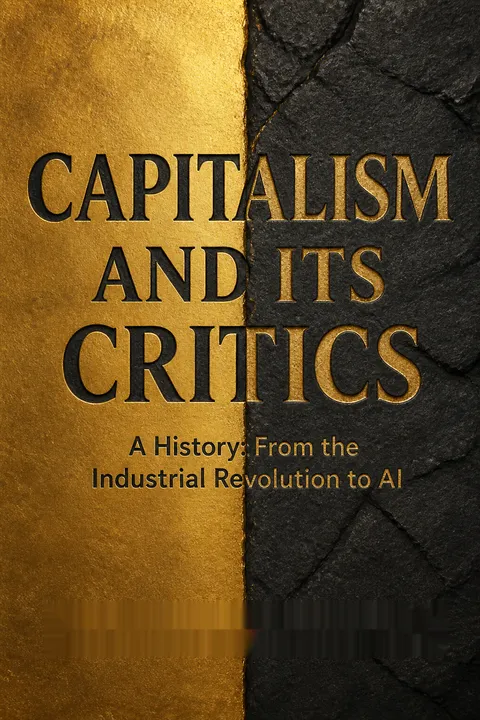
Capitalism and Its Critics receives mostly positive reviews, averaging 4.18/5. Readers praise Cassidy's sweeping, accessible survey of economic thinkers from Adam Smith to Piketty, appreciating its chronological, biography-driven structure and balanced treatment of complex ideas. Many highlight its value for non-economists and commend its inclusion of lesser-known figures like Polanyi, Kumarappa, and Federici. Critics note the book lacks a strong thesis, can feel like a surface-level textbook, and occasionally misrepresents thinkers. Some found it dense or dry, while others called it essential, timely reading.
People Also Read









Download PDF
Download EPUB
.epub digital book format is ideal for reading ebooks on phones, tablets, and e-readers.








































