
Key Takeaways
1. Inequality is Ideological and Political, Not Natural or Economic.
Inequality is neither economic nor technological; it is ideological and political.
Challenging assumptions. Every human society, throughout history, must justify its inequalities. These justifications are not inherent economic or technological necessities but rather social and historical constructs, shaped by prevailing ideologies and power dynamics. Elites often "naturalize" existing disparities, claiming they benefit all and that any change would be detrimental.
Ideas matter. This perspective emphasizes the autonomy of the realm of ideas. Given a certain economic state, a range of possible ideological, political, and inequality regimes always exists. Ideas and ideologies are crucial because they enable us to imagine new worlds and different types of society, offering multiple paths for social organization.
Historical evidence. History demonstrates that inequality varies widely in time and space, both in structure and magnitude. Rapid changes have occurred, often through political processes and revolutionary transformations that led to significant reductions in inequality. These shifts gave rise to cherished institutions like universal suffrage, public education, and progressive taxation, proving that current inequalities are not the only ones possible.
2. Historical Inequality Regimes: From Trifunctional to Proprietarian Societies.
Every human society needs to justify its inequalities: unless reasons for them are found, the whole political and social edifice stands in danger of collapse.
Ternary foundations. Premodern societies, particularly in Europe, were often "ternary" or "trifunctional," divided into three orders: clergy (spiritual/intellectual), nobility (military/security), and the third estate (laborers). This structure, justified by functional complementarity, intertwined political and economic powers at the local level, with the dominant classes owning most land and exercising regalian rights.
Rise of proprietarianism. The French Revolution (1789) marked a pivotal shift, aiming to separate regalian powers (monopolized by the centralized state) from private property rights (theoretically universal and inviolable). This "Great Demarcation" sought to end privileges but struggled to define legitimate property, often transforming old feudal dues into new forms of rent or debt.
Nineteenth-century paradox. Despite revolutionary ideals, France and other European nations saw wealth concentration increase throughout the 19th century, reaching levels even higher than under the Ancien Régime. This was facilitated by low, proportional taxes and a legal system that sacralized existing property rights, demonstrating that formal equality of rights did not automatically lead to reduced inequality.
3. Slavery and Colonialism: Foundations of Extreme Inequality and Enduring Legacies.
The abolition of slavery imposed a cost on slaveowners, and in the United Kingdom the public choice was for British taxpayers to bear that cost, thus illustrating both the political power of the slaveholders and the grip of proprietarian ideology.
Extreme exploitation. Slave societies, particularly in the Atlantic world (e.g., Haiti, Southern US), represented the most extreme forms of inequality, with slaves comprising up to 90% of the population and receiving minimal subsistence. Colonial societies, while less extreme, also exhibited profound disparities, with European settlers and administrators appropriating vast shares of wealth.
Owner compensation. The abolition of slavery in the 19th century (UK 1833, France 1848) often involved substantial financial compensation to slaveowners, not slaves. Haiti, for instance, was burdened with a massive debt to France (300% of its GDP) to compensate former slaveholders, crippling its development for over a century. This underscored the sacralization of private property, even when derived from human bondage.
Colonial extraction. European colonial empires, particularly in their second phase (1850-1960), were organized for the colonizers' benefit. This involved:
- Regressive taxation (e.g., head taxes) on colonized populations.
- Minimal investment in native education and social services.
- Legal systems that codified racial and ethnic discrimination.
- Persistence of forced labor (e.g., French Africa until 1946).
- Massive financial extraction: foreign assets held by UK/French citizens reached 1-2 years of national income by 1914.
4. The Twentieth Century's Great Transformation: Collapse of Private Wealth and Rise of Progressive Taxation.
The reduction of inequality and exit from the ownership society that took place in the twentieth century were not peaceful processes.
Unprecedented leveling. Between 1914 and 1945, global inequality underwent a dramatic, unprecedented reduction. The top decile's share of income in Europe fell from ~50% to ~30%, and wealth concentration saw a similar collapse (top 10% from 90% to 50-55%). This was a profound shift from centuries of rising or stable high inequality.
Multifaceted causes. This collapse was not solely due to wartime destruction, which accounted for a minor portion. Key factors included:
- Expropriations and nationalizations: Foreign assets (e.g., Russian bonds), key industries (e.g., Renault in France).
- Rent and price controls: Significantly reduced the value of real estate.
- Public debt and inflation: Wars led to massive public debt, often eroded by inflation, effectively taxing bondholders.
- Exceptional wealth taxes: Post-war levies (e.g., Japan, Germany) on large fortunes to finance reconstruction.
Progressive taxation's role. The most significant innovation was the widespread adoption of steeply progressive income and inheritance taxes, with top marginal rates reaching 70-90% in the US and UK for decades. This fiscal revolution fundamentally altered wealth accumulation and transmission, making it impossible to sustain the vast fortunes of the Belle Époque.
5. Social Democracy's Achievements and Limits: Incomplete Equality and Unaddressed Challenges.
The egalitarian character of the period 1950–1980 should not be exaggerated.
Post-war consensus. From 1950 to 1980, many non-communist nations, particularly in Western Europe, adopted "social-democratic" models characterized by:
- High taxation (30-50% of national income) funding extensive welfare states (health, education, pensions).
- Reduced income and wealth inequality compared to pre-1914 levels.
- Significant public ownership and state intervention in the economy.
Unfinished agenda. Despite successes, social democracy had limitations. Social ownership (e.g., German co-management) remained geographically limited and often incomplete, with shareholders retaining ultimate control. Educational systems, while expanding, often perpetuated stratification, particularly in higher education, as seen in the US.
Globalization's challenge. Social democracy largely failed to adapt to globalization. It contributed to liberalizing capital flows without establishing transnational regulations, information sharing, or common fiscal policies. This created a "race to the bottom" in taxation and weakened the national social contract, contributing to rising inequality since the 1980s.
6. The Communist Experiment: From State Ownership to Oligarchic Hypercapitalism.
The Soviet failure is also one of the most potent factors contributing to the return of economic liberalism since 1980–1990 and to the development of new forms of sacralization of private property.
Flawed vision. The Soviet Union's attempt to abolish private property entirely and replace it with hypercentralized state ownership proved disastrous. Lacking a coherent theory of economic organization beyond state control, the regime resorted to repression, mass incarceration (e.g., 5% of adults imprisoned by 1953), and criminalization of small-scale private activity.
Initial gains, later stagnation. Despite initial catch-up in modernization (education, infrastructure) and reduced monetary inequality (top decile ~25% of income), the Soviet standard of living stagnated after the 1950s, leading to a demographic crisis (e.g., declining male life expectancy). The system's inherent inefficiencies and lack of individual incentives became evident.
Post-communist reversal. The collapse of the USSR (1991) led to "shock therapy" and rapid privatization, transforming Russia into an oligarchic kleptocracy. Wealth inequality skyrocketed (top decile ~50% of income by 2000), fueled by massive capital flight to tax havens and a flat 13% income tax. This dramatic failure inadvertently reinforced the global appeal of unregulated capitalism.
7. Hypercapitalism's Paradox: Extreme Inequality Amidst Financial Opacity and Global Challenges.
The Middle East today is the most inegalitarian region in the world.
New global disparities. Today's hypercapitalist world is marked by unprecedented interconnectedness but also extreme inequality. Regions like the Middle East (top decile ~70% of income), South Africa, and Brazil exhibit the highest disparities, often linked to resource concentration (oil) or legacies of racial/colonial discrimination.
Opacity and evasion. Despite the "big data" era, financial opacity has increased. Governments and statistical agencies often lack tools to accurately measure wealth, especially cross-border assets. Tax havens facilitate massive capital flight (e.g., ~90% of Russian national income held offshore), undermining fiscal justice and democratic transparency.
Unaddressed challenges. Hypercapitalism faces critical, interconnected challenges:
- Climate change: High emitters (top 1% globally, largely in the US) contribute disproportionately, while the poor suffer most. Effective climate policy requires social justice.
- Pauperization of poor states: Trade liberalization, often imposed by rich countries, led to declining tax revenues in developing nations, hindering state-building.
- Monetary creation: Post-2008 "quantitative easing" by central banks prevented collapse but masked structural issues, inflated asset prices, and deepened reliance on financial solutions over democratic policy.
8. The Great Reversal: From Workers' Parties to the "Brahmin Left" in Western Democracies.
In the postwar years, the people who voted left were likely to be less well-educated salaried workers, but over the past half century this has changed, and they now are more likely to be people with higher levels of education, including managers and people in intellectual professions.
Shifting allegiances. From 1950-1980, Western democracies (US, UK, France, Germany, Nordics) had "classist" party systems: less educated, lower-income, less wealthy voters supported left-wing parties. This pattern has fundamentally reversed. By 1990-2020, left-wing parties increasingly draw support from the highly educated, forming a "Brahmin Left."
Educational cleavage. This "Great Reversal" of the educational cleavage is a robust, long-term phenomenon observed across all Western democracies. Voters with higher degrees, once more likely to vote right, now disproportionately support the left. Conversely, less educated voters have increasingly abandoned the left and reduced their electoral participation.
Abandonment of the disadvantaged. This shift reflects a perceived abandonment of the less advantaged by left-wing parties, whose platforms increasingly align with the interests of the educated elite. This ideological drift, coupled with the rise of globalization and the decline of traditional industrial employment, created fertile ground for new political cleavages.
9. The Social-Nativist Trap: Identity Conflicts Eclipse Redistribution in a Postcolonial World.
If the less advantaged truly supported anti-immigrant movements, their turnout should be at a peak today. The fact that it is very low clearly shows that many less advantaged voters are not satisfied with the choices presented to them.
Exploiting disillusionment. The decline of class-based politics and the perceived failure of traditional left parties to address rising inequality have created a vacuum. This vacuum is increasingly filled by "social-nativist" ideologies that combine:
- Social and egalitarian promises for the "native" population.
- Strong anti-immigrant, xenophobic, and nationalist rhetoric.
European examples. This phenomenon is evident in Eastern Europe (e.g., Poland's PiS, Hungary's Fidesz) and increasingly in Western Europe (e.g., Italy's Lega-M5S coalition). These parties capitalize on post-communist disillusionment, anti-EU sentiment, and anxieties about immigration, often portraying themselves as champions of the "people" against "globalist elites."
The danger. Social nativism is a dangerous trap. It diverts attention from fundamental socioeconomic inequalities by blaming external groups (immigrants) or abstract entities (Brussels, globalization). It risks escalating violence, undermining democratic norms, and is unlikely to deliver genuine redistribution, often leading to market-nativist policies that still favor the wealthy.
10. Participatory Socialism: A Vision for Just Ownership and Democratic Governance.
The history of all hitherto existing societies is the history of the struggle of ideologies and the quest for justice.
Transcending capitalism. A new "participatory socialism" aims to move beyond capitalism by redefining property. This involves:
- Social ownership: Power-sharing within firms (e.g., co-management with 50% worker representation), capping large shareholder voting rights.
- Temporary ownership: Replacing permanent private ownership with a system of wealth circulation.
Progressive wealth taxation. This circulation is achieved through steeply progressive taxes on large fortunes (e.g., 10-90% annual rates on wealth exceeding 10-10,000 times average wealth). These taxes would fund a "universal capital endowment" for every young adult (e.g., 120,000 euros at age 25), ensuring a more equitable start in life.
Complementary tools. Participatory socialism also includes:
- Progressive income tax: High marginal rates (e.g., 60-90% on top incomes) to fund a robust welfare state (health, education, pensions, basic income).
- Educational justice: Equal public investment per student, transparent admissions, and proactive measures to overcome social stratification.
11. Transnational Democracy: Reimagining Borders and Global Justice.
The current ideology of globalization, which first developed in the 1980s, is in crisis and entering a transitional phase.
Globalization's contradictions. The current global system, prioritizing free movement of goods, services, and capital while restricting people, is inherently contradictory. It fosters fiscal dumping, exacerbates inequality, and fuels nationalist reactions. A new framework is needed to embed markets within social and environmental goals.
Social federalism. This requires "transnational democracy," starting with regional unions like the European Union. A "European Assembly," composed of national and European parliamentarians, could:
- Approve common taxes (corporate, high income, wealth, carbon).
- Fund shared public goods (climate, research, education).
- Set limits on transfers to build trust.
Codevelopment treaties. Beyond regions, "codevelopment treaties" would replace existing trade agreements. These treaties would:
- Prioritize equitable and sustainable development goals over mere liberalization.
- Include verifiable targets for social, fiscal, and environmental justice.
- Require financial transparency and cooperation (e.g., public financial registers).
- Regulate capital flows and potentially facilitate free movement of people, linking rights to common financing.
Overcoming inertia. The path to transnational justice is complex, facing resistance from entrenched interests and nationalist ideologies. However, history shows that profound change is possible when social and political struggles converge with renewed ideas. The choice is between continued fragmentation and conflict, or a cooperative, egalitarian future.
Review Summary
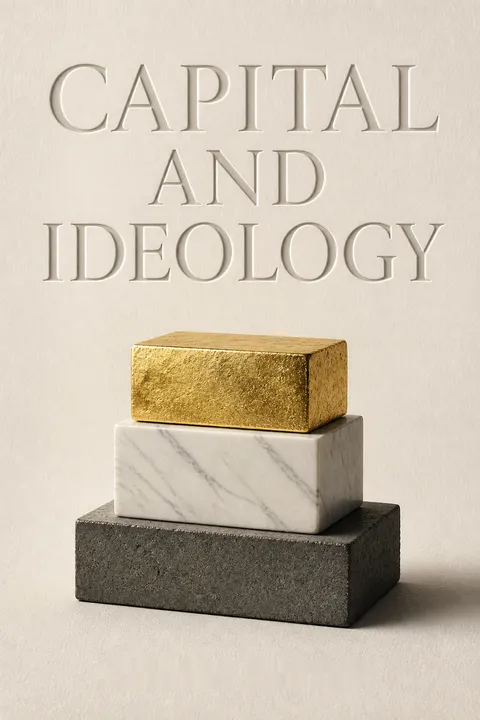
Capital and Ideology by Thomas Piketty examines inequality throughout history, analyzing how different societies have justified economic disparities through ideology. The 1,100-page work spans from medieval trifunctional societies to modern hyper-capitalism, using extensive data and historical analysis. Reviewers praise Piketty's ambitious scope and thorough research covering Europe, Asia, and the Americas, though some criticize the book's length and redundancy. The final chapters propose "participatory socialism" with progressive wealth taxes, co-management, and transnational cooperation. Most readers find it intellectually stimulating and thought-provoking, despite debates over its policy recommendations.
People Also Read






About the Author

Download PDF
Download EPUB
.epub digital book format is ideal for reading ebooks on phones, tablets, and e-readers.








































