
Key Takeaways
1. The Genesis of a Classic: Wartime Radio Talks for the Unchurched
"The microphone... is a limiting and often irritating instrument, but the quality of thinking and the depth of conviction which I find in your book ought surely to be shared with a great many other people; and for any talk we can be sure of a fairly intelligent audience of more than a million."
Wartime necessity. C. S. Lewis's "Mere Christianity" originated as four sets of radio broadcasts for the BBC during the harrowing years of World War II. Amidst the prolonged fears, suffering, and uncertainties of the Blitz and the threat of invasion, the BBC, guided by its public service mission and explicitly Christian ethos, sought edifying content. Recognizing a vast spiritual void among the British populace, they invited Lewis, already noted for "The Problem of Pain," to address a broad, largely unchurched audience.
Layman's appeal. Lewis, an Oxford literary scholar and recent convert, was uniquely positioned as a lay speaker to present Christian doctrine in accessible, non-clerical language. His strategy was to begin with universal human experiences, such as the innate sense of right and wrong, before introducing explicit Christian tenets. This deliberate approach aimed to engage listeners who might otherwise dismiss conventional religious talks, offering insights from his own pilgrimage from skepticism to commitment.
Unplanned classic. The broadcasts, initially not intended as a book, resonated immediately with listeners, leading to their publication as three separate paperbacks. These were later combined in 1952 under the title "Mere Christianity." This unplanned evolution underscores the profound impact of Lewis's message, which steadily gained momentum, transcending its modest origins to become one of the twentieth century's most influential religious books.
2. The Moral Law: A Universal Clue to God's Existence
"If no set of moral ideas was truer or better than any other, there would be no sense in preferring civilized morality to savage morality, or Christian morality to Nazi morality."
Starting point. Lewis commenced his first series of talks by appealing to the universal human experience of moral judgment and the inherent belief in an objective "Law of Nature." He argued that everyone, regardless of background, recognizes fundamental concepts of right and wrong, fair play, and justice. This shared moral intuition, he contended, points to a reality beyond mere social convention or "herd instinct."
Implied Lawgiver. If such a moral law truly exists, Lewis reasoned, it implies the existence of a Lawgiver—a personal intelligence who designed the universe and cares about right and wrong. This controlling power, he explained, could not be merely a part of the universe, but rather its architect, much like a cinema operator is not on the screen. This initial step aimed to "create, or recover, the sense of guilt" in his audience, preparing them for the Christian message.
Beyond relativism. In the stark context of wartime, Lewis powerfully underscored the critical importance of objective morality. He asserted that without it, there would be no rational basis to prefer "civilized morality to savage morality, or Christian morality to Nazi morality." This assertion challenged the prevailing relativism of his era, laying a foundational argument for the necessity of a transcendent moral framework before delving into specific Christian doctrines.
3. Jesus: Lord, Liar, or Lunatic? The Core Christian Claim
"You must make your choice."
The trilemma. Lewis's most famous and debated argument, presented in "What Christians Believe," posits that Jesus Christ could not simply be a "great moral teacher" if his claims to divinity were false. Instead, if Jesus was not God, he must have been either "a liar as evil as the Devil in Hell, or he was a lunatic on a par with 'the man who says he is a poached egg.'" This forces a stark choice upon the listener.
Challenging modern views. This argument directly confronted liberal Christian interpretations that sought to admire Jesus's ethics while dismissing his supernatural claims. Lewis, as a former atheist, found it illogical to accept Jesus's moral authority without also accepting his self-proclaimed divine identity. He argued that such outrageous claims, if untrue, would inevitably undermine any credibility as a moral guide.
Enduring persuasion. While critics have offered alternatives, such as Jesus being a "legend" or suffering from mental illness, Lewis's trilemma has remained remarkably persuasive for many, including prominent converts like Chuck Colson and Francis Collins. It compels readers to grapple with the astonishing implications of Jesus's identity, making the case that traditional Christianity offers the most coherent explanation for the historical figure of Christ.
4. "Mere Christianity": A Common Hall, Not a Specific Room
"The hall is a place to wait in, a place from which to try the various doors, not a place to live in."
Central core. Lewis coined the term "mere Christianity" to describe the fundamental, agreed-upon beliefs shared by nearly all Christians across denominations and throughout history. He explicitly stated that his book was not intended to guide readers between different Christian "denominations," but rather to expound this essential, positive, and "pungent" core of the faith. This non-sectarian approach was crucial for his broad appeal.
Ecumenical vision. Drawing inspiration from Richard Baxter, a 17th-century English preacher who advocated for "Meer Christianity" amidst sectarian strife, Lewis presented a vision of unity among diverse believers. He emphasized that despite unfortunate differences, there are vast areas of agreement that are "big enough to blow any of us sky-high if it happens to be true," urging readers not to let disagreements distract from these core truths.
A starting point. Lewis famously used the metaphor of a "hall" from which "doors open into several rooms" to illustrate his concept. He saw "mere Christianity" as the hall—a necessary starting point for inquiry and belief—but not a place to permanently reside. He encouraged readers to eventually choose a specific "room" (denomination) for deeper spiritual life, while advocating kindness and prayer for those in different rooms or still in the hall.
5. Christian Behavior: Practical Morality Rooted in Cosmic Truths
"The sins of the flesh are bad, but are the least bad of all sins."
Everyday ethics. In the third set of talks, titled "Christian Behaviour," Lewis shifted from cosmic arguments to practical, everyday Christian moral principles. He used musical analogies to describe morality's three parts: harmony among individuals, harmony within each individual, and pursuing the ultimate purpose of human life. This section covered topics like social morality, psychoanalysis, sexual morality, forgiveness, and the "great sin" of pride.
Virtues and transformation. Lewis grounded his ethical discussions in traditional virtues, distinguishing between the four "Cardinal" virtues (prudence, temperance, justice, fortitude) recognized by all civilized people, and the three "Theological" virtues (faith, hope, charity). He explained that practicing virtues is akin to becoming a skilled tennis player, emphasizing consistent effort over occasional good acts, and linking moral growth to a deeper transformation of character.
Challenging popular notions. Lewis often presented contrarian views, such as his assertion that "the sins of the flesh are bad, but are the least bad of all sins," aiming to reorient his audience's moral priorities. While some of his remarks on sexual morality and gender roles have been criticized as dated, his core emphasis remained on the profound personal demands of Christian living, urging readers to move beyond superficial self-improvement.
6. Beyond Personality: The Transformative Goal of Becoming "Little Christs"
"The Church exists for nothing else but to draw men into Christ, to make them little Christs."
Deepening theology. The fourth and final series of talks, "Beyond Personality," delved into more complex theological subjects, including the Trinity, Creation, Incarnation, Resurrection, and Ascension. Lewis began by asserting that theology is not impractical but essential, likening it to a map for a journey. He aimed to explain these doctrines with his characteristic clarity and use of analogies, presenting them not as obstacles but as unique and attractive qualities of Christianity.
The new humanity. A central theme was the radical transformation of the self, moving "Out of our selves, into Christ." Lewis argued that humans are meant to be united with Christ, becoming "new men" and "Sons of God." This process involves a "real giving up of the self" and allowing Christ to live within, enabling individuals to obey the command "Be ye perfect."
Grace and struggle. Lewis emphasized that this transformation is both a matter of God's grace and a demanding personal struggle. He used vivid metaphors, such as eggs needing to hatch to fly or tin soldiers becoming alive, to convey the profound, life-reorienting reality of becoming "little Christs." This ultimate goal, he argued, is the very purpose of the Church and the essence of Christianity, offering both immense appeal and challenging demands to serious readers.
7. The Apologist as Translator: Engaging Reason, Imagination, and Experience
"Any fool can write learned language. The vernacular is the real test."
Accessible communication. Lewis saw his primary role as an apologist as that of a "translator," putting complex Christian doctrine into simple, modern, vernacular language for a general audience. He deliberately avoided academic jargon and nuanced theological distinctions, recognizing that most of his listeners were unfamiliar with traditional Christian terminology. This commitment to clarity and directness was a hallmark of his style.
Holistic persuasion. Lewis's apologetic method went beyond mere logical argumentation; he appealed to the whole person, engaging reason, affections, imagination, and common human experience. He believed that while Christian belief must be consistent with reason, it also needed to resonate with people's deepest longings, moral sensibilities, and imaginative capacities. His use of vivid analogies and metaphors served to clarify arguments and excite the imagination.
Authentic voice. Lewis's personal journey from atheism to faith lent authenticity to his presentations. He spoke with the authority of someone who had wrestled with skepticism and found Christianity to be the most compelling explanation for reality. His self-effacing manner, coupled with his deep personal integrity (including donating most of his book earnings to charity), further enhanced his credibility and contributed to his lasting reputation as a trustworthy guide.
8. Timeless Truths Over Fleeting Fashions: Lewis's Enduring Relevance
"The scholar has lived in many times and is therefore in some degree immune from the great cataract of nonsense that pours from the press and the microphone of his own age."
Rejecting chronological snobbery. A foundational aspect of Lewis's thought, stemming from his friend Owen Barfield's influence, was his rejection of "chronological snobbery"—the uncritical acceptance of contemporary intellectual trends and the dismissal of older ideas as outdated. As a literary scholar deeply immersed in ancient and medieval thought, Lewis recognized the ephemeral nature of modern dogmas and the characteristic illusions of every age.
Critique of modernity. Lewis consistently critiqued the unproven assumptions of modern thought, particularly naive naturalistic philosophies and "scientism" that claimed science as the highest form of knowledge. He distinguished between genuine scientific inquiry and the philosophical overreach that sought to explain away spiritual realities. His interplanetary novels, for instance, satirized pseudo-scientists with delusional visions of controlling the universe.
Prophetic insights. Lewis's focus on perennial truths, rather than culturally bound issues or partisan politics, has contributed significantly to his enduring relevance. His critiques of modernity and warnings against being captivated by the "spirit of the age" often appear prophetic in retrospect, resonating with readers who find contemporary thought riddled with contradictions. His ability to present Christian truths as compelling across time and cultures is a testament to this approach.
9. A Divisive Yet Unifying Force: The Book's Varied Reception
"They obviously either regard you as 'the cat’s whiskers' or as 'beneath contempt.'"
Polarized reactions. From its initial broadcasts, "Mere Christianity" elicited sharply divided responses, with Lewis noting that letters were "nearly all either violent abuse or extravagant praise." While mainstream British press often lauded his work, liberal Protestants and atheists like George Orwell and Alistair Cooke vehemently criticized his "backward-looking" orthodoxy and "silly-clever" style, accusing him of intellectual laziness and promoting "B.B.C. Christianity."
American embrace. In America, Lewis's reception was generally more enthusiastic, especially after the success of "The Screwtape Letters." Mainstream publications like Time and The Saturday Review acclaimed him as a major apostle of Christian faith. While some conservative evangelicals initially expressed caution regarding his doctrinal precision, they eventually embraced him as a champion, with institutions like Wheaton College establishing the Marion E. Wade Center to promote his legacy.
Ecumenical appeal. Despite the controversies, "Mere Christianity" became a unifying force across diverse Christian traditions. It resonated deeply with those seeking an intellectually viable faith beyond liberalism or narrow fundamentalism, appealing to mainline Protestants, Roman Catholics (many of whom were led to Rome by Lewis), and Eastern Orthodox Christians. Its non-sectarian message fostered a practical ecumenism, making it a foundational text for countless individuals and groups worldwide, including in former Communist lands and China.
Review Summary
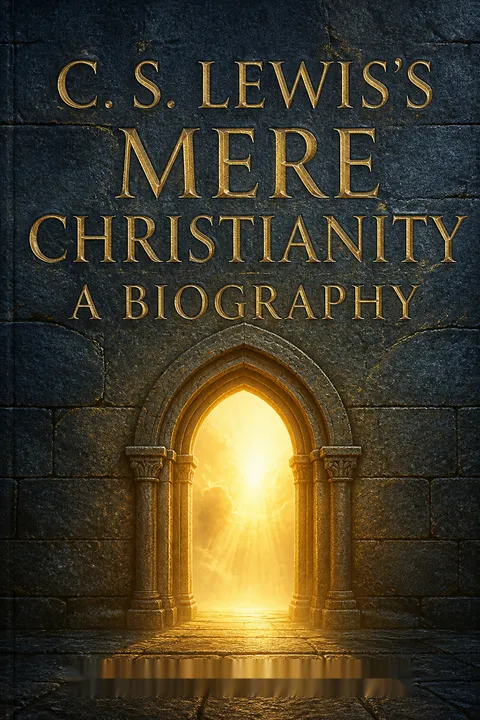
C. S. Lewis's Mere Christianity by George M. Marsden is a biography of the influential Christian book rather than its author. Reviewers appreciate Marsden's thorough historical research covering the book's origins as BBC radio talks during WWII, its reception across different Christian denominations, and reasons for its enduring popularity. Most praise the contextualization and criticism analysis, though some find portions repetitive or feel Marsden focuses too heavily on academic detractors. Readers recommend having read Mere Christianity first to fully appreciate this scholarly yet accessible work.
People Also Read








Download PDF
Download EPUB
.epub digital book format is ideal for reading ebooks on phones, tablets, and e-readers.








































