

Key Takeaways
You cannot manufacture desire, only channel what already burns
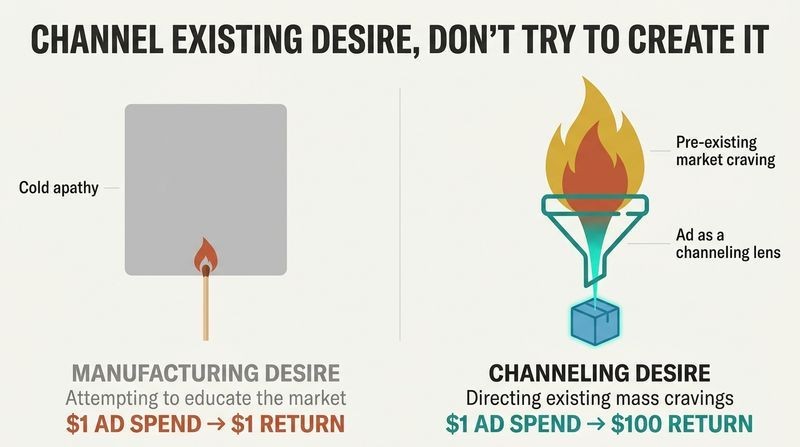
Schwartz's founding law: advertising copy is powerless to create wanting. It can only seize the hopes, fears, and cravings already alive in millions and aim them at one product. Fight the tide and you drown. In 1948 Chrysler bucked the trend toward long, low, wide cars with a squat, roomy model and a brilliant campaign; it flopped. Ford spent millions selling safety in 1954 while rivals sold horsepower, and got silence. The Edsel died resisting the shift to cheap compacts.
When you ride an existing mass desire, $1 in ads can return $50 to $100. Schwartz calls this the Amplification Effect. Try to create desire instead and you are doing education, which returns at best a dollar for a dollar.
This anticipates Byron Sharp's evidence in How Brands Grow that advertising rarely persuades and mostly nudges existing demand, and Christensen's jobs-to-be-done, where products are hired for wants customers already have. Schwartz's humility is the opposite of the ad industry's later self-flattery about manufacturing needs. One caveat: category-creating products like the smartphone or the microwave suggest desire can sometimes be crystallized from latent, unarticulated need faster than his model implies. Schwartz half-concedes this by noting copy can give words to a dream people could not yet name, which blurs the line between channeling and creating.
Nobody buys the steel; sell what the product does
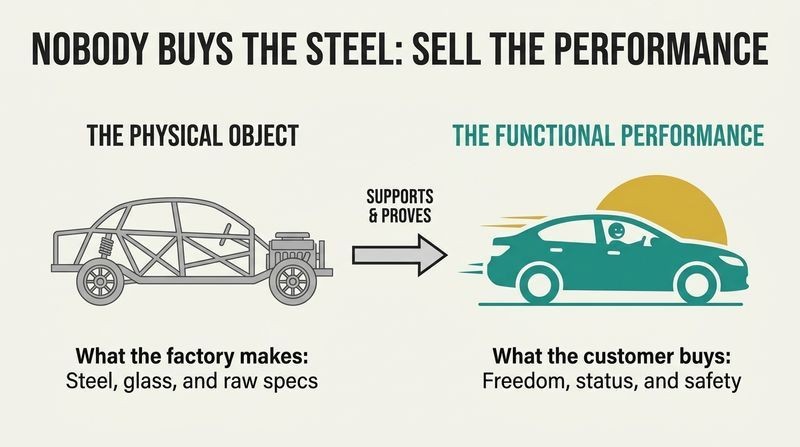
Every product is secretly two products. There is the physical product, the glass, paper, or tobacco the manufacturer proudly shapes, and the functional product, the string of things it actually does for the buyer. People never pay for the physical object itself. They pay for the performance.
Physical facts earn their keep only by supporting the promise in five ways:
1. Justifying the price
2. Documenting the quality of performance
3. Assuring the benefit lasts for years
4. Sharpening the mental picture of the result
5. Giving the claim fresh believability
A single car offers transportation, dependability, economy, power, recognition, value, and novelty. Your job is to inventory every performance, match each to a mass desire, then feature the one performance that unlocks the most sales power right now.
This is the ancestor of Theodore Levitt's famous line that people do not want a quarter-inch drill, they want a quarter-inch hole. Schwartz gets there earlier and more operationally. The framework maps neatly onto modern feature-versus-benefit training, but his sharper contribution is treating physical specs not as irrelevant but as evidence that must be recruited to prove the benefit. A spec sheet is not selling, yet a spec cited to make a benefit believable is pure persuasion. The discipline of choosing one dominant performance also foreshadows positioning theory: trying to say everything guarantees you say nothing memorable.
Start your headline where your prospect's knowledge actually is
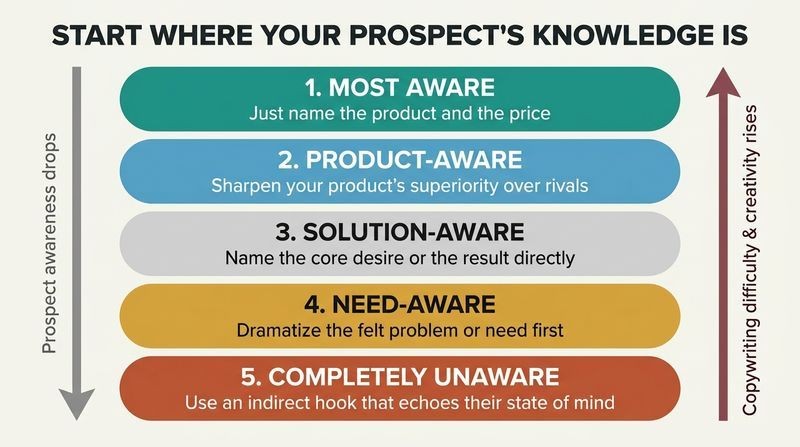
Schwartz maps five States of Awareness, and your headline must begin at the prospect's exact rung. As awareness drops, the copywriting gets harder and more creative:
1. Most Aware: knows the product and wants it. Just name it and the price.
2. Product-Aware: knows it but isn't sold. Sharpen superiority.
3. Solution-Aware: wants the result but doesn't know your product exists. Name the desire.
4. Need-Aware: feels the problem but hasn't linked it to a solution. Dramatize the need.
5. Completely Unaware: won't admit the desire or can't name it. Never mention price, product, or claim; write an identification headline that echoes their state of mind.
A headline that dazzles one stage falls flat at another, and once your market ages into a new stage, even winning copy goes stale.
This is arguably the book's most enduring practical engine, still taught verbatim in direct-response circles. Its power is that it forces the writer outward, into the reader's head, rather than inward toward the product. The framework aligns with the marketing funnel and with modern buyer-intent staging in search advertising, where a shopper typing a brand name needs radically different copy than one typing a symptom. The subtle warning that markets move through stages over time is easy to miss and expensive to ignore: yesterday's breakthrough headline becomes today's cliche not because it was wrong but because the audience graduated.
Count the rivals before you: sophistication decides your angle
The second question behind every headline is how many similar products have already shouted at this market. Schwartz's five Stages of Sophistication prescribe your move:
1. First in market: state the plain claim. "Lose ugly fat."
2. Second: enlarge the claim, outbid rivals. "Lose 47 pounds in 4 weeks."
3. Claims exhausted: introduce a new mechanism. "Floats fat right out of your body."
4. Mechanisms competing: elaborate the mechanism. "First no-diet reducing drug."
5. Market exhausted and cynical: abandon claims, sell identification.
He traces cigarettes through all five, from "I'd walk a mile for a Camel" (taste) to toasted and filtered mechanisms to Marlboro's wordless virile men. When claims and mechanisms both stop working, you revive a "dead" product by making the prospect identify with it, as Postum did with "Why Men Crack."
Sophistication is Schwartz's most original diagnostic and the one competitors most often overlook. It explains why a claim that built an empire fails when copied: the copier arrives at a later stage than the pioneer. The mechanism concept prefigures modern claims like "clinically proven" ingredients and proprietary technology names, from ProActiv to skincare's endless branded actives. The escalation-then-collapse arc also mirrors advertising's arms races and the eventual consumer skepticism documented in trust surveys. The framework pairs beautifully with awareness: sophistication asks how jaded they are, awareness asks how informed they are, and together they pin your exact starting point.
Your headline's only job is to make sentence two get read
Schwartz demolishes the idea that a headline must sell, or even mention the product. Loading the entire pitch into the 10 to 20 percent of space the headline occupies is a waste. The headline exists to stop the prospect and force him into the first sentence. That sentence's only job is to pull him into the second, and so on down the page.
This reframes copy as a chain of momentum, not a single knockout blow. Only a prospect already hunting your exact brand, offered a price cut, lets a headline do the full selling job. For everyone else, demanding a complete sale in ten words instead of a thousand is throwing away the client's money. Buy the space, then use it.
This principle, sometimes credited to Bond and later popularized by Joseph Sugarman as the "slippery slide," is Schwartz at his most modern. It reframes writing as engineering attention transitions rather than crafting slogans. Cognitive research on the Zeigarnik effect and curiosity gaps supports it: open loops compel completion. The insight scales perfectly to email subject lines, YouTube thumbnails, and article ledes today. The one tension is with brand advertising, where recall and emotional association can matter more than immediate readthrough; Schwartz, a mail-order man measuring dollars, is unapologetically writing for response, not for awareness campaigns that never ask for a click.
Rank desires by urgency, staying power, and scope, then pick one
Every product touches several mass desires, but only one can carry your headline. Schwartz scores each desire on three dimensions:
1. Urgency: how intense and demanding the desire is. Arthritic pain outranks a mild headache.
2. Staying power: how repeatable and unsatiable it is. Raw hunger outranks a gourmet craving.
3. Scope: how many people share it. Millions want to lose weight; fewer collect antiques.
Choose the desire that scores highest across all three, because your prospect, preoccupied and indifferent, grants you one glance. Only one thought penetrates that glance. This choice, embodied in the headline, is the single most important decision in the ad. Get it wrong and nothing else you write can rescue you.
This is a crude but shrewd prioritization matrix that predates and rhymes with modern market-sizing frameworks like TAM and with product prioritization scores such as RICE. Schwartz's genius is refusing to let writers hedge: the shotgun of many appeals dilutes the rifle shot of one. Behavioral science backs the urgency dimension, since present, painful problems drive action far more than abstract future ones, which is why prevention is notoriously hard to sell. His three-axis scoring also usefully separates a desire that is intense but rare from one that is mild but universal, a distinction that decides whether you build a niche business or a mass one.
People buy products to perform the role they wish to play
Beyond physical satisfaction lies a second, subtler hunger Schwartz calls the Longing for Identification: the wish to express who we are and to be recognized for what we've achieved. Products become costumes. We buy character roles (chic, well-read, virile) and achievement roles (Executive, Good Mother, sportsman).
A man spends $5,000 on a 150-mph sports car he drives on 35-mph parkways because it crowns him "successful sportsman." The 1926 Chesterfield ad "Blow Some My Way" opened cigarettes to women not by showing a woman smoking, which was taboo, but by dimming the man into the moonlit romance so she could accept the role. Marlboro layered virility three ways: virile men, virile settings, and the primitive tattoo. Character roles sell easily because they need no proof, only a flattering, unspoken image.
Schwartz articulates symbolic consumption years before Pierre Bourdieu's Distinction and Ernest Dichter's motivation research went mainstream, and it foreshadows brand-as-identity thinking from Apple to Patagonia. His sharpest observation is that character roles bypass the skeptical, rational mind because they are implied by image rather than claimed in words, so there is no assertion to fact-check. That is precisely why aspirational imagery outperforms bragging. The stated limit is crucial and often violated: an identification the audience cannot believe about themselves backfires and poisons the product's other claims, which is why luxury signaling aimed at the wrong tier of buyer reliably collapses.
Belief is built by structure, not by piling on bolder claims
Schwartz's Gradualization holds that belief depends less on what you claim than on how you sequence it. You begin with something the prospect already accepts, then build a chain of small yeses toward a conclusion he would have rejected cold. One fully believed promise outsells ten half-doubted ones.
His famous 1951 TV-repair-manual ad proves it. The blunt headline "Save $100 a year on TV repairs" failed because owners feared repairs. The winning version opened "Why Haven't TV Owners Been Told These Facts?", then asked "Was your set purchased after spring 1947?" (95 percent say yes), stacking agreements before ever mentioning that the owner would make adjustments himself. Devices include inclusion questions, detailed identification of symptoms, the language of logic ("therefore," "this proves"), and paragraph parallelism that smuggles a new claim in as an old one.
This is persuasion as architecture, and it maps directly onto Robert Cialdini's commitment-and-consistency principle: small initial agreements make later compliance far likelier. It also echoes the Socratic method and the sales technique of the "yes ladder." What elevates Schwartz is the granular attention to grammatical connective tissue, showing how a single word like "then" borrows credibility from the sentence before it. The approach has an ethical edge worth naming: the same structure that makes a true claim believable can make a dubious one slide past scrutiny, which is why the machinery of gradual assent deserves the reader's respect and wariness in equal measure.
Turn your product's biggest liability into its proof of power
Redefinition removes an objection by giving the product a new definition before the prospect even names the complaint. Schwartz sorts objections into three: too complicated, not important enough, or too expensive, and matches each a fix.
The classic is Lifebuoy soap in the 1930s. Its overwhelming medicinal odor could not be removed without killing its cleaning power. So the odor was redefined as the visible proof of odor-destroying strength, and the famous "B.O." campaign turned the flaw into the feature. Beyond this flip-flop, Redefinition works by simplification (recasting TV "repairs" as five-minute "adjustments"), escalation (reframing good English from grammar drills into a persuasion weapon that wins people over), and price reduction (comparing a $1.49 spark plug to a $40 hand-made equivalent so the price feels like a bargain).
This is reframing decades before it entered pop psychology, and it operates on the same cognitive lever as anchoring: the price-reduction tactic works because judgments are relative, not absolute, a finding Kahneman and Tversky later formalized. The Lifebuoy jujitsu is a masterclass in what negotiators call turning an objection into a selling point. The escalation move, widening a product's perceived importance, prefigures category reframing strategies like selling toothpaste as confidence rather than hygiene. The limit is credibility: a redefinition only holds if the prospect can accept it, so the reframe must build a believable bridge from what they think now to what you need them to conclude.
Show the reader exactly how it works, or he won't believe it
As copy builds desire, the prospect silently demands: "How does it work?" Mechanization is the verbal, logical demonstration that answers that question, the modern descendant of Claude Hopkins's "reason-why" copy. The question is never whether to include mechanism, only how much, which depends on the prospect's awareness.
Schwartz gives three escalating levels:
1. Name the mechanism when it's already understood ("Electronic Light Setter, Push-Button Zomar Lens").
2. Describe it when it isn't, as Rinso did in 1926 by explaining how its suds float dirt off after promising a whiter wash.
3. Feature it in the headline itself when the market is sophisticated and a strong mechanism becomes your point of difference ("Shrinks hemorrhoids without surgery").
Crucially, mechanism copy must still sell, loaded with promise and emotion, never dry science.
Mechanization explains the enduring power of the "secret ingredient" and the branded-technology name, from toothpaste's fluoride story to supplements touting a patented compound. Its psychological basis is real: research on the "placebo of explanation" shows people comply more readily when given a reason, even a thin one, as Ellen Langer's copier-line experiment demonstrated, where "because I have to make copies" worked nearly as well as a substantive reason. Schwartz's insistence that mechanism copy stay emotionally charged separates persuasion from a manual. The risk in a skeptical age is that invented or flimsy mechanisms now trigger the very distrust they aim to overcome, so the mechanism must be both legitimate and vividly rendered.
No formula works twice; every market is a brand-new problem
Schwartz opens and closes on a warning: copywriting, speculation, and science all harness immense forces nobody created, and in all three, memorized formulas fail because the forces keep shifting. Every new market, product, and ad is a problem that never existed before, so past successes are traps.
He ranks three approaches to a headline:
1. Word-substitution: dropping your product name into someone else's proven headline. The shallowest, producing lifeless "echo ads."
2. Formulas: pouring your idea into memorized molds. Useful only for phrasing.
3. Analysis: asking the right questions and letting the unique product-market-timing relationship dictate the answer. The only reliable path to a breakthrough.
The breakthrough is always locked inside that one unrepeatable relationship, never in a competitor's old file. The book offers compasses, he insists, not molds.
This is the philosophical spine that keeps a 1966 tactics manual from aging into a museum piece, and it is why Schwartz warned his own examples would date while the principles would not. It rhymes with the expert-intuition research of Gary Klein and with the deliberate-practice literature: masters internalize principles so deeply that analysis becomes fast pattern recognition rather than rote application. His golf-lesson metaphor, making the writer temporarily awkward with conscious technique before it turns intuitive, is a genuinely sophisticated model of skill acquisition. The uncomfortable implication for a productivity-obsessed culture is that there are no true shortcuts, only better questions asked freshly of each new situation.
Analysis
Breakthrough Advertising is a framework-driven manual disguised as a copywriting book, and Schwartz himself, revisiting it eighteen years later, decided its real subject was making markets, not making ads. That reframing is the key to its longevity. Most persuasion books teach tricks; Schwartz teaches a diagnostic sequence. Before a single word is written, he demands three coordinates: What mass desire drives this market? How aware is the prospect of my product? How sophisticated is the market from prior competition? Only then does craft begin. This front-loading of strategy over expression is what separates the book from the endless swipe-file culture it warned against. What makes it hard to summarize is that its enduring value lives in dozens of dissected ads, and Schwartz's own prose is dense, elliptical, and studded with mid-century examples. The transformative task is to extract the machinery, awareness stages, sophistication stages, the seven techniques, from the period wrapping.
Intellectually, the book is startlingly ahead of its time. Its symbolic-consumption theory predates Bourdieu; its jobs-to-be-done logic predates Christensen; its commitment-ladder structure predates Cialdini; its channel-do-not-create thesis predates Byron Sharp's evidence-based marketing. That convergence suggests Schwartz was reverse-engineering durable truths of human psychology from the brutal feedback loop of mail order, where every claim was scored in measured dollars.
The book's limits are worth flagging. It is relentlessly response-oriented, largely silent on brand-building, and its hyperbolic reducing-pill and spark-plug examples sit uneasily with modern advertising standards, a tension Schwartz acknowledges but sidesteps as "business strategy." The same gradualization and mechanization machinery that makes true claims believable can launder dubious ones. Read as a manual of influence, it is unmatched. Read as ethics, it demands a wary reader. Its final wisdom, that no formula survives contact with a new market, is both its humility and its guarantee against obsolescence.
Review Summary
Breakthrough Advertising is widely regarded as a classic in copywriting and marketing. Readers praise its timeless principles and insights into consumer psychology, despite dated examples. Many consider it essential reading for marketers and entrepreneurs. The book's high price and scarcity contribute to its legendary status. Some critics argue it's outdated, but most reviewers find immense value in its teachings on crafting effective headlines, understanding market sophistication, and channeling existing consumer desires. Overall, it's seen as a transformative text for those in advertising and sales.
People Also Read



Glossary
Mass Desire
Shared private want, publicly widespreadThe public spread of a private want, a desire shared by enough people to profitably repay advertising to them. Schwartz argues it is created by social, economic, and technological forces over years, never by copy. The copywriter's job is to detect it, choose the most powerful one, and channel it onto a specific product rather than attempt to create it.
Amplification Effect
Ad dollars multiplied by existing desireSchwartz's term for why advertising that rides an already-existing mass desire can turn $1 of spending into $50 or $100 in sales, because it borrows the economic force of a desire built by society. Advertising that instead tries to create desire becomes mere education and returns at best a dollar for every dollar spent.
Functional Product
What the product doesThe series of benefits and performances a product delivers to the buyer, as opposed to the physical product (the raw materials and object itself). Schwartz insists people never buy the physical product; they buy the functional product. Physical facts serve only to justify price, document quality, assure durability, sharpen the mental picture, and lend believability to the promise.
State of Awareness
How much the prospect knowsThe prospect's level of knowledge about the product and the desire it satisfies, running through five stages from Most Aware (knows and wants it) down to Completely Unaware. The headline must begin at the prospect's exact stage. The less aware the market, the harder and more creative the copywriting required.
State of Sophistication
How many rivals came firstHow much prior advertising for similar products a market has already absorbed, in five stages. First in market uses a plain claim; the second enlarges it; the third introduces a new mechanism; the fourth elaborates that mechanism; the fifth, an exhausted and cynical market, must be reached through identification rather than claims.
Intensification
Strengthening desire with vivid imagesThe first breakthrough technique: building desire by presenting a continuous stream of fresh, concrete images of the product's satisfaction, so the prospect visualizes every drop of fulfillment. Devices include putting the product in action, bringing in the reader, showing experts approving, before-and-after contrast, and closing with a guarantee that summarizes the benefits.
Identification
Building a saleable role into productsThe second breakthrough technique: building character roles (like virile or chic) and achievement roles (like Executive) into a product so buyers use it to express who they are and gain recognition. It exploits the Longing for Identification, a desire not for physical satisfaction but for self-definition and status.
Gradualization
Building belief through structureThe third breakthrough technique: starting an ad with statements the prospect already accepts and leading him through a chain of small agreements to a conclusion he would have rejected outright. Belief depends on the structure and sequence of claims, not just their content, so one fully believed promise outsells many half-doubted ones.
Redefinition
Reframing to remove objectionsThe fourth breakthrough technique: giving a product a new definition to eliminate an objection before the prospect voices it. It handles products that seem too complicated (simplification), too unimportant (escalation), or too expensive (price reduction), and at its sharpest flips a liability into an asset, as Lifebuoy did by making its medicinal odor proof of cleaning power.
Mechanization
Verbally proving how it worksThe fifth breakthrough technique, descended from reason-why copy: the verbal, logical demonstration of how a product delivers its promise. Depending on the market, the writer names the mechanism, describes it, or features it in the headline. Mechanism copy must still sell, loaded with promise and emotion rather than dry explanation.
Concentration
Destroying alternate ways to satisfy desireThe sixth breakthrough technique: directly attacking competing products by pointing out their weaknesses, but only while simultaneously proving your product cures those weaknesses. Attacking a rival without offering the solution merely breeds skepticism; showing the attack serves the prospect's own interest shatters loyalty to the competitor.
Camouflage
Borrowing the medium's credibilityThe seventh breakthrough technique: borrowing believability by adopting the format, phraseology, and mood of the publication or medium carrying the ad, so the reader's trust in the editorial content carries over to the advertisement. Includes matching layout and typography, using news-style phrasing, and moods like understatement or deadly sincerity to escape the hard-sell stereotype.
Creative Gamble
Headline that omits product to hookThe calculated risk of writing a headline that never mentions the product, its price, or its main claim, betting instead that grabbing attention and pulling the reader into the body copy will sell far more effectively. Used especially for unaware markets and identification headlines, where a direct claim would fail.
FAQ
What's Breakthrough Advertising by Eugene M. Schwartz about?
- Market Creation Focus: The book emphasizes creating markets by understanding and channeling mass desires towards products, rather than just selling them.
- Advertising as Science: Schwartz presents advertising as a systematic process involving consumer psychology and market dynamics, focusing on existing desires.
- Persuasion Techniques: It details techniques for intensifying desire and crafting compelling copy, serving as a guide for copywriters to enhance their skills.
Why should I read Breakthrough Advertising by Eugene M. Schwartz?
- Timeless Principles: Despite being published in 1966, its principles remain relevant across various industries today.
- Proven Success: Many successful marketers credit their achievements to strategies learned from this book, which has shaped numerous careers.
- Comprehensive Framework: It offers a structured approach to understanding advertising, valuable for both beginners and experienced professionals.
What are the key takeaways of Breakthrough Advertising by Eugene M. Schwartz?
- Mass Desire Focus: Advertising should tap into existing mass desires rather than creating new ones, understanding consumer wants is crucial.
- Market Sophistication: Recognizing market stages helps tailor advertising strategies to resonate with consumers.
- Intensification Techniques: Techniques like vivid imagery and emotional appeals are essential for creating compelling advertising copy.
What are the best quotes from Breakthrough Advertising by Eugene M. Schwartz and what do they mean?
- "You cannot create desire...": Highlights that effective advertising channels existing consumer desires rather than inventing new ones.
- "We are all primarily conceptual midwives.": Emphasizes marketers' role in nurturing consumer desires and bringing new markets to life.
- "Advertising is salesmanship in print.": Reinforces the strategic mindset needed in advertising, similar to direct sales.
What is the concept of "Mass Desire" in Breakthrough Advertising by Eugene M. Schwartz?
- Definition: Mass desire refers to the collective wants and needs of a large group of consumers.
- Exploitation of Existing Desires: Advertisers should focus on existing desires for more effective marketing strategies.
- Channeling Desire: Strategies are provided for channeling mass desire towards specific products, aligning with consumer psychology.
How does Breakthrough Advertising by Eugene M. Schwartz define the "State of Awareness"?
- Consumer Awareness Understanding: It refers to how much consumers know about a product and its benefits.
- Tailoring Messages: Advertisers must tailor messages based on awareness levels to resonate with the target audience.
- Stages of Awareness: Different stages require different advertising strategies to effectively engage consumers.
What are the "Seven Basic Techniques of Breakthrough Advertising" by Eugene M. Schwartz?
- Intensification: Expands consumer desire with multiple benefits and vivid imagery.
- Identification: Creates a relatable persona for the product, enhancing emotional connections.
- Gradualization: Builds belief in the product gradually, overcoming skepticism.
- Redefinition: Reframes product perception to remove objections.
- Mechanization: Emphasizes unique mechanisms delivering product benefits.
- Concentration: Eliminates alternative solutions, strengthening market position.
- Camouflage: Borrows credibility from established sources to build trust.
What is the Intensification technique in Breakthrough Advertising by Eugene M. Schwartz?
- Enhancing Emotional Appeal: Amplifies emotional aspects to make products more appealing.
- Building Desire: Stronger emotional connections increase purchase likelihood.
- Practical Examples: Successful ads using this technique demonstrate its effectiveness.
How does Identification work in advertising according to Breakthrough Advertising by Eugene M. Schwartz?
- Creating Relatable Personas: Builds a product personality that aligns with consumer aspirations.
- Dual Reasons for Purchase: Offers both physical benefits and identity expression.
- Emotional Connection: Fosters deeper emotional connections, encouraging product choice over competitors.
What is Gradualization in Breakthrough Advertising by Eugene M. Schwartz?
- Building Belief Over Time: Leads consumers through logical steps to build product belief.
- Logical Progression: Claims are presented in a sequence that enhances persuasiveness.
- Effective Use of Proof: Integrates proof to reinforce claims and increase believability.
How does Concentration help in advertising according to Breakthrough Advertising by Eugene M. Schwartz?
- Directly Addressing Competition: Highlights competitors' weaknesses while showcasing product strengths.
- Building a Strong Case: Systematically dismantles competitors' claims to strengthen product appeal.
- Combining Techniques: Often incorporates other techniques for a well-rounded persuasive ad.
How can I apply the concepts from Breakthrough Advertising by Eugene M. Schwartz to my marketing strategy?
- Identify Mass Desires: Research and understand the mass desires of your target audience.
- Tailor Your Messaging: Use insights to tailor messaging based on audience awareness.
- Utilize Intensification Techniques: Focus on vivid imagery, emotional appeals, and multiple perspectives to enhance advertising copy.
Download PDF
Download EPUB
.epub digital book format is ideal for reading ebooks on phones, tablets, and e-readers.








































