
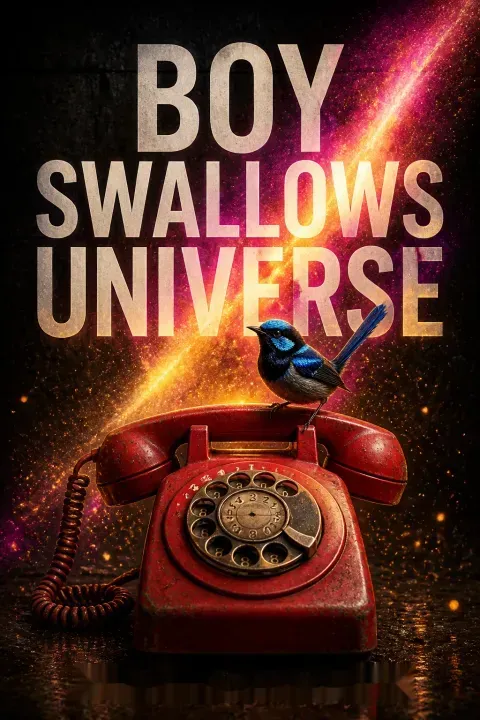


Plot Summary
Dead Blue Wren Prophecy
Slim Halliday,5 the Houdini of Boggo Road and convicted killer, teaches twelve-year-old Eli Bell1 to drive his rusted LandCruiser along Sandakan Street in Darra. While Eli1 struggles with the clutch, his older brother August2 sits on the brick fence writing words in thin air with his right forefinger.
August2 has not spoken since age six, but Eli1 has learned to read his brother's invisible cursive. He catches the message: a single sentence repeated, 'Your end is a dead blue wren,' then two words, 'Caitlyn Spies.7' Slim5 shrugs, curious.
Eli1 cannot know yet that these fragments will frame the coming years of his life. Slim5 tells Eli1 he possesses an adult mind in a child's body, and that the lucky freckle on his right forefinger is his true home, the fixed point where memory and self begin.
This opening establishes the novel's central preoccupation: the tension between what is seen and what is hidden. August writes in invisible ink on thin air; Eli must learn to read the unspoken. Slim's philosophy of 'details' introduces time as a malleable substance, a survival mechanism borrowed from decades of solitary confinement. The 'lucky freckle' as the origin point of Eli's consciousness suggests that identity is built on arbitrary markers we imbue with meaning. The dead blue wren prophecy and the name Caitlyn Spies function as narrative promises: obscure signifiers that will accumulate devastating significance. Dalton sets up a world where nothing is accidental, where childhood is a code waiting to be cracked.
The Red Telephone Rings
August2 leads Eli1 into Lena Orlik's off-limits bedroom, a shrine to Lyle4's dead mother. Behind the wardrobe, a false wall opens into a hidden underground room dug from the earth. Inside sits only a stool and a red push-button telephone. When the phone rings, August2 answers and grins, then passes the handset to Eli.1
A deep male voice greets Eli1 by name and knows intimate details of his life, including Slim5's reputation and the heroin brick Eli1 found in the mower catcher. Before Eli1 can learn the caller's identity, Lyle4 discovers them.
August2 crawls through a tunnel to the backyard thunderbox, Eli1 following. Lyle4 drags them out, furious. He insists the phone does not receive calls, that Eli1's imagination is running wild. But Eli1 knows what he heard. The secret room and its impossible ringing phone become a mystery that will haunt him for years.
The secret room beneath the house literalises the novel's obsession with hidden truths. The red telephone that 'doesn't receive calls' yet rings anyway represents the irrational hope that meaning can arrive unbidden from the void. Eli's conversation with the unknown caller, who knows his name and his secrets, externalises the developmental crisis of adolescence: the dawning awareness that adult life is built on enormous, undisclosed realities. Lyle's insistence that the phone is a figment of Eli's imagination mirrors how adults gaslight children about the danger they sense but cannot prove. The tunnel crawl to the thunderbox forces the brothers through literal shit, a baptism into the filth of adult knowledge.
Darren Dang's Education
At midnight, a purple firework bursts over Darra. Lyle,4 in his roo-shooting coat, follows the signal. Barefoot in his pyjamas, Eli1 tails him across Ducie Street Park to the sprawling home of Bich Dang,11 feared matriarch of the Little Saigon supermarket. Her son Darren10 catches Eli1 hiding behind a plastic princess castle, a samurai sword pressed to his throat.
Darren,10 Eli1's schoolmate and aspiring crime lord, explains how fireworks alert dealers that heroin orders are ready. Bich11 summons Eli1 inside. She admires his loyalty for not snitching about a machete incident at school.
Eli1 watches Lyle4 collect a Styrofoam box of Golden Triangle heroin. Darren10 shares his philosophy: Australians are inherently miserable, and the junk industry will never die because Australian misery will never die. He offers Eli1 a place in his future empire. Eli1 declines, declaring he will become a journalist for The Courier-Mail instead.
Darren Dang functions as Eli's dark double: another child of the drug trade who has embraced rather than resisted his circumstances. His casual explanation of the heroin supply chain demystifies crime as just another family business. The purple firework as a dealer alert system transforms the suburban sky into a network of secret signals, revealing the hidden economy beneath ordinary life. Bich Dang's philosophy that 'Australian misery will never die' offers a chillingly coherent worldview: the drug trade is not a corruption of Australian happiness but a logical response to its inevitable failure. Eli's declaration that he wants to be a journalist rather than a criminal is his first conscious act of self-definition against his environment.
Letters to a Killer
Every Saturday, Slim5 writes letters to Boggo Road inmates who receive no mail, and Eli1 joins him. Eli1's pen pal is Alex Bermudez,13 former sergeant-at-arms of the Rebels motorcycle gang, serving nine years for possessing illegal Soviet machine guns.
Their correspondence spans cockroach courier systems, prison recipes, and Days of Our Lives plotlines. Eli1 asks Alex13 how to spot a man intending to knife you. Over the kitchen table, Slim5 shares his own Boggo Road survival techniques: how he manipulated time in solitary confinement, how a screw named Officer Dale showed him goodness exists even in hell.
Slim5 recites Omar Khayyam's Rubaiyat and teaches Eli1 that details create eternity. When Eli1 reads the local paper's feature on Slim5's life, he notices the byline: Caitlyn Spies.7 The name August2 wrote in the air months earlier now stares back at them from newsprint.
The epistolary relationship with Alex Bermudez teaches Eli that connection transcends circumstance. A ten-year-old boy and a convicted gun-runner find common ground in loneliness, in questions about fathers, in the mundane details of Days of Our Lives. Slim's backstory, with its meditation on time and survival, provides the novel's philosophical core: 'Do your time before it does you' is not just prison wisdom but a strategy for anyone trapped by circumstances they cannot change. The cockroach courier system, where killers handle insects with gentleness, reveals the paradox that even violent men contain tenderness. The appearance of Caitlyn Spies's byline creates the first concrete link between August's air-writing and external reality.
The Lord of Limbs
Mama Pham's restaurant in Darra hosts Tytus Broz8's eightieth birthday. Tytus,8 Lyle4's boss, runs Human Touch, a prosthetics company that is a front for his heroin empire. He wears bone-white suits and has cheekbones sucked inward like a vampire.
His daughter Hanna,16 born without arms, inspired his legitimate business. At the table sits Iwan Krol,9 a silver-haired Polish enforcer with dead eyes who Darren10 claims dismembers bodies and hides them via Tytus8's limb factory. Darren10 whispers about 'dem bones' as he dissects a chilli crab, showing how limbs are removed.
Eli1 notices Teddy,12 Lyle4's best friend, staring too long at Eli1's mother Frances.3 Later, walking home, Eli1 pitches Lyle4 a plan: buy bulk heroin now, bury it, let market scarcity drive up prices. Lyle4 dismisses it, but the seed is planted.
Tytus Broz's birthday celebration is a feast of dramatic irony. Every detail that Eli catalogues (Teddy's lingering gaze on Frances, Bich Dang's envelope to the councilman, Iwan Krol's dead eyes) is a piece of evidence that will only cohere in retrospect. Tytus as Captain Ahab, obsessed with the white whale of technological perfection, reframes his philanthropy as monomania. His line about Hegesistratus, the Greek diviner who cut off his own foot to escape, carries the lesson: 'Never grow attached to anything you can't instantly separate yourself from.' This philosophy of radical detachment explains his capacity for cruelty. He has amputated his own humanity long before he began amputating others.
Finger for Silence
On an ordinary evening, as the family eats spaghetti bolognese at the green Formica table, Tytus Broz8 walks through the back door. Iwan Krol9 and two thugs follow. Tytus8 demands to know what Lyle4 wrote in the air to August2 moments before. August2 refuses.
Iwan Krol9's Bowie knife presses into Eli1's right forefinger on the table. Tytus8 asks again. August2 stays silent until the blade severs the finger clean at the knuckle. Blood pools on the table. Tytus8 wraps the finger in a white silk handkerchief.
Then, for the first time in eight years, August2 speaks: 'Your end is a dead blue wren.' Lyle4 is dragged away. Mum3 is knocked unconscious. Police will soon arrest her as a drug courier. Teddy,12 who betrayed Lyle4 to Tytus8 out of love for Frances,3 slips away into the night. Eli1 blacks out.
The severing of Eli's finger is the novel's irreducible act of violation. It is not a random assault but a targeted extraction of the talisman Eli believed made him lucky, the physical marker of his earliest memory and his sense of self. The finger, wrapped in white silk and carried away like a religious relic, will reappear in a specimen jar, revealing Tytus Broz's true nature as a collector of human pieces. August's first spoken words, 'Your end is a dead blue wren,' transform his years of silence into a strategic withholding: he was not unable to speak but unwilling, because speech carried consequences he could foresee but not prevent. The family unit is destroyed in minutes.
Houdini of the Hospital
Eli1 wakes in Royal Brisbane Hospital, his right hand bandaged where his forefinger once was. Slim5 visits, explaining the cover story: Mum3 told police August2 chopped the finger off with an axe while playing. She is now in Boggo Road women's prison on drug charges.
August2 has been taken to their father6's house in Bracken Ridge. Slim5 urges Eli1 to back up the axe story. But Eli1 escapes the children's ward with help from a dying boy named Christopher, who creates a diversion by hurling a television through a window. Eli1 rides the train to Darra, crawls back into Lyle4's secret room.
The heroin stash in the thunderbox is gone. Then the red telephone rings. A man's voice warns that Mum3 will not survive Christmas, that she is on suicide watch. The man says 'sleigh bells' and hangs up. Eli1 curls up on the cold earth, hallucinating Slim5's girl Irene and Caitlyn Spies.7
Eli's hospital escape, modelled on Slim's prison breaks, demonstrates how trauma is metabolised into action. The boy who was taught to manipulate time through details now uses those skills to manipulate physical space. His encounter with Christopher, the dying boy who hurls a television through a window, provides dark comic relief while underscoring the novel's theme that survival requires audacity. The phone call in the empty secret room, warning that Mum will not survive Christmas, blurs the line between supernatural intervention and psychological projection. Is the caller real or is Eli's mind, steeped in prison escape narratives, generating the warning he needs to hear? The question matters less than the action it provokes.
Caitlyn Spies Appears
At the South-West Star newspaper office in Sumner Park, Eli1 talks his way past the security desk by claiming he knows Slim Halliday5's whereabouts. Caitlyn Spies7 emerges: brown hair, green eyes, black-rimmed spectacles, acid-wash jeans. She is twenty-one, sharp and sceptical.
Before Eli1 can spill his story about Tytus Broz,8 a deranged man named Raymond Leary18 begins headbutting the reinforced glass frontage. The State demolished his house for a motorway exit; his wife threw herself in front of a cement truck.
When the newspaper refused to tell his story, he came to destroy theirs. Eli1 steps outside, calms Raymond18 with quiet words, then flees as police arrive. Caitlyn7 calls after him, curious about the strange boy who tamed a madman. Eli1 promises to return when the timing is right. He has other urgent places to be.
Caitlyn Spies's entrance grounds the novel's mystical elements in journalistic skepticism. She is everything Eli aspires to be: a truth-seeker who 'digs deep.' The Raymond Leary episode functions as a microcosm of the book's larger concerns. Leary, a man destroyed by institutional indifference, headbutts the reinforced glass of a newspaper that refused to tell his story. Eli's decision to step outside and simply listen to him, to offer the recognition no institution would provide, is his first act of journalism. It is also a test of character. He passes by doing what none of the adults around him will do: treating a broken man as human. His flight from the police afterwards confirms his allegiances remain with the vulnerable.
The Monster Dad
Number 5 Lancelot Street, Bracken Ridge. Robert Bell6 lives in a Housing Commission shoebox with a mountain of books, an axe handle for intruders, and a silver wine cask bladder. He howls along to The Doors at midnight, pisses on the toilet floor, and cannot hold a conversation without calling someone a cunt.
But he also reads obsessively and blitzes Sale of the Century. August2 has been surviving on chicken noodles. When Eli1 arrives, their father6 lunges at him with the axe handle, mistaking him for an intruder. August2 knocks him unconscious with a single punch.
Later, by the moon pool August2 creates with a garden hose, Eli1 demands answers. August2 finally speaks in a voice that sounds exactly like Eli1 's. He stopped talking because it was safer, because he knew things that would frighten people. Then he reveals who was on the red telephone: 'It's me, Eli.1 '
Robert Bell is the novel's most complex portrait of flawed masculinity. He is abusive, alcoholic, and pathetic, yet also brilliant, well-read, and capable of moments of startling tenderness. His book mountain and his Sale of the Century prowess suggest a man who retreated from life into intellect because life was too painful. The revelation that August is the man on the red telephone refracts the entire narrative. It suggests that Eli's supernatural experiences may be projections of his brother's uncanny intuition, a shared psychosis born from the moon pool trauma, or something genuinely inexplicable. August's explanation that he stayed silent to 'protect' Eli recasts his mutism as radical self-sacrifice: he swallowed his own voice to contain dangerous knowledge.
Slim's Last Fish
On the old Hornibrook Bridge, Slim5 sits fishing in the rain, his green coat hood pulled low. Eli1 has come for help breaking Mum3 out of prison. Slim5 passes him a slip of paper with instructions to meet a fruit truck smuggler named George. But he tells Eli1 this is the last time they can see each other.
Eli,1 hurt and raging, accuses Slim5 of being a cold-blooded killer who deserved everything he got. Slim5 finally shouts, then dissolves into a coughing fit that leaves blood on the bitumen. He hands Eli1 his fishing rod as a monster flathead strikes.
While Eli1 hauls the thrashing fish from the water, Slim5 collapses behind him. By the time Eli1 turns, Slim5 lies motionless, blood on his lips, eyes closed. The flathead snaps the line and escapes. Eli1 sobs over his best friend's body, apologising for his cruel words as the rain pounds down.
Slim's death on the Hornibrook Bridge is structured as a cruel inversion of his own philosophy. The man who taught Eli to see every detail, to stretch time into eternity, dies unnoticed while Eli's attention is fixed on a fish. The flathead that snaps the line and escapes becomes a symbol of everything that cannot be held: Slim's life, Lyle's presence, Eli's childhood. Eli's accusation that Slim is a cold-blooded murderer, spoken in the rage of abandonment, represents the cruelty of grief. But Slim's response, that he always had a choice between good and bad, completes his moral arc. He is not innocent, but he chose, in the end, to be better. He passes his final lesson to Eli: the choice is always yours.
Christmas in Boggo Road
At 4 a.m. on Christmas Day, Eli1 slips out of the Bracken Ridge house, leaving wrapped books beneath the saddest Christmas tree in the suburb. He meets George and his red fruit truck, climbs into a watermelon crate with a false bottom. At Boggo Road women's prison, George's forklift delivers the crate to the kitchen.
Bernie,17 an Aboriginal inmate with a rainbow serpent tattoo, lets Eli1 out. She warns him that his Mum3 is in a dark place, not eating, staring at walls. Eli1 is wheeled through B Block in a garbage bin while prisoners watch a Nativity-meets-Grease Christmas musical.
At Mum3's cell, he climbs the door to see her: skeletal, vacant, a photo of her boys on the wall. She refuses to open the door. Eli1 lies on the floor and sings 'Ruby Tuesday' through the crack until the door finally opens. They collapse into a group hug on the prison floor.
The prison break on Christmas Day is the novel's most overtly symbolic sequence. Eli, born into a world of crime and punishment, literally inserts himself into the carceral system to reach his mother. Bernie, the Aboriginal inmate with the rainbow serpent tattoo, represents an older, deeper wisdom about survival and connection. The guards' complicity in the smuggling economy reveals the prison as a microcosm of the outside world, where rules exist to be circumvented. The moment when Eli sings 'Ruby Tuesday' through the cell door crack, and the door opens, is the emotional fulcrum of the entire novel. Music, specifically this song about a woman who 'would never say where she came from,' becomes the password that breaches the walls between mother and son.
Fifty Thousand Dollars
Almost four years pass. Eli1 grows, finishes school, endures life with his erratic father.6 Slim5 dies in hospital months after the bridge. At Slim5's sparsely attended funeral, an old bookmaker tells Eli1 a man can have many best friends.
Eli1 discovers Lyle4's hidden heroin stash beneath the house in an abandoned washing machine. August2 insists the drugs must sit longer to appreciate in value. When Mum3 is finally released from prison, Eli1 returns to Darra to sell the heroin to Darren Dang,10 now a teenage gang leader in a red Adidas tracksuit commanding the 5T crew.
Darren10 offers $50,000, half what Eli1 wants, but Eli1 has no other buyers. Just as the deal closes, a rival BTK gang attacks. Darren10 tosses Eli1 a machete and charges into street battle. Eli1 flees with the cash.
The passage of time, tracked through the slow appreciation of Lyle's heroin stash, demonstrates how patience converts suffering into value. Eli's return to Darra closes a loop: the boy who once watched drug deals from behind a princess castle is now the man conducting them. Darren Dang's transformation from schoolyard ninja fantasist to ruthless gang leader with a '5T' chest tattoo illustrates the brutalising effects of the trade. Eli's negotiation from $80,000 to $50,000, and his flight from the machete battle, confirm that he lacks the predator's instinct. He is a journalist at heart, an observer, not a participant. The money is tainted, but it is also Lyle's legacy, the only inheritance his vanished father-figure could leave.
Teddy's Betrayal Exposed
Mum,3 fragile from prison, moves in with Teddy Kallas,12 the man who betrayed Lyle.4 Eli1 and August2 are forced to spend a week at Teddy12's Wacol house. Teddy12 drives a Woolworths truck, plays with his German shepherds, and pretends to be a decent man.
But on the fourth night, after Eli1 asks why he ratted on his best friend,4 Teddy12's mask slips. Fuelled by speed and resentment, he mocks August2's silence, then drags Mum3 by the hair down wooden stairs, shoving her face into the dog bowl. August2 brains Teddy12 with a lamb shank pot. They escape to a nun's refuge.
When Mum3 announces she is staying with Teddy,12 Eli1's hopes collapse. Back in Bracken Ridge, August2 takes the $50,000 and leaves it wrapped in Christmas paper on the doorstep of Shelly Huffman,14 a girl with muscular dystrophy who needs home modifications. Eli1 erupts in fury at his brother.2
Teddy Kallas is the banality of evil made flesh. He is not a cartoon villain like Tytus or a monster like Iwan Krol; he is a weak man whose desire curdled into entitlement and then into violence. His betrayal of Lyle was not grand strategy but petty covetousness. His abuse of Frances is the inevitable outcome of a culture that treats women as prizes to be won. August's decision to give away the $50,000 to Shelly Huffman is an act of radical reclamation. Money earned through heroin, hidden through trauma, and nearly fought over with machetes is converted into wheelchair ramps and a family van. August transforms dirty currency into clean meaning, proving that value is never intrinsic but always assigned by human intention.
Alex Bermudez Arrives
Eli,1 despondent, writes a suicide note confessing everything about Lyle4's disappearance. Then a Courier-Mail article by Caitlyn Spies7 about Asian gang wars catches his eye. He goes to the newspaper office, fails to impress editor Brian Robertson15 for a cadetship, but on the train platform meets Caitlyn7 again.
They talk. She admits she investigated Tytus Broz8 years ago but found nothing. Eli1 tells her everything. Meanwhile, Teddy12 tracks Mum3 to Bracken Ridge and arrives with two thugs. As the Bell family cowers, a stranger in a grey coat steps from a yellow Mustang.
It is Alex Bermudez,13 recently released from prison, repaying a decade of letters from a lonely boy. He floors Teddy12 with two punches, pulls a gun on the thugs, and declares Frankie Bell3 under Rebels protection. He gifts Eli1 a Dictaphone for his journalism dreams.
Alex Bermudez's arrival is the payoff to a subplot seeded early in the novel: the letters to a forgotten prisoner. His transformation from pen pal to protector demonstrates that small acts of kindness can compound into life-saving debts. The fact that a bikie enforcer proves more reliable than the police or the state is the novel's most pointed social critique. Teddy's humiliation at the hands of a man who has done 'real' violence reveals him as a bully who preyed on the vulnerable because he could. Alex's gift of a Dictaphone, a tool for the journalism career Eli dreams of, symbolises the passing of wisdom between generations of men who chose different relationships with crime. One chose to make it his life; the other chose to write about it.
The Colour Writer
Eli1 lands a job at The Courier-Mail as a junior property and turf writer, working alongside his idol Caitlyn Spies7 from afar. He pines for her, buys Replacements cassettes because she likes them. When a family named Penn vanishes from Oxley, leaving traces of llama hair, Eli1's instincts fire.
Llama hair means Iwan Krol,9 who owns a llama farm in Dayboro. Caitlyn7 digs into police files, finding five prior missing persons cases linked to Krol,9 all dropped.
Then editor Brian Robertson15 assigns Eli1 to cover the Queensland Champions awards, where Tytus Broz8 is being honoured as Senior Champion for his prosthetics work. Eli1 is to interview Broz8 at his Bellbowrie mansion. Caitlyn7 insists on driving him, posing as his photographer. They will finally confront the monster in his lair.
Eli's position at The Courier-Mail, at the 'back of the room by a loud photocopier,' is an apprenticeship in humility. He is not the crime writer he dreamed of being but a 'colour writer' who paints pretty pictures of horse races and property listings. His unrequited longing for Caitlyn Spies, tracked through cassette tapes and lunchtime observations, is a study in patience that mirrors his manipulation of time. The Penn family disappearance reconnects him to his past: another family destroyed by the drug trade, another child lost in the machinery. The 'llama hair' detail that only Eli would recognise (because Darren once told him about Iwan Krol's llama farm) validates his belief in the importance of details. Everything he observed as a child was evidence waiting for its moment.
Bunker of the Dead
At Tytus Broz8's mansion, Eli1 interviews the old man about his life's work: a revolutionary silicone prosthetic limb. After the interview, Caitlyn7 and Eli1 hide until dark, then break into a concrete bunker hidden behind jasmine vines.
Inside, they find a subterranean laboratory of horrors: plastinated human limbs in glass jars, severed heads on shelves, the composite bodies of the Penn family. Eli1 finds a jar labeled 'Male, 13, R index' containing his own severed finger. In the final room, eight-year-old Bevan Penn sits beside a red telephone, alive.
Iwan Krol9 arrives. Eli1 severs part of Krol9's foot with an axe. They escape with Bevan and Lyle4's preserved head. Racing to Brisbane City Hall, Eli1 gives August2 the bag. August2 swaps Lyle4's head for Tytus8's prototype limb in the display box.
When Tytus8 unveils it on stage, the audience sees the severed head. Police swarm. Iwan Krol,9 having followed, stabs Eli1 in the belly. Eli1 staggers up the clock tower. At 9 p.m., the bell tolls. Eli1 smashes the finger jar against Krol9's skull. Police gun down Krol.9 August2 whispers that Eli1 always comes back.
The bunker sequence is a descent into the literal underworld that mirrors the psychological descent of the entire novel. Tytus Broz's collection of human specimens reveals his philanthropy as a cover for necrophiliac obsession. The quest to build the perfect prosthetic was always fuelled by the dismemberment of inconvenient people. Eli finding his own finger in a jar is the confrontation with his trauma made physical: here is the lost part of himself, preserved but unreachable. Lyle's preserved head is confirmation of what Eli always knew but could not face. The substitution on stage is August's masterstroke, a piece of theatre that exposes the truth to an audience of powerful Queenslanders who cannot look away. The clock tower climax, with the 9 p.m. bell tolling and the finger jar used as a weapon, completes the symbolic arc: the lost talisman becomes the instrument of survival.
Caitlyn and Eli
In a dream, Eli1 walks the yard of Boggo Road prison. Slim Halliday5 tends the garden, then points to Halliday's Leap, the wall he escaped over. Eli1 climbs the rope and finds Caitlyn Spies7 standing on a beach at the edge of the universe. She calls him to jump. He opens his eyes in a hospital bed, his family around him. Mum3 demands a group hug. Dad6 awkwardly joins.
Caitlyn7 visits, sceptical that she brought him back. A month later, she drives him to the old Darra house for the final piece of their five-part exposé on Tytus Broz.8 In the secret room beneath the house, the red telephone rings. Eli1 reaches for it. Caitlyn7 rests her hand on his, then pulls him close and kisses him. The phone stops ringing. He has his answer now.
The final chapters refuse tidy resolution in favour of earned hope. The dream of Slim in the prison garden, pointing to Halliday's Leap, suggests that the dead remain present as guides. Caitlyn on the beach at the edge of the universe, calling Eli to jump, transforms the earlier nightmare of drowning into an invitation to trust. The kiss that silences the red telephone is not a denial of mystery but a choice to privilege the real over the inexplicable. Eli has spent his life chasing answers from disembodied voices, from prophetic brothers, from substitute fathers. Caitlyn offers presence instead of explanation. The phone stops ringing not because the questions have been answered but because Eli no longer needs to ask them. He has swallowed the universe, all of it, and found it survivable.
Analysis
Boy Swallows Universe is fundamentally about the stories we tell to survive. Eli Bell1 constructs his identity from fragments of others' narratives: Slim5's prison survival philosophy, Lyle4's code of loyalty, his mother3's scarred resilience, his father6's literary escapism. The novel explores how trauma reshapes memory into myth. The moon pool into which Robert Bell6 drove his sons is both a literal near-drowning and the psychological threshold where the boys nearly died and emerged fundamentally altered. August2's elective mutism and his belief that he has 'come back' from death represent a child's mind trying to process the inexplicable: how do you survive what should have killed you? The red telephone, whether supernatural or a shared hallucination born from trauma, embodies the human compulsion to believe that answers exist, that someone somewhere makes sense of the chaos. Dalton structures the novel as a series of escapes: Slim5 vaulting prison walls, Eli1 slipping out of hospital wards, brothers fleeing violent homes, a mother breaking free of addiction and incarceration. But the ultimate escape is from the prison of inherited damage. Eli1 becomes a journalist because writing is simply the professionalised form of the storytelling he has always done to stay alive. The novel suggests that to 'swallow the universe' (to internalise all of it, the horror and the beauty, the lost fathers and the found love) is the only way to transcend suffering. The dead blue wren that miraculously revives in Tytus Broz8's garden, the finger preserved in formaldehyde that Eli1 uses as a weapon, the kiss from Caitlyn7 that finally silences the ringing phone: each represents a moment where the past loses its grip. The book's deepest insight is that time is not a fixed river but a substance to be shaped. Do your time before it does you. Notice the details. Stretch the good moments until they last. And when the phone rings with unanswerable questions, the truest reply is not words but presence: the person who stands beside you at the edge of the universe and calls you home.
Review Summary
Boy Swallows Universe received mixed reviews, with many praising its vivid portrayal of 1980s Brisbane and compelling characters, particularly the protagonist Eli Bell. Readers appreciated the blend of coming-of-age story, magical realism, and gritty realism. Some found the writing style and Australian slang challenging, while others felt the ending was over-the-top. Critics lauded Dalton's ability to infuse love and humor into a dark narrative, though some felt the book was overlong and convoluted. Overall, it was widely regarded as an impressive debut novel.
People Also Read


Characters
Eli Bell
Boy journalist with an old soulThe narrator and protagonist, spanning ages twelve to nineteen. Eli possesses what Slim5 calls an 'adult mind in a child's body': he is observant, emotionally porous, and cries easily because he cares deeply. His lucky freckle on his right forefinger anchors his earliest memory and sense of self. Raised by a drug-dealing stepfather and a recovering addict mother in working-class Darra, he yearns for stability, father figures, and answers to the mysteries that surround him. His moral compass is shaped by Slim5's prison philosophy, Lyle4's loyalty, and August2's enigmatic wisdom. He dreams of becoming a crime journalist for The Courier-Mail, a vocation that channels his compulsive need to observe, record, and make sense of trauma into professional purpose. His childhood love for Caitlyn Spies7 matures across years into genuine partnership.
August Bell
Mute prophet and protective brotherEli1's older brother by one year. From age six until a pivotal moment, August chooses not to speak, communicating instead through gestures and writing words in the air with his forefinger. His silence conceals an uncanny prescience: he writes prophecies that later materialise and claims to have 'come back' from death multiple times. He channels his interior life into obsessive painting, particularly of the 'moon pool' into which their father6 drove them. His protective devotion to Eli1 is absolute, expressed through physical violence against bullies and emotional guardianship during their mother3's addiction. When he finally speaks, his voice sounds exactly like Eli1's. His decision to give away the $50,000 drug money to Shelly Huffman14 reveals his radical understanding of value and redemption.
Frances Bell
Survivor mother rebuilding from ashesEli1 and August2's mother. A resilient woman who fled an abusive marriage, fell into heroin addiction with Lyle4, then endured brutal withdrawal locked in a bedroom for seven days. She carries deep shame about her failures as a mother but loves her sons with primal intensity. After being framed as a drug courier and imprisoned in Boggo Road women's prison, she descends into catatonic depression until Eli1's Christmas Day prison break restores her will to live. Upon release, she makes a disastrous choice to live with Teddy12, the man who betrayed Lyle4, exposing her pattern of attaching to damaged men. She eventually studies social work and rebuilds her life, slowly reconciling with Robert6. Her defining trait is survival against odds that should have destroyed her.
Lyle Orlik
Doomed stepfather with a codeFrances3's long-term boyfriend and the closest thing Eli1 has to a real father. A heroin dealer and mechanic who works for Tytus Broz8, Lyle claims to have Disinhibited Social Engagement Disorder, a condition that makes him incapable of lying. He loves Frances3 and the boys with fierce loyalty, locking Frances3 in a room to force her through withdrawal, then returning from rehab to rebuild the family. He built the secret underground room and the red telephone system. His fatal flaw is ambition: he runs a secret side business dealing heroin behind Tytus8's back, dreaming of buying the family a house in The Gap. Teddy12's betrayal leads to his abduction by Tytus8's men. He is never seen alive again.
Arthur 'Slim' Halliday
Prison escape artist turned babysitterEli1's babysitter and best friend, based on a real historical figure. Known as the 'Houdini of Boggo Road,' Slim survived decades in prison, including fourteen days in the notorious underground isolation cell called Black Peter. He maintains his innocence of the taxi driver murder for which he was convicted but acknowledges he 'done enough' to deserve punishment. His philosophy of survival, taught to Eli1, involves manipulating time through obsessive attention to detail: smells, sounds, textures, the 'little movies within the movie.' He recites Omar Khayyam's Rubaiyat and introduces Eli1 to writing letters to prisoners. His ambiguous morality (good man or killer?) haunts Eli1. He dies of cancer on the Hornibrook Bridge while Eli1 catches a flathead, his final lesson delivered through action rather than words.
Robert Bell
Alcoholic father hiding in booksEli1 and August2's biological father. An agoraphobic alcoholic who lives in a Housing Commission house filled with thousands of op-shop paperbacks. He is brilliant, quoting Aristotle and Faulkner between benders, and unbeatable at Sale of the Century. He drove his sons into a dam during a panic attack years ago, a trauma that fractured the family and left August2 obsessed with the memory. He communicates love through fart jokes and awkward hugs, incapable of the emotional fluency his sons need. When circumstances force the boys back into his care, he slowly, painfully attempts sobriety and fatherhood. His library room becomes the site of fragile family reconstruction when Frances3 returns. He represents the broken masculinity that Eli1 must understand and forgive.
Caitlyn Spies
Journalist who becomes Eli's answerA young reporter who first appears as a byline on a newspaper article about Slim Halliday5, matching the name August2 wrote in the air. She works her way from the South-West Star community paper to The Courier-Mail's crime desk. Her mother died giving birth to her, leaving Caitlyn with a driving need to earn her existence through relentless effort. Her personal mantra, 'Spies digs deep,' makes her a formidable investigative journalist but also isolates her from lasting relationships. She is pragmatic, courageous, and sceptical of Eli1's mystical experiences while remaining drawn to his sincerity. When she kisses Eli1 in the secret room, silencing the ringing telephone, she represents the choice to privilege real human connection over the pursuit of unanswerable questions.
Tytus Broz
Prosthetics philanthropist and heroin kingpinThe 'Lord of Limbs,' an elderly Polish immigrant who built Human Touch, a prosthetics company, as a front for a vast heroin trafficking empire. He dresses entirely in white and has the gaunt, obsessive quality of Captain Ahab from his favourite novel, Moby Dick. His daughter Hanna16 was born without arms, inspiring his legitimate business and providing his public moral cover. Beneath the philanthropy lies a grotesque obsession: he collects human specimens, including Eli1's severed finger, for research into perfect prosthetics. His philosophy, drawn from the Greek diviner Hegesistratus who cut off his own foot to escape, is radical detachment: 'Never grow attached to anything you can't instantly separate yourself from.' He is ultimately exposed when his trophy collection is revealed to the public.
Iwan Krol
Psychopathic enforcer and body disposerTytus Broz8's Polish muscle. A silver-haired man with dead eyes who runs a llama farm in Dayboro. Rumours claim he dismembered his own abusive brother Magnar with a circular saw. He specialises in making people disappear, cutting bodies into transportable pieces that Tytus8's limb factory receives. He severs Eli1's right forefinger with a Bowie knife during the home invasion. His signature is leaving traces of llama hair at crime scenes. He is relentless, pursuing Eli1 and Caitlyn7 after they discover the bunker, and ultimately attacks Eli1 in the Brisbane City Hall clock tower, where police shoot him dead.
Darren Dang
Schoolyard ninja turned gang leaderEli1's classmate and the charismatic son of Bich Dang11. He fancies himself a ninja warrior, carrying samurai swords and quoting Chuck Norris films. He introduces Eli1 to the realities of the heroin trade with a mixture of menace and genuine friendship. His philosophy that 'Australians are inherently miserable' drives his ambition to build a crime empire. By his late teens, he has become the leader of the 5T gang, sporting a chest tattoo of the five Vietnamese words: Love, Money, Prison, Sin, Revenge. He buys Lyle4's heroin stash from Eli1 for $50,000, negotiating hard but maintaining personal respect. His trajectory illustrates how childhood play becomes adult violence.
Bich Dang
Matriarch of the Darra heroin tradeKnown as 'Back Off' Bich Dang. A formidable Vietnamese immigrant who runs the Little Saigon supermarket, Mama Pham's restaurant, and a major heroin importation business. She once stabbed a schoolgirl in the eye with a steel ruler for teasing her daughter. Her first husband, Darren10's father Lu Dang, vanished years ago, widely believed poisoned. She uses purple fireworks as coded signals to alert dealers when their orders are ready. Despite her ruthlessness, she respects Eli1's loyalty to Darren10 and offers him opportunities in the trade. She represents the older generation of ethnic organised crime that her son will inherit.
Teddy Kallas
Best friend who became the ratLyle4's childhood best friend and fellow mechanic at Human Touch. A man with a thick black moustache who drives a Woolworths food truck. He stares too long at Frances3 and covets Lyle4's life. His betrayal is motivated by desire for Frances3 and self-interest: he informs Tytus Broz8 about Lyle4's side dealing, precipitating the home invasion and Lyle4's abduction. After Lyle4 vanishes, Teddy visits Frances3 in prison, positioning himself as her support. When she moves in with him after release, his speed-fuelled mask slips into violence. He is ultimately humiliated by Alex Bermudez13, exposed as a bully rather than a genuine hard man.
Alex Bermudez
Imprisoned bikie turned family protectorFormer Queensland sergeant-at-arms of the Rebels outlaw motorcycle gang, sentenced to nine years for possessing illegal Soviet machine guns. He becomes Eli1's pen pal after Slim5 encourages the boy to write to prisoners who receive no mail. Eli1's letters, filled with details of childhood and questions about good and evil, sustain Alex through his sentence. Upon release, he tracks down the Bell family and intervenes when Teddy12 attacks, using his formidable presence and a handgun to declare Frankie Bell3 under Rebels protection. He gifts Eli1 a Dictaphone, encouraging his journalism dreams. His story proves that small acts of kindness can create life-saving debts.
Shelly Huffman
Girl whose illness inspires August's charityA Bracken Ridge teenager with muscular dystrophy. She lives around the corner from the Bell house, challenging Eli1 to arm-wrestles she usually wins because her arms are stronger than his. She is a smartarse with a gallows humour about her condition. August2 secretly donates the entire $50,000 drug money to her family, funding wheelchair ramps, bathroom rails, and an accessible van. Her tearful televised reaction to the anonymous gift becomes the catalyst for August2's ongoing charitable mission.
Brian Robertson
Hardbitten editor who gives Eli a chanceEditor-in-chief of The Courier-Mail. A veteran newsman who demands stories be told in three words, hates 'flowery bullshit,' and once covered the Narela Street Massacre as a young reporter. He rejects Eli1's initial cadetship application but later hires him as a back-up turf writer after reading the Alex Bermudez13 story. He labels Eli1 a 'colour writer' rather than a crime reporter, a distinction that shapes Eli1's understanding of his own talents.
Hanna Broz
Armless daughter and unwitting frontwomanTytus Broz8's daughter, born without arms (congenital amelia). Her mother died in childbirth. She is the public inspiration for Human Touch prosthetics and Tytus8's philanthropy, living in his shadow in their Bellbowrie mansion. She wears advanced silicone prosthetic hands that look remarkably real. Her relationship with her father8 is unsettling in its intensity. Whether she knows the truth about his crimes remains ambiguous.
Bernie
Prison kitchen worker and smuggler's allyAn Aboriginal inmate at Boggo Road women's prison with a Dreamtime rainbow serpent tattoo on her arm and a star formation tattooed on her temple. She runs the prison kitchen ('Jailbirds' or 'Cell Block Ate') and facilitates Eli1's smuggling operation on Slim5's behalf. She challenges Eli1 about the wisdom of seeing his mother3 in her deteriorated state, but ultimately helps him reach her cell.
Raymond Leary
Grief-maddened man who headbutts glassA middle-aged man in a camel-coloured suit whose house was demolished for a motorway exit after the South-West Star campaigned for the road. His wife threw herself in front of a cement truck. When the newspaper refuses to tell his story, he repeatedly headbutts their reinforced glass frontage until he knocks himself unconscious. Eli1 calms him by simply listening, demonstrating an instinct for journalism.
Plot Devices
The Red Telephone
Mysterious phone linking dimensionsA red push-button telephone in the secret underground room Lyle4 built beneath the Darra house. Lyle4 insists it does not receive calls, yet it rings and connects Eli1 to a man who knows everything about him. The man warns him of future events, including Mum3's suicide risk. August2 later claims he himself is the caller, speaking from another dimension or another version of reality. An identical red phone appears in Tytus Broz8's bunker, where Bevan Penn is found holding the handset. The phone represents the boundary between rational explanation and the inexplicable, between childhood magical thinking and adult acceptance of mystery. At the end, Caitlyn7's kiss silences the ringing, suggesting human connection is the only answer needed.
Eli's Lucky Freckle
Talisman of identity and homeA dark brown freckle on the middle knuckle of Eli1's right forefinger. His earliest memory is of noticing this freckle at age four, making it the anchor of his consciousness and sense of self. He believes it brings him luck and shares this belief with Slim5, who has his own lucky freckle that reminds him of his lost love Irene. When Iwan Krol9 severs the finger, the loss is both physical and existential: Eli1's talisman, his link to his own origin story, is taken. The finger reappears years later in a specimen jar in Tytus Broz8's bunker, labeled 'Male, 13, R index.' During the clock tower climax, Eli1 smashes this jar against Iwan Krol9's skull, turning the lost talisman into an instrument of survival and revenge.
The Moon Pool
Recurring trauma dream made physicalThe memory/dream of Robert Bell6 driving the Holden Kingswood into a dam at night when the boys were young. The full moon reflected in the water gave the dam the appearance of a glowing silver pool. August2 obsessively paints this scene, believing he and Eli1 died and came back. He creates literal moon pools with a garden hose, filling gutters with water at precise angles to reflect the moon, then gazing into them for answers. The moon pool represents the shared trauma that binds the brothers, the threshold between life and death, and August2's conviction that multiple versions of himself exist across dimensions. It is the origin of the phrase 'Boy swallows universe' and the central image of the novel's mythology.
Lyle's Heroin Stash
Nest egg that drives the plotTen kilograms of high-grade Golden Triangle heroin that Lyle4 secretly accumulated as a 'nest egg' to buy the family a house in The Gap. Hidden first in the thunderbox, then years later discovered in an abandoned washing machine beneath Robert Bell6's house. The stash represents Lyle4's love for the family and his doomed plan to escape the drug trade. After years of waiting for the market to increase its value, Eli1 sells it to Darren Dang10 for $50,000. August2 then gives the entire sum to Shelly Huffman14, a girl with muscular dystrophy, transforming drug money into wheelchair ramps and medical equipment. The stash drives the plot at key moments: its discovery precipitates Lyle4's abduction, its sale funds the future, and its donation redefines redemption.
Caitlyn Spies's Byline
Prophetic name linking August to realityThe name 'Caitlyn Spies7' first appears when August2 writes it in the air as Eli1 learns to drive with Slim5, months before either brother knows who she is. It materialises in the real world as a byline on a newspaper article about Slim Halliday5, confirming August2's inexplicable prescience. Caitlyn7 later becomes the journalist who helps Eli1 expose Tytus Broz8 and, ultimately, his romantic partner. Her byline functions as proof that August2's air-writing is not mere fantasy but somehow connected to future events. She is both a real person and a symbol of the answers Eli1 has been seeking since childhood. Her name is the narrative's first promise and its final fulfilment.
FAQ
Synopsis & Basic Details
What is Boy Swallows Universe about?
- Navigating a Chaotic Childhood: The novel follows 12-year-old Eli Bell growing up in Brisbane's working-class suburbs in the 1980s, grappling with a mute older brother, a drug-dealing mother, and her criminal boyfriend, all under the unconventional guidance of a legendary ex-convict babysitter.
- Blending Gritty Realism and Magical Thinking: Eli's narrative voice oscillates between the harsh realities of poverty, addiction, and crime, and a world infused with magical realism, prophetic visions, and a deep sense of wonder, reflecting his unique perspective on a difficult life.
- A Quest for Understanding and Survival: As Eli uncovers the dangerous secrets of his family's involvement in the local drug trade, he embarks on a perilous journey to find answers, protect his loved ones, and ultimately forge his own path towards a better future.
Why should I read Boy Swallows Universe?
- Experience a Unique Voice: Trent Dalton crafts a distinct, unforgettable first-person narrative through Eli Bell, blending childlike innocence with profound observations on human nature, trauma, and resilience, making for a deeply immersive reading experience.
- Explore Complex Themes: The book delves into powerful themes like the nature of good and evil, the impact of trauma across generations, the strength of family bonds, the search for identity amidst chaos, and the possibility of hope and redemption in unexpected places.
- Discover Vivid Characters and Setting: From the legendary Slim Halliday to the enigmatic August Bell and the fierce Frances Bell, the characters are richly drawn and memorable, set against the backdrop of a vividly rendered 1980s suburban Brisbane, capturing a specific time and place with sensory detail.
What is the background of Boy Swallows Universe?
- 1980s Brisbane Context: The story is set specifically in the mid-1980s in Brisbane, Queensland, referencing local landmarks like Boggo Road Gaol, the Ekka (Exhibition), City Hall, and suburbs like Darra, Bracken Ridge, and the Redcliffe peninsula, grounding the fantastical elements in a real historical and geographical setting.
- Cultural Melting Pot of Darra: The suburb of Darra is depicted as a diverse community shaped by waves of immigration, particularly Polish and Vietnamese refugees, whose presence and histories (like Lena and Aureli Orlik's story) add layers to the social and cultural fabric of Eli's world.
- Underbelly of Crime and Corruption: The narrative is deeply embedded in the local criminal landscape, referencing the Golden Triangle heroin trade, outlaw motorcycle gangs (Rebels), and alleged corruption within the Queensland Police force (mentioning Frank Bischof), reflecting a period known for its hidden criminal networks.
What are the most memorable quotes in Boy Swallows Universe?
- "Your end is a dead blue wren.": This recurring phrase, first written by August and later spoken by him to Tytus Broz, serves as a potent, enigmatic prophecy of doom, symbolizing the unexpected, perhaps insignificant, nature of a powerful man's downfall.
- "Do your time before it does you.": Slim Halliday's core philosophy, repeated throughout the book, encapsulates the theme of resilience and agency in the face of confinement and hardship, urging characters to actively engage with their circumstances rather than be consumed by them.
- "Boy swallows universe.": Written by August in the moon pool and later spoken by Eli, this phrase represents Eli's capacity to absorb and make sense of the vast, often overwhelming, chaos and wonder of his world, suggesting a profound internal journey and understanding.
What writing style, narrative choices, and literary techniques does Trent Dalton use?
- First-Person, Present Tense: The story is told entirely from Eli's perspective, creating immediacy and intimacy, allowing readers to experience events and emotions directly through his eyes, blending his youthful voice with moments of surprising maturity and insight.
- Magical Realism and Symbolism: Dalton weaves elements of magical realism, such as August's prophetic writing and the red phone calls, with rich symbolism (the moon pool, the ibis, the blue wren, the artificial limbs) to explore complex psychological states and thematic ideas in a non-literal way.
- Vivid Sensory Detail and Metaphor: The prose is highly descriptive, appealing strongly to the senses (smells of Darra, feel of the rain, taste of food), and employs striking metaphors and similes (clouds like axes, faces like maps, hands like tools) to create memorable imagery and convey emotional depth.
Hidden Details & Subtle Connections
What are some minor details that add significant meaning?
- The Ibis's Injured Leg: The recurring image of the ibis with fishing line cutting into its leg, later losing the leg, subtly mirrors the characters' own struggles with being trapped or damaged by circumstances, and the eventual, painful liberation that comes from letting go or being severed from what binds them.
- The Smell of Disinfectant: The pervasive smell of disinfectant in Tytus Broz's bunker, noted by Caitlyn, is a chilling detail that hints at the attempts to sanitize or hide the horrific reality of the human remains and plastination process occurring within, contrasting with the 'clean' public image Broz projects.
- Dad's Alphabet Tie: Eli's description of Dad's tie covered in alphabet letters, with "WORDS" highlighted, is a poignant detail that connects Dad, despite his struggles with communication and presence, to Eli's own passion for language and storytelling, hinting at a shared, perhaps buried, intellectual or emotional core.
What are some subtle foreshadowing and callbacks?
- The Axe Cloud Dream: Eli's early dream of a cloud shaped like an axe foreshadows the violent events to come, particularly the moment his finger is severed, linking the seemingly random imagery of his subconscious to the brutal reality he experiences.
- Hegesistratus's Sacrifice: Tytus Broz's story of Hegesistratus cutting off his foot to escape foreshadows the theme of radical sacrifice for freedom, and chillingly hints at Broz's own methods of dismemberment and control, linking ancient myth to modern horror.
- The Red Phone Calls: The initial, seemingly imaginary, red phone calls Eli experiences with August foreshadow the later, more concrete calls Eli receives, blurring the line between psychological manifestation and a mysterious, perhaps real, connection to an unseen network or entity.
What are some unexpected character connections?
- Slim Halliday and Officer Dale: Slim's story of Officer Dale, the one good screw who stood up for him, provides a surprising human connection within the brutal prison system and highlights Slim's capacity for recognizing and remembering goodness, even in hellish circumstances.
- Dad and the Samford Cottage Owner: The detail that the man who helped Dad pull Eli and August from the dam was the owner of a nearby cottage adds a layer of unexpected human intervention and luck to the traumatic "moon pool" incident, showing that help can come from strangers in moments of crisis.
- Alex Bermudez and Slim Halliday: The revelation that Alex knows Slim, and owes him a debt for protecting his brother George in prison, provides the crucial link that allows Eli to access the criminal underworld and ultimately expose Tytus Broz, demonstrating the long-reaching consequences of loyalty and past actions.
Who are the most significant supporting characters?
- Caitlyn Spies: More than just a journalist, Caitlyn represents truth, integrity, and the possibility of a future outside of Eli's traumatic past. Her willingness to listen, her investigative drive ("Spies Digs Deep"), and her connection with Eli are pivotal to both the plot's resolution and Eli's emotional arc.
- Dad (Robert Bell): Initially an absent and later a troubled figure, Dad's journey from alcoholism and reclusiveness to tentative connection and protective action (facing Teddy, driving Mum home) is a significant subplot exploring themes of redemption, parental failure, and the possibility of breaking cycles of damage.
- Alex Bermudez: As Eli's prison pen pal turned real-world contact, Alex serves as a bridge between Eli's innocent curiosity about the criminal world and its dangerous reality. His character embodies the complex mix of good and bad Slim describes, and his debt to Slim becomes the catalyst for Eli's ability to expose Tytus Broz.
- Mrs. Poppy Birkbeck: The school guidance counselor, though initially perceived as a threat by Eli, provides a crucial external perspective on the boys' trauma, highlighting the psychological impact of their experiences and acting as a catalyst for Dad to confront the reality of their situation.
Psychological, Emotional, & Relational Analysis
What are some unspoken motivations of the characters?
- Lyle's "Nest Egg" Plan: Lyle's motivation for running side deals with Bich Dang, described as building a "nest egg," is implicitly driven by a desire to escape the dangerous life he leads under Tytus Broz and provide a stable, safe future for Mum and the boys, even if his methods are criminal.
- August's Selective Mutism: August's refusal to speak is motivated by a deep-seated fear that his words, which he perceives as containing dangerous truths or foresight ("Big things... that people would not understand"), could cause harm or lead to him being taken away, leaving Eli unprotected.
- Tytus Broz's Philanthropy: Broz's public image as a benevolent philanthropist and advocate for the disabled is motivated by a desire to legitimize his ill-gotten gains and perhaps assuage guilt, using his wealth derived from criminal activities to fund research directly related to his daughter's disability.
What psychological complexities do the characters exhibit?
- Eli's Trauma-Informed Narrative: Eli processes the extreme violence and instability of his life through storytelling, fantasy, and a search for meaning ("the answers to the questions"), exhibiting resilience but also potential psychological fragmentation, blurring the lines between memory, dream, and reality.
- August's Potential Savant Abilities: August's ability to "see" things, write prophetic messages, and process complex information non-verbally suggests a mind potentially shaped by trauma into a unique form of perception or savant-like abilities, distinct from typical psychological responses.
- Dad's Panic Attacks and Avoidance: Dad's debilitating panic attacks and subsequent alcoholism and reclusiveness are complex psychological responses to the trauma of the dam incident and his perceived failure as a father, manifesting as physical symptoms and avoidance behaviors.
What are the major emotional turning points?
- Lyle's Disappearance: Lyle being dragged away by Tytus Broz's men is a devastating emotional turning point, shattering Eli's sense of security and trust in the adult world and initiating his quest for vengeance and understanding of Lyle's fate.
- Eli Losing His Finger: The brutal severing of Eli's finger by Iwan Krol is a physical manifestation of the violence Eli has been exposed to, a traumatic event that marks him permanently and fuels his determination to expose Tytus Broz.
- Mum's Breakdown at Teddy's: Mum's violent outburst and subsequent silent withdrawal after Teddy allows his dogs to eat their dinner is a raw emotional turning point, revealing the depth of her suppressed trauma and the breaking point of her resilience in the face of betrayal and disrespect.
How do relationship dynamics evolve?
- Eli and Lyle: Eli's relationship with Lyle evolves from unquestioning idolization of a father figure to a complex mix of love, betrayal, and a painful understanding of Lyle's flaws and ultimately tragic fate.
- Mum and Dad: The dynamic between Frances and Robert shifts from complete estrangement and mutual resentment to a tentative, cautious friendship and shared concern for their sons, culminating in a moment of fragile reconciliation when Mum needs a safe place.
- Eli and Caitlyn: Their relationship transforms from a professional interaction between a journalist and a source to a deep personal connection based on shared trauma, mutual respect, and a burgeoning, complex love that offers Eli hope for a future outside his past.
Interpretation & Debate
Which parts of the story remain ambiguous or open-ended?
- The Nature of August's Abilities: The novel leaves open whether August's foresight, silent communication, and connection to the red phone are manifestations of trauma-induced psychological states, genuine supernatural abilities, or a unique way of processing reality, allowing for multiple interpretations.
- The Reality of The Red Phone Calls: It is debatable whether the red phone in the bunker is a real, functional device connecting to other places/times/selves, or a powerful symbol of Eli and August's shared trauma response and imaginative coping mechanisms.
- The Full Extent of Dad's Intentionality: While Dad claims the dam incident was a panic attack, the narrative leaves a lingering ambiguity about the degree of intentionality behind driving the car into the water, reflecting Eli's own struggle to fully reconcile the event.
What are some debatable, controversial scenes or moments in Boy Swallows Universe?
- The Graphic Violence: The novel contains moments of extreme violence (finger severing, dismemberment descriptions, brutal fights), which some readers might find gratuitous, while others would argue it is necessary to realistically portray the harshness of the criminal world and the trauma Eli experiences.
- The Portrayal of Addiction: The depiction of Mum's heroin addiction and recovery, while sympathetic, could be debated in its portrayal of the complexities of substance abuse and its impact on family.
- The Blending of Realism and Fantasy: The seamless integration of gritty realism with elements of magical realism can be seen as either a powerful artistic choice that reflects Eli's coping mechanisms or a potentially jarring narrative technique that undermines the seriousness of the real-world issues.
Boy Swallows Universe Ending Explained: How It Ends & What It Means
- Exposure and Reckoning: The ending culminates in Eli and Caitlyn exposing Tytus Broz's horrific crimes by revealing the plastinated head of Lyle Orlik at the Queensland Champions ceremony, leading to Broz's arrest and the unraveling of his criminal empire, signifying a moment of justice and truth prevailing over hidden evil.
- Survival and Connection: Despite being stabbed by Iwan Krol, Eli survives, saved by luck (his pelvic bone) and the timely arrival of police (prompted by Caitlyn). His survival, alongside August's recognition as a "Queensland Champion" and Mum and Dad's tentative reconciliation, emphasizes the theme of resilience and the enduring strength of family bonds amidst chaos.
- Hope and a New Beginning: The final scene, where Eli and Caitlyn share a kiss by the red phone, symbolizes hope for a future built on truth, connection, and love. Eli embraces his path as a journalist ("Caitlyn and Eli"), ready to tell stories and navigate the universe with a newfound sense of purpose, suggesting that even after immense trauma, life can move forward and "get good."
Download PDF
Download EPUB
.epub digital book format is ideal for reading ebooks on phones, tablets, and e-readers.








































