
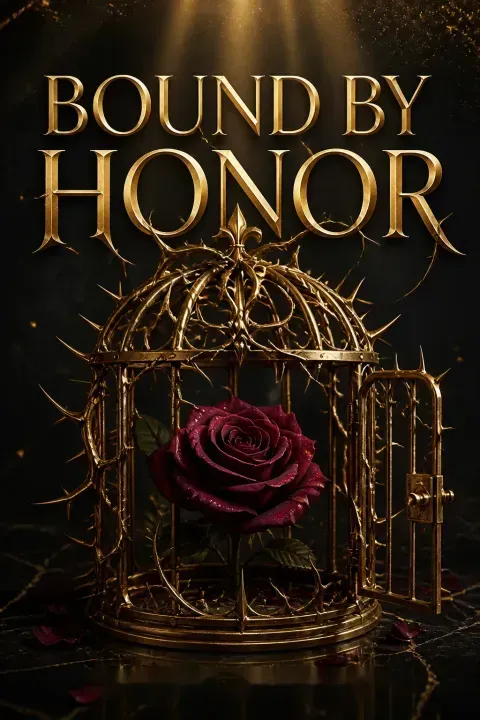


Plot Summary
Prologue
Aria's1 fingers tremble as Luca Vitiello2 slides the ring onto her hand: white gold with twenty small diamonds. Hundreds of faces from the Chicago and New York Famiglias watch her at the altar. She is eighteen, and this wedding is not about love or choice. It is about duty, honor, and uniting two crime families against the Russian Bratva.
The priest instructs Luca2 to kiss his bride. He bends down, towering over her by ten inches, and presses his lips to hers. There is no hesitation on his face, no fear. His cold gray eyes lock onto hers, and the message is unmistakable: she belongs to him now, until death. The golden cage has sealed shut.
The prologue establishes the central tension of the novel: a young woman trapped in a world where female agency is non-existent, married to a man whose very nickname evokes violence. The diamond ring is reframed from a symbol of love into manacles of ownership. The imagery of the cage recurs throughout the book, and here it is introduced as an inescapable fact. This opening functions as a thesis statement: within this patriarchal mafia structure, marriage is a life sentence. Yet the prologue is also a dramatic preview of the emotional journey to come. The terror Aria feels at this moment will be gradually replaced by a far more complicated emotional reality, one that neither she nor the reader can anticipate.
Father's Bargain
Aria's1 father7 summons her to his office and reveals that the Bratva and the Taiwanese Triad are threatening their territories. The Chicago Outfit must unite with the New York Famiglia, and the bond will be sealed with blood: Aria1 will marry Luca Vitiello,2 the future Capo dei Capi, when she turns eighteen. Her protests mean nothing.
He already shook hands on the deal. Desperate, she researches Luca2 online. He is tall, muscled, always photographed with different women. She learns he earned his nickname 'The Vise2' for crushing a man's throat with his bare hands. Their bodyguard Umberto9 adds that Luca2 killed his first man at age eleven. Aria's1 life, she realizes, ended before it began.
This section dramatizes the commodification of women in mafia culture. Aria is not consulted; she is informed. Her father's language is transactional: she is a door into the New York Famiglia, her blonde hair described as golden by the Boss. Her immediate instinct to research Luca online is a modern touch that underscores her naivete: Google results cannot capture the reality of the monster she will face. The juxtaposition of Luca's public persona as wealthy bachelor with his true identity as a killer since childhood mirrors the duality that defines their entire relationship, a duality Aria must navigate to survive.
Engagement Blood
Two months later, Luca2 arrives at the Scuderi mansion for the engagement party. Before the formal introduction, Aria's1 young brother Fabiano11 attacks Luca2 with small fists, shouting that he cannot have Aria.1 Gianna3 hurls insults. Luca2 is unmoved, almost amused.
That night, Aria1 and Gianna3 spy through a secret peephole as Luca2 interrogates the guards assigned to protect her. When their cousin Raffaele makes lewd comments about breaking in Aria1 and filming it, Luca2 throws him to the ground, seeks the Consigliere's7 permission with a glance, and severs Raffaele's pinky with a karambit knife.
Gianna3 vomits, revealing their hiding spot. Their father7 slaps Gianna.3 Luca2 stops him from hitting Aria,1 declaring she is no longer her father's7 to punish. She is his now.
The engagement party functions as Aria's initiation into the brutality she will live with. Luca's violence follows a code: he asks permission before maiming because they are in Chicago territory. This establishes him as governed by rules, however bloody. His intervention to stop Aria's father from slapping her introduces a crucial paradox: Luca claims ownership over her, but that ownership comes with protection. The peephole scene literalizes Aria's position throughout the novel: she is forced to watch male violence from the margins, unable to look away, unable to act. Gianna's vomiting is the body's honest response to horror, while Aria's frozen composure reflects her training as a mafia daughter.
Pills Before Vows
Five days before the wedding, Luca2 arrives at Aria's1 hotel suite with his brother Matteo,4 Cesare, and Romero.6 He dismisses the casual guarding and assigns Romero6 as Aria's1 permanent bodyguard, effective immediately.
Then he leads Aria1 to her bedroom, closes the door, and kisses her for the first time. She freezes. He hands her a packet of birth control pills from the Famiglia doctor, telling her to start taking them immediately since they require forty-eight hours to work.
When she asks what happens if she refuses, he shrugs: he will use a condom instead. Either way, on their wedding night, she is his. Aria1 feels the last flicker of hope extinguish. Gianna3 seethes at the injustice of Luca's2 sexual history when Aria1 has never even kissed a man.
The birth control scene crystallizes the fundamental power imbalance of the arranged marriage. Luca's clinical delivery of the pills reduces Aria's body to a site of his future pleasure, stripping away any romantic pretense. Yet within this violation lies a pragmatic consideration: he is not forcing pregnancy on her. This ambivalence, the mix of control and a twisted form of care, defines Luca's character. The assignment of Romero as bodyguard is equally double-edged: protection and surveillance become indistinguishable. Aria's frozen response to the kiss signals her dissociation, a survival mechanism that will slowly erode as intimacy develops.
Grace's Poisoned Whisper
At the wedding reception, Grace Parker,5 a senator's daughter and one of Luca's2 former lovers, pulls Aria1 into a false embrace. She whispers that Luca2 is a beast in bed, hung like one too, and that he will not care about Aria's1 pain. He will fuck her bloody. Aria1 forces a smile for the watching guests but crumbles inside.
The garter toss, the cake cutting, and the chanting for kisses blur past. Gianna3 notices Aria's1 distress and vows to kill Luca2 if he hurts her. The bridal shower earlier had already horrified Aria1 with the Sicilian tradition of the bloody sheets, where women collect the wedding bed linens as proof of the bride's purity. Grace's5 words now fuse with that image into singular terror.
Grace functions as the voice of Aria's worst fears made flesh. Her whisper weaponizes the sexual knowledge Aria lacks, transforming the wedding night from an abstract dread into a specific, violent scenario. The juxtaposition of Grace's cruelty with the festive traditions underscores how the mafia world masks brutality with ritual. The bloody sheets tradition is a particularly effective symbol: what should be private and intimate is made into a public spectacle of ownership, with the woman's body as the exhibit. Gianna's protective fury offers the only counter-narrative of female solidarity, but it is ultimately powerless against the institutionalized misogyny of both families.
Counterfeit Blood
Alone in the master bedroom, Aria1 trembles as Luca2 advances. When she flinches and cries, expecting violence, he pauses and drives his fist into the wall. He removes his karambit knife, the same blade that took Raffaele's finger, and cuts his own forearm, letting blood drip into a glass of water. He smears the diluted blood onto the center of the white sheets to fake the proof of consummation.
Aria1 watches, stunned. He undresses her with the knife, its blade never touching her skin, and tells her she is his. But then he swears an oath on the tattoo over his heart, born in blood, sworn in blood, that he will not take her virginity or harm her tonight. He has already bled for her, so the oath is sealed.
This is the novel's pivotal reversal. Luca, whom Aria has been conditioned to fear as a mindless brute, reveals an unexpected capacity for restraint and even tenderness. The fake blood is a brilliant piece of narrative misdirection: it preserves the public fiction of his ruthlessness while privately subverting it. The karambit knife, previously an instrument of mutilation, becomes a tool of intimate undressing, blurring the line between threat and sensuality. Luca's oath on his tattoo carries genuine weight in mafia culture; he is literally swearing on his identity as a Made Man. The scene establishes the central dynamic of their relationship: performance of ownership for the world, private negotiation of consent behind closed doors.
Fed by the Wolf
In New York, Aria1 languishes in Luca's2 sleek penthouse, watched constantly by Romero.6 Lonely and adrift, she is surprised when Luca2 takes her to his favorite restaurant, a cramped Korean spot in Manhattan. He teaches her to use chopsticks, feeds her bulgogi across the table, and shows her a charming, almost normal side. She begins to hope. Back home, he kisses her with growing hunger.
But when he growls that he has never wanted to fuck a woman as much as he wants to fuck her, she pulls away. His crude language cheapens what she wants: slow, gentle intimacy, not the animalistic rutting Grace5 described. He withdraws, frustrated, and stays away for two days. Aria1 is caught between craving his touch and needing more than his possession.
The Korean restaurant scene is the first glimpse of Luca outside his role as mafia heir. His choice of an independent, non-Famiglia establishment suggests a desire for something authentic, untainted by his world's corruption. The act of feeding Aria is intimate and nurturing, a stark contrast to his reputation. But the scene also reveals the chasm between their understandings of sex. For Luca, who lost his virginity at thirteen to paid prostitutes, sexual language is transactional and crude. For Aria, raised on romance novels and protected from any male contact, the same words feel degrading. Their conflict is not about desire but about language and meaning: he thinks he is expressing want; she hears dehumanization.
The Other Woman's Triumph
Luca's2 cousin Cosima12 hands Aria1 a key and an address. Aria1 sneaks away from Romero6 and enters a brownstone apartment. Following moans, she finds Luca2 having sex with Grace Parker5 from behind. Grace5 turns her head, locks eyes with Aria,1 and smiles in triumph. Aria1 flees into the subway, calls Gianna3 sobbing, and wanders Manhattan for hours.
When she finally returns to the penthouse, Luca2 is frantic with worry and fury. She confronts him. He counters that she refused him and he has needs. She tells him she wanted to take it slow, to kiss and explore first, not be used like a whore. Something shifts in his expression. He promises to stop seeing other women. But her trust is shattered.
The betrayal scene is constructed with almost theatrical cruelty: Grace's smile implicates her as the director of this humiliation, while Cosima's role as the lure reveals the internal misogyny of mafia women policing each other. Aria's flight into the anonymous city echoes her psychological flight from the reality of her marriage. The subway represents freedom she cannot actually access. Luca's defense about his needs is a cliché of male entitlement, but his eventual capitulation marks the first time he modifies his behavior in response to Aria's feelings. The promise to stop seeing other women is a concession to the idea that this marriage might be more than a property arrangement.
The Body Betrays
Luca2 takes Aria1 to the Famiglia gym, where he teaches her self-defense. She cannot land a hit until she bites his bicep, startling a laugh out of him. That evening on the roof terrace, he lowers her into the Jacuzzi and brings her to orgasm with his mouth. Over the following nights, their intimacy escalates: his fingers explore her, her hands learn his body, and she discovers she can make him groan with her touch.
He pleasures her relentlessly, giving her multiple orgasms, yet he never enters her. Aria's1 body craves him even as her mind warns her not to fall for a man who seems incapable of love. The boundary between survival strategy and genuine desire blurs completely.
The gym scene introduces physical parity: Aria's bite is an assertion of self within his training. The Jacuzzi sequence marks the novel's turn from fear-based tension to erotic exploration. Luca's skill as a lover, honed through years of casual encounters, is here repurposed for Aria's pleasure alone. His restraint regarding penetration, despite his obvious frustration, signals an investment in her comfort that transcends mere gratification. For Aria, the discovery of her own capacity for sexual pleasure is both empowering and destabilizing: she has been raised to view sex as wifely duty, but her body's enthusiastic response undermines that teaching. Her physical desire for Luca feels like a betrayal of her feminist instincts and her sister's warnings.
Roofied and Rescued
Aria1 and Gianna,3 craving a night of freedom, defy Luca's2 orders and go clubbing at Sphere. A local predator named Rick drugs Aria's1 drink and drags her toward the exit, whispering the exact words Grace5 used at the wedding: he will fuck her bloody. Romero6 and Cesare intercept him. Luca2 arrives, his expression terrifyingly blank.
In a back room, he forces Rick to confess, then kills him brutally. Later, drugged and half-conscious, Aria1 babbles that she loves Luca2 and reveals what Grace5 whispered at the wedding. Luca's2 fury redirects toward Grace5 and her family. The next morning, Aria1 wakes with only fragments of memory, but something between them has shifted irrevocably.
The rooftop drugging functions as a nexus where the novel's emotional and external threats converge. Rick's use of Grace's exact phrasing confirms that Aria's humiliation was orchestrated, transforming Grace from a jealous ex-lover into an active antagonist. Luca's killing of Rick is the most graphically violent scene in the book, and the method is symbolically appropriate: the predator is made to consume his own instrument of predation. Aria's drugged confession of love introduces dramatic irony: she cannot remember saying it, but Luca now knows. This knowledge changes his behavior, creating an asymmetry of emotional awareness that fuels the next act's conflict.
First Pain, Last Walls
When Gianna3 returns to Chicago, Aria1 keeps her promise. Luca2 enters her slowly, but the pain is overwhelming, a ten out of ten. He stops moving, holds her, kisses her, and waits for her body to relax before continuing. She bleeds onto the sheets, this time for real.
Afterward, he cleans her with a warm washcloth and holds her. In the vulnerable quiet, he tells her about his mother, who killed herself when he was nine. Luca2 found her body in a bathroom, slipped in her blood.
His father8 slapped him for crying and told him to be a man. He also reveals his first kill at eleven to save Matteo,4 and that he was shot while his father8 prioritized torturing a prisoner over getting him medical care. Aria1 begins to understand the damage that shaped him.
The loss of virginity scene subverts the genre expectation of a purely painful or purely transcendent first time. Luca's willingness to stop, to hold, to wait, demonstrates an empathy that his upbringing should have extinguished. The juxtaposition of physical pain with emotional intimacy is the novel's thesis in miniature: within the brutal container of their arranged marriage, moments of genuine tenderness can grow. Luca's backstory revelations are strategically placed in the aftermath of vulnerability. His mother's suicide, his father's emotional abuse, and the neglect that nearly killed him as a child explain but do not excuse his emotional armor. For Aria, understanding his trauma becomes a pathway to loving him.
Sister Sold
Gianna3 calls sobbing: their father7 has agreed to marry her to Matteo.4 Aria1 is devastated. Gianna3 is the one who always swore she would never submit. When Luca2 comes home, Aria1 attacks him physically, hitting his chest and aiming her knee at his groin. She storms down to Matteo's4 apartment and slaps him across the face.
Matteo4 pins her to the wall before Luca2 intervenes, furious at both of them. For three days, Aria1 and Luca2 barely speak. She finally admits she lied about faking her orgasms: the pleasure was real, and that terrified her. She hates that she loves a man she believes incapable of loving her back. Luca2 is stunned into silence. The distance between them feels insurmountable.
The Gianna subplot externalizes everything Aria has internalized. Gianna's forced betrothal proves that Aria's fate was not unique but systematic: the Scuderi daughters are currency, and their compliance or defiance is irrelevant. Aria's physical attack on Luca is her first active resistance, a reclaiming of agency that is both cathartic and futile. The admission that she lied about lying about her orgasms is a complex emotional revelation: she is confessing to a double falsehood, which reveals the depth of her self-protective instinct. She would rather Luca believe she is a skilled deceiver than admit her emotional vulnerability. The three days of silence demonstrate that their relationship has moved beyond physical possession into something neither can name.
Capo's Dark Night
Luca's2 father8 is killed by a Bratva sniper. When Luca2 returns home, he is covered in blood and barely recognizable. He nearly chokes Romero6 before Aria's1 presence pulls him back. Then he bends her over the sofa and takes her with raw, punishing intensity. She comes multiple times, passes out from sensory overload.
When she wakes in their bed, he is watching her with self-hatred, convinced he raped her. She reassures him: she wanted it, enjoyed it. In the aftermath, she tells him the full truth: she loves him, has loved him for a while, and she lied about faking because loving him means giving him the power to destroy her. He does not say it back. But something in his eyes cracks open.
This turning point reveals Luca at his most primal, his control shattered by his father's assassination. The violence of the sex act is a form of grief expression: in a world where men cannot cry, rage and lust become the only acceptable emotional outlets. Luca's immediate assumption that he raped Aria, and his subsequent self-loathing, reveal a moral awareness that contradicts his self-image as a remorseless killer. Aria's reassurance, her insistence that she wanted and enjoyed the encounter, is a radical act of reframing: she refuses the victim narrative that her world would assign her. Her love confession is the emotional climax of the novel, but its asymmetry, he does not say it back, preserves the tension for the final act.
Aria's Kill
At the Hamptons mansion, the Bratva attacks. A sniper kills Umberto9 on the loggia. Aria1 sends Romero6 to protect Lily10 and Fabi11 in the panic room and runs to find Gianna3 on the beach. Captured together, they are dragged before a Russian named Vitali. He holds a knife to Aria's1 throat, licks her cheek, and demands answers.
Luca2 arrives with Matteo,4 but Vitali threatens to cut Aria's1 throat if they advance. Aria1 remembers the switchblade in her back pocket, taken from Umberto's9 body. She stabs Vitali in the thigh. Luca2 lunges and slits his throat. In the firefight, Aria1 sees a Russian aiming at Luca.2 She fires and kills the man but takes a bullet in her shoulder. She collapses in Luca's2 arms.
The Hamptons sequence completes Aria's transformation from passive victim to active agent. Every choice she makes is consequential: sending Romero away prioritzes her siblings over her own safety; stabbing Vitali is an act of violent self-rescue; shooting the Russian to save Luca is a conscious embrace of the mafia ethos she was born into but never chose. The bullet she takes becomes a physical emblem of her new identity: blood on her hands, her own blood spilled, not as a victim but as a combatant. This baptism by violence earns her a place in Luca's world that compliance never could. The symmetry is deliberate: he once bled for her on their wedding night; now she bleeds for him.
Mine. Always.
During her recovery, Aria1 tells Luca2 she loves him. He resists, listing reasons she should not: he is a killer, he sometimes enjoys it, love is a weakness a Capo2 cannot afford. Then his resistance crumbles. He tells her that loving her is the only pure thing in his life. He would burn down the world for her. She is his first choice, before the Famiglia, before everything.
When he became Capo,2 he broke his oath before he even swore it. They make love slowly, her bandaged shoulder protected by his careful hands. Afterward, she presses her palm to the tattoo over his heart, the motto of blood and death. 'Mine,' she says. 'Always,' he replies. The golden cage has become a bond they both now choose.
The final chapter delivers the emotional payoff the entire novel has built toward: Luca's reciprocal love confession. His admission that he broke his Capo oath before taking it reveals that his emotional transformation was gradual and unacknowledged. The phrase 'the only pure thing in my life' is particularly striking: in a world of corruption, murder, and betrayal, Aria represents an untainted good. The final exchange echoes the possessive language of their wedding but infuses it with mutual consent. The golden cage metaphor, introduced in the prologue, is deliberately revised: the cage still exists, the mafia world is still a prison, but within its bars they have built something worth staying for. It is not a fairy-tale escape but an accommodation with reality.
Analysis
Bound by Honor operates within the dark romance genre but functions, at a deeper level, as a study of agency under extreme constraint. The novel asks what choices remain available to a woman who has been stripped of all legal and social autonomy. Aria1 cannot choose her husband, cannot choose her home, cannot choose her daily activities. What she can choose, and what the novel meticulously traces, is the pace and nature of her emotional and sexual surrender. This is not a small thing in a world where even that choice is contested. Luca's2 defining characteristic is not his violence but his capacity to recognize and respect Aria's1 boundaries once she articulates them. His restraint is the seed from which love grows. The novel suggests that within even the most oppressive structures, consent, however belated and constrained, has transformative power. It cannot change the cage, but it can change what the cage means to the person inside it. The subplot involving Gianna3 provides the necessary contrast: Gianna refuses to consent to her fate, and the narrative does not resolve her rebellion, instead gesturing toward the next book. This leaves the reader with an uncomfortable truth: Aria's1 happy ending is not a systemic victory but a personal one, contingent on the specific man she was given to. The mafia world remains intact, its brutalities unchanged. The love story blooms in the cracks of a structure that remains fundamentally unjust.
Review Summary
Bound by Honor receives mixed reviews, with ratings ranging from 1 to 5 stars. Some readers praise the chemistry between the characters and the mafia romance elements, while others criticize the problematic content, including cheating and misogynistic themes. The book's focus on virginity and sex scenes is divisive. Many readers find the main characters, Luca and Aria, either compelling or frustrating. Some appreciate the author's writing style and world-building, while others find the plot lacking depth. Despite criticisms, many readers express interest in continuing the series.
People Also Read





Characters
Aria Scuderi Vitiello
Reluctant Mafia PrincessThe protagonist. Blonde, blue-eyed, and deemed the most beautiful girl in the Chicago Outfit. At fifteen she learns she is betrothed to Luca Vitiello2 to seal an alliance between crime families. She loves her siblings, especially Gianna3, with fierce devotion and dreams of a life where women have choices. She is outwardly composed and skilled at masking her emotions, a survival adaptation in a world that punishes female expression. Her inner life is rich with longing for autonomy and love. Over the course of her marriage, she transforms from a terrified girl into a woman capable of both killing to protect those she loves and loving without reservation. Her core conflict is reconciling her desire for freedom with her growing attachment to a man who embodies everything she was raised to fear2.
Luca Vitiello
The Vise, Future CapoTall, heavily muscled, with cold gray eyes. Heir to the New York Famiglia and later its Capo dei Capi. He earned his nickname by crushing a man's throat with his bare hands. He killed his first man at eleven and was raised without gentleness by his father8 who valued the organization above all else. He presents a controlled, emotionless exterior to the world. Beneath it, he is possessive, fiercely protective, and capable of profound loyalty to the few he trusts. His early sexual experiences were with paid prostitutes, shaping a transactional view of intimacy. He genuinely believes himself incapable of love until Aria1 proves him wrong. His character arc is learning that emotions are not strategic weaknesses, and that his love for Aria1 is worth more than any oath he has sworn.
Gianna Scuderi
Defiant Sister and Truth-TellerAria's1 younger sister by eighteen months. Red-haired, blue-eyed, and utterly unwilling to submit to their world's rules. She speaks the truths Aria1 cannot, curses freely, and would rather die than be traded like property. She is impulsive, reckless with her sharp tongue, and uses defiance as her only weapon in a system designed to crush her. Her hatred of the mafia and its men is absolute, grounded in watching her beloved sister be sold. Her eventual betrothal to Matteo4 is her worst nightmare realized. She represents what Aria1 might have become if fear had not tempered her resistance: a woman who would rather burn everything down than bend.
Matteo Vitiello
The Shark-Grinning HunterLuca's2 younger brother. He is charming in a predatory way, always wearing a wolfish grin. He enjoys the chase and is not accustomed to being denied anything he wants. He chose Gianna3 precisely because she refused him so absolutely. Beneath his playful exterior, he shares Luca's2 capacity for brutal violence and the same emotionally barren upbringing. His pursuit of Gianna3 drives the subplot that tests Aria1 and Luca's2 fragile new bond, and his dynamic with Gianna3 is a darker mirror of the central relationship.
Grace Parker
Vengeful Former LoverA senator's daughter and one of Luca's2 many former sexual partners. Beautiful in an artificial, surgically enhanced way. She cannot accept or understand that Luca2 has married someone else for strategic reasons, viewing Aria1 as a rival to be destroyed. She orchestrates Aria's1 public humiliation at the wedding reception and later pays a man to drug and assault her at a club. She represents the dangerous collision between the mafia's transactional world and outsiders who mistake sexual access for emotional significance.
Romero
Loyal Bodyguard, Divided ConscienceA young Made Man assigned by Luca2 to guard Aria1. He is professional, disciplined, and deeply loyal to his Boss. He walks an impossible line between protecting Aria1 and reporting her every move to Luca2. His constant presence is a reminder of Aria's1 captivity, yet he also shows genuine concern for her wellbeing and risks Luca's2 wrath during the Hamptons attack by following her order to protect her siblings. He represents the decent soldier trapped in an indecent system, following orders while privately recognizing their injustice.
Consigliere Scuderi
The Father Who Sold His DaughtersAria's1 father and the Consigliere of the Chicago Outfit. He views his daughters as assets to be traded for power and alliances. He sold Aria1 to the Vitiellos2 without consulting her and later does the same with Gianna3. He enforces rigid gender roles, punishing Gianna3 for Aria's1 transgressions after Luca2 claims the right to discipline his future wife. He is the embodiment of the mafia's commodification of women, yet he operates within a value system that rewards him for these very transactions.
Salvatore Vitiello
The Capo Who Made MonstersLuca's2 father and the Capo dei Capi of the New York Famiglia. He raised his sons without affection, believing that gentleness is an unforgivable weakness. He paid prostitutes to initiate Luca2 at thirteen and left his bleeding eleven-year-old son untreated while he tortured an enemy for information. His emotional neglect and brutal pragmatism shaped both Luca2 and Matteo4 into the men they became. His assassination by the Bratva elevates Luca2 to Capo and triggers the novel's climactic conflict.
Umberto
Family Bodyguard, First VictimThe Scuderi family's longtime bodyguard, a thin man with a long facial scar and legendary knife skills. He has known Aria1 since her birth and treats her with a gruff, paternal affection, even as his loyalty to her father7 limits what he can do to protect her. His death by a Bratva sniper during the Hamptons attack provides the emotional shock and the switchblade Aria1 uses to escape her captor.
Liliana Scuderi
The Innocent FlirtAria's1 youngest sister, fourteen at the time of the wedding. She models her behavior on provocative aesthetics, using her beauty and flirtation to get reactions from those around her. She has a schoolgirl crush on Romero6 that flusters him. She is naive about the real danger her provocations could invite in their world, a naivete that worries Aria1 constantly.
Fabiano Scuderi
The Protective Little BrotherAria's1 younger brother, five at the engagement party and eight at the wedding. He attacks Luca2 with his small fists, declaring that Luca2 cannot have his sister. He is being groomed for initiation into the mafia, a process that will eventually strip away his childhood innocence. His fierce, uncomplicated love for Aria1 is one of the novel's few purely good emotional anchors.
Cosima
The Trap-Setting CousinLuca's2 cousin and Grace Parker's5 friend. She hands Aria1 the key and address that lead to the discovery of Luca's2 infidelity. She represents the internalized misogyny of women within the mafia who police and punish each other on behalf of the men who control them.
Plot Devices
The Bloody Sheets Tradition
Public proof of virginity and ownershipA Sicilian mafia custom in which the women of the groom's family collect the wedding bed linens the morning after the wedding and display them publicly to prove the bride was a virgin and that the marriage was consummated. This tradition is introduced at Aria's1 bridal shower, horrifying her. On the wedding night, Luca2 subverts it by cutting his own arm and smearing his blood, diluted with water, onto the sheets. This allows him to maintain his reputation for ruthlessness while privately sparing Aria1. The fake blood becomes their first shared secret, the foundation of trust on which their relationship slowly builds.
Luca's Karambit Knife
Instrument of violence and intimacyA curved, claw-like blade that Luca2 carries as his signature weapon. It is first seen when he uses it to sever Raffaele's finger at the engagement party. On the wedding night, it reappears in a radically different context: Luca2 uses it to cut himself for the fake blood and then to undress Aria1, the blade never touching her skin. The knife becomes a symbol of Luca's2 dual nature. It is capable of mutilation and murder, but also of ritualized, controlled intimacy. The way he wields it, always with precision and never with carelessness, mirrors his approach to power in general: deliberate, coded, and capable of surprising gentleness.
The Birth Control Pills
Bodily control and a measure of choiceGiven to Aria1 by Luca2 five days before the wedding, procured from the Famiglia's private doctor. They symbolize his intention to consummate the marriage immediately and his assumption of control over her reproductive life. However, they also represent a pragmatic concession: he is not forcing pregnancy on her before she is ready. The pills become a marker of the ambivalence that defines their entire relationship. He controls her body, but within that control there are boundaries he will not cross. The pills also serve a narrative function, allowing the novel's many sexual encounters to occur without the immediate complication of pregnancy.
Umberto's Switchblade
Inherited weapon of self-rescueA switchblade that Aria1 takes from Umberto's9 body after he is killed by the Bratva sniper. She hides it in her back pocket. When she is captured by Vitali and held at knifepoint, she remembers the blade and stabs him in the thigh, enabling Luca2 to slit his throat and initiating the firefight that follows. The switchblade represents Aria's1 transformation from passive victim to active agent. It is a physical inheritance from the man who guarded her childhood9, now repurposed for her own survival. The weapon passing from male protector to female protagonist subverts the novel's established gender dynamics in its most critical moment.
The Tattoo Over His Heart
Sacred oath and reclaimed bondA tattoo on Luca's2 chest bearing the Famiglia motto: 'Born in blood. Sworn in blood. I enter alive and I will have to get out dead.' Luca2 swears his wedding-night oath on this tattoo, and Aria1 presses her palm to it multiple times throughout the novel, feeling his heartbeat beneath the ink. The tattoo represents the mafia code that governs their world and the oath that should, by all logic, place the organization above any individual. In the final scene, Aria1 touches the tattoo and claims Luca2 as hers, and he responds, 'Always.' The symbol of his binding to the mafia is thus reappropriated as a symbol of his binding to her, an act of emotional treason against the very code it represents.
FAQ
Synopsis & Basic Details
What is Bound by Honor about?
- Arranged Marriage for Peace: The story centers on Aria Scuderi, daughter of a Chicago Outfit consigliere, who is forced into an arranged marriage with Luca Vitiello, the feared heir to the New York Famiglia, as a strategic alliance to end decades of feuding and unite against common enemies like the Bratva.
- Golden Cage of Duty: Aria, only fifteen when betrothed and eighteen when married, views her union not as a bond of love but as a prison, a sacrifice of her freedom and desires for the sake of family honor and political power within the American mafia landscape.
- Navigating a Violent World: The narrative follows Aria's struggle to survive and find agency within this brutal, patriarchal world, exploring her evolving relationship with Luca, the complexities of loyalty and betrayal, and the high cost of belonging to a life "born in blood, sworn in blood."
Why should I read Bound by Honor?
- Intense Psychological Depth: The novel delves into the emotional and psychological toll of living within a strict, violent mafia society, particularly for women, offering a raw look at fear, duty, and the search for identity under extreme pressure.
- Complex Character Dynamics: Readers are drawn into the intricate and often volatile relationships between characters like Aria and Luca, whose bond evolves from fear and obligation to unexpected intimacy and connection, challenging conventional romance tropes.
- Exploration of Dark Themes: It tackles mature themes such as arranged marriage, power dynamics, violence, and the loss of innocence, providing a gritty and unflinching portrayal of a hidden world and the moral compromises required for survival.
What is the background of Bound by Honor?
- Contemporary American Mafia Setting: The story is set in the modern era, focusing on the Italian-American mafia families in Chicago and New York, highlighting their ongoing struggles against rival crime organizations like the Russian Bratva and the Triad for territory and influence.
- Patriarchal Crime Society: The cultural backdrop is a deeply patriarchal structure where men hold absolute power, women are primarily valued for their beauty, obedience, and ability to form strategic alliances through marriage, and personal feelings are secondary to duty and honor.
- Fragile Alliances & External Threats: The plot is driven by the political necessity of uniting two historically rival families due to increasing pressure from external criminal groups, illustrating how shared threats can force even sworn enemies into uneasy cooperation.
What are the most memorable quotes in Bound by Honor?
- "I enter alive and I will have to get out dead.": This quote, originally part of the mafia induction oath, is chillingly paralleled with Aria's wedding vow in the prologue, immediately establishing the inescapable, life-or-death nature of her marriage and her world.
- "Born in blood. Sworn in blood.": The motto of the New York Famiglia, repeated throughout the book, serves as a constant reminder of the inescapable ties of family, violence, and fate that bind the characters, particularly Luca and Aria, to their predetermined lives.
- "You are mine.": Luca's declaration to Aria, first whispered after their wedding kiss and reiterated through his actions and words, encapsulates his possessiveness and the core theme of ownership that defines their initial relationship and Aria's struggle for autonomy.
What writing style, narrative choices, and literary techniques does Cora Reilly use?
- First-Person Perspective (Aria): The story is primarily told from Aria's intimate point of view, immersing the reader directly in her fears, anxieties, and evolving emotions, creating a strong sense of psychological realism and intimate POV.
- Juxtaposition of Violence and Intimacy: Reilly frequently contrasts scenes of brutal violence and the harsh realities of the mafia world with moments of unexpected tenderness and developing intimacy between Aria and Luca, highlighting the duality of their lives and relationship.
- Symbolism and Motif: Recurring symbols like the wedding ring as a "golden cage," blood (representing oaths, violence, and even staged intimacy), and the constant presence of weapons underscore key themes of captivity, danger, and the intertwined nature of love and violence in their world.
Hidden Details & Subtle Connections
What are some minor details that add significant meaning?
- Luca's Tattoo: The tattoo over Luca's heart, bearing the Famiglia motto "Born in blood. Sworn in blood," is initially just a physical detail but becomes deeply significant when Aria presses her hand against it during his oath not to harm her, literally connecting his core identity and loyalty to his promise to her.
- The Secret Passages: The existence of secret entrances and corridors in the Chicago house, mentioned casually in Chapter 1, highlights the constant paranoia and need for escape routes within the mafia world, foreshadowing the later desperate need for escape during the Bratva attack at the Hamptons mansion.
- Umberto Sharpening His Knife: The recurring image of Umberto sharpening his knife, often accompanied by the smell of tomato and oregano, grounds him in a domestic, almost comforting routine, contrasting sharply with his violent capabilities and making his sudden, brutal death during the attack more jarring and tragic.
What are some subtle foreshadowing and callbacks?
- Gianna's Defiance & Matteo's Interest: Gianna's outspoken rudeness towards Luca and Matteo during their first meeting, particularly her comment about Matteo's body, subtly foreshadows Matteo's later determination to marry her, viewing her defiance as a challenge he must conquer, as mentioned in Chapter 15.
- Luca's Mother's Suicide: The brief, detached mention of Luca's mother's death early on (Chapter 1) gains immense weight when Luca later reveals the horrific details of her suicide and his discovery of her body (Chapter 13), explaining his deep-seated trust issues and aversion to showing weakness or emotion.
- The "Bloody Sheets" Tradition: The detailed explanation of the Sicilian tradition of presenting the bloody sheets (Chapter 4) is initially presented as a terrifying expectation for Aria's wedding night, but the later reveal that Luca staged it with his own blood (Chapter 6) becomes a pivotal moment of unexpected kindness and a secret bond between them, referenced again when discussing the aftermath (Chapter 7).
What are some unexpected character connections?
- Cosima and Grace's Friendship: The seemingly minor character of Luca's cousin Cosima, who attends the bridal shower and wedding, is later revealed to be friends with Grace Parker, Luca's former lover. This connection is crucial as Cosima is implied to be the one who gives Aria the note and key to find Luca and Grace together (Chapter 9), orchestrating Aria's humiliation.
- Romero's Sister: Romero mentioning he has a sister Lily's age (Chapter 3) adds a layer of unexpected depth and empathy to his character, explaining his protective instincts towards Aria's younger sister and subtly humanizing him beyond his role as a loyal bodyguard.
- Luca and Dante's Shared Future: The brief, tense interaction and dance between Luca and Dante Cavallaro at the wedding (Chapter 5) subtly highlights their parallel paths as future leaders of their respective families, hinting at a complex relationship of rivalry and necessary cooperation that will define the future of the American mafia.
Who are the most significant supporting characters?
- Gianna Scuderi: More than just a supporting character, Gianna is Aria's emotional anchor and foil. Her fierce independence and open rebellion contrast with Aria's initial compliance, highlighting different responses to their world. Her eventual betrothal to Matteo becomes a major plot point and a source of deep anguish for Aria (Chapter 15).
- Romero: As Aria's constant bodyguard, Romero represents the ever-present surveillance and control in her life, but his quiet loyalty, occasional moments of empathy (like protecting Lily or explaining things to Aria), and his own backstory reveal the human cost of being a soldier in this world (Chapters 3, 9, 11).
- Matteo Vitiello: Luca's brother is a significant force, embodying the charming yet predatory nature of mafia men. His interactions with Aria and his relentless pursuit of Gianna drive conflict and highlight the power dynamics and objectification of women within the Famiglia (Chapters 2, 5, 15).
Psychological, Emotional, & Relational Analysis
What are some unspoken motivations of the characters?
- Luca's Need for Control: Beyond the obvious duty, Luca's intense need for control stems from the trauma of his mother's suicide and the constant threat of betrayal within his world. His possessiveness over Aria is not just about ownership but a desperate attempt to control one aspect of his chaotic life and protect something he values (Chapter 13).
- Aria's Search for Agency: Aria's subtle acts of defiance and her insistence on learning self-defense aren't just rebellion; they are driven by a deep-seated need to reclaim agency in a life where every major decision has been made for her. Her desire to understand Luca is also a way to gain some control by predicting his actions (Chapters 5, 10).
- Gianna's Provocation as Self-Preservation: Gianna's constant provocative behavior and verbal sparring, particularly with Matteo, can be interpreted as a form of self-preservation. By presenting herself as difficult and undesirable to the men of their world, she subconsciously hopes to avoid the fate of an arranged marriage, though it ultimately backfires (Chapters 2, 5, 15).
What psychological complexities do the characters exhibit?
- Luca's Duality of Monster and Protector: Luca embodies a profound psychological duality. He is capable of extreme violence and coldness ("The Vise"), yet shows unexpected tenderness and restraint with Aria, particularly after witnessing her fear and vulnerability. This internal conflict is a core aspect of his character development (Chapters 4, 6, 11).
- Aria's Trauma Response and Adaptation: Aria's journey reflects a complex trauma response. Initially paralyzed by fear and helplessness, she gradually adapts to her environment, developing coping mechanisms (like the "perfect mask"), finding strength in unexpected places (her bond with sisters, her relationship with Luca), and eventually integrating the violence of her world into her own identity (Chapters 1, 5, 14).
- Matteo's Charming Sadism: Matteo's character displays elements of charming sadism. He enjoys provoking others, particularly women like Gianna and Aria, and takes pleasure in their discomfort or fear. His pursuit of Gianna seems driven more by the challenge and the desire to break her spirit than genuine affection, highlighting a disturbing psychological trait common in their world (Chapters 2, 5, 15).
What are the major emotional turning points?
- The Staged Bloody Sheets: Luca's decision to stage the bloody sheets with his own blood instead of forcing himself on Aria (Chapter 6) is a pivotal emotional turning point. It shatters Aria's expectation of him as a pure monster and introduces the possibility of unexpected kindness and a secret shared bond, fundamentally altering her perception of him.
- Aria Witnessing Luca's Infidelity: Catching Luca with Grace (Chapter 9) is a devastating emotional blow for Aria. It moves her feelings for Luca beyond simple fear or obligation to include hurt, jealousy, and a sense of betrayal, forcing them to confront the transactional nature of their marriage and leading to a renegotiation of their terms.
- Aria Taking a Bullet for Luca: Aria instinctively shielding Luca and taking a bullet for him during the Bratva attack (Chapter 17) is the ultimate emotional turning point. It is a selfless act of love and loyalty that transcends duty, forcing Luca to confront the depth of his feelings for her and revealing Aria's transformation from a passive victim to an active protector.
How do relationship dynamics evolve?
- Aria and Luca: From Captivity to Partnership: Their relationship begins as a power imbalance between owner and possession, marked by Aria's fear and Luca's cold control. It evolves through tentative trust, shared vulnerability, and mutual exploration of intimacy, eventually becoming a partnership based on love, loyalty, and shared survival against external threats (Chapters 1-18).
- Aria and Gianna: Strain Under Pressure: The close, supportive bond between Aria and Gianna is strained by the realities of their world, particularly Gianna's impending arranged marriage. Gianna's anger and fear lead her to lash out at Aria, creating a temporary rift that highlights the immense pressure placed on their sisterly connection (Chapter 15).
- Luca and Matteo: Loyalty Tested by Possessiveness: Luca and Matteo share a deep bond forged in shared trauma and loyalty. However, Luca's fierce protectiveness over Aria leads him to threaten Matteo when his brother touches her inappropriately (Chapter 15), showing that while family loyalty is paramount, Luca's possessiveness over Aria introduces a new, potentially volatile dynamic.
Interpretation & Debate
Which parts of the story remain ambiguous or open-ended?
- The Full Extent of Luca's Trauma: While Luca reveals details about his mother's suicide and finding her body (Chapter 13), the long-term psychological impact of this trauma and other violent experiences on his capacity for emotional connection beyond his love for Aria remains somewhat open to interpretation.
- The Future of Gianna and Matteo's Marriage: Despite Matteo's determination and Gianna's fierce resistance, the actual dynamic and outcome of their forced union are left open-ended at the close of the book, leaving readers to wonder if Gianna will ever submit or if their relationship will be a perpetual battleground.
- The Long-Term Impact of Aria's Actions: Aria killing a man and her lack of remorse (Chapter 17, 18) mark a significant transformation. The extent to which this act fundamentally changes her character and her ability to maintain her "goodness" in the face of future violence is left for the reader to ponder.
What are some debatable, controversial scenes or moments in Bound by Honor?
- The Finger Cutting Scene: Luca cutting off Raffaele's finger (Chapter 2) is highly controversial due to its graphic violence and Luca's cold brutality, sparking debate among readers about the extent of his monstrousness and whether his later gentleness towards Aria can truly redeem him.
- The Staged Bloody Sheets: While intended as an act of kindness, Luca staging the bloody sheets with his own blood (Chapter 6) can be debated. Some might see it as manipulative, forcing Aria into complicity in a lie to protect his reputation, rather than a purely selfless act.
- Aria's Growing Arousal from Luca's Dominance: Aria's increasing arousal and pleasure from Luca's possessive and sometimes rough touch, particularly in scenes like the one after the Bratva attack (Chapter 16), can be controversial, sparking discussions about consent, trauma responses, and the portrayal of female sexuality within a power-imbalanced relationship.
Bound by Honor Ending Explained: How It Ends & What It Means
- Climax of Violence and Sacrifice: The book culminates with a brutal Bratva attack on the Hamptons mansion during Salvatore Vitiello's funeral. Aria is caught in the crossfire, witnesses Umberto's death, and is nearly captured by the enemy leader, Vitali. In a pivotal moment, Aria shoots and kills a Bratva member to save Luca, taking a bullet in the shoulder herself (Chapter 17).
- Confessions of Love and Mutual Vulnerability: In the aftermath, as Aria recovers, she confesses her love for Luca, acknowledging his darkness but accepting him. Luca, deeply shaken by the near-loss of Aria, reciprocates, admitting that loving her is the "only pure thing" in his life and that she is his "first choice," even over the Famiglia oath (Chapter 18).
- Meaning: Love as Strength and Risk: The ending signifies that love, initially presented as a weakness and impossible in their world, becomes the central bond and source of strength for Aria and Luca. However, it also highlights the immense risk this love poses, making them vulnerable targets for their enemies. Their union, forged in duty and sealed by shared trauma and confessed love, redefines their personal "born in blood, sworn in blood" oath to include loyalty and devotion to each other amidst the ongoing violence and danger of their lives.
Born in Blood Mafia Chronicles Series
About the Author

Download PDF
Download EPUB
.epub digital book format is ideal for reading ebooks on phones, tablets, and e-readers.








































