

Key Takeaways
You were born a body mind master, then trained it out of yourself
Infancy is peak performance. Millman opens with ten-month-old David Seale taking his first steps: relaxed body, present-focused mind, no fear of the falls, and pure delight at the goal. That baby, Millman argues, is the natural athlete we all once were. The essence of talent is not adding special qualities but subtracting the obstructions adults accumulate: limiting beliefs, emotional knots, and physical tension.
The goal is reclamation, not construction. Watching his daughter play with a cat, Millman saw both moved with a relaxed, mindless ease that most adults have lost. Body mind mastery means dedicating your training to your life, not your life to training, and using any skill (sport, dance, music, martial arts) to recover the clarity, serenity, and power you started with.
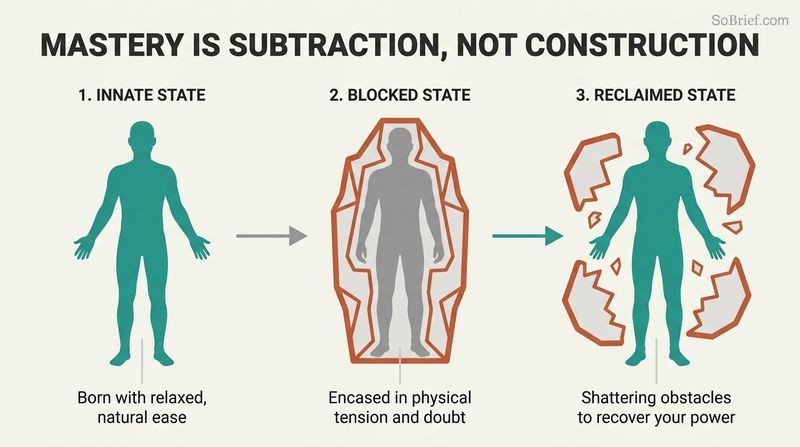
The framing echoes developmental psychology and the Taoist idea of returning to the uncarved block. It resonates with modern flow research: children display effortless absorption before self-consciousness intrudes. One caveat worth noting: infant learning also depends on immature prefrontal inhibition and radical neuroplasticity that adults cannot fully recover, so the metaphor romanticizes biology somewhat. Still, the practical core holds. Much adult underperformance is interference, not incapacity. Timothy Gallwey's inner game concept (performance equals potential minus interference) says nearly the same thing, and Millman's subtraction model is a liberating reframe for anyone convinced they simply lack talent.
Stop trying so hard; effort past a point sabotages the outcome
Trying tenses you against yourself. Millman defines nonresistance as blending with natural forces rather than fighting them, like bamboo bending under snow instead of snapping. The word try itself signals weakness and self-doubt. Walk a four-inch plank on the ground and you stroll it easily; raise it ten feet over alligators and you tense, wobble, and fail. Same plank, different mind.
Opposing muscles fight your goal. When you strain to hold your arm straight, you fire both triceps and biceps, wasting energy against yourself. Chuang Tzu observed archers who shoot flawlessly for fun but see double when a gold prize is at stake. The remedy: form a clear intention, then let the club swing, let the ball drop through the hoop, and stay relaxed even under pressure.
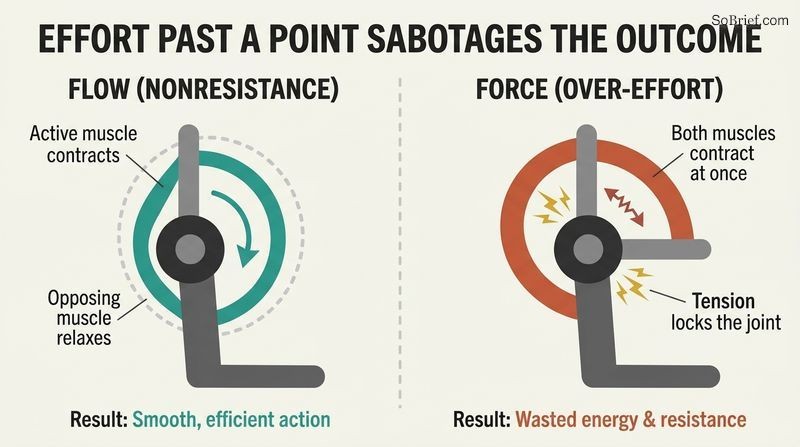
This maps precisely onto the Yerkes-Dodson law: performance rises with arousal only to a peak, then collapses. It also anticipates research on choking under pressure, where explicit self-monitoring disrupts automated motor skills (Sian Beilock's work on paralysis by analysis). Millman's fix, replacing effortful control with trusting intention, parallels what sport psychologists now call quiet eye and external focus of attention. The subtle risk is that beginners hear let it happen and skip the deliberate practice that builds the automaticity in the first place. Nonresistance is a mastery skill, earned after the mechanics are grooved, not a shortcut around them.
Grow by asking your body politely, just above your comfort zone
Development follows demand. Millman's law of accommodation states that the body adapts to progressive overload, but only demand slightly beyond current capacity, applied consistently. Grind a rock too fast and it shatters; grind it gradually and it reshapes. Most athletes train far outside their comfort zone, collecting fatigue, strain, and injury. Masters work near the top of theirs, improving slower but keeping the gains.
Ask nicely, ask often. His experiment: pick a feat just beyond reach (a one-arm push-up, touching your toes), attempt it a few times morning and evening every day, set no targets, visualize nothing, and after a month you will have quietly improved. Little failures are not setbacks but stepping-stones, the natural texture of learning. Trust the process rather than forcing it.
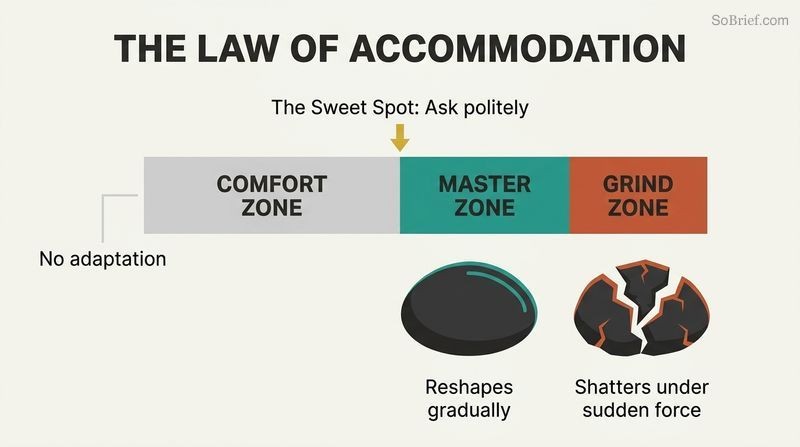
Accommodation is essentially the training principle of progressive overload plus the sports-science concept of supercompensation, framed gently. Millman's near the top of the comfort zone anticipates the modern debate between comfort-zone training and Anders Ericsson's deliberate practice, which insists real growth happens outside comfort. The reconciliation: sustainable overload is small and frequent, not heroic and sporadic. His polite request framing is more than poetry. It reduces the sympathetic stress response that impairs recovery and motor learning. Endurance coaches echoing this with the 80/20 rule (most training easy, little of it hard) have data on their side.
Awareness of getting worse is the sign you are getting better
Naming the error solves half of it. Awareness, Millman argues, converts vague failure into a specific, correctable action. His Stanford freshmen complained they were declining, yet film showed dramatic improvement. Their standards had risen faster than their skills. This felt regression is really expanding perception, the same drop in self-esteem writers feel when they can finally see the flaws in their last draft.
Awareness climbs in stages. Coaching diver Margaret, he watched her progress predictably: first she needed his feedback, then she could recount errors after the dive, then notice them mid-dive, and finally correct them before they happened, producing a beautiful dive. To speed awareness when a teacher is absent, deliberately exaggerate the error. Slice the ball worse on purpose and the mistake becomes conscious, deliberate, and far easier to fix.
This is a lucid folk version of the four stages of competence model (unconscious incompetence up to unconscious competence). The felt worse but actually better paradox is well documented in skill acquisition: as tacit knowledge becomes explicit, error detection outpaces error correction, temporarily denting confidence. Millman's exaggeration technique prefigures what motor-learning researchers call differential learning and error-augmentation training, where amplifying mistakes accelerates recalibration. The deeper wisdom is emotional: treating the dip in self-image as evidence of growth rather than failure keeps learners from quitting at exactly the moment their perception has upgraded. Many abandon skills right at this threshold.
Your self-concept, not your ability, sets your ceiling
You perform to your expectations. Millman tells of a shoe salesman who sold exactly $10,000 monthly whether his territory doubled or was halved. He had a $10,000 self-concept. Self-concept, the internalized belief about what you can do, becomes a self-fulfilling prophecy: expect to fail and you invest less energy, confirming the belief. Five-year-old Dan gave up painting after one lopsided tree, not realizing classmates had simply practiced more.
The best self-concept is none at all. Unrealistically high self-concepts are also a trap, breeding kids whose worth depends on constant praise and who crack under the pressure to never disappoint. Children raised free of exaggerated praise or blame explore and achieve from curiosity. His prescription: list twenty abilities, rate yourself, question the low scores, then burn the list.
Millman anticipates Carol Dweck's fixed versus growth mindset by decades, but goes further, arguing against attaching self-worth to achievement at all, praise included. That aligns with self-determination theory, where intrinsic motivation (curiosity, mastery) outperforms contingent external reward for long-term persistence. His warning about over-praised children maps onto research linking contingent self-esteem to fragility, anxiety, and even the darker findings on inflated praise and narcissism. The burn the list ritual is a clever bit of embodied cognition: physical destruction to symbolically release a mental construct. The honest tension is that some realistic self-assessment aids strategy. Total egolessness is an aspiration, not a starting technique.
You cannot control thoughts or feelings, only behavior, so master that
Emotions are weather, not destiny. Millman insists we have little direct control over thoughts and feelings, which arise and pass like clouds, but near-total control over how we move our arms, legs, and mouth. This is the great secret: you can feel afraid and still act bravely. His boxing-coach line captures it: heroes and cowards feel identical fear; they simply behave differently.
Regulate the body to steady the mind. Because behavior is the lever, the fastest route to emotional balance runs through the body, especially the breath. He maps three emotional blocks to breathing patterns: anger shows weak inhale and forced exhale, sorrow shows fitful inhale and weak exhale, fear nearly stops breathing altogether. His tense-shake-breathe-relax sequence discharges tension: clench everything for a few seconds, shake loose, then breathe slowly from the belly.
This is strikingly congruent with modern acceptance-based therapies. Acceptance and Commitment Therapy teaches that fighting internal states amplifies them, and that committed action can proceed regardless of feelings, precisely Millman's stance. His breath-emotion mapping aligns with polyvagal theory and abundant data that slow diaphragmatic breathing raises heart-rate variability and downshifts the sympathetic nervous system. Naming behavior as the only controllable variable is also the backbone of behavioral activation for depression. One nuance: cognitive reappraisal research shows we do have some indirect leverage over thoughts, so control is a spectrum rather than the binary Millman implies. Still, prioritizing action over mood is durable, evidence-backed advice.
Relaxation is the master key that unlocks all four physical talents
Tension leaks energy. Millman reduces physical talent to four Ss: strength, suppleness, stamina, and sensitivity. Relaxation underlies all of them. Studies of movement efficiency found people tense unrelated muscles even lifting a fork. A cat naps, then springs ten feet with blinding speed, carrying almost no tension; football players who tried to mimic a baby's movements for ten minutes dropped out exhausted.
Effective strength means relaxing the right muscles. In the Aikido unbendable arm test, a rigidly clenched arm bends easily, while a relaxed arm imagining energy streaming through the fingers becomes nearly unbendable. Dale, a muscular Stanford tumbler, couldn't get airborne because tension weighed him down; beginners with skinny legs out-jumped him. After relaxation and quickness drills, his tumbling transformed. The formula for skill: precision, then speed, then power (PSP).
The counterintuitive claim that relaxation produces power is biomechanically sound. Co-contraction of antagonist muscles genuinely reduces net force and speed, which is why elite sprinters are studied for their relaxed jaws and shoulders at top velocity. The unbendable arm, once dismissed as mysticism, is explained by kinetic-chain alignment and recruitment of larger stabilizers rather than isolated arm muscles. Millman's cat is a good icon for what researchers call economy of movement, a hallmark separating experts from novices across domains. The PSP ordering matches motor-learning stages, though power athletes would note that maximal strength development eventually requires deliberately high tension too. Relaxation optimizes expression of strength; it does not build maximal force alone.
Never repeat the same error twice, and only perfect practice makes perfect
You groove whatever you rehearse. Learning a skill is like blazing a path through fresh snow: the first attempt carves the neural pathway, and every repetition deepens it, correct or not. So practicing a flawed swing 500 times makes you excellent at swinging badly. Millman's rule: never repeat the same error twice. Make different errors each time and you avoid habituating any single bad pattern.
Quality of attention beats quantity. Hit 500 golf balls but attend to only 100 and you waste 400, possibly harming yourself. He recommends practicing in threes, since concentration holds best for about three attempts before the fourth degrades, then pausing to reset. Using this method he taught himself to juggle in five days at five minutes daily. Fast learners often absorb hidden bad habits; learning it right saves time.
This is a prescient articulation of what neuroscience now frames as Hebbian plasticity (neurons that fire together wire together) and myelination of repeated pathways. The insistence on attentive, error-varied reps aligns with contemporary findings that random and variable practice, though harder in the moment, produces better retention and transfer than blocked repetition (Robert Bjork's desirable difficulties). Practice in threes is a rough but reasonable nod to attention and working-memory limits. The one place to push back: Ericsson showed elite performers accumulate enormous volume, so quantity does matter, provided every rep carries the focused, corrective quality Millman demands. Volume and mindfulness are partners, not rivals.
Rehearse in your mind; the brain barely distinguishes it from doing
Imagined movement fires real muscles. Millman calls this ideomotor action: every vivid image of a movement produces a faint corresponding muscular impulse. Hold a weighted string still, imagine it swinging, and it begins to swing. A classic study split sixty novice basketball players into three groups: physical free-throw practice, purely mental practice, and nothing. The mental group improved almost as much as the physical one, while the control group did not.
Visualize to program success. As a Cal gymnast, Millman earned a reputation as a natural by dreaming through difficult moves the night before and running them in his head all day, so the physical attempt felt familiar and fear dissolved. Mental practice is safe, free, doable almost anywhere, error-free, and demands sharp concentration. The catch, shown by his beam gymnast who kept falling off even in her imagination, is you must picture it done right.
Motor imagery is now a validated tool in elite sport, surgery, and stroke rehabilitation. Functional imaging shows that imagined and executed movements activate overlapping premotor and motor cortex, giving Millman's brain cannot tell the difference claim genuine grounding, within limits. The PETTLEP model refined this by specifying that imagery works best when physical, environmental, and emotional details are richly matched. His falling gymnast is a sharp real-world illustration of a documented risk: negative imagery rehearses failure just as effectively as positive imagery rehearses success. Imagery amplifies whatever you vividly picture, so it demands quality control. It supplements rather than replaces physical reps, since it cannot build cardiovascular or connective-tissue adaptations.
Turn opponents into teachers and games into cooperation
Competition has a shadow side. Drawing on Alfie Kohn's No Contest, Millman notes musical chairs teaches children that resources are scarce and someone must be excluded to have fun. Competition can breed camaraderie among teammates but hostility toward opponents, reduce unique humans to scores, and split the world into winners and losers. Yet it also focuses attention in the present and reveals character.
Redesign the game or your perception. Sports psychologist Terry Orlick reinvented musical chairs so kids squeeze onto ever-fewer chairs together, everyone giggling to the end. Effortless Tennis rewards keeping a rally alive rather than beating your partner. Olympian Steve Hug never really competed against anyone; he measured himself by his own standard and became one of the most centered competitors Millman knew. The only honest scoreboard is one question: did I do my best today?
Kohn's anti-competition stance remains contested. Meta-analyses show cooperative structures generally beat purely competitive ones for learning and relationships, yet competition can sharpen motivation and performance when framed as a shared challenge rather than a zero-sum threat. Self-determination theory helps reconcile this: rivalry that supports autonomy and mastery energizes, while rivalry that makes worth contingent on beating others corrodes. Hug's self-referenced standard mirrors what achievement-goal theory calls a mastery orientation, consistently linked to persistence, resilience, and enjoyment over an ego orientation focused on outperforming others. Millman's cooperative game redesigns are more than utopian. They increase time-on-task and reduce dropout, which are real performance advantages.
Practice everything, because the master turns each moment into ceremony
Mastery is a way of being, not a skill set. This is the book's thesis. The musician practices music and the athlete practices athletics, but the body mind master practices everything, washing dishes, walking, and breathing with the same undivided attention given a championship. Handstands don't help on a date or with finances, but the internal qualities forged in training (mental focus, emotional energy, relaxation under stress) improve every moment.
The tea master defeats the samurai. Forced into a duel he cannot win, a tea master learns from swordmaster Miyamoto simply to face death with the same serene, total presence he brings to the tea ceremony. Standing sword raised, utterly composed, he so unnerves the samurai that the warrior lowers his blade and begs to become his student. Having mastered himself, the tea master had, in effect, mastered the sword.
This is the book's Zen heart, and it converges with the Japanese concept of do (the way) running through every traditional art, and with mindfulness research showing that trained present-moment attention transfers across domains and lowers stress reactivity. The tea master parable dramatizes what psychologists call state transfer: a deeply grooved state of composure, accessed reliably in one arena, becomes available under novel threat. The claim that mastering one art masters all is inspiring but should be read carefully. Skills themselves rarely transfer (chess mastery does not make you a surgeon), but meta-skills like attentional control, emotional regulation, and comfort with failure genuinely do. That transferable inner core is precisely what Millman is pointing at.
Your calendar age barely predicts your vitality; movement does
Fitness is chosen, not inherited by year. Millman argues each of us runs a psychological clock of beliefs about when we are old, and those beliefs shape decline more than birthdays. Some are unfit at thirty; others thrive into their nineties. Genetics set a starting face, but by fifty your habits of activity, diet, and rest write the rest.
Ruth Heidrich embodies the point. Diagnosed with breast cancer at forty-seven, she adopted a strict whole-foods vegan diet and, reasoning she had nothing to lose, took up the Ironman Triathlon. A decade later, in her sixties, she had completed six Ironmans, held age-group records, and posted a treadmill fitness score exceeding the superior category for a thirty-year-old man. Millman's practical advice: begin where your current vitality is, not your age; progress gradually; and stay active in daily life, since like sharks, humans decline when they stop moving.
The core claim is well supported. Lifestyle explains far more of the variance in healthspan than chronological age, and much of what was long attributed to aging is actually disuse and deconditioning. Heidrich is a vivid single case, so it warrants the usual caution against generalizing from one dramatic anecdote, and cancer outcomes depend on many factors beyond diet. Still, the direction aligns with population data linking physical activity, plant-forward eating, and purpose to longevity. The begin where you are, progress gradually prescription matches exercise-physiology consensus for older adults, where the greatest risk is not doing too little but doing too much too fast and getting injured.
Analysis
Body Mind Mastery is a 1992 revision of Dan Millman's The Inner Athlete, and it belongs to a lineage of East-meets-West performance philosophy alongside Eugen Herrigel's Zen in the Art of Archery and Timothy Gallwey's Inner Game series. Its structure is a mountain-path metaphor moving through three parts: natural laws and preparation, the development of mental, emotional, and physical talent, and mastery in action (training tools, competition, and evolution). The genre is part self-help, part sports psychology, part contemplative practice, unified by one bold thesis: the qualities cultivated in physical training are really vehicles for mastering daily life.
The book's enduring value is its integration. Millman refuses to treat body, mind, and emotions as separable, and his psychophysical framing anticipated by decades what neuroscience, acceptance-based therapy, and embodied-cognition research now take seriously. His four natural laws (nonresistance, accommodation, balance, natural order) are essentially heuristics for working with biological and psychological reality rather than against it. His most actionable contributions are concrete: relaxation as the master key to strength, the never repeat an error twice rule, practice in threes, overcompensation to find center, and mental rehearsal grounded in ideomotor action.
The weaknesses are equally clear. Evidence is largely anecdotal and metaphorical, drawn from Millman's gymnastics career and coaching rather than controlled study, and the occasional mystical flourish (subtle energies, the subconscious not distinguishing imagination from reality stated too absolutely) overreaches what the science supports. The romanticized infant-as-master motif underplays real neurodevelopmental limits, and the anti-competition argument, borrowed from Alfie Kohn, is more contested than presented.
Yet the book ages well because its center of gravity is not technique but attention. Its final image, climbing to the summit only to find the master waiting there is yourself, distills a genuinely useful truth: excellence and equanimity are the same discipline practiced in different arenas. For anyone who trains anything, that reframe justifies the read.
Review Summary
Body Mind Mastery receives mostly positive reviews, praised for its practical advice on integrating mental and physical training for athletes and non-athletes alike. Readers appreciate Millman's blend of Eastern and Western philosophies, finding the book's insights applicable to both sports and daily life. Many highlight its focus on relaxation, mindfulness, and overcoming mental barriers. While some find it repetitive or too self-help-oriented, most readers value its lessons on body-mind connection, emotional control, and achieving peak performance through holistic training approaches.
People Also Read









Glossary
Body Mind Mastery
Integrated body, mind, emotion excellenceMillman's central concept: the reclaimed natural state in which mind is present-focused, emotions flow freely as motivation, and the body is relaxed and sensitive. It is developed through any skill training but transcends sport, applying the same qualities of focus, energy, and relaxation to relationships, work, and daily life.
The Four Ss
Strength, suppleness, stamina, sensitivityMillman's four building blocks of physical talent. Strength is controlled muscular force, suppleness is flexibility and range of motion, stamina is the capacity to work over time, and sensitivity is coordination, balance, timing, and reflex speed. All four are unlocked by relaxation, which he calls the master key.
Accommodation
Body adapts to gradual demandMillman's natural law that development follows demand: the body, mind, and emotions adapt to progressive overload applied gently and consistently, slightly beyond current capacity. Push too hard and you break like an over-ground rock; ask politely and often, and lasting improvement follows. Little failures are the natural stepping-stones of the process.
Nonresistance
Blend with forces, don't fightThe first natural law: rather than resisting or ignoring life's forces, you use and blend with them, like bamboo bending under snow or a martial artist redirecting an attacker's momentum. Applied to the mind, it means dropping the effortful trying that creates tension and self-sabotage, forming clear intent, then letting action happen.
Ideomotor action
Imagined movement triggers muscle impulsesThe principle that any vivid mental image of a movement produces a faint corresponding muscular impulse. It is the mechanism behind mental practice: relaxing and imagining a skill performed correctly develops the actual motor response, as demonstrated by a weighted string that begins swinging when you merely imagine it moving.
PSP (Precision, Speed, Power)
Correct skill-learning sequenceMillman's formula for learning any skill in proper order: first develop precision through slow, aware practice, then add speed, then power. Each quality flows from the previous one. Slowing down to master accuracy paradoxically produces faster, more powerful movement later because tension is noticed and released.
Satori
Sudden unified body-mind awakeningA Japanese Zen term Millman uses for a momentary fusing of body, mind, and emotions: the mind free of distraction and present, emotions flowing as motivation, and the body vital and relaxed. It is the zone or flow state athletes describe, and over time it becomes the moment-to-moment practice of mastery.
Overcompensation
Work both extremes to centerA rapid-learning technique based on the law of balance. Since learners tend to undercorrect and stay near old habits, you deliberately exaggerate the opposite error (swing far too low if you habitually swing too high). Working both extremes lets you locate and settle into the correct center.
FAQ
1. What is "Body Mind Mastery" by Dan Millman about?
- Holistic Approach to Training: The book explores how integrating body, mind, and emotions leads to success in both sports and life.
- Natural Laws and Personal Growth: Millman presents natural laws—nonresistance, accommodation, balance, and natural order—as the foundation for personal development and mastery.
- Beyond Athletics: While rooted in athletic training, the principles apply to any skill or life challenge, making it a guide for overall human potential.
- Practical Tools and Stories: The book combines practical exercises, real-life anecdotes, and philosophical insights to help readers reclaim their innate potential.
2. Why should I read "Body Mind Mastery" by Dan Millman?
- Universal Relevance: The book is valuable for athletes, artists, professionals, parents, and anyone seeking personal growth, not just sports enthusiasts.
- Stress Reduction and Fulfillment: Millman offers a less stressful, more meaningful approach to training and daily living, focusing on enjoyment and process over mere results.
- Actionable Wisdom: Readers gain practical tools for overcoming self-imposed limitations, building resilience, and developing balanced talent.
- Inspiration and Motivation: Through stories and exercises, the book inspires readers to confront fears, embrace challenges, and strive for mastery in all areas of life.
3. What are the key takeaways from "Body Mind Mastery" by Dan Millman?
- Integration is Key: True mastery comes from developing body, mind, and emotions together, not in isolation.
- Natural Laws Govern Success: Aligning with principles like nonresistance, accommodation, balance, and natural order leads to sustainable growth and fulfillment.
- Awareness Fuels Improvement: Self-awareness—of strengths, weaknesses, and habits—is the starting point for meaningful change.
- Process Over Outcome: Focusing on the journey, preparation, and daily practice yields deeper satisfaction and long-term results than obsessing over victories or external rewards.
4. How does Dan Millman define "body mind mastery" in "Body Mind Mastery"?
- Unified Development: Body mind mastery is the balanced cultivation of physical, mental, and emotional talents for optimal performance and well-being.
- Everyday Application: It means practicing awareness and excellence not just in sports, but in all daily activities—relationships, work, and self-care.
- Natural State: Millman suggests we are born as body mind masters (as infants), and mastery is about reclaiming this natural state by removing learned obstructions.
- Path, Not Destination: Mastery is a lifelong process of growth, learning, and self-discovery, rather than a fixed achievement.
5. What are the four natural laws in "Body Mind Mastery" by Dan Millman, and how do they apply to training and life?
- Nonresistance: Go with the flow of circumstances, using challenges as opportunities rather than fighting against them.
- Accommodation: Progress comes from gradual, consistent demands—stretching your comfort zone without forcing or rushing.
- Balance: Success requires moderation and equilibrium in effort, rest, emotion, and ambition; extremes lead to setbacks.
- Natural Order: Growth unfolds in its own time and sequence; respecting the process and avoiding impatience leads to lasting results.
6. How does "Body Mind Mastery" by Dan Millman address the development of mental talent?
- Present-Moment Focus: Millman emphasizes the power of one-pointed attention and being fully present, both in sport and daily life.
- Overcoming Limiting Beliefs: The book teaches how to identify and transcend self-concepts, fear of failure, and destructive self-criticism.
- Visualization and Mental Practice: Techniques like mental rehearsal and positive self-talk are presented as tools for skill improvement and confidence.
- Awareness of Thought Patterns: Recognizing and managing internal distractions is key to unlocking mental potential.
7. What does Dan Millman say about emotional talent and motivation in "Body Mind Mastery"?
- Emotional Energy as Fuel: Motivation is seen as the driving force behind action, but willpower and purpose sustain progress when motivation wanes.
- Acceptance and Relaxation: Millman advocates accepting emotions without repression, staying physically relaxed even under stress, and using breath to regulate feelings.
- Witnessing Emotions: Developing the skill to observe and release emotional patterns, rather than being controlled by them, is central to mastery.
- Constructive Use of Emotions: Emotional talent involves channeling feelings into constructive action, regardless of mood or circumstance.
8. What are the four "Ss" of physical talent in "Body Mind Mastery" by Dan Millman, and why are they important?
- Strength: The ability to generate force efficiently, emphasizing relaxed strength over brute tension.
- Suppleness: Flexibility and the capacity to move freely, achieved through relaxation and gentle stretching.
- Stamina: Endurance to sustain effort over time, developed through gradual, consistent training.
- Sensitivity: Heightened awareness of body, balance, timing, and coordination, which accelerates learning and prevents injury.
9. How does "Body Mind Mastery" by Dan Millman recommend learning and mastering new skills?
- Step-by-Step Preparation: Break down complex skills into manageable parts, focusing on fundamentals before advanced techniques.
- Perfect Practice: Practice with full awareness, aiming for quality over quantity, and avoid repeating errors.
- Overcompensation and Balance: Deliberately work both sides of a skill (e.g., too much, too little) to find the optimal center.
- Imitation and Mental Rehearsal: Learn from role models, use visualization, and practice mentally as well as physically for faster, more effective learning.
10. What is Dan Millman's perspective on competition and cooperation in "Body Mind Mastery"?
- Competition as a Tool: While competition can inspire excellence and reveal strengths, it should not breed hostility or self-worth based solely on winning.
- Cooperative Mindset: Millman encourages viewing opponents as teachers and partners, focusing on mutual growth and enjoyment.
- Redefining Success: True achievement is measured by personal best and day-to-day improvement, not just by scores or titles.
- Balanced Attitude: Maintain perspective—play with full effort, but remember that games are ultimately just games, and the real value lies in the lessons learned.
11. How does "Body Mind Mastery" by Dan Millman suggest evolving sports and fitness for greater well-being?
- Symmetrical Training: Modify sports and routines to develop both sides of the body, promoting balance and reducing injury.
- New Games and Approaches: Millman introduces cooperative and meditative sports (like slow-motion running, Thunderball, and Effortless Tennis) to foster harmony, awareness, and enjoyment.
- Personalized Fitness: Choose activities that suit your temperament, interests, and current vitality, rather than following trends or external pressures.
- Lifelong Activity: Emphasize movement and activity at every age, adapting intensity and style to maintain health and vitality throughout life.
12. What are the best quotes from "Body Mind Mastery" by Dan Millman, and what do they mean?
- "The musician practices music, the athlete practices athletics, the body mind master practices everything." – Mastery is about bringing awareness and excellence to all aspects of life, not just specialized skills.
- "Stress happens when the mind resists what is." – Suffering arises from fighting reality; acceptance and nonresistance lead to peace and effectiveness.
- "Every bamboo shoot knows how to bend with the wind, but masters have the insight to build windmills." – Flexibility is essential, but true mastery uses challenges creatively for growth.
- "Smaller errors make the master." – Progress comes from refining and learning from small mistakes, not from avoiding them altogether.
- "If you play golf, just let the club swing. If you’re a gymnast, form the intent, then let the body pirouette." – Trusting the process and letting go of excessive effort leads to natural, effective action.
About the Author
Other books by Dan Millman






Download PDF
Download EPUB
.epub digital book format is ideal for reading ebooks on phones, tablets, and e-readers.








































