


Key Takeaways
One buried negative belief can spin your whole life in circles
A single hidden block sabotages everything. Tracy compares you to a finely engineered luxury car with one brake locked shut. Step on the gas and the machine simply rotates around that frozen wheel, going nowhere no matter how hard you work. He tells of his own Mercedes: a mechanic found a carburetor valve installed backward, choking the fuel. Once fixed, the car exploded forward. One tiny correction transformed the performance.
You are David trapped in marble. Michelangelo said he saw the finished statue inside the block and simply removed everything that was not David. Likewise, your task is to chip away the fears, doubts, and false self-limiting beliefs until only your best self remains. The harder you strain outwardly while a belief blocks you inwardly, the more frustrated you feel.
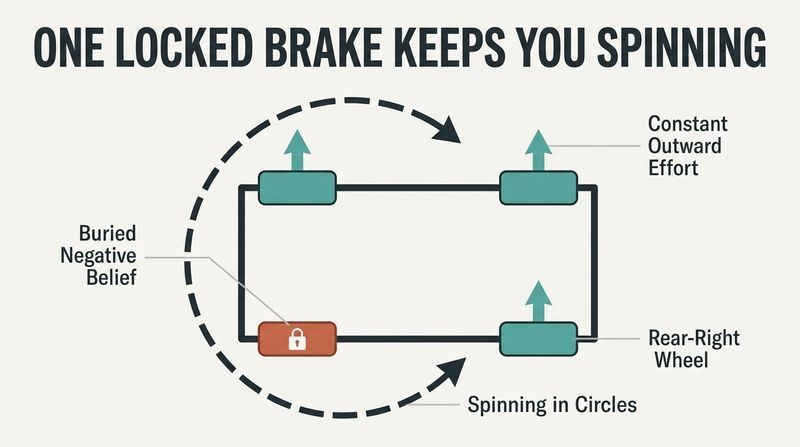
The mechanical metaphor is memorable but risks oversimplifying. Human dysfunction rarely reduces to one tidy valve; trauma, biology, and environment interact in tangled ways that a single insight seldom untangles. Still, the core claim aligns with cognitive behavioral therapy, where identifying a core maladaptive schema (an 'I am unlovable' or 'I am incompetent' belief) often unlocks disproportionate change. What's striking is Tracy framing limitation as subtractive rather than additive: you do not need to acquire greatness so much as remove interference. That echoes performance coaches like Timothy Gallwey, whose inner-game work argues potential minus interference equals performance.
You become what you dwell on, so weed your mental garden
Thought is a cause, conditions are effects. Tracy leans on ancient and modern mental laws: cause and effect (every result traces to specific causes), belief (whatever you accept with emotion becomes your reality), expectations (confident expectation is a self-fulfilling prophecy), and correspondence (your outer world mirrors your inner world). A University of Pennsylvania study of 350,000 people found the happiest, most successful top 10% shared one habit: they thought most about what they wanted and how to get it, spiraling upward.
Mind as garden. Christina, a therapist, describes exploring a client's mental garden to see which beliefs were planted by others long ago. Weeds grow automatically; flowers must be deliberately planted and tended. Left untended, the mind defaults to worry.
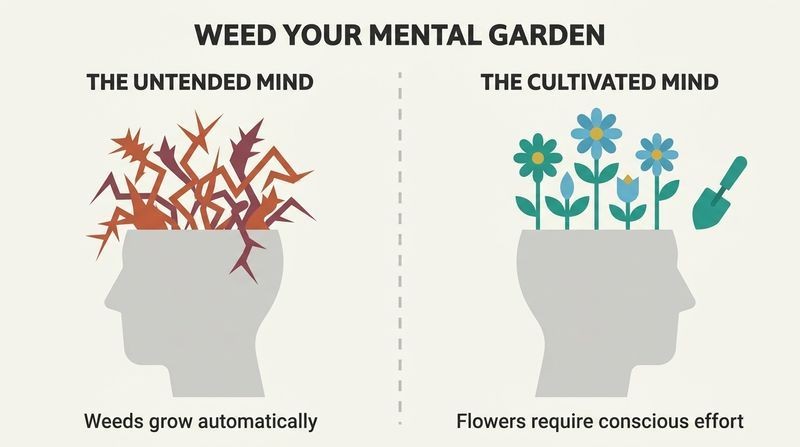
The 350,000-person figure and the mental laws should be taken as motivational framing rather than peer-reviewed causation; 'law of attraction' claims about thoughts vibrating across distances have no scientific support and dilute the credible parts. What survives scrutiny is robust: attentional focus shapes mood and behavior (the reticular activating system genuinely filters for what you prioritize, which is why you suddenly see your chosen car everywhere), and expectancy effects are documented, from placebo response to the Pygmalion effect in classrooms. The gardening metaphor also anticipates modern habit science: default states drift negative, so positive cognition requires active cultivation, not passive hope.
Childhood criticism installs two saboteurs: 'I can't' and 'I have to'
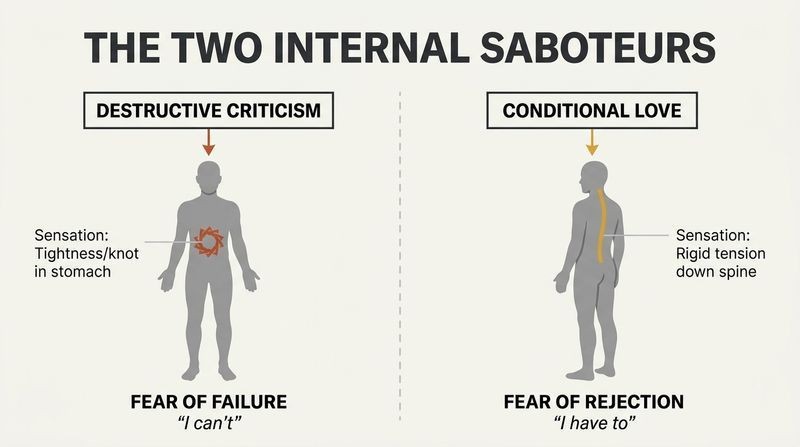
Two negative habit patterns run most adults. Tracy argues children are born with only two fears (loud noises and falling) and are otherwise fearless and spontaneous. Destructive criticism and physical punishment breed the inhibitive pattern, the fear of failure, felt as an automatic 'I can't' in the solar plexus whenever opportunity appears. Conditional love, where approval is granted and withdrawn to control behavior, breeds the compulsive pattern, the fear of rejection, felt as 'I have to' and tension down the spine.
Love deficiency leaves invisible scars. Just as calcium deficiency once left children bowlegged, love deficiency produces adults who are anxious, hypersensitive, and unable to decide without approval. Fear of rejection even outranks fear of death, which is why public speaking terrifies so many.
The attachment framing is broadly supported: Bowlby and Ainsworth's research links inconsistent early caregiving to insecure attachment styles that persist into adult relationships. Tracy's 'conditional love' maps neatly onto what psychologist Carl Rogers called the absence of unconditional positive regard. Where the argument overreaches is determinism; blaming nearly all adult dysfunction on parental criticism understates temperament, genetics, and resilience. Many criticized children thrive, a phenomenon researchers call post-traumatic growth. The useful, empowering move is Tracy's insistence that because these patterns were learned, they are unlearnable, which spares the reader from treating a difficult childhood as a life sentence.
Rebuild self-esteem from scratch by repeating 'I like myself'
Self-concept has three layers. Tracy divides it into your self-ideal (the values and person you aspire to be), your self-image (the inner mirror you consult before acting, since the person you see is the person you will be), and self-esteem (how much you like yourself), which he calls the reactor core of personality. A child arrives as a blank slate; every belief about yourself was taught, so it can be retaught.
The affirmation is the lever. Because you become what you say to yourself, Tracy prescribes repeating 'I like myself' ten, twenty, fifty times daily, and using it to cancel worry the moment it arises. As self-esteem climbs, self-image sharpens and behavior aligns with your ideal.
The mechanism is plausible but the dosage claim invites skepticism. Research by Joanne Wood found that repeating positive self-statements can backfire for people with low self-esteem, widening the gap between the affirmation and felt reality, producing worse mood. Self-affirmation theory (Claude Steele) works better when people affirm genuine values rather than chant flattering slogans. Maxwell Maltz's Psycho-Cybernetics, which Tracy cites, popularized self-image visualization decades before neuroscience partially validated mental rehearsal. The steelman: paired with actual competence and evidence, self-talk shapes the interpretive lens through which you read events, and that lens measurably influences persistence and risk-taking.
Say 'I am responsible' to instantly switch off anger and blame
Blame is the fuel of every negative emotion. Tracy claims all negativity ultimately becomes anger, and anger cannot survive without blaming someone or something. Five mechanisms keep negativity alive: justification (building your case), identification (taking it personally), hypersensitivity, judgmentalism, and rationalization. Cut the blame and the emotion vanishes like a flipped light switch.
Responsibility is the off-switch. You may not be responsible for what happened, but you are fully responsible for your response, the only thing you truly control. Repeating 'I am responsible' floods the mind with a thought incompatible with victimhood. This ties to locus-of-control research: an internal locus (feeling in charge) predicts happiness, health, and success, while an external locus predicts depression and helplessness. Every time you blame, you hand someone else your peace of mind.
Locus of control, developed by Julian Rotter, is one of psychology's more durable constructs, and internal locus does correlate with wellbeing. Yet the 'accept total responsibility' prescription needs guardrails. For survivors of abuse or genuine injustice, being told to declare responsibility can shade into self-blame and gaslighting. The nuance Tracy provides (responsible for response, not for the event) rescues the idea and mirrors Viktor Frankl's insight that the last human freedom is choosing one's attitude. Stoicism said it first: Epictetus divided the world into what is 'up to us' and what is not, urging emotional investment only in the former.
Forgiveness is a selfish act that frees you, not them
You forgive for your own liberation. Tracy insists forgiveness is not condoning bad behavior; it has nothing to do with the other person. Holding a grudge is like squeezing a pencil for years until your hand atrophies. The Sedona Method asks two questions: do you want to be free of this pain, and are you willing to let it go? Many people, feeling they earned their suffering, refuse.
Four people to forgive. In order: your parents (who did their best with what they knew), past romantic partners, everyone else who hurt you, and finally yourself, since the person you are today is not the person who erred. Tools include writing and mailing 'the Letter' accepting responsibility and wishing the other well, then dropping it in the mailbox as an irreversible act.
The health case is stronger than Tracy even states. Studies by Everett Worthington and Charlotte vanOyen Witvliet show that rumination on grievances spikes blood pressure, cortisol, and heart rate, while forgiveness interventions reduce anxiety and depression. The reframe of forgiveness as self-interested rather than saintly is psychologically shrewd, lowering the resistance people feel toward 'letting the offender win.' One caution: the blanket instruction that parents 'did their best' can feel dismissive to those with genuinely abusive histories. Modern trauma therapists distinguish forgiveness from reconciliation; you can release the emotional charge without resuming contact or excusing the harm.
Never rage at a fact; spend your energy only on problems
Facts versus problems. A fact is unchangeable and lives in the past; a problem is solvable and lives in the future. Getting angry at a fact is as irrational as kicking furniture. Tracy retells a man still furious that rain canceled a picnic five years ago, illustrating how absurd clinging to the unchangeable becomes.
Tools to defuse worry. The Disaster Report has four steps: define the worry precisely, determine the worst possible outcome, resolve to accept that worst case, then get busy improving on it. Naming the worst usually shrinks it. Zero-based thinking asks: knowing what I now know, would I get into this again? If not, ask how fast can I get out. Stress comes from inaction and denial; deciding to act dissolves it.
The fact/problem split is a clean cognitive tool that echoes the Serenity Prayer and Stoic dichotomy of control. The Disaster Report resembles what psychologists call decatastrophizing and what Tim Ferriss branded 'fear-setting,' both rooted in exposure logic: naming and accepting the worst outcome removes its ambiguous dread, which is often worse than the concrete reality. Zero-based thinking is a practical antidote to the sunk-cost fallacy, our documented tendency to throw good resources after bad simply because we already invested. The subtle risk is using 'it's just a fact' to prematurely quit solvable situations; wisdom lies in correctly sorting which is which.
Reframe every setback by hunting for its hidden lesson
Explanatory style decides optimism. Drawing on Martin Seligman's decades of research, Tracy notes it is not events but your interpretation of them that determines mood. Optimists and pessimists face identical facts and diverge entirely in how they explain them. Swap your vocabulary: a 'problem' becomes a 'situation' (neutral), then a 'challenge' (something you rise to), and best of all an 'opportunity.'
Pain is the tuition for growth. Tracy argues humans learn mainly through pain, so every difficulty arrives carrying a lesson; keep asking 'what else is the lesson here' to drill past the superficial answer. The average self-made millionaire went broke or nearly broke 2.3 times before succeeding, because the failures taught the wisdom that made wealth possible. Look for the seed of equal benefit inside every difficulty.
Seligman's learned-optimism framework is among the best-validated ideas Tracy invokes; explanatory style (whether one reads setbacks as permanent, pervasive, and personal) predicts depression, and it is trainable through cognitive reframing. The 'benefit-finding' instruction is supported by research on post-traumatic growth, though scholars warn that forced positivity can invalidate genuine grief; sometimes a loss is simply a loss. The vocabulary swap is more than semantics: linguistic framing measurably shifts appraisal and physiological stress response. The 2.3 figure should be read as illustrative rather than precise, but the underlying survivorship logic (failure as data) is echoed across entrepreneurship research from Sarasvathy's effectuation studies.
Expect upheaval every seven years and prepare before you need to
Change is the only constant. Tracy tells of Einstein giving the same physics exam two years running; when questioned, he answered that the answers had changed. Three forces accelerate change: information explosion, technology, and competition. Your industry, income, and even your body (every cell renews within seven years) keep transforming, so expect transitions roughly each decade rather than being blindsided.
Master change with foresight and response. Practice extrapolatory thinking and crisis anticipation: list the worst things that could happen and plan for them now. When loss hits, you move through six stages (denial, anger, bargaining, depression, acceptance, and Tracy's added resurgence); the only question is speed. Arnold Toynbee's challenge-and-response theory of history shows civilizations grow by meeting escalating challenges, and so do you.
The Toynbee analogy is elegant: growth is not comfort but successful adaptation to progressively harder tests, which mirrors biological antifragility, Nassim Taleb's term for systems that strengthen under stress. Tracy's counsel to pre-mortem your crises is validated by Gary Klein's research showing that imagining a project has already failed improves the ability to identify risks by around 30%. The seven-year and per-decade rhythms borrow from Gail Sheehy's Passages and Levinson's seasons-of-life research, useful as heuristics though not literal biological clocks. The 'every cell renews in seven years' line is a popular myth; renewal rates vary wildly and some neurons last a lifetime.
Raise anyone's self-esteem with the five A's of feeling important
People forget words but remember feelings. Since almost everything humans do is to gain or protect self-esteem, the master key to relationships is making others feel important. Tracy offers five behaviors, each starting with A:
1. Acceptance, expressed simply by smiling.
2. Appreciation, expressed by saying thank you constantly.
3. Admiration, complimenting specific traits and possessions.
4. Approval, praising accomplishments immediately and, when possible, publicly.
5. Attention, the most powerful, meaning genuine listening.
Listening builds trust. The four listening keys are: listen without interrupting, pause before replying, question for clarification, and paraphrase back what was said. Being deeply heard triggers measurable physiological changes and endorphin release. Praise specifically and instantly; correct only in private. Everything that raises another's self-esteem raises yours too.
The five A's compress durable social psychology into a memorable checklist. Praising specifics rather than global traits aligns with Carol Dweck's finding that process praise ('you worked hard on that') builds resilience while person praise ('you're so smart') breeds fragility. The 'praise publicly, criticize privately' rule matches organizational research on psychological safety. Tracy's listening framework echoes Carl Rogers' reflective listening and Stephen Covey's 'seek first to understand.' One tension worth flagging: relentless positivity can curdle into flattery, which people detect and discount; the anchor Tracy provides, sincerity, is doing heavy lifting and deserves more emphasis than the mechanics.
Trade vague wishing for written goals with deadlines and daily action
Clarity across seven arenas unleashes power. Tracy's capstone asks for absolute clarity on values (what you stand for), vision (your ideal five-year future), mission (the difference you make), purpose (your reason for being), goals, priorities, and actions. He cites research that people with clear written goals earn on average ten times more than those without.
The seven-step goal engine. Decide exactly what you want and write it down; set a deadline; list obstacles and tackle the biggest; identify knowledge and skills to acquire; identify people whose help you need; make a sequenced, prioritized plan; and act immediately. Then do something daily to trigger the momentum principle, where starting costs ten units of energy but continuing costs only one. Your weakest important skill sets the ceiling on your success, so master it deliberately.
The specific '10x income from written goals' claim is folklore; the famous Yale/Harvard goals study it resembles was never actually conducted, a caution against citing it as fact. That said, the underlying principle is well-supported: Locke and Latham's goal-setting theory, built on hundreds of studies, shows specific and challenging goals reliably outperform vague 'do your best' intentions. Implementation intentions (Peter Gollwitzer's 'if-then' plans) explain why Tracy's write-it-down, sequence-it steps work: they pre-load decisions. The 'weakest skill sets your ceiling' idea is a compelling reframe of Liebig's law of the minimum, borrowed from biology, where growth is capped by the scarcest resource, not the most abundant.
Analysis
Believe It to Achieve It is a synthesis rather than an innovation. Brian Tracy, a career sales trainer, and his daughter Christina Stein, a psychotherapist, braid together mid-twentieth-century self-image psychology (Maxwell Maltz), humanistic theory (Maslow, Rogers, Glasser), positive psychology (Seligman), and perennial self-help staples (Napoleon Hill, Earl Nightingale). The book's structural logic is a therapeutic arc: diagnose why people get stuck, trace the wound to childhood criticism and conditional love, then prescribe forgiveness, responsibility, reframing, adaptation, better relationships, and finally goal-directed action. Stein's clinical vignettes give the father's brisk motivational assertions a softer, evidence-adjacent texture.
The book's great strength is its distillation of hard-won practices into portable verbal tools: 'I like myself,' 'I am responsible,' the pencil test, the Disaster Report, the five A's. These are memorable and, in several cases, congruent with genuine research (locus of control, explanatory style, goal-setting theory, the health benefits of forgiveness). For a reader seeking momentum, the compression is a feature.
The weaknesses are equally clear. Tracy states as scientific law what is often folk wisdom or motivational lore: the law of attraction, thoughts vibrating across continents, the ten-times-income goals statistic, the seven-year cell renewal myth. The developmental determinism (nearly all adult dysfunction stemming from parental criticism) understates temperament, genetics, and resilience, and the blanket 'accept total responsibility' can shade toward self-blame for victims of real harm.
Read critically, the book is best understood not as psychology but as applied Stoicism dressed in American optimism. Its recurring thesis, that you cannot control events but you fully control interpretation and response, is ancient, sound, and genuinely liberating. The reader who takes the durable tools, discounts the pseudo-scientific packaging, and pairs affirmation with actual competence will extract most of the value. The book delivers energy and clarity; it should not be mistaken for rigor.
Review Summary
Believe It to Achieve It receives mostly positive reviews, with readers praising its motivational content and practical exercises. Many find it helpful for personal growth, goal-setting, and changing negative thought patterns. The book is commended for its simplicity and actionable advice. However, some critics find it repetitive, overly simplistic, or disagree with certain concepts. Overall, readers appreciate the book's emphasis on self-belief, positive thinking, and taking responsibility for one's life and success.
People Also Read








FAQ
What's "Believe It to Achieve It" about?
- Self-improvement focus: "Believe It to Achieve It" by Brian Tracy and Christina Stein is a self-help book aimed at helping readers overcome doubts, let go of the past, and unlock their full potential.
- Mindset transformation: The book emphasizes adopting an achiever's mindset, which involves changing one's thinking patterns to foster success and happiness.
- Practical strategies: It provides practical strategies and exercises to help readers identify and remove mental blocks that hinder personal and professional growth.
- Inspirational stories: The authors use stories and examples to illustrate how successful individuals have applied these principles to achieve their goals.
Why should I read "Believe It to Achieve It"?
- Personal growth: The book offers valuable insights into personal development, making it a useful resource for anyone looking to improve their life.
- Overcoming limitations: It provides tools and techniques to help readers identify and overcome self-limiting beliefs and negative emotions.
- Achieving potential: By following the book's guidance, readers can learn to unlock their full potential and achieve greater success and happiness.
- Practical exercises: The book includes exercises and actionable steps that readers can implement immediately to start seeing positive changes.
What are the key takeaways of "Believe It to Achieve It"?
- Mindset matters: Adopting a positive, achiever's mindset is crucial for overcoming doubts and achieving success.
- Forgiveness is freeing: Letting go of past grievances and forgiving others is essential for personal freedom and growth.
- Self-awareness is key: Understanding one's values, beliefs, and goals is necessary for creating a fulfilling life.
- Continuous improvement: The book emphasizes the importance of lifelong learning and personal development to achieve one's goals.
What are the best quotes from "Believe It to Achieve It" and what do they mean?
- "You become what you think about most of the time." This quote highlights the power of thoughts in shaping one's reality and emphasizes the importance of maintaining a positive mindset.
- "The only thing you can control in the whole world is the way you think." It underscores the idea that while external circumstances may be uncontrollable, one's thoughts and reactions are within personal control.
- "Forgiveness has nothing to do with the other person. Forgiveness has only to do with you." This quote emphasizes that forgiveness is a personal act that frees the individual from negative emotions, rather than condoning the actions of others.
- "Your greatest obstacles to happiness and success are usually contained within your self-limiting beliefs." It points out that internal beliefs, rather than external factors, are often the biggest barriers to achieving one's potential.
How does Brian Tracy suggest overcoming doubts in "Believe It to Achieve It"?
- Identify self-limiting beliefs: The first step is to recognize and challenge the negative beliefs that hold you back.
- Adopt positive affirmations: Use positive self-talk and affirmations to replace negative thoughts with empowering ones.
- Visualize success: Regularly visualize achieving your goals to reinforce a positive mindset and increase motivation.
- Take consistent action: Implement small, consistent actions towards your goals to build confidence and reduce doubts.
What role does forgiveness play in "Believe It to Achieve It"?
- Essential for mental health: Forgiveness is crucial for mental well-being and freeing oneself from the burden of past grievances.
- Personal liberation: By forgiving others, individuals release themselves from negative emotions and can move forward with their lives.
- Not condoning behavior: Forgiveness is about personal peace and does not mean approving of the other person's actions.
- Steps to forgive: The book provides strategies for forgiving others, such as understanding their perspective and letting go of resentment.
How can one change their thinking according to "Believe It to Achieve It"?
- Practice positive substitution: Replace negative thoughts with positive ones using the law of substitution.
- Focus on solutions: Shift your mindset from problems to solutions, which fosters a proactive and optimistic outlook.
- Reframe experiences: Reinterpret past negative experiences as learning opportunities to change your emotional response.
- Set clear goals: Having clear, written goals helps direct your thoughts and actions towards positive outcomes.
What is the "law of cause and effect" as explained in "Believe It to Achieve It"?
- Universal principle: The law of cause and effect states that every effect or result in life has a specific cause.
- Control over outcomes: By understanding and applying this law, individuals can create desired outcomes by focusing on the right causes.
- Modeling success: Emulate the actions of successful people to achieve similar results, as their actions are the causes of their success.
- Thoughts as causes: Recognize that thoughts are causes, and conditions are effects, meaning that positive thinking leads to positive outcomes.
How does "Believe It to Achieve It" address the fear of failure?
- Identify the root: Understand that fear of failure often stems from past experiences and destructive criticism.
- Reframe failure: View failure as a learning opportunity rather than a setback, which reduces its power over you.
- Set realistic goals: Break down large goals into smaller, achievable steps to build confidence and reduce fear.
- Focus on progress: Concentrate on the progress you make rather than the possibility of failure, which encourages continued effort.
What exercises does "Believe It to Achieve It" recommend for personal growth?
- Values clarification: Write down your top values and how they influence your decisions and actions.
- Goal setting: Use the seven-step goal-setting process to define and achieve your objectives.
- Visualization: Regularly visualize your ideal future to reinforce positive thinking and motivation.
- Forgiveness letter: Write a letter of forgiveness to release negative emotions and move forward.
How does "Believe It to Achieve It" suggest dealing with negative emotions?
- Acknowledge and accept: Recognize negative emotions without judgment and accept them as part of the human experience.
- Practice detachment: Learn to detach from negative emotions by observing them without reacting.
- Use positive affirmations: Counter negative emotions with positive affirmations to shift your mindset.
- Focus on gratitude: Cultivate gratitude by regularly reflecting on the positive aspects of your life, which reduces negativity.
What is the significance of self-esteem in "Believe It to Achieve It"?
- Foundation of success: High self-esteem is crucial for achieving success and happiness in all areas of life.
- Influences relationships: People with high self-esteem have better relationships because they value themselves and others.
- Linked to self-efficacy: Self-esteem is closely tied to self-efficacy, or the belief in one's ability to achieve goals.
- Build through achievements: Setting and achieving goals boosts self-esteem by reinforcing a sense of competence and worth.
About the Author
Other books by Brian Tracy







Download PDF
Download EPUB
.epub digital book format is ideal for reading ebooks on phones, tablets, and e-readers.








































