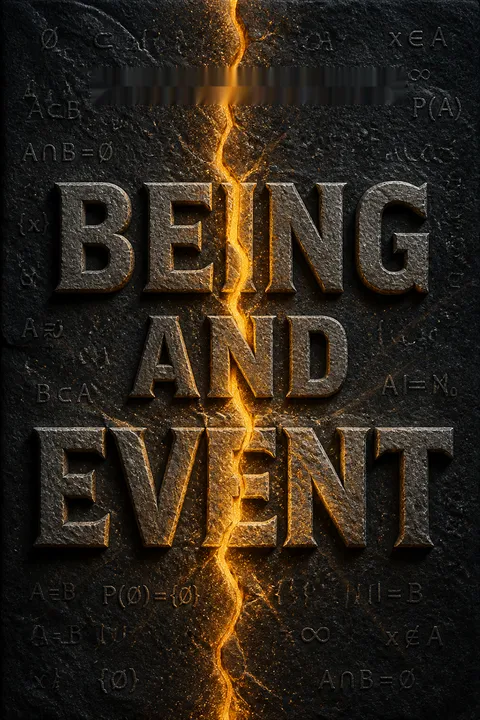

Key Takeaways
1. Being is Pure Multiplicity: Ontology as Mathematics
In mathematics, being, thought, and consistency are one and the same thing.
Mathematics as Ontology. Badiou posits that mathematics, specifically set theory, is ontology, the science of being qua being. This means that the fundamental structures of reality are best understood through mathematical concepts, particularly the concept of the pure multiple. This challenges traditional philosophical approaches to ontology, which often rely on intuition, language, or experience.
Set Theory as the Foundation. Cantor's set theory, with its focus on the infinite and the structure of multiplicities, provides the framework for Badiou's ontology. The axioms of set theory, such as the axiom of separation and the axiom of choice, become the tools for understanding the nature of being.
Rejection of Foundationalism. By identifying mathematics as ontology, Badiou rejects the need for a separate philosophical foundation for mathematics. The apodeictic nature of mathematics is directly warranted by being itself. This move circumvents traditional philosophical debates about the nature of mathematical objects and their relationship to reality.
2. The One is Not: Subtractive Ontology
The one, being an operation, is never a presentation.
Rejection of the One. Badiou's ontology is characterized by a rejection of the One as a fundamental principle. He argues that the One is not a pre-existing entity but rather an operation, a result of counting or structuring a multiplicity. This challenges traditional philosophical systems that posit the One as the ultimate source or ground of being.
The Count-as-One. Instead of a being of the One, Badiou emphasizes the "count-as-one" as the structuring force that organizes multiplicities. The count-as-one is an operation that imposes a structure on a situation, allowing us to identify and enumerate its elements.
Inconsistent Multiplicity. Badiou posits that being, in its pure state, is an inconsistent multiplicity, a collection of elements without any inherent unity or structure. It is only through the operation of the count-as-one that this multiplicity is organized into a consistent and comprehensible situation.
3. The Event: Rupture and Supplementation
A truth is solely constituted by rupturing with the order which supports it, never as an effect of that order.
The Event as Rupture. Badiou introduces the concept of the event as a radical rupture in the order of being. An event is an occurrence that cannot be predicted or explained by the existing structure of a situation. It is a point of absolute contingency that disrupts the established order.
Supplementation. The event is not simply a destructive force but also a source of new possibilities. It supplements the existing situation, opening up new avenues for thought and action. This supplementation is not a natural or inevitable process but requires an active intervention.
Examples of Events. Badiou identifies events in various domains, including politics (e.g., the French Revolution), art (e.g., the invention of serialism in music), science (e.g., Cantor's set theory), and love (e.g., the encounter that initiates a love affair).
4. Intervention: Naming the Unnameable
A subject is nothing other than an active fidelity to the event of truth.
The Role of Intervention. The event, in itself, is a chaotic and unformed occurrence. It requires an intervention to name it, to give it a meaning and significance. This intervention is not a neutral act of observation but a deliberate and transformative act of naming.
Illegal Nomination. The intervention is often an "illegal" act, a transgression of the established norms and conventions of the situation. It involves choosing a name for the event that is not authorized by the existing order.
The Logic of the Two. The intervention creates a division, a "logic of the two," between those who recognize the event and those who remain bound to the old order. This division is the foundation for the emergence of a subject.
5. Fidelity: The Subject's Response to the Event
A subject is nothing other than an active fidelity to the event of truth.
Active Fidelity. The subject is not a passive observer of the event but an active participant in its unfolding. Fidelity involves a commitment to exploring the consequences of the event, to working out its implications for the transformation of the situation.
Generic Procedures. Fidelity is not a blind adherence to a fixed set of beliefs but a dynamic and creative process of inquiry. It involves developing "generic procedures" that are applicable to all aspects of the situation, regardless of their specific content.
Militant of Truth. The subject is a "militant of truth," someone who is willing to challenge the established order and to fight for the recognition of the event's transformative power. This militancy is not necessarily violent or aggressive but involves a persistent and unwavering commitment to the truth.
6. The State: Managing the Unmanageable
The structure of situations does not, in itself, deliver any truths.
The State as Metastructure. Badiou introduces the concept of the State as a metastructure that attempts to manage and control the multiplicities of being. The State is not simply a political institution but a general principle of organization that operates in all domains of existence.
The State's Limitations. The State, by its nature, is incapable of grasping the event or the truth. It is limited to the realm of knowledge, to the established order of things. The event, as a rupture in that order, necessarily escapes the State's grasp.
Normalcy, Singularity, and Excrescence. Badiou identifies three types of being in relation to the State: normalcy (what is both presented and represented), singularity (what is presented but not represented), and excrescence (what is represented but not presented). These categories provide a framework for understanding the dynamics of power and resistance in any situation.
7. Truth: Generic Procedures and Indiscernibility
The being of a truth, proving itself an exception to any pre-constituted predicate of the situation in which that truth is deployed, is to be called ‘generic’.
Truth as Generic. Badiou argues that truth is not a property of statements or beliefs but a generic procedure, a process that unfolds independently of any pre-existing categories or predicates. A truth is "generic" in the sense that it is indifferent to the particularities of the situation in which it emerges.
Indiscernibility. Truth is also characterized by indiscernibility. A truth is a multiplicity that cannot be circumscribed by any particular predicate. It concerns everyone inasmuch as it is a multiplicity that no particular predicate can circumscribe.
The Thought of the Generic. The thought of the generic supposes the complete traversal of the categories of being and of the event. It crystallizes concepts to such a point that it is almost impossible to give an image of it.
8. Forcing: Bridging the Gap Between Being and Truth
Subjective production: decision of an undecidable, disqualification, principle of inexistents.
Cohen's Forcing. Badiou draws on Paul Cohen's mathematical technique of forcing to develop a theory of the subject. Forcing is a method for constructing new mathematical universes by adding "generic" elements to existing ones.
From Indiscernible to Undecidable. Badiou uses forcing to show how the indiscernible can give rise to the undecidable. By adding a generic element to a situation, we create new possibilities for truth that were previously inaccessible.
The Technique of Forcing. The technique of forcing involves starting with a "quasi-complete" situation and adding a generic element to it. This generic element is indiscernible in the original situation, but it has specific properties that allow us to prove new theorems.
9. The Limits of Knowledge: Constructivism and the Void
To know how to make thought pass through demonstrations as through plainsong, and thus to steep an unprecedented thinking in disparate springs.
Constructivist Thought. Badiou critiques constructivist thought, which seeks to build up knowledge from a set of basic principles. He argues that constructivism is limited by its reliance on pre-existing categories and its inability to grasp the event.
The Folding of Being. Badiou introduces the concept of the "folding of being" to describe the way in which being is both revealed and concealed by knowledge. Knowledge, in its attempt to grasp being, inevitably distorts and simplifies it.
The Sovereignty of Language. Badiou critiques the idea that language is the ultimate foundation of knowledge. He argues that language is always limited and that it cannot fully capture the richness and complexity of being.
10. Beyond Lacan: A New Theory of the Subject
Chance, from which any truth is woven, is the matter of the subject.
Theory of the Subject. Badiou develops a new theory of the subject that goes beyond both Cartesian and Lacanian conceptions. The subject is not a substance or a consciousness but a local active dimension of a generic procedure.
Subjectivization. Subjectivization is the process by which an individual becomes a subject, by actively engaging in a truth procedure. This process involves intervention, fidelity, and the production of new knowledge.
Subject and Truth. The subject is not the origin or foundation of truth but rather a local active dimension of a generic procedure. To be a Subject (and not a simple individual animal) is to be a local active dimension of such a procedure.
Review Summary
Being and Event is a challenging but influential philosophical work by Alain Badiou. It combines set theory mathematics with ontology to explore concepts of being, truth, and subjectivity. Readers find it dense and complex, requiring significant effort to comprehend. Some praise its innovative approach and insights, while others criticize its use of mathematics in philosophy. The book is seen as a landmark in continental philosophy, though opinions on its ultimate value and coherence are divided. Many consider it a necessary read for those interested in contemporary philosophy.
People Also Read




FAQ
1. What is Being and Event by Alain Badiou about?
- Ontology as mathematics: Badiou argues that ontology—the study of being qua being—is fundamentally mathematical, specifically grounded in set theory, where being is understood as pure multiplicity rather than unity.
- Event and truth: The book introduces the concept of the event as a radical rupture in a situation, which gives rise to new, universal truths that cannot be derived from the existing structure.
- Subject and fidelity: Badiou defines the subject as one who remains faithful to the consequences of an event, actively participating in the unfolding of truth in domains like politics, art, science, and love.
- Philosophical innovation: The work bridges analytic and continental philosophy, combining rigorous mathematical formalism with literary and poetic resources to rethink fundamental philosophical questions.
2. Why should I read Being and Event by Alain Badiou?
- Radical rethinking of ontology: The book offers a groundbreaking perspective by grounding ontology in set theory, challenging traditional metaphysics and providing a new way to understand being and existence.
- Novel theory of truth and subject: Badiou develops a unique theory of truth as a process linked to events and fidelity, and redefines the subject as an active participant in the creation of truth.
- Interdisciplinary approach: The text bridges philosophy and mathematics, showing how mathematical concepts like forcing and generic sets illuminate philosophical problems.
- Engagement with contemporary issues: Badiou critiques cultural relativism, market democracy, and the dissolution of political thinking, advocating for a renewed commitment to universal truths and emancipation.
3. What are the key concepts in Being and Event by Alain Badiou?
- Pure multiple and void: Being is conceived as pure multiplicity, with the void as the foundational absence or unpresentable remainder that underlies all situations.
- Count-as-one and structure: The "one" is not a being but an operation that structures multiplicities, while ontology studies multiples of multiples.
- Event and truth: An event is a rupture that cannot be predicted by the situation’s structure, initiating a generic and universal truth procedure.
- Subject and fidelity: The subject is the agent who remains faithful to the event, unfolding its consequences through a generic procedure.
- Forcing and generic sets: Borrowed from set theory, these concepts formalize the indiscernible and undecidable aspects of truth and subjectivity.
4. How does Alain Badiou define "being" in Being and Event?
- Being as pure multiplicity: Being is not a unified one but an inconsistent multiplicity, irreducible to any totality or unity.
- Void as being’s name: The void is the "proper name of being," representing the unpresentable and subtractive suture that underlies all presentation.
- Mathematical ontology: All entities are sets (multiples of multiples), and the one is an operation (count-as-one), not a substantive entity.
- Subtractive ontology: Being is defined as that which cannot be supposed on the basis of any presence or experience, opposing ontologies of presence.
5. What is the role of the "event" in Being and Event by Alain Badiou?
- Event as rupture: The event is a radical break with the order of a situation, producing a truth that cannot be derived from the situation’s structure.
- Truth procedure: An event initiates a generic truth procedure that is universal and indifferent to differences within situations.
- Subject formation: The subject is constituted by fidelity to the event, actively working to unfold the truth’s consequences.
- Beyond ontology: Events belong to "that-which-is-not-being-qua-being," marking the emergence of novelty and change beyond ontological structures.
6. How does Alain Badiou use set theory in Being and Event?
- Mathematics as ontology: Set theory is the formal language through which being qua being is expressed as pure multiplicity.
- Axiomatic system: Badiou relies on the Zermelo–Fraenkel axioms, including the axiom of the void (empty set), powerset, union, separation, and replacement, to structure ontology.
- Belonging and inclusion: The distinction between belonging (∈) and inclusion (⊂) is crucial, with the power-set axiom guaranteeing the existence of the set of subsets, leading to the theorem of the point of excess.
- Generic and forcing: Advanced set-theoretical concepts like generic sets and forcing formalize the indiscernible and undecidable, underpinning Badiou’s theory of truth and subject.
7. What is the significance of the "void" in Being and Event by Alain Badiou?
- Void as unpresentable being: The void is the name of being’s inconsistency, the non-one, and the unpresentable remainder that is subtracted from any count or presentation.
- Proper name of being: The void is uniquely named by the empty set (∅) in set theory, which is the foundational existence from which all multiples are composed.
- Universal inclusion: The void is a subset of every set, indicating its omnipresence as the latent absence within all presentations.
- Ontological anxiety: The void represents the fundamental risk or errancy in any situation, necessitating structures and metastructures (states) to ward off its catastrophic fixation.
8. What is the "theorem of the point of excess" in Being and Event by Alain Badiou?
- Excess of subsets: For any set a, the set of all its subsets p(a) is strictly larger than a itself; there exists at least one subset of a that is not an element of a.
- No set equals its powerset: This theorem formalizes that no multiple can form a one out of all its parts, indicating an irreducible gap between belonging and inclusion.
- Ontological implication: The gap between a set and its powerset is the site of the impasse of being, where the void’s errancy can manifest.
- Necessity of metastructure: This excess necessitates a metastructure or state that counts the count, ensuring the integrity of the one against the void.
9. How does Alain Badiou conceptualize the "state" or "metastructure" of a situation in Being and Event?
- State as count of the count: The state is a metastructure that counts as one the parts (subsets) of a situation, securing the consistency of the initial structure.
- Protection against the void: The state wards off the errancy of the void by ensuring that all parts are counted and the one-effect is reinforced.
- Typology of terms: Within a situation, terms can be normal (presented and represented), singular (presented but not represented), or excrescent (represented but not presented), reflecting their relation to structure and state.
- Ontological exception: In mathematical ontology, the state is inseparable from the situation itself, meaning ontology is "stateless," and the void’s errancy cannot be fully excluded.
10. What is the concept of the indiscernible and generic truth in Being and Event by Alain Badiou?
- Indiscernible as unnameable: An indiscernible part of a situation cannot be specified by any formula in the language of that situation, escaping explicit nomination and classification.
- Generic truth: Truth is a generic multiple, infinite and indiscernible, that cannot be captured by encyclopedic knowledge or existing categories.
- Existence via generic extension: The indiscernible exists in the generic extension of a situation, created through the process of naming and forcing, and remains indiscernible even in the extension.
- Truth as a hole in knowledge: The generic truth constitutes a "hole" in knowledge, representing what is universal and subtracted from the situation’s established order.
11. How does Alain Badiou define the subject and its relation to truth in Being and Event?
- Subject as local configuration: The subject is any local configuration of a generic procedure from which a truth is supported, not a substance or void point.
- Subjectivization and fidelity: Subjectivization is the emergence of an operator of faithful connection following the event’s nomination, enabling the unfolding of truth.
- Subject and chance: The subject’s trajectory is aleatory, depending on chance encounters with terms of the situation, and supports belief in the truth to come.
- Subject as forcing agent: The subject is the local evaluator who forces veracity, deciding undecidable statements by virtue of the indiscernible truth.
12. What is "forcing" and why is it central to Being and Event by Alain Badiou?
- Forcing as veracity relation: Forcing is a relation between conditions and formulas in the fundamental situation that controls the veracity of statements in the generic extension.
- Connects indiscernible and undecidable: Forcing links the indiscernible (truth) to the undecidable (statements not decided by axioms), allowing the subject to decide what cannot be decided within the situation.
- Subject as forcing agent: The subject uses forcing to evaluate and decide undecidable statements, thus actively participating in the creation of truth.
- Fundamental law of the subject: Forcing is the central mechanism by which the subject operates in the generic extension, making it the fundamental law of subjectivity in Badiou’s ontology.

Download PDF
Download EPUB
.epub digital book format is ideal for reading ebooks on phones, tablets, and e-readers.








































