

Key Takeaways
Your mind is enemy territory, and your thoughts decide the war
The battlefield metaphor is literal. Meyer's central claim is that spiritual struggle happens in the mind before it ever shows up in behavior. Drawing on the idea that a person becomes what he dwells on in his heart, she argues negative thoughts produce negative lives and God-aligned thoughts produce freedom, peace, and joy.
The enemy plays a patient game. Rather than one big lie, she describes a slow drip of nagging doubts, suspicions, fears, and reasonings, deliberately tailored to your specific insecurities. Because actions flow from thoughts, whoever controls the thinking controls the life. The remedy is not trying harder to behave, but changing the mental input first. You cannot behave better until you think better, and you cannot have a positive life while running a negative mind.
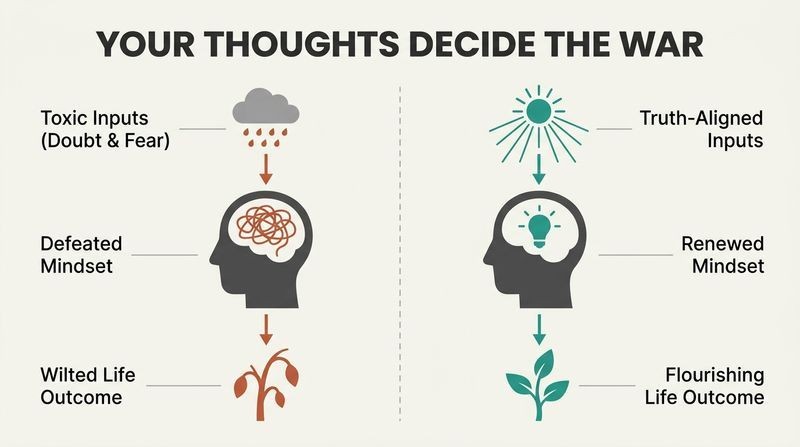
What's striking is how closely this 1995 devotional anticipates cognitive behavioral therapy, which holds that distorted automatic thoughts drive emotional distress and that changing thought patterns changes feelings and behavior. Meyer frames as spiritual warfare what Aaron Beck framed as cognitive restructuring. The overlap is not coincidental: both insist behavior is downstream of cognition. A skeptic might note that externalizing every intrusive thought as demonic can discourage people from seeking clinical help for conditions like OCD or depression. The strength, though, is agency. Telling readers they can choose their thoughts is empowering precisely because it locates the lever inside them.
Name the mental prison holding you hostage, then dismantle it
Strongholds are entrenched wrong thinking. Meyer defines a stronghold as an area where you are held captive by a habitual way of thinking, often built brick by brick since childhood. She illustrates with Mary and John, an unhappy married couple. Mary is controlling and combative because a domineering father taught her all men abuse power. John is passive and silent because a critical mother convinced him his voice never mattered.
Both are Christians, yet miserable. Salvation alone did not fix them because their minds were never renewed. The demolition tools she names are the Word (studied, spoken, sung, prayed), praise, and prayer. She stresses continuing, not sampling: the measure of study you give the truth is the measure of power that returns to you. Freedom comes by replacing lies with truth until it becomes inner conviction.
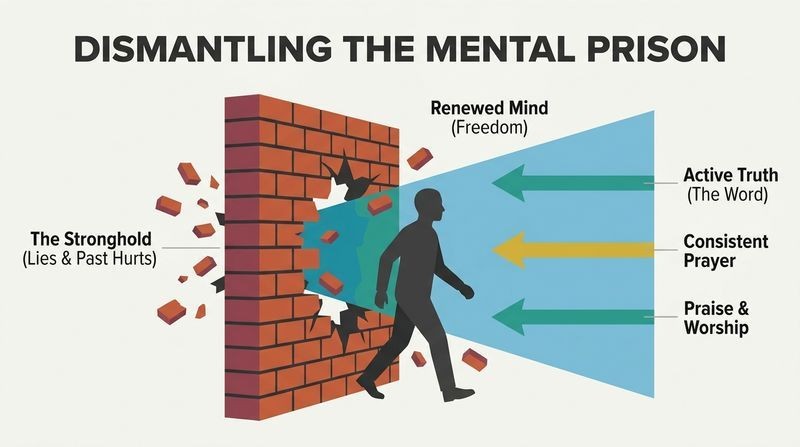
The Mary and John parable functions as a case study in how early attachment wounds calcify into adult scripts, echoing what psychologists call schemas, deep templates formed in childhood that filter all later experience. Meyer's insight that identical circumstances produce opposite pathologies (aggression versus withdrawal) tracks the fight-or-flight distinction in trauma research. Her prescription of repetition aligns with neuroplasticity: repeated rehearsal literally rewires neural pathways. One caveat worth flagging is that some strongholds involve genuine trauma requiring more than scripture reading. Meyer's own framing acknowledges the past explains suffering but should not excuse staying stuck, a distinction that keeps the model from becoming victim-blaming.
Catch yourself thinking, or the devil scripts your life
Meyer's turning-point instruction: think about what you're thinking about. For most of her life she simply thought whatever fell into her head, never realizing that thoughts could be inspected, chosen, or rejected. Once she began auditing her own mental stream, she discovered it was full of lies and nonsense that were quietly running her life.
Meditation is the counter-practice. She reclaims the word from its occult associations, defining it biblically as pondering, muttering, and dwelling on scripture day and night. She points to promises tying meditation to prosperity and good success. Practically, she recommends taking regular inventory: pause and ask what you have been dwelling on. Because misery usually comes from what is happening inside, not around us, this self-audit often locates the real source of trouble fast.
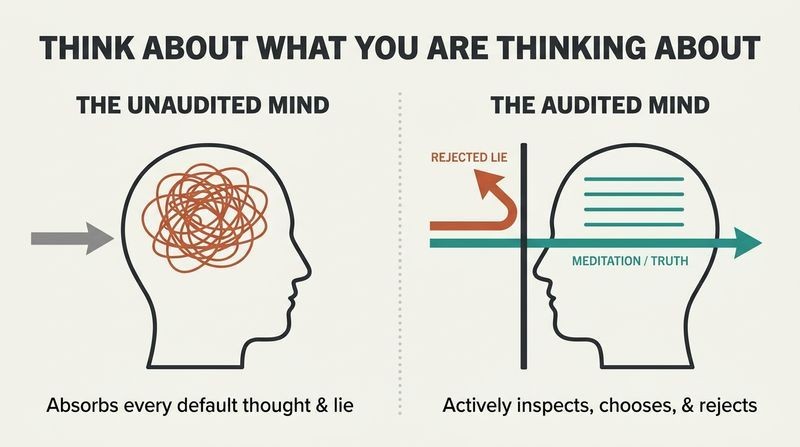
This is essentially metacognition, the capacity to observe one's own thinking, which developmental psychologists consider a hallmark of mature cognition and which mindfulness traditions have cultivated for millennia. Meyer arrives at the same practice from a Christian frame: watch the thoughts, do not identify with all of them. Her reclaiming of meditation is shrewd, noting that if a practice generates power for harm it can generate power for good. Modern attention research supports her: the mere act of labeling an intrusive thought reduces its emotional grip, a phenomenon neuroscientist Matthew Lieberman calls affect labeling. The self-inventory habit is the most portable, immediately usable tool in the book.
Expect good, because a negative mind cannot build a positive life
Positivity is faith in disguise. Meyer, a self-described former extreme pessimist whose motto was expect nothing so you are never disappointed, argues positive thoughts carry faith and hope while negative ones carry fear and doubt. Refusing to hope is not protection; it is a self-fulfilling prison.
She distinguishes realism from negativism. Being positive does not mean denying facts. When sick, you need not pretend health, but you can affirm that God is healing you. She names evil forebodings, that vague dread that something bad is about to happen, as a lifelong thief of joy she had to actively resist. A ready mind holds hope loosely and outcomes to God: I will believe for the best, and even if it disappoints, I will survive because my anchor is a Person, not a result.
Meyer predates but parallels positive psychology's finding that dispositional optimism correlates with better health outcomes, resilience, and even longevity. Her nuance separating optimism from denial is important and often missed in prosperity-gospel circles: she explicitly warns against claiming what is not true. Barbara Ehrenreich's critique of forced positivity would push back, arguing relentless cheerfulness can suppress legitimate grief and blind people to real threats. Meyer partly answers this with the ready mind concept, which resembles what Stoics called premeditatio malorum, rehearsing possible loss while remaining unshaken. The healthiest reading is hope anchored in meaning rather than in guaranteed outcomes.
Stop trying to figure everything out and the confusion lifts
Reasoning is a trap dressed as diligence. Meyer confesses she was addicted to reasoning, needing every loose end tied before she felt safe. She recounts sensing God prompt her to give a brand-new red dress to a faithful volunteer, then reasoning her way out of it because the dress was new and expensive, only to face the same prompt weeks later. Her mind rejected what her spirit affirmed.
The cure is obedience over logic. God told her that people stay confused because they keep trying to figure things out. Reasoning, she argues, opens the door to deception: you can logically construct something that fits neatly in your mind and is still flat wrong. When the spirit and mind disagree, she counsels following the spirit. Unanswered questions, left unresolved, become tools that stretch faith and finally deliver the mind into rest.
There is real cognitive science behind the confusion-from-overthinking claim. Rumination, the compulsive rehashing of problems, is strongly linked to anxiety and depression, and studies show excessive deliberation can degrade decision quality, what Timothy Wilson calls the perils of introspection. Meyer's red-dress story also illustrates motivated reasoning: the mind builds justifications for what the self already wants. Her remedy, trusting an inner witness over exhaustive analysis, resembles Gerd Gigerenzer's research on gut feelings often outperforming elaborate calculation. The tension for secular readers is distinguishing genuine intuition from mere impulse. Meyer's safeguard is scripture as the external check, which prevents intuition from becoming pure self-justification.
Doubt is a choice you can refuse; unbelief is disobedience
Meyer separates two enemies usually lumped together. Doubt makes you waver between two opinions, a mind blown back and forth like a wave. Unbelief goes further into disobedience, disregarding what God has spoken. She notes faith is a gift already deposited in every believer, so doubt is not the absence of faith but an external attack on it.
Peter on the water is her illustration. He walked toward Jesus until he fixated on the storm, then sank. Crucially, the wind ceased only after he climbed back into the boat, meaning the safe retreat is often what ends the miracle. By contrast, Abraham faced his impotent body and Sarah's barren womb honestly yet kept praising God, growing strong in faith. The practical move: when a doubting thought arrives, recognize it, say no thank you, and keep believing.
The doubt-versus-unbelief distinction is theologically sharper than most popular devotionals attempt, and it has a behavioral parallel. Psychologists distinguish between having an intrusive thought and fusing with it, acting as though it were fact, which Acceptance and Commitment Therapy calls cognitive fusion. Meyer's advice to acknowledge doubt without obeying it mirrors ACT's defusion technique precisely. The Peter narrative doubles as a lesson in attentional focus: performance collapses when attention shifts from the goal to the threat, a well-documented effect in sports psychology known as choking under pressure. Where critics may balk is the framing of persistent doubt as sin, which can breed guilt in people wired for anxiety.
Worry is spending today trying to solve tomorrow's problem
Meyer defines worry vividly. One dictionary sense she cites is an animal seizing prey by the throat and shaking it, which is exactly how a few hours of worry leave you: mangled and exhausted. Worry, she insists, changes nothing except your peace, and it is impossible to worry and rest in God simultaneously.
Her own kitchen scene makes it concrete. She would hunch over unpayable bills with a calculator while her husband Dave played with their kids on the floor, and she resented his refusal to worry with her. She reframes worry as the opposite of humility: the proud person believes he can solve it himself, while the humble person casts the care and waits. She also reframes peace itself: real peace is not a still mountain lake but a bird nesting calmly beside a raging waterfall. Peace without opposition is just stagnation.
The waterfall-versus-lake image is the book's most quietly profound reframe. It rejects the common notion that peace means the absence of stressors and defines it instead as equanimity amid them, which is exactly how contemporary resilience research and Stoic philosophy define it. Meyer's link between worry and pride is counterintuitive but psychologically astute: chronic worriers often carry an inflated sense of personal responsibility, a documented cognitive distortion in generalized anxiety disorder. The throat-shaking definition captures the somatic reality that anxiety is physical, not just mental, activating the stress axis. One limitation: for clinical anxiety, casting your care is necessary but often insufficient without professional treatment, a nuance the devotional frame understates.
You judge yourself through rose glasses and others through a magnifier
Judgment, criticism, and suspicion spring from pride. Meyer roots the critical mind in an inflated I, an exaggerated self-importance that makes you set yourself up as God in another person's life. Her memorable self-diagnosis: she viewed her own faults through rose-colored glasses but examined everyone else's through a magnifying glass.
Her pregnancy story lands the point. Healthy through three pregnancies, she was violently ill through a fourth. Praying for the reason, she recalled that two years earlier she and a friend had harshly criticized a pregnant woman for missing Bible study, judging her lazy rather than helping her. Now she was in that exact situation, reaping what she had sown. She repented and her health returned. Her governing rule for suspicion: love always believes the best, so trust God completely and people discreetly, staying balanced rather than naively open or reflexively cynical.
The rose-glasses-versus-magnifier line names what social psychologists call the fundamental attribution error, our tendency to attribute others' failures to character while excusing our own as circumstantial. Meyer intuited a robust, replicated finding decades of research would confirm. Her sowing-and-reaping pregnancy anecdote reads as karmic to secular ears, and correlation-causation skeptics will resist it, but the underlying behavioral principle holds: chronic criticism corrodes relationships and, per research on contempt, is among the strongest predictors of divorce in John Gottman's work. Her trust-completely-but-discreetly formula is a mature middle path, avoiding both the loneliness of cynicism and the vulnerability of indiscriminate openness.
Right action never comes before right thinking; the mind bridges both
Behavior change is impossible without thought change. Meyer anchors this in a three-part sequence: strip off the old self, be renewed in the mind, then put on the new self. The middle step is the bridge; you cannot leap from wrong behavior to right behavior without renewing the mind first. She calls a passive, empty mind dangerous because empty space is a place the enemy fills with wrong thoughts you then mistake for your own.
Two cases show the principle. A man begged for deliverance from lust but would not stop rehearsing pornographic images mentally; Meyer told him he must govern the picture screen of his mind first. A woman despised her ordinary husband because she spent her days daydreaming about a fairy-tale Prince Charming. When each changed their thinking, their behavior and even their circumstances began to change.
This is the operational heart of the book and its most defensible thesis. The sequence, thought precedes action, is the founding premise of cognitive behavioral therapy and, before it, of ancient philosophy from the Stoics to the Buddhist Dhammapada, which opens by declaring we are what we think. Meyer's daydreaming-wife example is a sharp illustration of how fantasy can poison reality by setting impossible comparison standards, a mechanism now studied in relation to pornography and social media, where curated ideals breed dissatisfaction with actual partners. The passivity warning also anticipates research on rumination filling idle mental time. The practical upshot: guard the inputs, because the mind rarely stays neutral.
Adopt the mind of Christ: positive, grateful, God-loves-me thinking
Meyer offers a concrete replacement menu. Instead of merely stopping wrong thoughts, she prescribes what to think, listing habits of the renewed mind:
1. Think positive, faith-filled thoughts
2. Be God-minded, keeping Him in constant awareness
3. Be God-loves-me-minded, consciously meditating on His love
4. Be exhortative, deliberately sending thoughts of encouragement toward others
5. Be thankful, treating complaint as a death principle and gratitude as a life principle
Love and gratitude must be practiced, not felt. She recounts that when she began ministry, God told her to teach that He loves people, and she resisted, thinking it too basic, until she realized few believers actually experience that love because they never dwell on it. Righteousness-consciousness replaces sin-consciousness: stop rehearsing how terrible you are and dwell instead on being made right with God as a gift.
This positive-replacement strategy is more sophisticated than simple thought-suppression, which research consistently shows backfires: try not to think of a white bear and it dominates your mind, as Daniel Wegner demonstrated. You cannot delete a thought, only crowd it out with a competing one, which is precisely Meyer's approach. Her gratitude emphasis aligns with a large body of evidence: Robert Emmons's studies show deliberate gratitude practice measurably raises well-being. The exhortation habit anticipates research showing prosocial thinking boosts the thinker's own mood. The God-loves-me practice functions psychologically like self-compassion work, which Kristin Neff links to lower anxiety and greater resilience, buffering the harsh inner critic.
You can turn an eleven-day trip into a forty-year detour
The wilderness mentality is the book's grand metaphor. Israel's journey from Egypt to the Promised Land should have taken eleven days but took forty years, and Meyer says the cause was not enemies or terrain but wrong mindsets. She catalogs ten of these self-imposed mental prisons, including:
1. My future is determined by my past
2. Someone else should take the responsibility
3. I cannot handle anything hard
4. I am addicted to complaining
5. My bad behavior is not my fault
These attitudes keep people circling the same mountain. She confesses she lived them for years despite being saved, being a wilderness inside while her external life looked fine. The escape is not changed circumstances but a changed mind: refuse self-pity (you can be pitiful or powerful, not both), stop blaming, take responsibility, and give up the excuse even when the wound was real.
Reframing Israel's desert wandering as a psychological rather than logistical failure is an interpretive move that transforms an ancient narrative into a mirror. The pitiful-or-powerful line captures learned helplessness, Martin Seligman's finding that repeated perceived powerlessness produces passivity that persists even when escape becomes possible. Meyer's insistence that a real wound can explain but must not excuse ongoing dysfunction is the crucial hinge distinguishing accountability from blame, and it echoes what trauma-informed therapists mean by moving from victim to survivor. The complaint-as-death-principle claim also finds support in research linking chronic negative verbalization to worse mood and even physiological stress markers. The metaphor's power is its diagnostic specificity: ten named traps to self-audit against.
Freedom arrives little by little, so refuse to quit
Mental renewal is incremental, not instant. Meyer draws on the promise that God would drive out Israel's enemies little by little, lest freedom come too fast and pride move in. Expecting overnight transformation sets you up to quit; expecting slow, inch-by-inch progress keeps you going. She compares the mind to a computer programmed with a lifetime of garbage that God is patiently reprogramming as you cooperate.
Reject condemnation on the bad days. Like a baby learning to walk, you will fall repeatedly, and falling does not make you a failure. She warns that the enemy uses discouragement and condemnation specifically to make you abandon the process right before breakthrough. The counter-move is to speak truth aloud on hard days, celebrate partial progress, and treat every mistake as one you now never have to repeat. Patience with yourself is not optional; it is strategy.
The little-by-little principle is where Meyer's spiritual model converges most cleanly with habit science. Behavior change research from James Clear to BJ Fogg confirms that small, sustainable increments outperform dramatic overhauls, which tend to collapse. Her warning against condemnation maps onto self-compassion findings: people who respond to lapses with harsh self-criticism are more likely to abandon goals, whereas those who forgive themselves recover faster, a paradox documented in studies on dieting and procrastination. The reframe of failure as data rather than verdict is exactly the growth-mindset distinction Carol Dweck describes. Meyer's pastoral packaging makes an evidence-based truth emotionally accessible: progress plus patience beats perfection plus burnout.
Analysis
Battlefield of the Mind is a thesis-driven Christian self-help book built on one deceptively simple claim: thoughts precede and determine behavior, so transformation must start in the mind. Structurally it moves in three arcs, establishing the mind as a spiritual war zone, cataloging specific abnormal mental conditions (wandering, confused, doubtful, anxious, judgmental, passive), and finally diagnosing ten wilderness mentalities that keep believers circling the same problems. Its enduring popularity, over three million English copies sold, rests less on theological novelty than on Meyer's willingness to expose her own dysfunction: the pessimist whose mind cramped at two positive thoughts, the wife who cleaned house in rage to guilt her husband, the woman who reasoned herself out of a divine prompt over a red dress.
What makes the book worth adapting is how thoroughly it prefigures secular cognitive science using a wholly different vocabulary. Meyer's think about what you're thinking about is metacognition. Her strongholds are schemas. Her positive-replacement strategy answers the well-documented failure of thought suppression. Her doubt-is-a-choice counsel mirrors cognitive defusion. She reached these conclusions not through research but through pastoral observation and personal recovery from childhood abuse, which lends the material an experiential authority clinical texts lack.
The book's limitations are equally worth naming. Attributing intrusive thoughts to demonic spirits can, for readers with OCD, anxiety, or depression, delay appropriate clinical care and breed guilt over involuntary mental events. The sowing-and-reaping logic occasionally collapses correlation into cosmic causation. And the prosperity-adjacent framing sometimes strains.
Yet Meyer's core ethical move is sound and humane: the past explains suffering but must not excuse remaining in it. That distinction, between explanation and excuse, between accountability and blame, is where her spiritual framework and modern trauma-informed therapy genuinely agree. For its intended audience, the book functions as accessible, repetition-friendly cognitive retraining wrapped in devotional language, and its central instruction, guard the inputs because the mind never stays neutral, is as defensible now as in 1995.
Review Summary
Battlefield of the Mind received generally positive reviews, with many readers finding it helpful for managing negative thoughts and anxiety. Readers appreciated Meyer's personal anecdotes and biblical references, though some found her writing style simplistic. The book's focus on positive thinking and spiritual warfare resonated with many, while others criticized its prosperity gospel elements. Some readers found the content life-changing, while others felt it oversimplified mental health issues. Overall, the book's impact varied significantly among readers.
People Also Read







Glossary
Stronghold
Entrenched wrong-thinking prisonAn area of the mind where a person is held in bondage by a habitual, false way of thinking, often constructed gradually since childhood. Meyer borrows the military term from 2 Corinthians 10, casting these as fortified mental positions the enemy builds through repeated lies. They are torn down by persistent use of scripture, praise, and prayer until truth replaces the lie as inner conviction.
Wilderness mentality
Wrong mindset trapping progressA self-defeating pattern of thought that keeps a person circling the same problems, named for Israel's forty-year detour on an eleven-day journey. Meyer identifies ten, including believing your past determines your future, refusing responsibility, chronic complaining, self-pity, blame-shifting, and jealousy. The wilderness is internal, not circumstantial, so escape requires renewing the mind rather than changing surroundings.
Renewing of the mind
Replacing thoughts with God'sThe gradual process, drawn from Romans 12:2, of retraining one's thinking to align with God's Word so behavior can change. Meyer treats it as the essential bridge between abandoning old conduct and adopting new conduct: you cannot leap from wrong action to right action without first changing the thoughts underneath. It happens little by little through meditation on scripture.
Evil forebodings
Vague dread of coming disasterA persistent, low-grade sense that something bad is about to happen, even when nothing is currently wrong. Meyer identifies it, from Proverbs 15:15, as a lifelong thief of joy that poisoned her ability to enjoy the present. She counsels resisting it aggressively rather than treating it as a reliable premonition.
Mind-binding spirits
Attack producing mental sluggishnessMeyer's term for a spiritual attack that leaves the mind sluggish, confused, and suddenly unable to believe things previously held firmly. She describes personally experiencing it and finding relief through prayer that specifically named and resisted these spirits, then recommends the same targeted prayer for readers whose minds feel bound or unable to trust God.
Vital necessity
Essential for spiritual lifeMeyer's phrase for something so important that life is impossible without it, like a heartbeat or blood pressure. She applies it to right thinking and to regular fellowship with God, arguing that once a believer recognizes these as vital rather than optional, they finally give them the priority that produces victorious living.
FAQ
What's "Battlefield of the Mind" about?
- Mind as a Battlefield: The book explores the concept that the mind is a battlefield where spiritual warfare takes place, emphasizing the importance of controlling one's thoughts.
- Renewing the Mind: It focuses on the necessity of renewing the mind according to God's Word to live a victorious Christian life.
- Overcoming Negative Thoughts: The author, Joyce Meyer, provides strategies to overcome negative thinking patterns that hinder spiritual growth and personal peace.
- Biblical Principles: The book is grounded in biblical principles, offering practical advice for aligning one's thoughts with God's will.
Why should I read "Battlefield of the Mind"?
- Spiritual Growth: It offers insights into achieving spiritual growth by transforming your thought life.
- Practical Advice: The book provides practical steps to overcome mental strongholds and live a more peaceful and fulfilling life.
- Biblical Foundation: It is based on biblical teachings, making it a valuable resource for Christians seeking to deepen their faith.
- Personal Testimonies: Joyce Meyer shares personal stories and testimonies that illustrate the effectiveness of the principles discussed.
What are the key takeaways of "Battlefield of the Mind"?
- Mind Renewal: Renewing your mind is essential for spiritual victory and personal peace.
- Thought Control: You have the power to control your thoughts and should actively choose positive, faith-filled thinking.
- Spiritual Warfare: Recognize that negative thoughts are often spiritual attacks that need to be countered with God's Word.
- Patience and Endurance: Developing patience and endurance is crucial for overcoming life's challenges and growing in faith.
How does Joyce Meyer suggest overcoming negative thoughts?
- Scripture Meditation: Regularly meditate on and confess God's Word to replace negative thoughts with positive ones.
- Prayer and Praise: Use prayer and praise as tools to shift focus from problems to God's promises.
- Mindfulness of Thoughts: Be vigilant about what you think, and actively reject thoughts that don't align with God's truth.
- Renewal Process: Understand that renewing the mind is a gradual process that requires persistence and reliance on the Holy Spirit.
What are the "Wilderness Mentalities" discussed in the book?
- Negative Mindsets: The book identifies ten "wilderness mentalities," which are negative mindsets that keep people from experiencing God's promises.
- Examples of Mentalities: These include thoughts like "My future is determined by my past" and "I deserve everything immediately."
- Impact on Life: These mentalities hinder spiritual growth and keep individuals in a state of dissatisfaction and defeat.
- Overcoming Strategies: Joyce Meyer provides strategies to overcome these mentalities through faith, patience, and obedience to God's Word.
What is the significance of "renewing the mind" in the book?
- Transformation: Renewing the mind is crucial for transforming one's life and aligning with God's will.
- Scriptural Basis: The concept is based on Romans 12:2, which emphasizes the importance of renewing the mind to discern God's perfect will.
- Continuous Process: It is a continuous process that involves replacing old, negative thought patterns with new, positive ones based on Scripture.
- Empowerment: Renewing the mind empowers individuals to live victoriously and fulfill their God-given potential.
How does Joyce Meyer use personal stories in "Battlefield of the Mind"?
- Illustrative Examples: Meyer shares personal stories to illustrate how the principles in the book have worked in her life.
- Relatable Experiences: Her experiences make the teachings relatable and demonstrate that change is possible.
- Encouragement: These stories serve as encouragement for readers facing similar struggles, showing that they are not alone.
- Practical Application: The stories provide practical examples of how to apply the book's teachings in everyday life.
What are the best quotes from "Battlefield of the Mind" and what do they mean?
- "You cannot have a positive life and a negative mind." This quote emphasizes the power of thoughts in shaping one's life and the necessity of positive thinking.
- "Where the mind goes, the man follows." It highlights the idea that thoughts lead to actions, underscoring the importance of controlling one's thought life.
- "You can be pitiful or powerful, but you cannot be both." This quote challenges readers to choose empowerment over self-pity.
- "The mind is the battlefield." It encapsulates the book's central theme that spiritual warfare occurs in the mind.
How does "Battlefield of the Mind" address spiritual warfare?
- Mind as a Battleground: The book identifies the mind as the primary battleground for spiritual warfare, where thoughts can either align with God's truth or the enemy's lies.
- Scriptural Weapons: It emphasizes using Scripture as a weapon to combat negative thoughts and spiritual attacks.
- Awareness and Vigilance: Readers are encouraged to be aware of the enemy's tactics and to remain vigilant in guarding their thoughts.
- Victory through Christ: The book assures that victory is possible through Christ, who empowers believers to overcome mental strongholds.
What role does patience play in "Battlefield of the Mind"?
- Endurance in Trials: Patience is portrayed as essential for enduring trials and waiting on God's timing.
- Spiritual Maturity: Developing patience is linked to spiritual maturity and the ability to handle life's challenges with grace.
- Faith and Patience: The book teaches that faith and patience work together to inherit God's promises.
- Overcoming Impatience: Strategies are provided to overcome impatience, such as trusting God's plan and timing.
How does Joyce Meyer define "strongholds" in the mind?
- Negative Patterns: Strongholds are defined as negative thought patterns that hold individuals in bondage.
- Spiritual Warfare: They are seen as spiritual strongholds that need to be torn down through God's Word.
- Mind Renewal: Overcoming strongholds involves renewing the mind and replacing lies with truth.
- Persistence Required: The process requires persistence and reliance on the Holy Spirit for lasting change.
What is the "mind of Christ" according to "Battlefield of the Mind"?
- Christ-like Thinking: The "mind of Christ" refers to thinking in alignment with Jesus' thoughts and attitudes.
- Positive and God-focused: It involves maintaining positive, God-focused thoughts that reflect His character.
- Scriptural Alignment: Having the mind of Christ means aligning one's thoughts with Scripture and God's will.
- Transformation Goal: The goal is to transform one's mind to think and act more like Christ in everyday life.
About the Author
Other books by Joyce Meyer









Download PDF
Download EPUB
.epub digital book format is ideal for reading ebooks on phones, tablets, and e-readers.








































